Pearson Edexcel · GCSE · Physics
Work Done and Power
Master the essential Edexcel GCSE Physics concepts of Work Done and Power. This guide breaks down the key equations, E = F x d and P = E/t, showing you how to secure every mark in the exam. We cover everything from unit conversions to the crucial link between work done and energy transfer.
- 5 min read
- 3 worked examples
- 5 practice questions
- 6 key terms
Study Notes
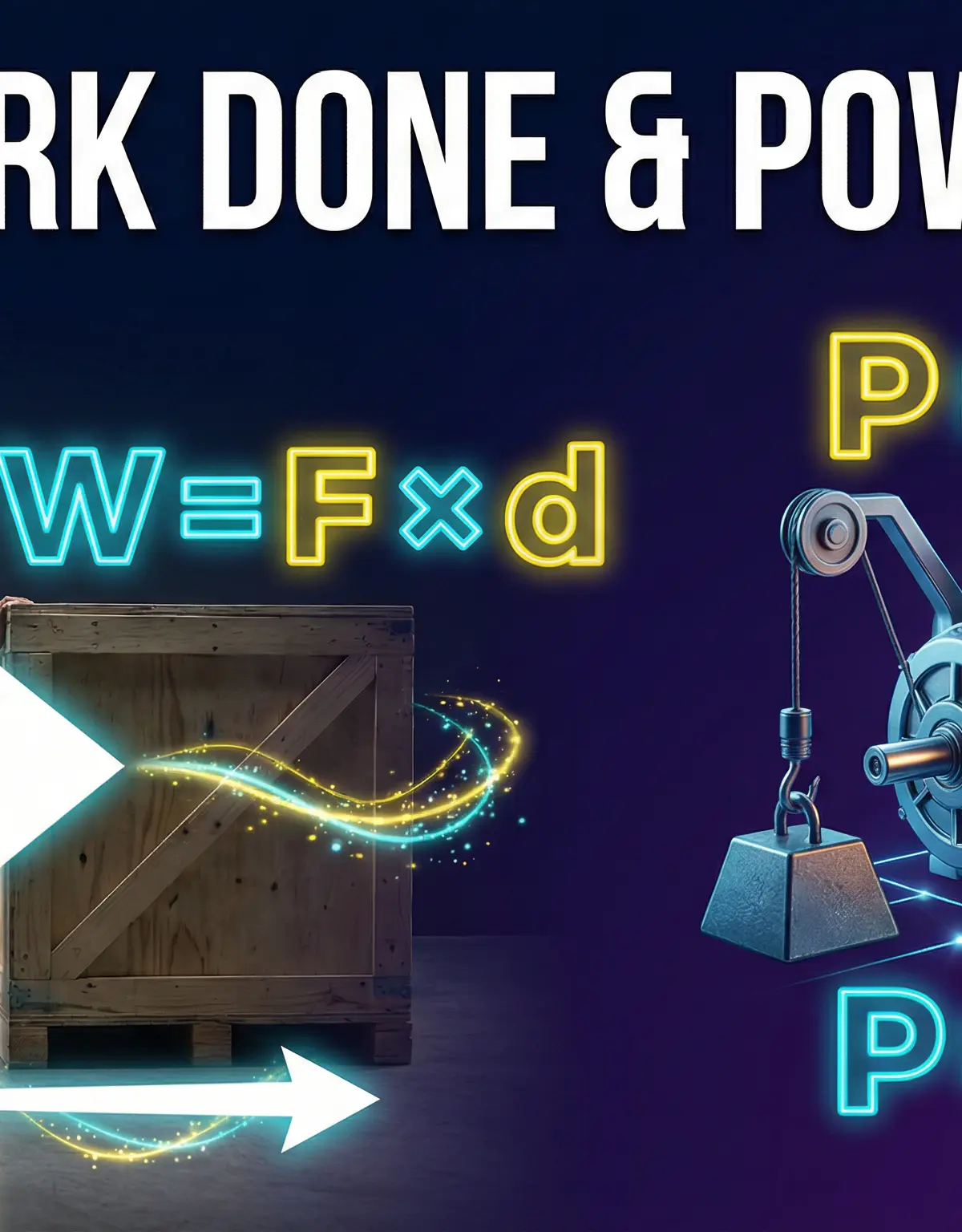
Overview
Welcome to your deep dive into Work Done and Power, a cornerstone of the Edexcel GCSE Physics specification (8.1). This topic is fundamental because it connects the concepts of forces, motion, and energy, which are central to all of physics. In your exam, you can expect to see multi-step calculation questions, definition-based questions, and questions that require you to explain energy transfers. A solid understanding here is not just about memorising formulas; it’s about understanding the physical meaning behind them. This guide will equip you with the precise knowledge and exam technique needed to tackle any question on this topic with confidence, showing you how to link work done to energy stores and how to define power as the rate of energy transfer – a distinction that examiners specifically look for.
Key Concepts
Concept 1: Work Done as Energy Transfer
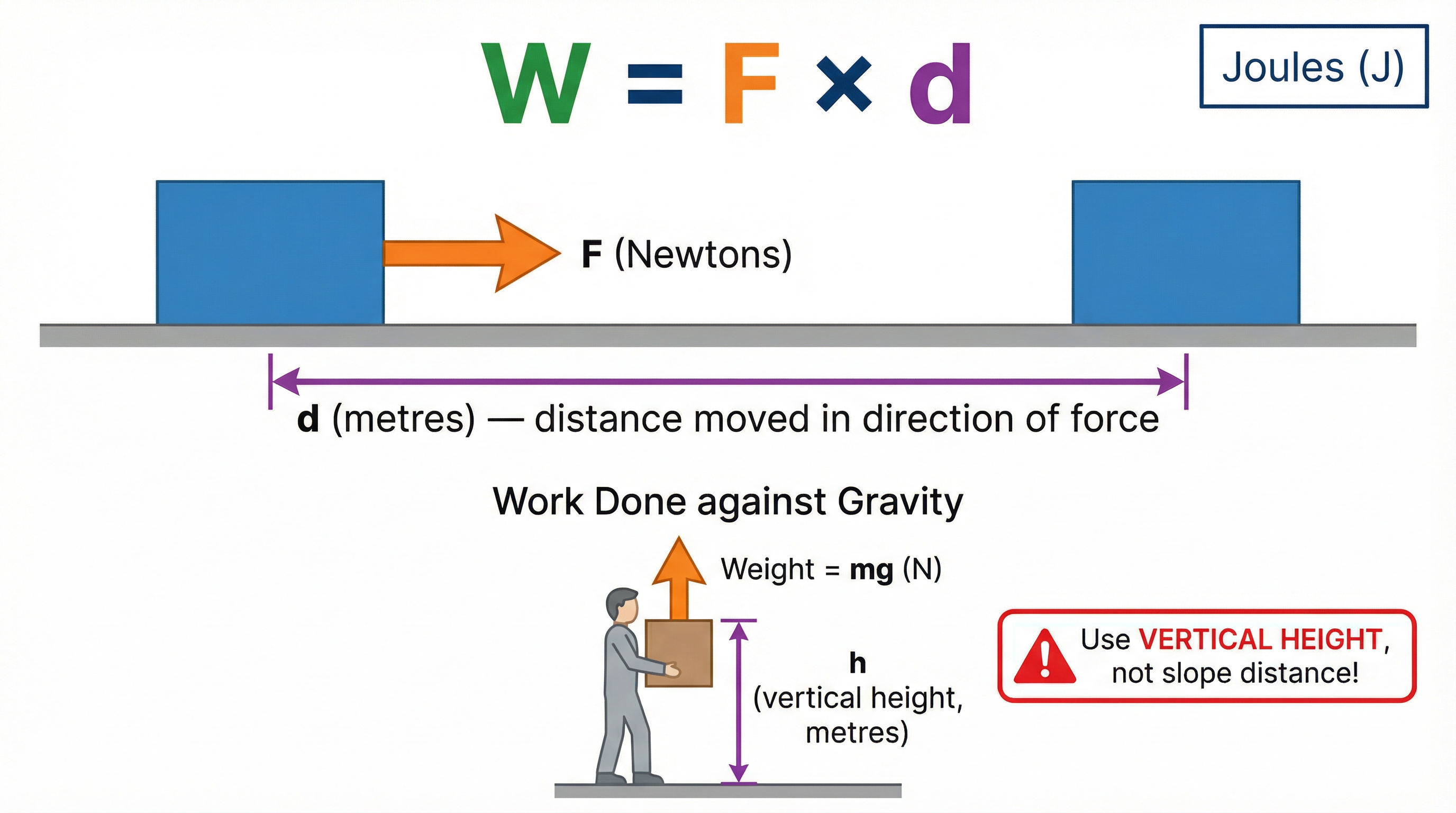
In physics, ‘work’ isn’t just about effort; it’s a measurable quantity. Work is done whenever a force causes an object to move. The amount of work done is a measure of the energy that has been transferred. If you push a box across a room, you are doing work on the box, and in doing so, you are transferring energy from your body’s chemical store to the box’s kinetic energy store. The two concepts are equivalent: Work Done = Energy Transferred. This is a critical link that you must make in your exam answers to gain full credit. For example, if you calculate that 500 J of work has been done, you can state that 500 J of energy has been transferred.
Example: A crane lifts a 500 kg steel beam vertically by 12 metres. The work done by the crane is transferred to the gravitational potential energy store of the beam.
Concept 2: The Work Done Equation
The relationship between work done, force, and distance is defined by a simple but powerful equation. It’s the mathematical tool you will use to quantify the energy transfer. Understanding how to apply it correctly, especially when dealing with vertical motion, is key to securing calculation marks.
Concept 3: Power as the Rate of Work
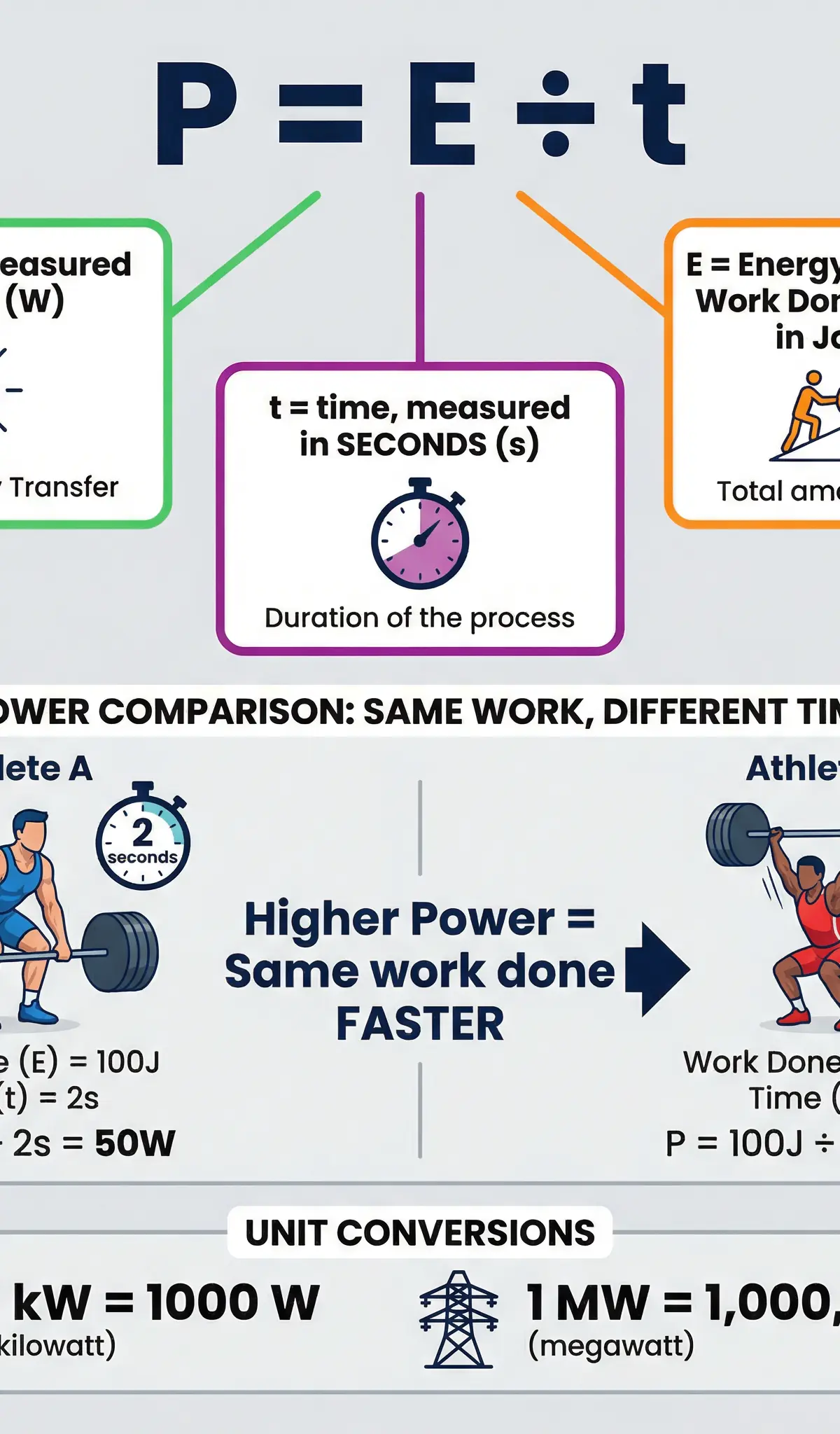
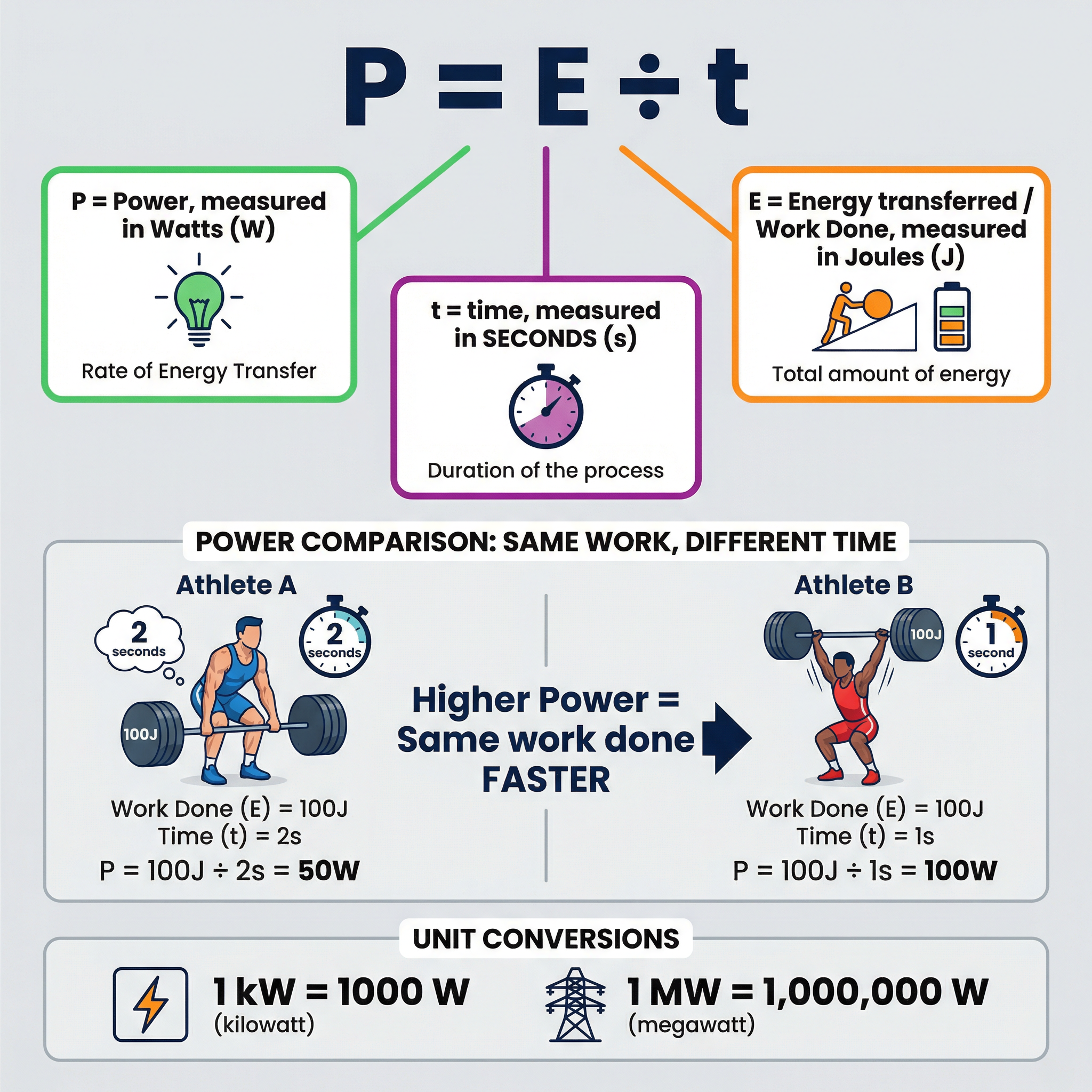
Power measures how quickly work is done or how quickly energy is transferred. Two machines could do the same amount of work, but if one does it in half the time, it is twice as powerful. This concept is vital for comparing the performance of engines, motors, and even athletes. The key exam language here is ‘rate’. Simply saying power is ‘how fast’ work is done is often not precise enough for the mark. You must state that power is the rate of energy transfer or the rate at which work is done.
Example: A sports car and a family car can both accelerate to 60 mph, doing the same amount of work to increase their kinetic energy. The sports car, having a more powerful engine, can do this work in a much shorter time.
Mathematical/Scientific Relationships
Here are the core equations you need for this topic. Pay close attention to the units and whether you need to memorise the formula.
| Formula | Symbol Meanings | Given or Memorise? |
|---|---|---|
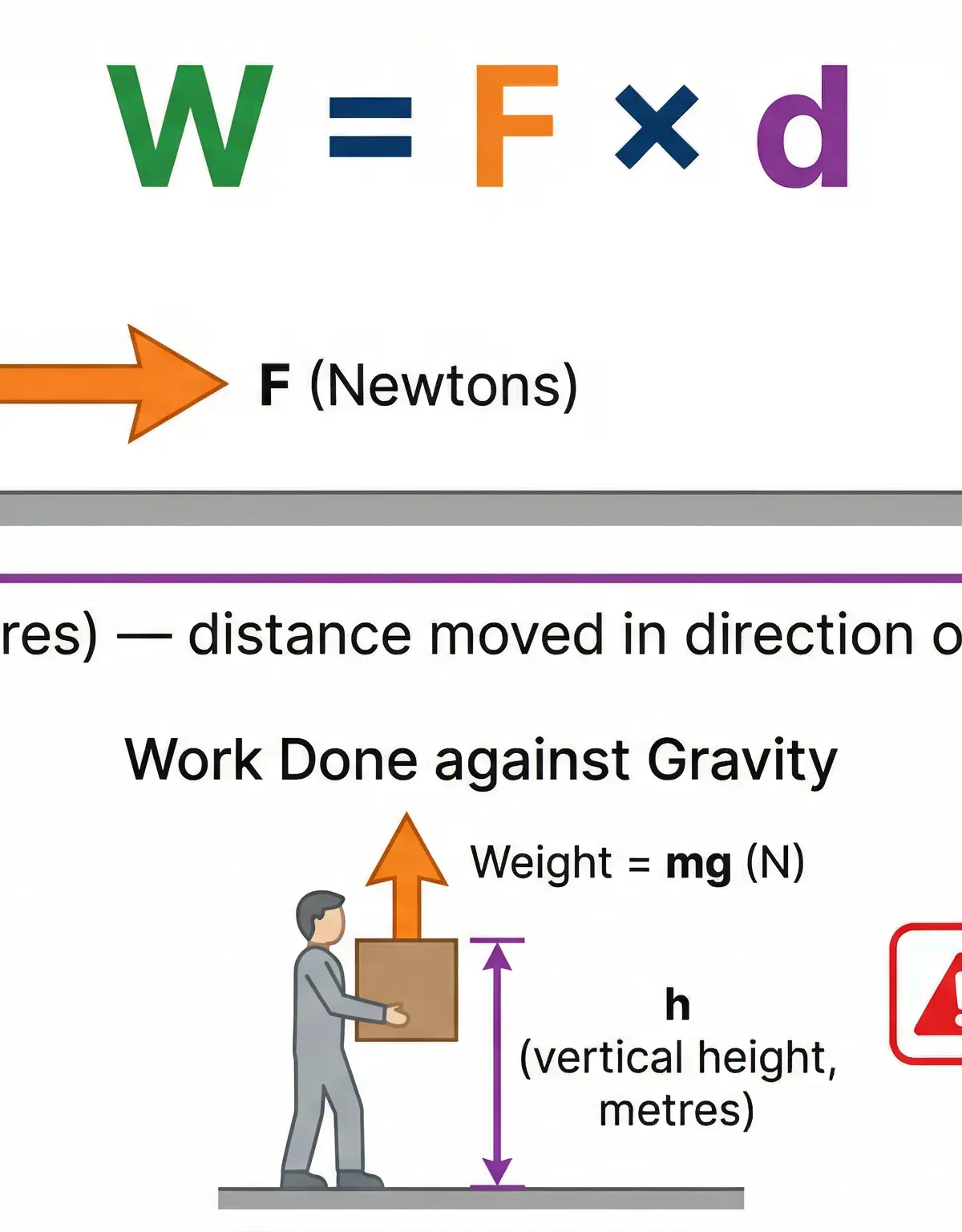
Work Done = Force × distance <br> W = F × d | W = Work Done (Joules, J) <br> F = Force (Newtons, N) <br> d = distance moved in the direction of the force (metres, m) | Given on formula sheet |
Power = Work Done / time <br> P = W / t | P = Power (Watts, W) <br> W = Work Done (Joules, J) <br> t = time (seconds, s) | Given on formula sheet |
Power = Energy transferred / time <br> P = E / t | P = Power (Watts, W) <br> E = Energy transferred (Joules, J) <br> t = time (seconds, s) | Given on formula sheet |
Weight = mass × gravitational field strength <br> W = m × g | W = Weight (Newtons, N) <br> m = mass (kilograms, kg) <br> g = gravitational field strength (N/kg, usually 10 on Earth) | Must memorise |
Practical Applications
- Lifts and Escalators: Engineers calculate the work done to lift a certain number of people (mass) a certain height (distance) and then determine the required power of the motor to do this in an acceptable amount of time.
- Vehicle Engines: The power output of a car's engine determines how quickly it can do work to accelerate the car, transferring chemical energy from the fuel into kinetic energy.
- Friction and Heat: When you brake a bicycle, the brake pads do work against the moving wheel. This work is transferred to the thermal energy stores of the pads and the wheel, which is why they get hot. This is a crucial energy transfer to understand for questions about efficiency.
Visual Resources
2 diagrams and illustrations
Interactive Diagrams
2 interactive diagrams to visualise key concepts
Conceptual Flow Outline
A flowchart showing the logical steps from identifying if work is done to calculating power.
Conceptual Flow Outline
A process diagram illustrating the full sequence of calculations from mass to power, highlighting necessary conversions.
Worked Examples
3 worked examples — open one to explore the question and available guidance.
Practice Questions
Test your understanding — click to reveal model answers
State the equation that links work done, force and distance.
A weightlifter lifts a 150 kg barbell through a vertical height of 2.0 m. Calculate the work done. (g = 10 N/kg)
Hint: Remember that the force in the equation is weight, not mass.
An electric motor has a power rating of 2.5 kW. How much work can it do in 30 seconds?
Hint: You will need to rearrange the power equation and convert kW to W.
A person of mass 70 kg runs up a flight of stairs with a vertical height of 8 m in 12 seconds. Calculate their average power output. (g = 10 N/kg)
Explain why a car travelling at a constant velocity on a level road still needs a power output from its engine.
Test your understanding of Work Done and Power
Active recall beats re-reading. Take an instant quiz now to test what you’ve learned and lock it into long-term memory.
7 days Premium · Then free forever · No card, no charge