OCR · A-Level · Physics
Course version: H556 · Version from Sept 2015
(g) intensity of a progressive wave; I = P/A; intensity ∝ (amplitude)²
Full specification wording
Wave motion: (g) intensity of a progressive wave; I = P/A; intensity ∝ (amplitude)²
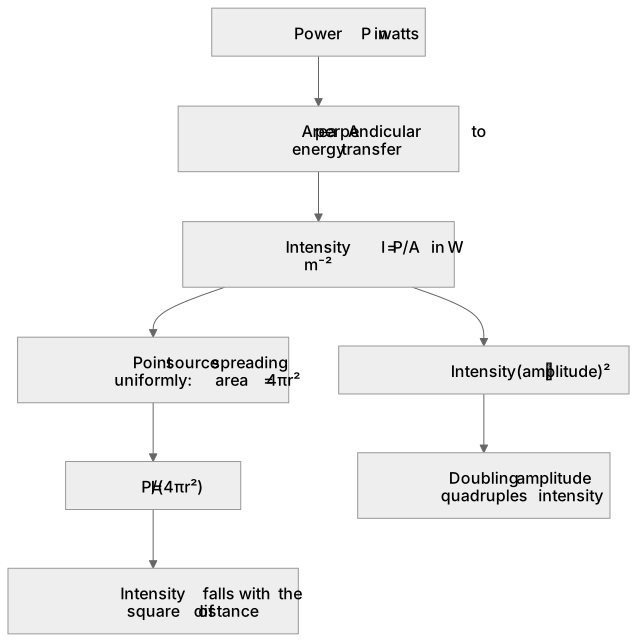
Intensity is the power transmitted per unit area perpendicular to the direction of energy transfer, so I = P/A, where P is power in watts and A is area in square metres, giving intensity in W m⁻².
Checked against the OCR H556 specification (opens in a new tab) on .
- Point 10 of 11
- 3 key terms
Study notes
From the checked teaching notes for this specification point.
The idea
Intensity is the power transmitted per unit area perpendicular to the direction of energy transfer, so I = P/A, where P is power in watts and A is area in square metres, giving intensity in W m⁻². For a point source radiating equally in all directions, the power spreads over a sphere of area 4πr², so I = P/(4πr²) and intensity falls with the square of distance. Intensity is proportional to the square of amplitude, so doubling the amplitude quadruples the intensity. This relationship lets you compare waves: if one wave has twice the amplitude of another, it carries four times the intensity. The equation applies to progressive waves and assumes the area is measured perpendicular to the energy flow.
What earns the marks
- Intensity is defined as power per unit area perpendicular to the direction of energy transfer, I = P/A.
- The SI unit of intensity is W m⁻², obtained from power in watts divided by area in square metres.
- For a point source spreading uniformly, the area at distance r is the surface area of a sphere, 4πr², so I = P/(4πr²).
- Intensity is directly proportional to the square of the amplitude, so I ∝ A².
- Doubling the amplitude increases the intensity by a factor of four, and tripling it increases intensity by a factor of nine.
- The inverse-square decrease with distance follows from the fixed power spreading over an ever-larger spherical area.
Common mistakes and how to put them right
Using the diameter instead of the radius in 4πr², which gives an area four times too large and an intensity four times too small.
Treating intensity as proportional to amplitude rather than amplitude squared, so a doubling of amplitude is wrongly said to double intensity.
Forgetting that the area in I = P/A must be perpendicular to the direction of energy transfer, not just any surface area.
Exam tips
- Write the equation, substitute values with units, and give the final answer in W m⁻².
- When comparing amplitudes, square the ratio before comparing intensities, for example a ratio of 3 in amplitude gives a ratio of 9 in intensity.
- For a point source, show clearly that you are using 4πr² as the area before calculating intensity.
Try the lesson
The start of the Wave motion: (g) intensity of a progressive wave; I = P/A; intensity ∝ (amplitude)² lesson, made from checked teaching notes for this specification point.
Listen
Intensity is the power transmitted per unit area perpendicular to the direction of energy transfer, so I = P/A, where P is power in watts and A is area in square metres, giving intensity in W m⁻². For a point source radiating equally in all directions, the power spreads over a sphere of area 4πr², so I = P/(4πr²) and intensity falls with the square of distance. Intensity is proportional to the square of amplitude, so doubling the amplitude quadruples the intensity. This relationship lets you compare waves: if one wave has twice the amplitude of another, it carries four times the intensity. The equation applies to progressive waves and assumes the area is measured perpendicular to the energy flow. A strong answer earns marks for these points. Intensity is defined as power per unit area perpendicular to the direction of energy transfer, I = P/A. The SI unit of intensity is W m⁻², obtained from power in watts divided by area in square metres. For a point source spreading uniformly, the area at distance r is the surface area of a sphere, 4πr², so I = P/(4πr²). Intensity is directly proportional to the square of the amplitude, so I ∝ A². Exam tip: Write the equation, substitute values with units, and give the final answer in W m⁻².
See it
Key words
Say what each word means before you turn the card.
Intensity
Try answering aloud or in your head before turning the card.
Inverse-square law for a point source
Try answering aloud or in your head before turning the card.
Intensity proportional to amplitude squared
Try answering aloud or in your head before turning the card.
See every definition
- Intensity
- The power transmitted per unit area perpendicular to the direction of energy transfer, given by I = P/A.
- Inverse-square law for a point source
- For a point source radiating equally in all directions, the power spreads over a sphere of area 4πr², so I = P/(4πr²) and intensity falls with the square of distance.
- Intensity proportional to amplitude squared
- Intensity is proportional to the square of amplitude, so doubling the amplitude quadruples the intensity.
Label the diagram
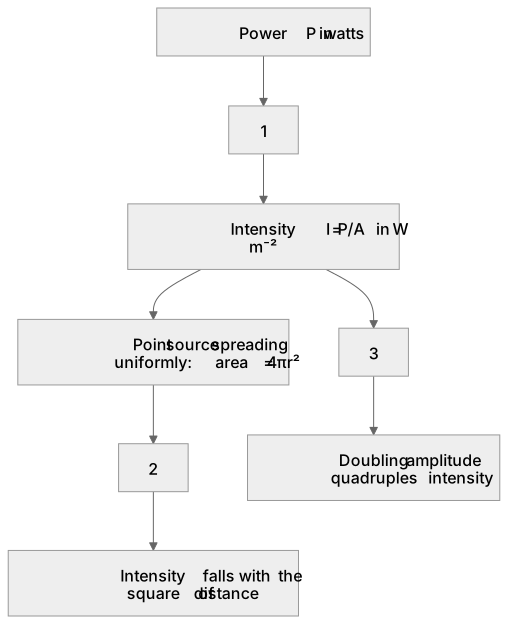
Some boxes have lost their names. Pick the right name for each number.
1Box 1
2Box 2
3Box 3
There is more to this lesson
The full lesson goes on to check your understanding and help you earn the marks. Create a free account to carry on, with your progress saved.
A week of Premium from your first lesson · Then the free plan continues · No card, no charge
Test your understanding of Wave motion: (g) intensity of a progressive wave; I = P/A; intensity ∝ (amplitude)²
Active recall beats re-reading. Take an instant quiz now to test what you’ve learned and lock it into long-term memory.
A week of Premium from your first lesson · Then the free plan continues · No card, no charge