OCR · GCSE · Physics
Absolute Zero
This guide provides a comprehensive overview of Absolute Zero (OCR GCSE Physics 6.8), focusing on the core concepts of the Kelvin scale, particle kinetic energy, and the pressure-temperature relationship. It is designed to build exam confidence by providing worked examples, examiner insights, and targeted revision materials.
- 4 min read
- 3 worked examples
- 5 practice questions
- 6 key terms
Study Notes
Overview
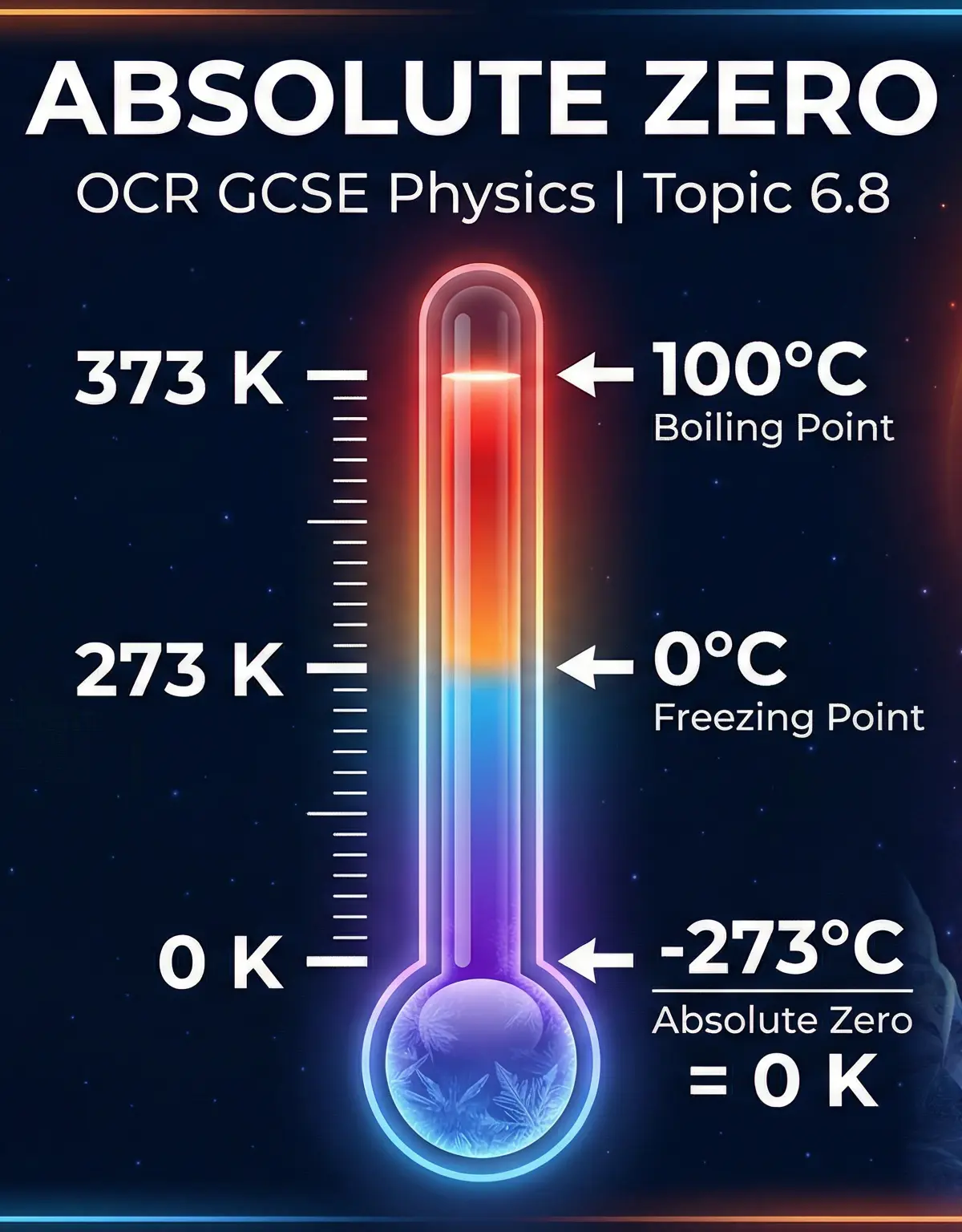
Absolute Zero is a cornerstone of thermodynamics, representing the theoretical lowest possible temperature. For your OCR GCSE Physics exam, a solid understanding of this topic is crucial for questions related to the particle model of matter and gas laws. This guide will break down the essential knowledge, from the definition of Absolute Zero (0 Kelvin or -273°C) to its implications for particle motion. We will explore the direct relationship between the temperature of a gas and its pressure at a constant volume, a concept frequently tested through calculations and graph interpretation. Expect to see questions that require you to convert between Celsius and Kelvin, analyse pressure-temperature graphs, and apply the kinetic theory to explain gas behaviour. Mastering these skills will not only secure marks in this section but also strengthen your understanding of energy and matter across the physics specification.

Key Concepts
Concept 1: Absolute Zero and the Kelvin Scale
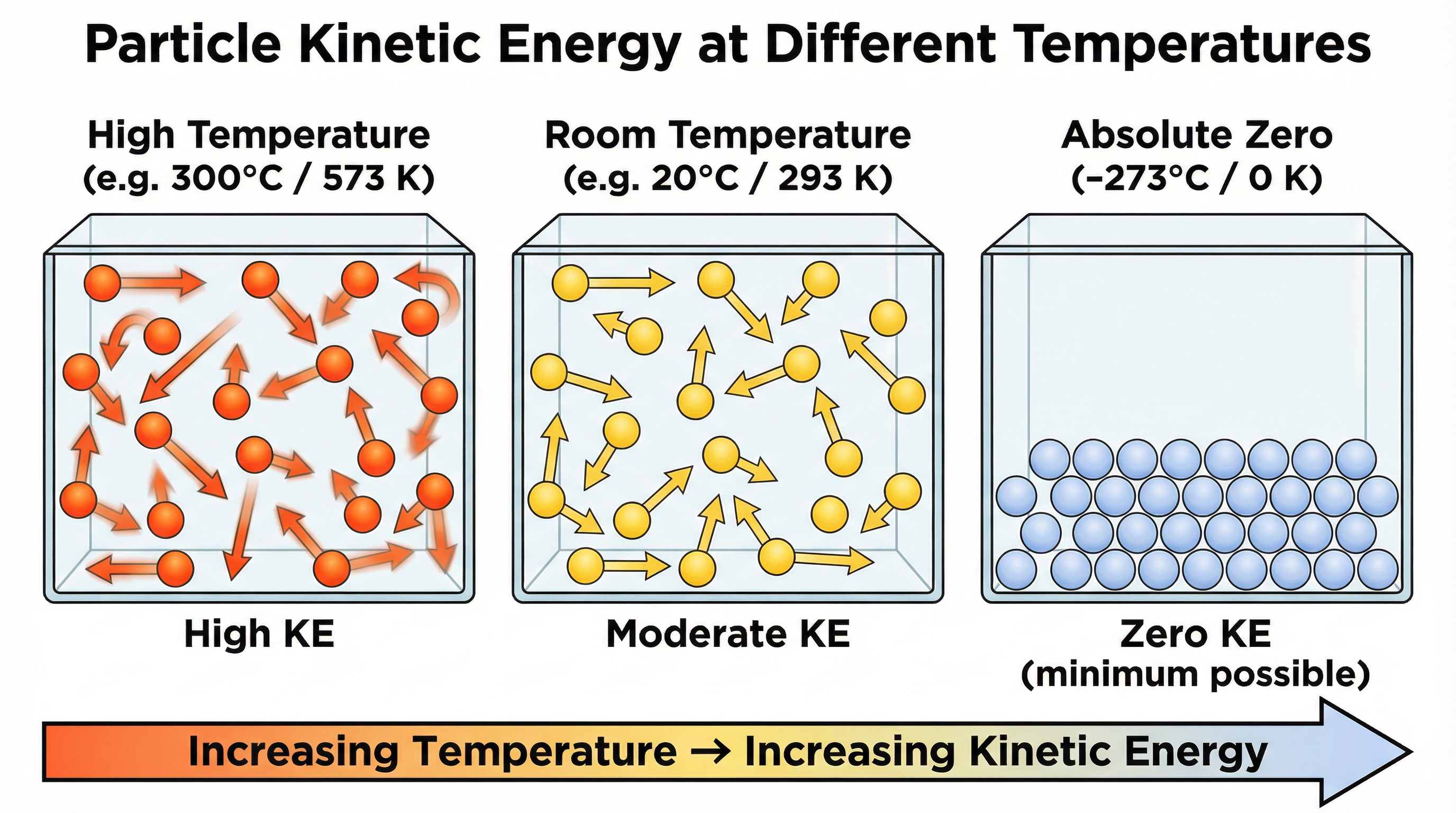
Absolute Zero is the point at which particles have their minimum possible kinetic energy. It is the coldest temperature that can be theoretically reached. On the Celsius scale, this is -273 °C. Physicists use the Kelvin scale for thermodynamic calculations because it is an absolute scale, meaning 0 K is absolute zero. This avoids the negative numbers and makes relationships, like the one between pressure and temperature, much simpler to express.
Example: To convert a room temperature of 20 °C to Kelvin, you add 273. So, 20 + 273 = 293 K. This conversion is a fundamental skill that you will be expected to apply in exam questions.
Concept 2: Kinetic Theory of Gases
The kinetic theory explains the macroscopic properties of gases (like pressure and temperature) by considering the motion of their constituent particles. The theory is based on three main assumptions:
- The gas consists of a large number of identical particles (atoms or molecules).
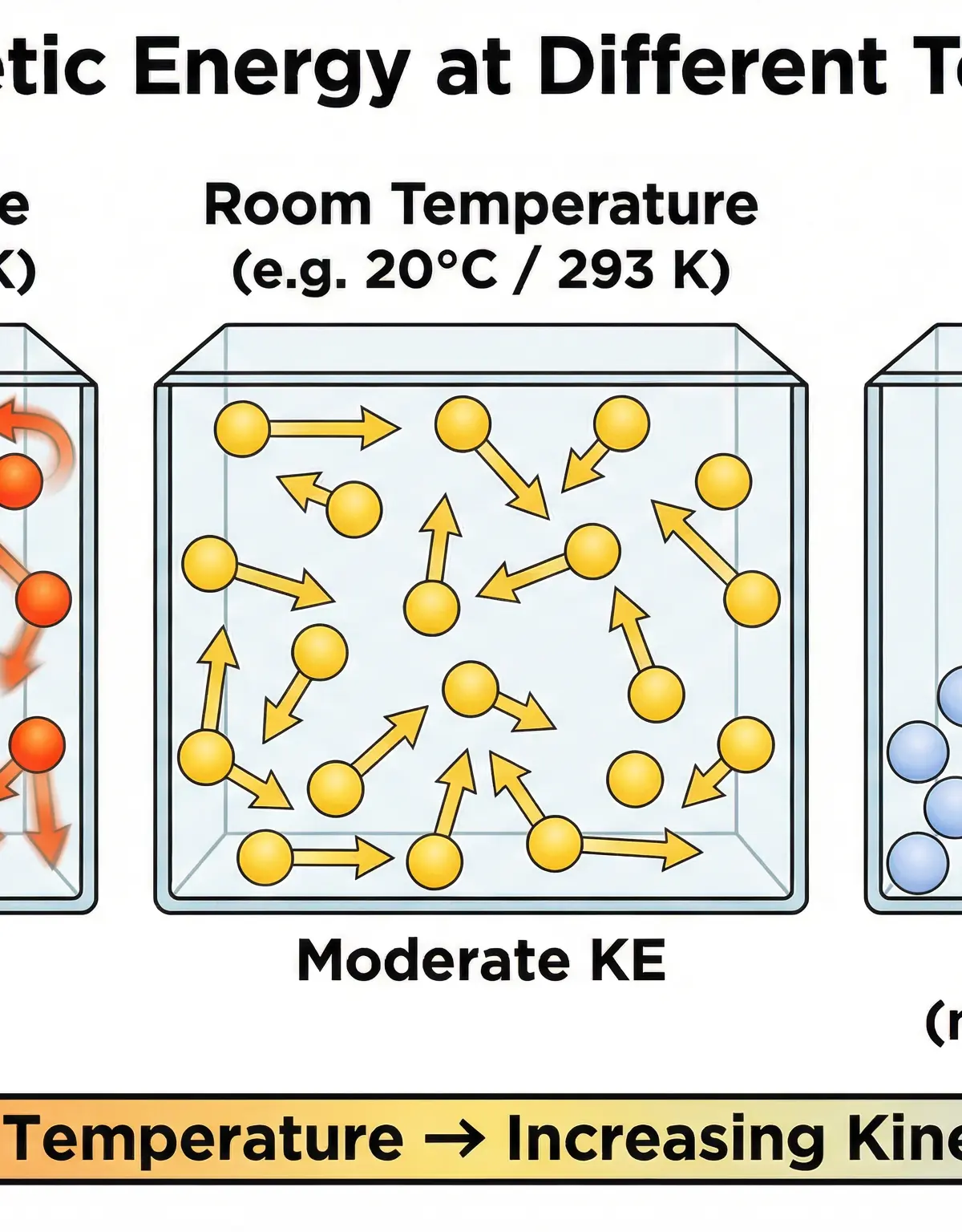
- The particles are in constant, random motion.
- The collisions between particles and with the walls of the container are perfectly elastic (no kinetic energy is lost).
Temperature is a measure of the average kinetic energy of the particles. The higher the temperature, the higher the average kinetic energy, and the faster the particles move.
Concept 3: The Pressure-Temperature Relationship
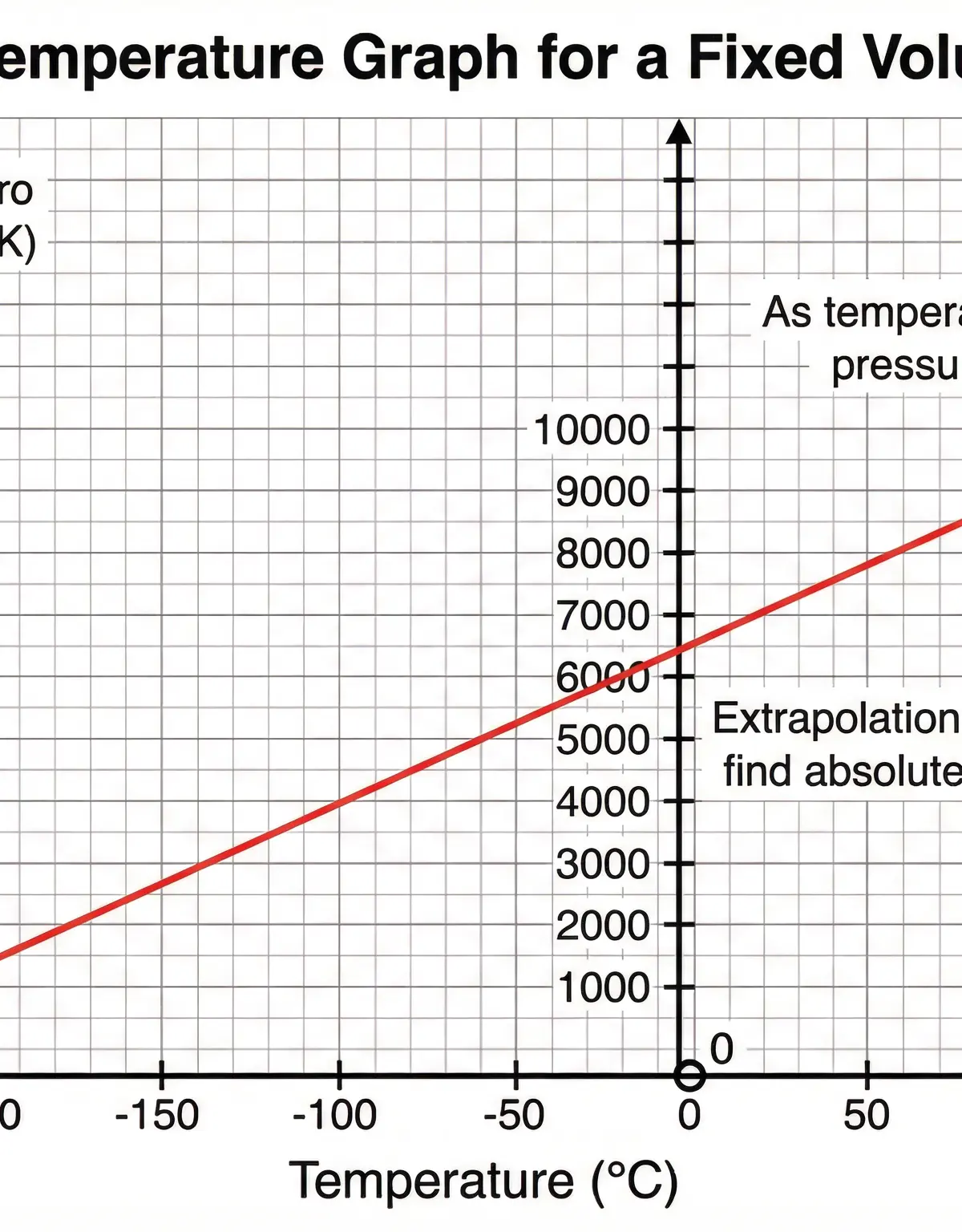
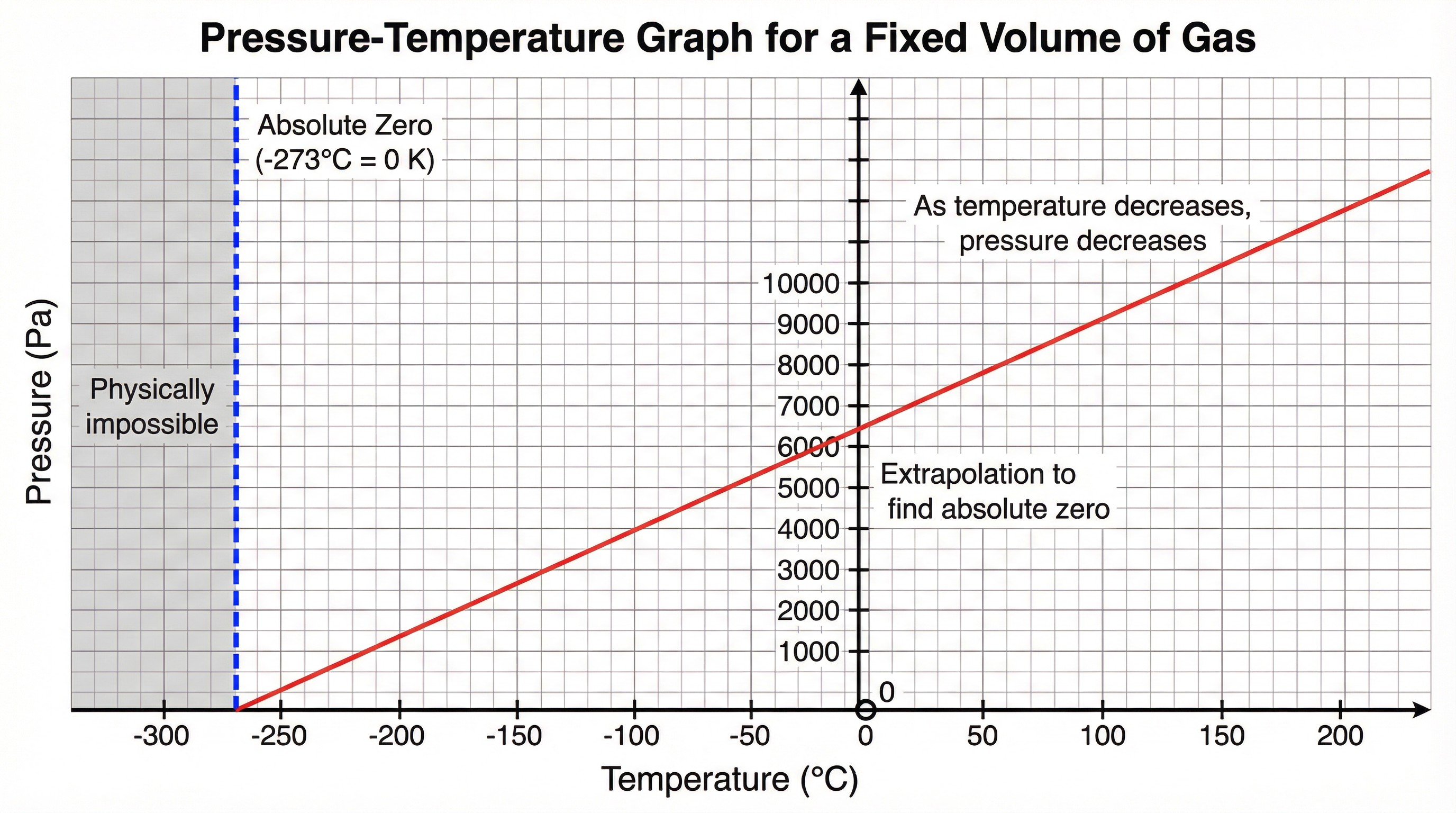
For a fixed mass of gas at a constant volume, the pressure of the gas is directly proportional to its absolute temperature in Kelvin. This is known as Gay-Lussac's Law or the Pressure Law. This means if you double the absolute temperature (in Kelvin), you double the pressure. This relationship is explained by the kinetic theory: as temperature increases, particles move faster and collide with the container walls more frequently and with greater force, increasing the pressure.
Mathematical/Scientific Relationships
-
Celsius to Kelvin Conversion (Must memorise):
T(K) = T(°C) + 273 -
Kelvin to Celsius Conversion (Must memorise):
T(°C) = T(K) - 273 -
The Pressure Law (Given on formula sheet):
P₁/T₁ = P₂/T₂
Where:P₁is the initial pressureT₁is the initial absolute temperature (in Kelvin)P₂is the final pressureT₂is the final absolute temperature (in Kelvin)
Practical Applications
While reaching absolute zero is practically impossible, the principles are fundamental to many technologies. Cryogenics, the study of very low temperatures, is used for:
- Superconducting Magnets: Used in MRI scanners and particle accelerators.
- Food Preservation: Freezing food at very low temperatures slows down the process of decay.
- Rocket Fuel: Liquefied gases like hydrogen and oxygen are used as rocket propellants.
Visual Resources
2 diagrams and illustrations
Interactive Diagrams
2 interactive diagrams to visualise key concepts
Conceptual Flow Outline
Flowchart for solving gas pressure calculation questions.
Conceptual Flow Outline
Concept map showing the relationship between key points on the Celsius and Kelvin temperature scales.
Worked Examples
3 worked examples — open one to explore the question and available guidance.
Practice Questions
Test your understanding — click to reveal model answers
State the value of absolute zero in Kelvin.
Hint: This is the starting point of the absolute temperature scale.
Describe the motion of particles in a substance at absolute zero.
Hint: Think about what temperature represents at a particle level.
A bicycle tyre has a pressure of 4.0 x 10⁵ Pa at 15 °C. After a long ride, the temperature of the tyre increases to 45 °C. Calculate the new pressure in the tyre, assuming the volume is constant. [4 marks]
Hint: Remember the first rule of gas law calculations: Kelvin is King!
Explain why the pressure law (P₁/T₁ = P₂/T₂) is only valid when the temperature is measured in Kelvin. [3 marks]
Hint: Consider what would happen if you used Celsius and had a temperature of 0°C or a negative temperature.
A graph of pressure against temperature in degrees Celsius for a fixed volume of gas is a straight line that does not pass through the origin. Describe how you could use this graph to find a value for absolute zero. [2 marks]
Hint: What does the term 'extrapolation' mean?