Energy Stores (kinetic, gravitational, elastic, thermal, chemical, nuclear, electrostatic, magnetic) Revision Notes

    Subject: Physics | Level: GCSE | Exam Board: OCR

    Master one of GCSE Physics' most fundamental concepts: Energy Stores. This guide provides a complete breakdown of the eight stores, four transfer pathways, and the essential calculations you need to secure top marks with OCR. We'll explore how energy is never 'lost', only transferred, a key concept that examiners love to test.

    Revision Notes & Key Concepts

    ![The eight energy stores for OCR GCSE Physics.](https://xnnrgnazirrqvdgfhvou.supabase.co/storage/v1/object/public/study-guide-assets/guide_7d407d93-afdd-44b9-9a58-ce052078a47e/header_image.png) ## Overview Welcome to the definitive guide for OCR GCSE Physics Topic 5.1: Energy Stores. This topic forms the bedrock of your understanding of energy, a concept that weaves through nearly every other area of physics, from forces and motion to electricity and waves. In the exam, you will be assessed on your ability to precisely identify the eight distinct energy stores, describe how energy is transferred between them using one of the four pathways, and apply mathematical formulae to calculate changes in kinetic and gravitational potential energy. Examiners are looking for candidates who can think like a physicist, analysing the world in terms of 'systems' and the energy they contain. A common question style involves presenting a real-world scenario (like a falling object, a boiling kettle, or a moving vehicle) and asking you to provide a step-by-step description of the energy transformations occurring. Mastering the specific vocabulary and sentence structures outlined in this guide is not just helpful—it is essential for achieving full marks. ## Key Concepts ### Concept 1: The 'Systems' Approach In OCR Physics, a **system** is defined as an object or a group of objects. When we talk about energy, we are talking about the energy stored within a system or transferred between systems. This is a crucial starting point. Instead of vaguely saying 'a car has energy', a physicist says 'the moving car is a system, and it has energy in its kinetic store'. **Example**: A swinging pendulum. The system is the pendulum bob and the Earth. At the top of its swing, energy is primarily in the gravitational potential store. As it swings downwards, energy is transferred to the kinetic store. At the bottom, the kinetic store is at its maximum. This constant transfer happens within the defined system. ### Concept 2: The Eight Energy Stores Candidates must be able to name and identify all eight energy stores. Credit is awarded for using the precise terminology. ![A summary of the eight key energy stores candidates must memorise.](https://xnnrgnazirrqvdgfhvou.supabase.co/storage/v1/object/public/study-guide-assets/guide_7d407d93-afdd-44b9-9a58-ce052078a47e/energy_stores_wheel.png) 1. **Kinetic Store (Ek)**: Energy stored in a moving object. The faster an object moves or the greater its mass, the more energy is in its kinetic store. 2. **Gravitational Potential Store (Ep)**: Energy stored in an object due to its position in a gravitational field. The higher it is, the more GPE it has. 3. **Elastic Potential Store (Ee)**: Energy stored when an object is stretched or compressed (e.g., a spring, a rubber band). 4. **Thermal Store**: Energy stored due to the temperature of an object, related to the kinetic energy of its particles. 5. **Chemical Store**: Energy stored in the bonds between atoms, released during chemical reactions (e.g., in food, fuel, batteries). 6. **Nuclear Store**: Energy stored in the nucleus of an atom, released during nuclear reactions (fission or fusion). 7. **Electrostatic Store**: Energy stored when electric charges are separated (e.g., in a capacitor, or a thundercloud). 8. **Magnetic Store**: Energy stored in a magnetic field (e.g., around a magnet or an electromagnet). ### Concept 3: The Four Energy Transfer Pathways Energy moves from one store to another via one of four pathways. You must be able to name these and apply them correctly. 1. **Mechanical Transfer**: When a force does work and moves an object (e.g., pushing a box, lifting a weight). 2. **Electrical Transfer**: When charge moves through a potential difference (i.e., in an electrical circuit). 3. **Heating**: Energy transfer from a hotter object to a cooler object. 4. **Radiation**: Energy transferred as a wave, such as light, infrared, or sound (e.g., the sun heating the Earth). ### Concept 4: The Law of Conservation of Energy This is one of the most important laws in all of physics. It states that **energy can never be created or destroyed, only transferred from one store to another.** In a 'closed system' (one where no energy can enter or leave), the total amount of energy is constant. This principle is the key to solving many higher-level problems. ### Concept 5: Dissipation and 'Wasted' Energy In real-world systems, energy transfers are rarely 100% efficient. Some energy is always transferred to a less useful store. This is called **dissipation**. Crucially, this energy is NOT 'lost' or 'used up'. The correct OCR-approved phrase is that the energy is **'transferred to the thermal store of the surroundings'**. For example, when a light bulb is on, some energy is usefully transferred by radiation as light, but much is also dissipated, transferred by heating to the thermal store of the bulb and the air around it. ## Mathematical/Scientific Relationships There are two key formulae for this topic that you **must memorise**. They are not provided on the OCR formula sheet. ![The two key formulae for this topic. These must be memorised.](https://xnnrgnazirrqvdgfhvou.supabase.co/storage/v1/object/public/study-guide-assets/guide_7d407d93-afdd-44b9-9a58-ce052078a47e/formula_reference_card.png) 1. **Kinetic Energy (Ek)** - **Formula**: Ek = ½ × m × v² - **Ek**: Kinetic Energy, measured in Joules (J) - **m**: mass, measured in kilograms (kg) - **v**: velocity (or speed), measured in metres per second (m/s) - **Key Point**: Notice the velocity is squared (v²). This means velocity has a much bigger impact on kinetic energy than mass does. Doubling the mass doubles the Ek, but doubling the velocity quadruples the Ek. 2. **Gravitational Potential Energy (Ep)** - **Formula**: Ep = m × g × h - **Ep**: Gravitational Potential Energy, measured in Joules (J) - **m**: mass, measured in kilograms (kg) - **g**: gravitational field strength, measured in Newtons per kilogram (N/kg). On Earth, this is approximately 9.8 N/kg. - **h**: height, measured in metres (m) **Higher Tier Link: GPE lost = KE gained** For a falling object where air resistance is negligible, the energy from the gravitational potential store is transferred to the kinetic store. This allows us to equate the two formulae: *m × g × h = ½ × m × v²* Notice that mass (m) is on both sides, so it can be cancelled out. This shows that the final speed of a falling object (without air resistance) does not depend on its mass! ## Practical Applications - **Roller Coasters**: A classic example of GPE being converted to KE at the bottom of a drop, and back to GPE as it goes up the next hill. The initial GPE at the top of the first lift hill determines the maximum possible KE (and therefore speed) of the ride. - **Vehicle Safety**: Car crumple zones are designed to increase the time taken for a car to stop in a crash. This reduces the rate of energy transfer from the car's kinetic store, lowering the forces involved and protecting the occupants. - **Power Generation**: In a hydroelectric power station, the GPE of water stored in a high reservoir is converted to KE as it flows down pipes. This KE is then used to turn turbines (a mechanical transfer), which turn generators to produce an electrical transfer. - **Bungee Jumping**: A perfect example of interplay between GPE, KE, and Elastic Potential Energy. As the jumper falls, GPE is converted to KE. As the bungee cord starts to stretch, KE is converted to Elastic Potential Energy in the cord. ![Listen to the 10-minute revision podcast for this topic.](https://xnnrgnazirrqvdgfhvou.supabase.co/storage/v1/object/public/study-guide-assets/guide_7d407d93-afdd-44b9-9a58-ce052078a47e/energy_stores_podcast.mp3)

    Revision Podcast Transcript

    Welcome to the OCR GCSE Physics Revision Podcast. I'm your host, and today we're diving deep into one of the most fundamental topics in the entire specification: Energy Stores. This is Topic 5.1, and whether you're sitting Foundation or Higher Tier, you absolutely need to nail this. So grab your revision notes, get comfortable, and let's get started. Before we dive in, here's why this topic matters so much. Energy is the thread that runs through almost every topic in GCSE Physics. Understanding energy stores correctly will help you with forces, electricity, waves, and even atomic physics. Examiners love linking energy to other topics, so getting this right now pays dividends throughout the whole exam. Let's go. --- SECTION ONE: THE SYSTEMS APPROACH --- The very first thing OCR wants you to understand is the concept of a system. A system is simply an object, or a group of objects, where energy is stored or transferred. When you describe what happens energetically in any situation, you're describing what happens within or between systems. Think of it like this: imagine you're holding a ball above the ground. That ball is a system. It has energy stored in it — specifically, gravitational potential energy. When you let it go, energy is transferred. The system changes. This is the OCR way of thinking about energy, and it's crucial you adopt this language. --- SECTION TWO: THE EIGHT ENERGY STORES --- Now, OCR requires you to know exactly eight energy stores. Not seven, not nine — eight. I'm going to go through each one with a real-world example, because that's exactly how examiners will test you. Store number one: Kinetic energy. This is the energy stored in any moving object. A car driving down a motorway, a football flying through the air, even the particles vibrating in a warm object — all of these have energy in their kinetic store. The key word here is movement. Store number two: Gravitational potential energy, often shortened to GPE. This is the energy stored in an object due to its position in a gravitational field. The higher up an object is, the more energy is in its gravitational potential store. A book on a high shelf, a skydiver before they jump, water at the top of a dam — all classic examples. Store number three: Elastic potential energy. This is stored in objects that have been stretched, compressed, or deformed elastically — meaning they can spring back to their original shape. A stretched rubber band, a compressed spring in a mattress, a drawn bow in archery. The key word is deformation. Store number four: Thermal energy. This is the energy stored in an object due to the random motion and vibration of its particles. The hotter an object is, the more energy is in its thermal store. Hot coffee, a warm radiator, the filament of a light bulb — all have significant thermal stores. Store number five: Chemical energy. This is stored in the bonds between atoms and molecules. When chemical reactions occur, these bonds break and reform, releasing energy. Food, fuel like petrol, batteries, and even the cells in your body all store chemical energy. Store number six: Nuclear energy. This is stored in the nucleus of atoms. It's released during nuclear fission — splitting heavy nuclei like uranium — or nuclear fusion, which is how the Sun generates its energy. This is a Higher Tier concept in more detail, but all candidates should know it exists as a store. Store number seven: Electrostatic energy. This is stored in systems of separated electric charges. Think of a charged capacitor, or the static electricity that builds up on a balloon when you rub it against your hair. The energy is stored in the electric field between the charges. Store number eight: Magnetic energy. This is stored in magnetic fields. A permanent magnet, or an electromagnet, stores energy in its magnetic field. This is less commonly tested in calculation questions but you must be able to name it. Now, here's a brilliant memory trick to remember all eight stores. Use the acronym K-G-E-T-C-N-E-M — which you can remember as: "King George Enjoys Tea, Crumpets, Not Eggs, Mostly." That gives you Kinetic, Gravitational, Elastic, Thermal, Chemical, Nuclear, Electrostatic, Magnetic. Say it out loud a few times. King George Enjoys Tea, Crumpets, Not Eggs, Mostly. --- SECTION THREE: ENERGY TRANSFER PATHWAYS --- Now, energy doesn't just sit in one store forever. It gets transferred between stores via four pathways. OCR requires you to know all four. Pathway one: Mechanically. This is when a force does work on an object. Pushing a box, a bat hitting a ball, a person lifting a weight — all mechanical transfers. Pathway two: Electrically. This is when charge flows through a circuit. A battery powering a motor, a phone charging — electrical transfer. Pathway three: By heating. This is when energy moves from a hotter object to a cooler one. A hot pan heating water, the Sun warming the Earth — transfer by heating. Pathway four: By radiation. This includes light, sound, and other forms of electromagnetic radiation. The Sun sending energy to Earth as light waves, a speaker sending sound waves through the air — these are radiation transfers. And here's the golden sentence structure that OCR examiners absolutely love. Whenever you describe an energy change, use this template: "Energy is transferred from the [X] store of the [object] to the [Y] store of the [object] via [pathway]." For example: "Energy is transferred from the chemical store of the battery to the kinetic store of the motor via electrical transfer." That sentence, written precisely like that, will earn you marks every single time. --- SECTION FOUR: THE KEY FORMULAE --- Now let's talk maths. There are two essential formulae you must memorise for this topic — and I do mean memorise, because neither of them is given on the OCR formula sheet. Formula one: Kinetic energy. Ek equals one half times m times v squared. In words: kinetic energy equals half times mass times velocity squared. The units are joules for energy, kilograms for mass, and metres per second for velocity. Let's do a quick example. A 1,000 kilogram car is travelling at 20 metres per second. What is its kinetic energy? Step one: write the formula. Ek equals 0.5 times m times v squared. Step two: substitute. Ek equals 0.5 times 1,000 times 20 squared. Step three: calculate v squared first. 20 squared is 400. Step four: multiply. 0.5 times 1,000 times 400 equals 200,000 joules, or 200 kilojoules. The most common mistake candidates make here is forgetting to square the velocity. They multiply 0.5 times 1,000 times 20 and get 10,000 joules. That is wrong. You must square v first, always. Formula two: Gravitational potential energy. Ep equals m times g times h. In words: GPE equals mass times gravitational field strength times height. The value of g on Earth is 9.8 newtons per kilogram, and you will usually be given this in the question. Units: joules for energy, kilograms for mass, and metres for height. Quick example. A 5 kilogram book is placed on a shelf 2 metres above the floor. What is its gravitational potential energy? Step one: Ep equals m times g times h. Step two: Ep equals 5 times 9.8 times 2. Step three: Ep equals 98 joules. Straightforward — but watch out for unit traps. If the question gives you mass in grams, convert to kilograms first. If height is given in centimetres, convert to metres. Examiners deliberately include these traps. --- SECTION FIVE: CONSERVATION OF ENERGY --- The Law of Conservation of Energy states that energy cannot be created or destroyed — it can only be transferred from one store to another. In a closed system, the total amount of energy remains constant. This is enormously useful for Higher Tier calculations. If a ball is dropped from a height and you're asked to find its speed just before it hits the ground, you use the principle that GPE lost equals KE gained, assuming no air resistance. So: m times g times h equals 0.5 times m times v squared. The mass cancels from both sides, giving you: g times h equals 0.5 times v squared. Rearranging: v squared equals 2 times g times h. Then take the square root to find v. This is a beautiful piece of physics — and examiners reward candidates who can set up this equation correctly and carry it through to a final answer with correct units. --- SECTION SIX: DISSIPATION AND THE THERMAL STORE --- One of the most heavily penalised mistakes in OCR mark schemes is writing that energy is "lost" or "used up." Energy is never lost. It is dissipated — meaning it is transferred to the thermal store of the surroundings in a way that is no longer useful. When a car brakes, the kinetic store decreases. Where does that energy go? It is transferred to the thermal store of the brakes and the surroundings via heating due to friction. That is the correct OCR answer. Similarly, when a light bulb glows, energy from the chemical store of the power station is eventually transferred to the thermal store of the surroundings — the room gets slightly warmer. Only a small fraction ends up as useful light energy in the radiation pathway. The key distinction OCR tests is between heat as a transfer pathway and thermal energy as a store. You cannot say "energy is transferred to heat." Heat is not a store. You must say "energy is transferred to the thermal store of the surroundings via heating." --- SECTION SEVEN: EXAM TIPS AND COMMON MISTAKES --- Let me now give you the insider examiner tips that will make the difference between a grade 5 and a grade 8. Tip one: Always name the specific store. Don't write "the battery loses energy." Write "the chemical store of the battery decreases." Examiners award marks for the specific store name. Tip two: Never write "energy is lost." Always write "energy is dissipated to the thermal store of the surroundings." This single change could be worth 1 or 2 marks in a question. Tip three: In calculations, always show your substitution step before you calculate. OCR mark schemes award a mark for correct substitution even if your final arithmetic is wrong. Never skip this step. Tip four: Check your units before substituting. If mass is in grams, divide by 1,000. If height is in centimetres, divide by 100. If energy is in kilojoules, multiply by 1,000 to get joules. Tip five: For Higher Tier, remember that in a falling object problem, GPE lost equals KE gained. Set up the equation, cancel mass, and solve for velocity. Always take the square root at the end. Tip six: When a question says "describe the energy changes," use the full template sentence: "Energy is transferred from the [X] store of the [object] to the [Y] store of the [object] via [pathway]." Include both the store and the object. --- SECTION EIGHT: QUICK-FIRE RECALL QUIZ --- Right, let's test your memory. I'll ask a question, pause for a moment, then give the answer. Ready? Question one: Name all eight energy stores. Pause. The answer is: Kinetic, Gravitational Potential, Elastic Potential, Thermal, Chemical, Nuclear, Electrostatic, and Magnetic. Remember: King George Enjoys Tea, Crumpets, Not Eggs, Mostly. Question two: What is the formula for kinetic energy? Pause. Ek equals one half m v squared. Must memorise — not on the formula sheet. Question three: A ball is dropped from a height. Energy is transferred from which store to which store? Pause. From the gravitational potential store to the kinetic store. Question four: What is the correct OCR phrase when energy is wasted? Pause. "Energy is dissipated to the thermal store of the surroundings." Question five: What are the four energy transfer pathways? Pause. Mechanically, electrically, by heating, and by radiation. --- SECTION NINE: SUMMARY AND SIGN-OFF --- Let's bring it all together. Energy Stores is a topic where precision of language earns marks. OCR examiners are looking for specific store names, the correct transfer language, and careful mathematical working. Remember the big three: first, there are eight stores — use the King George mnemonic. Second, there are four transfer pathways — mechanical, electrical, heating, radiation. Third, energy is never lost — it is always dissipated to the thermal store of the surroundings. For calculations: memorise both formulae, always show substitution, and always square v in the kinetic energy equation. For Higher Tier, master the GPE equals KE approach for falling objects. You've got this. Go back over your notes, try some past paper questions, and use the full sentence template every time you describe an energy change. That's the OCR way, and that's how you earn marks. Thanks so much for listening to today's episode. Good luck in your exams — I know you're going to do brilliantly. See you next time.

    Key Terms & Definitions

    System
    An object or a group of objects that are being considered.
    Energy Store
    A way in which energy is stored within a system. There are eight types candidates need to know.
    Energy Transfer
    The movement of energy from one store to another via a pathway (mechanical, electrical, heating, radiation).
    Conservation of Energy
    The principle that energy cannot be created or destroyed, only transferred from one store to another.
    Dissipation
    The process by which energy is transferred to less useful stores, typically the thermal store of the surroundings.
    Closed System
    A system in which no energy can enter or leave. The total energy within a closed system is always constant.

    Worked Examples

    Practice Questions

    Energy Stores (kinetic, gravitational, elastic, thermal, chemical, nuclear, electrostatic, magnetic)

    OCR
    GCSE
    Physics

    Master one of GCSE Physics' most fundamental concepts: Energy Stores. This guide provides a complete breakdown of the eight stores, four transfer pathways, and the essential calculations you need to secure top marks with OCR. We'll explore how energy is never 'lost', only transferred, a key concept that examiners love to test.

    7
    Min Read
    3
    Examples
    5
    Questions
    6
    Key Terms
    🎙 Podcast Episode
    Energy Stores (kinetic, gravitational, elastic, thermal, chemical, nuclear, electrostatic, magnetic)
    0:00-0:00

    Study Notes

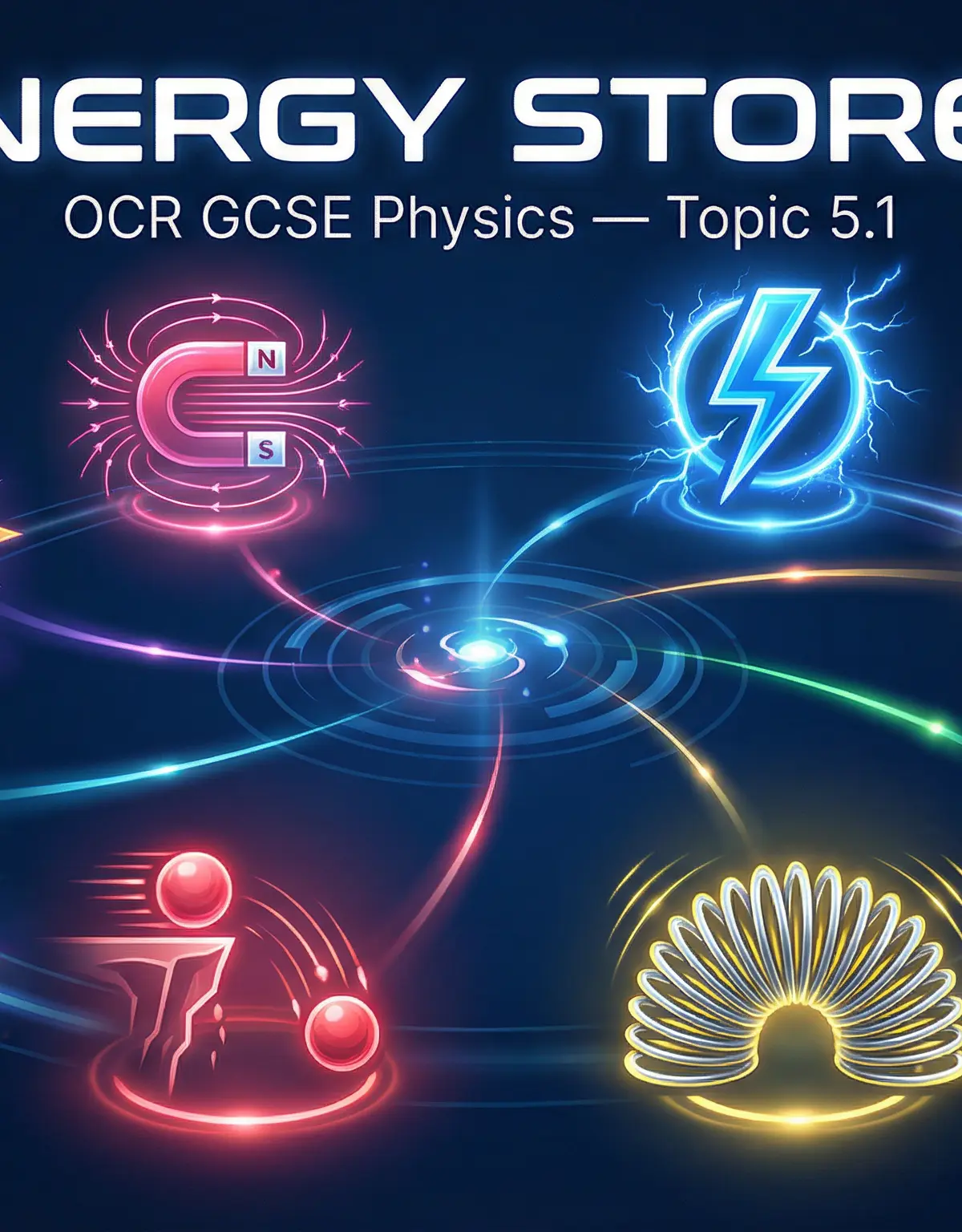
    The eight energy stores for OCR GCSE Physics.

    Overview

    Welcome to the definitive guide for OCR GCSE Physics Topic 5.1: Energy Stores. This topic forms the bedrock of your understanding of energy, a concept that weaves through nearly every other area of physics, from forces and motion to electricity and waves. In the exam, you will be assessed on your ability to precisely identify the eight distinct energy stores, describe how energy is transferred between them using one of the four pathways, and apply mathematical formulae to calculate changes in kinetic and gravitational potential energy. Examiners are looking for candidates who can think like a physicist, analysing the world in terms of 'systems' and the energy they contain. A common question style involves presenting a real-world scenario (like a falling object, a boiling kettle, or a moving vehicle) and asking you to provide a step-by-step description of the energy transformations occurring. Mastering the specific vocabulary and sentence structures outlined in this guide is not just helpful—it is essential for achieving full marks.

    Key Concepts

    Concept 1: The 'Systems' Approach

    In OCR Physics, a system is defined as an object or a group of objects. When we talk about energy, we are talking about the energy stored within a system or transferred between systems. This is a crucial starting point. Instead of vaguely saying 'a car has energy', a physicist says 'the moving car is a system, and it has energy in its kinetic store'.

    Example: A swinging pendulum. The system is the pendulum bob and the Earth. At the top of its swing, energy is primarily in the gravitational potential store. As it swings downwards, energy is transferred to the kinetic store. At the bottom, the kinetic store is at its maximum. This constant transfer happens within the defined system.

    Concept 2: The Eight Energy Stores

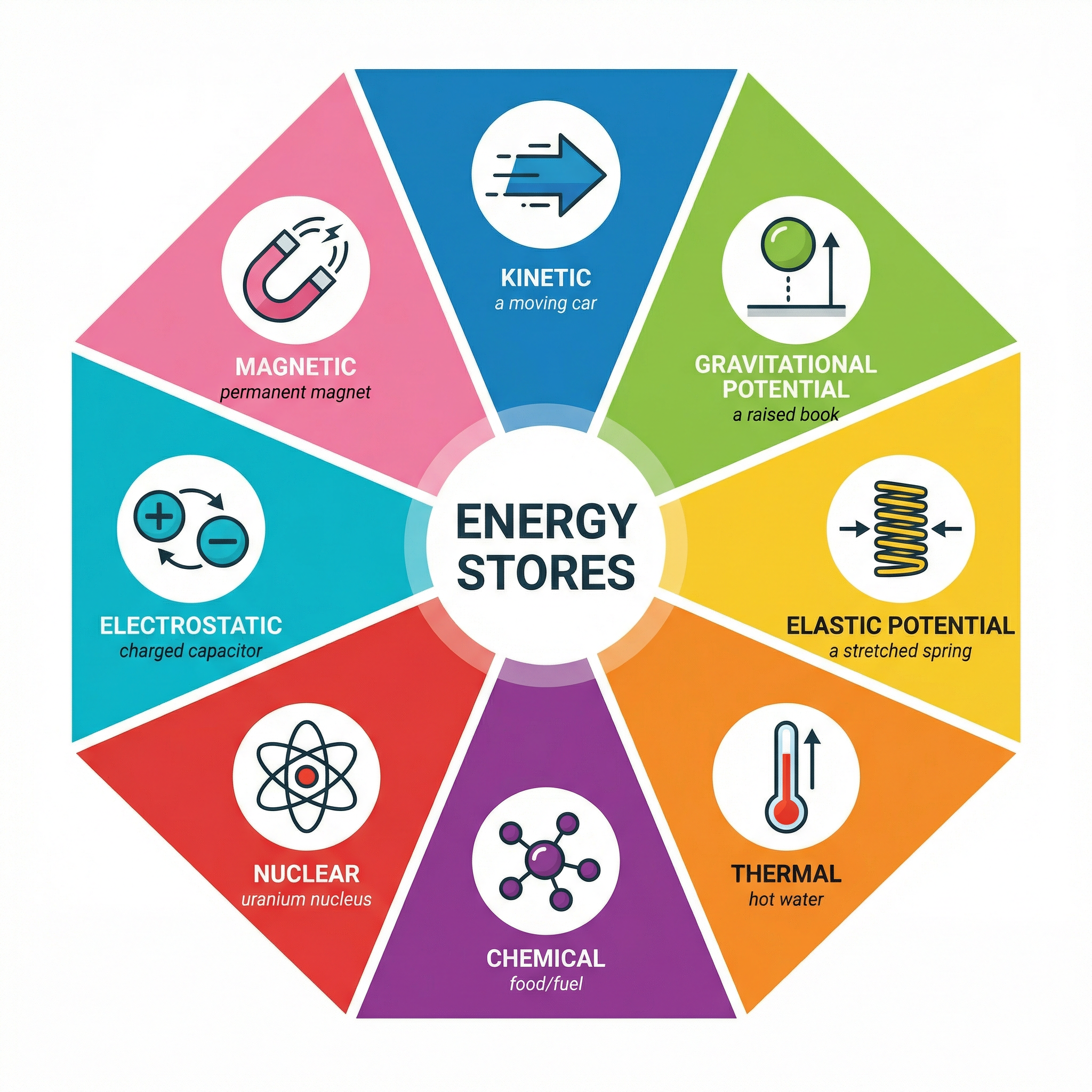
    Candidates must be able to name and identify all eight energy stores. Credit is awarded for using the precise terminology.
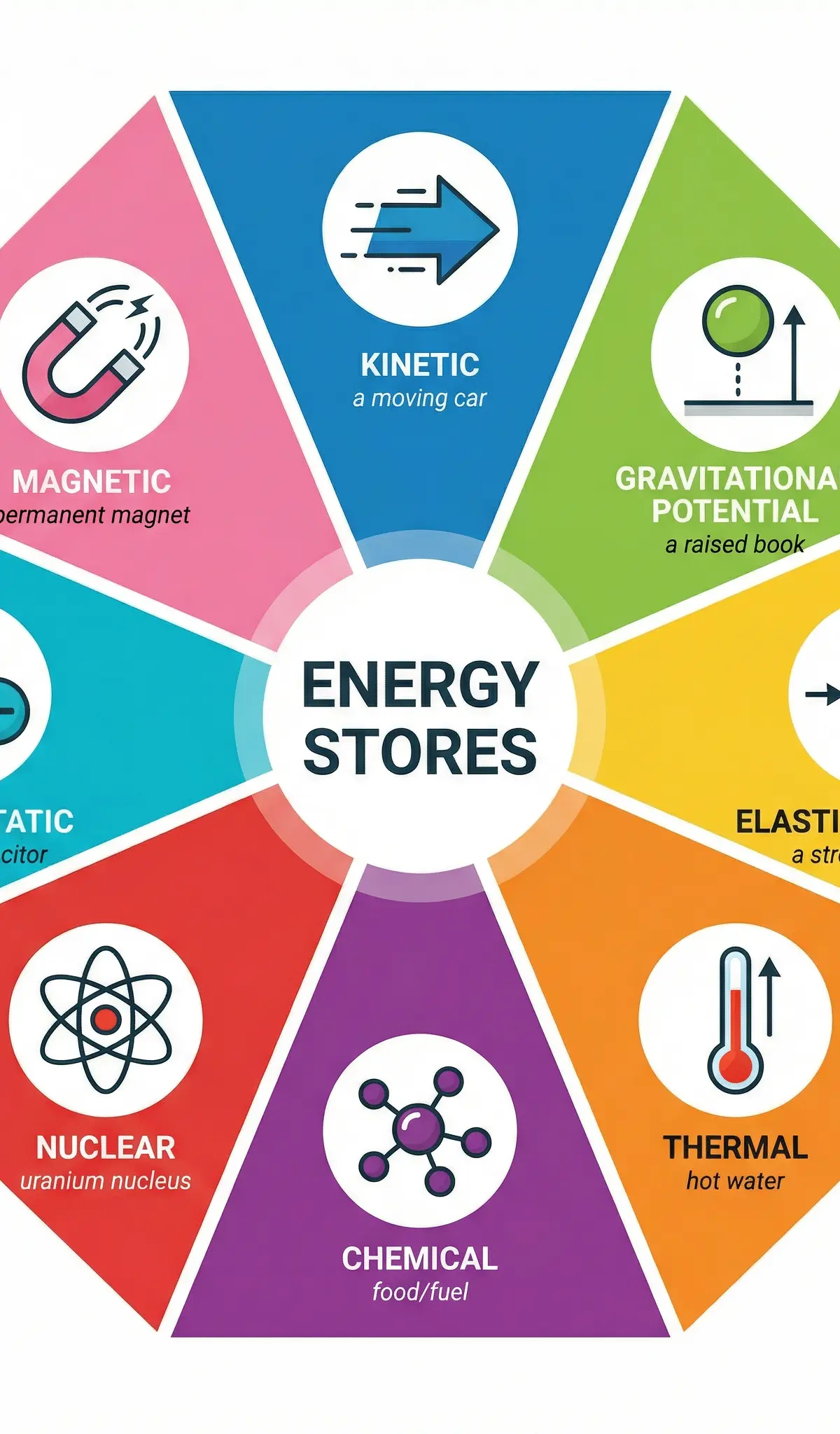
    A summary of the eight key energy stores candidates must memorise.

    1. Kinetic Store (Ek): Energy stored in a moving object. The faster an object moves or the greater its mass, the more energy is in its kinetic store.
    2. Gravitational Potential Store (Ep): Energy stored in an object due to its position in a gravitational field. The higher it is, the more GPE it has.
    3. Elastic Potential Store (Ee): Energy stored when an object is stretched or compressed (e.g., a spring, a rubber band).
    4. Thermal Store: Energy stored due to the temperature of an object, related to the kinetic energy of its particles.
    5. Chemical Store: Energy stored in the bonds between atoms, released during chemical reactions (e.g., in food, fuel, batteries).
    6. Nuclear Store: Energy stored in the nucleus of an atom, released during nuclear reactions (fission or fusion).
    7. Electrostatic Store: Energy stored when electric charges are separated (e.g., in a capacitor, or a thundercloud).
    8. Magnetic Store: Energy stored in a magnetic field (e.g., around a magnet or an electromagnet).

    Concept 3: The Four Energy Transfer Pathways

    Energy moves from one store to another via one of four pathways. You must be able to name these and apply them correctly.

    1. Mechanical Transfer: When a force does work and moves an object (e.g., pushing a box, lifting a weight).
    2. Electrical Transfer: When charge moves through a potential difference (i.e., in an electrical circuit).
    3. Heating: Energy transfer from a hotter object to a cooler object.
    4. Radiation: Energy transferred as a wave, such as light, infrared, or sound (e.g., the sun heating the Earth).

    Concept 4: The Law of Conservation of Energy

    This is one of the most important laws in all of physics. It states that energy can never be created or destroyed, only transferred from one store to another. In a 'closed system' (one where no energy can enter or leave), the total amount of energy is constant. This principle is the key to solving many higher-level problems.

    Concept 5: Dissipation and 'Wasted' Energy

    In real-world systems, energy transfers are rarely 100% efficient. Some energy is always transferred to a less useful store. This is called dissipation. Crucially, this energy is NOT 'lost' or 'used up'. The correct OCR-approved phrase is that the energy is 'transferred to the thermal store of the surroundings'. For example, when a light bulb is on, some energy is usefully transferred by radiation as light, but much is also dissipated, transferred by heating to the thermal store of the bulb and the air around it.

    Mathematical/Scientific Relationships

    There are two key formulae for this topic that you must memorise. They are not provided on the OCR formula sheet.
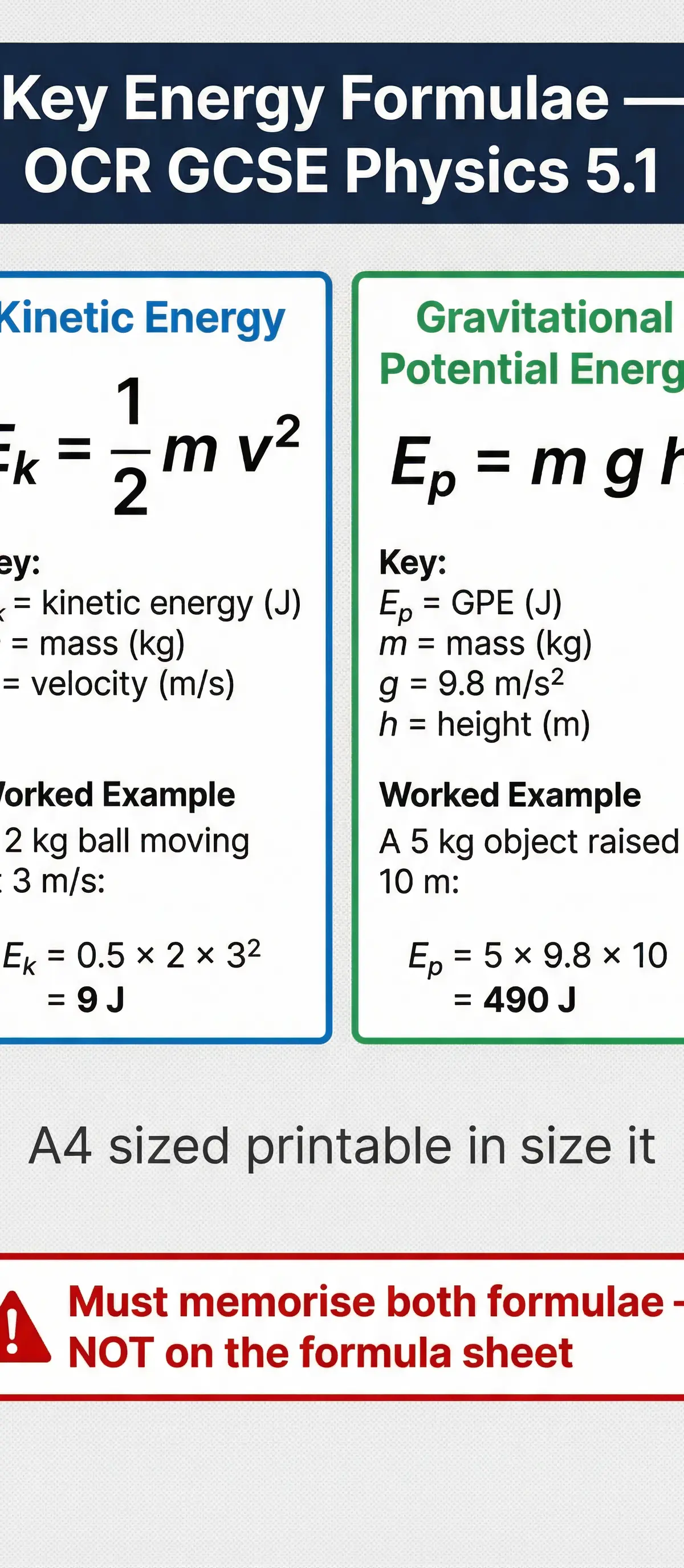
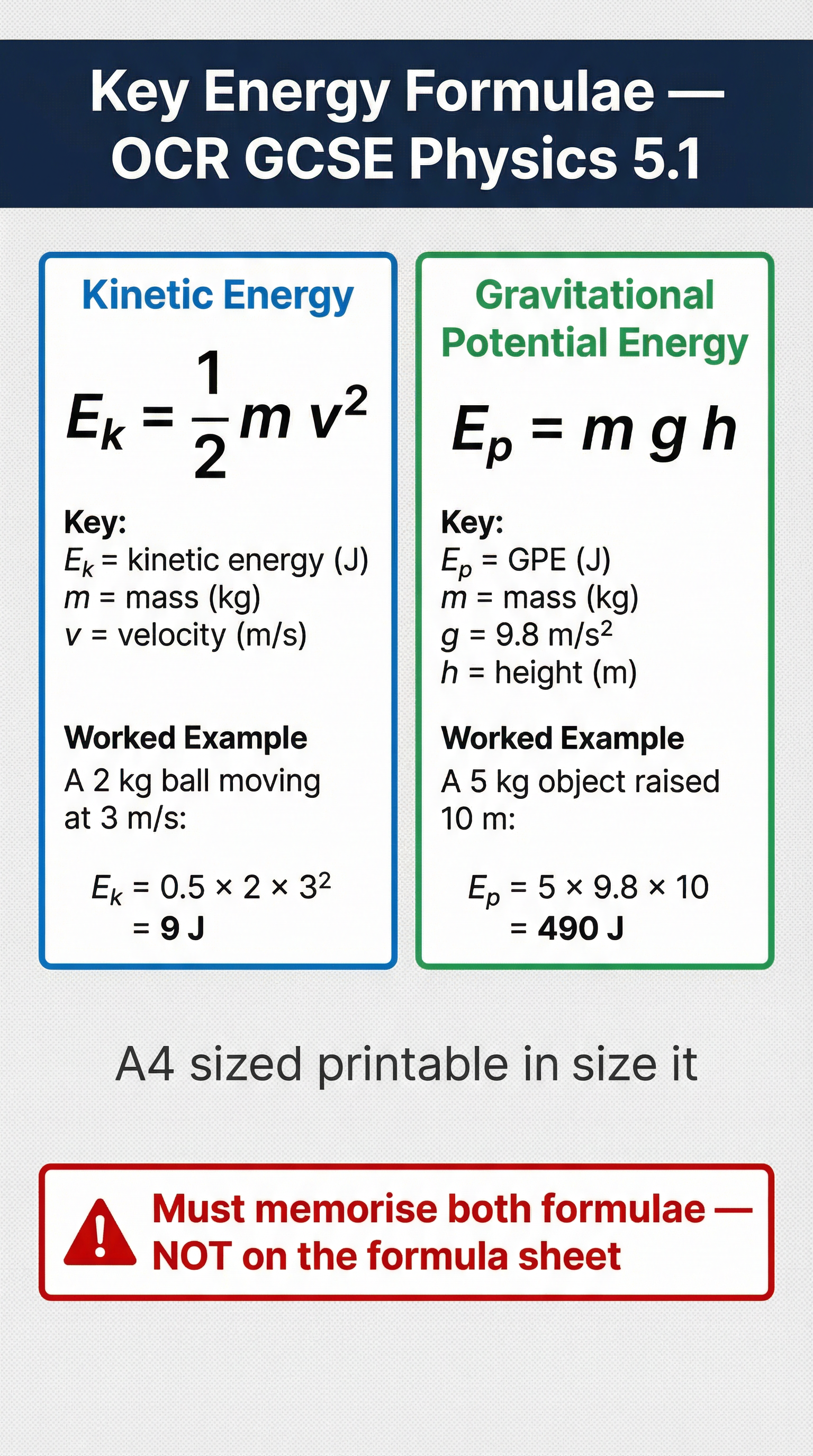
    The two key formulae for this topic. These must be memorised.

    1. Kinetic Energy (Ek)

      • Formula: Ek = ½ × m × v²
      • Ek: Kinetic Energy, measured in Joules (J)
      • m: mass, measured in kilograms (kg)
      • v: velocity (or speed), measured in metres per second (m/s)
      • Key Point: Notice the velocity is squared (v²). This means velocity has a much bigger impact on kinetic energy than mass does. Doubling the mass doubles the Ek, but doubling the velocity quadruples the Ek.
    2. Gravitational Potential Energy (Ep)

      • Formula: Ep = m × g × h
      • Ep: Gravitational Potential Energy, measured in Joules (J)
      • m: mass, measured in kilograms (kg)
      • g: gravitational field strength, measured in Newtons per kilogram (N/kg). On Earth, this is approximately 9.8 N/kg.
      • h: height, measured in metres (m)

    Higher Tier Link: GPE lost = KE gainedFor a falling object where air resistance is negligible, the energy from the gravitational potential store is transferred to the kinetic store. This allows us to equate the two formulae:

    m × g × h = ½ × m × v²

    Notice that mass (m) is on both sides, so it can be cancelled out. This shows that the final speed of a falling object (without air resistance) does not depend on its mass!

    Practical Applications

    • Roller Coasters: A classic example of GPE being converted to KE at the bottom of a drop, and back to GPE as it goes up the next hill. The initial GPE at the top of the first lift hill determines the maximum possible KE (and therefore speed) of the ride.
    • Vehicle Safety: Car crumple zones are designed to increase the time taken for a car to stop in a crash. This reduces the rate of energy transfer from the car's kinetic store, lowering the forces involved and protecting the occupants.
    • Power Generation: In a hydroelectric power station, the GPE of water stored in a high reservoir is converted to KE as it flows down pipes. This KE is then used to turn turbines (a mechanical transfer), which turn generators to produce an electrical transfer.
    • Bungee Jumping: A perfect example of interplay between GPE, KE, and Elastic Potential Energy. As the jumper falls, GPE is converted to KE. As the bungee cord starts to stretch, KE is converted to Elastic Potential Energy in the cord.

    Listen to the 10-minute revision podcast for this topic.

    Visual Resources

    4 diagrams and illustrations
    A summary of the eight key energy stores candidates must memorise.
    A summary of the eight key energy stores candidates must memorise.
    The two key formulae for this topic. These must be memorised.
    The two key formulae for this topic. These must be memorised.
    Common energy transfers between stores.
    Common energy transfers between stores.
    Conservation of energy for a falling object.
    Conservation of energy for a falling object.

    Interactive Diagrams

    2 interactive diagrams to visualise key concepts

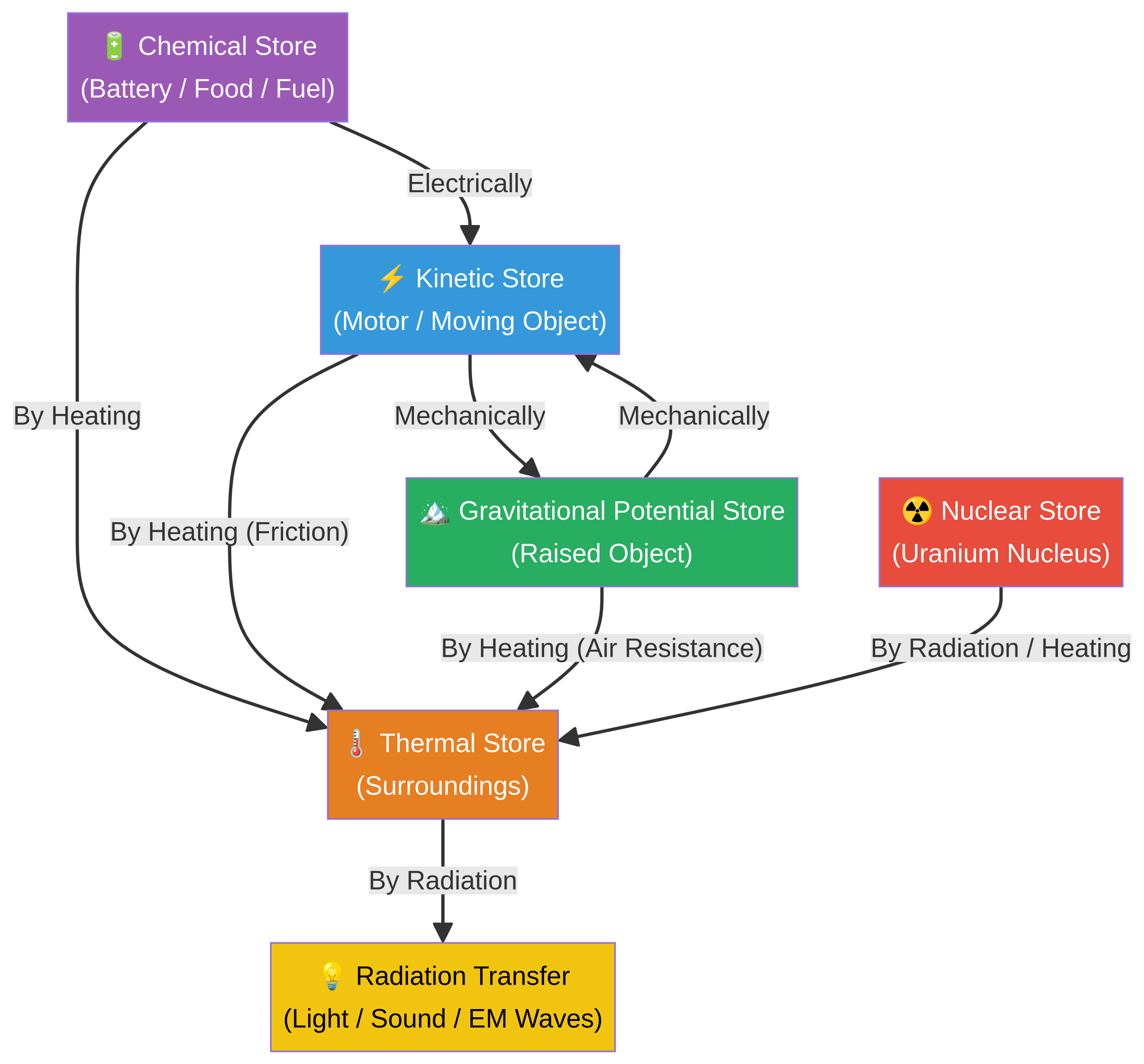
    A flowchart showing common energy transfers between different stores and the pathways they use. Note how many pathways lead to the Thermal Store, representing dissipation.

    This diagram illustrates the conservation of energy for a falling object in a closed system. The total energy (GPE + KE) remains constant at all points during the fall.

    Worked Examples

    3 detailed examples with solutions and examiner commentary

    Practice Questions

    Test your understanding — click to reveal model answers

    Q1

    A 60 W filament lamp is 5% efficient. Calculate the useful light energy it produces in 10 seconds.

    3 marks
    standard

    Hint: First, calculate the total energy transferred by the lamp in 10 seconds (Power = Energy / time). Then, find 5% of that total.

    Q2

    A student throws a 0.2 kg ball vertically upwards. It leaves their hand with a speed of 12 m/s. Calculate the maximum height it reaches. (g = 9.8 N/kg)

    4 marks
    challenging

    Hint: This is the reverse of a falling object. The initial kinetic energy is transferred to the gravitational potential energy store at its maximum height.

    Q3

    State the main energy store in: (a) a compressed spring, (b) a moving bus, (c) a piece of coal.

    3 marks
    foundation

    Hint: Think about what each object is doing or what it is made of.

    Q4

    A bungee cord is stretched. Describe the main energy store to which energy has been transferred.

    1 marks
    foundation

    Hint: What kind of energy is stored in stretched objects?

    Q5

    A battery is connected to a fan, which starts to turn. Describe the energy transfers that occur, starting from the battery.

    3 marks
    standard

    Hint: Use the full sentence structure: 'Energy is transferred from the... store of the... to the... store of the... via...'

    Explore this topic further

    View Topic PageAll Physics Topics

    Key Terms

    Essential vocabulary to know