OCR · GCSE · Physics
Refraction
This guide explains light refraction for OCR GCSE Physics (4.6), covering why light bends, how to draw ray diagrams, and the secrets to exam success. Master the concepts of optical density and total internal reflection to secure top marks.
- 5 min read
- 3 worked examples
- 5 practice questions
- 6 key terms
Study Notes
Overview
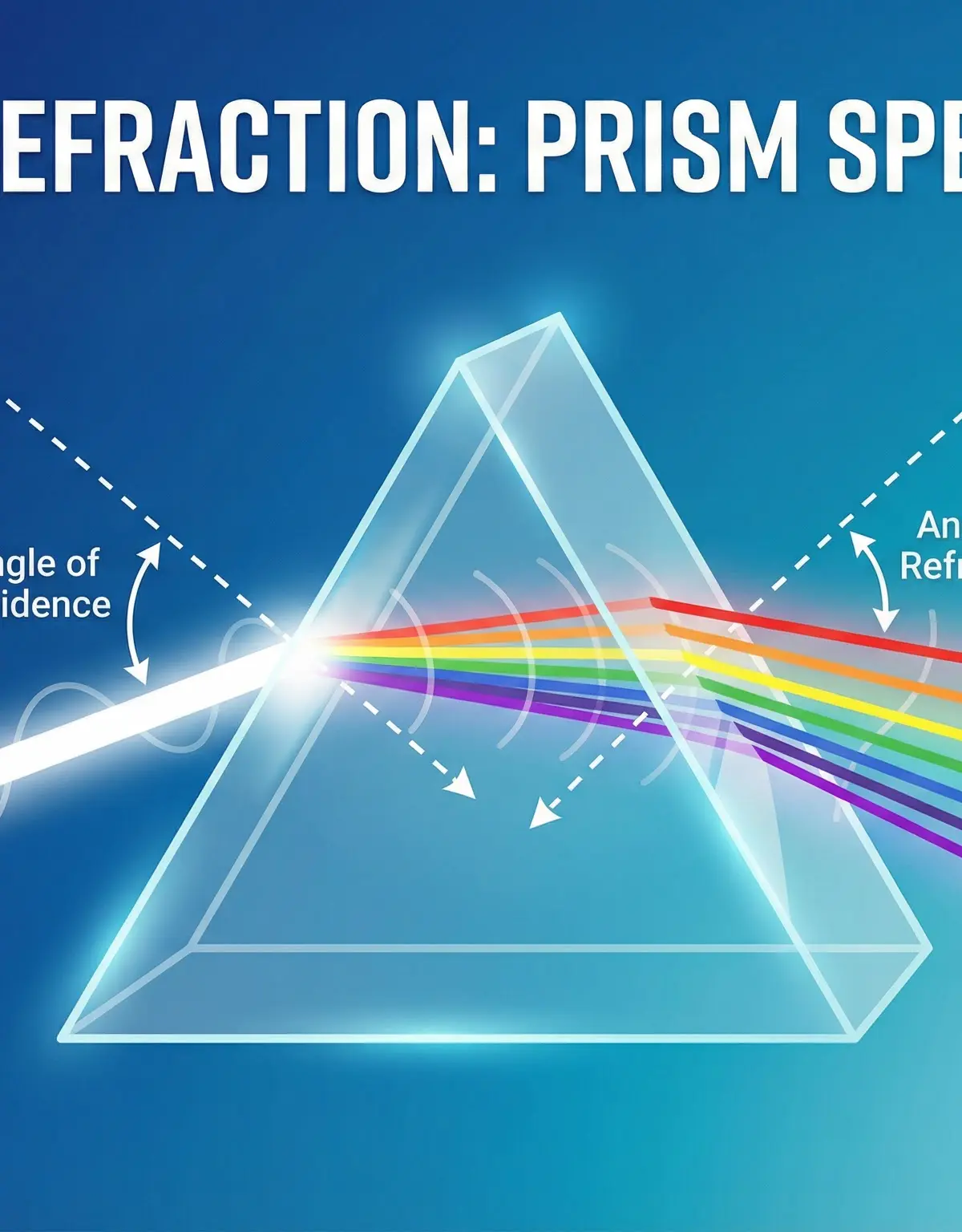
Refraction is a fundamental concept in physics that describes how waves, including light, change direction when they move from one medium to another. For your OCR GCSE Physics exam, understanding refraction is crucial, not just as a standalone topic but also for its applications in lenses, fibre optics, and explaining natural phenomena. This guide will equip you with the knowledge to describe and explain refraction using both ray diagrams and the wave model, ensuring you can tackle everything from simple definitions to challenging 6-mark questions. You will learn why a straw appears bent in water, how diamonds sparkle, and the principles behind high-speed internet. Examiners will test your ability to draw precise diagrams (AO2), explain the underlying physics (AO1), and apply your knowledge to unfamiliar contexts (AO3).
Key Concepts
Concept 1: Optical Density and Change of Speed
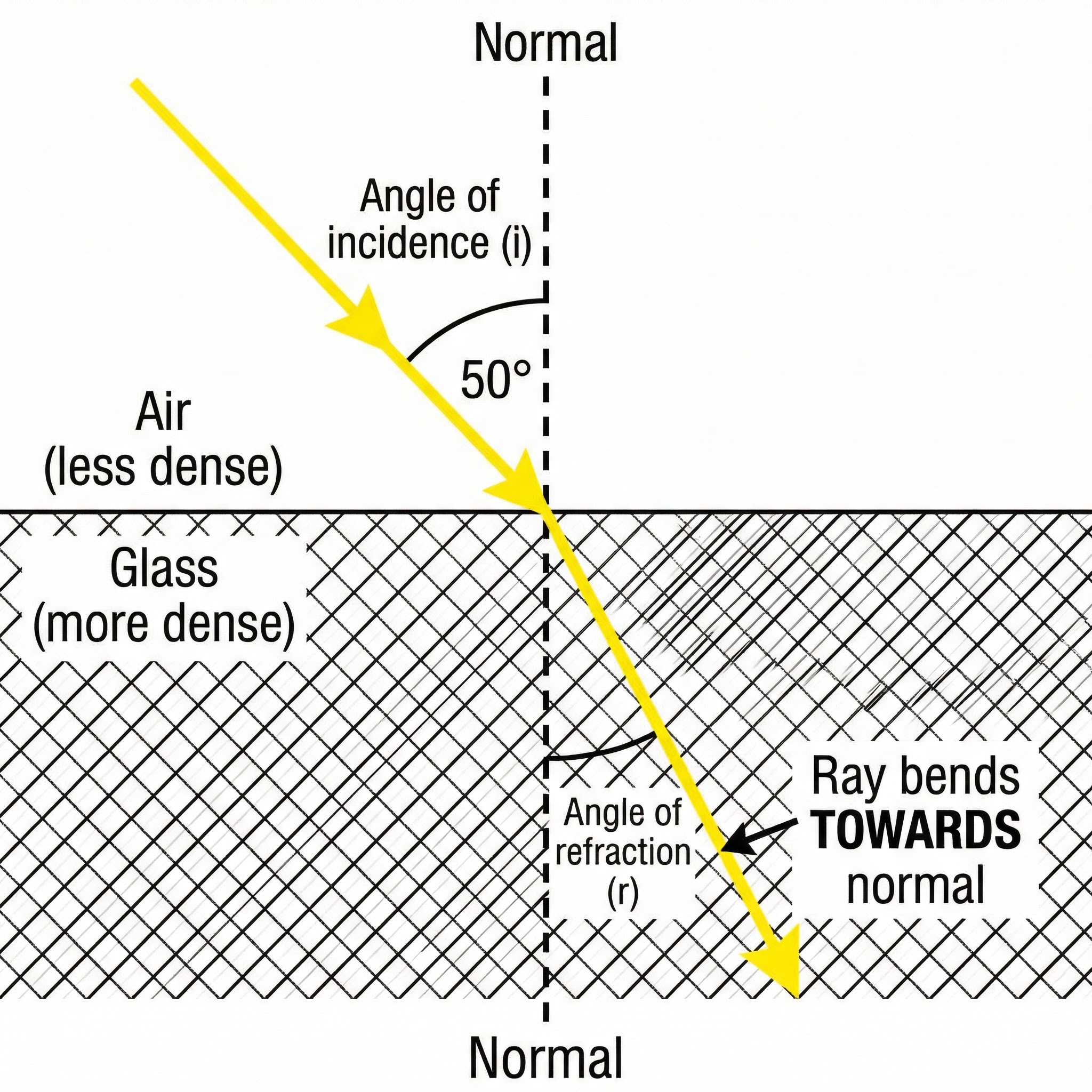
Refraction happens because light changes speed when it crosses a boundary between two different substances, or 'media'. The property that determines how much the light slows down is called optical density. It is crucial that candidates do not confuse this with physical density (mass per unit volume). A medium that is more optically dense is harder for light to travel through, so light moves more slowly.
- From Less Dense to More Dense (e.g., Air to Glass): When light enters an optically denser medium, it slows down and bends towards the normal.
- From More Dense to Less Dense (e.g., Glass to Air): When light enters an optically less dense medium, it speeds up and bends away from the normal.
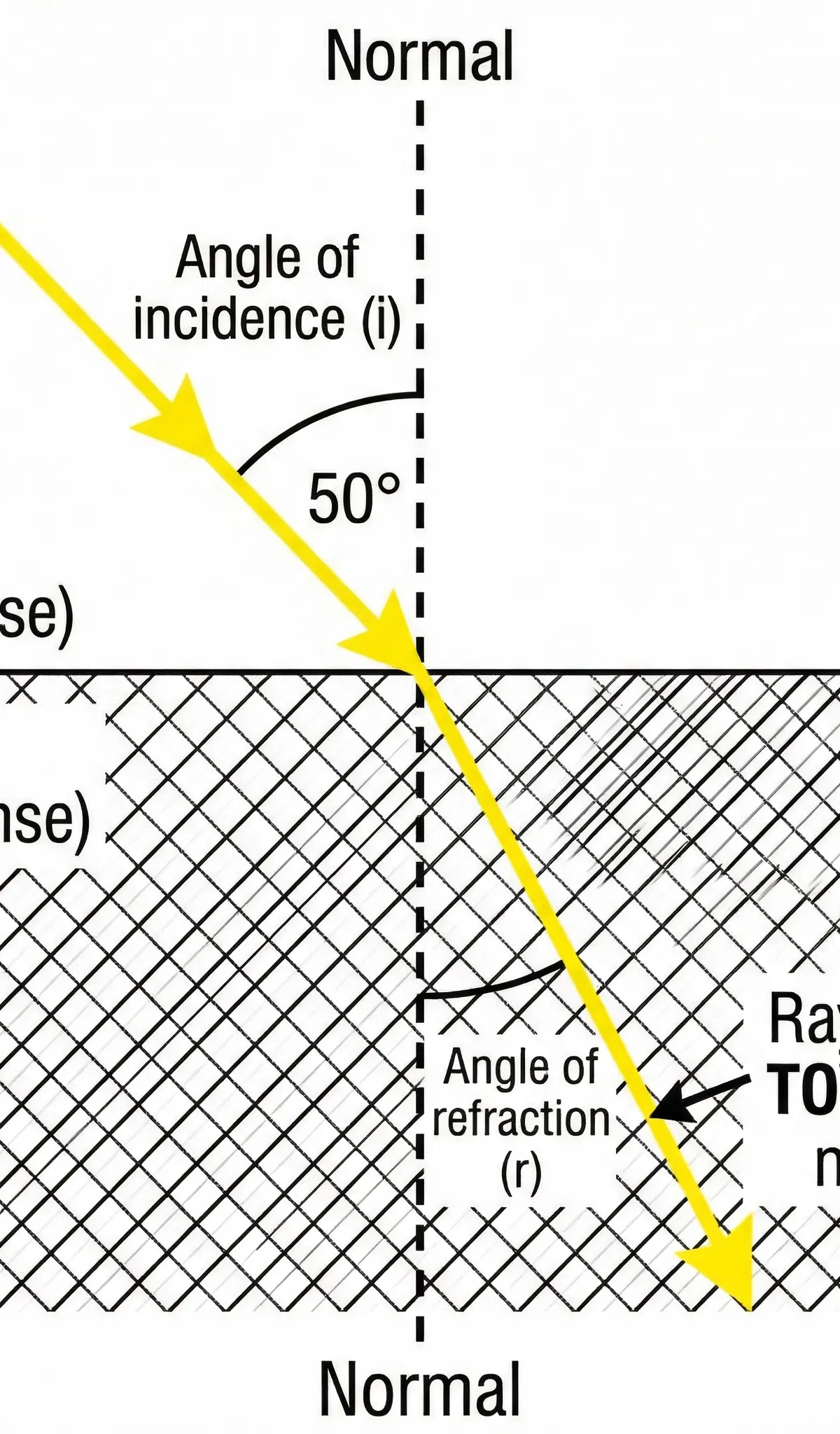
Key point for 1 mark: The frequency of the light wave remains constant when it refracts. Since wave speed = frequency × wavelength (v = fλ), a change in speed must cause a corresponding change in wavelength.
Concept 2: The Wavefront Explanation (Higher Tier)
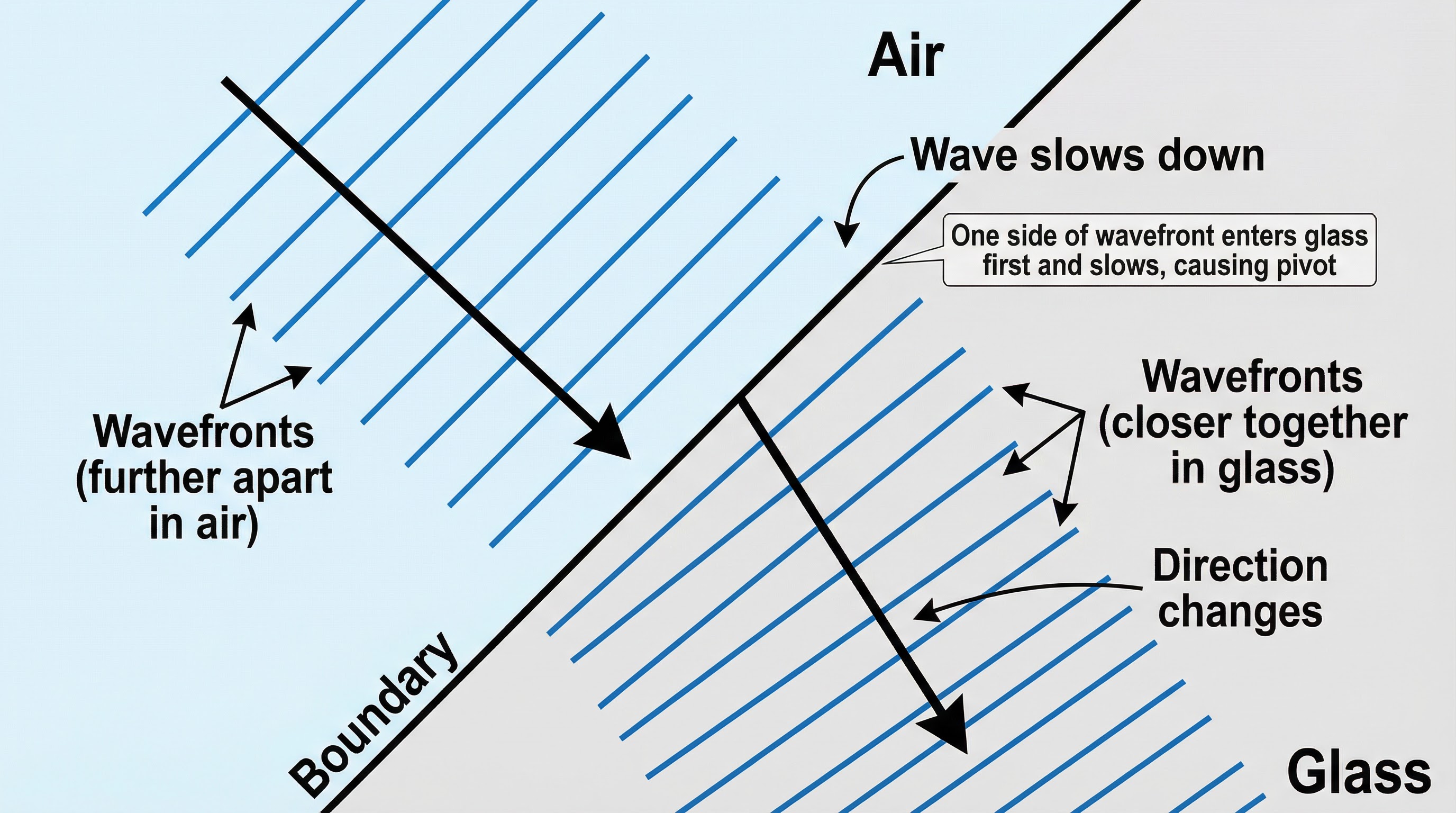
Higher Tier candidates must be able to explain refraction using the concept of wavefronts. This provides a deeper understanding of why the direction changes. Imagine a series of parallel wavefronts approaching a boundary at an angle. The part of the wavefront that reaches the boundary first will enter the new medium and slow down, while the rest of the wavefront is still travelling at the original speed. This difference in speed across the wavefront causes it to pivot or rotate, changing the direction of travel.
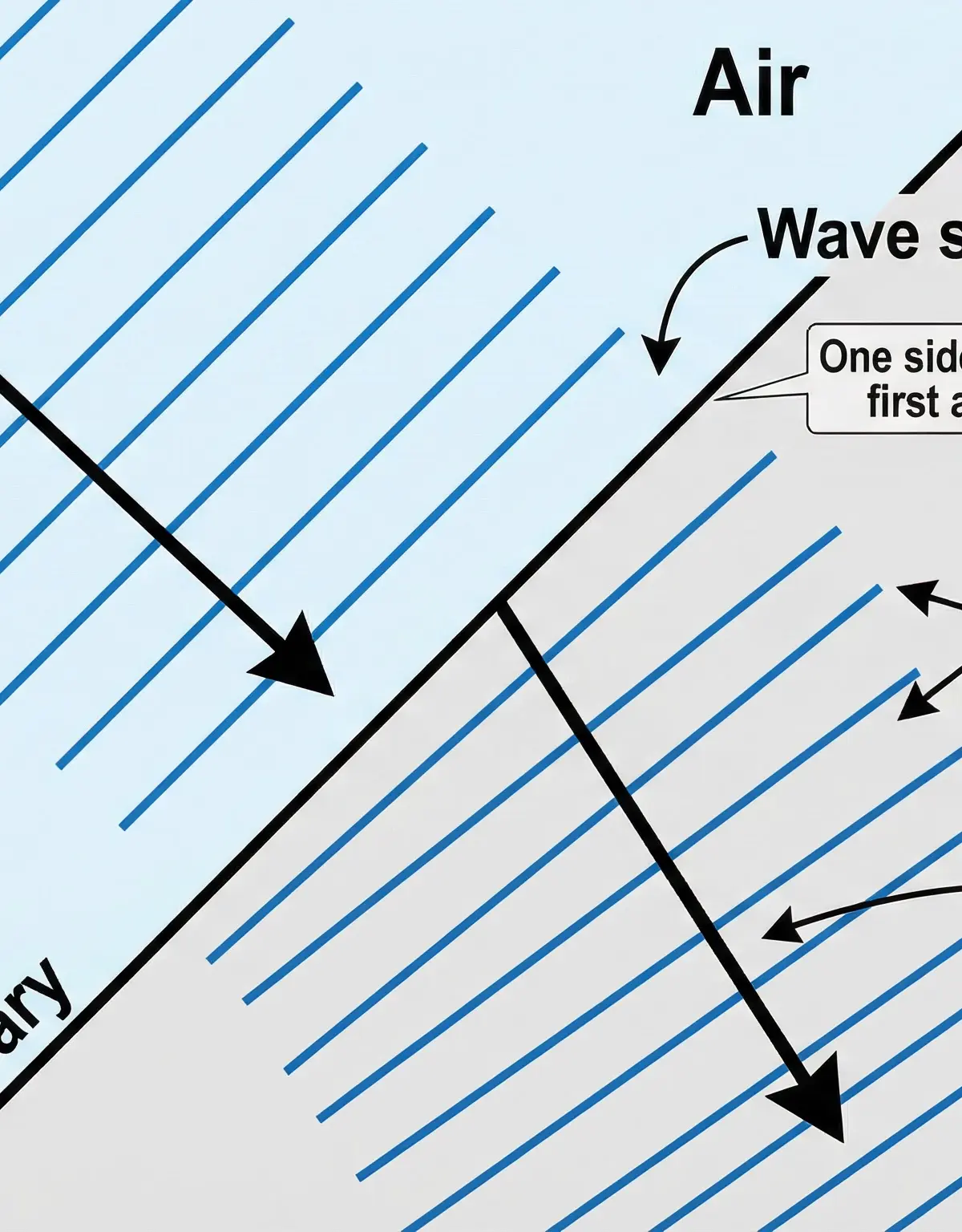
This is a high-level explanation that is often rewarded with marks in extended response questions.
Concept 3: Total Internal Reflection (TIR) and the Critical Angle
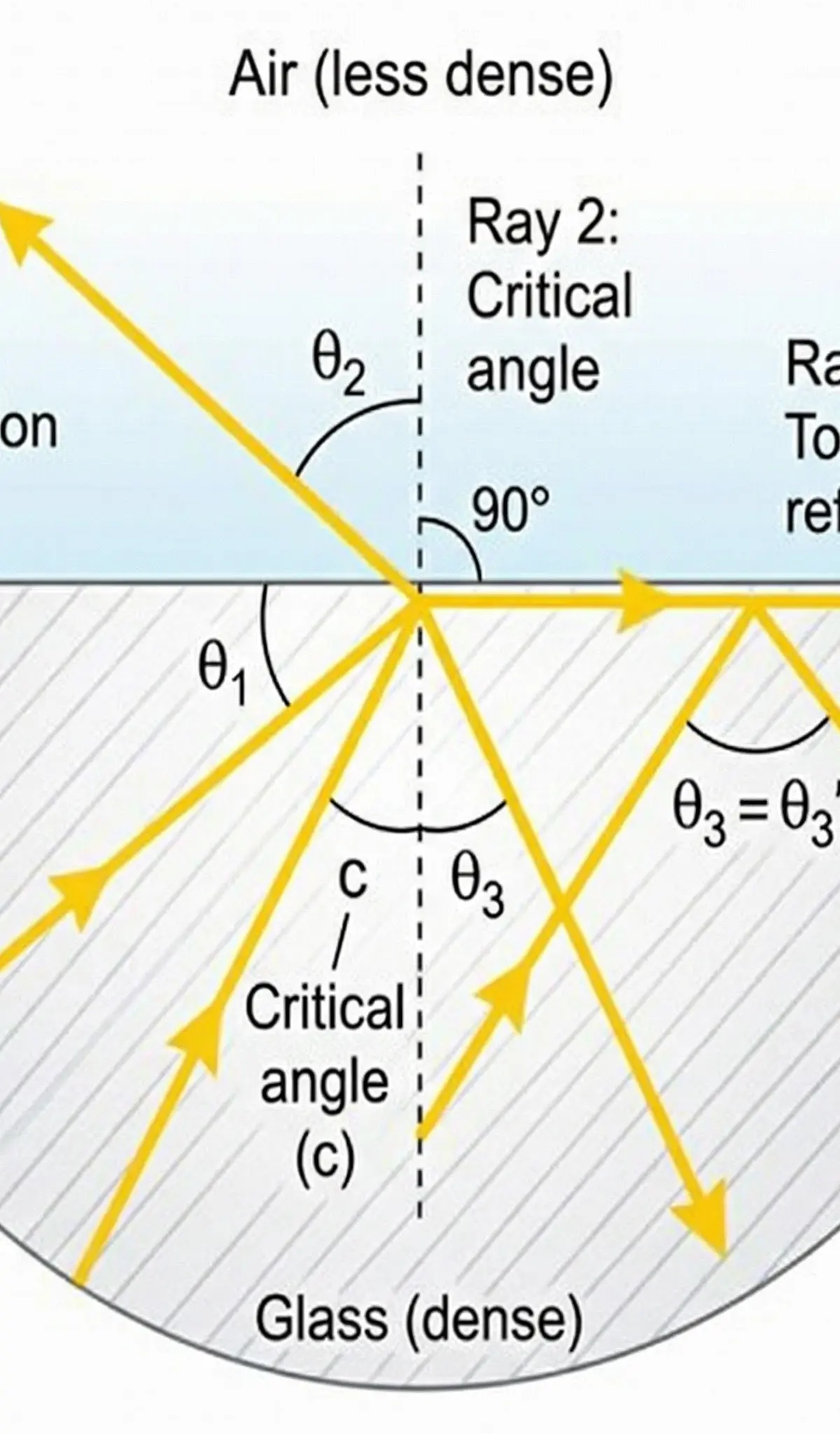
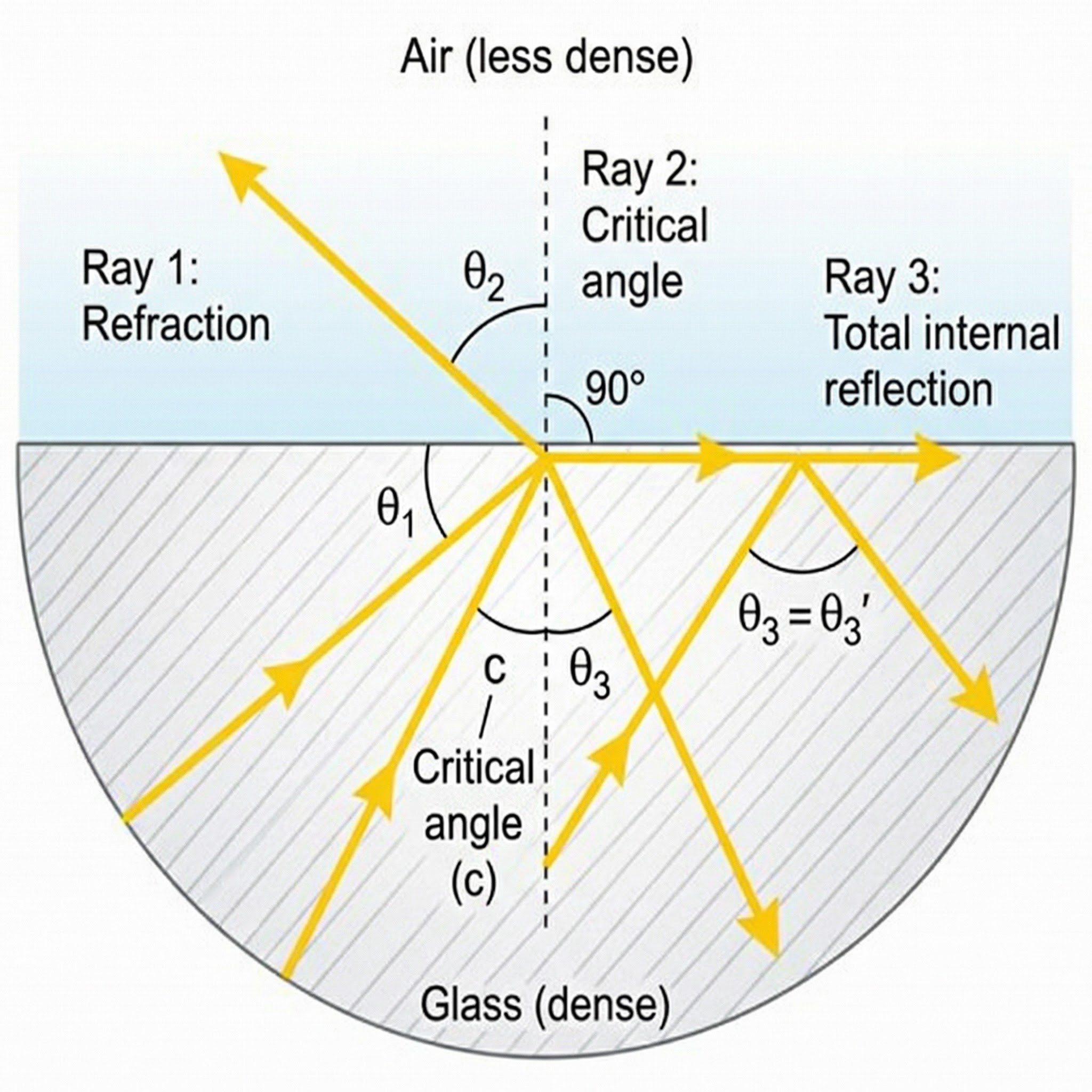
When light travels from a denser medium to a less dense one (e.g., from glass into air), it speeds up and bends away from the normal. If you increase the angle of incidence, the angle of refraction gets bigger. At a certain angle of incidence, called the critical angle (c), the refracted ray travels exactly along the boundary (an angle of refraction of 90°).
If the angle of incidence is greater than the critical angle, the light does not refract out of the medium at all. Instead, it is completely reflected back into the denser medium. This phenomenon is called Total Internal Reflection (TIR).
Two conditions are necessary for TIR:
- The light must be travelling from a denser medium towards a less dense one.
- The angle of incidence must be greater than the critical angle.
Mathematical/Scientific Relationships
Refractive Index (Higher Tier Only)
The refractive index (n) is a number that describes how optically dense a material is. It is defined as the ratio of the speed of light in a vacuum (c) to the speed of light in that medium (v).
n = c / v (Must memorise)
For your exam, you are more likely to use Snell's Law, which relates the angles of incidence and refraction to the refractive indices of the two media:
n = sin(i) / sin(r) (Given on formula sheet)
n: refractive index of the second medium (relative to the first)i: angle of incidencer: angle of refraction
Practical Applications
Refraction and TIR are not just abstract concepts; they are essential to many technologies:
- Lenses: Glasses and contact lenses use shaped pieces of glass or plastic to refract light and focus it correctly on the retina.
- Optical Fibres: These thin strands of glass are used for high-speed internet and medical endoscopes. They work by trapping light using TIR, allowing data to be sent over long distances with minimal loss.
- Diamonds: The brilliance and sparkle of a diamond are due to its very high refractive index and low critical angle, which causes a lot of light to be totally internally reflected inside the stone before it emerges.
Visual Resources
3 diagrams and illustrations
Interactive Diagrams
2 interactive diagrams to visualise key concepts
Conceptual Flow Outline
Decision flowchart showing the process of refraction as light enters a denser medium.
Conceptual Flow Outline
Flowchart showing the conditions for Total Internal Reflection (TIR).
Worked Examples
3 worked examples — open one to explore the question and available guidance.
Practice Questions
Test your understanding — click to reveal model answers
State two changes that happen to a light wave when it is refracted.
Hint: Think about the properties of a wave. Which ones change and which one stays the same?
A student investigates the path of a light ray through a glass block. Describe a method they could use to find the angle of incidence and the angle of refraction.
Hint: Think about the equipment you would use. How would you draw the lines and measure the angles?
Explain why a diamond sparkles more than a glass bead of the same shape.
Hint: This is about Total Internal Reflection. How does the material of the diamond affect this?
Draw a ray diagram to show a ray of light passing from water into air at an angle of incidence of 30°. (The ray should show the correct change in direction).
Hint: Is air more or less optically dense than water? Which way will the ray bend?
(Higher Tier) The refractive index of a glass block is 1.6. Calculate the critical angle for the glass-air boundary.
Hint: At the critical angle, what is the angle of refraction? Use this in Snell's Law.
Test your understanding of Refraction
Active recall beats re-reading. Take an instant quiz now to test what you’ve learned and lock it into long-term memory.
7 days Premium · Then free forever · No card, no charge