OCR · GCSE · Physics
The Solar System
This guide covers OCR GCSE Physics Topic 8.1, The Solar System. It explores the shift from geocentric to heliocentric models, the physics of orbital motion, and the complete life cycles of stars. Mastering this topic is crucial for tackling high-mark questions on stellar evolution and gravitational forces.
- 7 min read
- 3 worked examples
- 5 practice questions
- 6 key terms
Study Notes
Overview
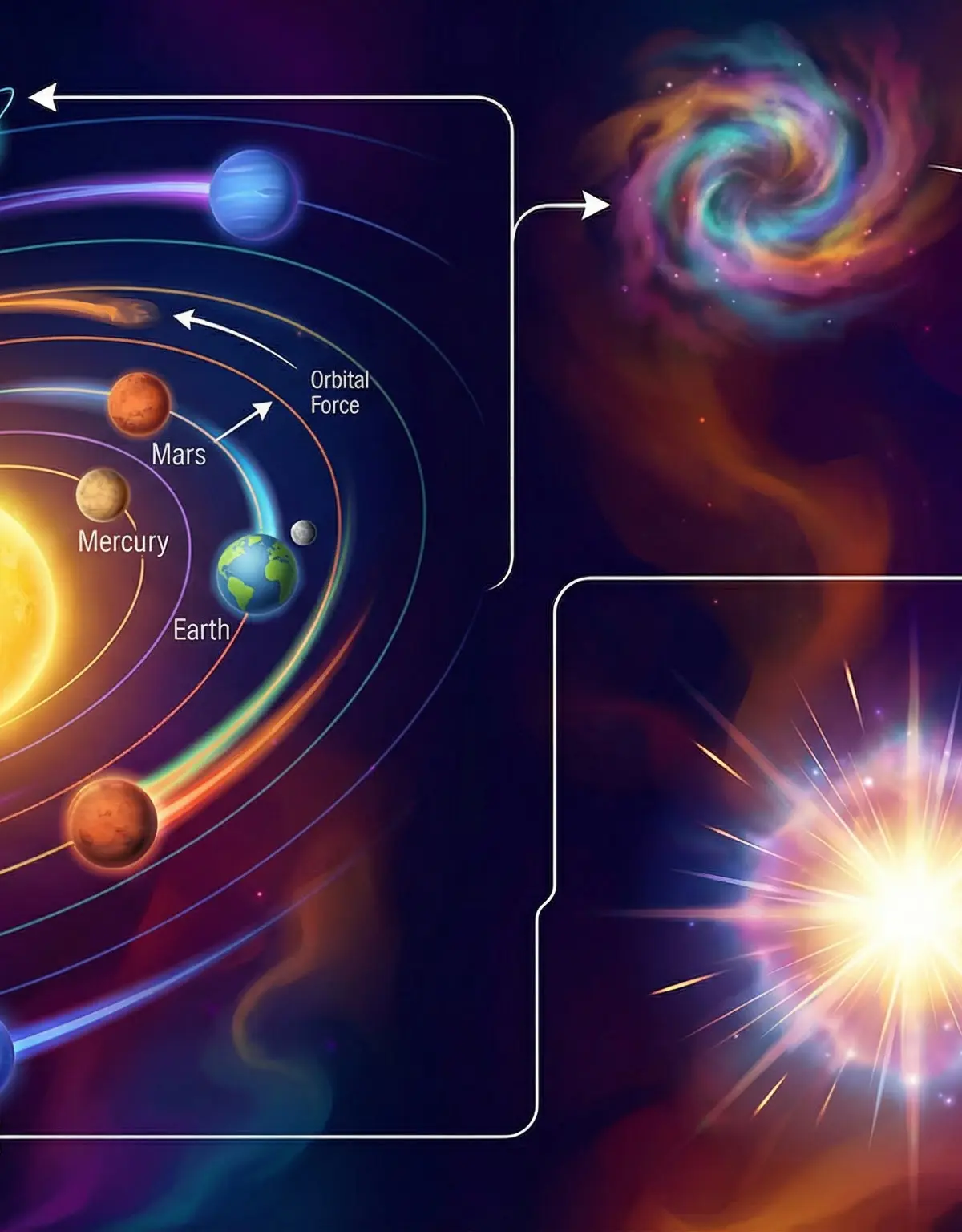
Welcome to Topic P8.1: The Solar System. This topic takes you on a journey through space and time, from ancient models of the universe to the explosive deaths of massive stars. For your exam, it's not enough to simply know the facts; you must understand the underlying physics. Examiners will test your ability to compare cosmological models, explain orbital mechanics with precision, and describe the stages of stellar evolution in a logical sequence. This topic frequently features 6-mark Level of Response questions, where a structured, detailed answer is key to achieving top marks. You'll also find synoptic links to forces (Topic P2) and energy (Topic P3), making it a vital part of the specification.
Key Concepts
Concept 1: Models of the Solar System
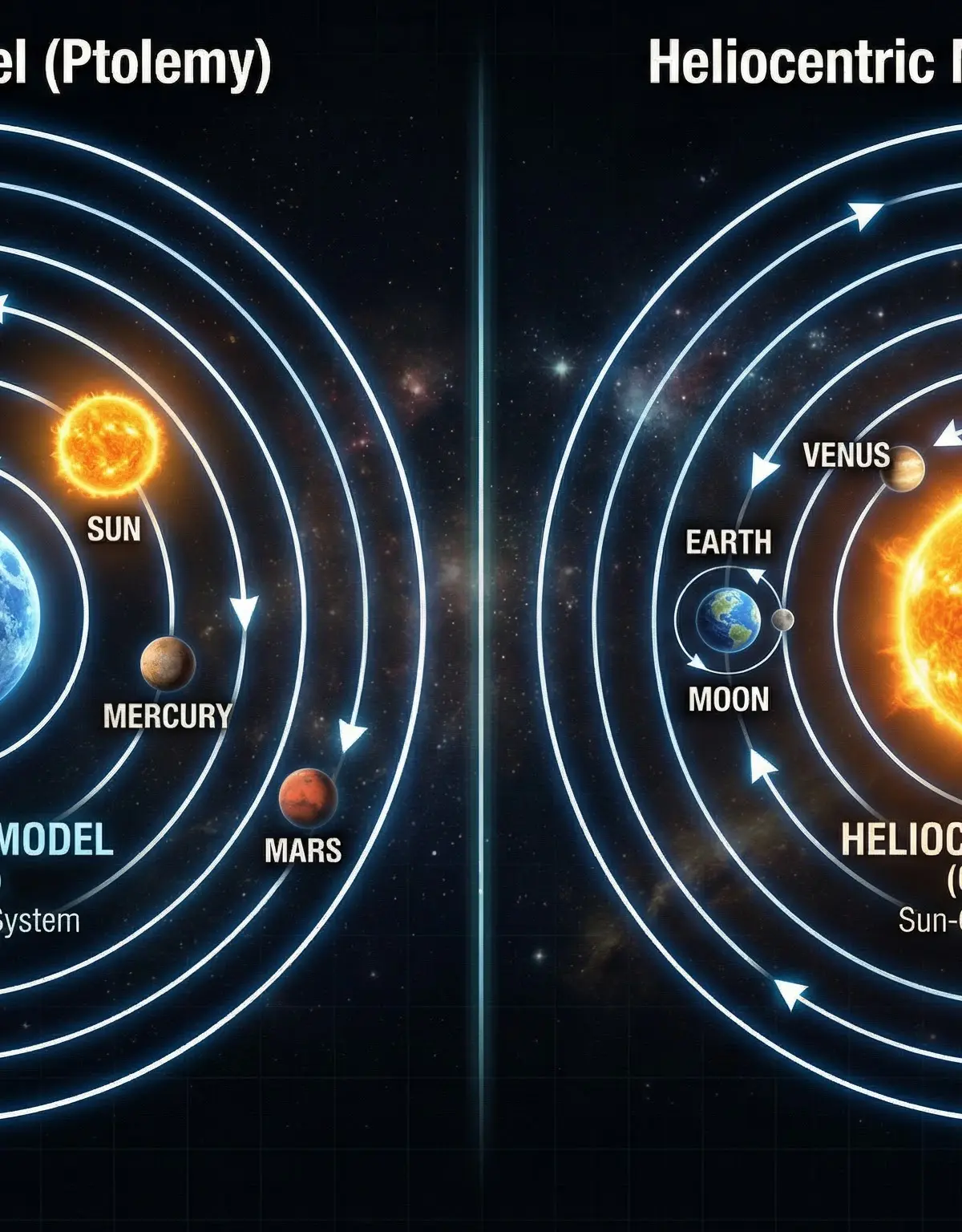
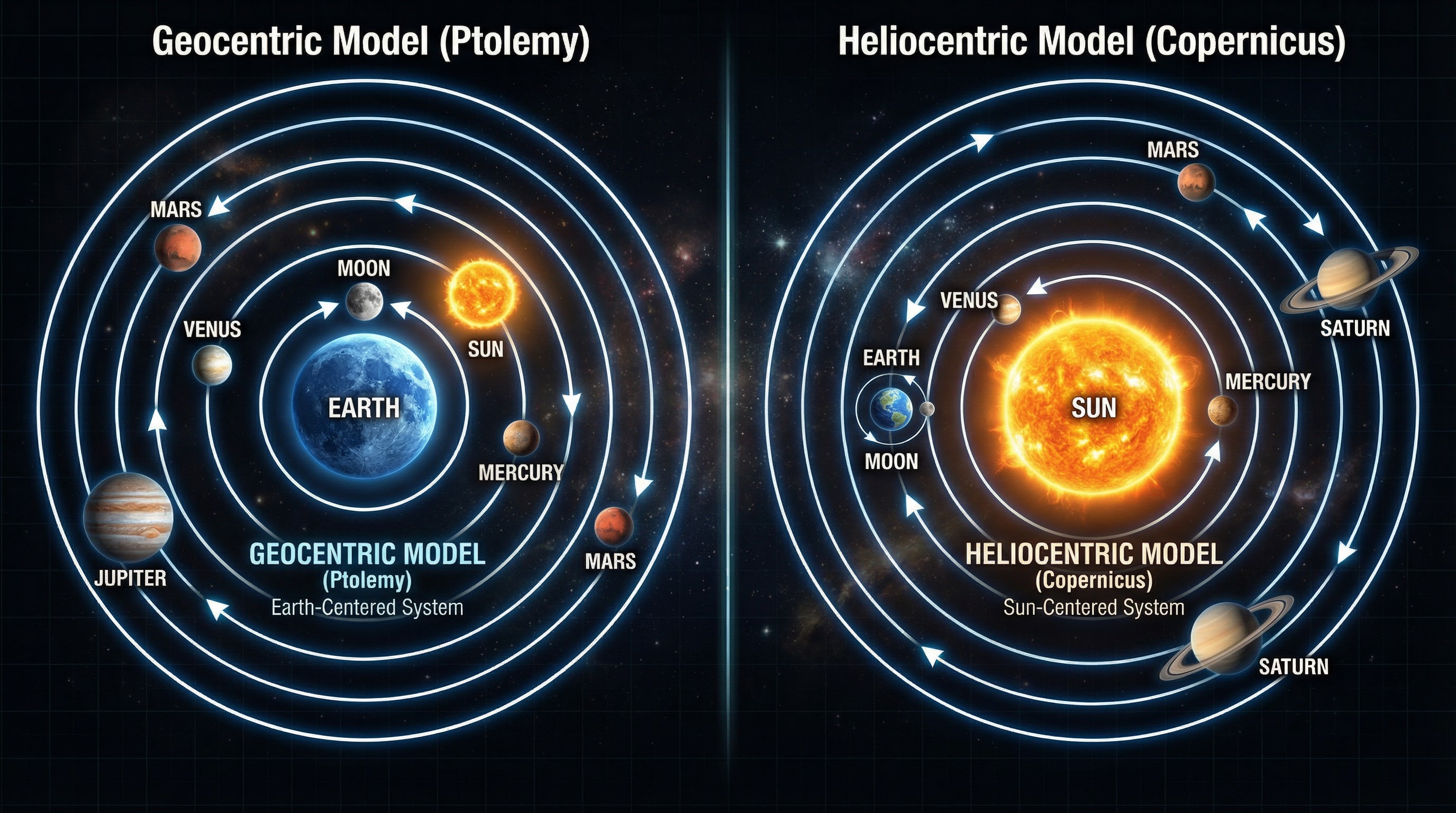
Our understanding of the cosmos has evolved significantly. The two key models you must know are the geocentric and heliocentric models.
- The Geocentric Model: Championed by Ptolemy, this model places the Earth at the centre of the universe. The Moon, Sun, planets, and stars are all considered to be in orbit around the Earth. This was the accepted model for over 1,500 years because it aligned with the everyday observation that the ground we stand on feels stationary.
- The Heliocentric Model: Proposed by Copernicus and later supported by Galileo's observations, this model correctly places the Sun at the centre of the Solar System. The Earth and other planets orbit the Sun. This model explained the observed motions of the planets more simply than the geocentric model.
For the exam, you must be able to state the difference clearly. A simple statement like, "The geocentric model is Earth-centred, while the heliocentric model is Sun-centred," will earn you a mark.
Concept 2: The Life Cycle of Stars
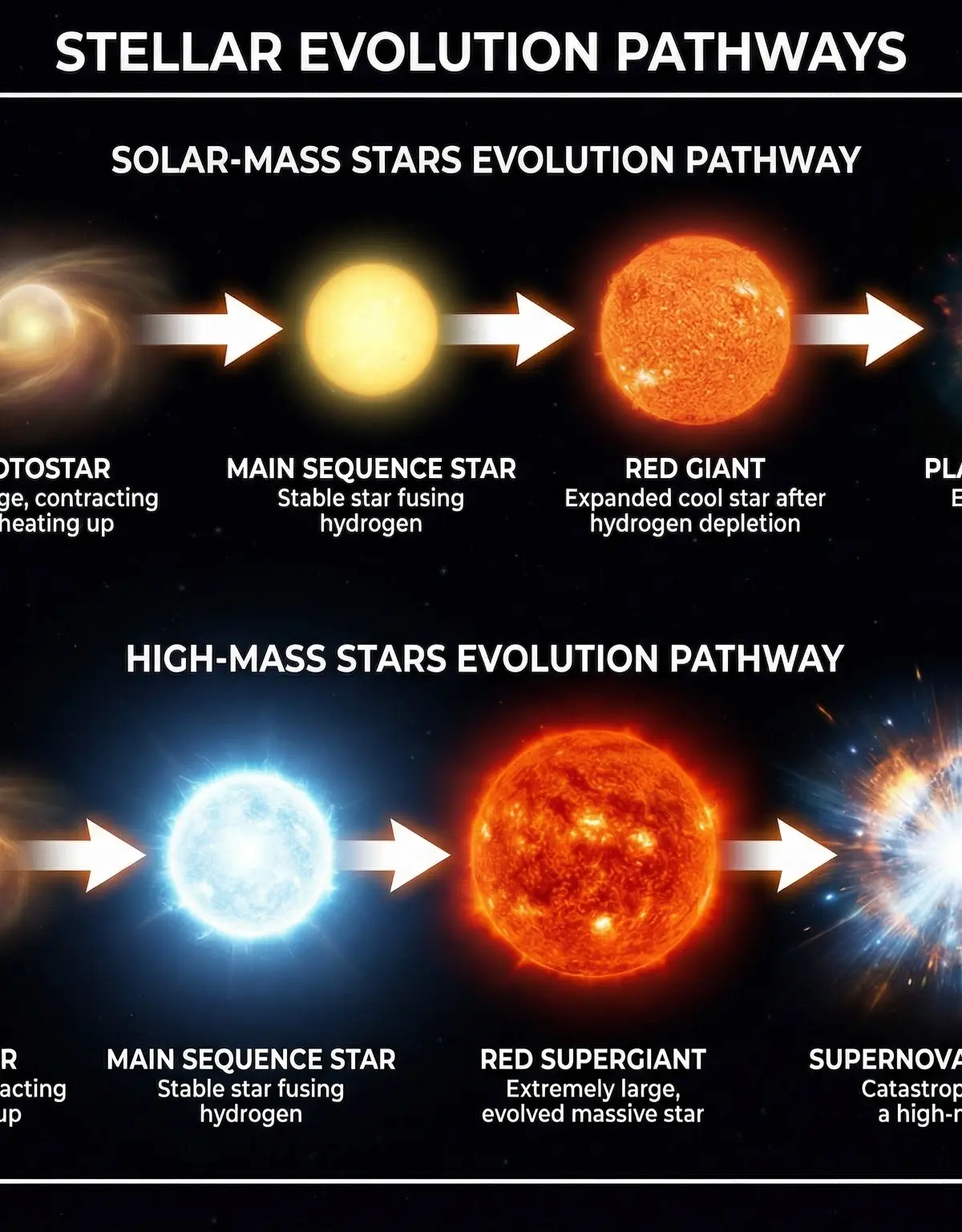
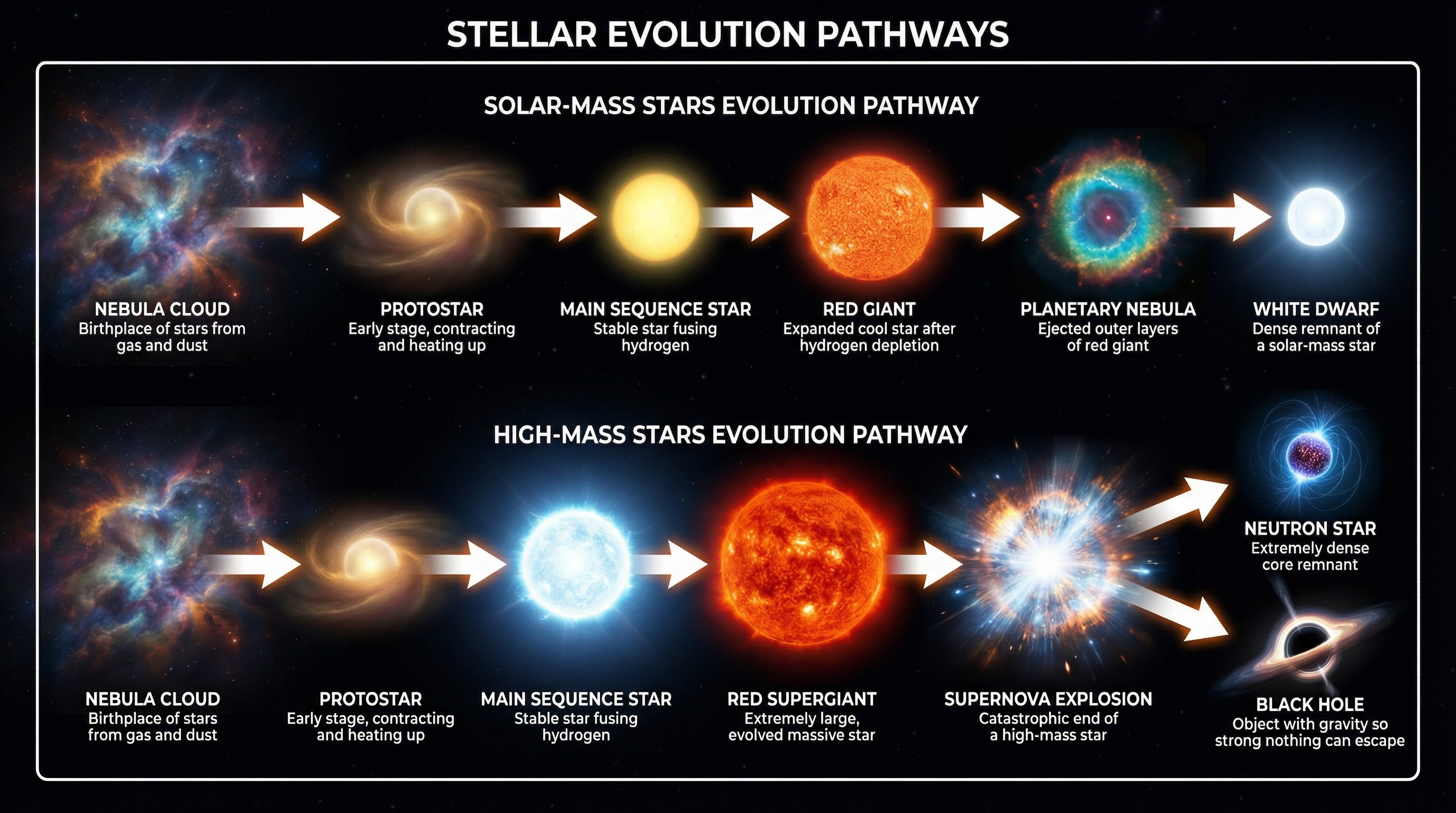
Stars are not eternal; they are born, they live, and they die. The life cycle of a star is determined by its initial mass. You need to know two distinct pathways: for solar-mass stars (like our Sun) and for high-mass stars.
Pathway 1: Solar-Mass Stars
- Nebula: A star's life begins as a vast cloud of gas (mostly hydrogen) and dust called a nebula.
- Protostar: Gravity pulls material in the nebula together. As it clumps, it heats up and begins to glow, forming a protostar.
- Main Sequence Star: When the core becomes hot and dense enough (around 15 million °C), nuclear fusion begins. Hydrogen nuclei fuse to form helium, releasing a vast amount of energy. This outward radiation pressure balances the inward pull of gravity, creating a stable star. Our Sun is currently in this phase.
- Red Giant: After billions of years, the hydrogen fuel in the core runs out. The core contracts and heats up, causing the outer layers of the star to expand and cool, forming a red giant.
- Planetary Nebula & White Dwarf: The outer layers drift away into space, creating a structure called a planetary nebula. The hot, dense core left behind is a white dwarf, which will slowly cool and fade over billions of years.
Pathway 2: High-Mass Stars
- Nebula & Protostar: The initial stages are the same as for a solar-mass star, but on a much larger scale.
- Main Sequence Star: A high-mass star is hotter, bluer, and burns through its fuel much more quickly than a low-mass star.
- Red Supergiant: When the hydrogen is depleted, the star swells to become a red supergiant.
- Supernova: The core collapses catastrophically, triggering a massive explosion called a supernova. For a short time, it can outshine an entire galaxy, distributing heavy elements across space.
- Neutron Star or Black Hole: The remnant of the explosion depends on the mass of the core. If the core is between about 1.4 and 3 times the mass of our Sun, it becomes an incredibly dense neutron star. If the core is more massive, it collapses completely to form a black hole, a region of spacetime where gravity is so strong that nothing, not even light, can escape.
Concept 3: Orbital Motion
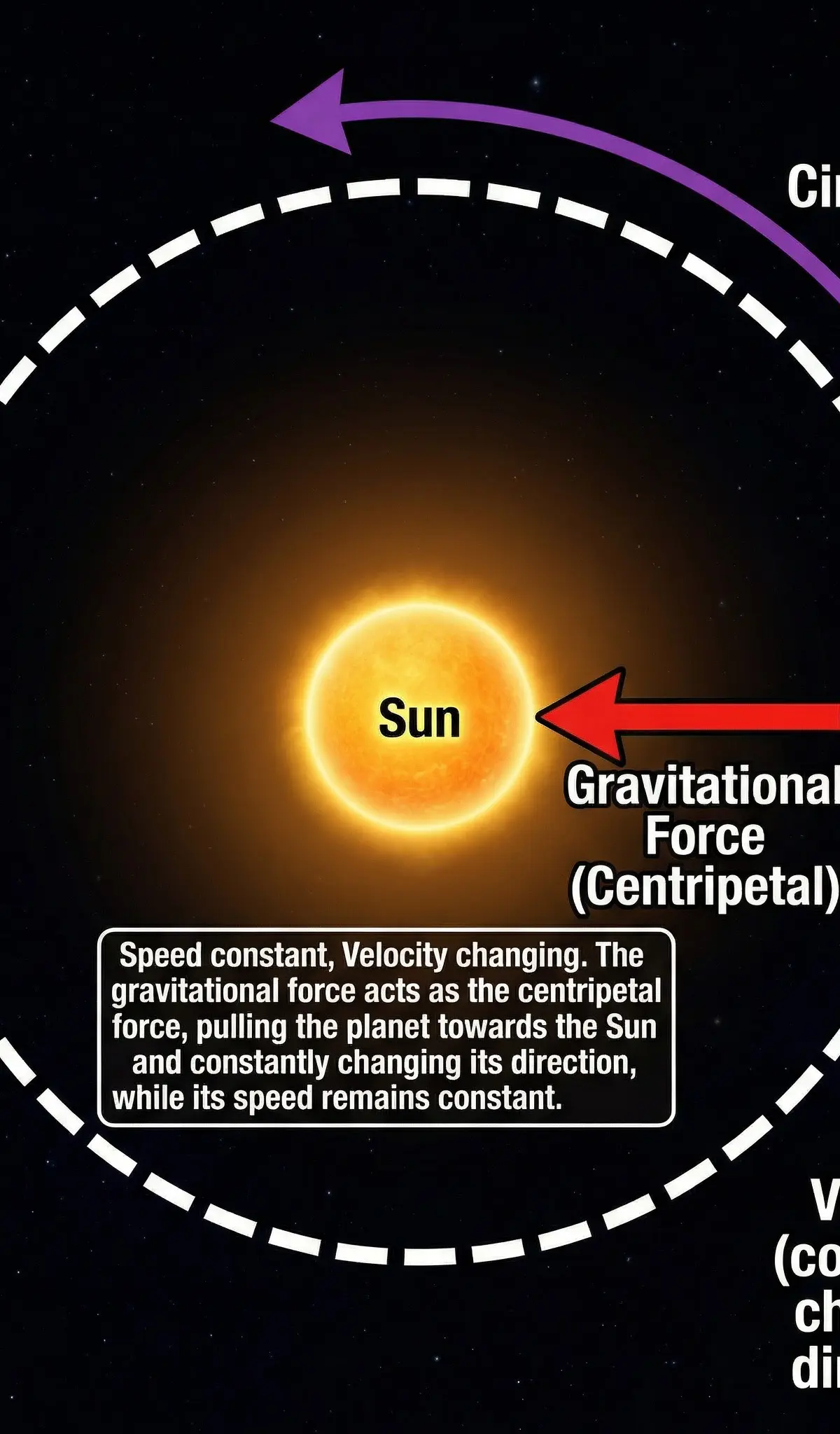
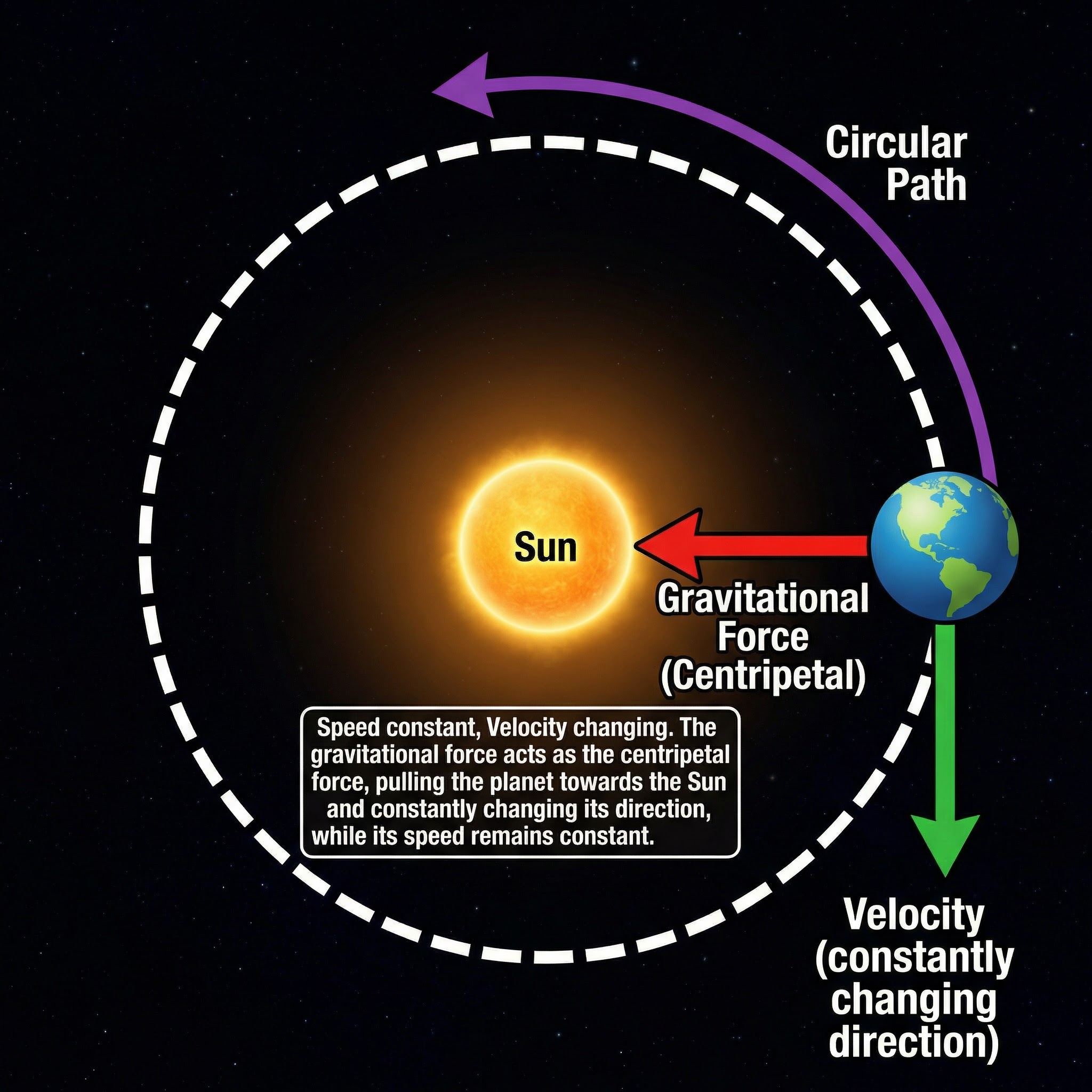
Planets, moons, and satellites are all held in orbit by gravity. For a stable, circular orbit, the force of gravity provides the required centripetal force.
- Centripetal Force: This is a force that acts towards the centre of a circle. It is responsible for constantly changing the direction of the orbiting object, keeping it on a curved path.
- Velocity and Speed: An object in a circular orbit may have a constant speed, but its velocity is always changing. This is a crucial distinction. Velocity is a vector quantity, meaning it has both magnitude (speed) and direction. Since the direction of the orbiting object is constantly changing, its velocity is also constantly changing. This change in velocity means the object is accelerating, and this acceleration is caused by the centripetal force (gravity).
Mathematical/Scientific Relationships
While this topic is less formula-heavy than others, you must understand the relationship between force, mass, and acceleration from P2, as it underpins orbital mechanics. The key idea is that the gravitational force provides the centripetal force. For Higher Tier candidates, you should understand that the force of gravity is stronger for more massive objects and for objects that are closer together. The speed of a stable orbit depends on its radius: for a given central body, the smaller the orbital radius, the faster the orbital speed required to maintain a stable orbit.
Practical Applications
- Artificial Satellites: The principles of orbital motion are used to place artificial satellites into specific orbits around Earth. Geostationary satellites, used for communications, orbit at a very specific altitude (approx. 36,000 km) and speed so that they remain above the same point on the Earth's surface.
- GPS (Global Positioning System): A network of satellites orbiting Earth, each broadcasting a precise time signal. A receiver on the ground uses the signals from multiple satellites to calculate its exact position.
- Stellar Forensics: By observing the light from distant stars and galaxies, astronomers can determine their composition, temperature, and motion, allowing them to piece together the history and future of the universe.
Visual Resources
3 diagrams and illustrations
Interactive Diagrams
2 interactive diagrams to visualise key concepts
Conceptual Flow Outline
Flowchart showing the two distinct life cycle pathways for stars based on their initial mass.
Conceptual Flow Outline
Concept map comparing the basic structure of the Geocentric and Heliocentric models.
Worked Examples
3 worked examples — open one to explore the question and available guidance.
Practice Questions
Test your understanding — click to reveal model answers
State two differences between the life cycle of a star much more massive than the Sun and the life cycle of the Sun. [2 marks]
Hint: Think about the final stages of each pathway. What is the key difference in how they end?
Explain how a stable main sequence star is maintained. [3 marks]
Hint: Think about the two main forces acting on a star. How do they interact?
A satellite is in a stable circular orbit around the Earth. A scientist proposes increasing the satellite's orbital speed. Explain what would happen to the satellite's orbit. [4 marks]
Hint: For a stable orbit, the gravitational force provides the exact centripetal force needed for that speed and radius. What happens if you change the speed?
Describe the evidence that led to the acceptance of the heliocentric model over the geocentric model. [3 marks]
Hint: Think about what Galileo saw with his new invention, the telescope.
What is a nebula? [1 mark]
Hint: What is the very first stage of a star's life?
Test your understanding of The Solar System
Active recall beats re-reading. Take an instant quiz now to test what you’ve learned and lock it into long-term memory.
7 days Premium · Then free forever · No card, no charge