Identity and culture Revision Notes

    Subject: Polish | Level: GCSE | Exam Board: AQA

    This topic covers essential vocabulary for Polish customs and festivals, requiring students to narrate past and future celebrations using accurate tenses and case endings. It tests all four skills, with a strong emphasis on justifying opinions about cultural traditions.

    Revision Notes & Key Concepts

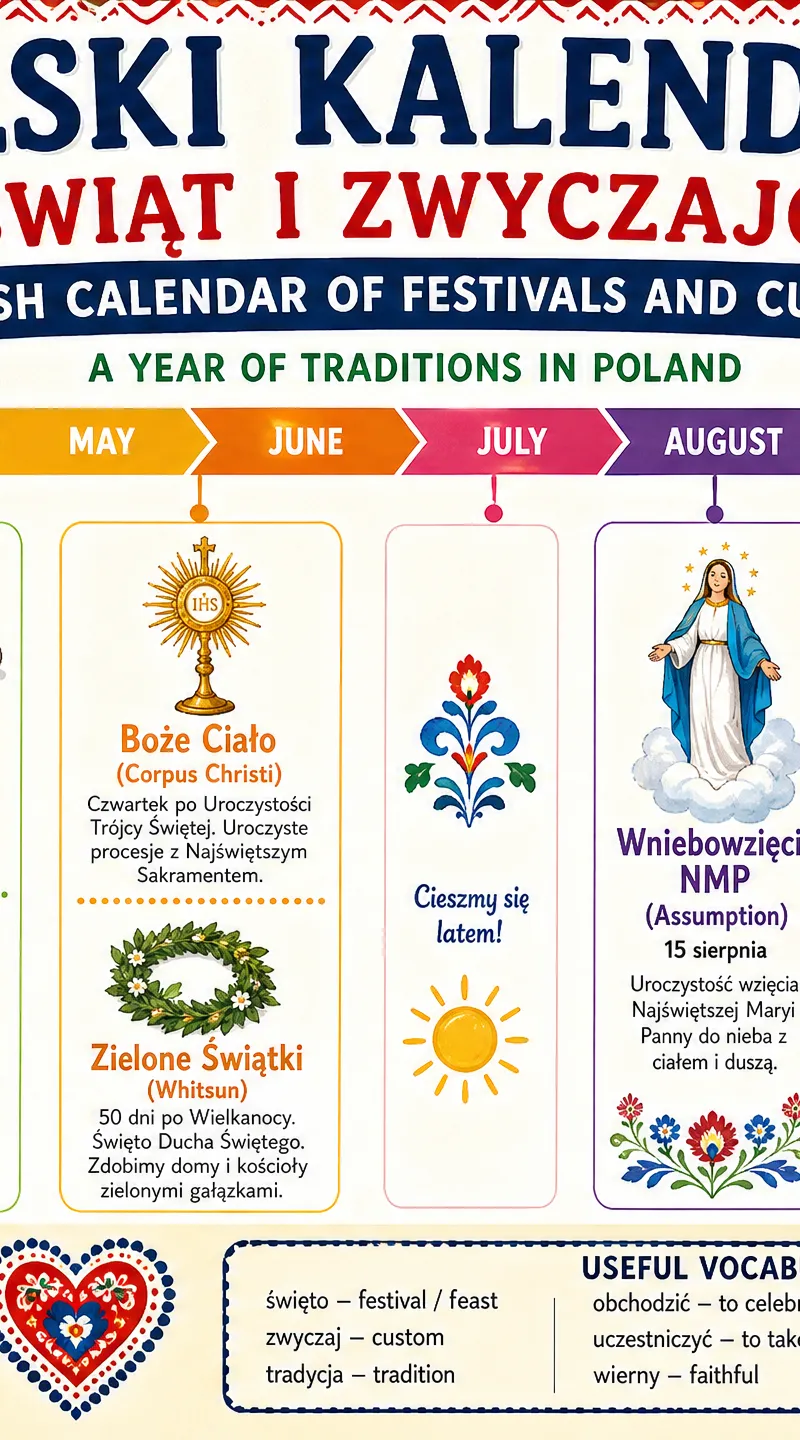
    ![Header image for Customs and Festivals](https://xnnrgnazirrqvdgfhvou.supabase.co/storage/v1/object/public/study-guide-assets/guide_fe528fcd-9bcd-43dc-a609-900bcdf28979/header_image.png) ## Overview This topic covers the customs and festivals celebrated in Poland, including religious and national holidays. It is a high-yield topic across all four papers (Listening, Speaking, Reading, Writing). Examiners love this topic because it naturally invites the use of three tenses (how I celebrated last year, how I usually celebrate, how I will celebrate next year) and allows you to demonstrate genuine cultural knowledge, which is highly rewarded. --- ## 📖 Essential Vocabulary ### Tier 1 — Foundation Core | Polish | English | Gender | Example Sentence | |---|---|---|---| | święto | festival/holiday | n | Moim ulubionym świętem jest Wielkanoc. | | prezent | present/gift | m | Dostałem dużo prezentów na urodziny. | | choinka | Christmas tree | f | Ubieramy choinkę w grudniu. | | kościół | church | m | W niedzielę idziemy do kościoła. | | rodzina | family | f | Spędzam święta z moją rodziną. | | jedzenie | food | n | Tradycyjne jedzenie jest bardzo smaczne. | | ciasto | cake | n | Moja babcia piecze pyszne ciasto. | | muzyka | music | f | Słuchamy świątecznej muzyki. | | kolacja | supper/dinner | f | Jemy kolację o szóstej. | | śpiewać | to sing | verb | Lubimy śpiewać kolędy. | | tańczyć | to dance | verb | Będziemy tańczyć na weselu. | | wesoły | happy/merry | adj | Wesołych Świąt! | | zima | winter | f | Święta są w zimie. | | wiosna | spring | f | Wielkanoc jest na wiosnę. | | zaprosić | to invite | verb | Chcę zaprosić moich przyjaciół. | ### Tier 2 — Higher Tier | Polish | English | Gender | Example Sentence | |---|---|---|---| | uroczystość | celebration/ceremony | f | To była wspaniała uroczystość. | | tradycja | tradition | f | Tradycja jest dla mnie bardzo ważna. | | zwyczaj | custom | m | Zwyczaje w Polsce są bardzo interesujące. | | obchodzić | to celebrate | verb | Jak obchodzisz Boże Narodzenie? | | uczestniczyć | to take part in | verb | Będę uczestniczyć w festiwalu. | | potrawa | dish/course | f | Na stole było dwanaście potraw. | | pasterka | midnight mass | f | O północy idziemy na pasterkę. | | wierni | the faithful | m pl | Wierni modlą się w kościele. | | procesja | procession | f | Procesja idzie przez miasto. | | post | fast/Lent | m | W Wielki Post nie jemy mięsa. | ### High-Frequency Words & Phrases | Phrase | English | Usage Context | |---|---|---| | Moim zdaniem... | In my opinion... | Speaking/Writing: introducing an opinion | | Uważam, że... | I think that... | Speaking/Writing: expressing a view | | Z jednej strony... | On one hand... | Writing: balancing an argument | | Ponieważ | Because | Speaking/Writing: justifying an opinion | | W zeszłym roku | Last year | Speaking/Writing: triggering past tense | | W przyszłym roku | Next year | Speaking/Writing: triggering future tense | | Zazwyczaj | Usually | Speaking/Writing: triggering present tense | | Z okazji | On the occasion of | Writing: introducing a celebration | | Najbardziej lubię... | I like most... | Speaking: giving preferences | | Nie przepadam za... | I am not keen on... | Speaking: giving negative preferences | --- ## 📝 Grammar Focus ![Grammar Quick Reference](https://xnnrgnazirrqvdgfhvou.supabase.co/storage/v1/object/public/study-guide-assets/guide_fe528fcd-9bcd-43dc-a609-900bcdf28979/grammar_reference.png) ### Key Structure 1: The Past Tense (Czas Przeszły) **When to use it**: To describe how you celebrated a festival in the past (e.g., last Christmas, last Easter). Examiners look for accurate gender agreement. #### Conjugation Table: "być" (to be) and "świętować" (to celebrate) | Subject | Verb Form (Masculine) | Verb Form (Feminine) | English | |---|---|---|---| | ja (I) | byłem / świętowałem | byłam / świętowałam | I was / I celebrated | | ty (you sg) | byłeś / świętowałeś | byłaś / świętowałaś | you were / you celebrated | | on/ona/ono (he/she/it) | był / świętował | była / świętowała | he/she/it was / celebrated | | my (we) | byliśmy / świętowaliśmy | byłyśmy / świętowałyśmy | we were / we celebrated | | wy (you pl) | byliście / świętowaliście | byłyście / świętowałyście | you were / you celebrated | | oni/one (they) | byli / świętowali | były / świętowały | they were / they celebrated | **Irregulars to learn**: jeść (to eat) -> jadłem/jadłam (I ate), iść (to go) -> poszedłem/poszłam (I went). ### Key Structure 2: The Future Tense (Czas Przyszły) **When to use it**: To describe your plans for an upcoming festival. The easiest way is to use "będę" + the infinitive. #### Conjugation Table: "będę" + infinitive | Subject | Verb Form | English | |---|---|---| | ja (I) | będę świętować | I will celebrate | | ty (you sg) | będziesz świętować | you will celebrate | | on/ona/ono (he/she/it) | będzie świętować | he/she/it will celebrate | | my (we) | będziemy świętować | we will celebrate | | wy (you pl) | będziecie świętować | you will celebrate | | oni/one (they) | będą świętować | they will celebrate | ### Key Structure 3: The Instrumental Case (Narzędnik) **When to use it**: When talking about who you celebrate with (using "z" - with) or what you are interested in. | Noun Gender | Preposition | Ending | Example | English | |---|---|---|---|---| | Masculine | z | -em | z bratem | with brother | | Feminine | z | -ą | z rodziną | with family | | Plural | z | -ami | z rodzicami | with parents | --- ## 🎧 Listening Skills ![GCSE Polish Revision Podcast: Customs & Festivals](https://xnnrgnazirrqvdgfhvou.supabase.co/storage/v1/object/public/study-guide-assets/guide_fe528fcd-9bcd-43dc-a609-900bcdf28979/identity_and_culture_podcast.mp3) ### What to Expect Listening tasks on this topic often feature short dialogues where people describe what they did for a festival, what they ate, or what they liked/disliked about it. You may hear regional variations or references to specific Polish traditions. ### Listening Strategies - **Listen for time indicators**: Words like "wczoraj" (yesterday), "zawsze" (always), or "jutro" (tomorrow) dictate the tense. - **Watch for negatives**: "Nie lubię" (I don't like) completely flips the meaning of a sentence. - **Note the specific festival**: Is it Boże Narodzenie (Christmas) or Wielkanoc (Easter)? They have very different associated vocabulary. ### Common Listening Traps - **False Friends**: "Aktualnie" means currently, not actually. "Sympatyczny" means nice, not sympathetic. - **Similar sounding words**: "Prezent" (present) vs. "Prezydent" (president). --- ## 🗣️ Speaking Skills ### Role Play Scenarios **Scenario**: You are talking to your Polish friend about a recent festival. - **Friend**: Jak spędziłeś/spędziłaś Święta? - **You**: Spędziłem/Spędziłam Święta z rodziną. Było bardzo miło. - **Friend**: Co jedliście? - **You**: Jedliśmy tradycyjne potrawy, na przykład pierogi i barszcz. ### Photo Card Practice **Model Photo Card Response (A photo showing a family at a Christmas Eve table):** - **Qu 1 (Description)**: Na zdjęciu widzę rodzinę przy stole. Jedzą kolację. W tle jest choinka. - **Qu 2 (Opinion)**: Myślę, że są bardzo szczęśliwi, ponieważ się uśmiechają. - **Qu 3 (Related topic)**: Tradycje są ważne, ponieważ łączą rodzinę. - **Qu 4 (Past)**: W zeszłym roku spędziłem Wigilię u babci. - **Qu 5 (Future)**: W przyszłym roku będziemy świętować w górach. ### General Conversation Questions | Question (Polish) | Model Answer | English Translation | |---|---|---| | Jakie jest twoje ulubione święto? | Moim ulubionym świętem jest Boże Narodzenie, ponieważ dostaję prezenty. | My favourite festival is Christmas because I get presents. | | Jak obchodziłeś/obchodziłaś swoje ostatnie urodziny? | W zeszłym roku zorganizowałem/zorganizowałam imprezę dla przyjaciół. Było super! | Last year I organised a party for friends. It was great! | | Czy uważasz, że tradycje są ważne? | Tak, uważam, że tradycje są bardzo ważne, gdyż uczą nas o naszej historii. | Yes, I think traditions are very important because they teach us about our history. | | Co będziesz robić w Sylwestra? | W przyszłym roku będę oglądać fajerwerki z moją rodziną. | Next year I will watch fireworks with my family. | | Co zazwyczaj jesz w Wigilię? | Zazwyczaj jem karpia i pierogi z kapustą i grzybami. | I usually eat carp and dumplings with cabbage and mushrooms. | --- ## ✍️ Writing Skills ### Translation Practice **English → Polish:** | English | Polish | Key Grammar | |---|---|---| | I like Christmas. | Lubię Boże Narodzenie. | Present tense, direct object | | Last year I ate a lot. | W zeszłym roku jadłem/jadłam dużo. | Past tense, gender agreement | | We will go to church. | Pójdziemy do kościoła. | Future tense | | Traditions are important because... | Tradycje są ważne, ponieważ... | Plural adjective agreement, conjunction | | I spent Easter with my family. | Spędziłem/Spędziłam Wielkanoc z moją rodziną. | Instrumental case (z + -ą) | ### Extended Writing **Model 90-word response (Foundation):** Moim ulubionym świętem jest Boże Narodzenie. Zazwyczaj spędzam ten czas z moją rodziną w domu. Jemy tradycyjne jedzenie, na przykład pierogi. Bardzo lubię to święto, ponieważ dostaję dużo prezentów i jest wesoło. W zeszłym roku pojechaliśmy do babci. Było bardzo miło. W przyszłym roku będziemy świętować w górach. Będę jeździć na nartach. Uważam, że święta są super. **Model 150-word response (Higher):** Moim zdaniem, najważniejszym świętem w Polsce jest Boże Narodzenie, a szczególnie Wigilia. Zazwyczaj spędzam ten magiczny czas z całą moją rodziną. Na stole zawsze jest dwanaście tradycyjnych potraw, a moją ulubioną jest barszcz z uszkami. Uważam, że polskie tradycje są niezwykle ważne, ponieważ łączą pokolenia i przypominają nam o naszej historii. W zeszłym roku zorganizowaliśmy wspaniałą uroczystość u moich dziadków na wsi. Śpiewaliśmy kolędy i dzieliliśmy się opłatkiem. Atmosfera była niesamowita, chociaż było bardzo zimno. W przyszłym roku planujemy pojechać do Krakowa na jarmark świąteczny. Będziemy kupować rękodzieło i pić gorącą czekoladę. Nie mogę się doczekać, gdyż uwielbiam to miasto zimą. Podsumowując, święta to dla mnie najlepszy czas w roku. ### Writing Checklist - ✅ Three tenses used (Present, Past, Future)? - ✅ Opinions given? - ✅ Opinions justified with 'ponieważ' or 'gdyż'? - ✅ Connectives used (i, ale, dlatego)? - ✅ Adjective agreements correct (e.g., tradycyjne potrawy)? - ✅ Correct past tense endings for your gender? --- ## 📚 Reading Skills ### Key Strategies - **Skim for gist**: Read the text quickly first to understand the general topic (e.g., is it about a wedding or Easter?). - **Look for cognates**: Words that look similar in English (e.g., tradycja, festiwal). - **Context clues**: Use the surrounding words to guess the meaning of unknown vocabulary. ### False Friends & Tricky Words | Word | Looks Like | Actually Means | |---|---|---| | aktualnie | actually | currently | | ewentualnie | eventually | possibly/alternatively | | ordynarny | ordinary | vulgar/rude | | sympatyczny | sympathetic | nice/friendly | --- ## 🌍 Cultural Knowledge ![Polish Festivals Timeline](https://xnnrgnazirrqvdgfhvou.supabase.co/storage/v1/object/public/study-guide-assets/guide_fe528fcd-9bcd-43dc-a609-900bcdf28979/festivals_timeline.png) Understanding Polish culture is crucial for top marks. - **Wigilia (Christmas Eve)**: The most important celebration. 12 meatless dishes, sharing the 'opłatek' (wafer), leaving an empty place at the table for an unexpected guest. - **Wielkanoc (Easter)**: Śmigus-Dyngus (Wet Monday) involves splashing people with water. Families take baskets of food (koszyczek) to church to be blessed on Holy Saturday. - **Wszystkich Świętych (All Saints' Day)**: 1st November. A solemn day where millions of Poles visit cemeteries to light candles (znicze) on graves. - **Tłusty Czwartek (Fat Thursday)**: The last Thursday before Lent, where everyone eats 'pączki' (doughnuts).

    Revision Podcast Transcript

    Welcome to your GCSE Polish revision podcast. I'm your tutor today, and we're diving into one of the most fascinating and culturally rich topics on the specification: Customs and Festivals in Poland. Whether you're sitting a listening, speaking, reading, or writing paper, this topic comes up again and again — so let's make sure you're fully prepared. Grab a pen, because there's a lot of brilliant stuff to cover. Let's start with why this topic matters. Poland has a deeply rooted cultural identity shaped by centuries of Catholic tradition, Slavic folk customs, and national history. When examiners set tasks on this theme, they're looking for you to demonstrate not just vocabulary, but genuine cultural understanding. A student who can say 'Wigilia to najważniejszy wieczór w roku' — Christmas Eve is the most important evening of the year — and then explain why, will always earn more marks than one who simply lists words. So let's build that depth together. SECTION ONE: CORE CONCEPTS — THE FESTIVALS AND CUSTOMS YOU MUST KNOW Let's work through the Polish calendar of festivals. I'll give you the Polish name, the English translation, and a key cultural detail for each one. First up: Wigilia. This is Christmas Eve, celebrated on the 24th of December. In Polish: dwudziesty czwarty grudnia. Wigilia is arguably the most important celebration in the Polish year. Families gather for a twelve-course meal — dwanaście potraw — which traditionally contains no meat. The meal begins when the first star appears in the sky — pierwsza gwiazdka. Families share a special wafer called opłatek, wishing each other health and happiness. The vocabulary you need here: wieczerza wigilijna — Christmas Eve supper; opłatek — Christmas wafer; prezenty — presents; choinka — Christmas tree; kolędy — Christmas carols. Next: Boże Narodzenie — Christmas Day, celebrated on the 25th and 26th of December. The 26th is called drugi dzień świąt — the second day of the feast. This is when families visit relatives and continue celebrating. Moving to January: Święto Trzech Króli — the Feast of the Three Kings, on the 6th of January. This is a public holiday in Poland. People attend church processions and children dress up as the Three Wise Men. The letters C, M, and B — representing the names Caspar, Melchior, and Balthasar — are written above doorways in chalk to bless the home for the coming year. Now let's talk about Easter — Wielkanoc. This is the most important religious festival in the Christian calendar, and in Poland it is celebrated with enormous enthusiasm. The week before Easter is called Wielki Tydzień — Holy Week. On Palm Sunday — Niedziela Palmowa — Poles carry beautifully decorated palms, often made from dried flowers and coloured ribbons, to church. On Easter Saturday, families take baskets of food — koszyk wielkanocny — to be blessed at church. The basket contains: chleb — bread; jajka — eggs; szynka — ham; chrzan — horseradish; and a lamb-shaped cake called baranek. On Easter Sunday, families share a festive breakfast called śniadanie wielkanocne. Then comes Easter Monday — Śmigus-Dyngus, also known as Lany Poniedziałek — Wet Monday. This is a beloved tradition where people splash each other with water. It's great fun and a brilliant cultural detail to mention in your speaking or writing tasks. Let's talk about Corpus Christi — Boże Ciało. This falls on a Thursday, sixty days after Easter. It's a major Catholic procession — procesja — through the streets. People decorate the route with flowers and greenery. This is a public holiday in Poland. Zielone Świątki — Whitsun or Pentecost — falls fifty days after Easter. Homes and churches are decorated with green branches, symbolising the arrival of the Holy Spirit. Tłusty Czwartek — Fat Thursday — is the last Thursday before Lent. Poles eat enormous quantities of pączki — doughnuts filled with rose jam — and faworki, also called chrust, which are crispy fried pastry strips. It's estimated that Poles eat over one hundred million doughnuts on this single day. That's a fantastic statistic to drop into a writing task! Wszystkich Świętych — All Saints' Day — on the 1st of November is a deeply solemn occasion. Families visit cemeteries — cmentarze — to clean and decorate the graves of loved ones with flowers and candles called znicze. The sight of thousands of candles flickering in the darkness is one of the most striking images in the Polish cultural calendar. Mikołajki — Saint Nicholas Day — on the 6th of December. Children leave shoes out the night before, and Saint Nicholas — Święty Mikołaj — leaves small gifts and sweets for good children, and twigs for naughty ones. And finally, Prima Aprilis — April Fools' Day — on the 1st of April. Poles love pranks and jokes on this day. The phrase 'Prima Aprilis, uważaj, bo się pomylisz!' means 'First of April, watch out or you'll be fooled!' SECTION TWO: KEY VOCABULARY GROUPS Now let's consolidate your vocabulary. I'll group these thematically so they're easier to remember. Celebrations and events: święto — festival or public holiday; uroczystość — celebration or ceremony; tradycja — tradition; zwyczaj — custom; obchodzić — to celebrate; uczestniczyć — to take part in; świętować — to celebrate. Religious vocabulary: kościół — church; msza — mass; procesja — procession; modlitwa — prayer; wierni — the faithful; post — fast or Lent; Wielki Post — Lent. Food and festive items: pączki — doughnuts; opłatek — Christmas wafer; choinka — Christmas tree; pisanki — decorated Easter eggs; koszyk — basket; potrawy — dishes or courses; barszcz — beetroot soup; pierogi — dumplings; makowiec — poppy seed cake. Describing feelings and opinions — essential for speaking and writing: Uważam, że… — I think that…; Moim zdaniem… — In my opinion…; Najbardziej lubię… — I like most…; Nie przepadam za… — I'm not keen on…; To jest ważne, ponieważ… — It's important because…; Tradycje są istotne, gdyż… — Traditions are important because… SECTION THREE: GRAMMAR FOCUS Now for the grammar. This is where marks are won and lost. The past tense — czas przeszły. To talk about how you celebrated a festival in the past, you need the past tense. The key thing to remember is that Polish past tense verbs change depending on the gender of the subject. For a male speaker: byłem — I was; świętowałem — I celebrated; jadłem — I ate. For a female speaker: byłam — I was; świętowałam — I celebrated; jadłam — I ate. The ending changes: masculine uses -łem, -łeś, -ł; feminine uses -łam, -łaś, -ła. Example sentence: W zeszłym roku świętowałam Wigilię z rodziną. — Last year I celebrated Christmas Eve with my family. That's a perfect exam sentence — it has a time phrase, a past tense verb, a festival name, and a reference to family. The future tense — czas przyszły. For plans and intentions, use będę plus the infinitive. Będę świętować — I will celebrate; Będę uczestniczyć — I will take part; Będziemy razem jeść — We will eat together. Example: W przyszłym roku będę obchodzić Wielkanoc z dziadkami. — Next year I will celebrate Easter with my grandparents. Again — time phrase, future tense, festival, family member. That's a winning formula. Opinions with justification. Examiners at Higher tier specifically reward opinions with reasons. Use: Lubię Wigilię, ponieważ jest to czas spędzony z rodziną — I like Christmas Eve because it's time spent with family. Uważam, że tradycje są ważne, gdyż łączą nas z przeszłością — I think traditions are important because they connect us to the past. SECTION FOUR: EXAM TIPS AND COMMON MISTAKES Right, let's talk exam technique. These are the things that separate a grade 4 from a grade 7. Common mistake number one: confusing festival names. Boże Ciało is Corpus Christi — not Christmas. Boże Narodzenie is Christmas. Candidates who mix these up lose marks for communication. Learn the names precisely. Common mistake number two: using only the present tense. At Higher tier, you must use at least three tenses. Present, past, and future. If your writing task is about festivals, describe what you normally do — present tense — what you did last year — past tense — and what you plan to do — future tense. Examiners are specifically looking for this range. Common mistake number three: incorrect case endings. Polish is a case language, which means nouns change their endings depending on their role in the sentence. When you say 'I celebrate Easter,' the word Wielkanoc stays in the nominative. But when you say 'I think about Easter,' it changes to 'myślę o Wielkanocy' — the locative case. You don't need to master every case for GCSE, but be careful with the most common ones. Common mistake number four: giving opinions without justification. Don't just say 'Lubię Wigilię' — I like Christmas Eve. Say 'Lubię Wigilię, ponieważ cała rodzina jest razem' — I like Christmas Eve because the whole family is together. That extra clause is worth marks. Exam tip for speaking: prepare three or four festival-related opinions in advance and practise saying them fluently. If you forget a word during the speaking test, use a repair strategy: describe what you mean, or use a related word. For example, if you forget the word 'opłatek,' you could say 'specjalny biały chleb, który dzielimy w Wigilię' — a special white bread that we share at Christmas Eve. Examiners credit this kind of linguistic resourcefulness. Exam tip for writing: always cover all bullet points in the prompt. Missing a bullet point means you cannot access the full range of marks for content, regardless of how well you write the parts you do cover. Exam tip for listening: before the recording plays, read the questions carefully and underline key words. Polish festival names are distinctive — once you know them, you'll recognise them even in fast speech. Listen for negatives: 'nie lubię' — I don't like — completely changes the meaning. Exam tip for reading: watch out for false friends. The word 'aktualnie' in Polish means 'currently' — not 'actually.' 'Sympatyczny' means 'nice' or 'friendly' — not 'sympathetic.' These traps catch candidates out every year. SECTION FIVE: QUICK-FIRE RECALL QUIZ Time for your quick-fire quiz! I'll ask the question — pause the podcast, think of your answer, then I'll give you the Polish. Question one: How do you say 'Christmas Eve' in Polish? … The answer is: Wigilia. Question two: What is Śmigus-Dyngus? … It's Easter Monday — the tradition of splashing people with water. Question three: How do you say 'I celebrated' as a female speaker? … Świętowałam. Question four: What are pisanki? … Decorated Easter eggs. Question five: How do you say 'In my opinion, traditions are important because…'? … Moim zdaniem, tradycje są ważne, ponieważ… Question six: What is Tłusty Czwartek, and when does it happen? … Fat Thursday — the last Thursday before Lent, when Poles eat pączki. Question seven: How do you form the future tense in Polish? … Będę plus the infinitive. Question eight: What is the twelve-course Christmas Eve meal called? … Wieczerza wigilijna — or simply the dwanaście potraw. SECTION SIX: SUMMARY AND SIGN-OFF Let's wrap up. The key things to take away from today's episode are these. Know your festivals by name — in Polish. Wigilia, Boże Narodzenie, Wielkanoc, Śmigus-Dyngus, Boże Ciało, Zielone Świątki, Tłusty Czwartek, Wszystkich Świętych, Mikołajki. Learn them, spell them, use them confidently. Master three tenses: present for habits, past for memories, future for plans. Every writing and speaking task benefits from this range. Opinions with justification are non-negotiable at Higher tier. Build the habit: opinion plus 'ponieważ' plus reason. Cultural knowledge enriches your answers. The twelve-course Wigilia meal, the opłatek wafer, the Śmigus-Dyngus water tradition — these details show examiners that you have genuine engagement with Polish culture. And finally — practise out loud. Polish pronunciation can be tricky, but the more you say these words, the more natural they become. Świętować, uczestniczyć, uroczystość — say them ten times each today. That's it for this episode. Powodzenia na egzaminie — good luck in your exam. You've got this. Cześć!

    Key Terms & Definitions

    Infinitive (Bezokolicznik)
    The base form of a verb, usually ending in -ć or -c (e.g., świętować, biec).
    Conjugation (Koniugacja)
    Changing the verb ending to match the subject (I, you, he, etc.).
    Gender Agreement
    Making adjectives and past tense verbs match the gender of the noun or speaker.
    Nominative Case (Mianownik)
    The basic dictionary form of a noun, used for the subject of a sentence.
    Instrumental Case (Narzędnik)
    The case used after the preposition 'z' (with).
    Cognate
    A word that looks and means the same in two languages (e.g., tradycja).
    False Friend
    A word that looks similar but has a different meaning (e.g., aktualnie).
    Justification
    Providing a reason for an opinion using words like 'ponieważ' or 'gdyż'.

    Worked Examples

    Practice Questions

    Identity and culture

    AQA
    GCSE
    Polish

    This topic covers essential vocabulary for Polish customs and festivals, requiring students to narrate past and future celebrations using accurate tenses and case endings. It tests all four skills, with a strong emphasis on justifying opinions about cultural traditions.

    11
    Min Read
    4
    Examples
    6
    Questions
    8
    Key Terms
    🎙 Podcast Episode
    Identity and culture
    0:00-0:00

    Study Notes

    Header image for Customs and Festivals

    Overview

    This topic covers the customs and festivals celebrated in Poland, including religious and national holidays. It is a high-yield topic across all four papers (Listening, Speaking, Reading, Writing). Examiners love this topic because it naturally invites the use of three tenses (how I celebrated last year, how I usually celebrate, how I will celebrate next year) and allows you to demonstrate genuine cultural knowledge, which is highly rewarded.


    📖 Essential Vocabulary

    Tier 1 — Foundation Core

    PolishEnglishGenderExample Sentence
    świętofestival/holidaynMoim ulubionym świętem jest Wielkanoc.
    prezentpresent/giftmDostałem dużo prezentów na urodziny.
    choinkaChristmas treefUbieramy choinkę w grudniu.
    kościółchurchmW niedzielę idziemy do kościoła.
    rodzinafamilyfSpędzam święta z moją rodziną.
    jedzeniefoodnTradycyjne jedzenie jest bardzo smaczne.
    ciastocakenMoja babcia piecze pyszne ciasto.
    muzykamusicfSłuchamy świątecznej muzyki.
    kolacjasupper/dinnerfJemy kolację o szóstej.
    śpiewaćto singverbLubimy śpiewać kolędy.
    tańczyćto danceverbBędziemy tańczyć na weselu.
    wesołyhappy/merryadjWesołych Świąt!
    zimawinterfŚwięta są w zimie.
    wiosnaspringfWielkanoc jest na wiosnę.
    zaprosićto inviteverbChcę zaprosić moich przyjaciół.

    Tier 2 — Higher Tier

    PolishEnglishGenderExample Sentence
    uroczystośćcelebration/ceremonyfTo była wspaniała uroczystość.
    tradycjatraditionfTradycja jest dla mnie bardzo ważna.
    zwyczajcustommZwyczaje w Polsce są bardzo interesujące.
    obchodzićto celebrateverbJak obchodzisz Boże Narodzenie?
    uczestniczyćto take part inverbBędę uczestniczyć w festiwalu.
    potrawadish/coursefNa stole było dwanaście potraw.
    pasterkamidnight massfO północy idziemy na pasterkę.
    wiernithe faithfulm plWierni modlą się w kościele.
    procesjaprocessionfProcesja idzie przez miasto.
    postfast/LentmW Wielki Post nie jemy mięsa.

    High-Frequency Words & Phrases

    PhraseEnglishUsage Context
    Moim zdaniem...In my opinion...Speaking/Writing: introducing an opinion
    Uważam, że...I think that...Speaking/Writing: expressing a view
    Z jednej strony...On one hand...Writing: balancing an argument
    PonieważBecauseSpeaking/Writing: justifying an opinion
    W zeszłym rokuLast yearSpeaking/Writing: triggering past tense
    W przyszłym rokuNext yearSpeaking/Writing: triggering future tense
    ZazwyczajUsuallySpeaking/Writing: triggering present tense
    Z okazjiOn the occasion ofWriting: introducing a celebration
    Najbardziej lubię...I like most...Speaking: giving preferences
    Nie przepadam za...I am not keen on...Speaking: giving negative preferences

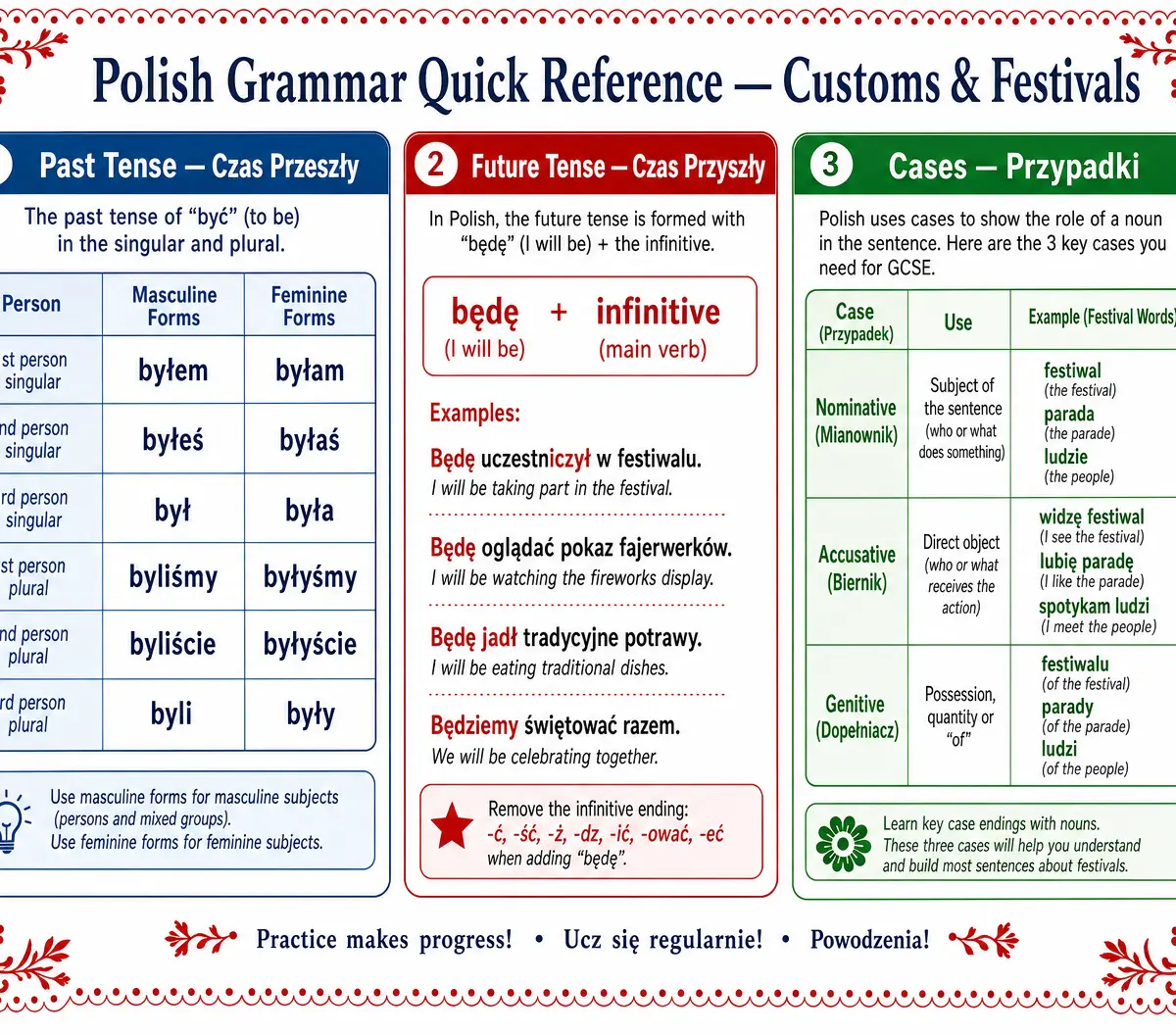
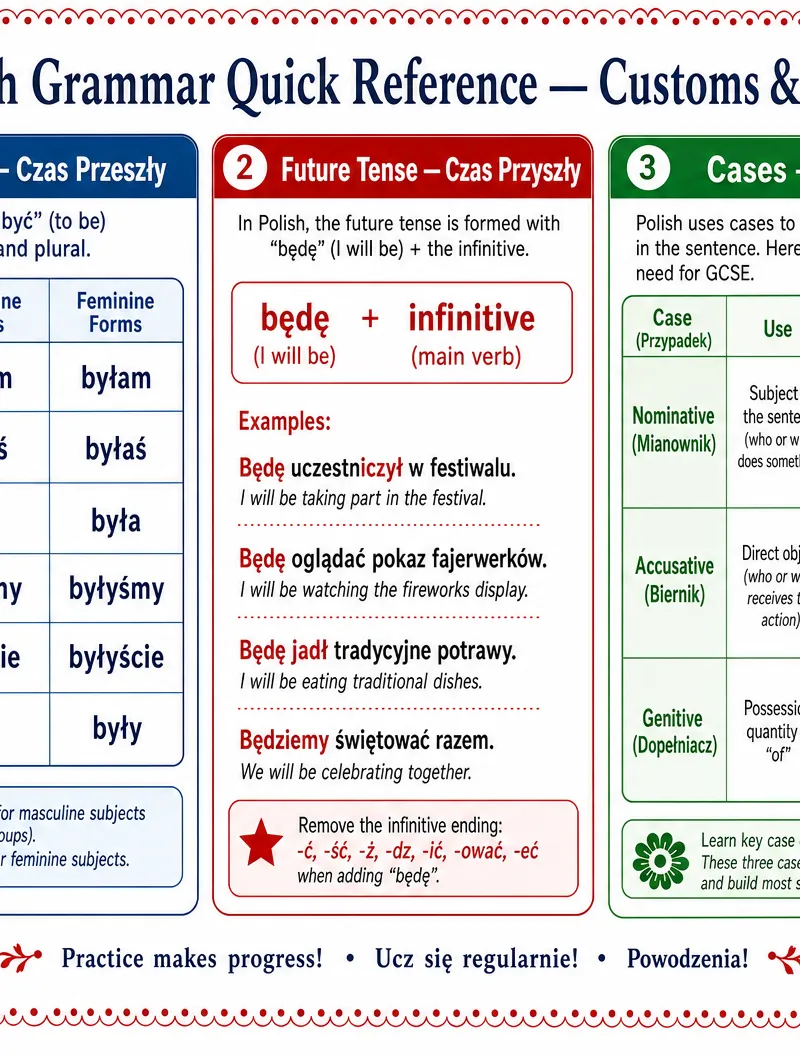
    📝 Grammar Focus

    Grammar Quick Reference

    Key Structure 1: The Past Tense (Czas Przeszły)

    When to use it: To describe how you celebrated a festival in the past (e.g., last Christmas, last Easter). Examiners look for accurate gender agreement.

    Conjugation Table: "być" (to be) and "świętować" (to celebrate)

    SubjectVerb Form (Masculine)Verb Form (Feminine)English
    ja (I)byłem / świętowałembyłam / świętowałamI was / I celebrated
    ty (you sg)byłeś / świętowałeśbyłaś / świętowałaśyou were / you celebrated
    on/ona/ono (he/she/it)był / świętowałbyła / świętowałahe/she/it was / celebrated
    my (we)byliśmy / świętowaliśmybyłyśmy / świętowałyśmywe were / we celebrated
    wy (you pl)byliście / świętowaliściebyłyście / świętowałyścieyou were / you celebrated
    oni/one (they)byli / świętowalibyły / świętowałythey were / they celebrated

    Irregulars to learn: jeść (to eat) -> jadłem/jadłam (I ate), iść (to go) -> poszedłem/poszłam (I went).

    Key Structure 2: The Future Tense (Czas Przyszły)

    When to use it: To describe your plans for an upcoming festival. The easiest way is to use "będę" + the infinitive.

    Conjugation Table: "będę" + infinitive

    SubjectVerb FormEnglish
    ja (I)będę świętowaćI will celebrate
    ty (you sg)będziesz świętowaćyou will celebrate
    on/ona/ono (he/she/it)będzie świętowaćhe/she/it will celebrate
    my (we)będziemy świętowaćwe will celebrate
    wy (you pl)będziecie świętowaćyou will celebrate
    oni/one (they)będą świętowaćthey will celebrate

    Key Structure 3: The Instrumental Case (Narzędnik)

    When to use it: When talking about who you celebrate with (using "z" - with) or what you are interested in.

    Noun GenderPrepositionEndingExampleEnglish
    Masculinez-emz bratemwith brother
    Femininezz rodzinąwith family
    Pluralz-amiz rodzicamiwith parents

    🎧 Listening Skills

    GCSE Polish Revision Podcast: Customs & Festivals

    What to Expect

    Listening tasks on this topic often feature short dialogues where people describe what they did for a festival, what they ate, or what they liked/disliked about it. You may hear regional variations or references to specific Polish traditions.

    Listening Strategies

    • Listen for time indicators: Words like "wczoraj" (yesterday), "zawsze" (always), or "jutro" (tomorrow) dictate the tense.
    • Watch for negatives: "Nie lubię" (I don't like) completely flips the meaning of a sentence.
    • Note the specific festival: Is it Boże Narodzenie (Christmas) or Wielkanoc (Easter)? They have very different associated vocabulary.

    Common Listening Traps

    • False Friends: "Aktualnie" means currently, not actually. "Sympatyczny" means nice, not sympathetic.
    • Similar sounding words: "Prezent" (present) vs. "Prezydent" (president).

    🗣️ Speaking Skills

    Role Play Scenarios

    Scenario: You are talking to your Polish friend about a recent festival.

    • Friend: Jak spędziłeś/spędziłaś Święta?
    • You: Spędziłem/Spędziłam Święta z rodziną. Było bardzo miło.
    • Friend: Co jedliście?
    • You: Jedliśmy tradycyjne potrawy, na przykład pierogi i barszcz.

    Photo Card Practice

    Model Photo Card Response (A photo showing a family at a Christmas Eve table):

    • Qu 1 (Description): Na zdjęciu widzę rodzinę przy stole. Jedzą kolację. W tle jest choinka.
    • Qu 2 (Opinion): Myślę, że są bardzo szczęśliwi, ponieważ się uśmiechają.
    • Qu 3 (Related topic): Tradycje są ważne, ponieważ łączą rodzinę.
    • Qu 4 (Past): W zeszłym roku spędziłem Wigilię u babci.
    • Qu 5 (Future): W przyszłym roku będziemy świętować w górach.

    General Conversation Questions

    Question (Polish)Model AnswerEnglish Translation
    Jakie jest twoje ulubione święto?Moim ulubionym świętem jest Boże Narodzenie, ponieważ dostaję prezenty.My favourite festival is Christmas because I get presents.
    Jak obchodziłeś/obchodziłaś swoje ostatnie urodziny?W zeszłym roku zorganizowałem/zorganizowałam imprezę dla przyjaciół. Było super!Last year I organised a party for friends. It was great!
    Czy uważasz, że tradycje są ważne?Tak, uważam, że tradycje są bardzo ważne, gdyż uczą nas o naszej historii.Yes, I think traditions are very important because they teach us about our history.
    Co będziesz robić w Sylwestra?W przyszłym roku będę oglądać fajerwerki z moją rodziną.Next year I will watch fireworks with my family.
    Co zazwyczaj jesz w Wigilię?Zazwyczaj jem karpia i pierogi z kapustą i grzybami.I usually eat carp and dumplings with cabbage and mushrooms.

    ✍️ Writing Skills

    Translation Practice

    English → Polish:

    EnglishPolishKey Grammar
    I like Christmas.Lubię Boże Narodzenie.Present tense, direct object
    Last year I ate a lot.W zeszłym roku jadłem/jadłam dużo.Past tense, gender agreement
    We will go to church.Pójdziemy do kościoła.Future tense
    Traditions are important because...Tradycje są ważne, ponieważ...Plural adjective agreement, conjunction
    I spent Easter with my family.Spędziłem/Spędziłam Wielkanoc z moją rodziną.Instrumental case (z + -ą)

    Extended Writing

    **Model 90-word response (Foundation):**Moim ulubionym świętem jest Boże Narodzenie. Zazwyczaj spędzam ten czas z moją rodziną w domu. Jemy tradycyjne jedzenie, na przykład pierogi. Bardzo lubię to święto, ponieważ dostaję dużo prezentów i jest wesoło. W zeszłym roku pojechaliśmy do babci. Było bardzo miło. W przyszłym roku będziemy świętować w górach. Będę jeździć na nartach. Uważam, że święta są super.

    **Model 150-word response (Higher):**Moim zdaniem, najważniejszym świętem w Polsce jest Boże Narodzenie, a szczególnie Wigilia. Zazwyczaj spędzam ten magiczny czas z całą moją rodziną. Na stole zawsze jest dwanaście tradycyjnych potraw, a moją ulubioną jest barszcz z uszkami. Uważam, że polskie tradycje są niezwykle ważne, ponieważ łączą pokolenia i przypominają nam o naszej historii.

    W zeszłym roku zorganizowaliśmy wspaniałą uroczystość u moich dziadków na wsi. Śpiewaliśmy kolędy i dzieliliśmy się opłatkiem. Atmosfera była niesamowita, chociaż było bardzo zimno.

    W przyszłym roku planujemy pojechać do Krakowa na jarmark świąteczny. Będziemy kupować rękodzieło i pić gorącą czekoladę. Nie mogę się doczekać, gdyż uwielbiam to miasto zimą. Podsumowując, święta to dla mnie najlepszy czas w roku.

    Writing Checklist

    • ✅ Three tenses used (Present, Past, Future)?
    • ✅ Opinions given?
    • ✅ Opinions justified with 'ponieważ' or 'gdyż'?
    • ✅ Connectives used (i, ale, dlatego)?
    • ✅ Adjective agreements correct (e.g., tradycyjne potrawy)?
    • ✅ Correct past tense endings for your gender?

    📚 Reading Skills

    Key Strategies

    • Skim for gist: Read the text quickly first to understand the general topic (e.g., is it about a wedding or Easter?).
    • Look for cognates: Words that look similar in English (e.g., tradycja, festiwal).
    • Context clues: Use the surrounding words to guess the meaning of unknown vocabulary.

    False Friends & Tricky Words

    WordLooks LikeActually Means
    aktualnieactuallycurrently
    ewentualnieeventuallypossibly/alternatively
    ordynarnyordinaryvulgar/rude
    sympatycznysympatheticnice/friendly

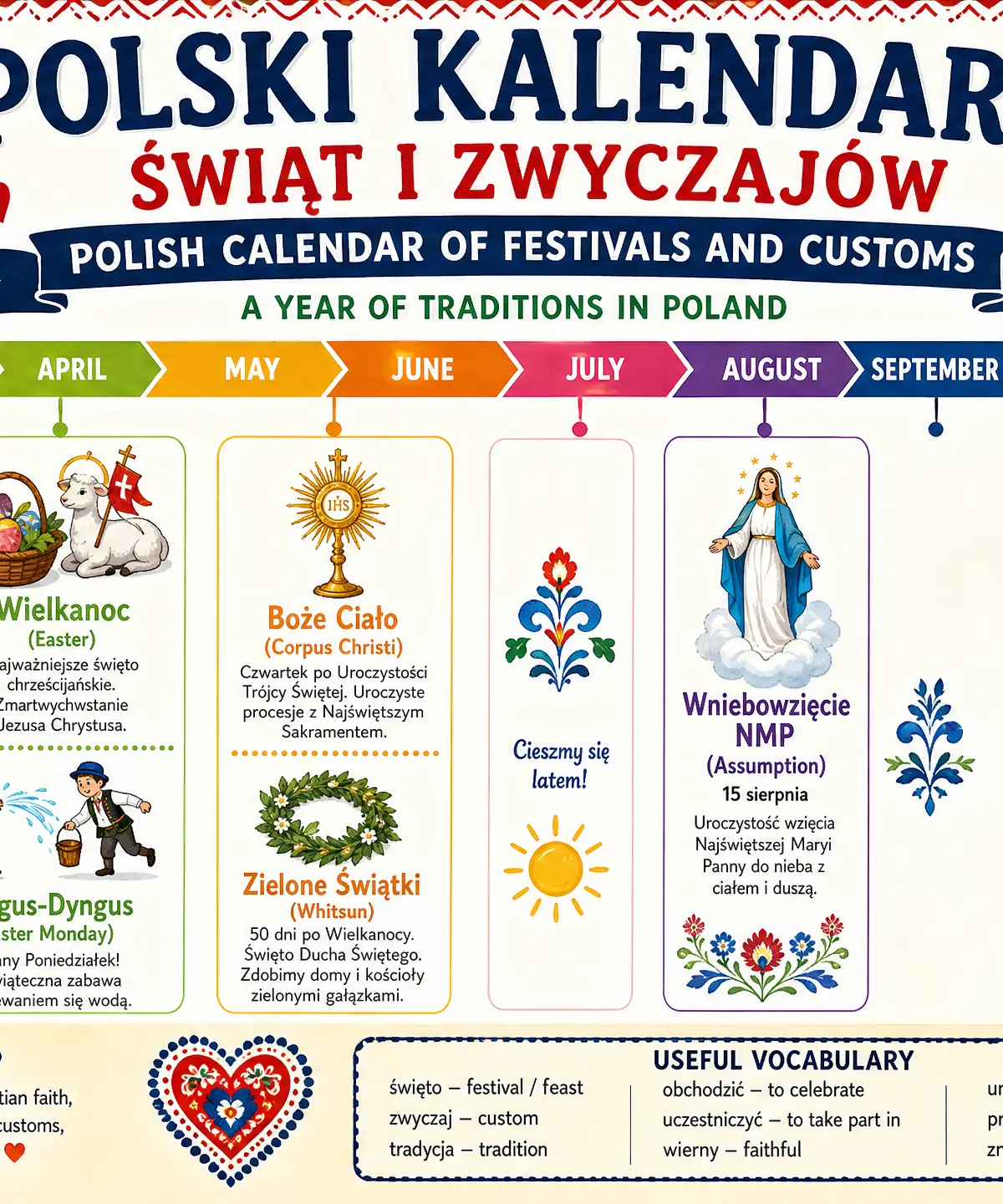
    🌍 Cultural Knowledge

    Polish Festivals Timeline

    Understanding Polish culture is crucial for top marks.

    • Wigilia (Christmas Eve): The most important celebration. 12 meatless dishes, sharing the 'opłatek' (wafer), leaving an empty place at the table for an unexpected guest.
    • Wielkanoc (Easter): Śmigus-Dyngus (Wet Monday) involves splashing people with water. Families take baskets of food (koszyczek) to church to be blessed on Holy Saturday.
    • Wszystkich Świętych (All Saints' Day): 1st November. A solemn day where millions of Poles visit cemeteries to light candles (znicze) on graves.
    • Tłusty Czwartek (Fat Thursday): The last Thursday before Lent, where everyone eats 'pączki' (doughnuts).
    Visual Resources

    2 diagrams and illustrations

    Grammar Quick Reference
    Grammar Quick Reference
    Polish Festivals Timeline
    Polish Festivals Timeline

    Interactive Diagrams

    1 interactive diagram to visualise key concepts

    Writing Task Strategy for Festivals

    Worked Examples

    4 detailed examples with solutions and examiner commentary

    Practice Questions

    Test your understanding — click to reveal model answers

    Q1

    Translate into Polish: Last year I celebrated Easter with my family.

    2 marks
    standard

    Hint: Remember the instrumental case for 'with my family' and the correct past tense ending for your gender.

    Q2

    Speaking (Conversation): Dlaczego tradycje są ważne? (Why are traditions important?)

    3 marks
    challenging

    Hint: Start with 'Uważam, że...' and use 'ponieważ' to give a detailed reason.

    Q3

    Writing (Foundation): Napisz o swoim ulubionym święcie. (Write about your favourite festival - approx 90 words).

    16 marks
    foundation

    Hint: Cover what it is, what you do, what you eat, and why you like it.

    Q4

    Reading: Co Kasia myśli o Wigilii? (What does Kasia think about Christmas Eve?) Text: 'Uwielbiam Wigilię, chociaż przygotowania są bardzo stresujące.'

    2 marks
    standard

    Hint: Look for the contrasting conjunction 'chociaż' (although).

    Q5

    Translate into English: W przyszłym roku będę uczestniczyć w procesji na Boże Ciało.

    2 marks
    standard

    Hint: Identify the tense from 'W przyszłym roku' and 'będę'.

    Q6

    Listening: Kiedy są urodziny Marka? (When is Marek's birthday?) Audio: 'Moje urodziny są w lecie, dokładnie piętnastego lipca.'

    1 marks
    foundation

    Hint: Listen for the month and the number.

    Explore this topic further

    View Topic PageAll Polish Topics

    Key Terms

    Essential vocabulary to know