AQA · GCSE · Polish
Course version: AQA-GCSE-Polish · Version from Mar 2026
School
This comprehensive GCSE Polish study guide on the topic of School (Szkoła) equips students with essential vocabulary for subjects and facilities, crucial grammar structures like the reflexive verb 'uczyć się', and strategies for expressing justified opinions across all four skills. It provides targeted exam technique advice to help candidates secure top marks.
- 14 min read
- 4 worked examples
- 6 practice questions
- 8 key terms
Check what you remember
Read the wording for your board, then hide it and explain Reflexive Verb (Czasownik zwrotny) in your own words. Rough notes are fine. This is a self-check, with no mark or grade.
Reference: AQA
A verb whose action reflects back on the subject, always accompanied by the pronoun 'się'. Example: 'uczyć się' (to study/teach oneself).
Study Notes

Overview
This study guide covers one of the most fundamental topics in the GCSE Polish specification: Szkoła (School). You will encounter this theme across all four assessment areas: Listening, Speaking, Reading, and Writing. Mastering this topic is essential because it allows examiners to assess your ability to describe routines, express opinions, and discuss future plans using multiple tenses.
Whether you are aiming for a strong Foundation pass or top Higher tier grades, the ability to accurately use vocabulary related to school subjects, facilities, and daily life, combined with accurate grammar (such as adjective agreements and the reflexive verb uczyć się), will significantly boost your marks.
🎧 Audio Lesson
Listen to our comprehensive 10-minute podcast episode covering the essential vocabulary, grammar, and exam tips for the School topic:
📖 Essential Vocabulary
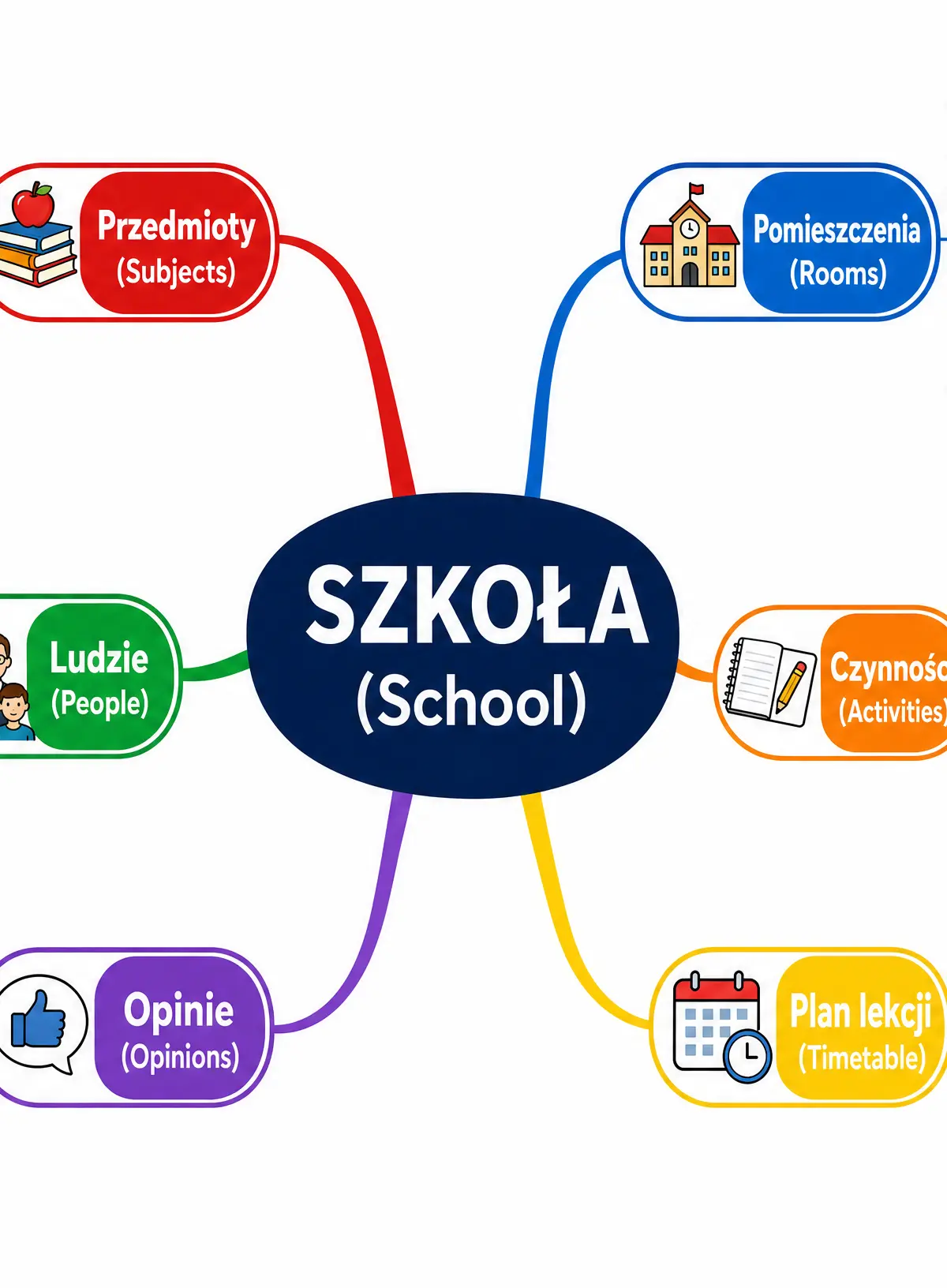
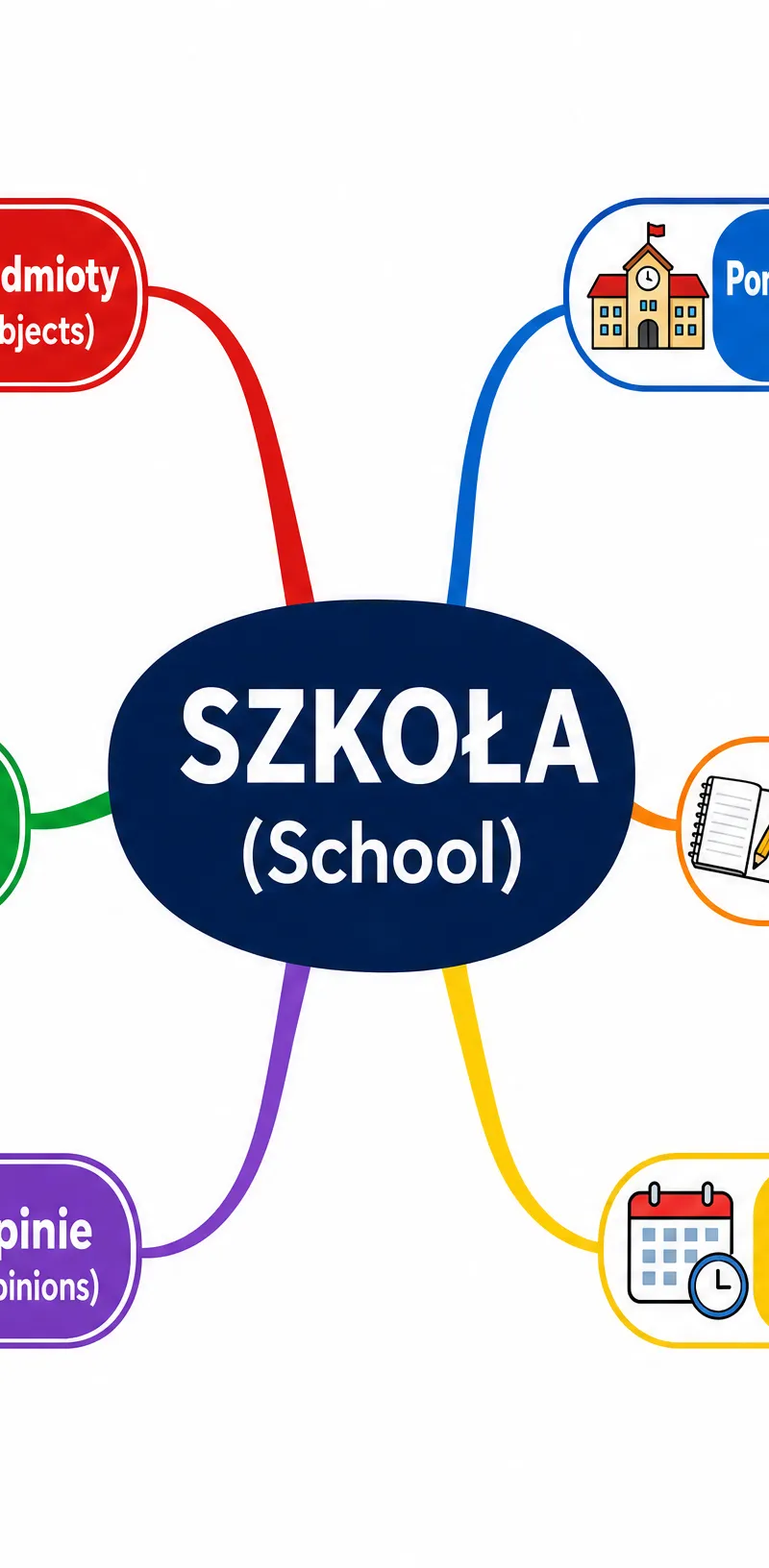
Tier 1 — Foundation Core
| Polish | English | Gender | Example Sentence |
|---|---|---|---|
| szkoła | school | f | Moja szkoła jest duża i nowoczesna. |
| lekcja | lesson | f | Pierwsza lekcja zaczyna się o ósmej. |
| przedmiot | subject | m | Jaki jest twój ulubiony przedmiot? |
| nauczyciel | teacher (male) | m | Nasz nauczyciel matematyki jest surowy. |
| nauczycielka | teacher (female) | f | Moja nauczycielka historii jest bardzo miła. |
| uczeń | pupil / student (boy) | m | On jest dobrym uczniem. |
| uczennica | pupil / student (girl) | f | Ona jest nową uczennicą w naszej klasie. |
| klasa | classroom / class | f | Nasza klasa jest na pierwszym piętrze. |
| przerwa | break | f | Przerwa obiadowa trwa dwadzieścia minut. |
| matematyka | mathematics | f | Matematyka jest trudna, ale ważna. |
| język angielski | English language | m | Lubię uczyć się języka angielskiego. |
| biblioteka | library | f | Często czytam książki w bibliotece. |
| boisko | playground / pitch | n | Chłopcy grają w piłkę na boisku. |
| zadanie domowe | homework | n | Codziennie mam dużo zadań domowych. |
| egzamin | exam | m | W maju mam ważny egzamin. |
Tier 2 — Higher Tier
| Polish | English | Gender | Example Sentence |
|---|---|---|---|
| wychowanie fizyczne (WF) | physical education | n | Wychowanie fizyczne to mój ulubiony przedmiot. |
| sala gimnastyczna | sports hall / gym | f | Mamy nową salę gimnastyczną w szkole. |
| stołówka | canteen / dining hall | f | Jem obiad w szkolnej stołówce. |
| korytarz | corridor | m | Na korytarzu jest zawsze głośno podczas przerwy. |
| świadectwo | school certificate / report | n | Na koniec roku dostajemy świadectwa. |
| ocena | mark / grade | f | Dostałem dobrą ocenę z biologii. |
| sprawdzian | test | m | Jutro mamy trudny sprawdzian z chemii. |
| zajęcia pozalekcyjne | extracurricular activities | pl | Biorę udział w zajęciach pozalekcyjnych. |
| wycieczka szkolna | school trip | f | W przyszłym miesiącu jedziemy na wycieczkę szkolną. |
| wymagający | demanding | adj | Mój nauczyciel fizyki jest bardzo wymagający. |
High-Frequency Words & Phrases
| Phrase | English | Usage Context |
|---|---|---|
| Moim zdaniem... | In my opinion... | Introducing your viewpoint in speaking/writing. |
| Uważam, że... | I think that... | Giving an opinion with justification. |
| Interesuję się... | I am interested in... | Discussing hobbies or favourite subjects (takes instrumental case). |
| Z jednej strony... z drugiej strony... | On one hand... on the other hand... | Showing balanced arguments (Higher tier). |
| Ponieważ | Because | Essential for justifying opinions to secure higher marks. |
| W przyszłości | In the future | Introducing future plans or ambitions. |
| Niestety | Unfortunately | Adding nuance or expressing a negative opinion politely. |
| Na przykład | For example | Providing evidence for your points. |
| Zazwyczaj | Usually | Describing regular school routines. |
| Moim ulubionym przedmiotem jest... | My favourite subject is... | Standard phrase for discussing preferences. |
📝 Grammar Focus
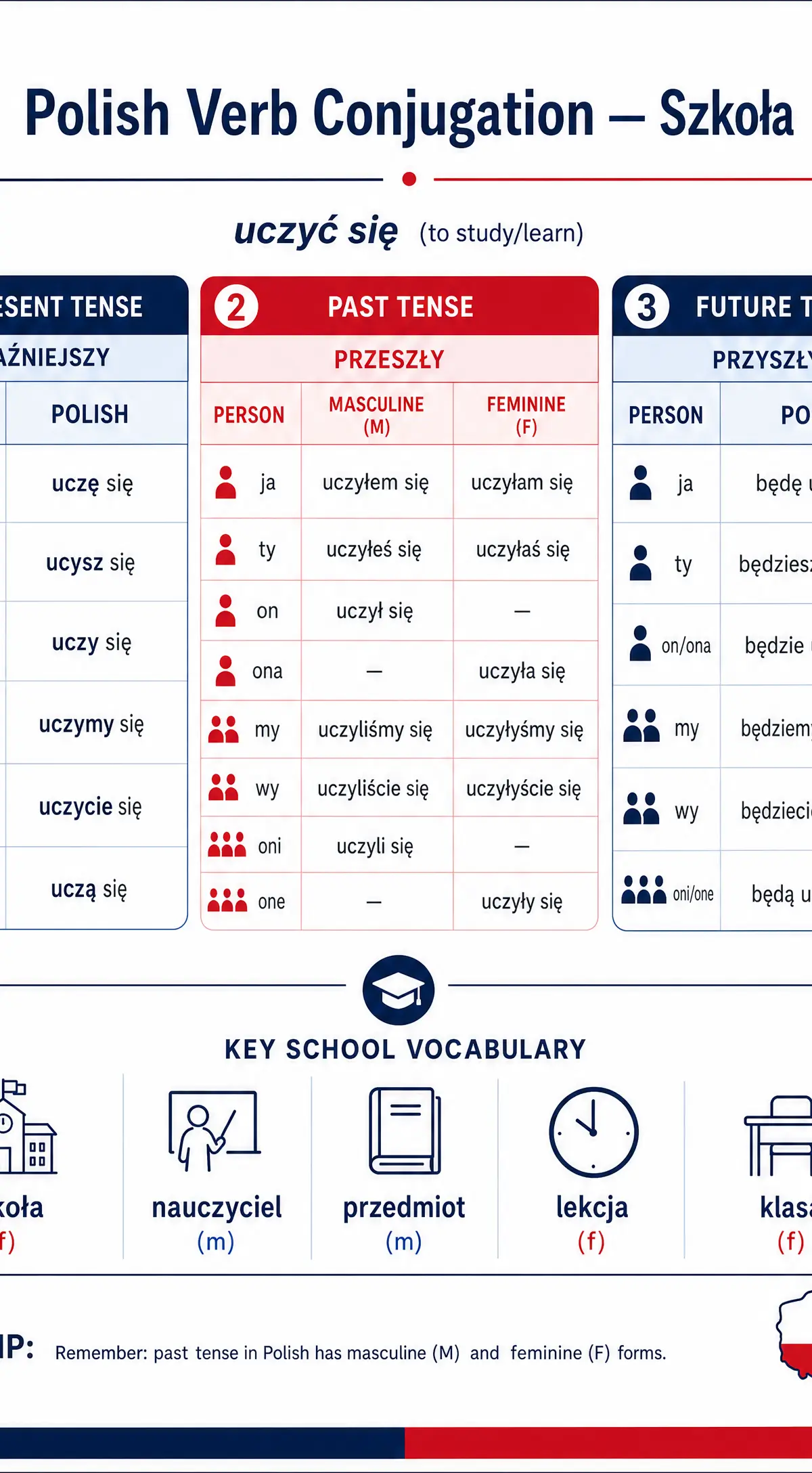
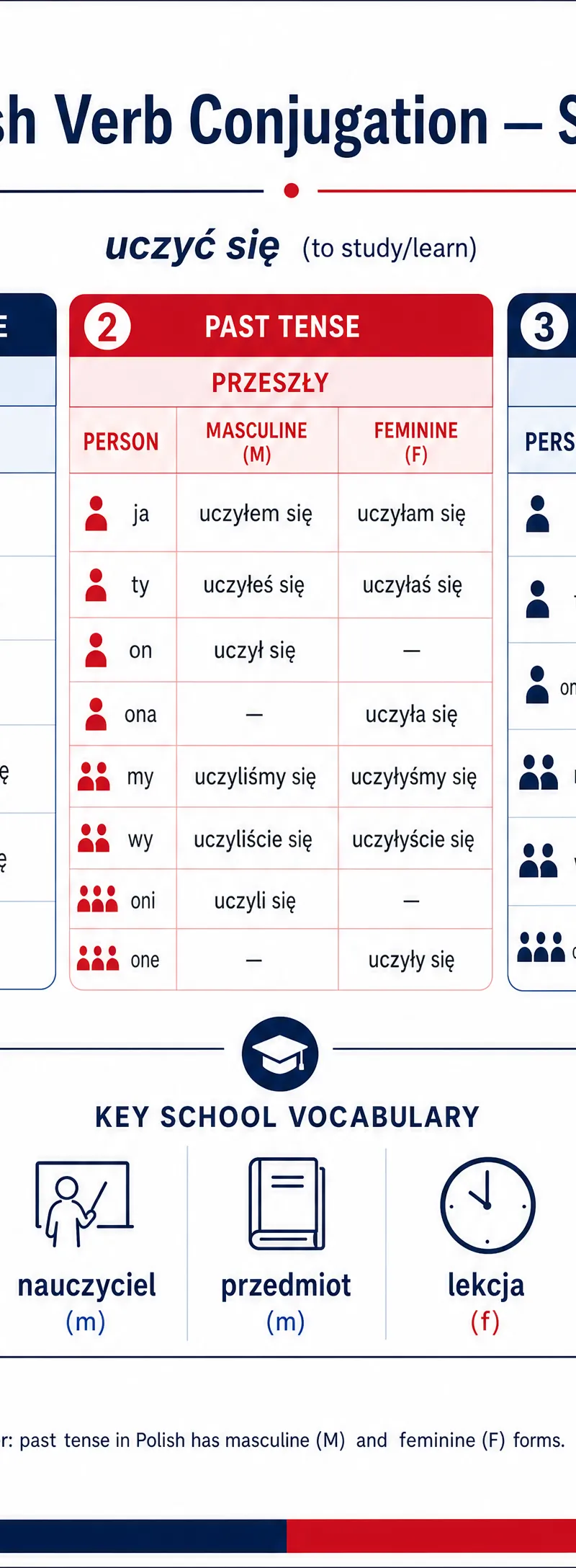
Key Structure 1: The Reflexive Verb uczyć się (to study / learn)
When to use it: This is the most crucial verb for the school topic. It is reflexive, meaning it must always be accompanied by the pronoun się. You will use this to describe your current studies, past learning, and future educational plans.
Conjugation Table
| Subject | Present Tense | Past Tense (Masculine / Feminine) | Future Tense |
|---|---|---|---|
| ja (I) | uczę się | uczyłem się / uczyłam się | będę uczyć się (będę się uczył/uczyła) |
| ty (you sg.) | uczysz się | uczyłeś się / uczyłaś się | będziesz uczyć się |
| on/ona/ono (he/she/it) | uczy się | uczył się / uczyła się / uczyło się | będzie uczyć się |
| my (we) | uczymy się | uczyliśmy się / uczyłyśmy się | będziemy uczyć się |
| wy (you pl.) | uczycie się | uczyliście się / uczyłyście się | będziecie uczyć się |
| oni/one (they) | uczą się | uczyli się / uczyły się | będą uczyć się |
Irregulars to learn: While uczyć się follows a regular pattern for -yć verbs, remember that the past tense in Polish is marked for gender. This is a common area where candidates lose marks in the writing paper.
Key Structure 2: Expressing Opinions with lubić + Accusative / Genitive
When to use it: You must express and justify opinions to access higher mark bands. The verb lubić (to like) requires the noun that follows it to change its ending.
The Rule:
- Positive (lubić): Takes the Accusative case.
- Feminine nouns ending in -a change to -ę (e.g., matematyka ➔ matematykę).
- Masculine inanimate and neuter nouns usually stay the same.
- Negative (nie lubić): Takes the Genitive case.
- Feminine nouns ending in -a change to -y or -i (e.g., matematyka ➔ matematyki).
Examples:
- Positive: Lubię historię. (I like history.)
- Negative: Nie lubię historii. (I don't like history.)
- Positive: Lubię język angielski. (I like English.)
- Negative: Nie lubię języka angielskiego. (I don't like English.)
Key Structure 3: Adjective Agreement
When to use it: Whenever you describe a school, a subject, or a teacher. Adjectives in Polish must agree with the noun they describe in gender, number, and case.
The Rule (Nominative Case):
- Masculine nouns take adjectives ending in -y or -i (e.g., trudny przedmiot - difficult subject).
- Feminine nouns take adjectives ending in -a (e.g., nudna lekcja - boring lesson).
- Neuter nouns take adjectives ending in -e (e.g., duże boisko - big playground).
🎧 Listening Skills
What to Expect
Listening tasks on this topic often feature students discussing their timetables, complaining about homework, describing their teachers, or talking about their plans after leaving school. You may hear announcements about school trips or changes to the daily routine.
Listening Strategies
- Listen for cognates and near-cognates: Words like matematyka, biologia, fizyka, and geografia are easy to spot and can anchor your understanding of the passage.
- Watch for negatives and opinion qualifiers: Pay close attention to words like nie (not), nigdy (never), wcale nie (not at all), and niezbyt (not very). A speaker might mention a subject but then state they do not like it.
- Note times and days: Timetable questions are common. Listen out for days of the week (poniedziałek, wtorek) and times (o ósmej, o wpół do dziesiątej).
Common Listening Traps
- False Friends: Klasa usually means 'classroom' or 'year group', not 'social class'. Liceum refers to a Polish secondary school (similar to sixth form), not a British 'lyceum'.
- Changing opinions: A speaker might say they used to like a subject, but now find it difficult. Listen for time markers like kiedyś (in the past) versus teraz (now).
🗣️ Speaking Skills
Role Play Scenarios
Scenario 1: Discussing school with a Polish exchange student.
- Examiner: Jakie przedmioty lubisz najbardziej? (What subjects do you like the most?)
- Candidate: Najbardziej lubię matematykę i informatykę, ponieważ są interesujące i bardzo pożyteczne. Nie lubię historii, bo jest nudna. (I like maths and IT the most because they are interesting and very useful. I don't like history because it is boring.)
Photo Card Practice
Model Photo Card Response (A photo of students in a classroom):
- Qu 1 (Description): Na zdjęciu widzę klasę. Są tam uczniowie i nauczycielka. Uczniowie siedzą w ławkach i piszą. Nauczycielka stoi przy tablicy. (In the photo I see a classroom. There are students and a teacher. The students are sitting at desks and writing. The teacher is standing by the board.)
- Qu 2 (Opinion): Moim zdaniem oni mają lekcję matematyki, ponieważ na tablicy są liczby. Myślę, że lekcja jest ciekawa. (In my opinion they are having a maths lesson because there are numbers on the board. I think the lesson is interesting.)
- Qu 3 (Related topic): Mój ulubiony przedmiot to biologia, bo lubię uczyć się o przyrodzie. (My favourite subject is biology because I like learning about nature.)
- Qu 4 (Past): Wczoraj w szkole miałem trudny sprawdzian z chemii. (Yesterday at school I had a difficult chemistry test.)
- Qu 5 (Future): W przyszłym roku będę uczyć się w nowej szkole. (Next year I will study in a new school.)
General Conversation Questions
| Question (Polish) | Model Answer | English Translation |
|---|---|---|
| Opisz swoją szkołę. | Moja szkoła jest duża i nowoczesna. Mamy świetną salę gimnastyczną i dużą bibliotekę, ale stołówka jest za mała. | Describe your school. / My school is big and modern. We have a great sports hall and a large library, but the canteen is too small. |
| Jaki jest twój ulubiony przedmiot i dlaczego? | Moim ulubionym przedmiotem jest język angielski, ponieważ lubię czytać książki i nauczyciel jest bardzo miły. | What is your favourite subject and why? / My favourite subject is English because I like reading books and the teacher is very nice. |
| Czego nie lubisz w swojej szkole? | Nie lubię wstawać wcześnie rano. Lekcje zaczynają się o ósmej i jestem zawsze zmęczony. Nie lubię też nosić mundurka. | What don't you like about your school? / I don't like getting up early in the morning. Lessons start at eight and I am always tired. I also don't like wearing a uniform. |
| Co robiłeś wczoraj podczas przerwy? | Wczoraj podczas przerwy jadłem kanapkę i rozmawiałem z kolegami na korytarzu. Potem poszliśmy na boisko. | What did you do yesterday during the break? / Yesterday during the break I ate a sandwich and talked with my friends in the corridor. Then we went to the playground. |
| Co zamierzasz robić po skończeniu szkoły? | Po skończeniu szkoły zamierzam iść na uniwersytet, żeby studiować medycynę, ponieważ chcę zostać lekarzem. | What do you intend to do after finishing school? / After finishing school I intend to go to university to study medicine because I want to become a doctor. |
✍️ Writing Skills
Translation Practice
English → Polish:
| English | Polish | Key Grammar |
|---|---|---|
| I like my school. | Lubię moją szkołę. | lubić + Accusative case (szkołę) |
| History is boring but important. | Historia jest nudna, ale ważna. | Adjective agreement (feminine -a) |
| Yesterday I had a difficult exam. | Wczoraj miałem/miałam trudny egzamin. | Past tense gender agreement |
| We don't like chemistry because the teacher is strict. | Nie lubimy chemii, ponieważ nauczyciel jest surowy. | nie lubić + Genitive case (chemii) |
| Next year I will study mathematics at university. | W przyszłym roku będę studiować matematykę na uniwersytecie. | Future tense (będę + infinitive) |
Extended Writing
**Model 90-word response (Foundation):**Moja szkoła jest duża i bardzo nowoczesna. Znajduje się blisko mojego domu. Mamy świetną bibliotekę i duże boisko. Mój ulubiony przedmiot to język angielski, ponieważ jest interesujący i łatwy. Nasz nauczyciel jest bardzo miły. Nie lubię matematyki, bo jest bardzo trudna i nudna. Wczoraj w szkole miałem trudny sprawdzian z biologii. Byłem bardzo zestresowany. Podczas przerwy jadłem obiad w stołówce i rozmawiałem z kolegami. W przyszłości chcę iść na uniwersytet, żeby studiować informatykę.
(Covers description, opinions with reasons, past tense, and future plans).
**Model 150-word response (Higher):**Uczęszczam do dużej szkoły średniej, która znajduje się w centrum miasta. Ogólnie rzecz biorąc, lubię moją szkołę, ponieważ atmosfera jest przyjazna, a budynek jest nowoczesny. Mamy świetnie wyposażoną salę gimnastyczną i nową pracownię komputerową. Z drugiej strony, nasza stołówka jest zdecydowanie za mała dla wszystkich uczniów.
Jeśli chodzi o przedmioty, moim ulubionym jest historia. Uważam, że jest fascynująca i pozwala nam zrozumieć dzisiejszy świat. Mój nauczyciel historii jest bardzo inspirujący. Niestety, nienawidzę fizyki. Moim zdaniem jest zbyt skomplikowana, a nauczyciel zadaje za dużo pracy domowej.
W zeszłym tygodniu pojechaliśmy na wycieczkę szkolną do muzeum w Warszawie. Było wspaniale i dowiedziałem się wielu ciekawych rzeczy. Pogoda była piękna, więc zjedliśmy obiad w parku.
W przyszłym roku zamierzam zdać dobrze wszystkie egzaminy. Po skończeniu szkoły planuję pójść na uniwersytet, aby studiować prawo, ponieważ moim marzeniem jest zostać prawnikiem i pomagać ludziom.
(Demonstrates complex vocabulary, multiple justified opinions, accurate past and future tenses, and sophisticated connectives).
Writing Checklist
- ✅ Three tenses used: Have you included present, past, and future references?
- ✅ Opinions with reasons: Have you used ponieważ or bo to justify your views?
- ✅ Connectives: Are you linking sentences with i (and), ale (but), więc (so), dlatego (therefore)?
- ✅ Adjective agreements: Do your adjectives match the nouns in gender and case?
- ✅ Gender in past tense: If writing about yourself, did you use the correct masculine (-łem) or feminine (-łam) ending?
📚 Reading Skills
Key Strategies
- Skim for gist: Read the whole text quickly first to understand the general tone. Is the student happy or unhappy with their school?
- Read the questions carefully: Look at the question words (Kto - Who, Gdzie - Where, Kiedy - When, Dlaczego - Why) to know exactly what information you need to extract.
- Look for synonyms: The text might say nie jest interesująca (is not interesting), but the correct multiple-choice answer might use the word nudna (boring).
False Friends & Tricky Words
| Word | Looks Like | Actually Means |
|---|---|---|
| klasa | social class | classroom / year group |
| lektura | lecture | set book / required reading |
| liceum | lyceum | secondary school / sixth form |
| gimnazjum | gymnasium | (historical) lower secondary school |
| ewentualnie | eventually | possibly / alternatively |
🌍 Cultural Knowledge
Understanding the Polish education system adds depth to your writing and speaking responses. In Poland, children start primary school (szkoła podstawowa) at age 7 and attend for 8 years. After that, they take an exam to enter secondary education.
The most academic route is the liceum ogólnokształcące (often just called liceum), which lasts 4 years and ends with the matura exams (similar to A-Levels). The matura is crucial for university entrance. Alternatively, students can attend a technikum (technical school, 5 years) or a szkoła branżowa (vocational school).
Polish schools use a grading system from 1 to 6, where 1 (niedostateczny) is a fail, and 6 (celujący) is excellent. So, if a Polish student says they got a "five" (piątka), they are very happy!
Visual Resources
2 diagrams and illustrations
Interactive Diagrams
1 interactive diagram to visualise key concepts
Conceptual Flow Outline
MFL exam approach by skill
Worked Examples
4 worked examples — open one to explore the question and available guidance.
Practice Questions
Try the question, then reveal an answer plan or example response
Writing: Przetłumacz na język polski. (Translate into Polish): 1. My school is modern. 2. I like history because it is interesting. 3. Yesterday I had a maths exam. 4. In the future, I will study at university.
Hint: Check your adjective agreements in sentence 1 and 2. Remember the gendered past tense in sentence 3.
Speaking: Odpowiedz na pytanie. (Answer the question): Co sądzisz o mundurkach szkolnych? (What do you think about school uniforms?)
Hint: Give an opinion, justify it, and perhaps offer a balanced view (Z jednej strony... z drugiej strony...).
Reading: Przeczytaj tekst i odpowiedz na pytania po angielsku. (Read the text and answer in English). Tekst: 'W mojej szkole lekcje zaczynają się o 8:00. Najbardziej lubię chemię, ale nienawidzę geografii, bo nauczyciel jest bardzo surowy.' Pytanie: What time do lessons start, and why does the author hate geography?
Hint: Scan for the number and the word 'geografia'.
Listening: Posłuchaj nagrania i zaznacz poprawne odpowiedzi. (Listen and tick the correct answers). Transcript: 'Wczoraj nie byłem w szkole, bo byłem chory. Dzisiaj muszę odrobić dużo pracy domowej z matematyki.' Question: Why was the boy not at school yesterday? A) He was on a trip B) He was ill C) He was tired.
Hint: Listen for the word 'chory'.
Writing (Foundation): Napisz e-mail do kolegi z Polski o swojej szkole (około 90 słów). Napisz o: 1) opisie swojej szkoły, 2) twoich ulubionych przedmiotach, 3) co robiłeś w szkole wczoraj, 4) co będziesz robić po szkole dzisiaj.
Hint: Cover all 4 bullet points. Use present, past, and future tenses.
Speaking (Photo Card): Look at the photo of a school canteen. Answer the examiner's question: Co robią uczniowie na zdjęciu? (What are the students doing in the photo?)
Hint: Describe the physical actions you can see using the present tense.
Exam technique
How to turn what you know into marks
How to approach the question
Skill-by-skill strategy: Listening — read questions first, note keywords and distractors. Speaking — prepare opinions in advance, have fillers ready (np. 'to znaczy'). Reading — skim first, then scan for detail. Writing — plan tenses before writing, check adjective agreements after.
How to structure your answer
Writing: Introduction (description) → Main points with opinions → Justified reasons ('ponieważ') → Past tense event → Future plans. Speaking: Give opinion → Justify → Extend → Use a different tense.
Timing
Listening: 25-35 mins (heard twice). Speaking: 7-12 mins total (role play + photo card + conversation). Reading: 45-60 mins. Writing: 60-75 mins (translation + structured + extended).
Common pitfalls
- Forgetting adjective agreements (matching gender and case with the noun)
- Using only the present tense — examiners want at least 3 tenses at Higher
- Giving one-word Speaking answers instead of developing responses with reasons
- Using the wrong gender ending in the past tense (e.g., a girl saying 'czytałem' instead of 'czytałam')
- Confusing false friends in Listening/Reading (like 'klasa' and 'liceum')
- Not justifying opinions with 'ponieważ' or 'bo'
What the command words want
- Describe the photo
- Say what you can see physically, give an opinion on what is happening, and relate it to your own experience.
- Translate into Polish
- Write full sentences with correct grammar — partial marks are awarded for partially correct grammar, so attempt every word.
- Translate into English
- Focus on meaning over word-for-word literal translation — capture the sense of the Polish sentence.
- Write approximately 90 words
- Foundation task — ensure you cover all 4 bullet points, use the present tense + at least one other tense.
- Write approximately 150 words
- Higher task — must include 3 tenses, justified opinions, complex structures, and ambitious vocabulary to reach top bands.
Watch or listen (optional)
Test your understanding of School
Active recall beats re-reading. Take an instant quiz now to test what you’ve learned and lock it into long-term memory.
7 days Premium · Then the free plan continues · No card, no charge