Approaches in Psychology Revision Notes

    Subject: Psychology | Level: A-Level | Exam Board: AQA

    The 'Approaches in Psychology' topic is the bedrock of AQA A-Level Psychology, exploring the different lenses through which psychologists explain human behaviour. Mastering these diverse perspectives, from the observable actions of Behaviourism to the unconscious drives of the Psychodynamic approach, is essential for building the analytical and comparative skills needed to excel in the exam.

    Revision Notes & Key Concepts

    ![Header image for AQA A-Level Psychology: Approaches in Psychology](https://xnnrgnazirrqvdgfhvou.supabase.co/storage/v1/object/public/study-guide-assets/guide_cb6a9226-bd32-4670-ac0b-6083f8cc2d7f/header_image.png) ## Overview This topic traces the evolution of psychology from its philosophical roots to a modern science. Candidates are expected to understand, apply, and critically evaluate seven key approaches: the Origins of Psychology (Wundt), the Behaviourist Approach, Social Learning Theory, the Cognitive Approach, the Biological Approach, the Psychodynamic Approach, and the Humanistic Approach. A core skill is the ability to compare and contrast these approaches, particularly in relation to the major issues and debates such as determinism vs. free will, reductionism vs. holism, and the nature-nurture debate. Examiners look for precise use of terminology and the ability to apply theoretical concepts to novel scenarios (AO2), as well as providing well-developed evaluation points (AO3). ![Overview of the seven psychological approaches](https://xnnrgnazirrqvdgfhvou.supabase.co/storage/v1/object/public/study-guide-assets/guide_cb6a9226-bd32-4670-ac0b-6083f8cc2d7f/approaches_overview_diagram.png) ## Key Approaches & Developments ### The Behaviourist Approach **What happened**: Pioneered by figures like Watson and Skinner, this approach rejected the subjective nature of introspection and argued that psychology should be the scientific study of observable behaviour. It proposes that all behaviour is learned from the environment. **Why it matters**: It introduced scientific rigour and objective measurement to psychology. Key concepts like Classical Conditioning (learning by association) and Operant Conditioning (learning through consequences) provide powerful explanations for behaviour formation and are the basis for many therapies (e.g., token economies). **Specific Knowledge**: Pavlov (Classical Conditioning), Skinner (Operant Conditioning), Positive Reinforcement, Negative Reinforcement, Punishment. ### Social Learning Theory (SLT) **What happened**: Albert Bandura proposed SLT as a bridge between Behaviourism and the Cognitive approach. He argued that learning also occurs indirectly, through observation and imitation of others within a social context. **Why it matters**: SLT introduced the importance of cognitive 'mediational processes' (Attention, Retention, Reproduction, Motivation) that lie between stimulus and response. This acknowledged the role of thought in learning. The concept of 'vicarious reinforcement' is crucial. **Specific Knowledge**: Bandura's Bobo Doll Study (1961), Vicarious Reinforcement, Identification, Modelling, Mediational Processes (ARRM). ![Comparison of Behaviourism and Social Learning Theory](https://xnnrgnazirrqvdgfhvou.supabase.co/storage/v1/object/public/study-guide-assets/guide_cb6a9226-bd32-4670-ac0b-6083f8cc2d7f/behaviourist_slt_comparison.png) ### The Cognitive Approach **What happened**: With the advent of computers in the 1950s and 60s, psychologists began to use the 'computer analogy' to explain human mental processes. This approach focuses on the scientific study of internal mental processes such as perception, memory, and thinking. **Why it matters**: It re-established the scientific study of the mind. The use of theoretical and computer models to explain and test cognitive processes has been highly influential. The concept of 'schema' is a key contribution, explaining how our expectations shape our interpretation of the world. **Specific Knowledge**: Schema, Theoretical Models (e.g., Multi-Store Model of Memory), Computer Models, Cognitive Neuroscience. ### The Biological Approach **What happened**: This approach views humans as biological organisms and seeks to explain behaviour through genetics, neurochemistry, and the structure of the nervous system. It assumes that all thoughts, feelings, and behaviours have a physical basis. **Why it matters**: It has led to significant real-world applications, particularly in the development of psychoactive drugs to treat mental illnesses like depression and schizophrenia. It also provides a strong scientific basis for understanding behaviour, using methods like brain scanning (fMRI) and twin studies. **Specific Knowledge**: Genotype vs. Phenotype, Twin Studies, Evolution, Neurotransmitters (e.g., Serotonin, Dopamine), Nervous System. ### The Psychodynamic Approach **What happened**: Sigmund Freud developed this approach, emphasising the role of the unconscious mind in shaping behaviour. He proposed that our personality is composed of three parts (Id, Ego, Superego) and that we progress through psychosexual stages in childhood. **Why it matters**: Freud's work represented a monumental shift, highlighting the importance of early childhood experiences and unconscious conflicts. It formed the basis of psychoanalysis, the first 'talking cure', and its concepts have had a lasting impact on Western culture. **Specific Knowledge**: The Unconscious, Tripartite Personality (Id, Ego, Superego), Psychosexual Stages (Oral, Anal, Phallic, Latency, Genital), Defence Mechanisms (e.g., Repression, Denial). ### The Humanistic Approach **What happened**: Emerging in the 1950s, humanistic psychology was a reaction against the deterministic and negative views of the other approaches. Carl Rogers and Abraham Maslow championed a holistic view that emphasised free will and the innate human drive for 'self-actualisation'. **Why it matters**: It offered a more positive and optimistic alternative, focusing on personal growth and fulfilment. Rogers' client-centred therapy has been hugely influential, and the approach's focus on subjective experience has brought the 'person' back into psychology. **Specific Knowledge**: Free Will, Self-Actualisation, Maslow's Hierarchy of Needs, Congruence, Conditions of Worth, Client-Centred Therapy. ## Podcast Episode Listen to our 10-minute podcast episode for a full breakdown of the approaches, exam tips, and a quick-fire quiz. ![Approaches in Psychology Revision Podcast](https://xnnrgnazirrqvdgfhvou.supabase.co/storage/v1/object/public/study-guide-assets/guide_cb6a9226-bd32-4670-ac0b-6083f8cc2d7f/approaches_in_psychology_podcast.wav)

    Revision Podcast Transcript

    # AQA A-Level Psychology: Approaches in Psychology - Podcast Script **(Intro Music Fades In and Out)** **Host:** Hello and welcome to the AQA A-Level Psychology revision podcast. I’m your host, and today we’re tackling one of the absolute cornerstone topics of your entire A-Level: the Approaches in Psychology. Getting a firm grip on these different perspectives isn’t just crucial for one exam question; it’s the lens through which you’ll view almost every other topic, from psychopathology to relationships. We’ll break down the seven key approaches, give you some high-yield exam tips, and finish with a quick-fire quiz to make sure it’s all sinking in. Let’s get started. **(Short musical sting)** **Host:** So, where did it all begin? With Wilhelm Wundt, in Germany, 1879. He opened the very first psychology lab, moving the study of the mind from philosophical roots to a more structured, scientific footing. His method was **Introspection**, or ‘looking into’. He’d get trained participants to reflect on their own cognitive processes when presented with a stimulus, like a metronome. While it was criticised for being too subjective, Wundt’s work paved the way for more rigorous methods. For the exam, you don’t need to evaluate him in depth, but you must know his role as the starting point of psychology as a science. Next, came the **Behaviourists**, who rejected introspection entirely. They argued that if you can’t see it or measure it, it’s not science. So, they focused only on observable behaviour. Pavlov gave us **Classical Conditioning** – learning by association. Remember his dogs, who learned to associate the sound of a bell with food and would salivate at the bell alone. Then Skinner gave us **Operant Conditioning** – learning through consequences. A rat in a Skinner box learns that pressing a lever results in a food pellet – that’s positive reinforcement. Or it learns that pressing the lever stops an electric shock – that’s negative reinforcement. It’s all about how our environment shapes us. But what about the bit between the stimulus and the response? Albert Bandura’s **Social Learning Theory** provided the bridge. He agreed we learn from our environment, but he argued we also learn indirectly, by observing others. His famous Bobo Doll study showed that children who watched an adult behave aggressively towards a doll were more likely to imitate that aggression. This introduced key concepts like **modelling**, **imitation**, and **vicarious reinforcement** – that’s when you learn by seeing someone *else* being rewarded or punished. Crucially, SLT introduced **mediational processes** – Attention, Retention, Reproduction, Motivation – the cognitive steps that occur between observation and behaviour. This was a huge step, because it re-introduced the mind into the equation. And that leads us perfectly to the **Cognitive Approach**. This approach sees the human mind as being like a computer. It’s all about our internal mental processes: perception, memory, language. Cognitive psychologists use theoretical models, like the multi-store model of memory, and computer models to understand these processes. A key concept here is the **schema** – a mental framework of beliefs and expectations that develop from experience. Schemas help us process information quickly, but they can also lead to stereotypes and distortions. Now for a big shift in perspective: the **Biological Approach**. This one is all about the body. It states that everything psychological is at first biological. It looks at the influence of our **genes**, the structure and function of our **nervous system**, and the role of **neurochemistry**. For example, low levels of the neurotransmitter serotonin are linked to depression. This approach also considers the role of evolution, suggesting behaviours that were adaptive for our ancestors, like attachment, are passed down through our genes. Remember to be precise with your terms here: the **genotype** is your genetic code, while the **phenotype** is how those genes are expressed through interaction with the environment. Next, we dive deep into the mind with Freud’s **Psychodynamic Approach**. This is the one you’ve probably heard of! Freud’s big idea was the **unconscious mind**, a vast storehouse of biological drives and repressed memories that influences our behaviour. He proposed the tripartite personality: the **Id**, which operates on the pleasure principle; the **Ego**, the reality principle which mediates between the two; and the **Superego**, our internalised sense of right and wrong. He also proposed five psychosexual stages of development, and said that getting fixated at a stage could cause problems in adulthood. It’s a controversial but hugely influential approach. Finally, we have the **Humanistic Approach**, which emerged as a reaction against the negativity of Freud and the mechanistic views of behaviourism. Humanists like Carl Rogers and Abraham Maslow emphasised **free will** – the idea that we are active agents in our own development. They believed everyone has an innate drive to achieve their full potential, a state called **self-actualisation**. For Rogers, achieving this required **congruence** between your self-concept and your ideal self. He argued that many of our issues stem from the **conditions of worth** placed on us in childhood, leading to incongruence. It’s a uniquely positive and person-centred perspective. **(Short musical sting)** **Host:** Okay, let’s talk exam technique. For a 16-mark ‘Discuss’ or ‘Outline and Evaluate’ question on the approaches, you need a clear structure. Aim for 6 marks of AO1 – that’s your accurate description of the approach. Then, you need 10 marks of AO3 – your evaluation. Don’t just list strengths and weaknesses. Develop your points. For example, don’t just say ‘the biological approach is reductionist’. Explain *why* it’s reductionist – because it reduces complex human behaviour to the level of genes and neurons – and then discuss whether that’s a strength or a limitation. A common mistake is confusing **negative reinforcement** with **punishment**. Remember: negative reinforcement *removes* something unpleasant to *increase* a behaviour. Punishment *adds* something unpleasant to *decrease* a behaviour. Another pitfall is just describing a study. The examiner doesn’t want a full page on the Bobo Doll procedure; they want you to explain the *theory* of Social Learning, using the study as evidence. When you’re comparing approaches, use comparative language. Words like ‘whereas’, ‘in contrast’, and ‘similarly’ force you to make a direct link and show the examiner you are thinking synoptically. For example: “Whereas the Behaviourist approach sees the individual as a passive machine, the Humanistic approach champions the idea of free will and personal agency.” That’s a high-level comparison. **(Short musical sting)** **Host:** Right, are you ready for a quick-fire quiz? Let’s see what you can remember. Cover your notes! One: What term describes learning by observing someone else being rewarded for their behaviour? **(Pause)** That’s vicarious reinforcement. Two: Which approach proposes the existence of the Id, Ego, and Superego? **(Pause)** The Psychodynamic approach. Three: The concept of schema is central to which approach? **(Pause)** The Cognitive approach. Four: Who argued that to achieve self-actualisation, an individual’s self-concept and their ideal self must be in a state of congruence? **(Pause)** Carl Rogers. Five: What is the key difference between the Behaviourist approach and Social Learning Theory? **(Pause)** Social Learning Theory includes mediational (cognitive) processes, while behaviourism rejects the study of internal mental processes. **(Short musical sting)** **Host:** And that’s a wrap! We’ve journeyed from Wundt’s lab in Leipzig, through behaviourism, the cognitive revolution, and the diverse perspectives of the biological, psychodynamic, and humanistic approaches. The key to success is not just knowing them in isolation, but being able to compare and contrast them using the core issues and debates like determinism vs. free will, and reductionism vs. holism. Think about where each approach sits on these spectrums. Thanks for listening. Go back through your notes, create some flashcards, and practice applying these theories to novel scenarios. You’ve got this. **(Outro Music Fades In)**

    Key Terms & Definitions

    Vicarious Reinforcement
    Learning that occurs by observing the consequences of another person's behaviour. If a model is seen to be rewarded for a behaviour, the observer is more likely to imitate it.
    Congruence
    A state in which a person's 'ideal self' and 'actual self' are consistent or very similar.
    Schema
    A mental framework of beliefs and expectations that influence cognitive processing. They are developed from experience.
    Reductionism
    The scientific strategy of reducing complex systems to simpler components to understand them. In psychology, this can be explaining behaviour at a lower level (e.g., biological or environmental).
    Determinism
    The view that an individual's behaviour is shaped or controlled by internal or external forces rather than an individual's will to do something.
    Negative Reinforcement
    The removal of an unpleasant stimulus to increase the likelihood of a behaviour being repeated.

    Worked Examples

    Practice Questions

    Approaches in Psychology

    AQA
    A-Level
    Psychology

    The 'Approaches in Psychology' topic is the bedrock of AQA A-Level Psychology, exploring the different lenses through which psychologists explain human behaviour. Mastering these diverse perspectives, from the observable actions of Behaviourism to the unconscious drives of the Psychodynamic approach, is essential for building the analytical and comparative skills needed to excel in the exam.

    6
    Min Read
    3
    Examples
    5
    Questions
    6
    Key Terms
    🎙 Podcast Episode
    Approaches in Psychology
    0:00-0:00

    Study Notes

    Header image for AQA A-Level Psychology: Approaches in Psychology

    Overview

    This topic traces the evolution of psychology from its philosophical roots to a modern science. Candidates are expected to understand, apply, and critically evaluate seven key approaches: the Origins of Psychology (Wundt), the Behaviourist Approach, Social Learning Theory, the Cognitive Approach, the Biological Approach, the Psychodynamic Approach, and the Humanistic Approach. A core skill is the ability to compare and contrast these approaches, particularly in relation to the major issues and debates such as determinism vs. free will, reductionism vs. holism, and the nature-nurture debate. Examiners look for precise use of terminology and the ability to apply theoretical concepts to novel scenarios (AO2), as well as providing well-developed evaluation points (AO3).
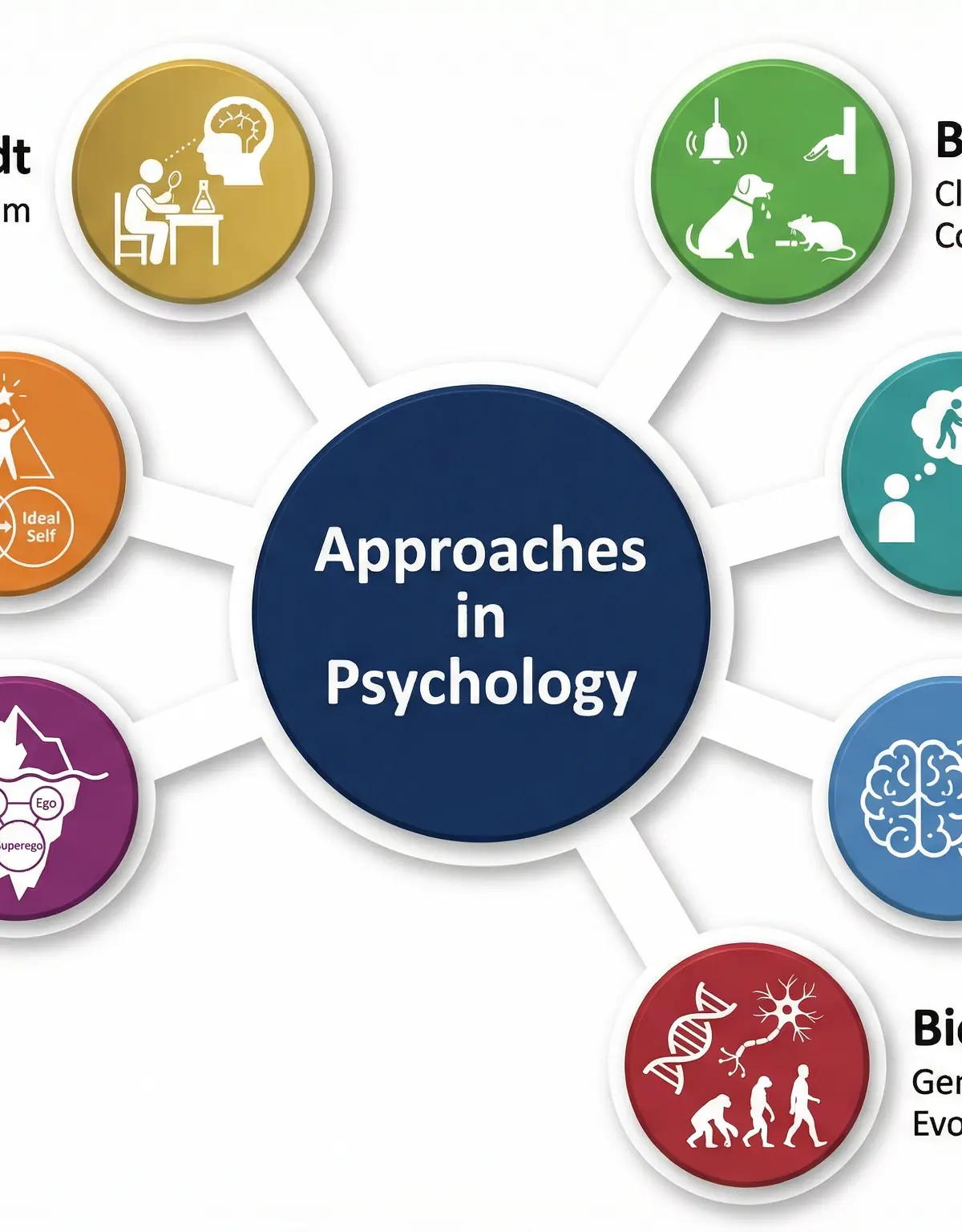
    Overview of the seven psychological approaches

    Key Approaches & Developments

    The Behaviourist Approach

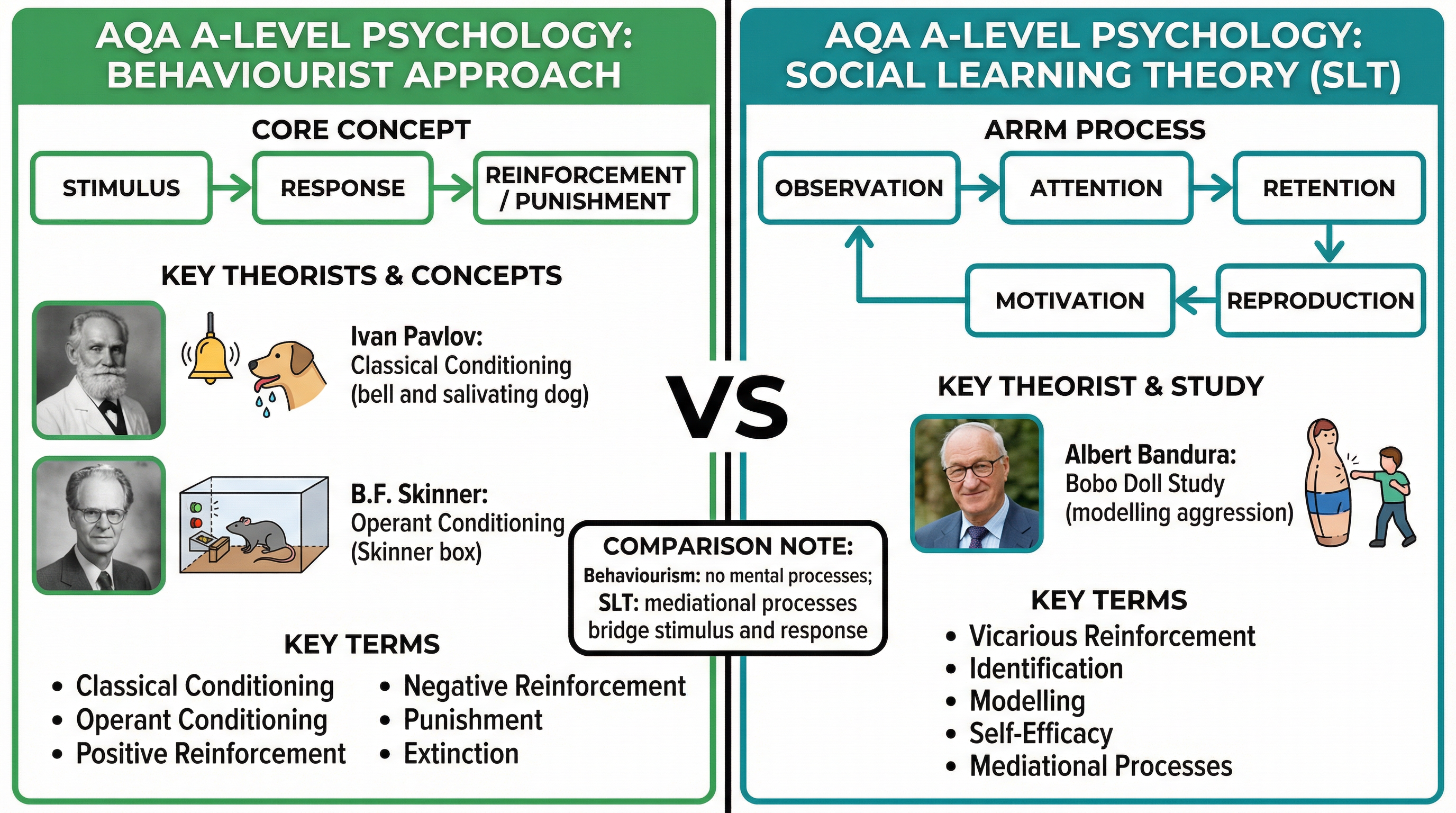
    What happened: Pioneered by figures like Watson and Skinner, this approach rejected the subjective nature of introspection and argued that psychology should be the scientific study of observable behaviour. It proposes that all behaviour is learned from the environment.

    Why it matters: It introduced scientific rigour and objective measurement to psychology. Key concepts like Classical Conditioning (learning by association) and Operant Conditioning (learning through consequences) provide powerful explanations for behaviour formation and are the basis for many therapies (e.g., token economies).

    Specific Knowledge: Pavlov (Classical Conditioning), Skinner (Operant Conditioning), Positive Reinforcement, Negative Reinforcement, Punishment.

    Social Learning Theory (SLT)

    What happened: Albert Bandura proposed SLT as a bridge between Behaviourism and the Cognitive approach. He argued that learning also occurs indirectly, through observation and imitation of others within a social context.

    Why it matters: SLT introduced the importance of cognitive 'mediational processes' (Attention, Retention, Reproduction, Motivation) that lie between stimulus and response. This acknowledged the role of thought in learning. The concept of 'vicarious reinforcement' is crucial.

    Specific Knowledge: Bandura's Bobo Doll Study (1961), Vicarious Reinforcement, Identification, Modelling, Mediational Processes (ARRM).

    Comparison of Behaviourism and Social Learning Theory

    The Cognitive Approach

    What happened: With the advent of computers in the 1950s and 60s, psychologists began to use the 'computer analogy' to explain human mental processes. This approach focuses on the scientific study of internal mental processes such as perception, memory, and thinking.

    Why it matters: It re-established the scientific study of the mind. The use of theoretical and computer models to explain and test cognitive processes has been highly influential. The concept of 'schema' is a key contribution, explaining how our expectations shape our interpretation of the world.

    Specific Knowledge: Schema, Theoretical Models (e.g., Multi-Store Model of Memory), Computer Models, Cognitive Neuroscience.

    The Biological Approach

    What happened: This approach views humans as biological organisms and seeks to explain behaviour through genetics, neurochemistry, and the structure of the nervous system. It assumes that all thoughts, feelings, and behaviours have a physical basis.

    Why it matters: It has led to significant real-world applications, particularly in the development of psychoactive drugs to treat mental illnesses like depression and schizophrenia. It also provides a strong scientific basis for understanding behaviour, using methods like brain scanning (fMRI) and twin studies.

    Specific Knowledge: Genotype vs. Phenotype, Twin Studies, Evolution, Neurotransmitters (e.g., Serotonin, Dopamine), Nervous System.

    The Psychodynamic Approach

    What happened: Sigmund Freud developed this approach, emphasising the role of the unconscious mind in shaping behaviour. He proposed that our personality is composed of three parts (Id, Ego, Superego) and that we progress through psychosexual stages in childhood.

    Why it matters: Freud's work represented a monumental shift, highlighting the importance of early childhood experiences and unconscious conflicts. It formed the basis of psychoanalysis, the first 'talking cure', and its concepts have had a lasting impact on Western culture.

    Specific Knowledge: The Unconscious, Tripartite Personality (Id, Ego, Superego), Psychosexual Stages (Oral, Anal, Phallic, Latency, Genital), Defence Mechanisms (e.g., Repression, Denial).

    The Humanistic Approach

    What happened: Emerging in the 1950s, humanistic psychology was a reaction against the deterministic and negative views of the other approaches. Carl Rogers and Abraham Maslow championed a holistic view that emphasised free will and the innate human drive for 'self-actualisation'.

    Why it matters: It offered a more positive and optimistic alternative, focusing on personal growth and fulfilment. Rogers' client-centred therapy has been hugely influential, and the approach's focus on subjective experience has brought the 'person' back into psychology.

    Specific Knowledge: Free Will, Self-Actualisation, Maslow's Hierarchy of Needs, Congruence, Conditions of Worth, Client-Centred Therapy.

    Podcast Episode

    Listen to our 10-minute podcast episode for a full breakdown of the approaches, exam tips, and a quick-fire quiz.

    Approaches in Psychology Revision Podcast

    Visual Resources

    2 diagrams and illustrations
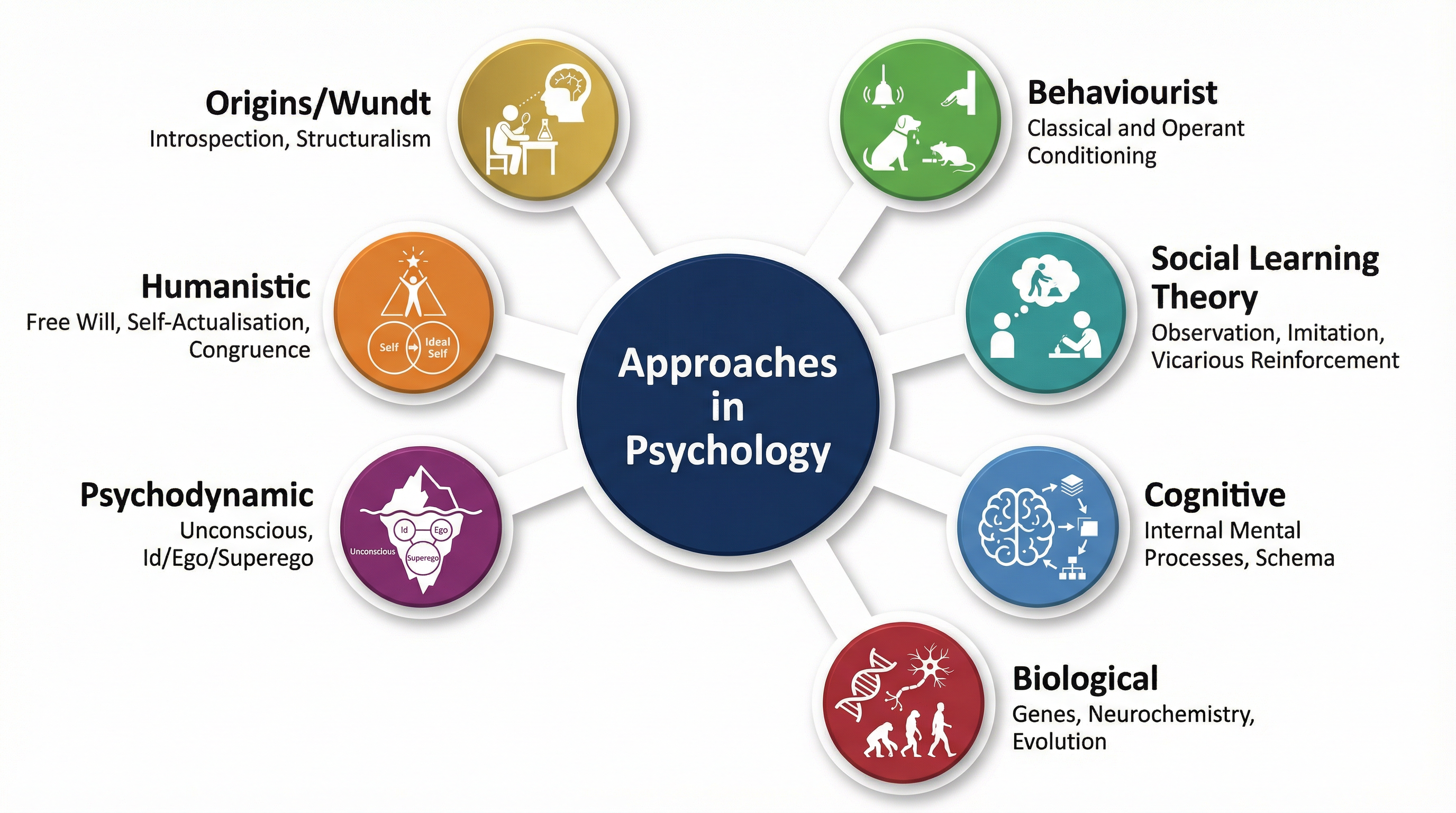
    Overview of the seven psychological approaches
    Overview of the seven psychological approaches
    Comparison of Behaviourism and Social Learning Theory
    Comparison of Behaviourism and Social Learning Theory

    Interactive Diagrams

    1 interactive diagram to visualise key concepts

    A timeline showing the rough emergence and prominence of the major psychological approaches.

    Worked Examples

    3 detailed examples with solutions and examiner commentary

    Practice Questions

    Test your understanding — click to reveal model answers

    Q1

    Outline the key features of the Biological Approach in psychology. (6 marks)

    6 marks
    standard

    Hint: Think about the three main assumptions: genetics, neurochemistry, and the nervous system. Mention genotype/phenotype.

    Q2

    Compare the Cognitive Approach with the Psychodynamic Approach. (8 marks)

    8 marks
    hard

    Hint: Focus on similarities and differences. Consider their views on determinism, scientific methods, and the importance of childhood.

    Q3

    Outline what is meant by 'congruence' in the context of the Humanistic Approach. (2 marks)

    2 marks
    easy

    Hint: Define the term and link it to the 'self-concept' and 'ideal self'.

    Q4

    Explain one limitation of Social Learning Theory. (3 marks)

    3 marks
    standard

    Hint: Consider the evidence it relies on, or the factors it might overlook.

    Q5

    Distinguish between classical conditioning and operant conditioning. (4 marks)

    4 marks
    standard

    Hint: Focus on the type of behaviour (voluntary vs. involuntary) and the nature of the learning (association vs. consequence).

    Explore this topic further

    View Topic PageAll Psychology Topics

    Key Terms

    Essential vocabulary to know