AQA · A-Level · Psychology
Course version: 7182 · Exams through 2026
Eating behaviour
This topic explores the fascinating interplay between our biology and our psychology in determining what, when, and how much we eat. Understanding these mechanisms is crucial for explaining everyday food preferences as well as complex eating disorders like anorexia nervosa and obesity, making it a high-yield topic for exams.
- 5 min read
- 3 worked examples
- 5 practice questions
- 6 key terms
Check what you remember
Read the wording for your board, then hide it and explain Neophobia in your own words. Rough notes are fine. This is a self-check, with no mark or grade.
Reference: AQA
An innate reluctance to consume novel or unfamiliar foods.
Study Notes
Overview
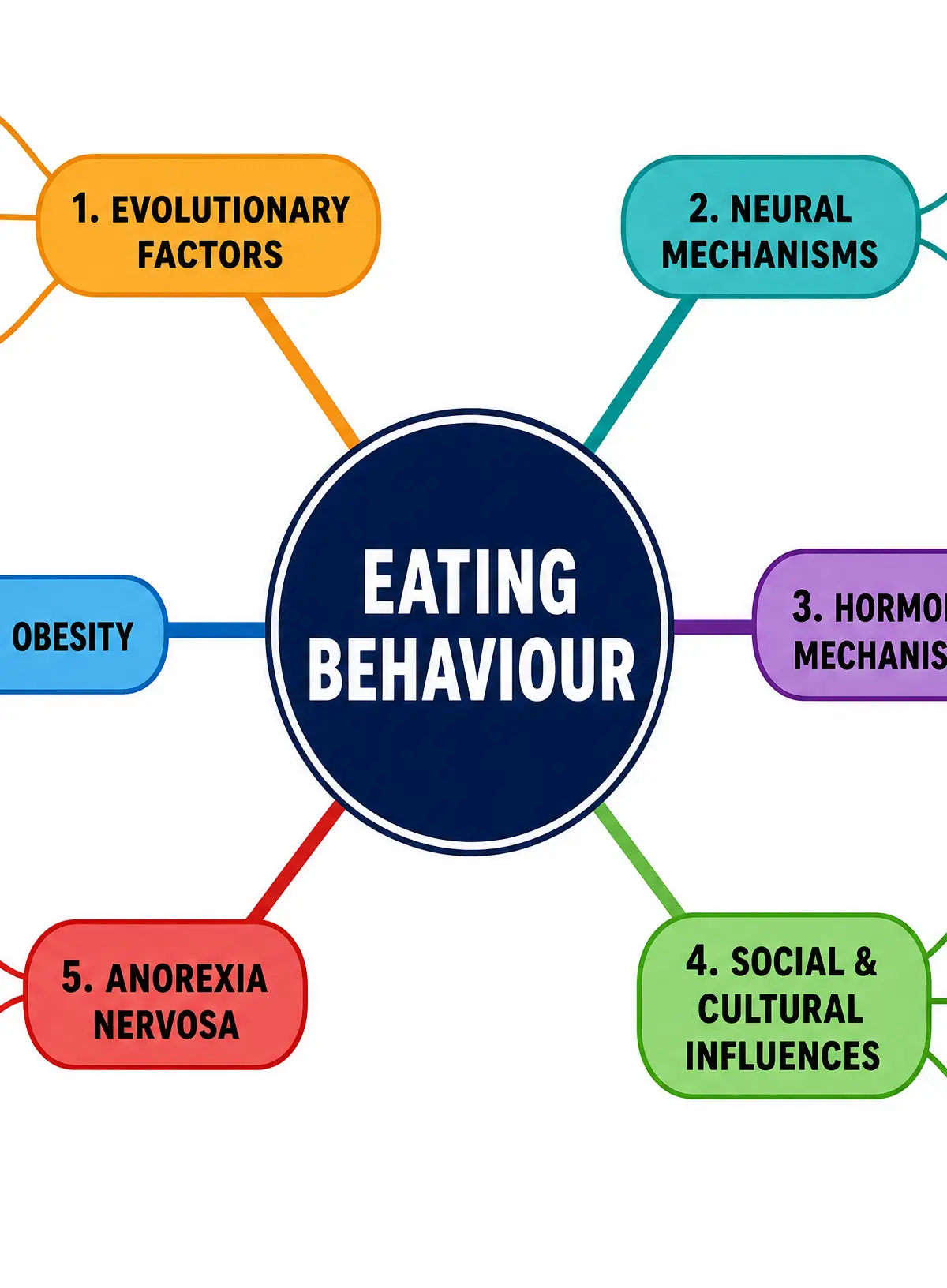
Eating behaviour is a central topic in psychology because it perfectly illustrates the debate between biological and psychological explanations of human behaviour. Historically, eating was viewed purely as a survival mechanism driven by physiological needs. However, modern psychology recognises that social, cultural, and cognitive factors play an equally significant role. For examiners, the key to success in this topic is your ability to clearly distinguish between these different types of explanations and to evaluate them using specific research evidence. You will need to understand evolutionary factors, neural and hormonal mechanisms, and apply these to explain conditions like anorexia nervosa and obesity.
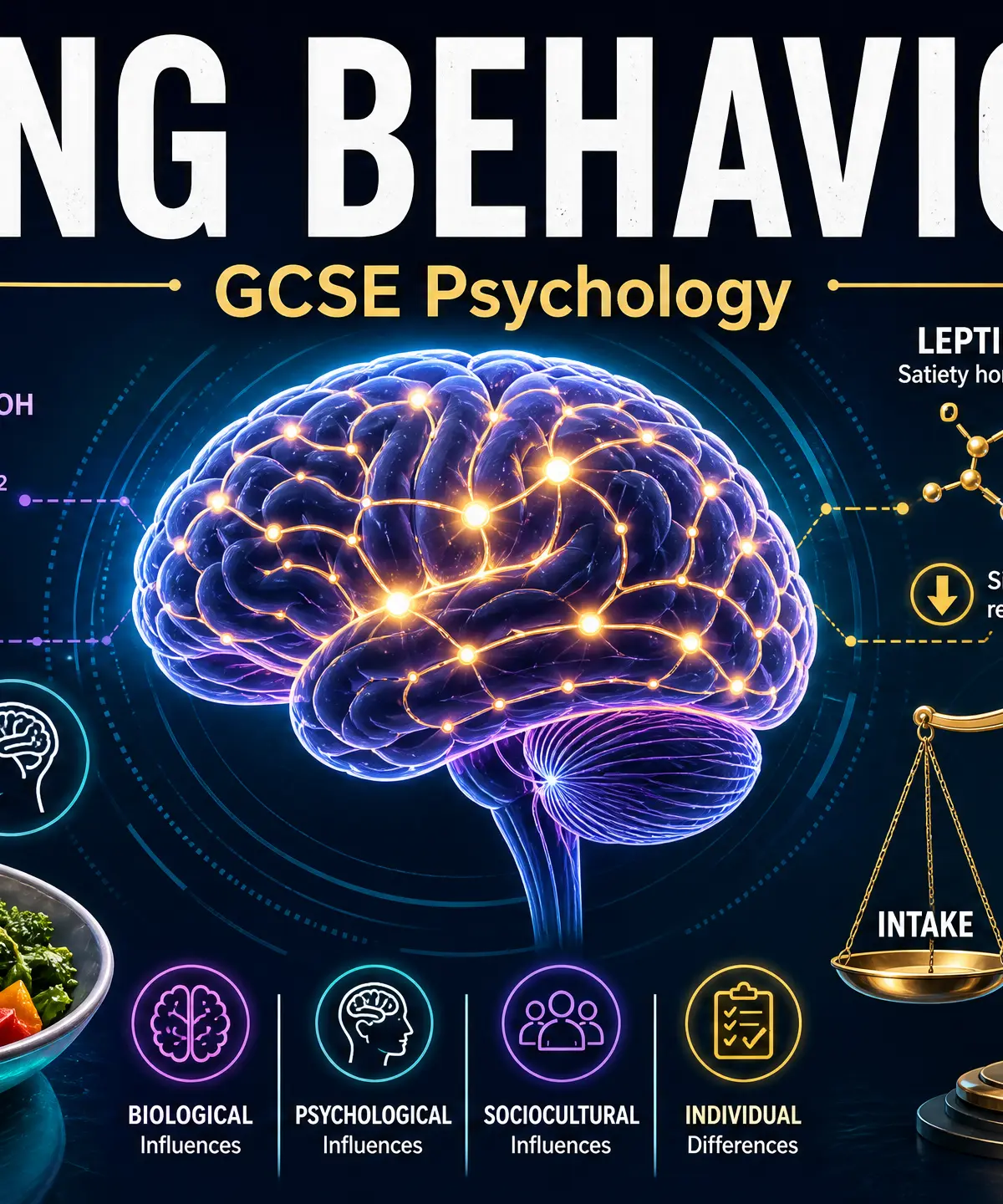
Neural and Hormonal Mechanisms
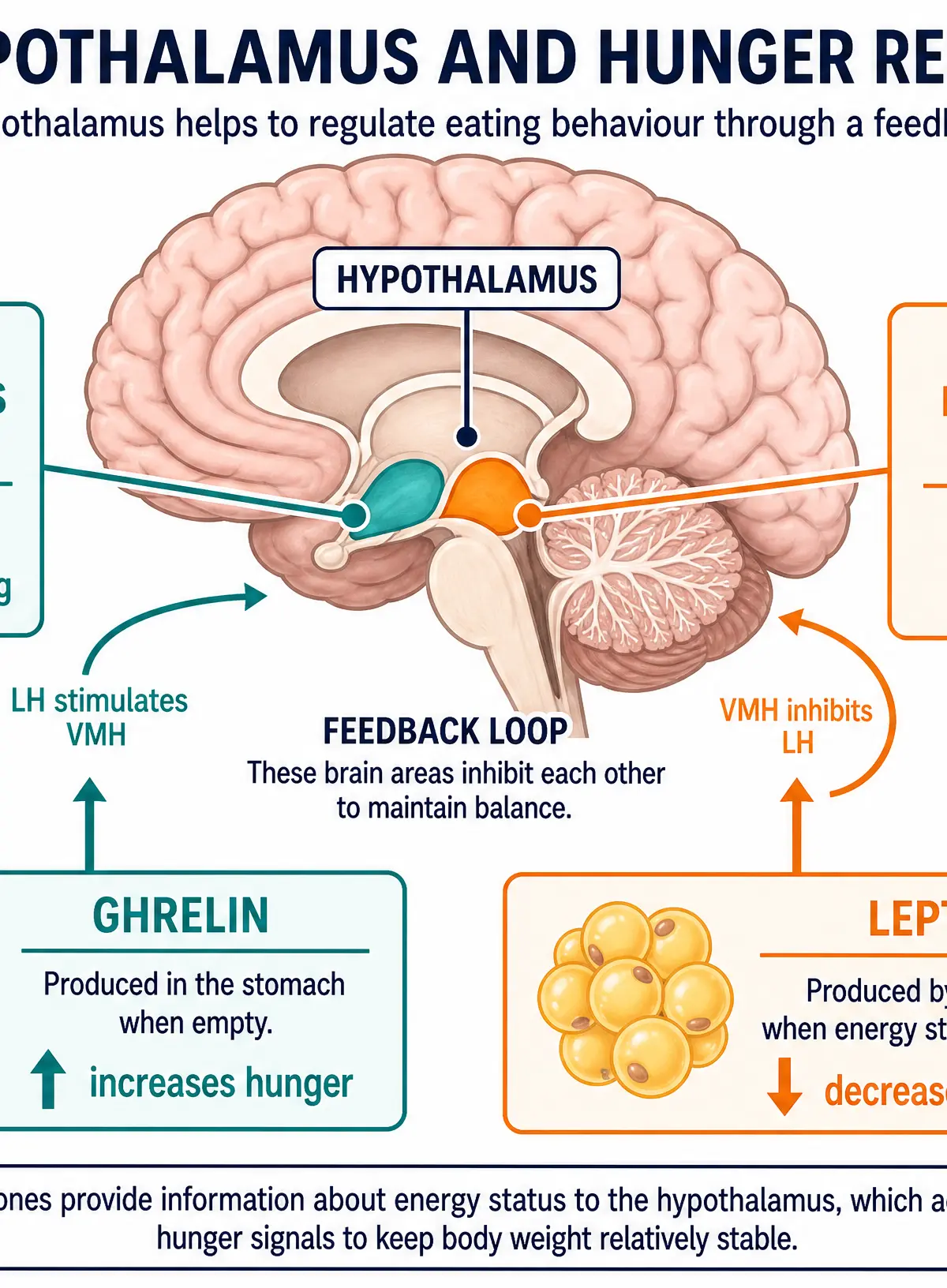
The Hypothalamus
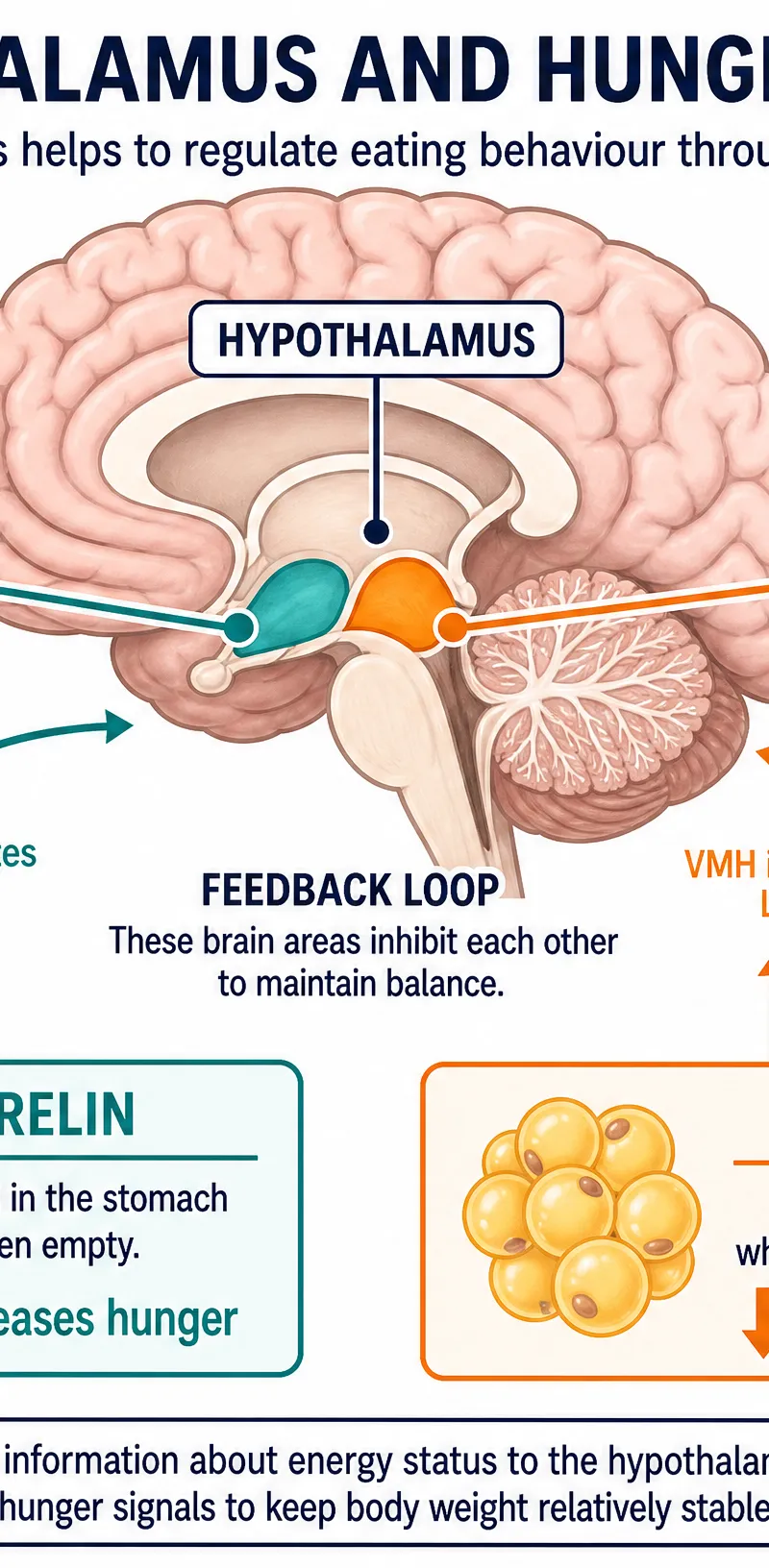
Role: The body's central hunger regulation system, operating on a dual-centre feedback loop.
Key Actions:
- Lateral Hypothalamus (LH): The 'hunger centre'. When stimulated, it triggers the urge to eat.
- Ventromedial Hypothalamus (VMH): The 'satiety centre'. When stimulated, it signals fullness and stops eating.
Specific Knowledge: Research by Anand and Brobeck (1951) showed that lesioning the LH in rats led to aphagia (refusal to eat), while lesioning the VMH led to hyperphagia (overeating and obesity).
Hormones: Ghrelin and Leptin
Role: Chemical messengers that communicate energy status to the hypothalamus.
Key Actions:
- Ghrelin: Secreted by the empty stomach, travels to the brain, and stimulates the LH to increase appetite.
- Leptin: Secreted by adipose (fat) tissue. High levels signal that energy stores are full, stimulating the VMH to suppress appetite.
Specific Knowledge: Mice with a genetic mutation preventing leptin production become severely obese. Injecting them with leptin reverses the obesity (Campfield et al., 1995).
Evolutionary Explanations
Food Preferences
Role: Explains why we naturally prefer certain foods based on ancestral survival environments of scarcity.
Key Actions:
- Preference for sweet/fatty foods: Sweet foods indicate high calories; fatty foods provide dense, long-lasting energy.
- Neophobia: An innate reluctance to consume novel or unfamiliar foods, protecting ancestors from potentially toxic substances.
- Taste Aversion: A biological preparedness to rapidly associate a specific taste with nausea, even after a single pairing and a long delay.
Specific Knowledge: Garcia and Koelling (1966) demonstrated taste aversion in rats, showing that classical conditioning could occur with a significant time delay between the stimulus (taste) and response (illness), challenging traditional behaviourist models.
Psychological Explanations of Eating Disorders
Anorexia Nervosa: Family Systems Theory
Role: Proposes that anorexia develops as a result of dysfunctional family dynamics rather than individual pathology.
Key Actions: Salvador Minuchin identified the concept of enmeshment — families where members are overly involved in each other's lives with poor emotional boundaries. The adolescent may use food restriction as the only way to assert control and establish autonomy.
Obesity: Restraint Theory
Role: A cognitive explanation for obesity focusing on the paradoxical effects of dieting.
Key Actions: Herman and Mack (1975) proposed that chronic dieting (restrained eating) makes individuals hypersensitive to food cues. A minor violation of their strict dietary rules triggers disinhibition (the 'what-the-hell' effect), leading to a complete breakdown of restraint and subsequent binge eating.
Second-Order Concepts
Causation
Examiners expect you to distinguish between biological causes (genes, neurotransmitters like serotonin, hormones) and psychological causes (family dynamics, social learning, cognitive distortions) for eating disorders.
Consequence
The consequence of chronic dieting, according to Restraint Theory, is not weight loss but paradoxical overeating due to disinhibition when cognitive boundaries are breached.
Significance
Understanding the multi-causal nature of eating behaviour is significant because it dictates treatment approaches. If anorexia is biological, drug therapies (e.g., SSRIs) might be used; if it is psychological, family therapy or CBT is required.
Visual Resources
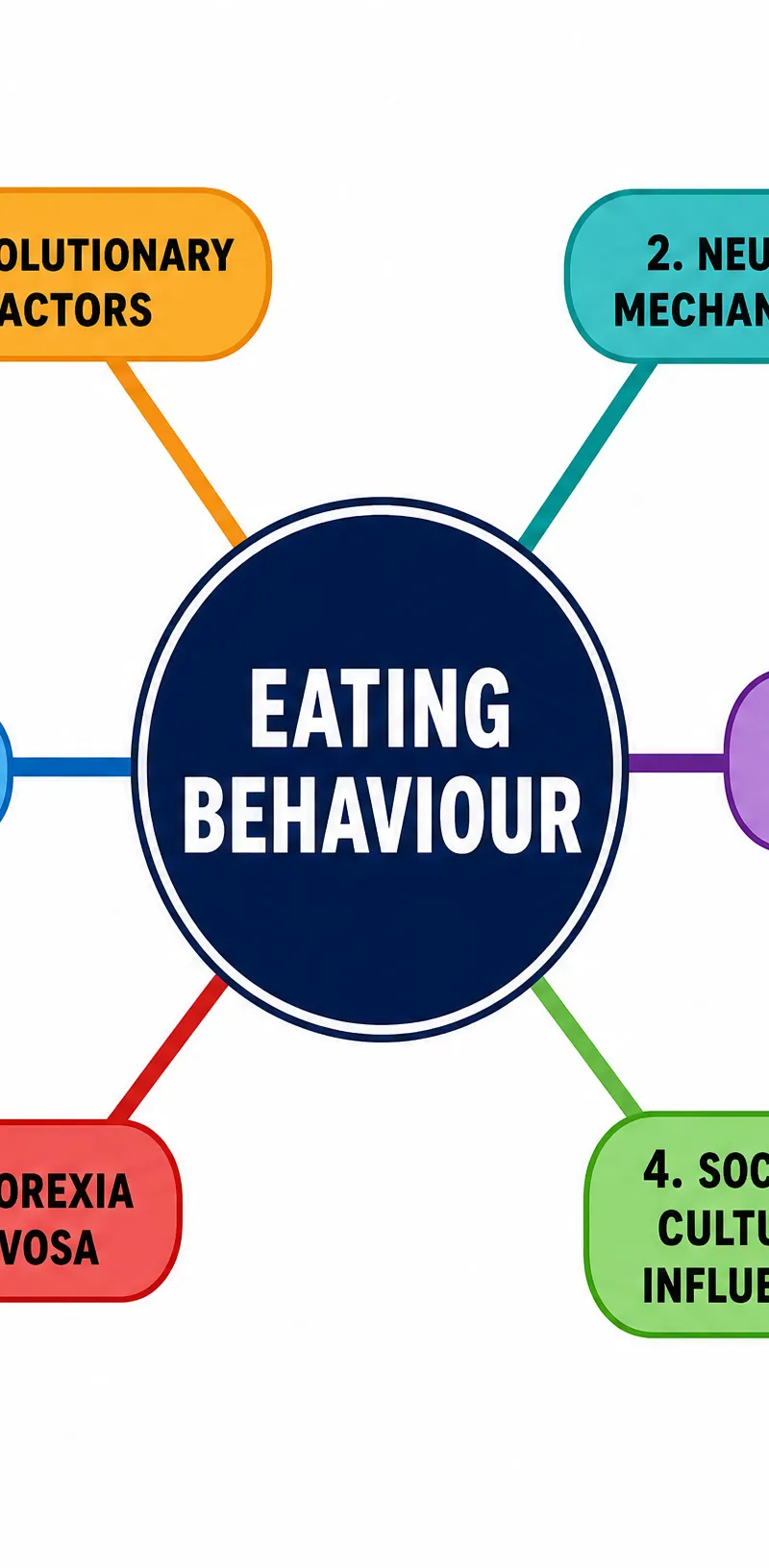
2 diagrams and illustrations
Interactive Diagrams
1 interactive diagram to visualise key concepts
Conceptual Flow Outline
The dual-centre feedback loop of hunger regulation
Worked Examples
3 worked examples — open one to explore the question and available guidance.
Practice Questions
Try the question, then reveal an answer plan or example response
Describe the role of ghrelin and leptin in the control of eating behaviour. (4 marks)
Hint: Think about where each hormone is produced and which part of the hypothalamus it affects.
Evaluate Family Systems Theory as an explanation for anorexia nervosa. (6 marks)
Hint: Provide one clear strength (e.g., treatment) and one clear limitation (e.g., cause vs effect).
Outline Restraint Theory as an explanation for obesity. (4 marks)
Hint: Explain what restrained eating is and the crucial mechanism of disinhibition.
Discuss the role of social learning in food preferences. (8 marks)
Hint: Outline modelling and vicarious reinforcement, then evaluate using research evidence and contrasting with biological factors.
Identify two evolutionary explanations for food preferences. (2 marks)
Hint: Think about survival mechanisms related to new foods and specific tastes.
Exam technique
How to turn what you know into marks
How to approach the question
Always identify whether the question is asking for a BIOLOGICAL or PSYCHOLOGICAL explanation before you start writing.
How to structure your answer
- Essay questions
- AO1 (Outline theory/mechanisms) followed by AO3 (Evaluation: Strengths, Limitations, Alternative explanations, Conclusion).
- Source questions
- Identify the key theme in the stem/source, apply psychological theory to it, and evaluate if required.
- Explain questions
- Point, Evidence (specific study/theory), Explanation, Link to the question.
Timing
Approximately 1 minute per mark. For a 12-mark essay, spend 2-3 minutes planning and 9-10 minutes writing.
Common pitfalls
- Confusing the roles of the Lateral Hypothalamus (LH) and Ventromedial Hypothalamus (VMH).
- Describing Restraint Theory without explicitly mentioning the crucial mechanism of 'disinhibition'.
- Failing to use specific terminology like 'neophobia' or 'enmeshment' when outlining theories.
What the command words want
- Discuss
- Requires both AO1 (outline) and AO3 (evaluation). Present the theory and then critically analyse it.
- Explain
- Give reasons how or why something happens, detailing the mechanism.
- Outline
- Provide a clear, concise description of the theory or mechanism without evaluating it.
- Evaluate
- Assess the strengths and limitations of a theory or study, ideally using research evidence.
Watch or listen (optional)
Test your understanding of Eating behaviour
Active recall beats re-reading. Take an instant quiz now to test what you’ve learned and lock it into long-term memory.
7 days Premium · Then the free plan continues · No card, no charge