Study Notes
Overview
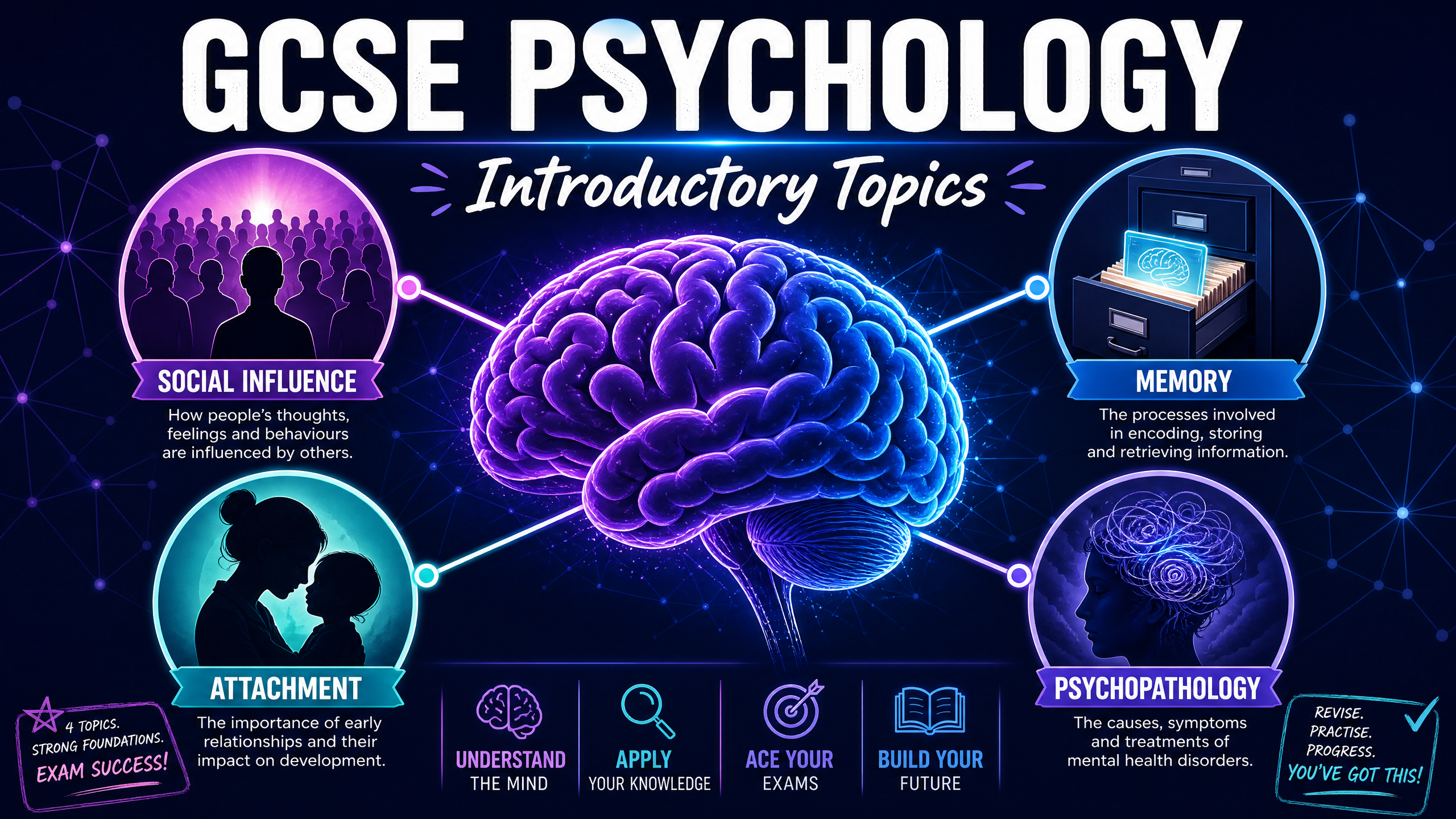
The Introductory topics in Psychology form the bedrock of your GCSE course. This section covers four distinct but interconnected areas: Social Influence (how groups affect our behaviour), Memory (how we encode, store, and retrieve information), Attachment (the vital early bonds between infants and caregivers), and Psychopathology (the definitions, causes, and treatments of mental health disorders). Examiners expect candidates to not only demonstrate accurate knowledge of key studies (like Milgram and Ainsworth) but also to apply these concepts to novel scenarios and evaluate their strengths and limitations. This guide is designed to maximize your marks by focusing on precise details, AO2 application, and critical evaluation.
Audio Revision: The Psychology Podcast
Listen to our comprehensive 8-minute revision podcast covering all four topics, exam tips, and a quick-fire recall quiz.
1. Social Influence
Social influence examines how our thoughts, feelings, and behaviours are shaped by others. The two major themes are conformity and obedience.
Conformity
Definition: Yielding to group pressure (real or imagined).
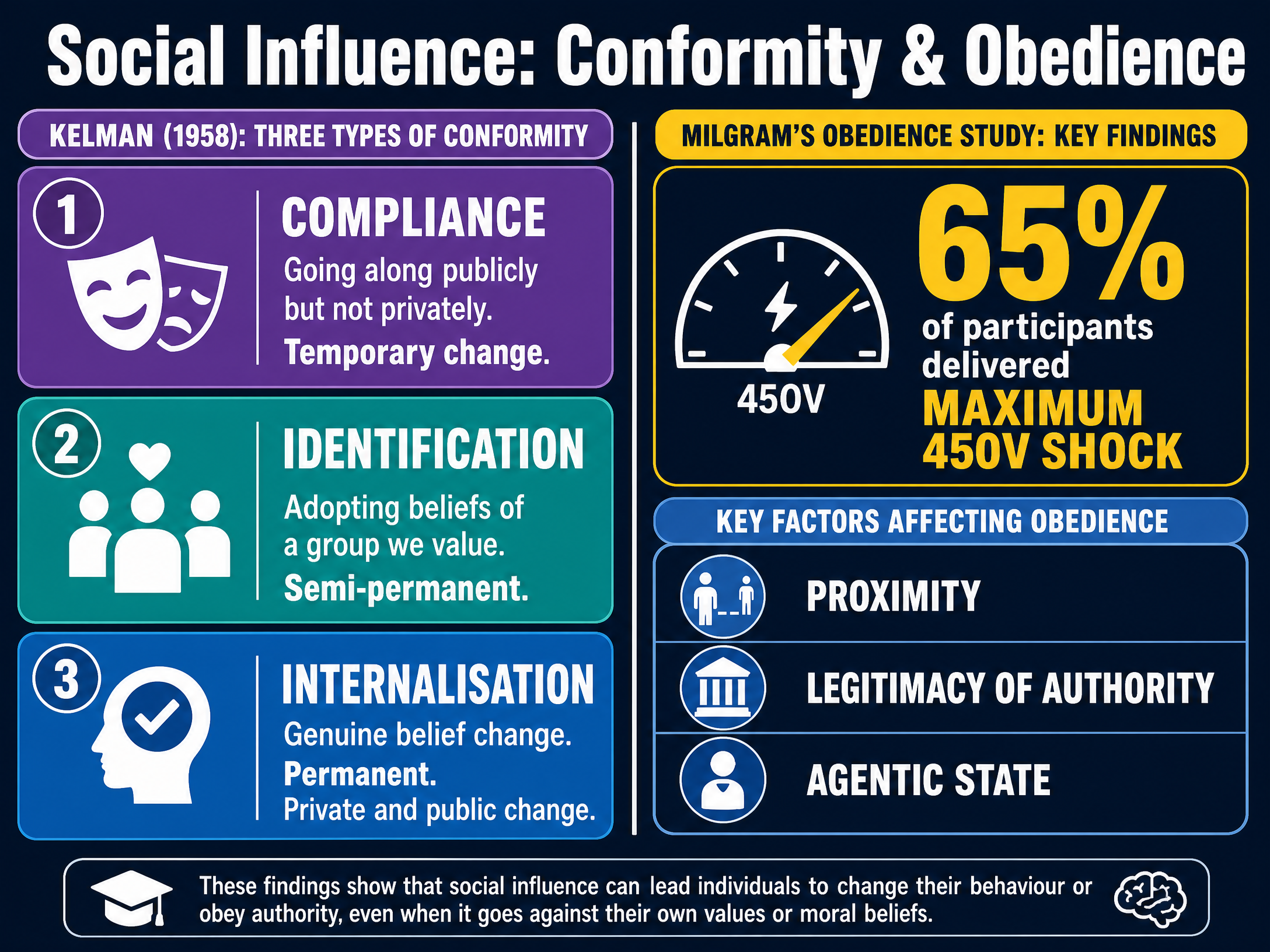
Types of Conformity (Kelman, 1958):
- Compliance: Superficial and temporary. Going along publicly but privately disagreeing. Stops when group pressure stops.
- Identification: Moderate. Valuing the group and wanting to be part of it, so publicly and privately changing behaviour/opinions, but only while a group member.
- Internalisation: Deep and permanent. Genuinely accepting the group's norms. Public and private change continues even in the absence of the group.
Explanations for Conformity (Deutsch & Gerard, 1955):
- Normative Social Influence (NSI): Conforming to be liked and accepted. An emotional process.
- Informational Social Influence (ISI): Conforming to be right. A cognitive process, common in ambiguous situations.
Obedience
Definition: Following a direct order, usually from a perceived authority figure.
Key Study: Milgram (1963):
- Aim: To see if ordinary Americans would obey an unjust order to inflict pain.
- Method: 40 male volunteers. 'Teacher' (participant) gave fake electric shocks to a 'Learner' (confederate) for incorrect answers, increasing by 15V up to 450V.
- Findings: 100% went to 300V. 65% went to the maximum 450V.
- Conclusion: Ordinary people will obey authority even if it causes harm.
Explanations for Obedience:
- Agentic State: Feeling no personal responsibility because you are acting as an 'agent' for an authority figure.
- Legitimacy of Authority: We are socialised to obey people with recognized social power (e.g., police, teachers, scientists in lab coats).
- Situational Variables: Proximity (obedience dropped to 40% when teacher and learner were in the same room), Location (dropped to 47.5% in a run-down office), Uniform (dropped to 20% when the experimenter wore everyday clothes).
2. Memory
Memory is the cognitive process of encoding, storing, and retrieving information.
The Multi-Store Model (Atkinson & Shiffrin, 1968)
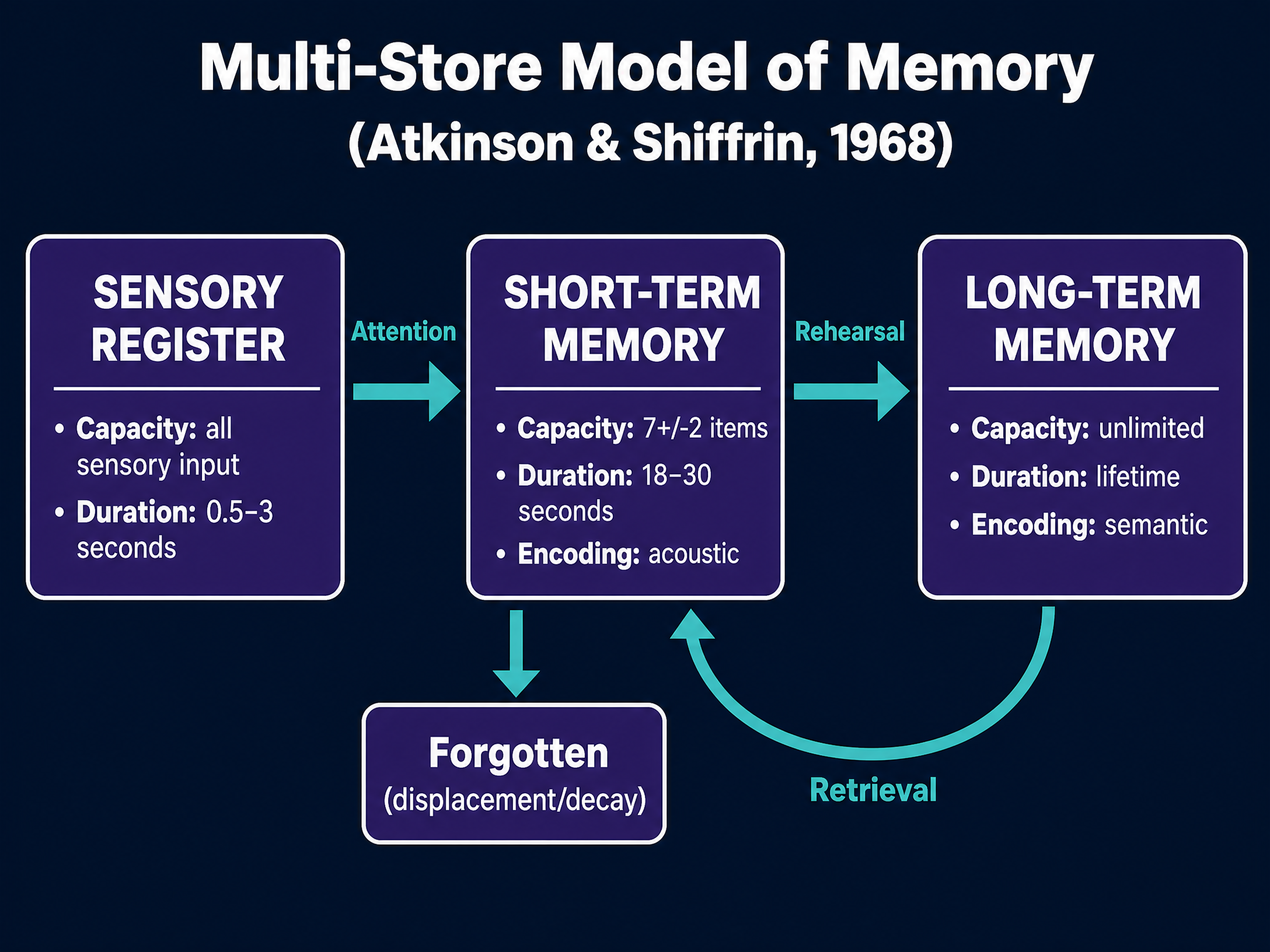
This model describes memory as a linear flow through three separate stores.
- Sensory Register (SR):
- Capacity: Very large (all sensory experience).
- Duration: Very short (0.5 to 3 seconds).
- Encoding: Modality specific (e.g., iconic for vision, echoic for sound).
- Transfer to STM requires attention.
- Short-Term Memory (STM):
- Capacity: Limited to 7 ± 2 items (Miller, 1956).
- Duration: 18-30 seconds (without rehearsal).
- Encoding: Primarily acoustic (sound).
- Transfer to LTM requires prolonged maintenance rehearsal.
- Long-Term Memory (LTM):
- Capacity: Unlimited.
- Duration: Up to a lifetime.
- Encoding: Primarily semantic (meaning).
Forgetting
- Interference Theory: Two pieces of information conflict. Proactive: Old interferes with new. Retroactive: New interferes with old.
- Retrieval Failure: The memory is available but inaccessible due to a lack of cues. Context-dependent (external environment cues) and State-dependent (internal physiological/psychological cues).
3. Attachment
Attachment is a strong emotional bond between two people, typically an infant and a primary caregiver.
Bowlby's Monotropic Theory (1969)
Bowlby proposed an evolutionary explanation: attachment is an innate system that provides a survival advantage.
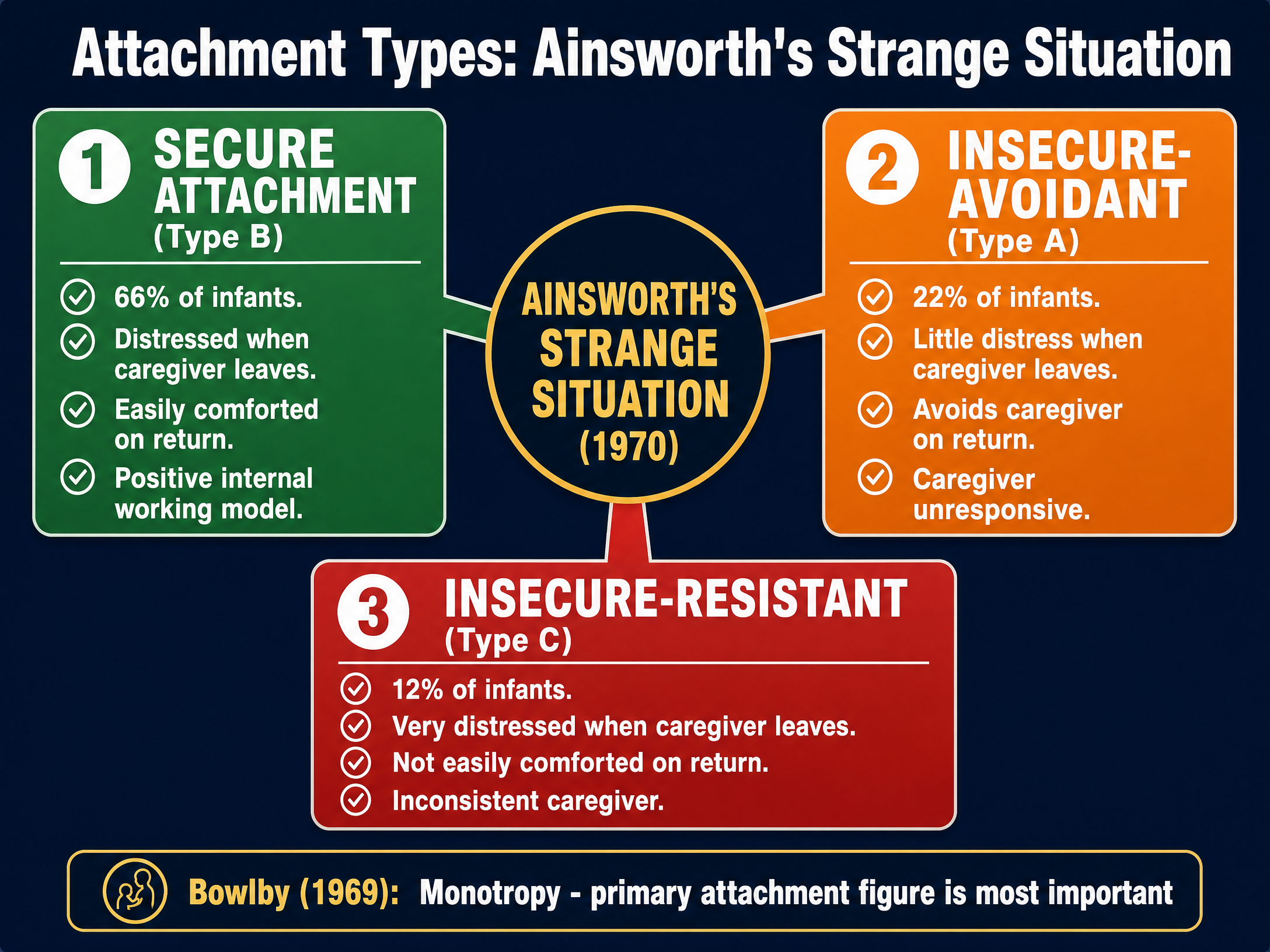
- Monotropy: Infants form one special, primary attachment (usually the mother) which is qualitatively different from others.
- Social Releasers: Innate cute behaviours (smiling, cooing) that activate adult caregiving.
- Critical Period: Attachment must form within the first 2.5 years, or it may never form.
- Internal Working Model: The primary attachment forms a mental representation that acts as a template for all future relationships.
Ainsworth's Strange Situation (1970)
A controlled observation to measure attachment security in infants (12-18 months) through a series of separations and reunions.
Attachment Types Identified:
- Secure (Type B - 66%): Explores happily but uses caregiver as a safe base. Moderate separation and stranger anxiety. Easily comforted on reunion.
- Insecure-Avoidant (Type A - 22%): Explores freely without safe base behaviour. Low separation and stranger anxiety. Avoids or ignores caregiver on reunion.
- Insecure-Resistant (Type C - 12%): Explores less, stays close to caregiver. High separation and stranger anxiety. Resists comfort on reunion.
4. Psychopathology
Psychopathology involves the study of mental disorders, including their definitions, characteristics, and treatments.
Definitions of Abnormality
- Statistical Infrequency: Behaviour that is numerically rare in the population (e.g., IQ below 70).
- Deviation from Social Norms: Behaviour that violates the unwritten rules and expectations of a society or culture.
- Failure to Function Adequately: Inability to cope with everyday life (e.g., poor hygiene, inability to hold a job, experiencing severe personal distress).
- Deviation from Ideal Mental Health: Jahoda (1958) defined abnormality as the absence of criteria for good mental health (e.g., lacking self-actualisation, autonomy, or an accurate perception of reality).
Key Disorders and Treatments
- Phobias: Characterised by excessive fear and avoidance. Treated primarily with Systematic Desensitisation (gradual exposure paired with relaxation).
- Depression: Characterised by low mood, low energy, and negative cognitive biases. Treated with Cognitive Behavioural Therapy (CBT) to challenge irrational thoughts, and sometimes SSRIs (antidepressants).
- OCD (Obsessive-Compulsive Disorder): Characterised by intrusive thoughts (obsessions) and repetitive behaviours (compulsions). Treated with SSRIs and CBT (specifically Exposure and Response Prevention).
Visual Resources
3 diagrams and illustrations
Interactive Diagrams
1 interactive diagram to visualise key concepts
Conceptual Flow Outline
Simplified Multi-Store Model of Memory Flow
Worked Examples
3 detailed examples with solutions and examiner commentary
Practice Questions
Test your understanding — click to reveal model answers
Describe the procedure and findings of Milgram's original obedience study. (6 marks)
Hint: Ensure you separate the 'procedure' (what they did) from the 'findings' (what the results were) and include specific numbers.
Explain one difference between short-term memory and long-term memory. (2 marks)
Hint: Focus on capacity, duration, or encoding, and make a direct comparison.
Evaluate Bowlby's monotropic theory of attachment. (4 marks)
Hint: Provide one strength and one weakness, using evidence.
Read the scenario: John is terrified of spiders. He refuses to go into the garden and checks his shoes every morning. Explain how John's phobia could be treated using systematic desensitisation. (4 marks)
Hint: Apply the three stages of SD directly to John and his fear of spiders.
Briefly outline the failure to function adequately definition of abnormality. (2 marks)
Hint: Focus on the inability to cope with daily life.