AQA · A-Level · Psychology
Course version: 7182 · Exams through 2026
Memory
Master the cognitive processes of memory, from Atkinson and Shiffrin's foundational Multi-Store Model to Baddeley and Hitch's dynamic Working Memory Model. This guide breaks down the structural models of memory, types of long-term memory, and provides essential examiner insights to help you secure top marks.
- 13 min read
- 3 worked examples
- 5 practice questions
- 6 key terms
Try the lesson
The start of the Memory lesson, made from checked teaching notes for this specification point.
Have a go first
According to the multi-store model of memory, what is the capacity of short-term memory?
There is more to this lesson
The full lesson goes on to check your understanding and help you earn the marks. Create a free account to carry on, with your progress saved.
7 days Premium · Then the free plan continues · No card, no charge
Check what you remember
Read the wording for your board, then hide it and explain Coding in your own words. Rough notes are fine. This is a self-check, with no mark or grade.
Reference: AQA
The format in which information is stored in the various memory stores (e.g., acoustic, semantic, visual).
Study Notes
Overview
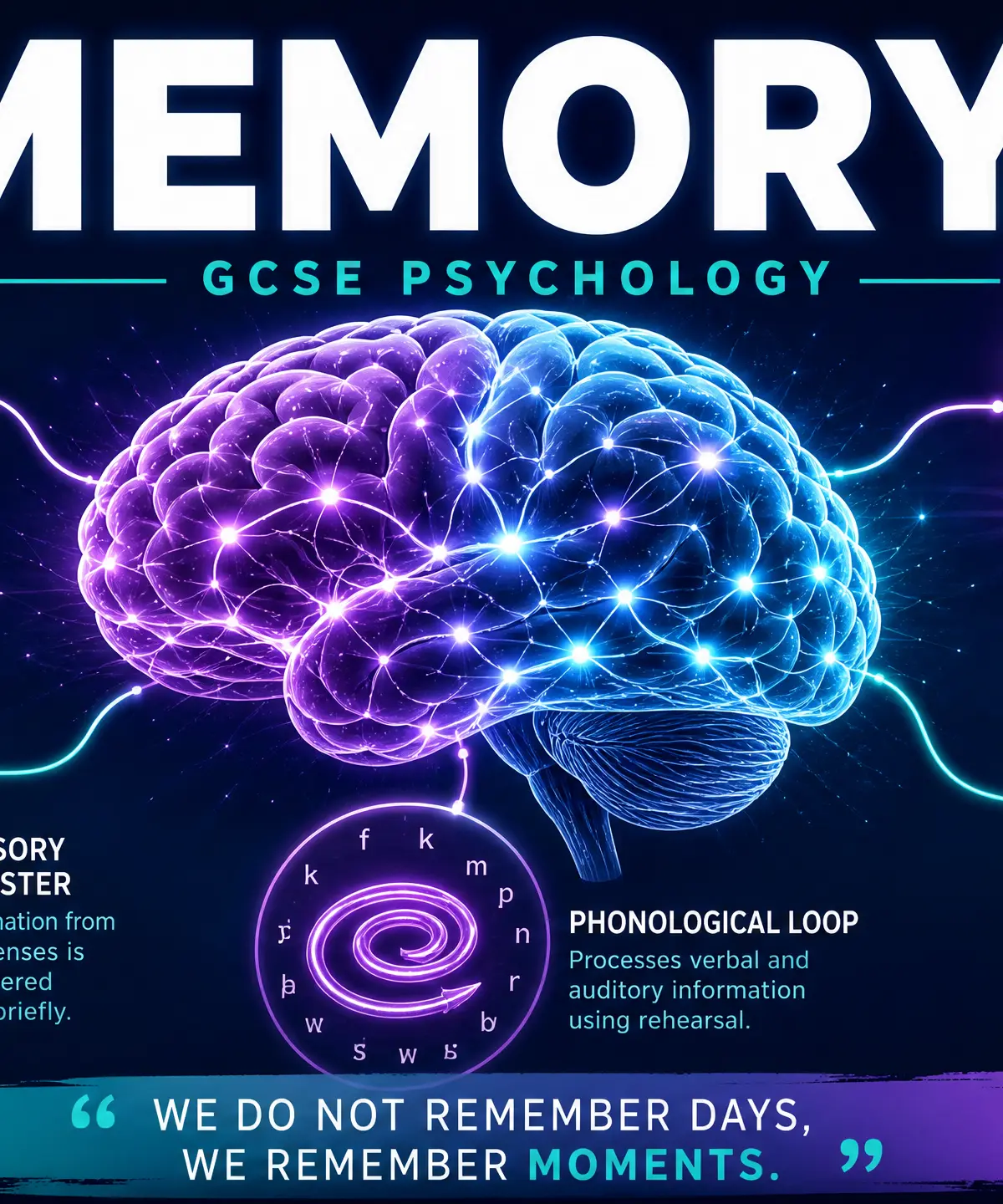
The Memory topic is a cornerstone of cognitive psychology at GCSE. It explores how we encode, store, and retrieve information. Examiners expect candidates to demonstrate a precise understanding of two major structural models: the Multi-Store Model (MSM) and the Working Memory Model (WMM), alongside the different types of long-term memory. A common pitfall is confusing the specific features (capacity, duration, coding) of different memory stores. This guide provides the exact terminology, named researchers, and evaluative points required to access the highest mark bands.
The Multi-Store Model of Memory (MSM)
Researchers: Atkinson and Shiffrin (1968)
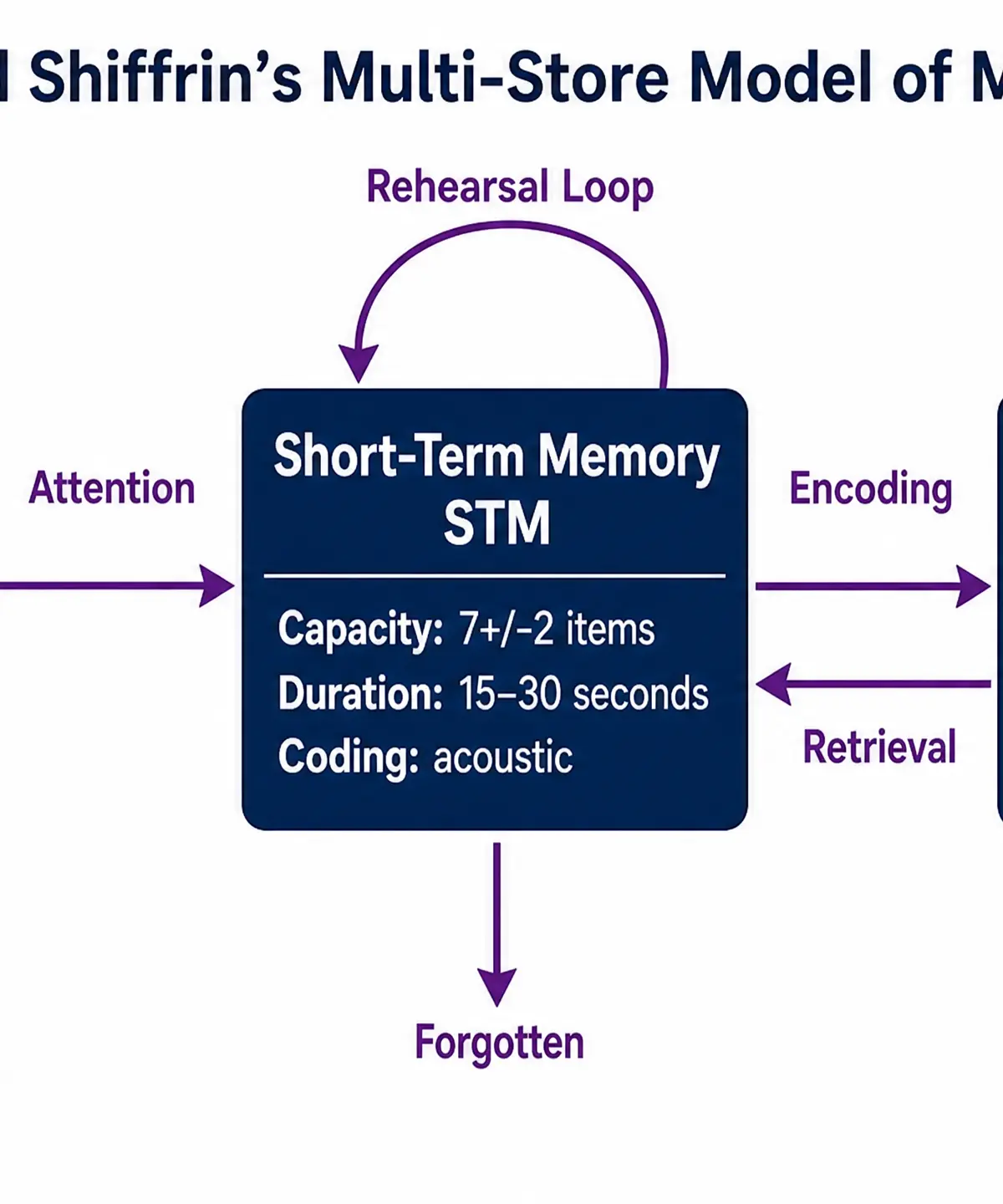
What it is: A structural model suggesting memory consists of three separate stores: Sensory Register, Short-Term Memory (STM), and Long-Term Memory (LTM), with information flowing in a linear sequence.
Specific Knowledge - The Three Stores:
- Sensory Register:
- Coding: Modality-specific (e.g., iconic for visual, echoic for acoustic).
- Capacity: Very large/unlimited.
- Duration: Very brief (0.5 to 3 seconds).
- Transfer to STM requires attention.
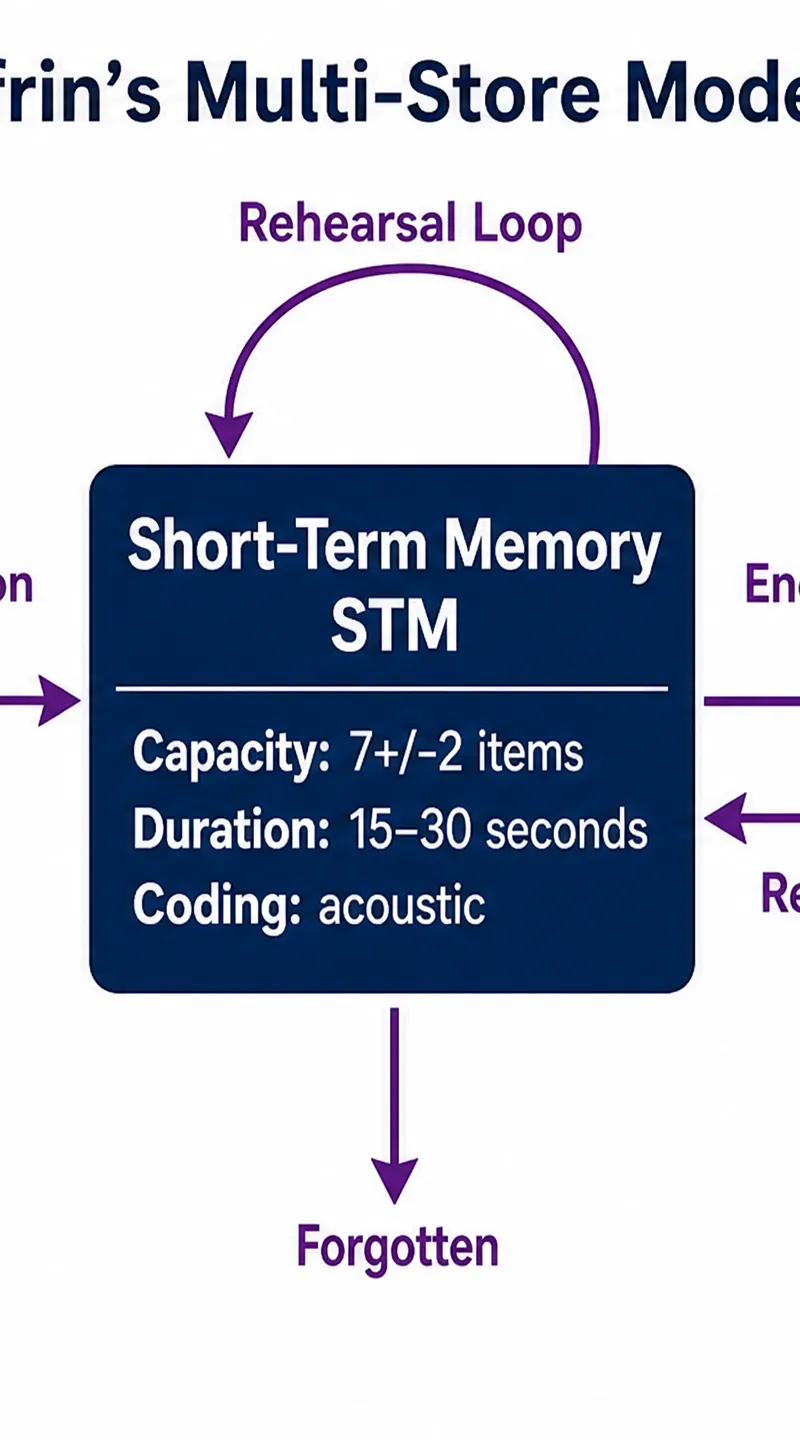
- Short-Term Memory (STM):
- Coding: Primarily acoustic (sound).
- Capacity: Limited to 7 ± 2 items (Miller, 1956).
- Duration: 15-30 seconds without rehearsal.
- Transfer to LTM requires prolonged/maintenance rehearsal.
- Long-Term Memory (LTM):
- Coding: Primarily semantic (meaning).
- Capacity: Unlimited.
- Duration: Up to a lifetime.
Why it matters: The MSM was the first cognitive explanation of memory and stimulated decades of research. However, it is often criticised for oversimplifying STM and LTM as single, unitary stores.
Types of Long-Term Memory
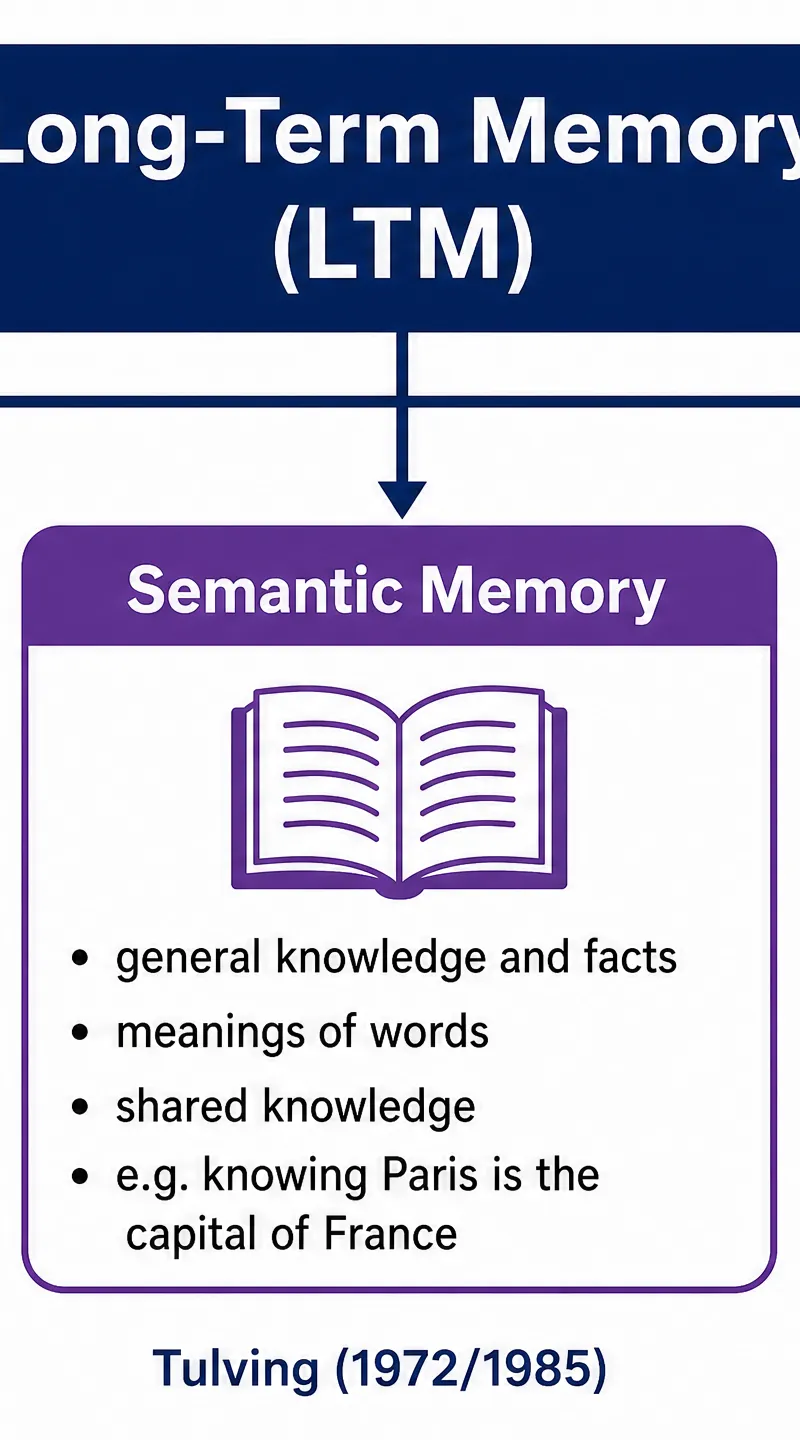
Researcher: Endel Tulving (1972/1985)
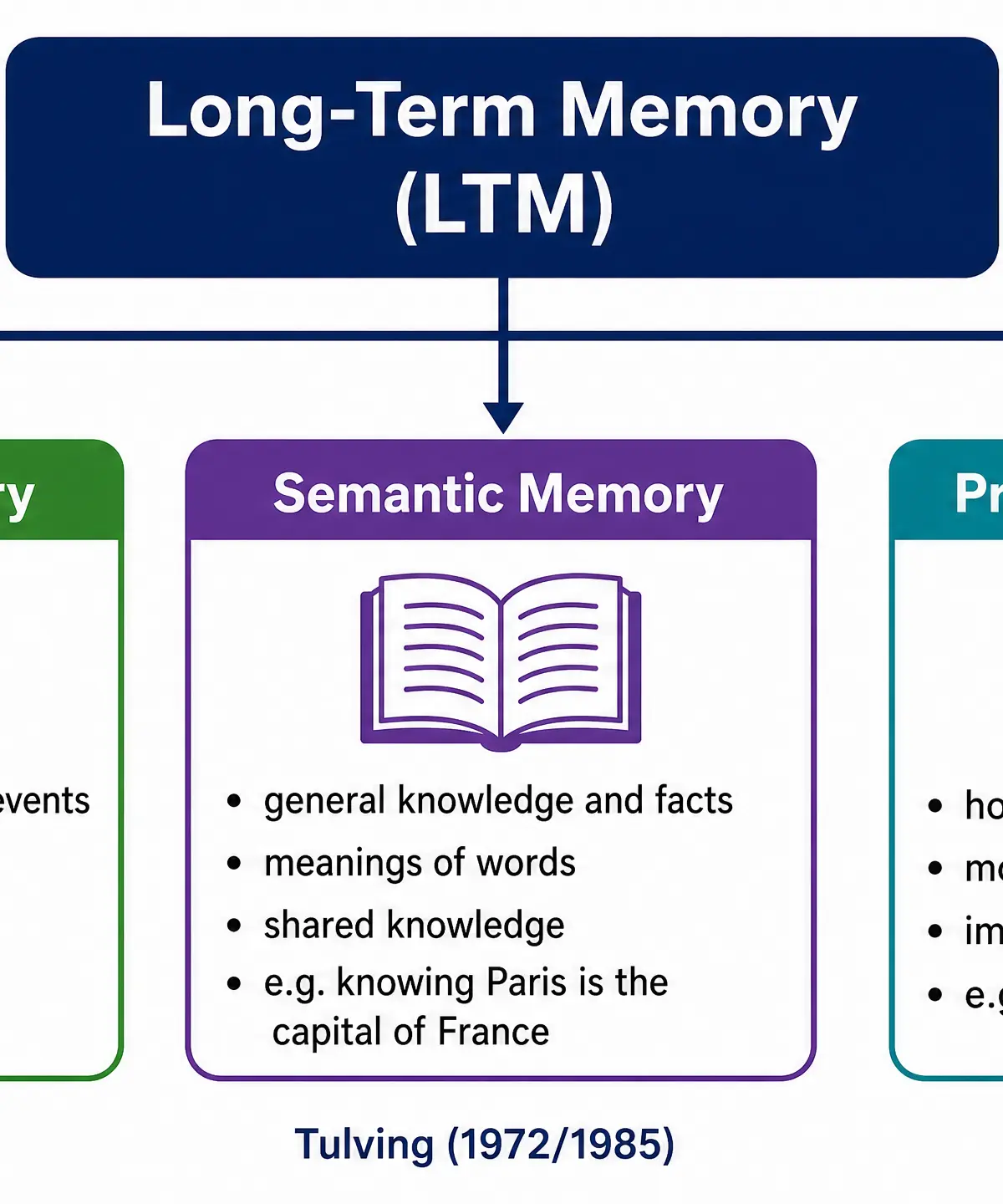
What it is: Tulving argued that the MSM's view of LTM was too simplistic. He proposed that LTM is divided into three distinct types based on the nature of the information stored.
Specific Knowledge - The Three Types:
- Episodic Memory: Personal memories of events (e.g., your last birthday). They are 'time-stamped' and require conscious effort to recall.
- Semantic Memory: Shared knowledge of the world, facts, and concepts (e.g., knowing the capital of France). They are not time-stamped.
- Procedural Memory: Memory for actions, skills, and operations (e.g., riding a bike). These are implicit and usually recalled without conscious awareness.
The Working Memory Model (WMM)
Researchers: Baddeley and Hitch (1974)
What it is: A model of short-term memory that replaces the unitary STM store of the MSM with a multi-component, active system.
Specific Knowledge - The Components:
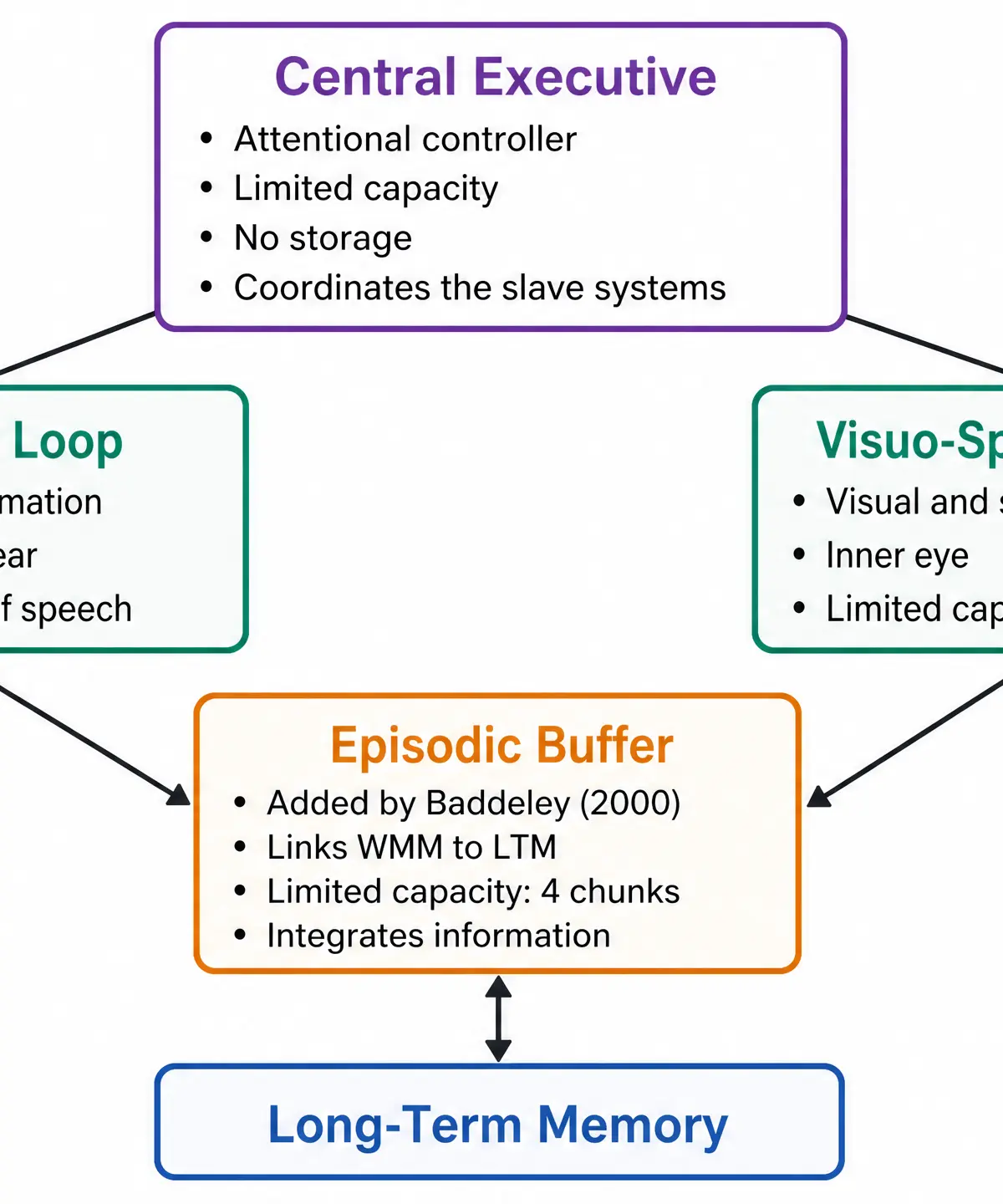
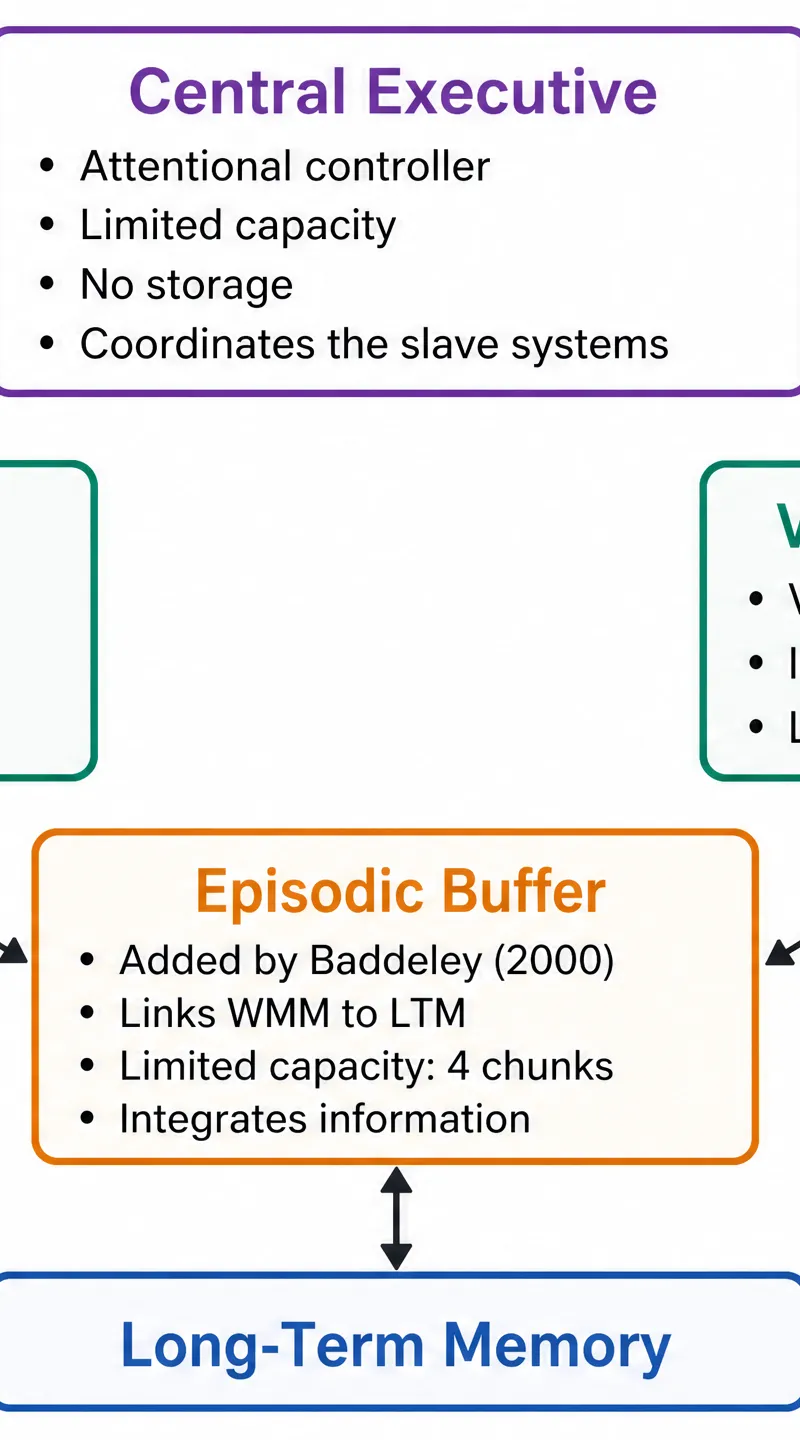
- Central Executive (CE): The 'boss' that monitors incoming data, makes decisions, and allocates slave systems to tasks. It has a very limited processing capacity and does not store information.
- Phonological Loop (PL): Deals with auditory information and preserves the order in which information arrives. Subdivided into:
- Phonological Store: Stores the words you hear (inner ear).
- Articulatory Process: Allows maintenance rehearsal (inner voice). Capacity is about 2 seconds of what you can say.
- Visuo-Spatial Sketchpad (VSS): Stores visual and/or spatial information when required (the inner eye). Limited capacity of about 3-4 objects.
- Episodic Buffer (EB): Added by Baddeley in 2000. It integrates visual, spatial, and verbal information processed by other stores and maintains a sense of time sequencing. Links working memory to LTM.
Podcast Revision
Listen to our 10-minute deep dive into Memory, featuring explanations of all key models and a quick-fire recall quiz.
Podcast Script:
Hello, and welcome to your GCSE Psychology revision podcast. I'm so glad you're here, because today we are diving into one of the most fascinating topics in the entire course — Memory. [short pause] Whether you've ever forgotten someone's name, or you can still remember every word of a song you haven't heard in years, memory is something we all experience every single day. And in this episode, we're going to break it all down so that you can walk into your exam feeling completely confident.
Here's what we're covering today. First, we'll explore the Multi-Store Model of Memory — the classic foundational theory by Atkinson and Shiffrin. Then we'll look at the three types of long-term memory. After that, we'll move on to Baddeley and Hitch's Working Memory Model, which is a more detailed and modern explanation of how we process information. Then I'll give you my top exam tips and the most common mistakes students make. And finally, we'll finish with a quick-fire recall quiz to test yourself. Ready? Let's go.
[medium pause]
So, let's start with the Multi-Store Model of Memory, proposed by Atkinson and Shiffrin in 1968. This model suggests that memory is not one single thing — it's actually made up of three separate stores, and information flows through them in a specific sequence.
The first store is the Sensory Register. Think of this as the doorway into your memory system. Every single second, your senses — sight, sound, touch, smell, taste — are bombarding your brain with information. The sensory register holds all of this incoming information, but only very briefly. We're talking about half a second to three seconds. And its capacity? Essentially unlimited. It takes in everything. But here's the thing — most of it is immediately lost. The only information that moves forward is the stuff you pay attention to.
So when you pay attention to something, it moves into the second store — Short-Term Memory, or STM. Now, STM is much more limited. Its capacity is around seven items, plus or minus two — that's the famous finding by George Miller in 1956, who called it "the magical number seven." The duration of STM is also quite short — around 15 to 30 seconds without rehearsal. And the coding in STM is primarily acoustic — meaning we tend to store information as sounds in our heads, like when you repeat a phone number to yourself. [short pause]
If you rehearse information — if you keep repeating it — it can be transferred into the third store: Long-Term Memory, or LTM. And this is where things get really impressive. LTM has an unlimited capacity and can last a lifetime. The coding in LTM is primarily semantic — meaning we store information based on its meaning. Think about everything you know — your name, your address, how to ride a bike, every memory you've ever had. All of that lives in your LTM.
Now, the model also includes a rehearsal loop — information in STM can be rehearsed and sent back into STM, or eventually transferred to LTM. And information can also be retrieved from LTM back into STM when you need it. Pretty elegant, right?
[medium pause]
Now let's talk about the three types of Long-Term Memory, identified by Endel Tulving in 1972 and further developed in 1985. Tulving argued that LTM isn't just one big storage unit — it actually has different compartments for different kinds of memories.
The first type is Episodic Memory. This is your personal autobiography — memories of specific events and experiences in your life, with a sense of time and place attached to them. Your first day of secondary school, your last birthday, a holiday you went on — these are episodic memories. They're personal to you.
The second type is Semantic Memory. This is your general knowledge about the world — facts, concepts, the meanings of words. Knowing that London is the capital of England, knowing that two plus two equals four, knowing what a "metaphor" means — all semantic memory. Crucially, semantic memories are shared — they're not personal experiences, they're just things you know.
The third type is Procedural Memory. This is your memory for how to do things — skills and habits. Riding a bike, typing on a keyboard, tying your shoelaces. The fascinating thing about procedural memory is that it's largely implicit — you don't have to consciously think about it. Once a skill is learned, it becomes automatic.
A really useful way to remember these three types is the mnemonic E-S-P: Episodic, Semantic, Procedural. Just think of it as your memory having ESP — extrasensory perception — it knows your experiences, your facts, and your skills.
[medium pause]
Now let's move on to the Working Memory Model, proposed by Baddeley and Hitch in 1974. This model was developed as a more detailed alternative to the STM component of the Multi-Store Model. Rather than seeing short-term memory as one simple store, Baddeley and Hitch argued it's actually a complex, active system with multiple components.
At the top of the model is the Central Executive. This is the boss — the attentional controller. It has limited capacity, it doesn't store information itself, but it coordinates and directs the other components, called the slave systems. Think of the Central Executive as the manager of a busy office.
The first slave system is the Phonological Loop. This deals with verbal and acoustic information — things you hear or say in your head. It has two parts: the phonological store, which is like an inner ear that holds sounds briefly, and the articulatory process, which is like an inner voice that rehearses information. When you're trying to remember a new word or a phone number by repeating it in your head, that's your phonological loop at work. Its capacity is roughly two seconds worth of speech.
The second slave system is the Visuo-Spatial Sketchpad. This deals with visual and spatial information — what things look like and where they are in space. It's sometimes called the inner eye. When you're trying to remember what someone's face looks like, or you're mentally navigating a route, you're using your visuo-spatial sketchpad. It also has a limited capacity.
In 2000, Baddeley added a fourth component — the Episodic Buffer. This is a temporary store that integrates information from the phonological loop, the visuo-spatial sketchpad, and long-term memory into a single, unified episode. It has a limited capacity of around four chunks of information. Think of it as the component that brings everything together — like a whiteboard where all the different pieces of information can be combined.
[medium pause]
Right, now let's talk exam technique — because knowing the content is only half the battle. You need to know how to use it in the exam to actually earn marks.
First, command words. When a question says "Describe," you need to give two or more features with supporting detail. Don't just name something — explain what it means. For example, don't just write "STM has a limited capacity." Write: "STM has a limited capacity of around seven items, plus or minus two, as shown by Miller's research."
When a question says "Explain," you need to give a reason or a mechanism. Use the word "because" or "this means that" to show you're actually explaining, not just describing.
When a question says "Evaluate," you need to consider both strengths and weaknesses. Always aim for a balanced response. For the Multi-Store Model, a strength is that it has research support — for example, the serial position effect shows we remember the first and last items in a list, supporting the idea of separate STM and LTM stores. A weakness is that it oversimplifies memory — it treats STM as a single store, when Baddeley and Hitch showed it's actually more complex.
Now, the most common mistakes I see candidates make. [short pause]
Mistake number one: confusing the features of the different memory stores. Please learn these precisely. STM: capacity seven plus or minus two, duration 15 to 30 seconds, coding acoustic. LTM: capacity unlimited, duration potentially a lifetime, coding semantic. Sensory Register: capacity unlimited, duration half a second to three seconds, coding modality-specific.
Mistake number two: describing the Working Memory Model components without explaining what they do. Don't just say "the phonological loop deals with sound." Say: "the phonological loop processes verbal and acoustic information using an inner voice and inner ear, allowing us to rehearse information briefly."
Mistake number three: forgetting to name the researchers. Atkinson and Shiffrin, 1968 for the Multi-Store Model. Baddeley and Hitch, 1974 for the Working Memory Model. Tulving, 1972 for the types of LTM. Examiners love to see these names — they show you know your stuff.
Mistake number four: in evaluation questions, only giving one side. Always try to give at least one strength and one weakness, and link them back to the question.
[medium pause]
Okay, quick-fire recall quiz! I'll ask you a question — pause the podcast, think of your answer, then press play to hear the answer. Ready?
Question one: What are the three stores in the Multi-Store Model? [long pause] Answer: Sensory Register, Short-Term Memory, and Long-Term Memory.
Question two: What is the capacity of Short-Term Memory? [long pause] Answer: Seven items, plus or minus two — Miller, 1956.
Question three: Name the four components of the Working Memory Model. [long pause] Answer: Central Executive, Phonological Loop, Visuo-Spatial Sketchpad, and Episodic Buffer.
Question four: What are the three types of Long-Term Memory? [long pause] Answer: Episodic, Semantic, and Procedural.
Question five: Who added the Episodic Buffer to the Working Memory Model, and when? [long pause] Answer: Baddeley, in 2000.
[medium pause]
Brilliant work if you got those right! And if you didn't — don't worry. That's exactly why we do retrieval practice. The act of trying to remember something, even when you get it wrong, actually strengthens your memory. So keep testing yourself.
Let me leave you with a quick summary of today's key points. The Multi-Store Model by Atkinson and Shiffrin, 1968, proposes three memory stores: the Sensory Register, STM, and LTM, each with different capacities, durations, and coding. Tulving identified three types of LTM: episodic, semantic, and procedural — remember ESP. The Working Memory Model by Baddeley and Hitch, 1974, describes STM as an active system with four components: the Central Executive, the Phonological Loop, the Visuo-Spatial Sketchpad, and the Episodic Buffer added in 2000.
In your exam, always name researchers, use specific figures, and make sure you're explaining not just describing. You've got this. Good luck, and I'll see you in the next episode.
Visual Resources
3 diagrams and illustrations
Interactive Diagrams
1 interactive diagram to visualise key concepts
Conceptual Flow Outline
Flow of information in the Multi-Store Model
Worked Examples
3 worked examples — open one to explore the question and available guidance.
Practice Questions
Try the question, then reveal an answer plan or example response
Outline the capacity and duration of Short-Term Memory (STM). (2 marks)
Hint: Think of George Miller's magic number for capacity, and the time limit before rehearsal is needed.
Explain one limitation of the Multi-Store Model of memory. (3 marks)
Hint: Consider the findings of Baddeley and Hitch regarding STM.
Describe the phonological loop as a component of the Working Memory Model. (3 marks)
Hint: What type of information does it deal with, and what are its two sub-components?
Evaluate the Working Memory Model. (6 marks)
Hint: Provide strengths (clinical evidence, dual-task studies) and weaknesses (lack of clarity over the central executive).
Distinguish between procedural memory and semantic memory. (3 marks)
Hint: Compare what they store and whether recalling them requires conscious effort.
Exam technique
How to turn what you know into marks
How to approach the question
Identify the command word immediately. 'Outline' or 'Describe' requires accurate factual recall. 'Evaluate' or 'Discuss' requires critical analysis of strengths and weaknesses.
How to structure your answer
- Explain questions
- State the point clearly, then use 'because' or 'this means that' to elaborate on the mechanism or reason.
- Evaluate questions
- Use PEEL (Point, Evidence, Explain, Link) for each evaluation paragraph. Always provide a balanced argument (at least one strength and one weakness).
- Application questions
- Always explicitly link your psychological knowledge back to the scenario or person mentioned in the stem (e.g., 'This explains why Sarah forgot the phone number...').
Timing
Approximately 1 minute per mark.
Common pitfalls
- Confusing the capacity, duration, and coding of STM and LTM.
- Failing to name the researchers (e.g., Atkinson & Shiffrin, Baddeley & Hitch).
- Describing a model in an 'Evaluate' question without providing any actual critical evaluation (strengths/weaknesses).
What the command words want
- Explain
- Set out purposes or reasons; make the relationships between things evident.
- Outline
- Set out main characteristics.
- Describe
- Provide a detailed account of features or components.
- Evaluate
- Judge or calculate the quality, importance, amount, or value of something. Provide strengths and limitations.
Watch or listen (optional)
Test your understanding of Memory
Active recall beats re-reading. Take an instant quiz now to test what you’ve learned and lock it into long-term memory.
7 days Premium · Then the free plan continues · No card, no charge