AQA · A-Level · Psychology
Course version: 7182 · Exams through 2026
Scientific processes
Scientific Processes are the foundation of psychology, teaching you how research is designed, conducted, and evaluated. Mastering this topic is crucial as it unlocks your ability to understand and critique every other study in the specification.
- 5 min read
- 3 worked examples
- 5 practice questions
- 6 key terms
Check what you remember
Read the wording for your board, then hide it and explain Operationalisation in your own words. Rough notes are fine. This is a self-check, with no mark or grade.
Reference: AQA
Clearly defining variables in terms of how they can be objectively measured.
Study Notes
Overview

Scientific processes cover the fundamental methodologies required to conduct and report psychological research. This topic is the bedrock of the entire GCSE Psychology specification. Examiners expect candidates not just to know definitions, but to be able to apply these concepts to novel scenarios, design their own studies, and critically evaluate the research of others. Mastering this area is essential, as research methods questions appear in almost every exam paper and often carry high mark weightings.
The Research Process
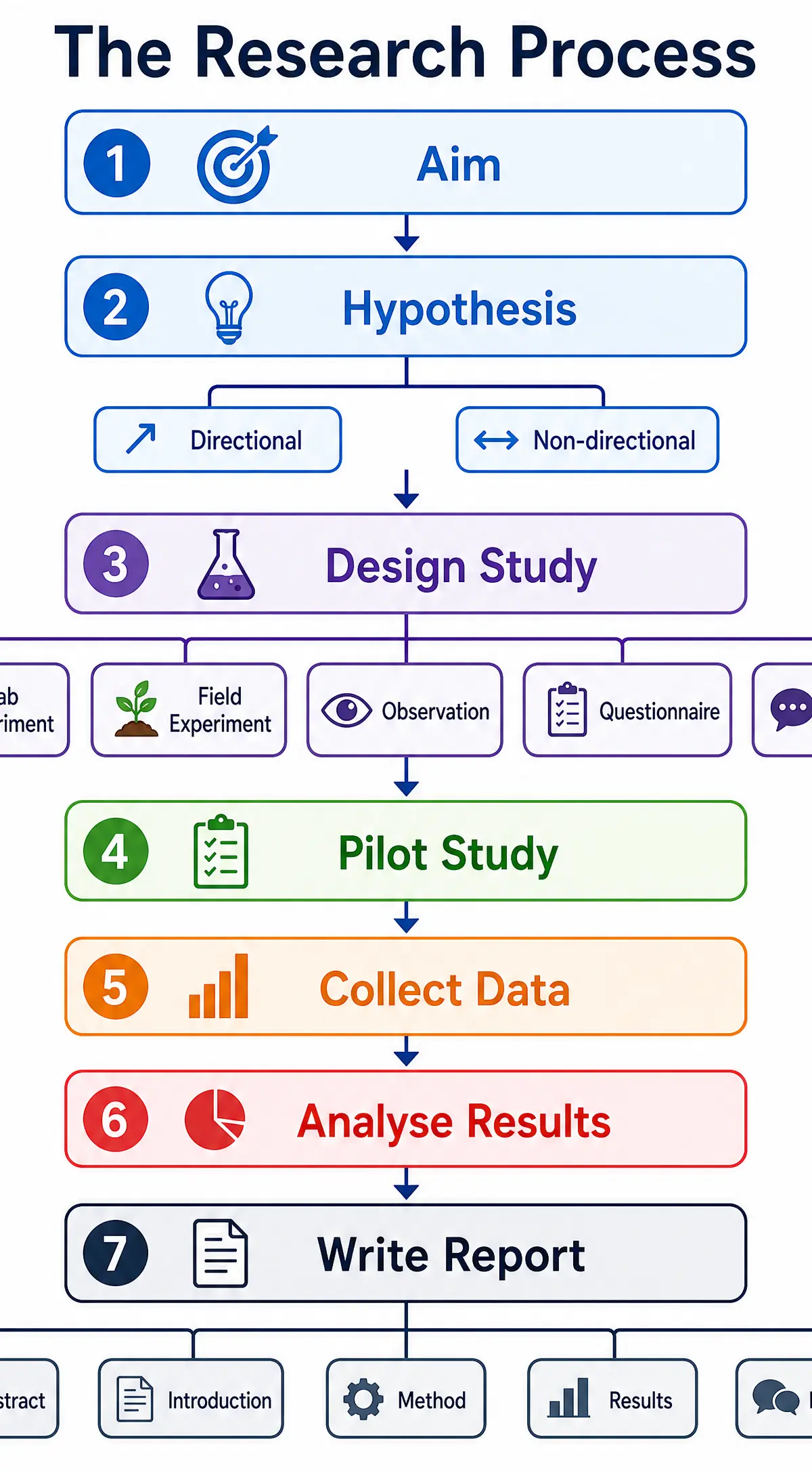
Aims and Hypotheses
Date(s): Fundamental to all psychological research.
What happened: Before conducting research, psychologists must establish what they are trying to achieve and what they expect to find.
Why it matters: A clear aim and a testable hypothesis are essential for ensuring research is focused and scientific.
Specific Knowledge:
- Aim: A general statement of the researcher's intention (e.g., 'To investigate the effect of sleep on memory').
- Hypothesis: A precise, testable statement predicting the outcome of the study.
- Directional (One-tailed) Hypothesis: Predicts the specific direction of the results (e.g., 'Participants who sleep 8 hours will recall more words than those who sleep 4 hours').
- Non-directional (Two-tailed) Hypothesis: Predicts a difference will exist, but not which direction it will go (e.g., 'There will be a difference in the number of words recalled between participants who sleep 8 hours and those who sleep 4 hours').
Variables and Control
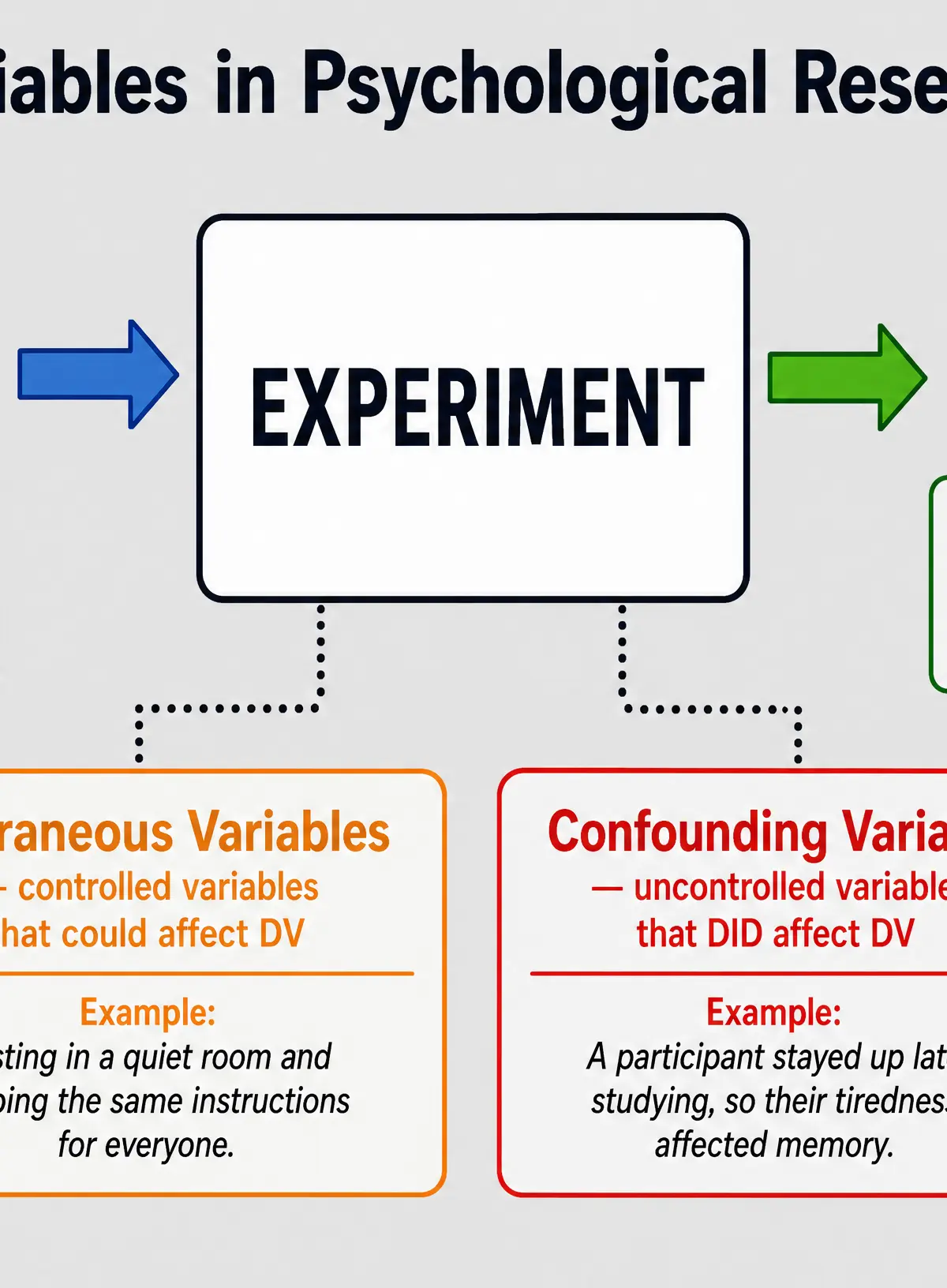
Role: The core components of any experiment.
Key Actions: Researchers manipulate the Independent Variable (IV) to observe its effect on the Dependent Variable (DV).
Impact: Proper control of variables is what allows psychologists to establish cause and effect.
Specific Knowledge:
- Operationalisation: Defining variables in a way that makes them precisely measurable (e.g., defining 'memory' as 'number of words recalled from a 20-word list').
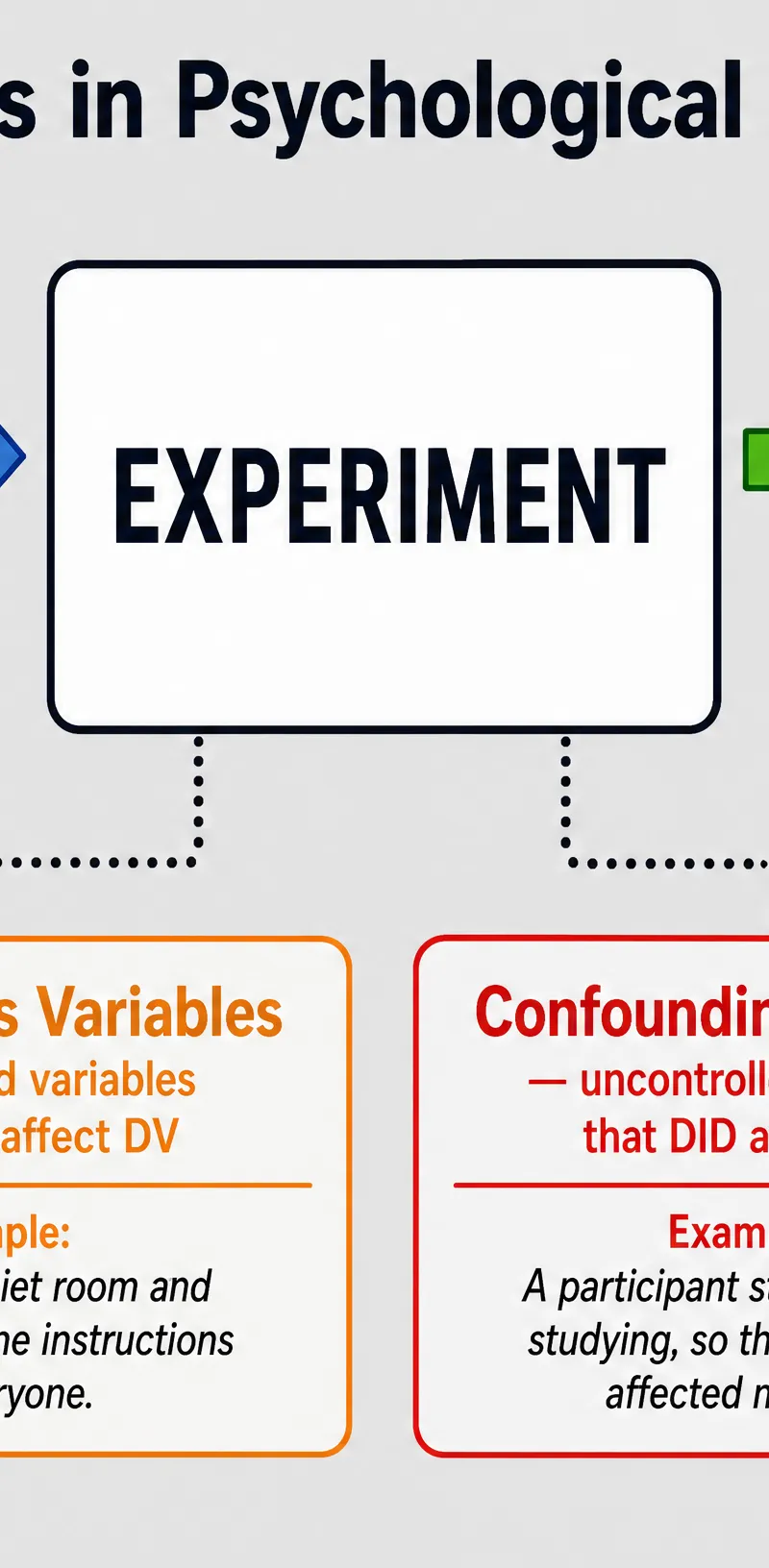
- Extraneous Variables: Any variable other than the IV that could affect the DV if not controlled.
- Confounding Variables: Uncontrolled extraneous variables that have systematically affected the DV, meaning we cannot be sure if the IV caused the change.
- Control Techniques: Random allocation, standardisation, counterbalancing.
Sampling Methods
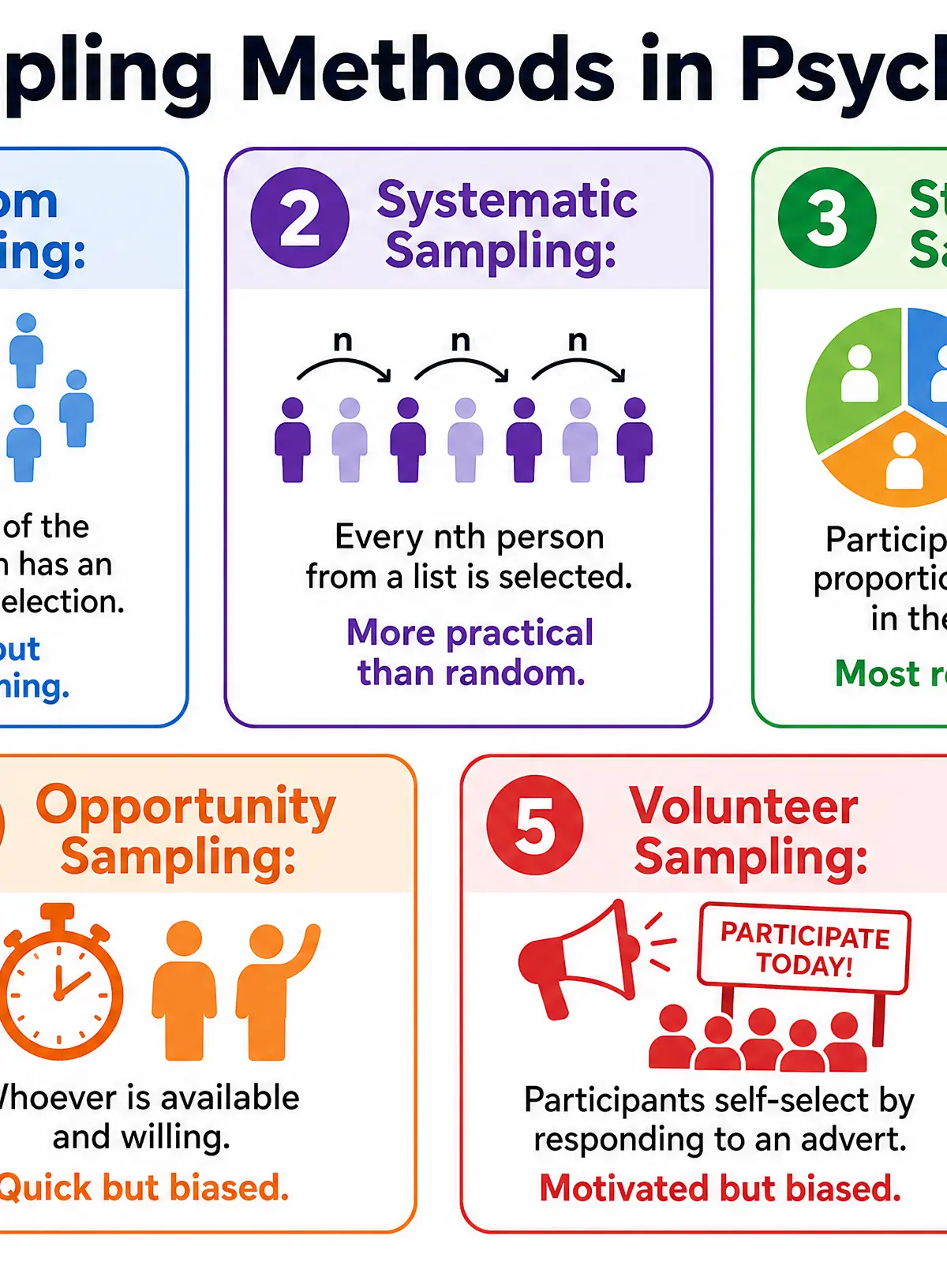
Role: Selecting participants for a study.
Key Actions: Researchers must choose a sample from the target population.
Impact: The sampling method determines how representative the sample is, and therefore how far the results can be generalised.
Specific Knowledge:
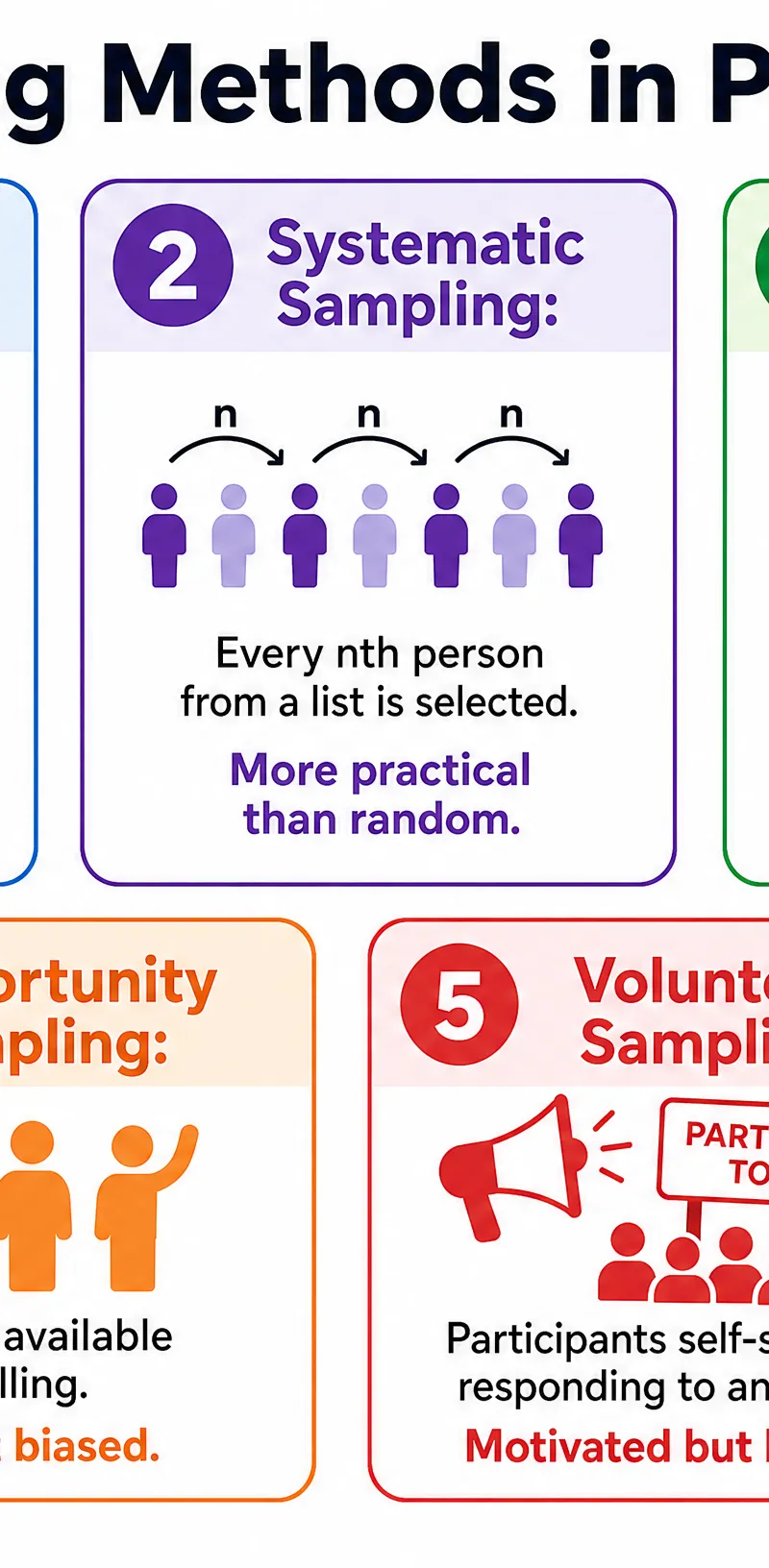
- Random: Every member of the target population has an equal chance of selection. Unbiased, but time-consuming.
- Systematic: Every nth person from a list is selected. Practical, but can be biased if the list has a hidden pattern.
- Stratified: The sample reflects the proportions of subgroups (strata) in the population. Highly representative, but very time-consuming.
- Opportunity: Selecting whoever is available and willing. Quick and easy, but highly biased.
- Volunteer: Participants self-select by responding to an advert. Participants are motivated, but volunteer bias occurs (they may share specific traits).
Experimental Designs
Role: Allocating participants to experimental conditions.
Specific Knowledge:
- Independent Groups: Different participants in each condition. Avoids order effects, but participant variables may confound results.
- Repeated Measures: The same participants in all conditions. Controls participant variables, but introduces order effects (practice/fatigue). Managed via counterbalancing.
- Matched Pairs: Different participants in each condition, but matched on key variables (e.g., age, IQ). Reduces participant variables without order effects, but time-consuming to match perfectly.
Ethics and the BPS Code
Role: Protecting participants and the reputation of psychology.
Specific Knowledge:
- Informed Consent: Participants must agree to take part knowing the true aims of the study.
- Deception: Misleading participants is generally avoided, but permitted if scientifically justified and followed by a full debrief.
- Protection from Harm: Participants must not face greater physical or psychological risk than in everyday life.
- Confidentiality: Personal data must be kept private (often via anonymity).
- Right to Withdraw: Participants can leave the study at any time and have their data destroyed.
Podcast Audio Lesson
Listen to our comprehensive 13-minute audio lesson covering all the core concepts of Scientific Processes, complete with exam tips and a quick-fire recall quiz.
Visual Resources
3 diagrams and illustrations
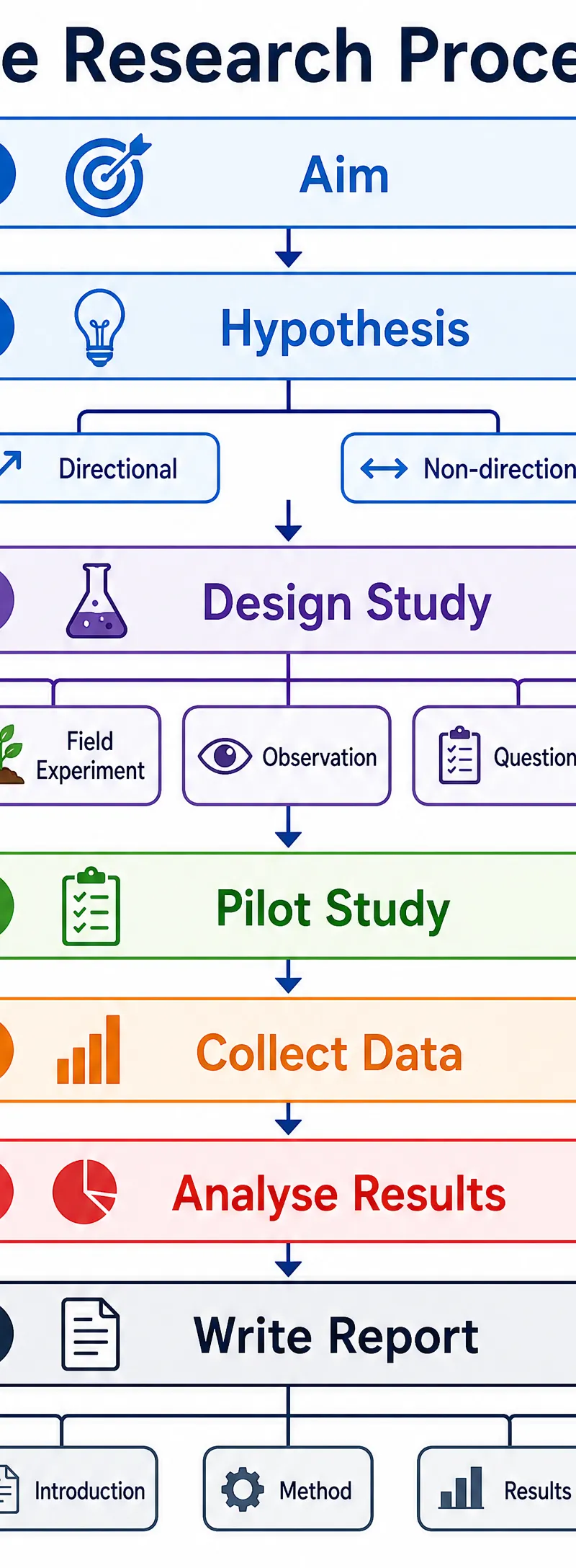
Interactive Diagrams
1 interactive diagram to visualise key concepts
Conceptual Flow Outline
The Scientific Research Cycle
Worked Examples
3 worked examples — open one to explore the question and available guidance.
Practice Questions
Try the question, then reveal an answer plan or example response
A psychologist wants to investigate whether listening to music affects revision. She recruits 30 students from her college. Half revise in silence, half revise while listening to pop music. She then gives them a 20-question memory test. Identify the experimental design used in this study and explain one limitation of this design. (3 marks)
Hint: Look at how the participants are allocated to the conditions. Are they doing one condition or both?
Write a fully operationalised, directional hypothesis for the study described above. (3 marks)
Hint: Directional means you must state who will do better. Operationalised means you must mention exactly how it is measured (the 20-question test).
Explain the difference between a sample and a target population. (2 marks)
Hint: Think about which group is larger and which group actually takes part in the research.
Evaluate the use of volunteer sampling in psychological research. (4 marks)
Hint: You need to provide both strengths and limitations to evaluate effectively.
Explain what is meant by 'peer review' and why it is an important feature of science. (4 marks)
Hint: What happens before a psychological study is published in a journal? Why do we need other experts to look at it?
Exam technique
How to turn what you know into marks
How to approach the question
Always read the stimulus/scenario twice. Underline key variables, the sample, and the design before you start writing.
How to structure your answer
- Explain questions
- Make your point, then explain WHY it is the case, linking back to the scenario if one is provided.
- Evaluate questions
- Provide balanced arguments. State a strength, explain why it's a strength. State a limitation, explain why it's a limitation.
- Design a study questions
- Use subheadings: Aim/Hypothesis, Sample, Design/Procedure, Variables/Controls, Ethics.
Timing
Approximately 1 minute per mark, leaving time at the end to check your work.
Common pitfalls
- Failing to operationalise variables when asked to write a hypothesis.
- Confusing extraneous variables (controlled) with confounding variables (uncontrolled).
- Giving generic definitions without applying them to the specific scenario provided in the question.
What the command words want
- Design
- Provide a step-by-step, replicable plan covering sample, design, variables, and procedure.
- Explain
- Make a point and provide reasoning or detail to support it.
- Evaluate
- Discuss strengths and limitations, leading to a reasoned conclusion.
- Identify
- Simply name the concept (e.g., 'Independent groups design'). No explanation needed.
Watch or listen (optional)
Test your understanding of Scientific processes
Active recall beats re-reading. Take an instant quiz now to test what you’ve learned and lock it into long-term memory.
7 days Premium · Then the free plan continues · No card, no charge