Pearson Edexcel · A-Level · Psychology
Course version: Pearson-A-Level-Psychology · Version from Mar 2026
Topic 2: Cognitive psychology
Cognitive psychology explores the internal mental processes that dictate how we think, learn, and remember. Understanding models like the Multi-Store Model and the Working Memory Model is crucial for explaining human behaviour and answering high-mark evaluation questions.
- 4 min read
- 3 worked examples
- 5 practice questions
- 6 key terms
Check what you remember
Read the wording for your board, then hide it and explain Encoding in your own words. Rough notes are fine. This is a self-check, with no mark or grade.
Reference: Pearson Edexcel
The format in which information is stored in the various memory stores (e.g., acoustic, visual, semantic).
Study Notes
Overview
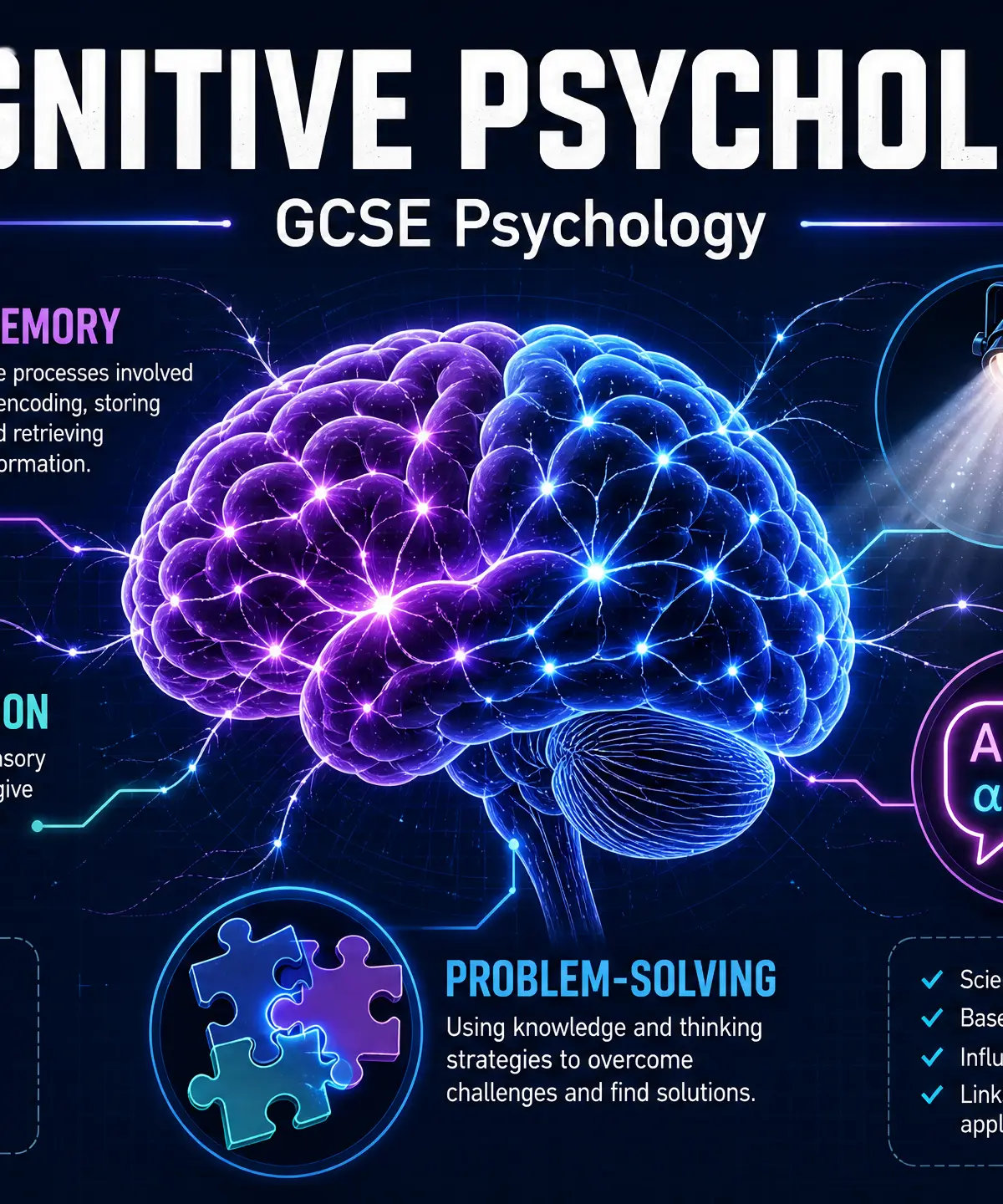
Cognitive psychology is the scientific study of internal mental processes, including memory, perception, attention, language, and problem-solving. For the GCSE Psychology specification, the primary focus is on Memory—how information is encoded, stored, and retrieved, as well as why we forget. Examiners expect candidates to demonstrate precise knowledge of key theoretical models, specifically Atkinson and Shiffrin's Multi-Store Model and Baddeley and Hitch's Working Memory Model. Furthermore, you must be able to evaluate these models using empirical evidence, such as the classic eyewitness testimony study by Loftus and Palmer (1974). A strong grasp of this topic requires not just recalling facts, but applying these theories to real-world scenarios, such as police interviews.
Key Theoretical Models
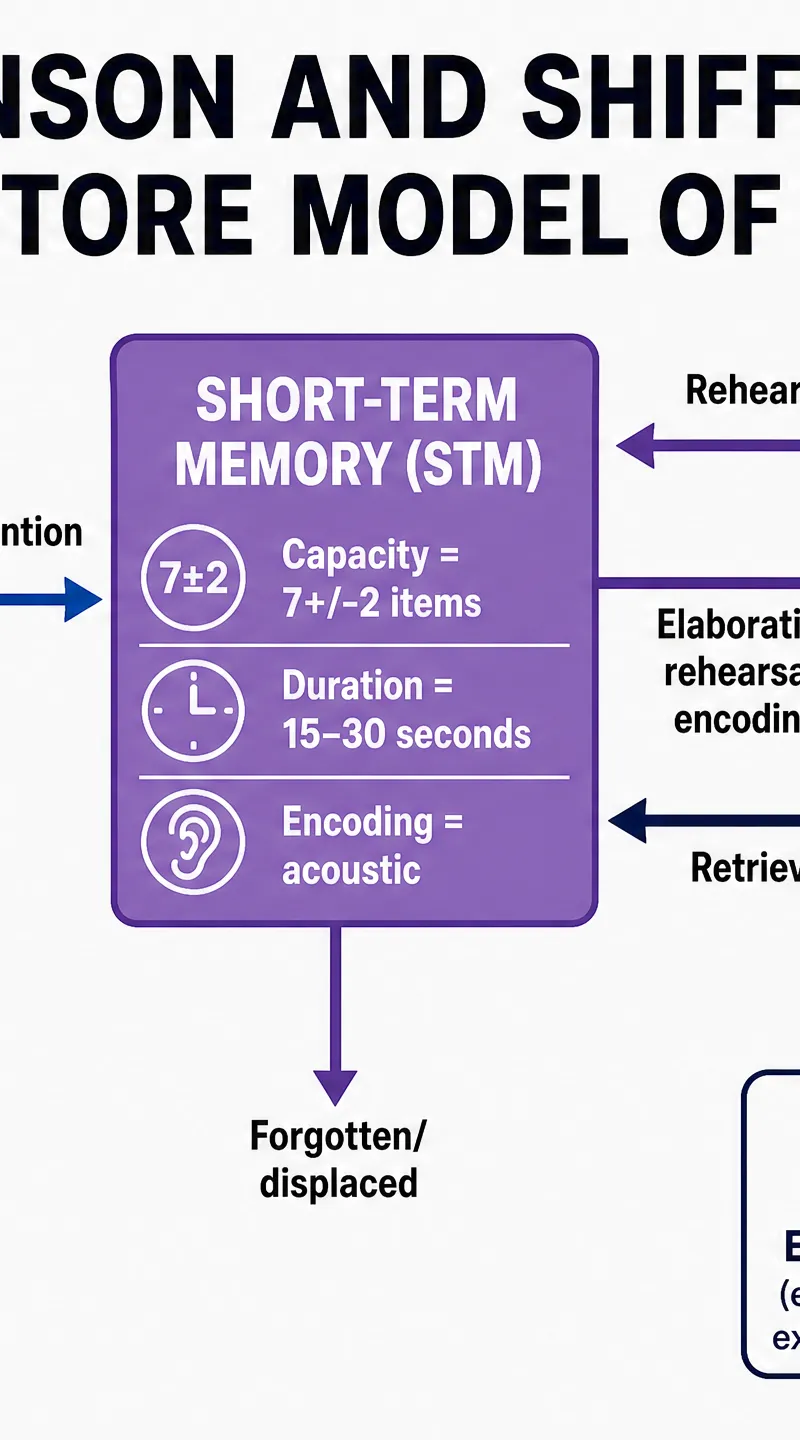
The Multi-Store Model of Memory (Atkinson & Shiffrin, 1968)
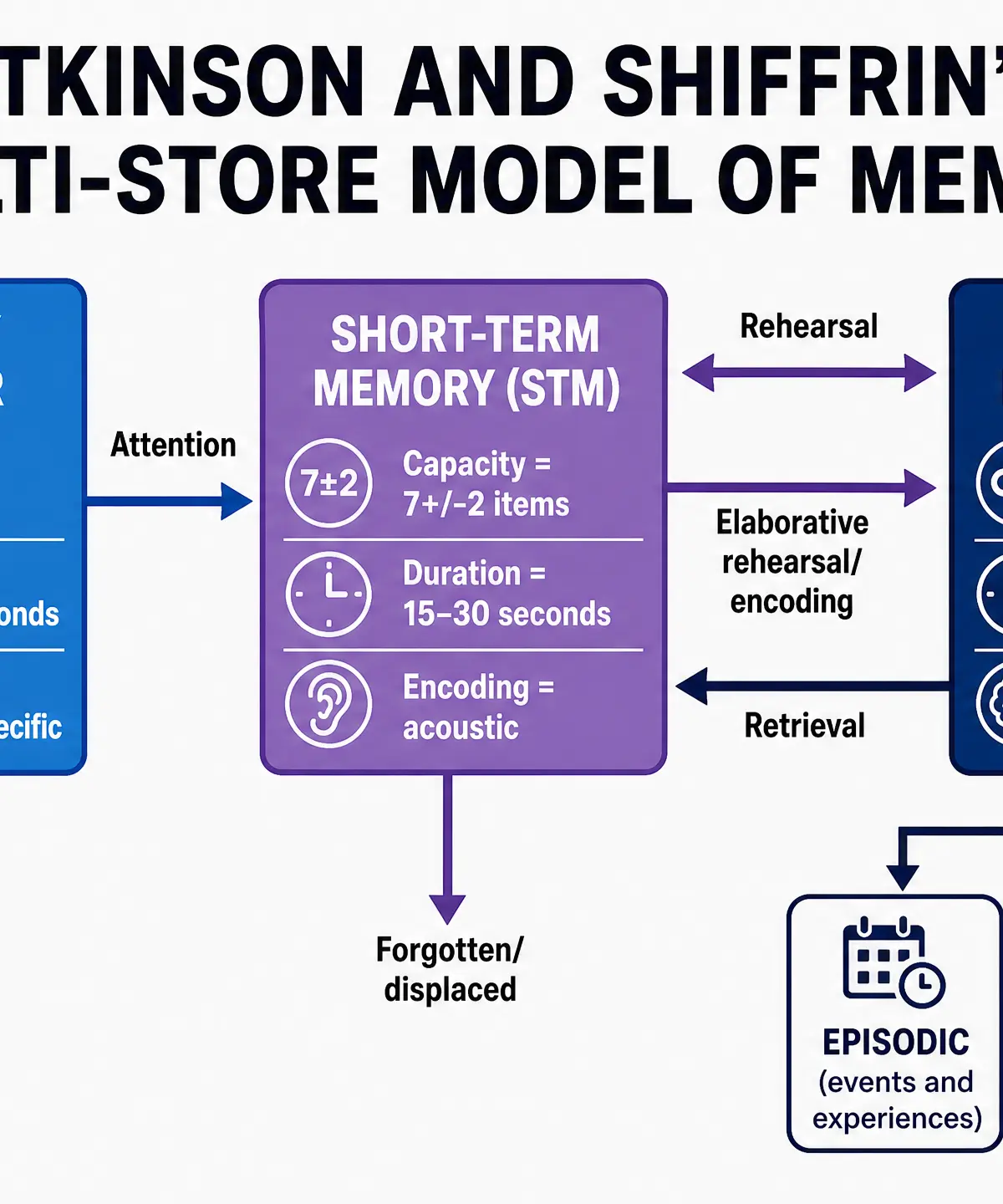
What it is: A structural model proposing that memory consists of three separate, linear stores: the Sensory Register, Short-Term Memory (STM), and Long-Term Memory (LTM).
Specific Knowledge:
- Sensory Register: Capacity is unlimited; Duration is very brief (0.25 - 2 seconds); Encoding is modality-specific (e.g., iconic for visual, echoic for acoustic). Information passes to STM only if attention is paid.
- Short-Term Memory (STM): Capacity is 7 ± 2 items (Miller, 1956); Duration is 15-30 seconds without rehearsal; Encoding is primarily acoustic. Information is maintained via maintenance rehearsal.
- Long-Term Memory (LTM): Capacity is unlimited; Duration is up to a lifetime (Bahrick et al., 1975); Encoding is primarily semantic (by meaning). Information is transferred here via elaborative rehearsal.
Why it matters: It provides a foundational framework for understanding memory architecture, but examiners frequently ask candidates to evaluate its simplicity.
The Working Memory Model (Baddeley & Hitch, 1974)
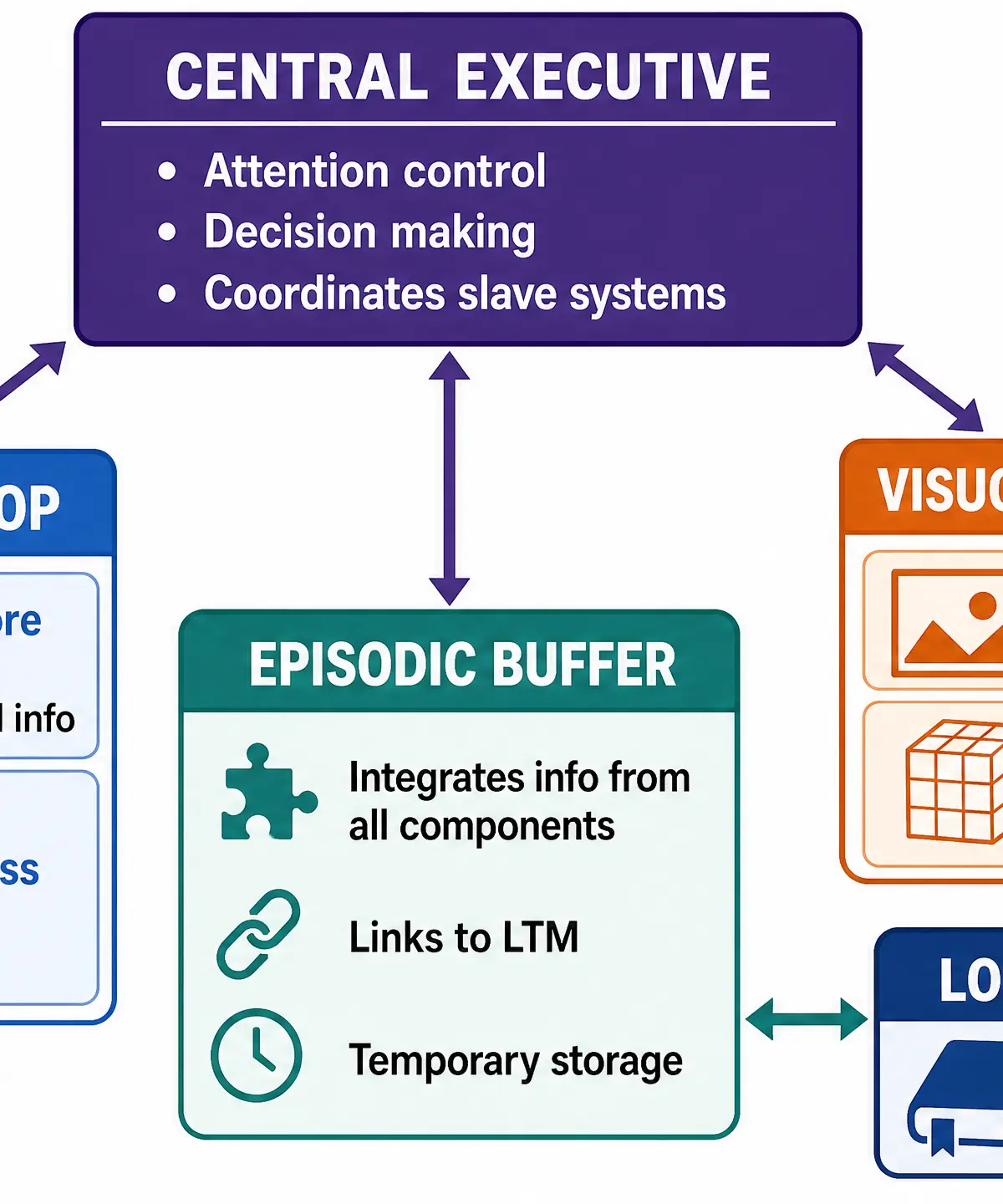
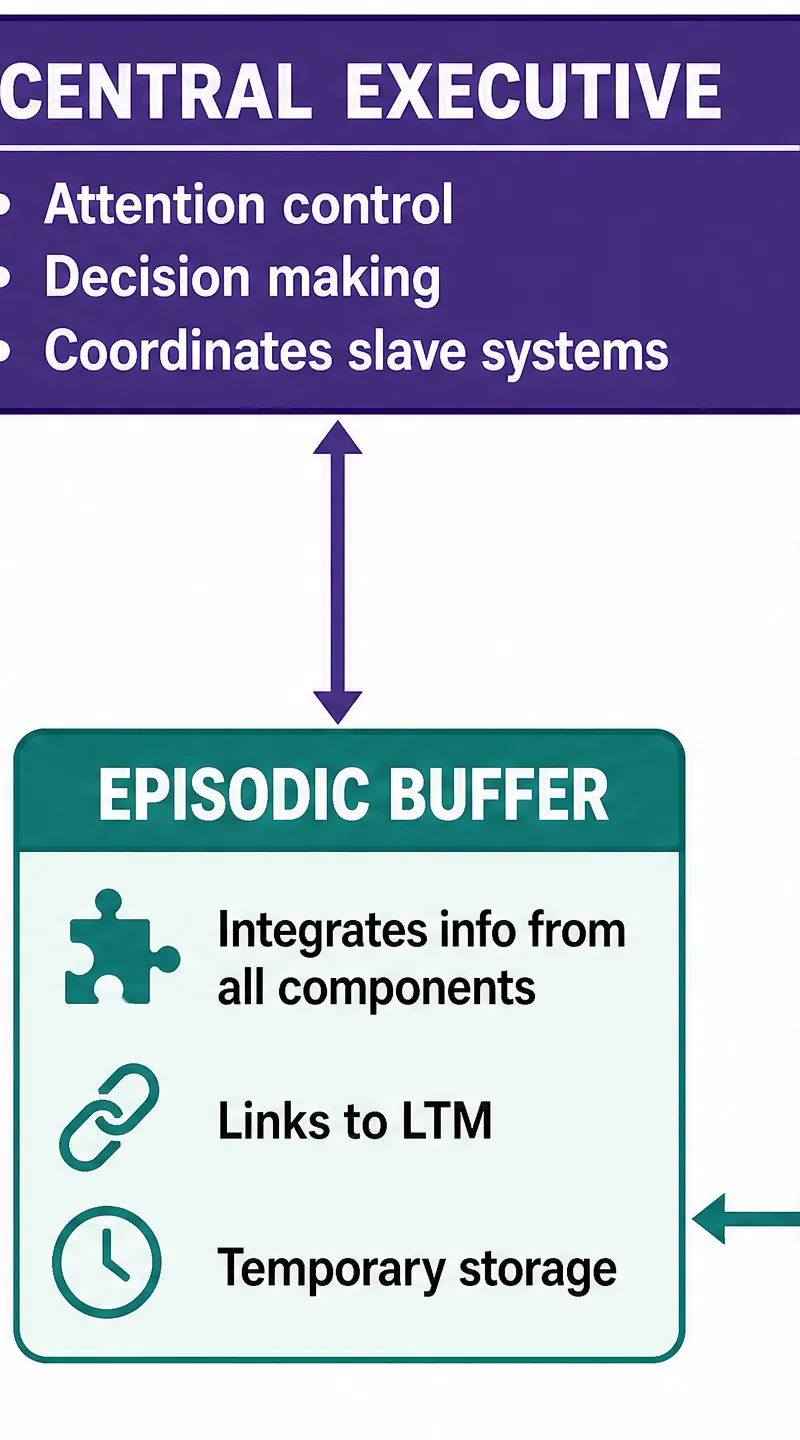
What it is: A multi-component model that replaced the idea of a unitary STM, suggesting that short-term memory is an active processor consisting of multiple slave systems coordinated by a central executive.
Specific Knowledge:
- Central Executive: The 'boss' that directs attention and coordinates the slave systems. It has very limited capacity.
- Phonological Loop: Deals with auditory information. Divided into the Phonological Store (inner ear) and the Articulatory Process (inner voice).
- Visuospatial Sketchpad: Deals with visual and spatial information (inner eye). Divided into the Visual Cache and Inner Scribe.
- Episodic Buffer: Added in 2000, it integrates information from the other components and links to LTM.
Why it matters: It explains how we can perform dual tasks (e.g., reading while listening to music) if they use different slave systems, which the Multi-Store Model cannot explain.
Classic Studies
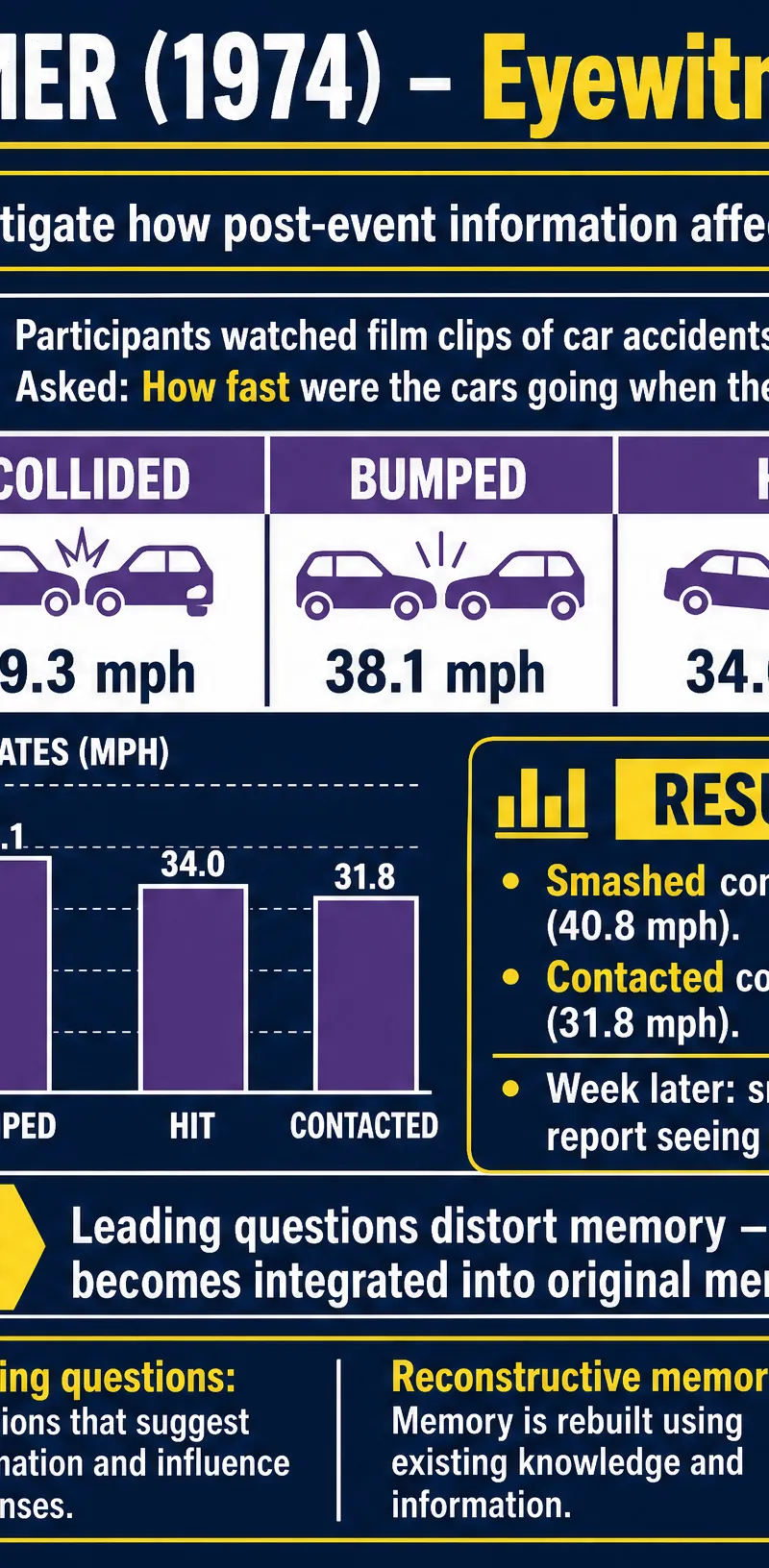
Loftus and Palmer (1974) - Eyewitness Testimony
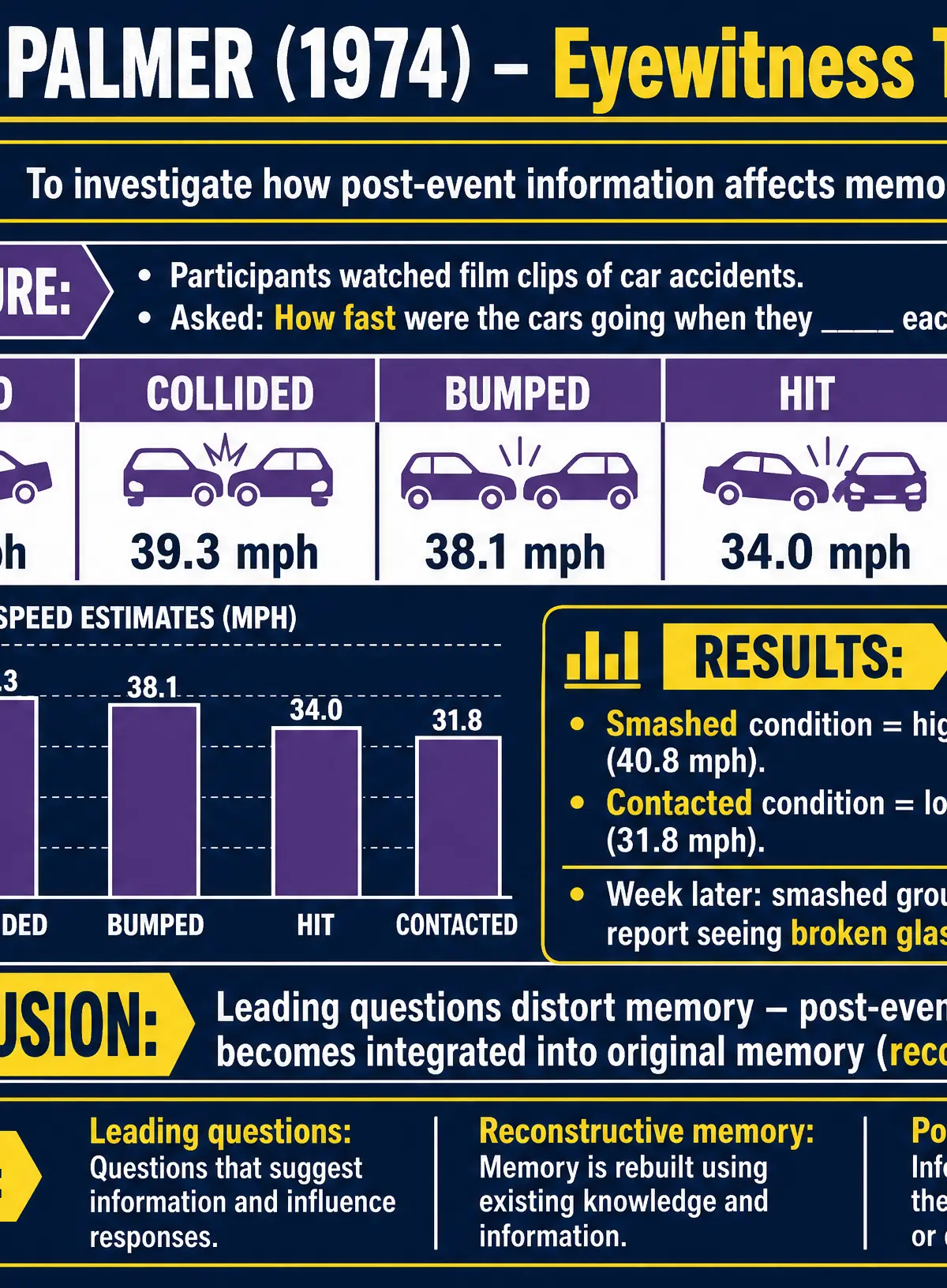
Aim: To investigate the effect of leading questions on the accuracy of eyewitness testimony.
Procedure: Participants watched film clips of car accidents and were then asked questions about the speed of the cars. The critical question varied the verb used: "How fast were the cars going when they smashed / collided / bumped / hit / contacted each other?"
Results: The estimated speed was influenced by the verb. The 'smashed' condition gave the highest mean estimate (40.8 mph), while 'contacted' gave the lowest (31.8 mph). In a follow-up, the 'smashed' group was more likely to falsely report seeing broken glass.
Conclusion: Leading questions can distort memory. This supports the concept of reconstructive memory—the idea that memory is not a perfect recording but is rebuilt using post-event information.
Audio Revision
Listen to this comprehensive 10-minute podcast covering all the key concepts, examiner tips, and a quick-fire recall quiz.
Visual Resources
3 diagrams and illustrations
Interactive Diagrams
1 interactive diagram to visualise key concepts
Conceptual Flow Outline
Simplified flow of Atkinson and Shiffrin's Multi-Store Model
Worked Examples
3 worked examples — open one to explore the question and available guidance.
Practice Questions
Try the question, then reveal an answer plan or example response
A student is revising for an exam while listening to a podcast. According to the Working Memory Model, explain why the student might find it difficult to concentrate on both tasks. (3 marks)
Hint: Think about which component of the Working Memory Model processes both reading (sub-vocalising) and listening to audio.
Outline one difference between episodic memory and semantic memory. (2 marks)
Hint: Compare what type of information is stored in each.
Evaluate the use of lab experiments in cognitive psychology. (4 marks)
Hint: Give one strength (think about control) and one weakness (think about real life).
Identify the capacity and duration of Short-Term Memory. (2 marks)
Hint: Think of Miller's magic number and the time before decay.
Describe the procedure of Loftus and Palmer's (1974) first experiment. (4 marks)
Hint: What did participants watch? What were they asked? What was the independent variable?
Exam technique
How to turn what you know into marks
How to approach the question
Always identify the command word and the Assessment Objective (AO) being tested. Highlight the specific theory or study requested.
How to structure your answer
- Essay questions
- Introduction outlining the theory → Paragraph of Knowledge (AO1) → Paragraph of Application/Explanation (AO2) → Two paragraphs of balanced Evaluation (AO3) → Brief conclusion.
- Source questions
- Apply your knowledge directly to the stem/scenario provided. Do not just write out theory without linking it to the character in the question.
- Explain questions
- Use PEEL structure: Point, Evidence (specific knowledge), Explanation, Link to question.
Timing
Approximately 1 minute per mark, plus planning time for longer questions
Common pitfalls
- Confusing the Multi-Store Model with the Working Memory Model.
- Evaluating a study by just saying 'it lacks ecological validity' without explaining *why* that matters for the specific findings.
- Forgetting specific data points (e.g., writing 'smashed was faster' instead of 'smashed estimated 40.8 mph').
What the command words want
- Discuss
- Requires both description (knowledge) and evaluation (strengths/weaknesses).
- Explain
- Give reasons how or why something happens. Use words like 'because' or 'therefore'.
- Describe
- Give a detailed account of the theory, model, or study procedure/results. No evaluation needed.
- Evaluate
- Judge the value or success of a theory or study. Must include both strengths and weaknesses.
Watch or listen (optional)
Test your understanding of Topic 2: Cognitive psychology
Active recall beats re-reading. Take an instant quiz now to test what you’ve learned and lock it into long-term memory.
7 days Premium · Then the free plan continues · No card, no charge