OCR · A-Level · Psychology
Piliavin et al. (1969) - Bystander Behaviour
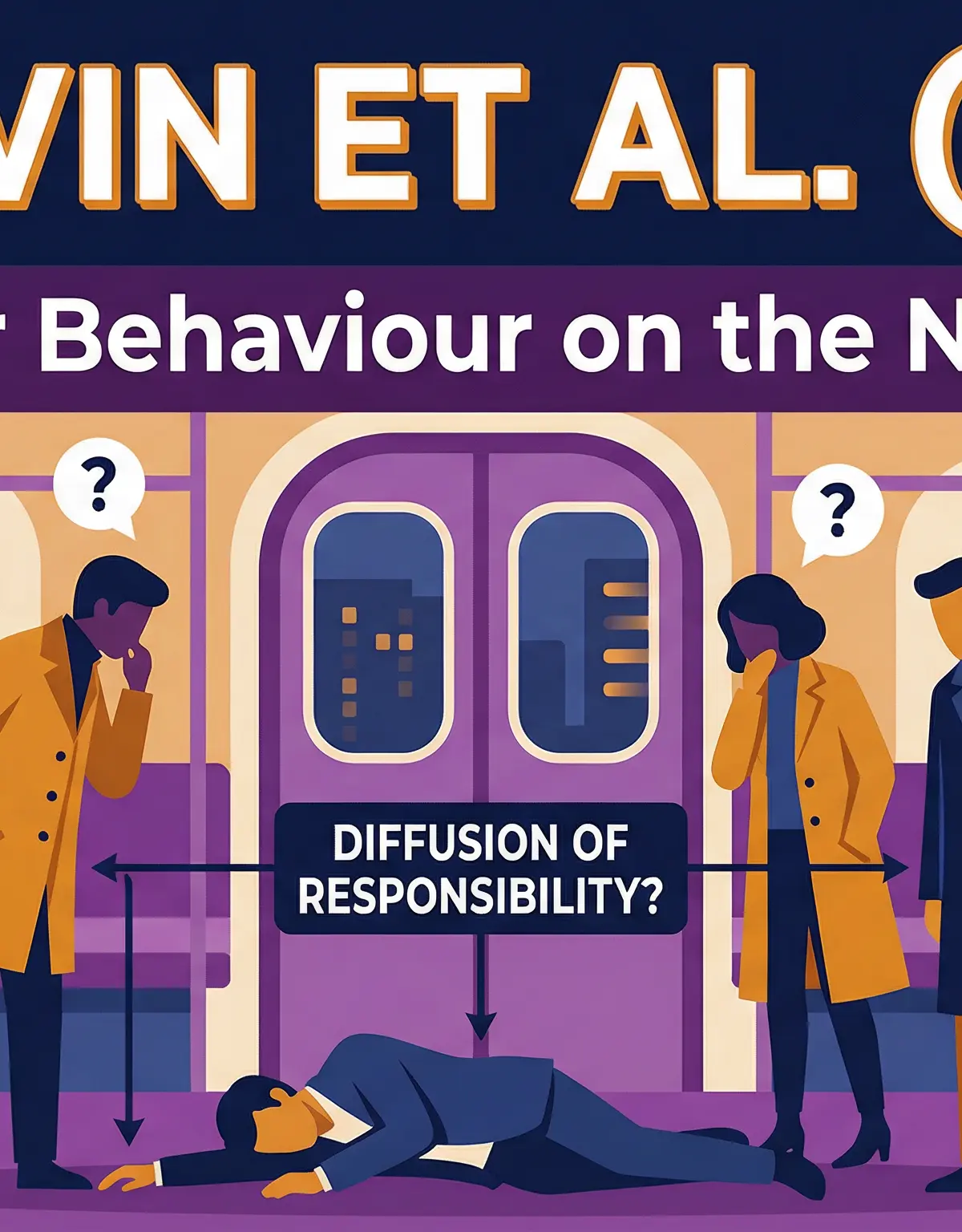
Piliavin et al.\'s (1969) groundbreaking subway study challenged the famous \'diffusion of responsibility\' theory, revealing that in a real-life emergency, people help far more than expected. This guide breaks down why this study is crucial for your exam, focusing on the Arousal: Cost-Reward Model and the specific statistics you need to earn top marks."
- 4 min read
- 3 worked examples
- 5 practice questions
Study Notes
Overview
Piliavin, Rodin, and Piliavin's (1969) study, 'Good Samaritanism: An Underground Phenomenon?' is a cornerstone of the Social Area in OCR A-Level Psychology. This audacious field experiment, conducted on the New York City subway, directly challenged the then-dominant theory of 'diffusion of responsibility' popularised by Latané and Darley. Instead of finding that more bystanders led to less helping, Piliavin et al. discovered surprisingly high rates of spontaneous assistance, particularly for a victim who appeared ill rather than drunk. Examiners expect candidates to understand not just the procedure and findings, but to explain them using the Arousal: Cost-Reward Model. This study is significant because it demonstrated the power of the situation in shaping behaviour and provided a more nuanced model for understanding why people do—and don't—intervene in emergencies. Mastery of this study requires precise knowledge of the four independent variables, the key statistical differences in helping rates, and a balanced evaluation of its high ecological validity against its significant ethical breaches.

The Arousal: Cost-Reward Model
At the heart of Piliavin et al.'s explanation is the Arousal: Cost-Reward Model. This is the theoretical framework you MUST use to explain the results. It proposes that observing an emergency is an emotionally arousing experience that creates an unpleasant state of tension. The bystander is motivated to reduce this arousal. They then conduct a rapid, often unconscious, cost-benefit analysis to decide on a course of action.
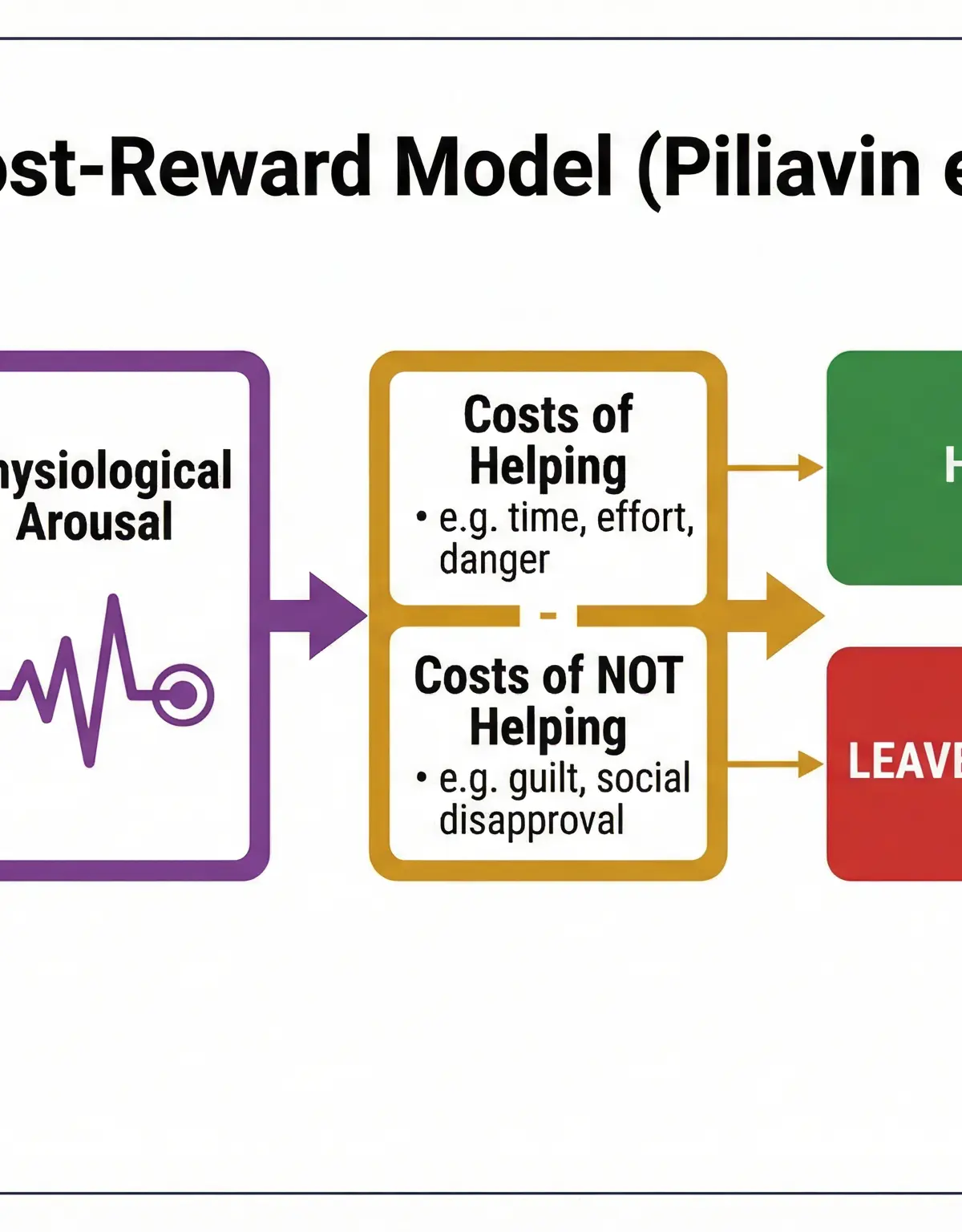
The Costs of Helping:
- Effort and time
- Potential physical harm (especially with the drunk victim)
- Embarrassment or social awkwardness
The Costs of NOT Helping:
- Guilt and self-blame
- Social disapproval from other bystanders
- Continued physiological arousal from seeing the victim in distress
The model predicts that bystanders will choose the response that most effectively reduces their arousal at the lowest possible cost. For the 'cane' victim, the costs of helping were low and the costs of not helping were high (e.g., high guilt), leading to high rates of helping. For the 'drunk' victim, the costs of helping were higher (e.g., potential danger, disgust), leading to lower rates of helping.
Research Design and Key Findings
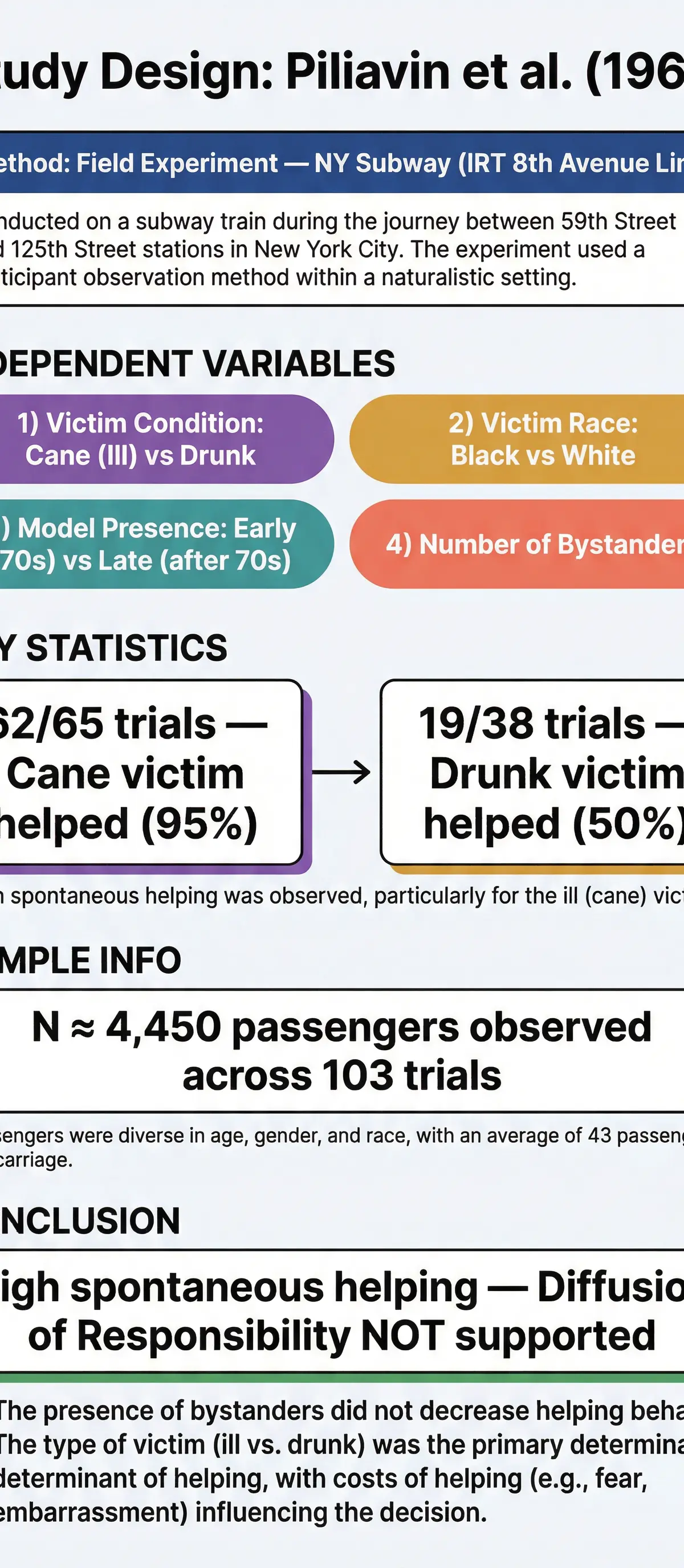
Independent and Dependent Variables
- Independent Variables (IVs): The factors manipulated by the researchers.
- Victim Responsibility: Cane (ill) vs. Drunk.
- Victim Race: Black vs. White.
- Presence of a Model: A confederate helped after 70s (Early) or 150s (Late).
- Number of Bystanders: The naturally occurring number of passengers in the carriage.
- Dependent Variables (DVs): The behaviours measured by the observers.
- Frequency of helping.
- Speed of helping.
- Race of the helper.
- Sex of the helper.
Key Statistical Findings
- Cane Victim: Received help in 62/65 (95%) of trials.
- Drunk Victim: Received help in 19/38 (50%) of trials.
- Spontaneous Help: 90% of first helpers were male.
- Race: A slight same-race helping bias was observed, but only in the drunk condition.
- Diffusion of Responsibility: NOT observed. The rate of helping was not lower when more bystanders were present. In fact, the highest helping rates were often in the most crowded carriages."
Worked Examples
3 worked examples — open one to explore the question and available guidance.
Practice Questions
Test your understanding — click to reveal model answers
Describe two features of the sample used in the study by Piliavin et al. (1969). (4 marks)
Hint: Think about the total number of participants and their demographic characteristics.
Explain one strength and one weakness of the field experiment method as used by Piliavin et al. (1969). (6 marks)
Hint: Link your points about strengths and weaknesses directly to the context of this study.
Outline the Arousal: Cost-Reward model proposed by Piliavin et al. (1969). (4 marks)
Hint: Break the model down into its key stages.
Outline one conclusion from the study by Piliavin et al. (1969). (2 marks)
Hint: Focus on one of the main findings.
Evaluate the ethics of the study by Piliavin et al. (1969). (10 marks)
Hint: Go beyond just listing issues. Weigh the costs (ethical breaches) against the benefits (scientific knowledge gained).