Memory Models Revision Notes
Subject: Psychology | Level: GCSE | Exam Board: OCR
This study guide provides a comprehensive overview of two foundational memory models for OCR GCSE Psychology: the Multi-Store Model and the Theory of Reconstructive Memory. It is designed to be exam-focused, providing candidates with the precise knowledge, key studies, and evaluation points needed to achieve top marks.
Revision Notes & Key Concepts
Revision Podcast Transcript
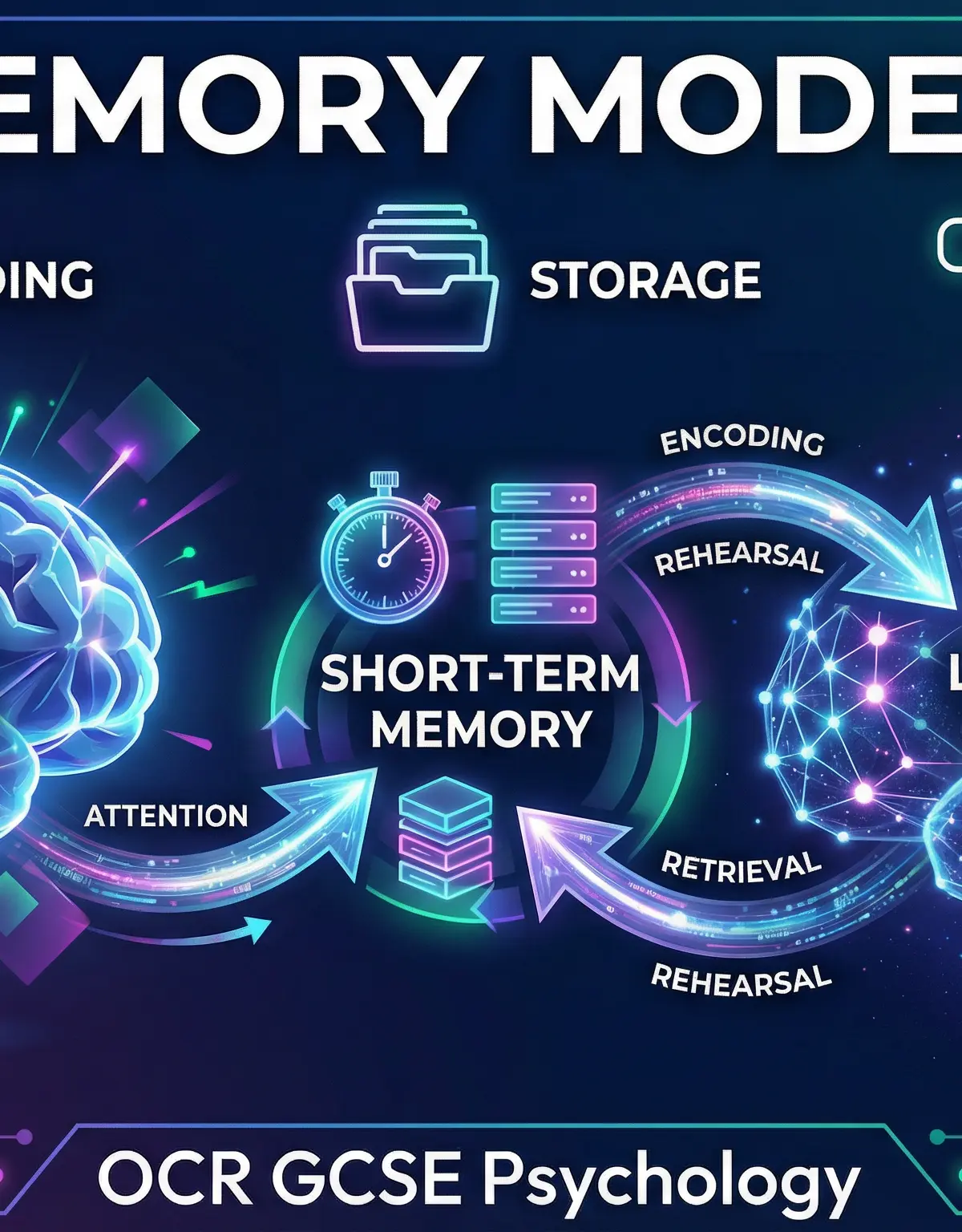
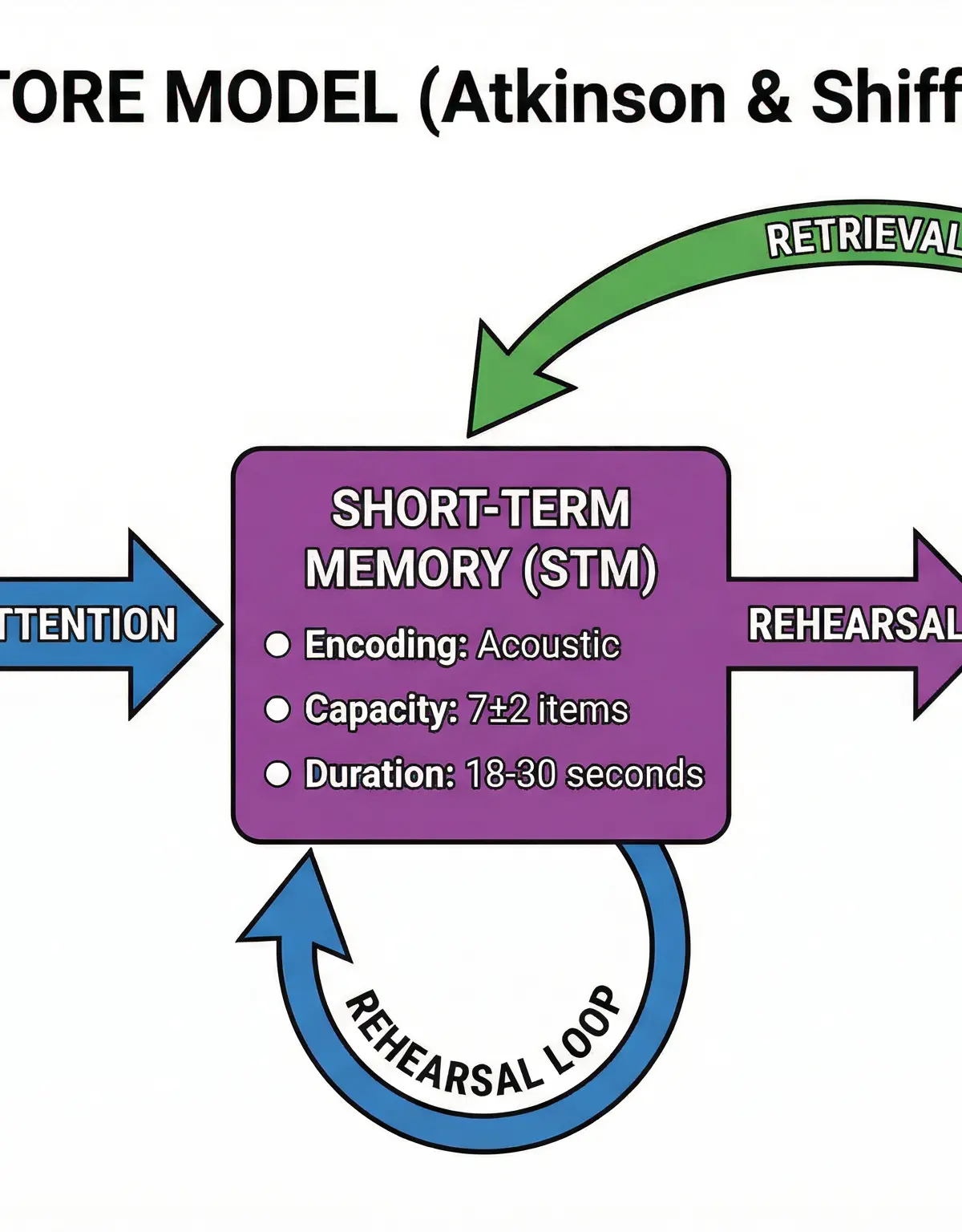
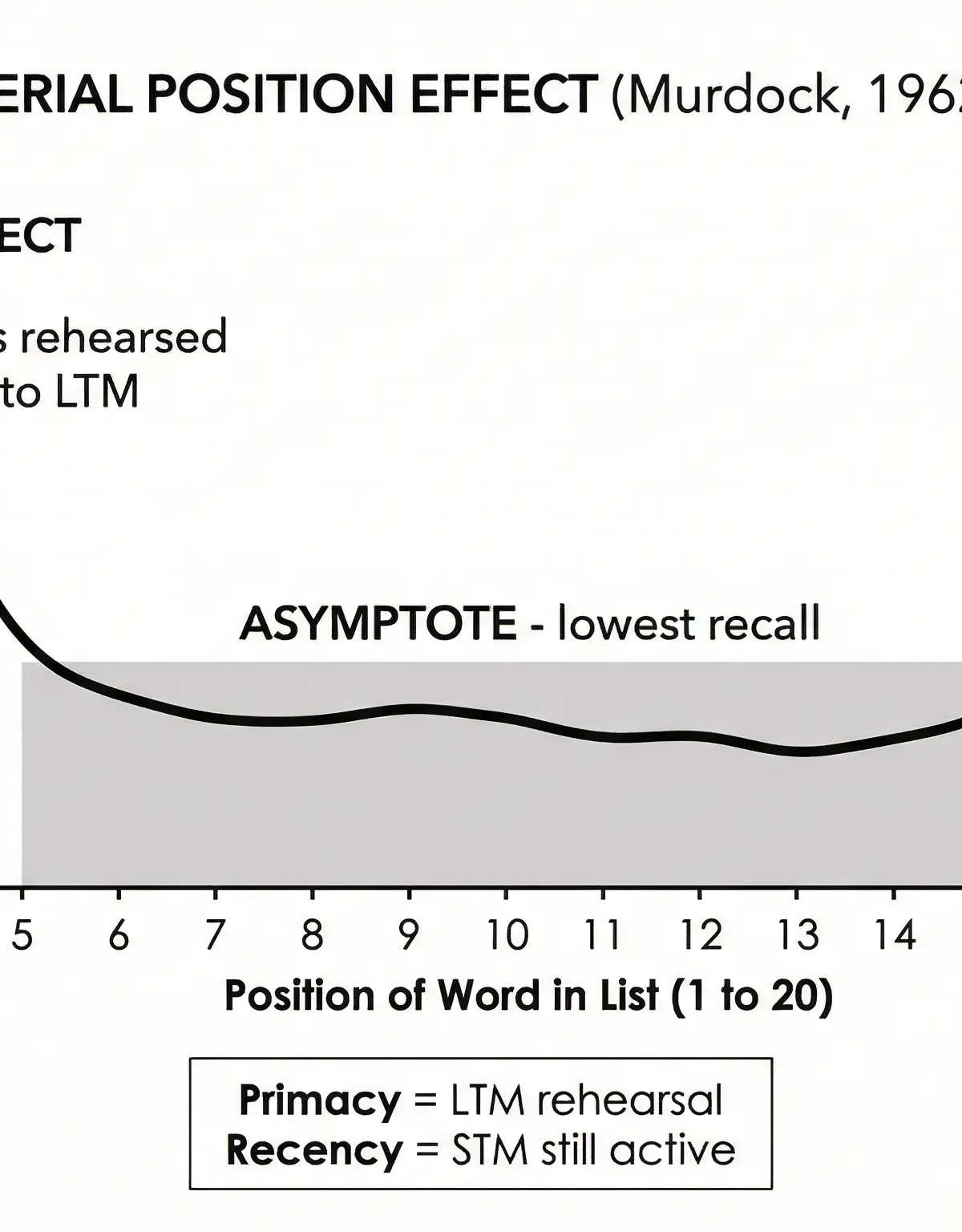
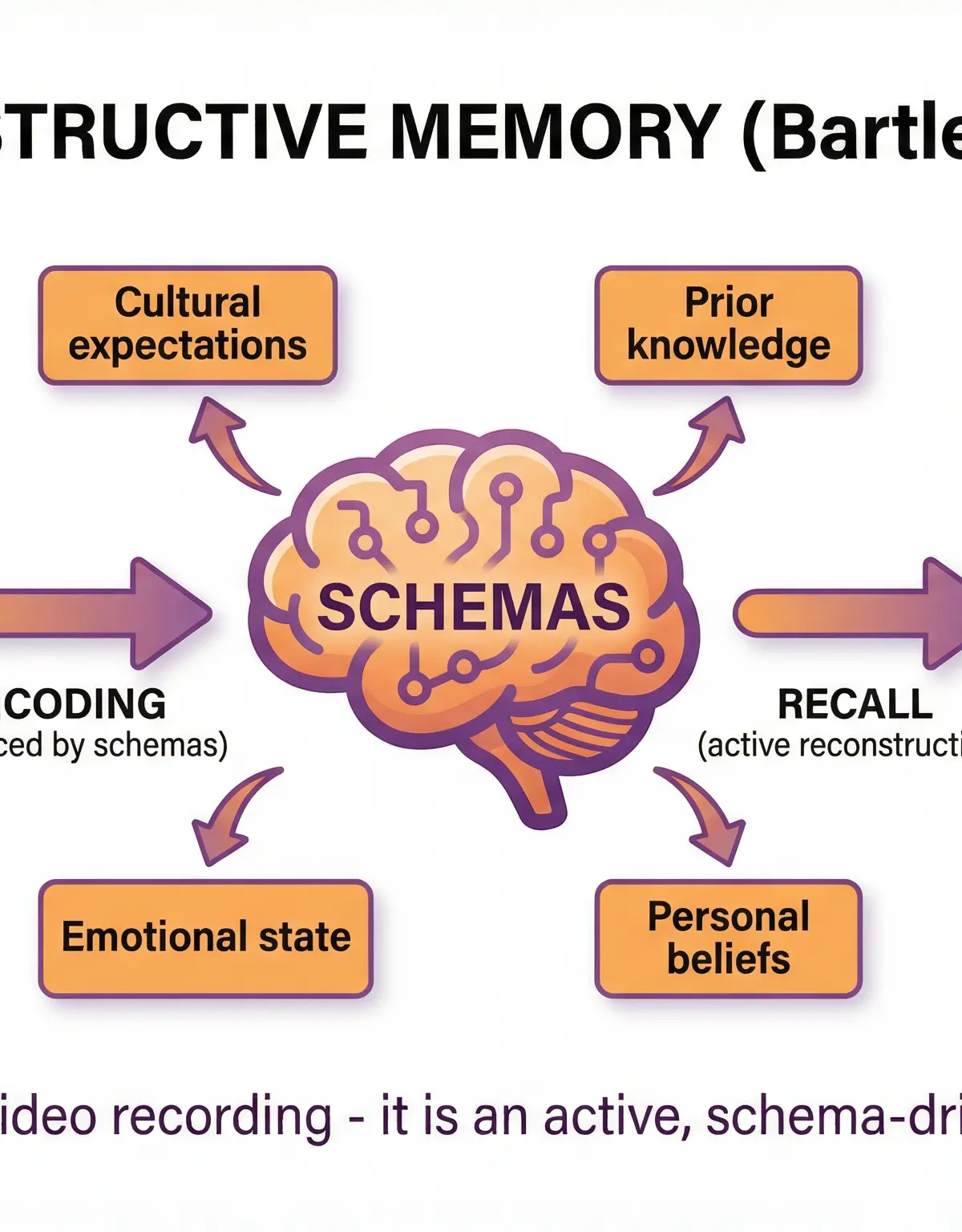
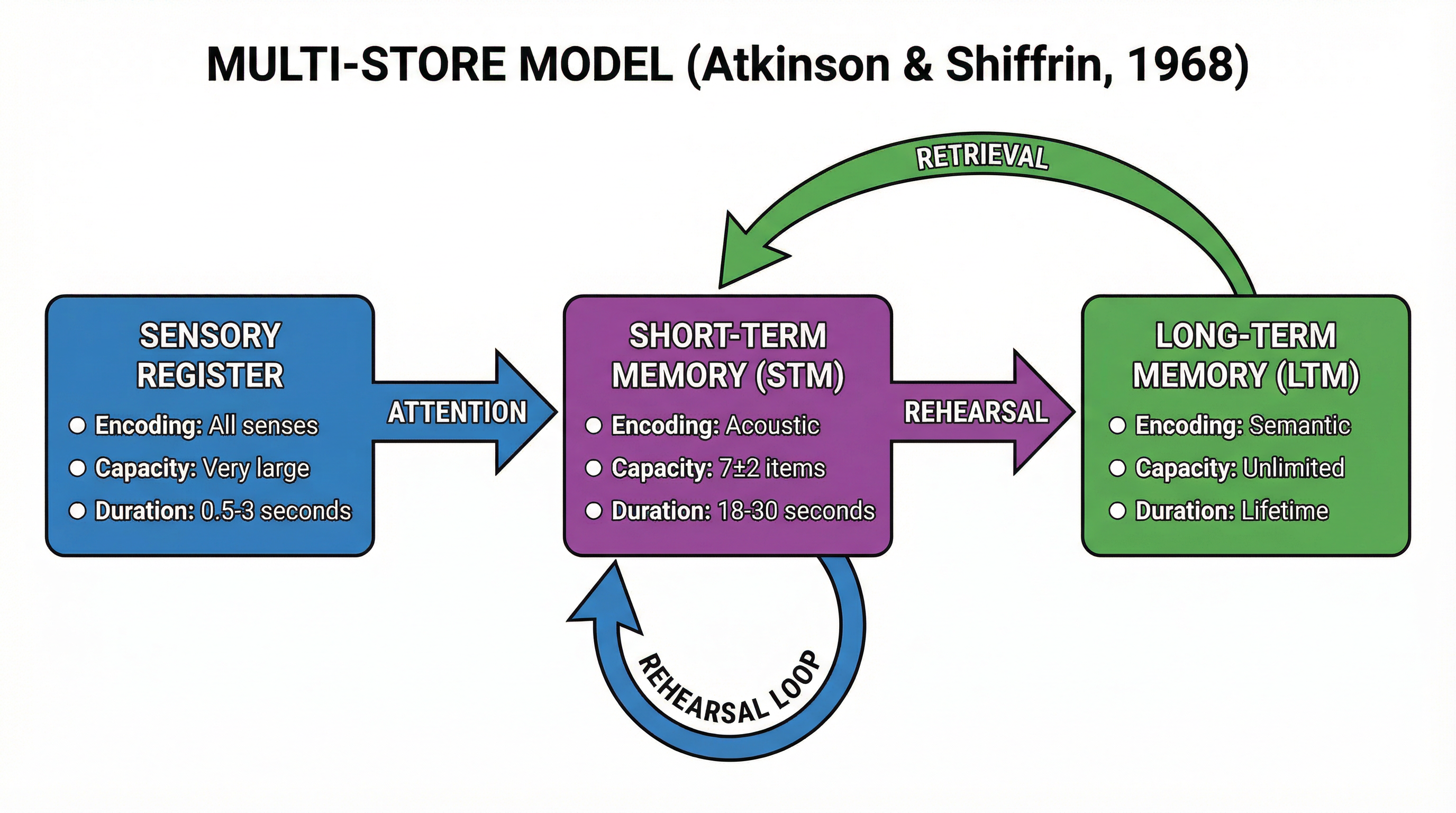
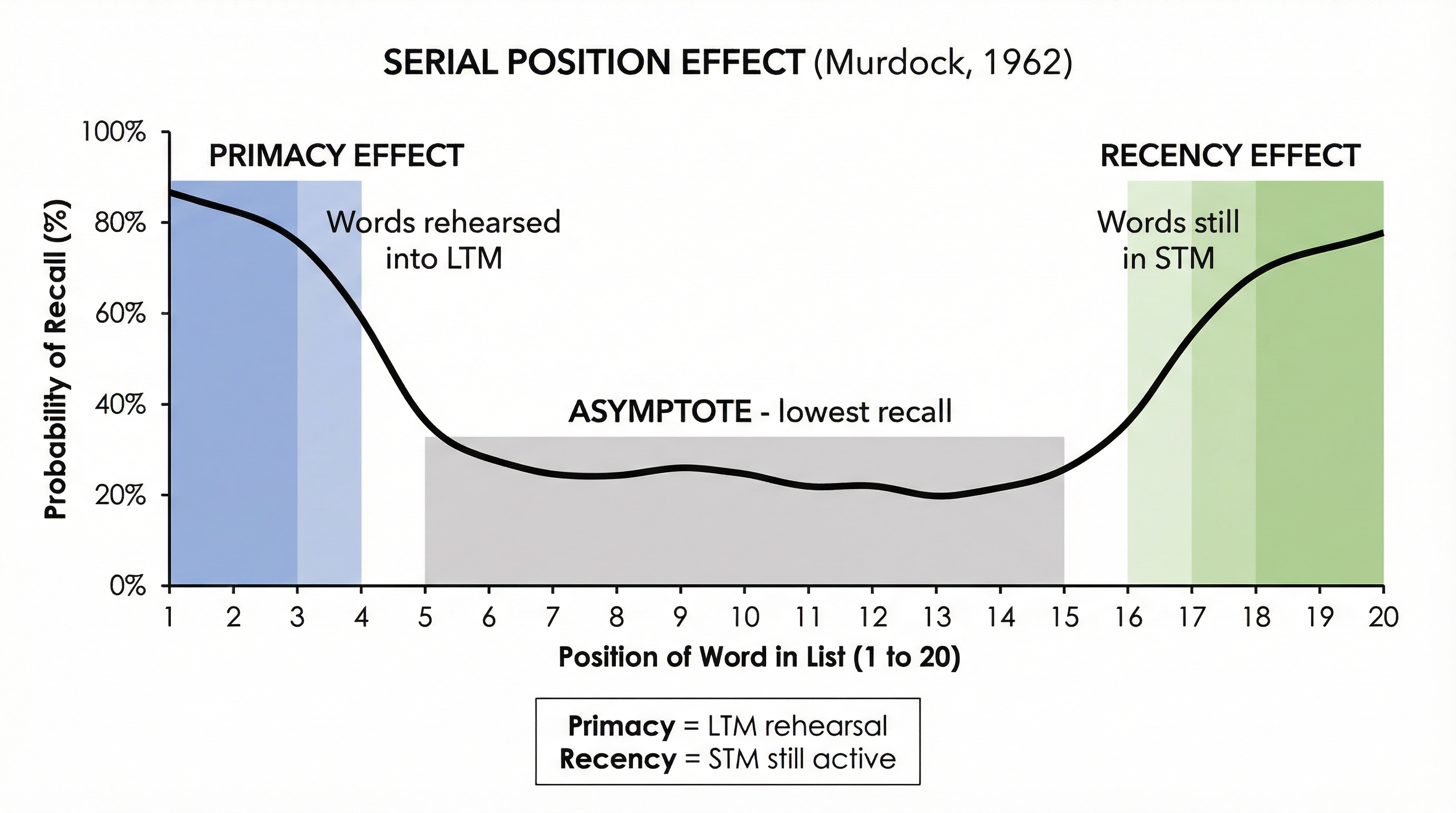
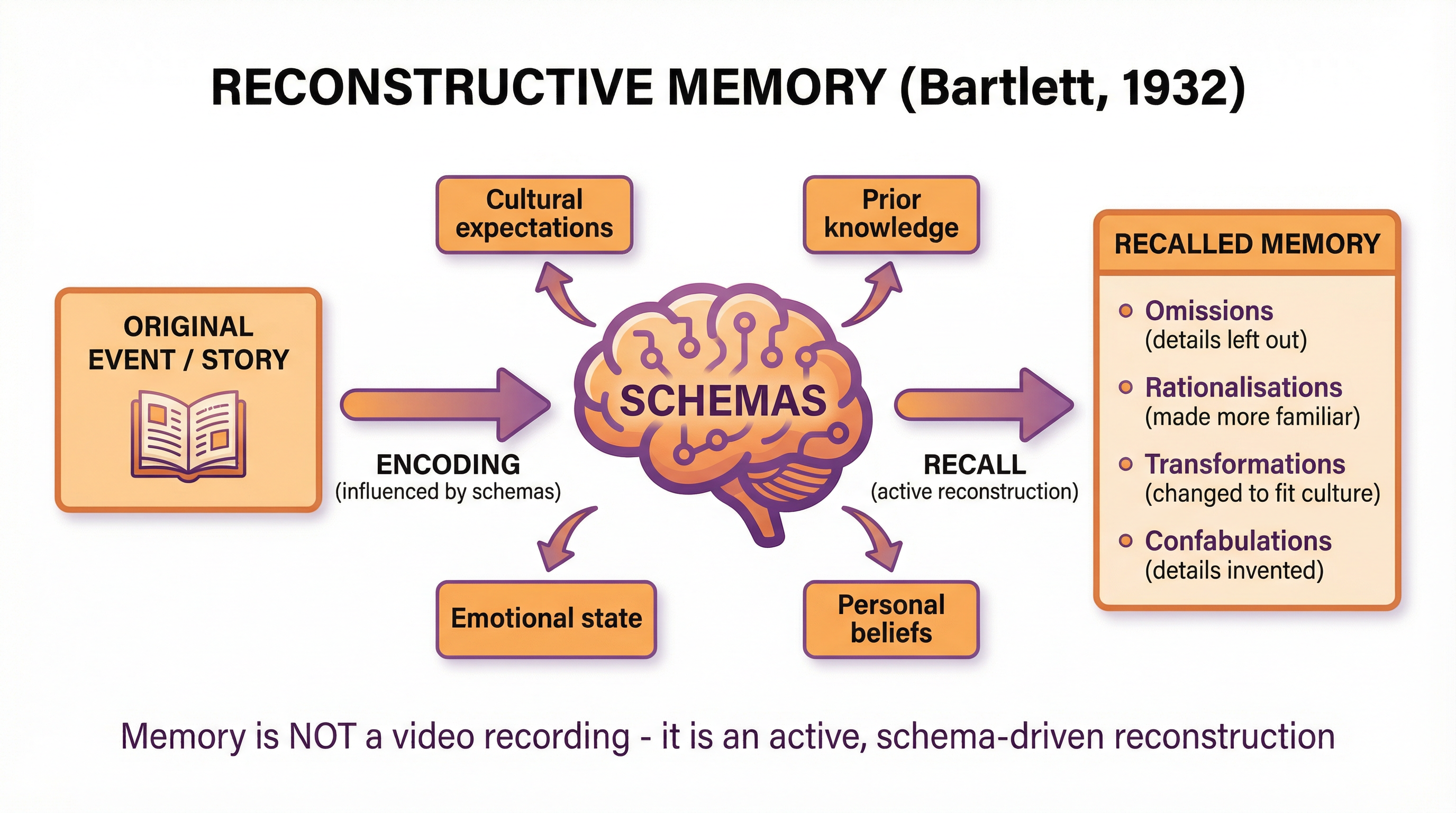
Welcome to the OCR GCSE Psychology Study Podcast. I'm your tutor, and today we're diving deep into one of the most important topics on your specification: Memory Models. Whether you're revising for the first time or doing a final polish before your exam, this episode has everything you need — from core theory to exam technique to a quick-fire quiz at the end. So grab a pen, get comfortable, and let's get started. Memory is one of those topics that feels familiar because we all use our memories every day. But in psychology, we study memory in a very specific, scientific way — and the examiners at OCR want you to show that you understand not just what the models say, but why they matter, what evidence supports them, and where they fall short. By the end of this episode, you'll be able to do exactly that. Let's begin with the big picture. There are two main theories you need to know for this topic. First, the Multi-Store Model, proposed by Atkinson and Shiffrin in 1968. Second, the Theory of Reconstructive Memory, proposed by Frederic Bartlett in 1932. These two models take very different approaches to understanding memory, and the exam will test you on both — so let's go through each one carefully. The Multi-Store Model. Atkinson and Shiffrin proposed that memory is made up of three separate stores: the Sensory Register, Short-Term Memory — which we call STM — and Long-Term Memory — which we call LTM. Information flows through these stores in a specific sequence, and each store has its own distinct characteristics in terms of encoding, capacity, and duration. Let's start with the Sensory Register. This is the entry point for all information. Every second, your senses — sight, sound, touch, taste, smell — are bombarded with information. The Sensory Register holds this raw sensory data very briefly. The duration is just half a second to three seconds. The capacity is very large — it can hold a huge amount of information. But here's the key: most of it is never processed further. Only information that you pay attention to gets passed on to Short-Term Memory. This is why attention is so important in the model — it acts as a gateway. Now, Short-Term Memory. This is your conscious, working memory — the information you're actively thinking about right now. STM has three defining features you must memorise precisely, because vague answers will not earn you marks. First, encoding: STM encodes information acoustically — that means in terms of sound. Even when you read written words, you tend to convert them into a sound-based format in your head. Second, capacity: STM can hold 7 plus or minus 2 items. That's between 5 and 9 items. This was established by George Miller in 1956, and it's a specific number you must know. Third, duration: STM lasts approximately 18 to 30 seconds without rehearsal. After that, information is either transferred to LTM or it's lost — it decays or is displaced by new information. The key mechanism for moving information from STM to LTM is rehearsal. Specifically, maintenance rehearsal — which means repeating information over and over. Think about when you repeat a phone number to yourself before you can write it down. That's maintenance rehearsal in action. The more you rehearse, the more likely information is to be consolidated into Long-Term Memory. Long-Term Memory is the final and most permanent store. LTM has three key features. Encoding: LTM encodes information semantically — that means in terms of meaning. You don't just remember the sound of a word; you remember what it means and how it connects to other things you know. Capacity: LTM has an essentially unlimited capacity. Duration: LTM can last a lifetime — though be careful here. Examiners will not give credit if you say LTM is simply "permanent." You must qualify this by acknowledging that retrieval failure or interference can prevent us from accessing memories, even if they are stored. Now, what's the evidence for the Multi-Store Model? The key study here is Murdock's 1962 Serial Position Effect experiment. Murdock asked participants to learn a list of words and then recall them in any order. He found a characteristic U-shaped curve. Words at the beginning of the list were recalled well — this is the primacy effect. Words at the end of the list were also recalled well — this is the recency effect. But words in the middle were recalled poorly. Here's the crucial part that examiners want you to explain: why do these effects occur? The primacy effect occurs because words at the beginning of the list had more time to be rehearsed and transferred into Long-Term Memory. The recency effect occurs because words at the end of the list were still held in Short-Term Memory at the time of recall — they hadn't decayed yet. This U-shaped pattern is powerful evidence that STM and LTM are separate stores, just as Atkinson and Shiffrin proposed. Now let's move on to the second major theory: Bartlett's Theory of Reconstructive Memory, from 1932. Bartlett had a very different view of memory. He argued that memory is not like a video recording — it's not a passive, accurate copy of what happened. Instead, memory is an active process of reconstruction. Every time we recall something, we don't simply play back a stored recording. We rebuild the memory, and in doing so, we are influenced by our schemas. What is a schema? A schema is a mental framework — a package of prior knowledge and expectations about the world. We develop schemas through experience. For example, you have a schema for "going to a restaurant" — you expect to be seated, given a menu, order food, eat, pay, and leave. If something unusual happens, your schema might cause you to misremember or distort the event to fit your expectations. Bartlett demonstrated this beautifully with his "War of the Ghosts" study. He asked British participants to read a Native American folk tale — a story that was culturally unfamiliar to them, containing supernatural elements and an unusual narrative structure. He then asked them to recall the story at various intervals. What he found was remarkable. Participants did not recall the story accurately. Instead, they made systematic errors. They omitted details that didn't fit their cultural expectations. They rationalised strange elements to make them more familiar. They transformed supernatural events into more logical explanations. And sometimes they confabulated — they added details that weren't in the original story at all, but that made sense within their own cultural framework. This tells us something profound: memory is not reproductive — it's reconstructive. We use our existing knowledge and expectations to fill in gaps and make sense of what we've experienced. This has important real-world implications, particularly for eyewitness testimony in legal settings. Now let's talk about evaluation. The examiners want you to go beyond simply describing these models. You need to evaluate them — and that means using specific psychological terminology. For the Multi-Store Model, one strength is that it has strong empirical support. Murdock's 1962 study provides clear experimental evidence for separate STM and LTM stores, as shown by the serial position effect. The model is also parsimonious — it provides a simple, elegant explanation of memory structure. However, a weakness is that the model is reductionist. It oversimplifies memory by treating STM as a single, unitary store. Later research by Baddeley and Hitch in 1974 showed that STM is actually more complex — it has multiple components including a phonological loop, a visuospatial sketchpad, and a central executive. Another weakness is that the model lacks ecological validity. Murdock's study used artificial word lists in a laboratory setting, which doesn't reflect how we use memory in real life. For Bartlett's Theory of Reconstructive Memory, a strength is that it has high ecological validity compared to the MSM. Bartlett used meaningful, narrative material rather than word lists, which better reflects real-world memory use. The theory also has important practical applications — it helps explain why eyewitness testimony can be unreliable. However, a weakness is that Bartlett's methodology was not very scientific. He didn't use standardised procedures, and his analysis of participants' recall was subjective. This makes it difficult to replicate his findings reliably. Now, let's talk exam technique — because knowing the content is only half the battle. You also need to know how to apply it under exam conditions. First, command words. When you see the word "Describe," the examiner wants you to state what something is with supporting detail. When you see "Explain," you need to go further — you need to show how or why something works, linking your points together. When you see "Evaluate," you need to make a judgement, using evidence to support and challenge the theory. Second, AO1, AO2, and AO3. OCR GCSE Psychology has three assessment objectives. AO1 is knowledge and understanding — describing what the theories say. AO2 is application — using the theories to explain a scenario. AO3 is evaluation — critically assessing the theories using evidence. For the 13-mark extended response question, you should aim for roughly one-third description and two-thirds evaluation. Structure your answer with a clear description first, then at least three distinct evaluation points. Third, application questions. These are AO2 questions where you're given a scenario — for example, "Tom is trying to remember a phone number he just heard." You must link every psychological point you make back to a specific detail in the scenario. Don't just say "information in STM decays after 18 to 30 seconds." Say "Tom's memory of the phone number will decay after 18 to 30 seconds because it is held in STM, which has a limited duration." Fourth, the most common mistakes. Number one: confusing capacity and duration. Capacity is how much STM can hold — 7 plus or minus 2 items. Duration is how long it lasts — 18 to 30 seconds. These are different things. Number two: when asked about the Theory of Reconstructive Memory, don't just describe the War of the Ghosts study. The question is asking about the theory — schemas, active reconstruction, distortion. The study is evidence for the theory, not the theory itself. Number three: saying LTM is "permanent." Always qualify this — say "potentially lifetime duration, subject to retrieval failure." Now it's time for your quick-fire recall quiz! I'll ask the questions, and you try to answer before I give the answer. Ready? Question one: What is the capacity of Short-Term Memory? ... The answer is 7 plus or minus 2 items — between 5 and 9 items. Question two: What type of encoding does Long-Term Memory use? ... The answer is semantic encoding — based on meaning. Question three: What does the primacy effect tell us about the Multi-Store Model? ... The answer is that early items were rehearsed into Long-Term Memory, supporting the idea of a separate LTM store. Question four: What is a schema? ... A schema is a mental framework of prior knowledge and expectations that influences how we encode and recall memories. Question five: Name one way in which Bartlett found participants distorted the War of the Ghosts story. ... Acceptable answers include: omissions, rationalisations, transformations, or confabulations. Question six: What year did Atkinson and Shiffrin propose the Multi-Store Model? ... 1968. Question seven: What is the duration of Short-Term Memory without rehearsal? ... 18 to 30 seconds. How did you do? If you got all seven, you're in great shape. If you missed some, go back and review those specific points — and remember, the numbers are crucial. Examiners will not award marks for vague answers like "a short time." Let's wrap up with a quick summary of everything we've covered today. The Multi-Store Model, proposed by Atkinson and Shiffrin in 1968, describes memory as three sequential stores: the Sensory Register, Short-Term Memory, and Long-Term Memory, each with distinct encoding, capacity, and duration characteristics. Murdock's 1962 Serial Position Effect study provides strong experimental support for this model. Bartlett's Theory of Reconstructive Memory, from 1932, argues that memory is an active reconstruction influenced by schemas — mental frameworks of prior knowledge. His War of the Ghosts study showed that people systematically distort memories to fit their cultural expectations. Both models have strengths and weaknesses, and the best exam answers will evaluate them using terms like ecological validity, reductionism, and empirical support. Remember: in your exam, be precise with numbers, hook every AO2 point to the scenario, and always qualify statements about LTM duration. You've got this. Thank you for listening to the OCR GCSE Psychology Study Podcast. Good luck with your revision — and remember, the more you practise retrieving this information, the stronger your memory for it will become. That's the science of learning working in your favour. See you next time!
Key Terms & Definitions
- Encoding
- The process of converting incoming information from the senses into a format or code that can be stored in memory.
- Capacity
- The amount or quantity of information that can be held in a memory store.
- Duration
- The length of time that information can be held in a memory store.
- Schema
- A mental framework of beliefs and expectations that influence cognitive processing. They are developed from experience.
- Ecological Validity
- The extent to which the findings of a research study can be generalized to real-life settings.
- Reductionism
- The scientific approach of reducing complex systems to their simplest components. In psychology, this often means explaining behaviour in terms of basic cognitive processes or biological structures.
Worked Examples
Worked Example
Question: Describe the Multi-Store Model of memory. (6 marks)
Solution: The Multi-Store Model, proposed by Atkinson and Shiffrin (1968), is a structural model that suggests memory consists of three distinct stores. Information from the environment first enters the **Sensory Register**, which has a very large capacity but a very brief duration of around 0.5-3 seconds. If attention is paid to this information, it is transferred to **Short-Term Memory (STM)**. STM encodes information acoustically, has a limited capacity of 7+/-2 items, and a duration of 18-30 seconds without rehearsal. Information can be kept in STM through maintenance rehearsal. If rehearsed sufficiently, the information is transferred to **Long-Term Memory (LTM)**. LTM has a potentially unlimited capacity and duration, and it encodes information semantically. Retrieval involves passing information from LTM back into STM.
Worked Example
Question: Jamal witnessed a robbery. When questioned by the police, his memory of the event was different from what the CCTV showed. For example, he remembered the robber wearing a plain black jumper, but the CCTV showed it had a large logo. Use Bartlett's theory of reconstructive memory to explain why Jamal's memory might be inaccurate. (4 marks)
Solution: Bartlett's theory states that memory is an active reconstruction influenced by our schemas. A schema is a mental framework of expectations. Jamal's schema for a 'robber' might include the idea that they wear plain, dark clothing to avoid being identified. When recalling the event, Jamal may have unconsciously altered his memory to fit this schema, leading to a **rationalisation** where the jumper becomes plain black. This is not a deliberate lie, but an unconscious distortion during recall. The original detail of the logo, which did not fit his schema, may have been **omitted** and replaced with a more expected detail.
Worked Example
Question: Evaluate the Multi-Store Model of memory. (5 marks)
Solution: One major strength of the Multi-Store Model is the significant body of research that supports it. For example, Murdock's (1962) study on the serial position effect provides evidence for separate STM and LTM stores, as the primacy effect (LTM) and recency effect (STM) are clearly demonstrated. This gives the model good empirical support. However, a key weakness is that the model is reductionist and oversimplifies memory. It presents STM as a single, unitary store. Research by Baddeley and Hitch (1974) with their Working Memory Model showed that STM is far more complex, comprising multiple components like the phonological loop and visuospatial sketchpad. This suggests the MSM is an incomplete explanation. Furthermore, many of the supporting studies, like Murdock's, lack ecological validity. Recalling lists of random words in a lab is an artificial task that doesn't reflect how we use memory in everyday life, limiting the generalisability of the findings.
Practice Questions
Question: Outline the findings of one study into the capacity of Short-Term Memory. (3 marks)
Answer:
Question: Compare the Multi-Store Model with the Theory of Reconstructive Memory. (8 marks)
Answer:
Question: Explain the primacy and recency effect. (4 marks)
Answer:
Question: Outline what schemas are in the context of reconstructive memory. (2 marks)
Answer:
Question: Evaluate Bartlett's Theory of Reconstructive Memory. (5 marks)
Answer: