Pearson Edexcel · GCSE · Psychology
Course version: 1PS0 · Version from Sept 2017
Social influence - 5.2 Studies: 5.2.1 Piliavin et al (1969) Good…
Full specification wording
Topic 5: Social influence - 5.2 Studies: 5.2.1 Piliavin et al (1969) Good Samaritanism: An Underground Phenomenon?
Piliavin et al. (1969) investigated bystander behaviour in a natural setting, testing how a victim's type and race affected helping.
Checked against the Pearson Edexcel 1PS0 specification (opens in a new tab) on .
- Point 1 of 2
- 2 key terms
Study notes
From the checked teaching notes for this specification point.
The idea
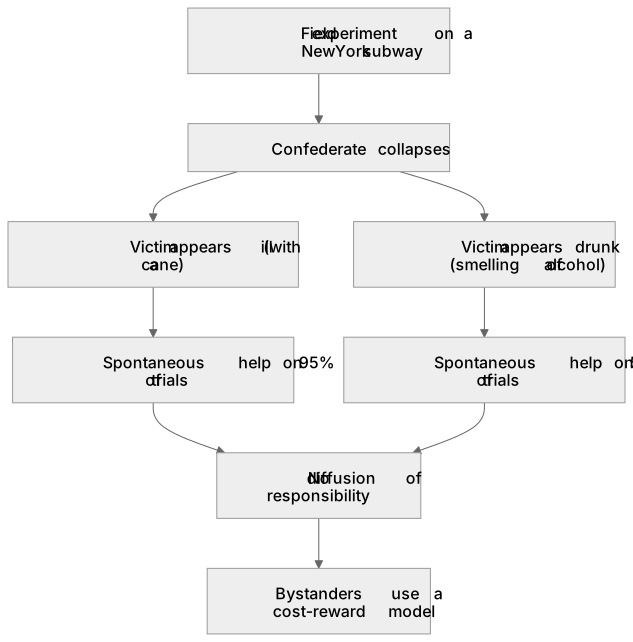
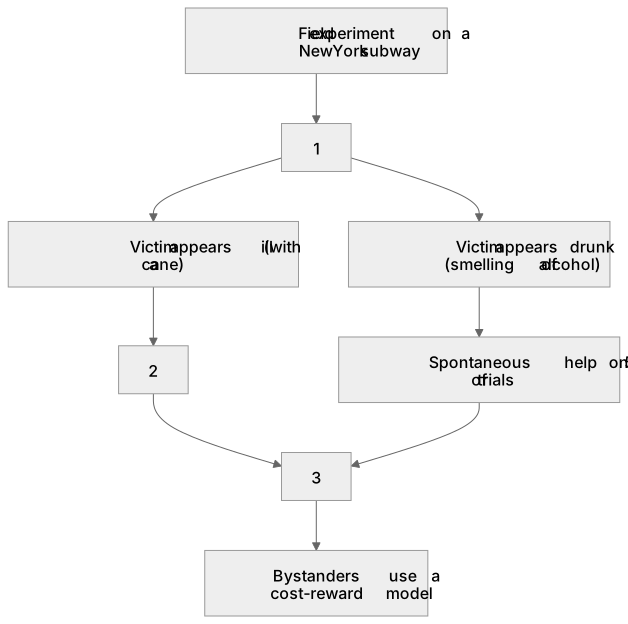
Piliavin et al. (1969) investigated bystander behaviour in a natural setting, testing how a victim's type and race affected helping. In a field experiment on a New York subway, a confederate collapsed, appearing either ill (with a cane) or drunk (smelling of alcohol). The ill victim received spontaneous help on 95% of trials, compared to 50% for the drunk victim. Piliavin concluded that diffusion of responsibility did not occur; instead, bystanders use a cost-reward model to decide whether to help. Strengths include high ecological validity and a large sample. Weaknesses involve ethical issues, such as deception, lack of informed consent, and the inability to debrief passengers who may have been distressed by the staged emergency.
What earns the marks
- Identification of the study as a field experiment conducted on a New York subway train.
- Recall of the independent variables: type of victim (ill or drunk) and race of victim (black or white).
- Recognition of the key finding that the ill victim received help more frequently and quickly than the drunk victim.
- Understanding of the conclusion that the cost-reward arousal model explains helping behaviour better than diffusion of responsibility.
Common mistakes and how to put them right
Believing that diffusion of responsibility was supported by the study.
Put it right by noting that Piliavin found no evidence for it, as larger groups were just as likely to help.
Confusing the independent variables.
Put it right: The victim was either ill with a cane or drunk, not both simultaneously.
Assuming the study was a laboratory experiment.
Put it right: It was a field experiment, which gives it high ecological validity but lower control over extraneous variables.
Exam tips
- Memorise the specific percentages for spontaneous help: 95% for the ill victim and 50% for the drunk victim.
- Be prepared to identify the ethical issues in this study, specifically the lack of informed consent and the inability to debrief participants.
- Link the findings of this study to the broader topic of bystander intervention and the cost-reward model.
Try the lesson
The start of the Topic 5: Social influence - 5.2 Studies: 5.2.1 Piliavin et al (1969) Good Samaritanism: An Underground Phenomenon? lesson, made from checked teaching notes for this specification point.
Have a go first
In Piliavin et al.'s (1969) subway study, which two conditions were used to test how the type of victim affected helping behaviour?
Listen
Piliavin et al. (1969) investigated bystander behaviour in a natural setting, testing how a victim's type and race affected helping. In a field experiment on a New York subway, a confederate collapsed, appearing either ill (with a cane) or drunk (smelling of alcohol). The ill victim received spontaneous help on 95% of trials, compared to 50% for the drunk victim. Piliavin concluded that diffusion of responsibility did not occur; instead, bystanders use a cost-reward model to decide whether to help. Strengths include high ecological validity and a large sample. Weaknesses involve ethical issues, such as deception, lack of informed consent, and the inability to debrief passengers who may have been distressed by the staged emergency. A strong answer earns marks for these points. Identification of the study as a field experiment conducted on a New York subway train. Recall of the independent variables: type of victim (ill or drunk) and race of victim (black or white). Recognition of the key finding that the ill victim received help more frequently and quickly than the drunk victim. Understanding of the conclusion that the cost-reward arousal model explains helping behaviour better than diffusion of responsibility. A common slip: Believing that diffusion of responsibility was supported by the study. Instead, noting that Piliavin found no evidence for it, as larger groups were just as likely to help. Exam tip: Memorise the specific percentages for spontaneous help: 95% for the ill victim and 50% for the drunk victim.
See it
Key words
Say what each word means before you turn the card.
Bystander intervention
Try answering aloud or in your head before turning the card.
Field experiments
Try answering aloud or in your head before turning the card.
See every definition
- Bystander intervention
- Helping behaviour shown by people who witness a victim in need, which Piliavin et al. investigated in a natural setting.
- Field experiments
- A study carried out in a natural setting, such as the New York subway, rather than in a laboratory.
Label the diagram
Some boxes have lost their names. Pick the right name for each number.
1Box 1
2Box 2
3Box 3
There is more to this lesson
The full lesson goes on to check your understanding and help you earn the marks. Create a free account to carry on, with your progress saved.
A week of Premium from your first lesson · Then the free plan continues · No card, no charge
Test your understanding of Topic 5: Social influence - 5.2 Studies: 5.2.1 Piliavin et al (1969) Good Samaritanism: An Underground Phenomenon?
Active recall beats re-reading. Take an instant quiz now to test what you’ve learned and lock it into long-term memory.
A week of Premium from your first lesson · Then the free plan continues · No card, no charge