AQA · GCSE · Religious Studies
Wealth and Poverty
This study guide for AQA GCSE Religious Studies (Theme F) explores the complex relationship between wealth, poverty, and faith in Christianity and Islam. It is designed to equip candidates with the precise knowledge and analytical skills needed to tackle high-mark questions on stewardship, charity, and the causes of poverty."
- 7 min read
- 3 worked examples
- 5 practice questions
Study Notes
Overview
This unit, focusing on Theme F: Religion, Peace and Conflict from the AQA GCSE Religious Studies A specification, delves into the ethical and theological challenges posed by wealth and poverty. Candidates are required to analyse the teachings of Christianity and Islam on the morality of acquiring and using wealth, the responsibilities of the rich to the poor, and the complex causes of poverty. Examiners expect candidates to move beyond simple descriptions, demanding a nuanced evaluation of concepts like stewardship, the prosperity gospel, and the specific requirements of religious duties such as Zakah. A successful candidate will be able to cite sacred texts with precision, differentiate between various forms of giving, and construct well-supported arguments in extended evaluation questions. This topic is not just about what religious people believe; it is about how those beliefs translate into action, from individual charity to the global work of organisations like Christian Aid and Islamic Relief.

Key Concepts & Beliefs
Stewardship (Christianity & Islam)
What it is: The belief that everything ultimately belongs to God (Allah in Islam) and that humans are temporary caretakers or managers (stewards) of the resources He has provided, including wealth, the environment, and personal talents.
Why it matters: This is a foundational concept. It frames the entire debate about wealth. If wealth is a gift from God held in trust, it cannot be used for purely selfish purposes. It must be used in a way that pleases God, which includes caring for the poor and needy. For the exam, this concept provides the theological justification for all forms of charity and giving.
Specific Knowledge: In Christianity, the Parable of the Talents (Matthew 25:14-30) is a key text illustrating stewardship. In Islam, the concept of amanah (trust) is central.
The Dangers of Wealth (Christianity & Islam)
What it is: Both religions warn that wealth can be a spiritual danger, leading to greed, arrogance, and a neglect of God.
Why it matters: This provides a crucial counterpoint to the idea that wealth is a blessing. It allows for a balanced evaluation in 12-mark questions. Candidates must be able to explain why wealth can be problematic.
Specific Knowledge: The most important text here is 1 Timothy 6:10: "For the love of money is a root of all kinds of evil." It is essential to quote this accurately – it is the love of money, not money itself, that is condemned. Another key Christian teaching is Jesus' statement: "It is easier for a camel to go through the eye of a needle than for someone who is rich to enter the kingdom of God" (Mark 10:25). In Islam, the Quran warns against hoarding wealth and forgetting one's obligations to the poor.
Zakah vs. Sadaqah (Islam)
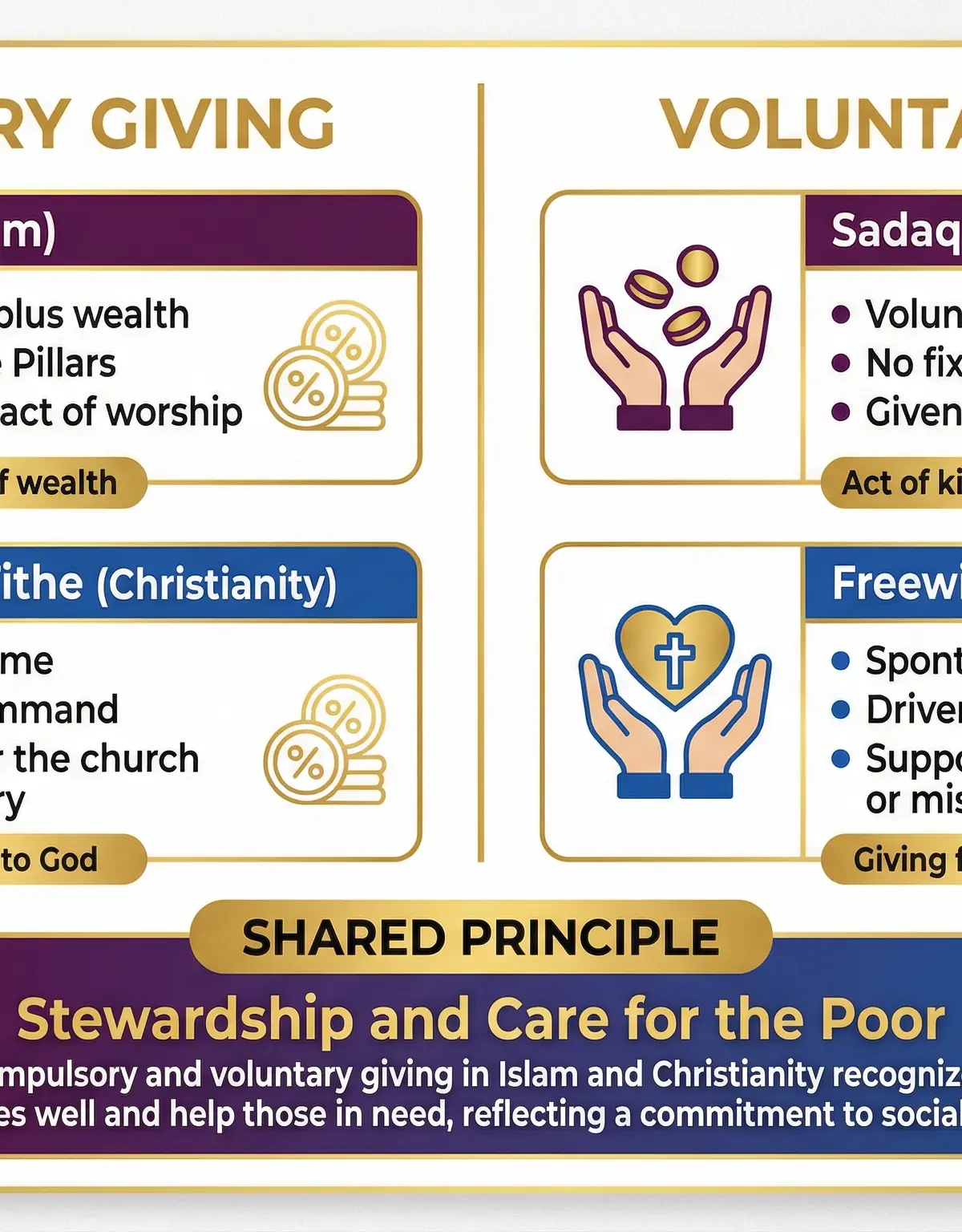
What it is: A critical distinction between two types of giving in Islam.
- Zakah: Compulsory giving. It is the Third Pillar of Islam. It requires Muslims to donate 2.5% of their surplus wealth annually. This is a calculated, obligatory act of worship that purifies the wealth of the giver and redistributes it to the needy.
- Sadaqah: Voluntary charity. This is any charitable act given out of compassion, with no fixed amount or time. It can be money, but also includes acts of kindness.
Why it matters: Examiners frequently test this distinction. Confusing the two is a common mistake. Marks are awarded for showing precise knowledge of Zakah's status as a Pillar and its specific percentage.
The Prosperity Gospel vs. Vows of Poverty (Christianity)
What it is: Two opposing Christian views on wealth.
- Prosperity Gospel: A belief, common in some Pentecostal and Charismatic churches, that God shows his favour by blessing believers with material wealth and good health. It suggests wealth is a sign of strong faith.
- Vows of Poverty: A practice in some Christian traditions (e.g., monks and nuns in the Catholic Church) of renouncing all personal possessions to live a simple life dedicated to God.
Why it matters: This is perfect material for a 12-mark evaluation. Candidates can contrast these two views to explore the diversity within Christian thought on whether wealth is a blessing or a hindrance to spiritual life. Most mainstream Christian views lie somewhere between these two extremes.
Causes of Poverty & Religious Responses
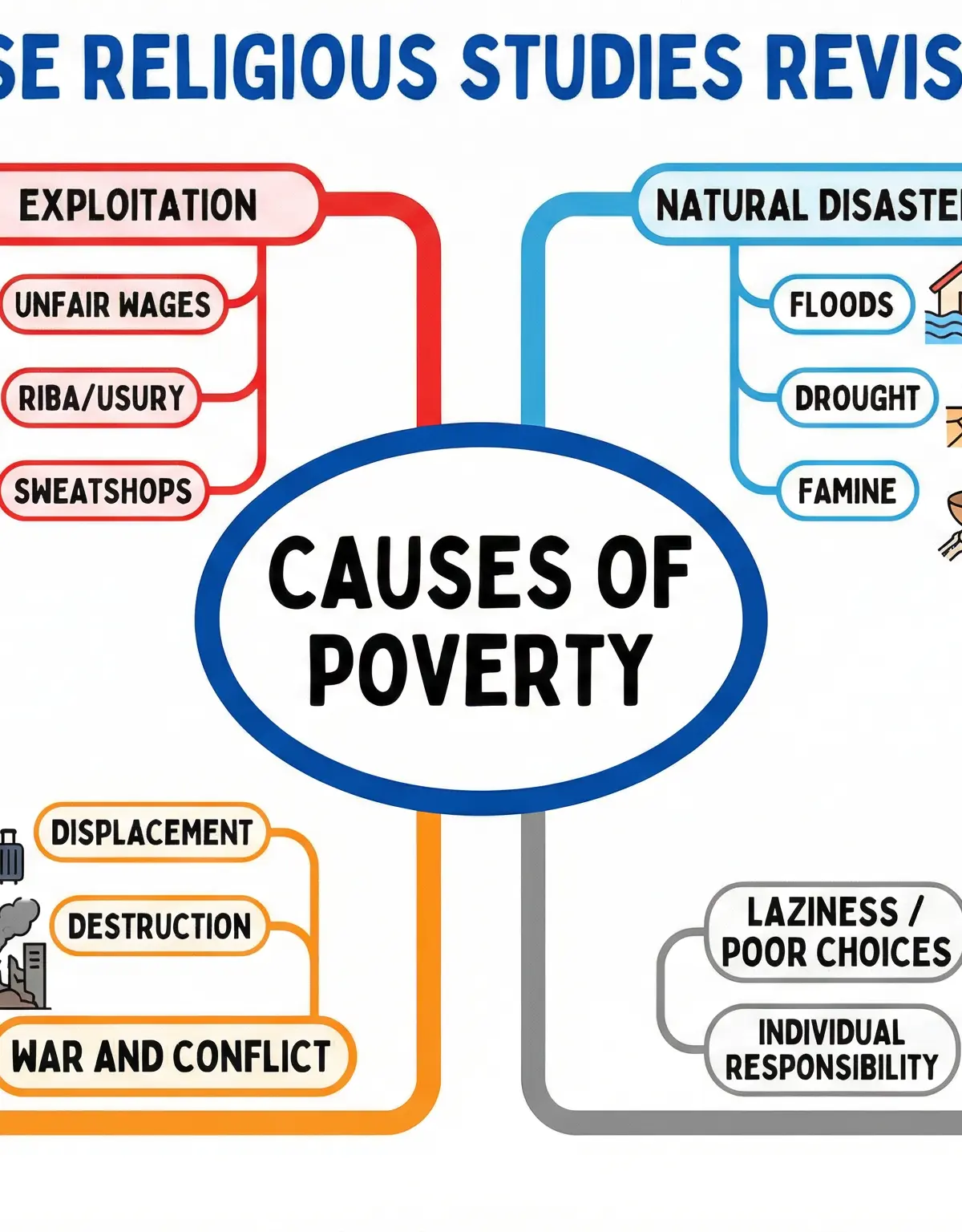
Exploitation
What happened: This refers to poverty caused by injustice, such as unfair wages, human trafficking, and charging excessive interest (usury/Riba).
Why it matters: This links poverty to human sin and injustice, requiring a prophetic response. Religious believers are called not just to give to the poor, but to challenge the systems that make and keep them poor.
Specific Knowledge: In Islam, the charging of interest, known as Riba, is strictly forbidden (Haram). In Christianity, the Fair-Trade movement, supported by many churches, is a direct response to exploitation in global trade.
Natural Disaster & War
What happened: Poverty caused by events beyond an individual's control, such as floods, famines, or conflict.
Why it matters: This highlights the role of compassion and emergency aid. It shows religion in action on a global scale.
Specific Knowledge: Name-drop specific religious charities. Christian Aid and Islamic Relief are the two most important examples. Both provide emergency aid (food, shelter, medicine) and long-term development projects (e.g., building wells, providing education) in response to disasters and conflict.
Key Individuals & Organisations
Christian Aid
Role: A major Christian charity working globally to end poverty.
Key Actions: Provides emergency relief after disasters, runs long-term development projects to tackle the root causes of poverty, and campaigns to change government policies that harm the poor.
Impact: Demonstrates the Christian principles of compassion (agape) and stewardship in action. A key example for any question on religious responses to poverty.
Islamic Relief
Role: A leading international Muslim charity.
Key Actions: Similar to Christian Aid, it provides disaster relief and runs development programmes. It is also a key channel for the collection and distribution of Zakah and Sadaqah.
Impact: Shows the practical application of Islamic teachings on charity and social justice. It demonstrates how concepts like Zakah are put into practice on a global scale."
Worked Examples
3 worked examples — open one to explore the question and available guidance.
Practice Questions
Test your understanding — click to reveal model answers
Explain two religious beliefs about the right way to use wealth. Refer to sacred writings in your answer. (5 marks)
Hint: Think about stewardship and the dangers of greed. Pick one belief from Christianity and one from Islam for contrast.
Explain two contrasting Christian attitudes to possessing wealth. (4 marks)
Hint: Think about the most extreme views: the Prosperity Gospel and vows of poverty.
'Religious charities are the most effective way to tackle poverty.' Evaluate this statement. (12 marks)
Hint: Use the FARM structure. Consider what makes religious charities effective (motivation, volunteer base, Zakah funding) and what their limitations might be (proselytizing, scale compared to governments).
Explain the difference between Zakah and Sadaqah in Islam. (4 marks)
Hint: Focus on: Compulsory vs. Voluntary, Fixed vs. Unfixed amount, Pillar vs. General charity.
Describe the work of one religious organisation that aims to relieve poverty. (2 marks)
Hint: Name an organisation and give two distinct things it does.