OCR · GCSE · Religious Studies
Applying religious teachings to real-life situations
This study guide for OCR GCSE Religious Studies focuses on the crucial skill of applying religious teachings to real-life situations. It provides a framework for analyzing contemporary ethical issues through the lens of Christian Sources of Wisdom and Authority, equipping students to construct high-scoring, analytical responses.
- 7 min read
- 3 worked examples
- 5 practice questions
- 7 key terms
Check what you remember
Read the wording for your board, then hide it and explain Sanctity of Life in your own words. Rough notes are fine. This is a self-check, with no mark or grade.
Reference: OCR
The belief that all human life is sacred and created by God, and that only God has the right to take it away.
Study Notes

Overview
This guide explores how to apply Christian teachings to contemporary ethical issues, a central requirement of the OCR J625 specification. Examiners expect candidates to move beyond simple statements of belief to a nuanced analysis of how scripture, tradition, and reason shape Christian responses to modern dilemmas. This involves understanding the diversity of views within Christianity and evaluating the influence of these teachings on believers' lives. A high-level response will demonstrate a clear chain of reasoning, connecting a specific Source of Wisdom and Authority to a real-world situation and explaining its impact on decision-making. This skill is essential for success in both the 5-mark 'Explain' and 15-mark 'Discuss' questions, which together constitute a significant portion of the exam.
Key Concepts
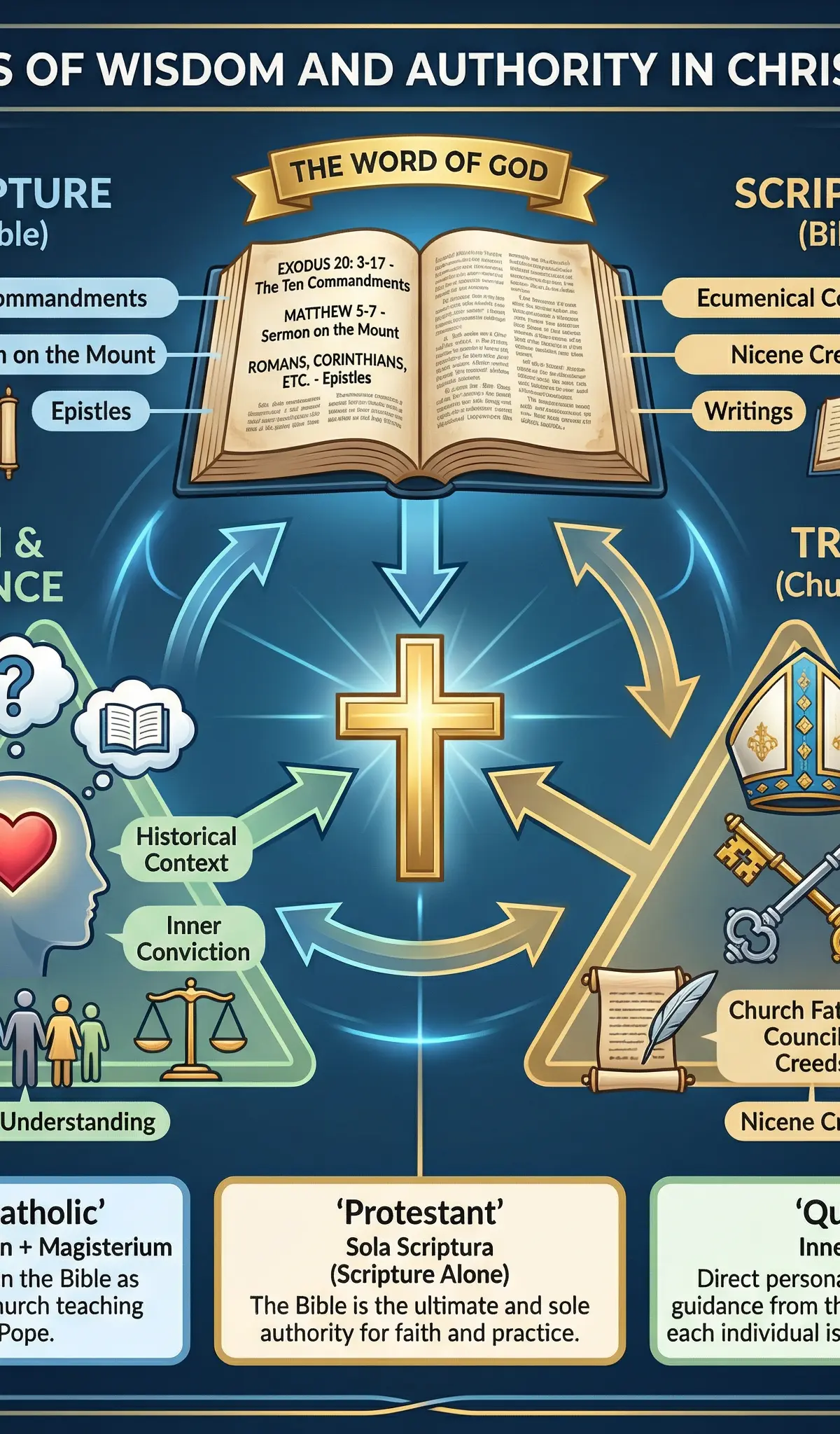
Sources of Wisdom and Authority
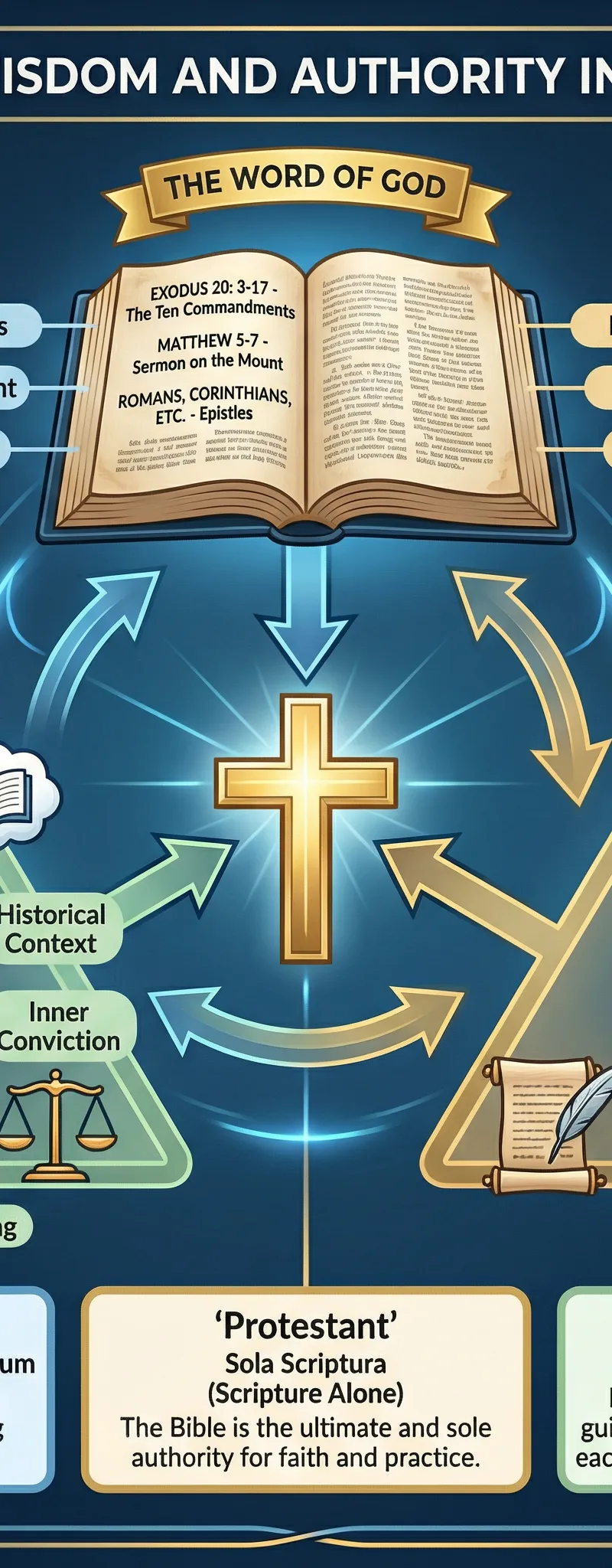
What it is: The foundations upon which Christians base their beliefs and moral decisions. For the OCR exam, these are primarily Scripture, Tradition, and Reason.
Why it matters: You cannot earn marks without referencing these. Every argument must be grounded in a specific source.
Specific Knowledge:
- Scripture: The Bible (Old and New Testaments). Key texts include Genesis, the Ten Commandments (Exodus 20), the Sermon on the Mount (Matthew 5-7), the Parable of the Good Samaritan (Luke 10), and Paul's Epistles (e.g., Romans, Corinthians).
- Tradition: The accumulated wisdom of the Church. This includes the teachings of the Church Fathers (e.g., Augustine, Thomas Aquinas), the Creeds (e.g., Nicene Creed), and the formal pronouncements of Church councils (e.g., Second Vatican Council) and leaders (e.g., the Pope for Roman Catholics).
- Reason/Experience: The use of logic, conscience, and personal experience to interpret and apply scripture and tradition. This is particularly important for understanding how teachings are adapted to new contexts.
Denominational Diversity
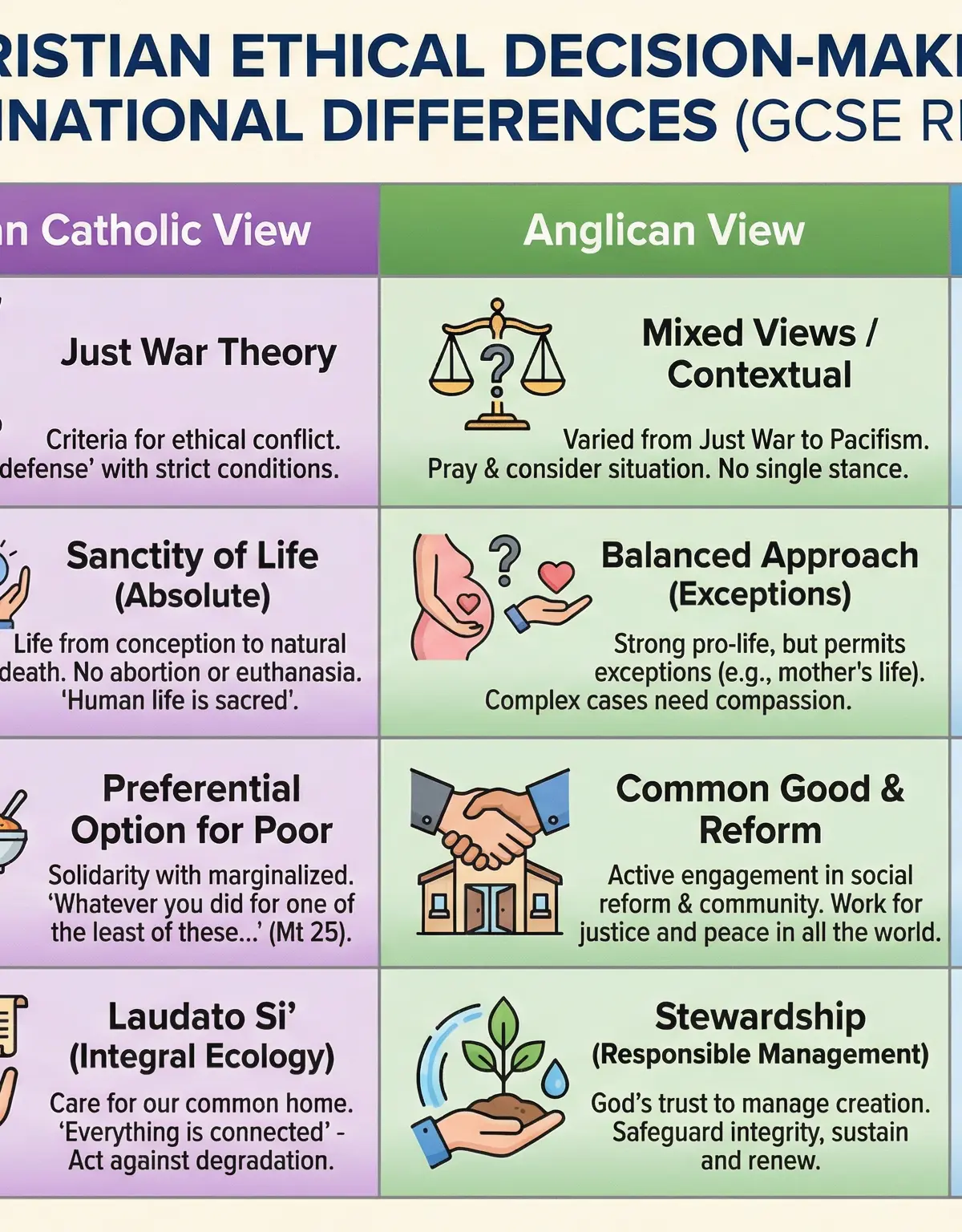
What it is: The recognition that Christianity is not a single, monolithic entity. Different denominations (e.g., Roman Catholic, Anglican, Quaker, Methodist) often have distinct interpretations and ethical stances.
Why it matters: Using phrases like "All Christians believe..." is a common mistake that limits marks. Showing awareness of different viewpoints is a hallmark of a high-level response.
Specific Knowledge: Be able to contrast at least two denominational views on key issues. For example:
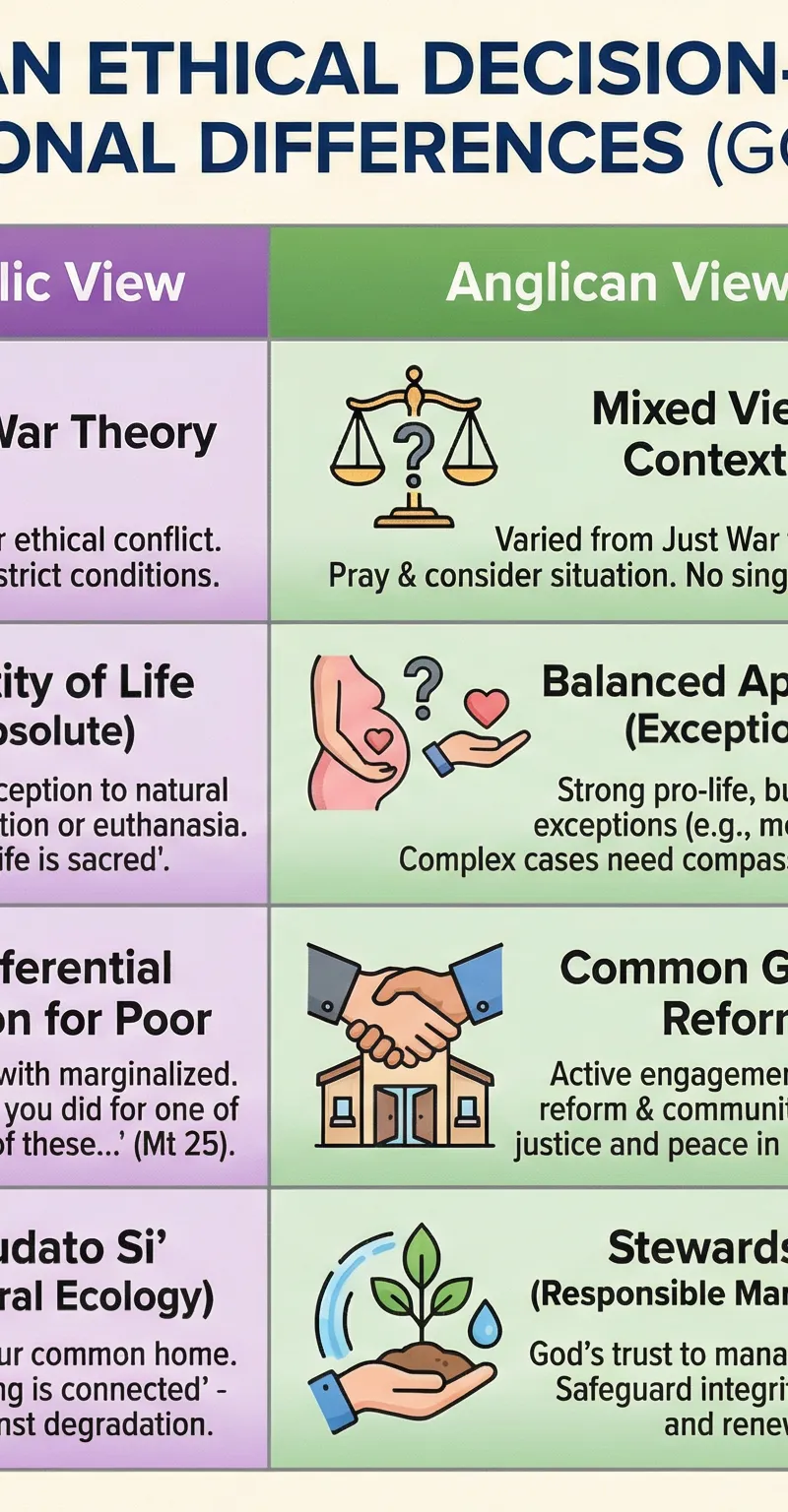
- War: Roman Catholic Just War Theory vs. Quaker Pacifism.
- Abortion: The absolute prohibition in Roman Catholicism vs. the more nuanced, situational approach of the Church of England.
- Social Justice: The focus on charity and the 'Preferential Option for the Poor' in Catholicism vs. the emphasis on structural change and equality in Quakerism.
The 'This Means That' Bridge
What it is: A technique for ensuring you explain the connection between a teaching and its application. After citing a source, you must explicitly state what it means for a believer's actions.
Why it matters: It forces you to move from description (AO1) to analysis (AO2). It is the core of what it means to 'apply' a teaching.
Example: "The Bible teaches 'Love thy neighbour as yourself' (Mark 12:31). This means that a Christian should show compassion and care for others, regardless of their background. Therefore, when faced with the issue of poverty, a Christian might be motivated to volunteer at a food bank or campaign for fairer wages."
Exam Structure and Technique
Named Example Bank
Examiners reward specific, detailed knowledge. Here are five essential named examples to use in your answers:
-
The Quaker Peace Testimony (1661): A formal declaration by the Religious Society of Friends rejecting all forms of violence and war. Use this when discussing pacifism and conscientious objection.
-
Second Vatican Council (1962-1965): A major gathering of Catholic bishops that modernized Church teaching. Key documents include Gaudium et Spes (on the Church in the modern world) which addresses social justice, war, and human dignity.
-
Pope Francis's Encyclical Laudato Si' (2015): A papal letter on environmental care, calling for 'integral ecology' and care for our common home. Use for questions on environmental ethics and stewardship.
-
Desmond Tutu (1931-2021): Anglican Archbishop and anti-apartheid activist who applied Christian teachings to the struggle for racial justice in South Africa. Use for questions on social justice and reconciliation.
-
The Trussell Trust: A Christian charity operating food banks across the UK. Use as a concrete example of how the teaching in Matthew 25 (feeding the hungry) is applied in modern Britain.
Application to Real-Life Situations: Step-by-Step
When answering a question about applying teachings, follow this process:
- Identify the ethical issue: What is the question asking about? (e.g., poverty, war, abortion)
- Select a relevant Source of Wisdom and Authority: Choose a biblical passage, church teaching, or theological principle that directly addresses this issue.
- Explain the teaching: What does it say? What is the core principle?
- Apply the 'This means that' bridge: How does this teaching translate into action or belief?
- Give a real-world example: Name a specific person, organization, or action that demonstrates this application.
- Show denominational diversity (if relevant): Are there different Christian views on this? Contrast at least two.
Common Ethical Issues and Key Teachings
| Ethical Issue | Key Teaching | Source | Application |
|---|---|---|---|
| Poverty | "Whatever you did for the least of these, you did for me" | Matthew 25:40 | Supporting food banks, fair trade, campaigning for living wage |
| War & Peace | "Blessed are the peacemakers" | Matthew 5:9 | Pacifism (Quakers) vs. Just War Theory (Catholics) |
| Abortion | Sanctity of Life | Genesis 1:27 | Absolute prohibition (Catholic) vs. situational compassion (Anglican) |
| Environment | Stewardship | Genesis 2:15 | Reducing carbon footprint, supporting renewable energy, Laudato Si' |
| Forgiveness | "Forgive seventy times seven" | Matthew 18:22 | Restorative justice, prison chaplaincy, reconciliation movements |
| Social Justice | "There is that of God in everyone" | Quaker belief | Equality testimony, opposing systemic injustice, civil rights movements |
Visual Resources
3 diagrams and illustrations
Interactive Diagrams
1 interactive diagram to visualise key concepts
Diagram could not be rendered
A timeline showing the development of key Christian ethical ideas and authorities.
Worked Examples
3 worked examples — open one to explore the question and available guidance.
Practice Questions
Try the question, then reveal an answer plan or example response
Explain two Christian teachings about wealth. (5 marks)
Hint: Think about one teaching that is critical of wealth and one that sees it as a potential for good. Use specific biblical examples.
"War is never the right choice for a Christian." Discuss this statement. (15 marks)
Hint: Structure your answer with arguments for (pacifism) and against (Just War Theory). Use specific denominational views and biblical quotes for each side before reaching a justified conclusion.
Explain why some Christians support the use of food banks. (5 marks)
Hint: Connect the act of giving food to a core Christian teaching about compassion and service. Use a parable as your main evidence.
Explain two different Christian views on abortion. (5 marks)
Hint: Contrast the Roman Catholic view with the Anglican (Church of England) view. Use the concepts of 'Sanctity of Life' and 'Situation Ethics' or 'compassion'.
"Following your conscience is the most important guide for a Christian." Discuss this statement. (15 marks)
Hint: Explore the role of conscience (especially for Quakers) versus the authority of Scripture (Protestants) and Church Tradition (Catholics). Is conscience a reliable guide on its own?
Exam technique
How to turn what you know into marks
How to approach the question
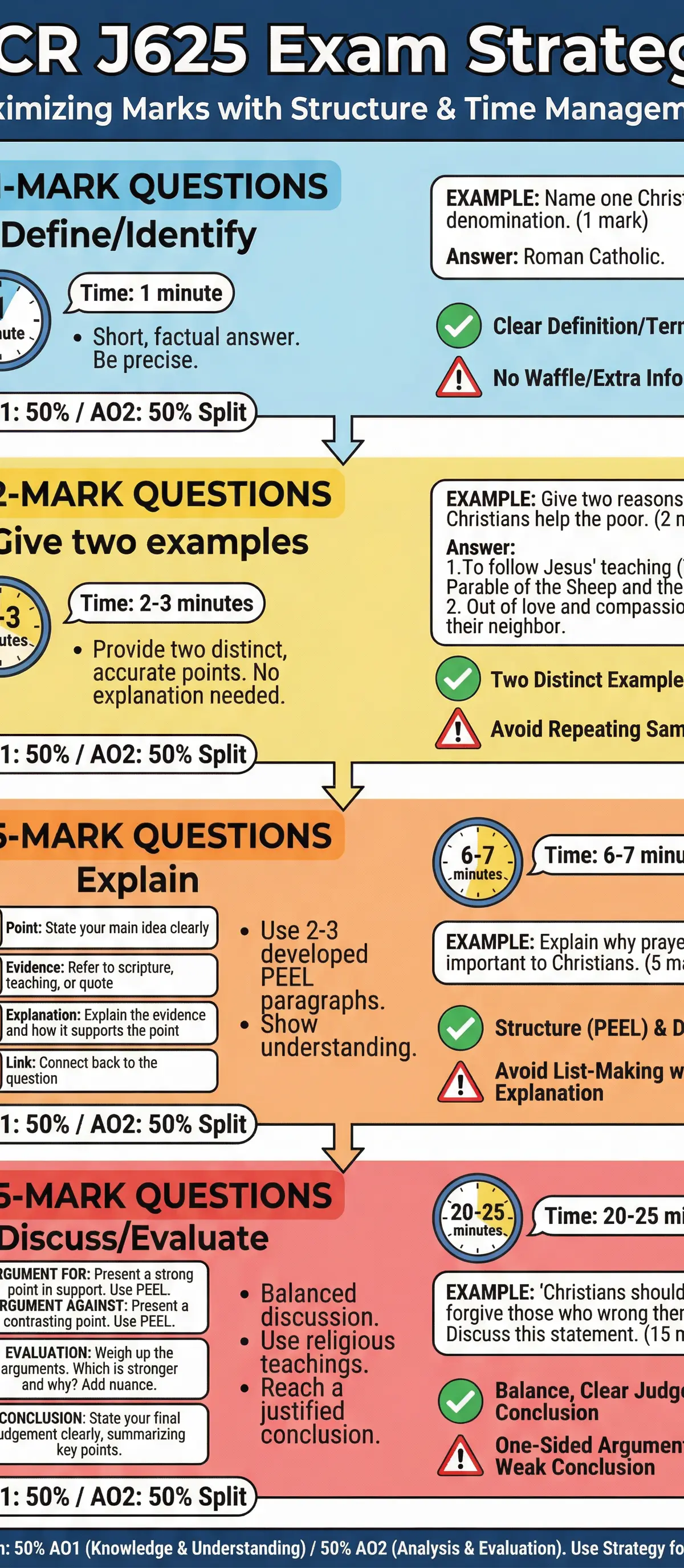
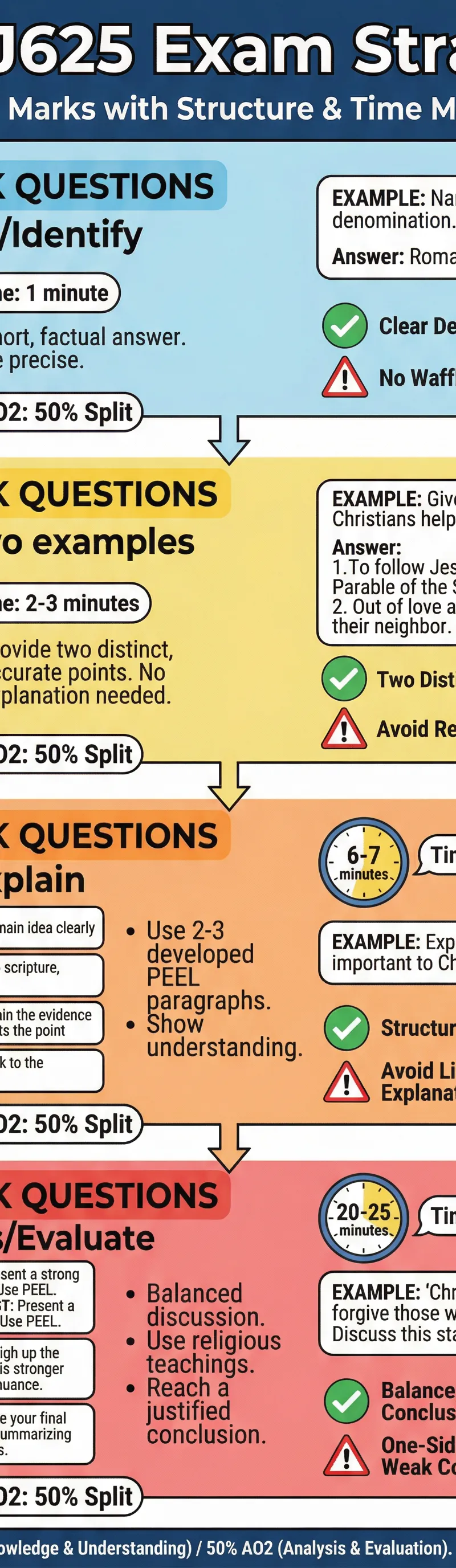
1. **Identify the Command Word**: Is it an 'Explain', 'Discuss', or 'Give' question? This determines the required structure. 2. **Spot the Topic**: What ethical issue is it about (e.g., war, poverty, medical ethics)? 3. **Identify the Religious Tradition**: The question will always specify Christianity. 4. **Plan Your Points**: For a 5-mark question, plan two PEEL paragraphs. For a 15-mark question, plan your 'for' and 'against' arguments and your final judgment.
How to structure your answer
- Essay questions
- A balanced discussion is key. Introduction setting out your argument. At least two paragraphs arguing for the statement and two against (or one very developed one for each). Use specific teachings and denominational views. A conclusion that makes a clear, justified judgment and doesn't just repeat earlier points.
- Source questions
- N/A for this paper, but if a quote is provided, treat it as a Source of Wisdom and Authority.
- Explain questions
- Use the PEEL structure. Two separate, well-developed paragraphs. Each paragraph needs a specific teaching, an explanation of what it means, and a link to a real-world influence.
Timing
Approximately 1.5 minutes per mark. This gives you 7.5 minutes for a 5-mark question and over 22 minutes for a 15-mark question, including planning time.
Common pitfalls
- Using monolithic language like 'All Christians believe...'.
- Describing a story (e.g., the Good Samaritan) without explaining its ethical message.
- Not linking teachings to real-life, practical examples.
- Running out of time and writing a weak conclusion for the 15-mark question.
- Confusing secular arguments (e.g., 'it's a human right') with religious ones.
What the command words want
- Describe
- Give a detailed account of two features. E.g., 'Describe two ways Christians worship'.
- Explain why
- Provide reasons, showing cause and effect. Use PEEL paragraphs. E.g., 'Explain why some Christians are pacifists'.
- How far do you agree
- This is the same as a 'Discuss' or 'Evaluate' question. You must present both sides of the argument and reach a justified conclusion.
- Discuss this statement
- The classic 15-mark question. Requires a balanced argument and a final, decisive judgment.
Watch or listen (optional)
Test your understanding of Applying religious teachings to real-life situations
Active recall beats re-reading. Take an instant quiz now to test what you’ve learned and lock it into long-term memory.
7 days Premium · Then the free plan continues · No card, no charge