WJEC · A-Level · Religious Studies
Ancient Philosophical Influences (Plato and Aristotle)
This study guide delves into the foundational principles of Western philosophy, exploring the contrasting ideas of Plato and Aristotle. It is a critical component of the WJEC A-Level Religious Studies specification, providing the essential framework for understanding the Philosophy of Religion."
- 5 min read
- 3 worked examples
- 3 practice questions
Study Notes

Overview
WJEC A-Level Religious Studies requires a rigorous examination of Ancient Greek thought as the foundation of Philosophy of Religion. Candidates must navigate the epistemological divide between Plato's Rationalism (a priori) and Aristotle's Empiricism (a posteriori). The focus is not merely on describing the Analogy of the Cave or the Four Causes, but on evaluating their validity as arguments for reality and the nature of the divine (Prime Mover vs. Form of the Good). Examiners expect candidates to demonstrate a precise understanding of the philosophical language and concepts, and to be able to critically evaluate the strengths and weaknesses of each philosopher's arguments.
Key Concepts & Developments
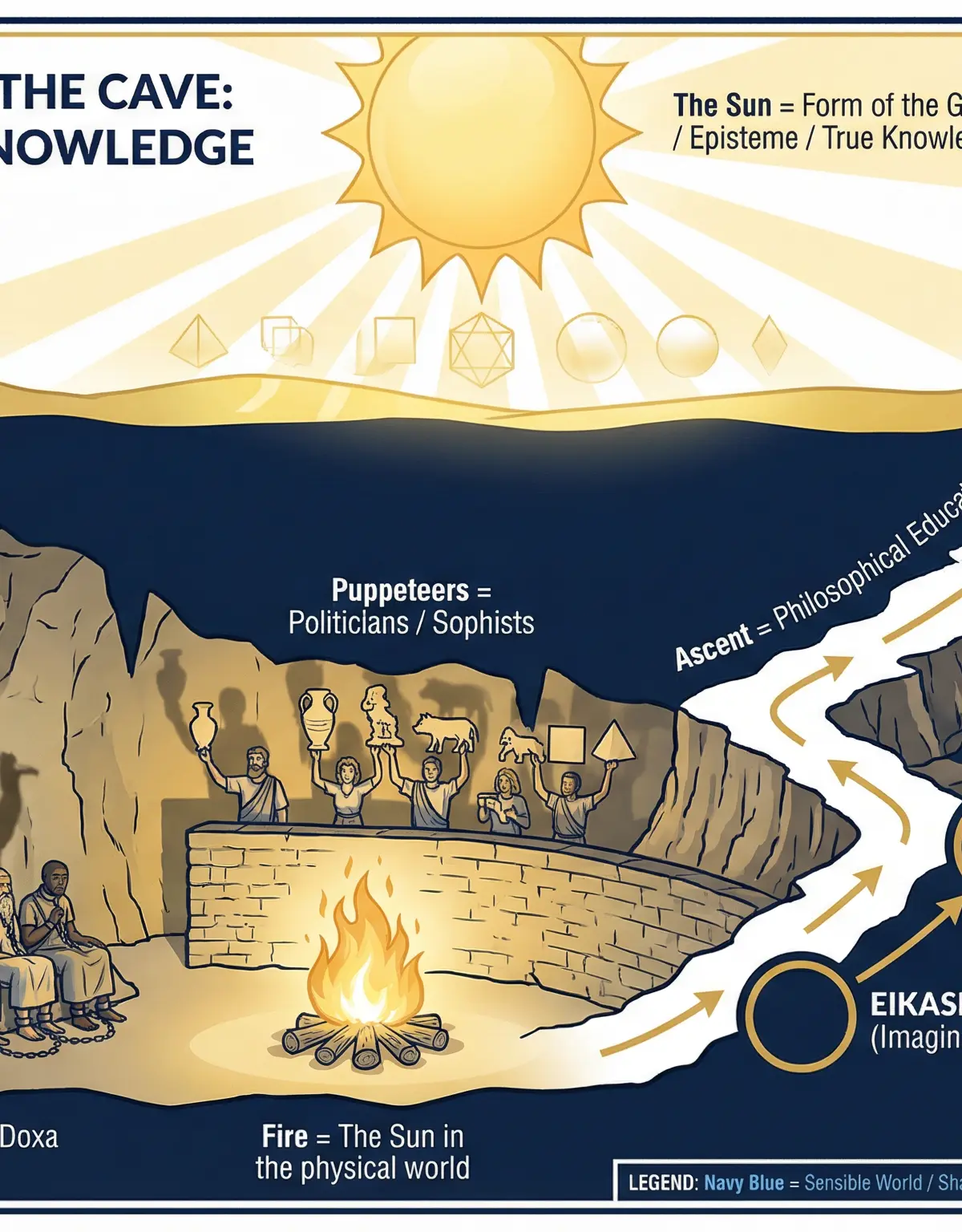
Plato's Theory of Forms & Analogy of the Cave
What happened: Plato, writing in 'The Republic' (c. 380 BCE), proposed that the physical world is not the real world; instead, it is a shadow or copy of the true reality, the World of Forms. The Analogy of the Cave is a powerful illustration of this theory, depicting prisoners in a cave mistaking shadows for reality, with one prisoner's journey out of the cave representing the philosopher's ascent to knowledge of the Forms.
Why it matters: This is the foundation of rationalism. For the exam, you must be able to explain the symbolism of the cave in detail: the prisoners, the shadows, the fire, the ascent, and the sun (representing the Form of the Good). Credit is given for explaining the levels of cognition on Plato's divided line (Eikasia, Pistis, Dianoia, Noesis).
Specific Knowledge: Plato's 'Republic, Book VII', the concepts of 'doxa' (opinion) and 'episteme' (knowledge), the symbolism of the sun as the 'Form of the Good'.
Aristotle's Four Causes & Prime Mover
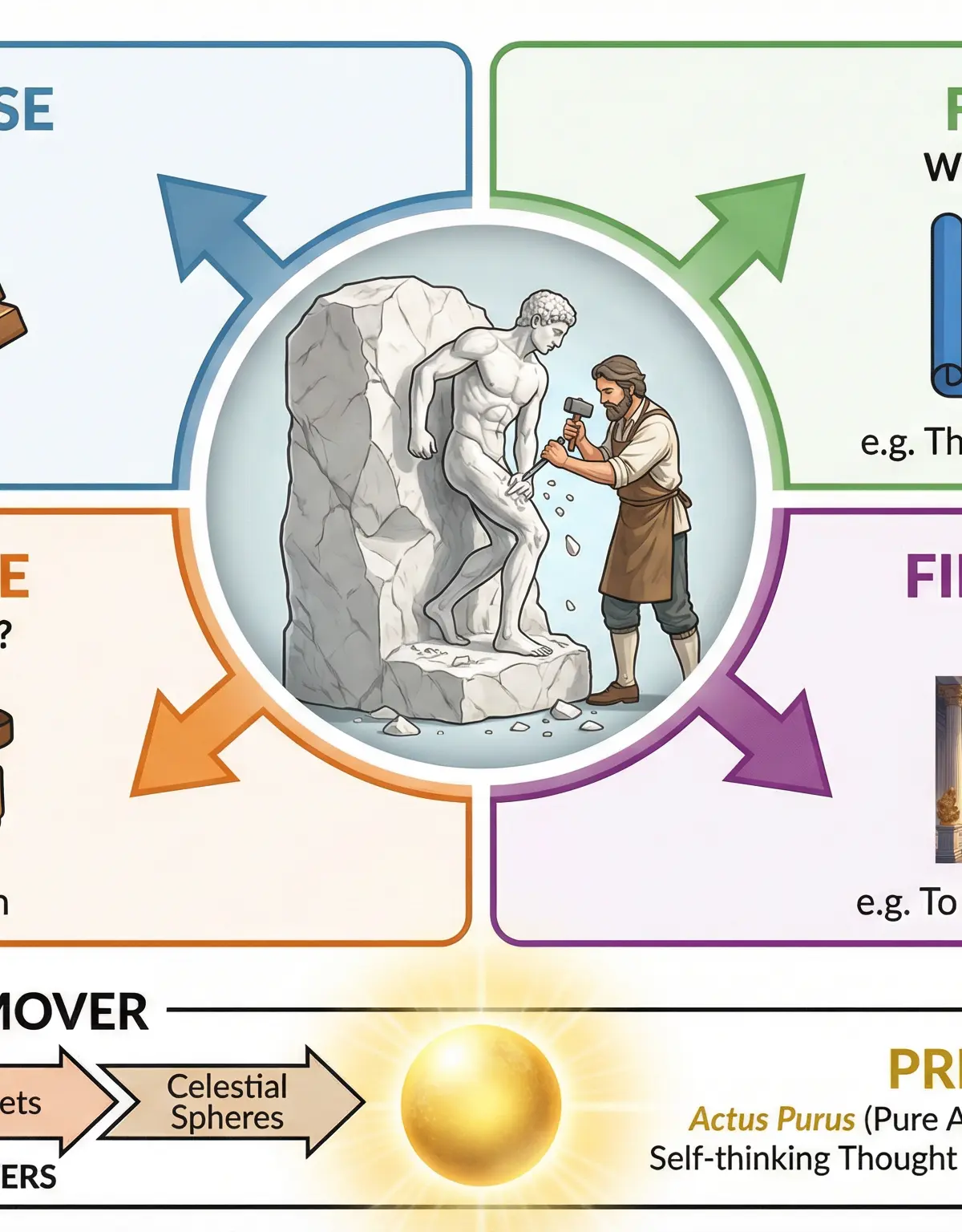
What happened: Aristotle, in his works 'Metaphysics' and 'Physics', rejected Plato's theory of a separate World of Forms. He argued that reality is the physical world we experience. His framework for understanding reality is the Four Causes: Material, Formal, Efficient, and Final (Telos). This leads to his concept of the Prime Mover, a necessary, eternal, and perfect being that is the ultimate cause of all motion in the universe.
Why it matters: This is the foundation of empiricism. For the exam, you must be able to explain each of the Four Causes with examples (e.g., a statue). Crucially, you must understand that the Prime Mover is a Final Cause, not an Efficient Cause — it attracts, it does not create. High-level responses will contrast the Prime Mover with the personal, interactive God of the Judeo-Christian tradition.
Specific Knowledge: The Four Causes (Material, Formal, Efficient, Final), 'telos', the Prime Mover as 'Actus Purus' (Pure Act), and the critique of infinite regress.
Key Individuals
Plato (c. 428-348 BCE)
Role: Athenian philosopher, founder of the Academy in Athens.
Key Actions: Developed the Theory of Forms, the Analogy of the Cave, and the concept of the philosopher-king. A rationalist who believed in a priori knowledge.
Impact: His ideas have profoundly influenced Western philosophy, theology, and political theory for over two millennia.
Aristotle (384-322 BCE)
Role: Greek philosopher, student of Plato, and tutor to Alexander the Great.
Key Actions: Developed the system of the Four Causes, the concept of the Prime Mover, and the principles of logic. An empiricist who believed in a posteriori knowledge.
Impact: His work laid the foundation for much of Western science and philosophy, and his ethical and political theories remain highly influential.
Second-Order Concepts
Causation
Plato's causation is top-down: the Forms are the ultimate cause of everything in the physical world. Aristotle's causation is bottom-up: causation is observed in the physical world through the four causes, leading to the necessity of a Prime Mover.
Consequence
The consequence of Plato's thought is a distrust of the senses and a focus on abstract reason. The consequence of Aristotle's thought is a focus on empirical observation and the scientific method.
Change & Continuity
Plato posits a world of eternal, unchanging Forms and a world of changing appearances. Aristotle sees change (potentiality to actuality) as a fundamental aspect of the physical world, with the Prime Mover as the only unchanging entity.
Significance
The significance of these two thinkers is that they established the two major opposing schools of Western thought: rationalism and empiricism. This debate continues to shape philosophy today.
Source Skills
This is a philosophy paper, not a history paper, so there are no historical sources to evaluate. However, you are expected to know the key texts: Plato's 'Republic' and Aristotle's 'Metaphysics'. You will be rewarded for direct references to these texts and their arguments.
Worked Examples
3 worked examples — open one to explore the question and available guidance.
Practice Questions
Try the question, then reveal an answer plan or example response
Explain what Plato meant by the 'Form of the Good'. (20 marks)
Hint: Think about the role of the sun in the Analogy of the Cave. What are its functions? How does this relate to the Form of the Good?
Explain Aristotle's concept of the Prime Mover. (20 marks)
Hint: Focus on the idea of the Unmoved Mover. Why is it necessary? What are its characteristics? Crucially, what kind of cause is it?
'Aristotle's empiricism provides a more convincing account of reality than Plato's rationalism.' Evaluate this view. (30 marks)
Hint: This is a big question about the core of the course. Structure your answer as a debate. Argue for Plato, then for Aristotle, and then come to a justified conclusion.
Watch or listen (optional)
Test your understanding of Ancient Philosophical Influences (Plato and Aristotle)
Active recall beats re-reading. Take an instant quiz now to test what you’ve learned and lock it into long-term memory.
7 days Premium · Then the free plan continues · No card, no charge