WJEC · A-Level · Religious Studies
Applied Ethics: Medical Ethics
This study guide delves into the contentious field of Medical Ethics for WJEC A-Level Religious Studies, focusing on abortion and euthanasia. It provides a detailed analysis of the critical tension between the Sanctity of Life and Quality of Life, equipping students to apply complex ethical theories with the precision required by examiners.
- 6 min read
- 3 worked examples
- 5 practice questions
- 6 key terms
Check what you remember
Read the wording for your board, then hide it and explain Sanctity of Life in your own words. Rough notes are fine. This is a self-check, with no mark or grade.
Reference: WJEC
The belief that human life is sacred, holy, and has intrinsic value from conception to natural death.
Study Notes
Overview
Component 3: Religion and Ethics requires a rigorous application of ethical theories to the contentious issues of Abortion and Euthanasia. This guide will navigate the tension between the Sanctity of Life and Quality of Life arguments, integrating legal precedents and religious concepts with scholarly critique. Examiners expect candidates to move beyond descriptive accounts and construct evaluative arguments, weighing the strengths and weaknesses of Natural Law, Situation Ethics, and Utilitarianism. A high-level response will demonstrate a nuanced understanding of meta-ethical terminology and the practical application of theoretical frameworks to real-world medical dilemmas, such as the case of Tony Bland or the legal status of abortion in the UK. This topic is not just about what thinkers believe, but how their theories function under pressure.
Key Concepts & Debates
The Sanctity of Life vs. Quality of Life
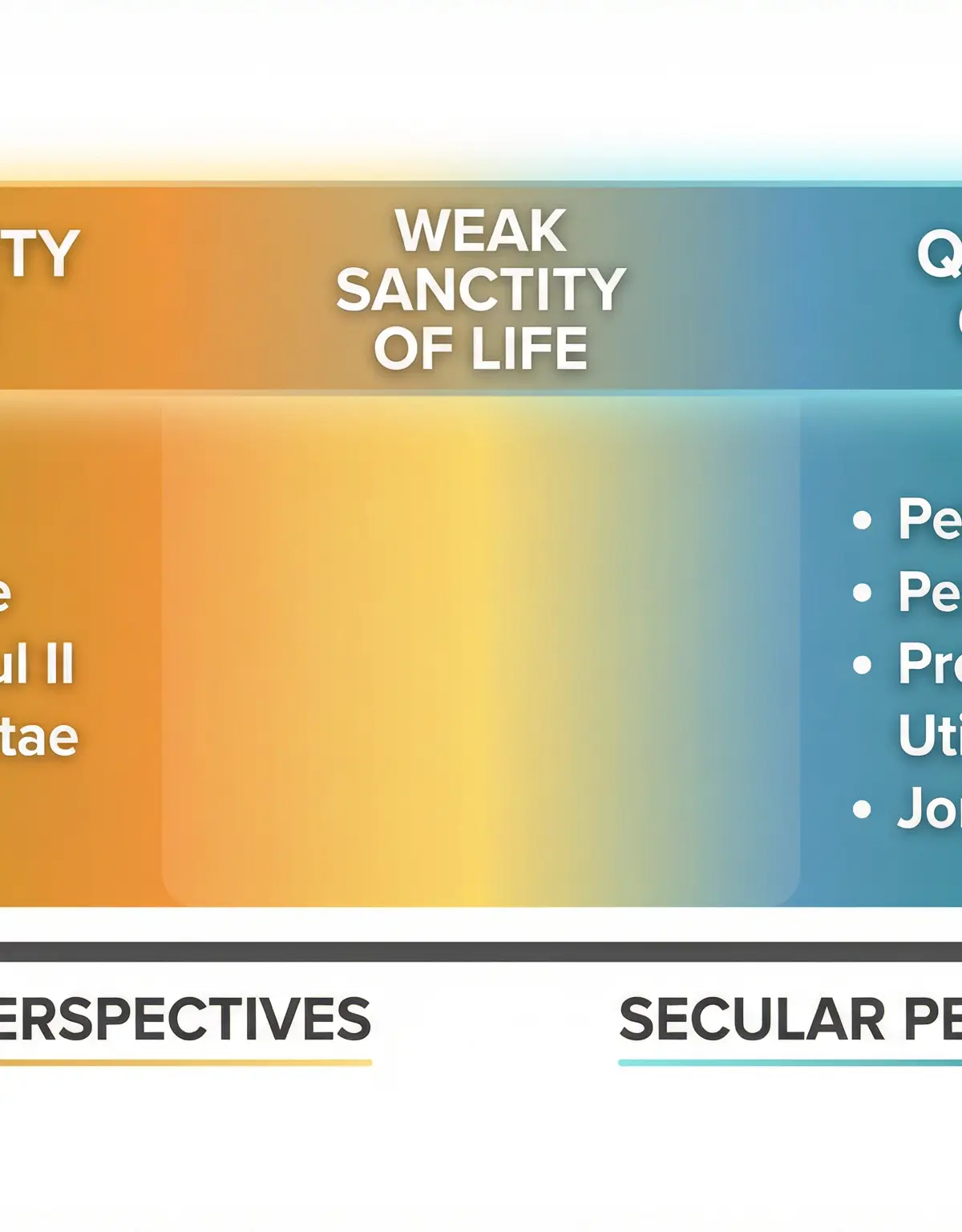
What is it: This is the central philosophical clash in medical ethics. The Sanctity of Life principle, often rooted in religious doctrine (e.g., Catholicism), holds that life is intrinsically sacred and God-given. The concept of Imago Dei (made in the image of God) is fundamental here, suggesting that all innocent human life has an absolute value from conception to natural death. In contrast, the Quality of Life principle, often argued from a secular or utilitarian perspective, maintains that the value of life depends on its quality. Thinkers like Peter Singer argue that factors like self-awareness, rationality, and the capacity for relationships determine whether a life is worth living.
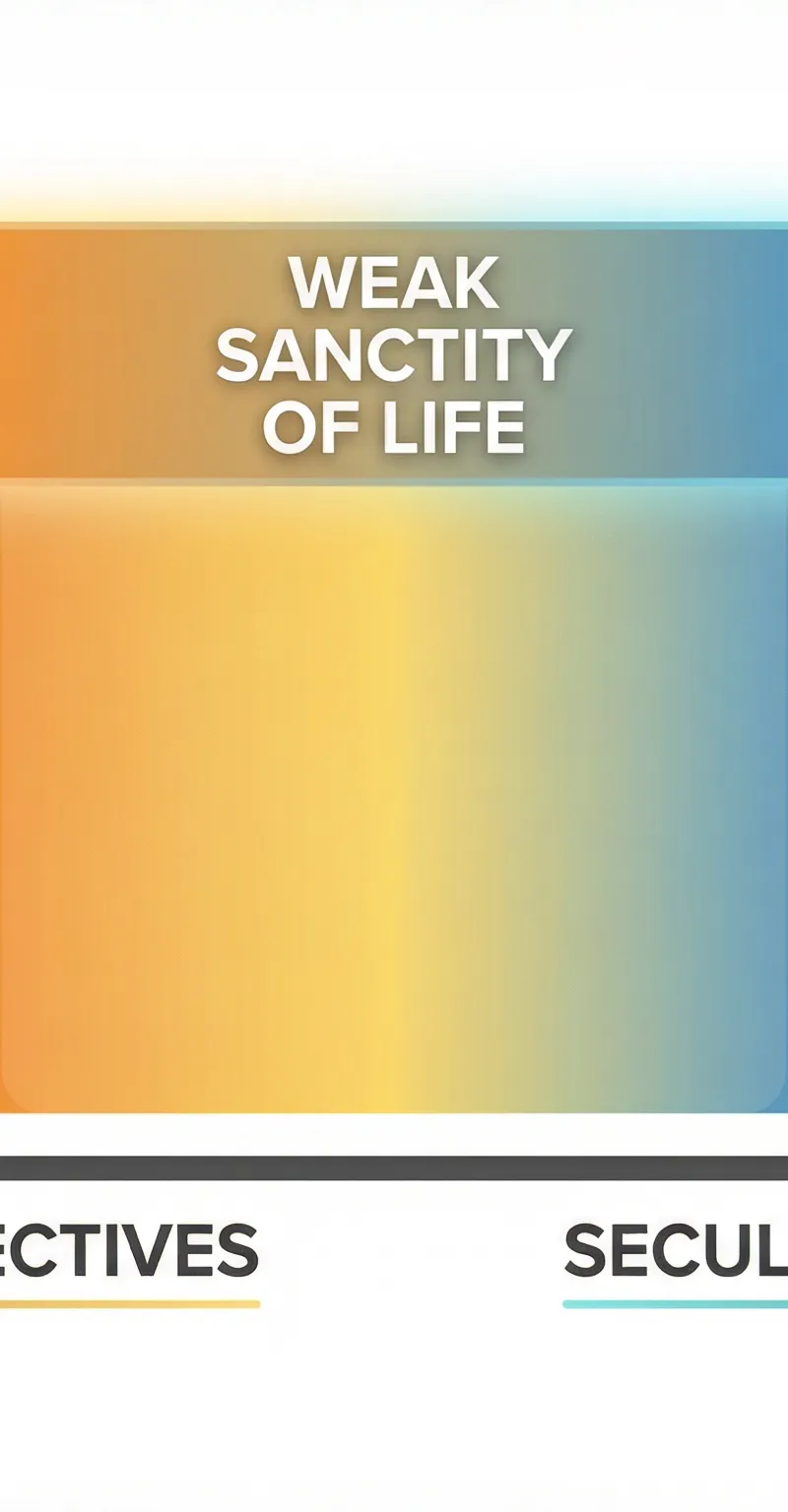
Why it matters: Examiners expect you to frame your essays around this core tension. You must be able to explain why Natural Law champions the Sanctity of Life and why Preference Utilitarianism prioritizes the Quality of Life. High-level marks are awarded for showing how 'Weak' Sanctity of Life positions (e.g., allowing the withdrawal of treatment) try to find a middle ground.
Personhood
What is it: The debate over what constitutes a 'person' with a right to life. Joseph Fletcher and Peter Singer have proposed criteria for personhood, such as self-consciousness, rationality, and a sense of the future. Under these definitions, a foetus, an anencephalic infant, or a patient in a Persistent Vegetative State (PVS) may not be considered a 'person'.
Why it matters: This concept is crucial for AO2 evaluation. You can use it to critique the absolutism of Natural Law or to build a utilitarian argument for abortion or euthanasia. For example, if a foetus is not a 'person', then from a utilitarian perspective, the preferences of the actual persons involved (e.g., the mother) take precedence. Examiners credit the use of scholarly views on personhood to challenge assumptions.
Key Ethical Theories in Application

Natural Law
Key Principles: Associated with Thomas Aquinas, this is an absolutist, deontological theory. It posits that our God-given reason can discern the 'natural law'. The purpose of humanity is to flourish and achieve fellowship with God. This is achieved by following the Five Primary Precepts, including the 'Preservation of Life' and 'Living in an Ordered Society'.
Application: Natural Law forbids actions that directly violate a primary precept. Therefore, abortion and euthanasia are seen as intrinsically wrong because they intentionally end an innocent human life. However, top-band responses MUST discuss the Doctrine of Double Effect. This principle allows for an action that has a bad consequence (e.g., death) if the primary intention was good. For instance, administering pain-killing drugs to a terminally ill patient to alleviate suffering is permissible, even if the drugs foreseeably shorten the patient's life. The intention is to relieve pain, not to kill.
Situation Ethics
Key Principles: Developed by Joseph Fletcher, this is a teleological and relativistic theory. It rejects legalistic rules and argues that the only absolute is Agape (selfless, unconditional love). The right action in any situation is the one that produces the most loving outcome.
Application: A situationist would ask, “What is the most loving thing to do in this specific medical scenario?” There are no fixed answers. For a woman whose pregnancy is the result of rape, or for a patient suffering unbearably from a terminal illness, a situationist might argue that abortion or euthanasia, respectively, could be the most compassionate and loving course of action. To earn high marks, candidates must apply Fletcher’s Four Working Principles: Pragmatism (the proposed action must work in practice), Relativism (no fixed rules), Positivism (faith in God and love), and Personalism (people come before rules).
Utilitarianism
Key Principles: A teleological theory focused on consequences. Act Utilitarianism (Bentham) focuses on the specific act and uses the Hedonic Calculus to measure the greatest good for the greatest number. Rule Utilitarianism (Mill) considers the consequences if a particular action were to become a universal rule. For medical ethics, Preference Utilitarianism (Peter Singer) is the most sophisticated tool. It argues we should seek to maximize the satisfaction of the preferences of all involved.
Application: A utilitarian approach weighs the different interests at stake. In the case of abortion, a preference utilitarian would weigh the preferences of the woman against the foetus. Since the foetus (according to Singer) is not a person and has no preferences, the woman's preference to not continue the pregnancy would likely prevail. In the case of euthanasia, if a person has a clear and settled preference to end their life due to extreme suffering, a preference utilitarian would likely support it. The case of Airedale NHS Trust v Bland (1993) is a key example where the courts, using utilitarian-style reasoning, decided it was in the best interests of the PVS patient Tony Bland to have his life-sustaining treatment withdrawn as he had no preferences or interests to satisfy.
Visual Resources
2 diagrams and illustrations

Interactive Diagrams
1 interactive diagram to visualise key concepts
Diagram could not be rendered
Timeline of key legal and papal developments in medical ethics.
Worked Examples
3 worked examples — open one to explore the question and available guidance.
Practice Questions
Try the question, then reveal an answer plan or example response
Explain the concept of 'personhood' in the debate about abortion. (12 marks)
Hint: Focus on the criteria proposed by thinkers like Fletcher and Singer and explain how this impacts the moral status of the foetus.
‘Natural Law is not helpful when dealing with the issue of euthanasia.’ Evaluate this view. (20 marks)
Hint: Consider both the strengths (clarity, consistency) and weaknesses (rigidity, apparent lack of compassion) of Natural Law. You must discuss the Doctrine of Double Effect.
Explain how a follower of Situation Ethics might respond to the issue of abortion. (12 marks)
Hint: Focus on the principle of Agape and the Four Working Principles. Avoid giving a single answer; show that the response would depend on the situation.
To what extent is Utilitarianism a good ethical theory for making decisions about euthanasia? (20 marks)
Hint: Use different forms of Utilitarianism (Act, Rule, Preference). Consider the benefits (rationality, compassion) and the problems (can it justify too much? The problem of measurement).
Explain the main arguments for and against the Sanctity of Life principle. (12 marks)
Hint: For the 'for' argument, focus on religious ideas like Imago Dei. For the 'against' argument, focus on secular critiques from thinkers like Singer.
Exam technique
How to turn what you know into marks
How to approach the question
1. **Deconstruct the question**: Identify the command word (e.g., 'Explain', 'Evaluate') and the key concepts. 2. **Plan your argument**: Create a quick bullet-point plan for your paragraphs. For an essay, decide your overall argument. 3. **Write with focus**: Ensure every paragraph links back to the question.
How to structure your answer
- Essay questions
- Introduction setting out your argument -> For/Against paragraphs with evidence and scholarly views -> A nuanced counter-argument -> A conclusion that makes a clear judgement based on the evidence presented.
- Source questions
- Not applicable for this paper.
- Explain questions
- Introduction defining the concept -> Paragraphs explaining different facets with specific knowledge -> Brief conclusion.
Timing
Approximately 1.5 minutes per mark. For a 20-mark essay, this means around 30 minutes.
Common pitfalls
- Conflating legal and moral arguments.
- Using generic phrases like 'Christians believe...' without being specific.
- Describing theories without applying them to the specific issue in the question (e.g., abortion).
- Failing to reach a clear judgement in an 'Evaluate' question.
What the command words want
- Describe
- State the key features of a concept or event.
- Explain why
- Provide a series of linked reasons, showing cause and effect.
- To what extent
- Similar to 'Evaluate', requiring a judgement on the importance or contribution of a factor.
- How far do you agree / Evaluate
- Construct a balanced argument with a clear line of reasoning leading to a final, substantiated judgement.
Watch or listen (optional)
Test your understanding of Applied Ethics: Medical Ethics
Active recall beats re-reading. Take an instant quiz now to test what you’ve learned and lock it into long-term memory.
7 days Premium · Then the free plan continues · No card, no charge