A Level Biology Practice Questions: The Smart Revision Guide
You've revised the definitions, memorised the pathways and worked through a stack of topic quizzes. Then a question gives you an unfamiliar graph, a command word such as evaluate, and a biological situation you've never seen before. Suddenly, knowing the content doesn't feel like enough.
That feeling is common, and it doesn't mean you're bad at biology. A level Biology practice questions need to train more than memory. They need to help you retrieve facts, apply them to new contexts, interpret evidence, handle calculations and write answers that match the mark scheme. That matters whether you're trying to recover lost ground or push towards the top grades, and it gives teachers a clearer way to judge whether a question bank is useful.
Why Most Biology Practice Feels Unhelpful
A student can score well on a quiz about enzymes and still lose marks on an enzyme investigation. They may remember that enzymes have an optimum temperature, but struggle to explain why a graph changes shape, identify a control variable or judge whether the evidence supports a conclusion.
That gap explains why endless recall questions can feel productive without improving exam performance. You recognise the answer when you see it, but the exam asks you to build an answer from unfamiliar information. Examiners have repeatedly highlighted difficulties with application, graph interpretation, quantitative reasoning and practical contexts, including logarithmic scales, chemiosmosis, cloning and serial-dilution calculations in Biology assessments. The OCR examiner report on unified Biology gives specific examples of these recurring weaknesses.
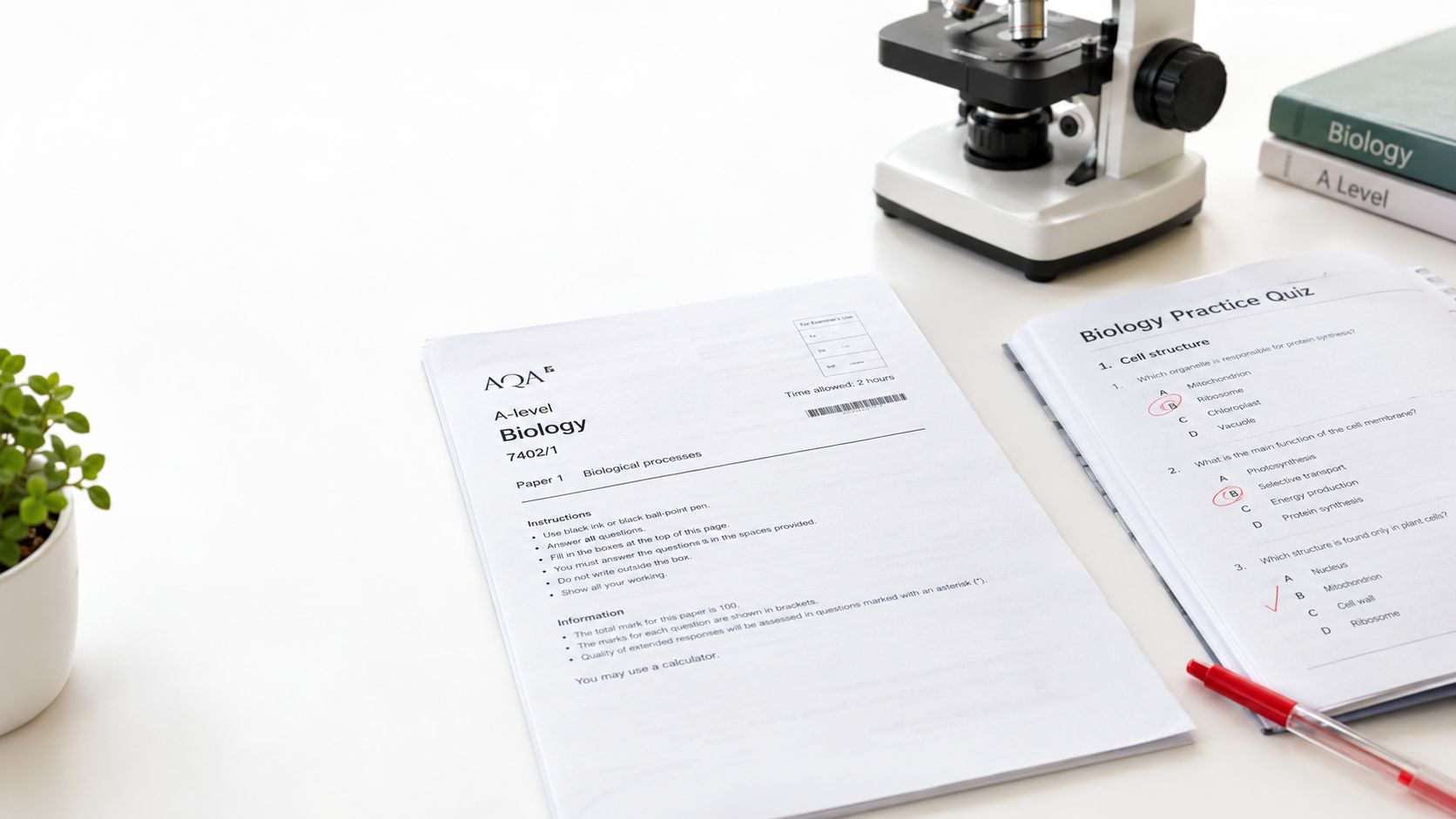
The recall trap
Suppose a quiz asks, “What is the role of ATP?” You might answer that ATP provides energy for cellular processes and move on. A real exam could instead show data from a muscle experiment and ask you to suggest why ATP production changed, calculate a rate, then evaluate the reliability of the method.
Those are different tasks, even though they involve related knowledge. A useful practice bank should make you move between them rather than letting you answer the same style of question repeatedly.
A practical revision sequence might include:
- Recall: name the stages of a process or state a definition.
- Application: use the process to explain a new biological situation.
- Data handling: identify patterns, calculate values and interpret uncertainty.
- Evaluation: judge the evidence, method or conclusion and support that judgement.
Practical rule: If every answer is retrieved directly from your notes, your practice is probably too comfortable.
This doesn't make short quizzes pointless. They're useful for repairing gaps in knowledge, especially when you're returning to Biology after under-revision. The mistake is treating them as the final stage. After a recall question, add a second question that changes the context. If you revise gas exchange, move from labelling a diagram to explaining how a change in surface area could affect diffusion, then assess a data set from an investigation.
Teachers can use the same principle when reviewing resources. A polished quiz with attractive formatting may still be weak if it tests only isolated facts. Interleaved learning for exam prep can help students mix topics and question types, which is closer to the switching demanded by a live paper: interleaved learning for exam prep.
How A Level Biology Is Actually Marked
A level Biology becomes easier to practise when you understand the three assessment objectives behind the questions. They aren't three separate subjects. They're three ways of showing what you know.
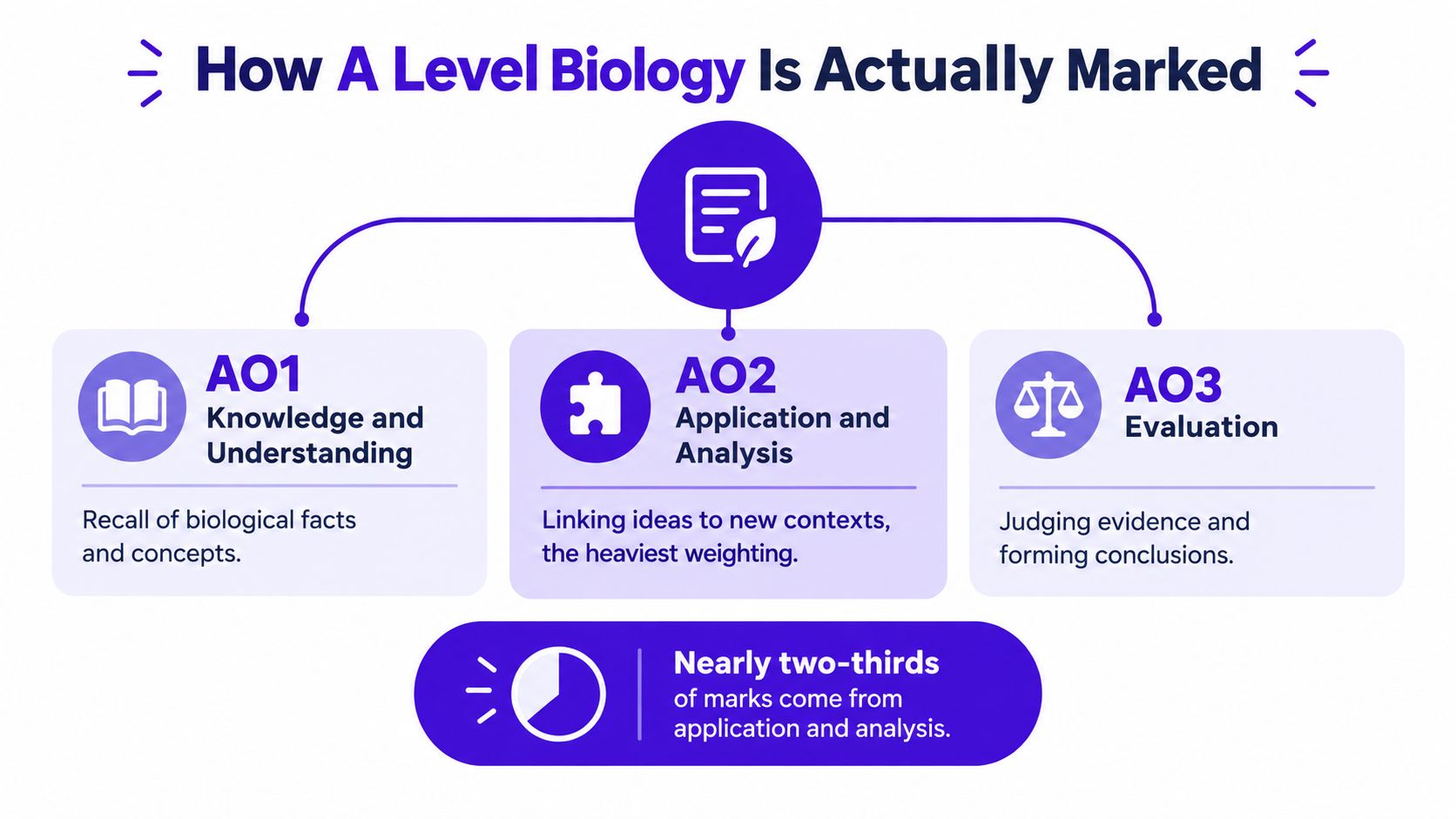
AO1 means knowing the biology
AO1 covers knowledge and understanding. This includes definitions, structures, processes and the relationships between biological ideas. A question asking you to state the function of a structure or describe a process may mainly test AO1.
That doesn't mean AO1 is easy or unimportant. You can't explain oxidative phosphorylation without knowing the relevant structures and steps. However, AO1 practice should be quick and precise. If you spend most of your revision time copying notes or answering simple definition questions, you may be preparing for only one part of the assessment.
AO2 means using knowledge in context
AO2 covers application, including theoretical, practical and quantitative contexts. OCR's published assessment weighting gives approximately 31 to 34% for AO1, 40 to 43% for AO2 and 25 to 28% for AO3 in A level Biology. Those figures are set out in the AQA Biology scheme of assessment.
AO2 questions often provide information you haven't memorised. You may need to connect a familiar concept to an unfamiliar organism, experiment or set of results. For example, knowing that water potential affects movement across membranes is AO1. Using that knowledge to explain a change in mass shown in an investigation involves AO2.
AO3 means judging evidence
AO3 covers analysis, interpretation, evaluation and refining procedures. It asks you to decide what the data means and whether a method or conclusion is justified. That might involve identifying a limitation, explaining how to improve reliability or comparing evidence with a prediction.
The important point is that roughly two-thirds of the assessment weighting sits in AO2 and AO3, rather than simple recall. That's why a student can feel confident after a revision session but still lose marks in a full paper. The practice has tested recognition, while the exam tests decisions.
A strong question set should therefore show the objective being practised. Teachers can use AO labels to diagnose a class problem, while students can track whether they're avoiding a particular type of thinking. Tools offering AI marking for GCSE and A-Levels can be useful when the feedback identifies whether an answer missed knowledge, application or evaluation, rather than just saying it was wrong.
A biology paper should feel like a mixture of these objectives. If your practice contains only one of them, it isn't showing you the whole assessment challenge.
Command Words and What They Really Demand
A command word tells you what kind of response the examiner wants. It doesn't tell you everything you need to write, but it sets the direction.
A common mistake is to treat every question as an invitation to write everything you know. That approach wastes time and can bury the relevant point. A better approach is to match the answer to the verb, then use the information in the question.
| Command word | What it asks you to do | A useful response habit |
|---|---|---|
| State | Express something clearly | Give the required fact without a long explanation |
| Name | Identify a biological term | Use the precise term |
| Describe | Give an account of what happens or what is shown | Report features, trends or stages without adding unsupported causes |
| Compare | Identify similarities and differences | Make paired points where possible |
| Explain | Give reasons using biological knowledge | Build a linked chain of cause and effect |
| Suggest | Apply knowledge to a less familiar situation | Use plausible biology and refer to the information given |
| Calculate | Work out a value | Show the method, units and final answer |
| Evaluate | Judge evidence or a claim | Give strengths, limitations and a supported conclusion |
These distinctions follow the AQA guidance on biology command words. Calculate isn't the same as state. Compare isn't a list of two descriptions. Evaluate requires a judgement based on evidence, not a collection of criticisms.
One question can require two skills
AQA points out that two command words can appear in one question, such as describe and explain or suggest and explain. Students often answer only the first part. They describe a graph but don't explain the trend, or they suggest a reason but don't connect it to biological knowledge.
Underline each command word before you begin. Then split the response mentally:
- What feature, result or pattern must I identify?
- What biological reason must I give?
- What evidence from the question supports my answer?
For a “describe and explain” graph question, the first sentence might report the trend. The next sentences should link that trend to a mechanism. Don't jump straight into explanation and forget to state what the graph shows.
Train the verb, not just the topic
Two students can revise the same topic in very different ways. One completes a quiz called “Cell membranes” and checks whether each fact is correct. The other completes a set containing “state”, “describe”, “explain”, “calculate” and “evaluate” prompts about membranes.
The second student is rehearsing the decisions that affect marks. Keep a small command-word log and record the error you made. If you repeatedly write explanations for “describe”, practise reporting patterns only. If your evaluations stop at “the sample size was small”, add why that weakens confidence and how the investigation could be improved.
Building a Progressive Practice Plan
Starting with a full paper when your knowledge is patchy can be discouraging. Starting with recall forever creates false confidence. A progressive plan gives you a route from basic retrieval to unfamiliar, timed responses.
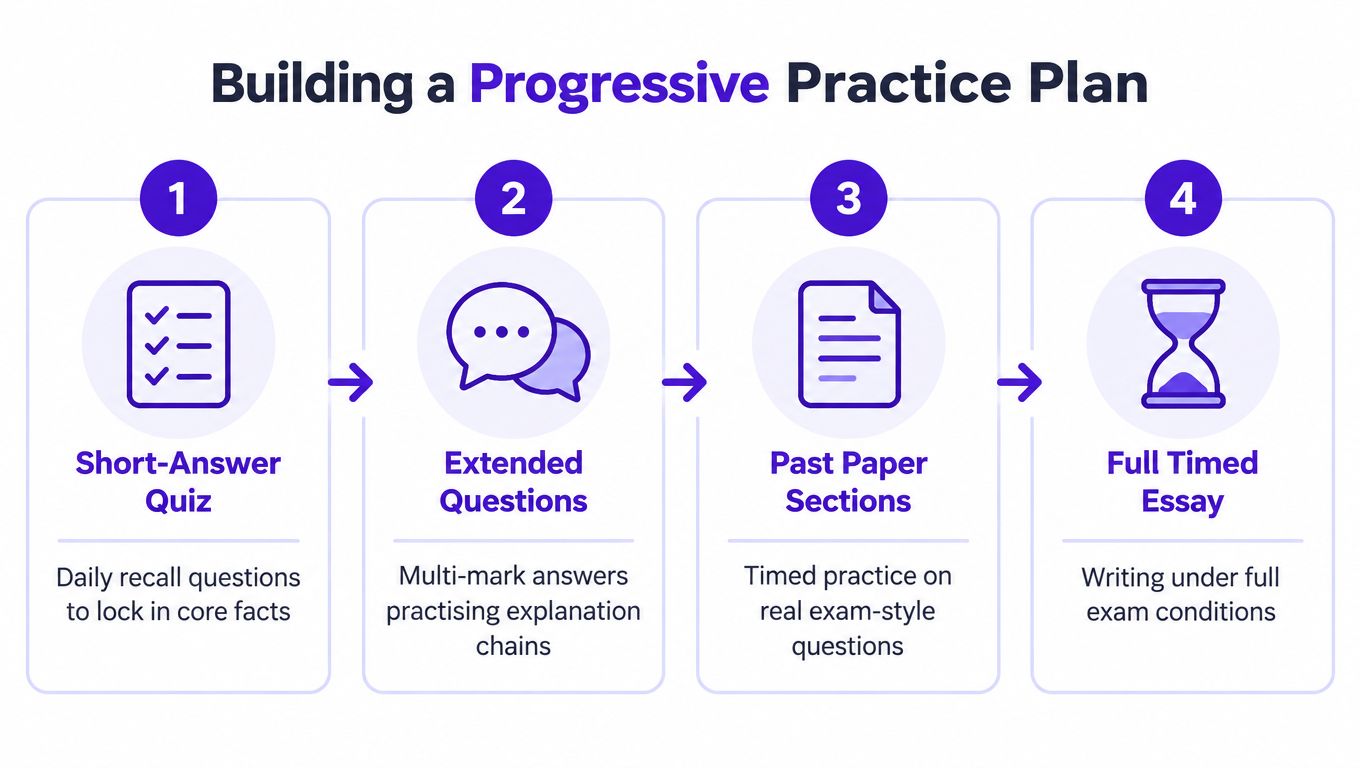
Step one starts with short answers
Begin with short questions on one weak topic. Test definitions, structures, processes and required practical terms. Keep the answers brief, then mark them immediately. If you can't answer a question, repair that gap before adding harder questions.
Don't stay here for the whole session. After recalling a fact, change the demand. For respiration, you might define a term, describe a graph, explain a change in ATP production and calculate a rate. That sequence turns one topic into several assessment experiences.
Step two adds explanation chains
Move to questions worth several marks. Write in linked steps rather than disconnected statements. A useful explanation often follows a pattern such as:
- Starting condition: identify what changed.
- Biological mechanism: name the process affected.
- Consequence: explain what happens next.
- Observed result: connect the mechanism to the data or situation.
Mark each link separately. If your answer contains the right vocabulary but no causal connection, you've found a specific skill to practise.
Step three introduces timed sections
Once you can answer extended questions without relying heavily on notes, complete a timed section from a real paper. Use questions from your exam board, because AQA, Edexcel, OCR and WJEC can differ in wording, structure and emphasis.
The AQA Biology specification at a glance shows that Biology 7402 includes 76 marks of short and long-answer questions and 15 marks of extended response. Your practice should reflect that mixture. A topic quiz alone won't teach you how to manage a longer response or sustain a logical argument.
Step four reaches full essay conditions
Build towards a 24-mark essay only after you've practised retrieving relevant content and organising paragraphs. Start by making a quick plan with the biological themes you'll cover. Then write from memory, using precise examples and linking sentences rather than listing everything in your notes.
Teachers can scaffold this by giving students a paragraph frame first, then removing it. Students working independently can review one essay for content and another for structure. Use Exam Practice for A-Level when you need a focused environment for moving from untimed answers to timed work.
Practical work needs its own place in the plan. OCR's A Level Biology A specification requires students to complete a minimum of 12 practical activities as part of the Practical Endorsement. The OCR practical and coursework guidance shows why practical skills shouldn't be treated as an optional extra.
Revise variables, controls, uncertainty, sampling, apparatus, safety and evaluation. After a practical activity, write one question that asks what the results mean and another that asks how the method could be improved. That turns classroom experience into exam-ready practice.
The Pitfalls That Cost Real Marks
A student reads a table correctly, identifies the highest value and writes a sensible conclusion. Then the next question presents similar information on a logarithmic scale, and the answer falls apart. The biology hasn't disappeared. The representation has changed.
Examiner reports describe this pattern. Students could often extract information from tables and graphs but struggled when the same type of information appeared on a logarithmic scale. That's why practice questions should vary the format of the data, not just the topic.
Make graphs do more work
For every graph question, practise a fixed checking routine:
- Read the axes: identify the variable, unit and scale.
- Describe the pattern: mention direction, comparisons and unusual results.
- Use values carefully: quote or calculate only what the question needs.
- Explain the biology: connect the pattern to a mechanism.
- Judge the evidence: consider spread, anomalies and reliability.
Don't call a graph “exponential” just because it curves upwards. Check the scale first. A logarithmic axis changes how equal distances represent values, so your interpretation must reflect the labels rather than the visual shape alone.
Separate variables from controls
Control-variable questions also expose shallow understanding. Students may name temperature as a control but fail to explain why keeping it constant matters. A stronger answer connects the control to the factor being measured and explains how variation could affect the result.
For example, if you're investigating the effect of pH on enzyme activity, temperature should remain constant because temperature changes can alter enzyme activity independently of pH. The explanation earns more value than a bare list of variables.
Combine calculation with interpretation
A calculation is rarely the end of a data question. Check the formula, substitute values carefully, include units and then explain what the result means in the biological context. If the question asks for a rate, make sure you've considered the time interval and whether the change is an increase or decrease.
OCR reports have identified problems with serial-dilution population calculations and interpretation of data. Practise questions that require both operations in one response. Calculate the value, then answer a sentence such as, “What does this result suggest about the population?” That final interpretation is where many students stop too early.
The strongest practice questions don't let you hide behind a correct number. They ask you to explain what the number means.
Spaced Review and Exam-Day Readiness
Cramming one topic repeatedly can make it feel familiar without proving that you can retrieve it later. Spaced review works better when you return to a topic after working on something else, then mix recall, data questions, practical contexts and extended responses.
Keep a simple error record. Write the topic, command word, mistake and corrected approach. Revisit the errors through A-Level Past papers, but don't just redo questions you remember. Choose unfamiliar questions and check whether you can transfer the method.
Practical skills and academic honesty belong in the same plan. JCQ says assessed coursework must be the candidate's own work, and students using material from an external source must identify the relevant part and state where it came from. Use feedback to improve your thinking, not to replace your work with unsupported rewriting.
The final routine should be balanced: short recall for foundations, mixed questions for transfer, timed sections for pace, practical review for method and evaluation, and spaced correction for lasting improvement. That combination prepares you for what the paper demands.
MasteryMind offers specification-aligned A level Biology quizzes and exam-style practice across AQA, Edexcel, OCR and WJEC, moving from recall to application, analysis and extended responses with examiner-style feedback. Try MasteryMind to practise command words, mark allocations and timed Biology questions in one structured revision system.
Ready to master this topic?
Practise with quizzes, blurt exercises and exam questions on MasteryMind.
7 days Premium · Then free forever · No card, no charge