10 a Level Biology Quizzes for Better Exam Practice
You've revised unevenly. You can recognise terms such as oxidative phosphorylation, codominance and limiting factors, but unfamiliar graphs still slow you down, and a six-mark answer loses marks because it doesn't explain enough. Or you're a teacher checking a revision resource and wondering whether its instant feedback reflects the specification, or rewards a guessed multiple-choice answer.
The best A-level Biology quizzes depend on the job you need them to perform. A quick retrieval session, an exam-board-specific question bank, a practical-data drill and a full-paper preparation tool aren't interchangeable. You need to check syllabus coverage, question formats, board fit, feedback quality, adaptive or spaced practice, accessibility and limitations before deciding which resource deserves a regular place in your routine.
Quiz scores are useful evidence, but they're not the whole picture. Question quality, mark schemes and human review still matter, especially when you're learning how to handle command words, calculations, unfamiliar data and extended answers. This comparison looks at where each platform fits in a realistic workflow, from rebuilding topic knowledge to closing gaps after an exam-style attempt.
If you're organising wider science learning, K-12 biology planning made simple can help you connect revision activities with a broader study plan.
1. MasteryMind
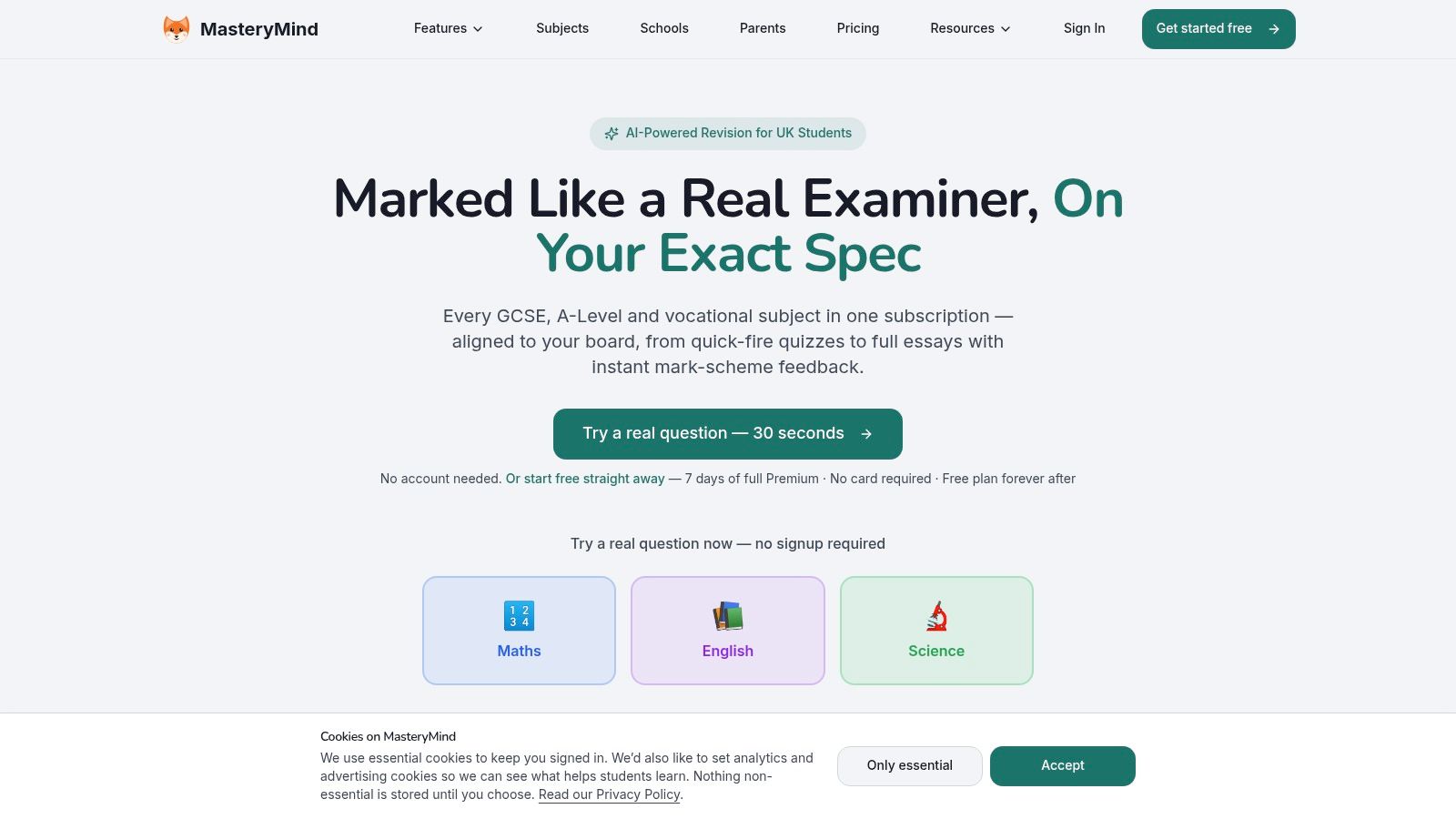
A student who can define oxidative phosphorylation may still lose marks on a respiration graph or an extended response. MasteryMind fits the rebuild-and-then-practise job: students who need specification-linked questions, command words and mark allocations, rather than a generic biology question bank.
It is an AI-powered revision platform for UK learners from Years 3 to 13, covering GCSEs, iGCSEs, A-Levels and vocational qualifications. For A-level Biology, the practical starting point is board selection. The platform supports AQA, Edexcel, OCR, WJEC and more than 200 awarding bodies, according to its product description. A student can therefore choose a relevant specification, while a teacher can use the resource as a targeted supplement instead of checking every broad biology question for board fit.
Questions move from quick-fire knowledge checks to extended responses, including essays worth up to 24 marks. Adaptive difficulty is intended to take learners from AO1 recall towards AO2 application and AO3 analysis and evaluation. That progression gives the platform a different role from a short retrieval quiz, although students still need official papers to practise the exact demands of their board.
Where the feedback earns its place
The useful feature is feedback that explains why an answer succeeds or falls short. Essay responses can receive AO breakdowns, mathematical working can be checked step by step, and LaTeX support keeps notation clear. The system also flags common pitfalls and provides mark-scheme-aligned comments.
That feedback is particularly relevant after questions on genetics, respiration, ecology or photosynthesis. A student may remember the vocabulary but fail to connect cause, evidence and conclusion. AI review can identify the next correction, yet it should not replace expert judgement. It may miss context, accept imprecise phrasing or overlook a valid alternative explanation, so teachers should review uncertain answers against the official mark scheme.
Practical rule: Use AI feedback to identify the next correction, then compare the response with the official mark scheme or ask a teacher to review an uncertain answer.
The Blurt Challenge provides a separate retrieval route. Students speak an answer aloud, the platform compares it with curriculum objectives and creates follow-up quizzes for detected gaps. Spaced review scheduling and mixed-topic practice help prevent a familiar problem: repeating one topic until it feels easy without testing recall across the course.
For coursework, NEA Coach offers Socratic guidance and mark estimation without rewriting drafts or supplying direct solutions. Students can upload PDF, Word or text files for section-by-section feedback. That makes the tool relevant to students, tutors and schools that want structured support while respecting JCQ boundaries.
You can begin with a real question without signing up, try a seven-day Premium trial without entering card details and continue on a free plan. The free version is suitable for checking whether the question style and feedback fit your needs. Serious exam preparation may require the paid tools, including NEA Coach and full AI marking.
For a closer look at its exam practice, see Exam Practice for A-Level.
Pros
- Exam-board alignment: Practice can be matched to AQA, Edexcel, OCR and WJEC specifications.
- Feedback depth: AO breakdowns, mark-scheme-style comments and step verification go beyond right-or-wrong marking.
- Learning design: Spaced review, mixed-topic practice and spoken active recall support retention.
- Wide use: The platform supports more than 70 subjects and Years 3 to 13.
- Important limitation: AI feedback is helpful, but it is not a substitute for personalised teacher marking.
2. Save My Exams
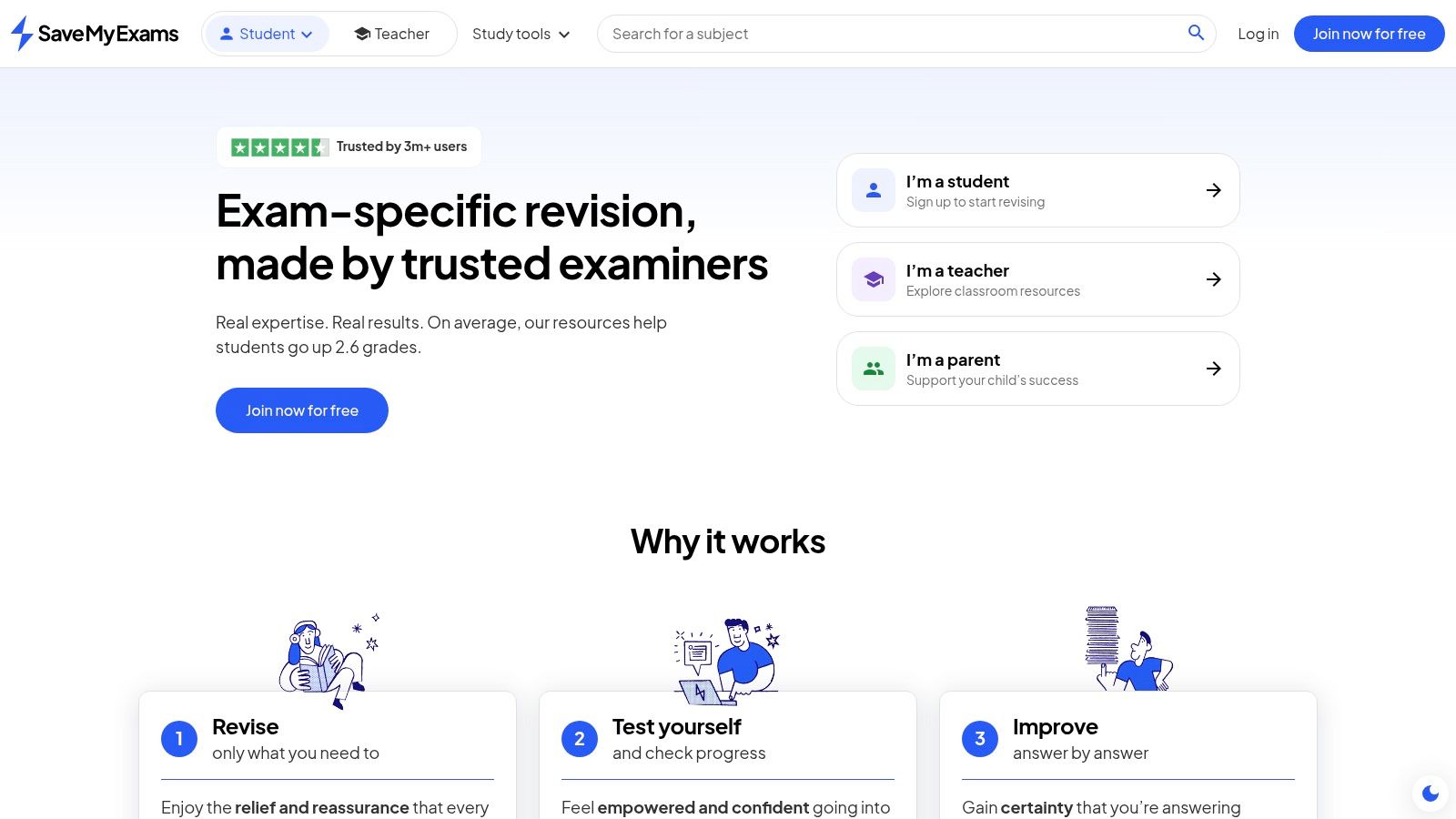
Save My Exams works best when you want a clear route from learning content to exam-style practice. Its A-level Biology materials are organised around AQA, Edexcel and OCR, so students can select a relevant course rather than relying on board-agnostic questions that may omit a required practical, topic detail or command-word pattern.
The workflow is straightforward. Read or review the notes, attempt topic questions, use Target Tests to find weak areas, then move towards mock exams. That progression suits a student who has fallen behind and needs structure, because it reduces the temptation to jump straight into a full paper without knowing why marks are being lost.
Topic questions are paired with mark schemes, which matters more than attractive progress graphics. A mark scheme lets you identify whether the problem is missing terminology, incomplete explanation, poor data interpretation or a failure to answer the command word. Flashcards and Smart Lessons are useful for rapid recall, but they shouldn't become the whole revision plan.
Best use in a weekly routine
Use Save My Exams after rebuilding a topic such as membranes, inheritance or biodiversity. Start with notes only when you have a knowledge gap. Once you can explain the idea without looking, answer the topic questions closed-book and annotate the mark scheme with the exact point you missed.
The platform's mock exams are more useful later, when you need to practise stamina and switching between topics. Don't assume a good topic score means you're ready for a full paper. A-level Biology exams can combine recall with calculations, practical methods, graph interpretation and extended explanations, so your revision needs that variety too.
Premium access provides the strongest experience, including full answers and broader access to the library. The free tier can help you sample the content, but students may find that some boards, years or detailed answer material are restricted.
For an alternative view of the same revision workflow, read this MasteryMind platform comparison guide.
Best for: Students who want exam-board-organised notes, topic questions, Target Tests, flashcards, mark schemes and mock exams in one structured library.
3. Seneca Learning Premium Quiz Mode
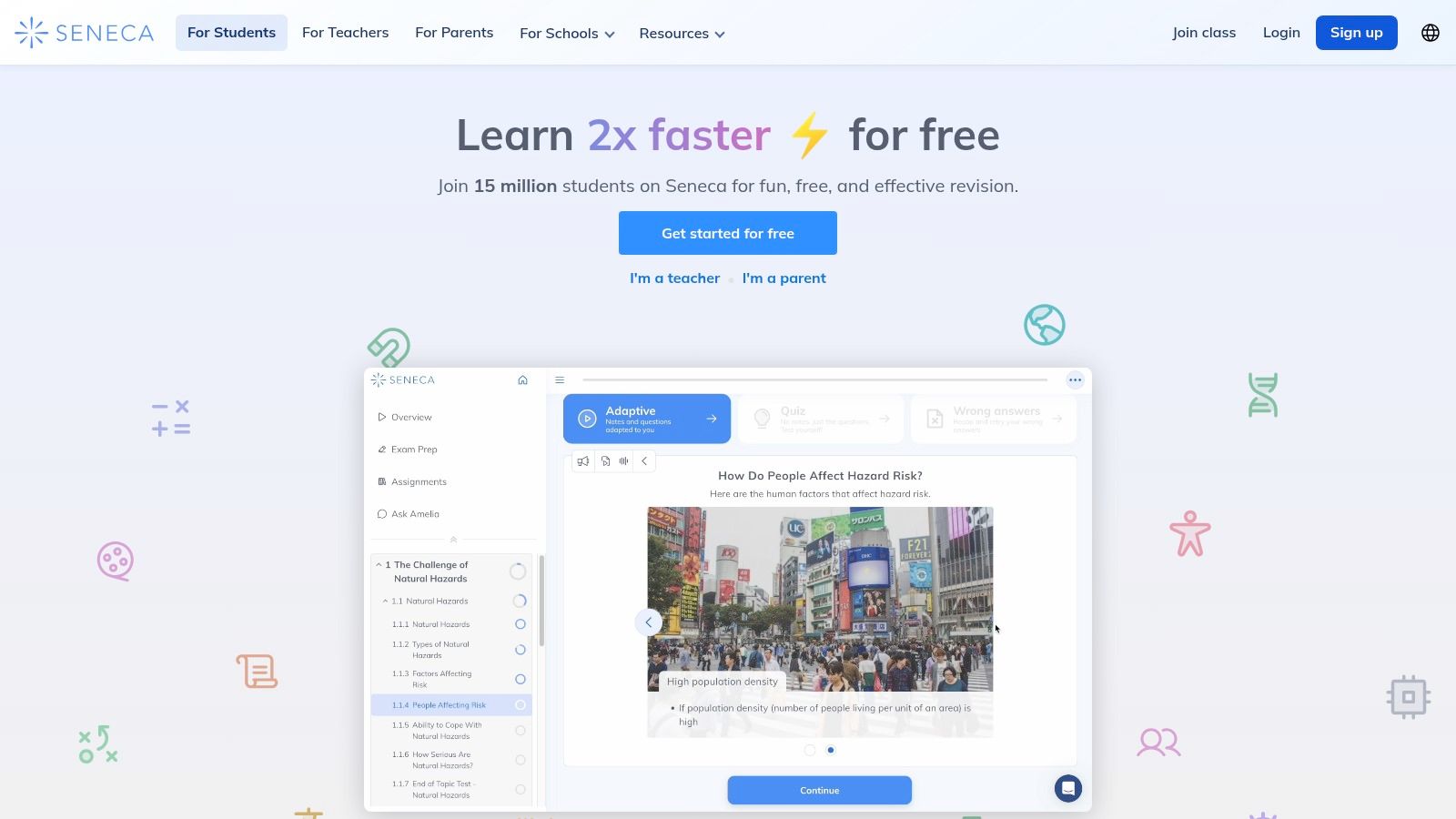
Seneca Learning is a good fit when you need to turn a lesson into a fast retrieval session. Its A-level Biology courses cover AQA, OCR and Edexcel, and Premium Quiz mode converts lesson content into rapid-fire questions. That makes it easy to revise in short bursts, especially when you're travelling, waiting for a lesson or trying to restart a neglected topic without facing a large workbook.
The adaptive course flow is useful because it mixes teaching and testing. You can review an explanation, answer questions, receive feedback and continue through the syllabus without switching between several resources. That convenience helps students who struggle more with starting revision than with understanding the subject itself.
Seneca also offers AI-marked exam questions for schools and a Resource Hub containing teacher and community-created quizzes. Teachers can use shared materials for starters, retrieval practice or homework, while students can find additional questions beyond the main course.
The quality-control trade-off
The main weakness is that not every quiz in a community resource hub will have the same level of quality. A teacher-created quiz may be excellent, but users should still check its wording and answers against the current specification. A question that tests a detail outside your board, or gives an oversimplified explanation, can create confusion rather than close a gap.
Premium is required for Quiz mode, and pricing and full access details are behind login. That makes it harder to evaluate the complete product before committing. The free lesson experience can still show whether the short-question format suits you.
Seneca is strongest for frequent retrieval and syllabus coverage, not as a complete replacement for written exam practice. Follow a Seneca session with a longer answer, data question or practical-method task from an official paper. That combination tests whether you can use the knowledge when the question stops looking familiar.
Students comparing adaptive revision options can also read this Seneca Learning alternative comparison.
Best for: Learners who want short, adaptive quiz sessions integrated with teaching content, plus schools that need shared retrieval activities.
4. Cognito
Cognito combines teaching content with self-marking quizzes, which makes it practical for students who don't yet know whether they need explanation or testing. Its A-level Biology provision includes OCR A and CIE quiz pages, alongside videos and notes. You can watch a lesson, attempt questions and then build a custom quiz or deck around the part you found difficult.
That customisation is the feature to focus on. If you're losing marks on water potential but managing cell structure, there's little value in repeatedly revising the whole cells unit. Build a narrower quiz, test the terms and processes you missed, then return later with a mixed set that includes both weak and secure areas.
Cognito also lets users create their own papers. This can be useful for teachers setting a short starter or for students making a mini-assessment before a test. Self-marking keeps the process quick, but it can't always judge the quality of a longer biological explanation.
Board fit matters here
Cognito's coverage is stronger for OCR and CIE than for every UK board. AQA or Edexcel students should verify that the course content, terminology and required practical emphasis match their own specification before relying on it as a main resource. The videos may still explain the underlying biology well, but conceptual accuracy isn't the same as complete exam-board coverage.
Individual pricing is competitive compared with some larger platforms, although some users report limits on free flashcard use. The best role for Cognito is targeted self-testing alongside a board-specific question bank or official papers.
Best for: Students who want videos, notes and custom quizzes in one place, especially those following OCR A or CIE.
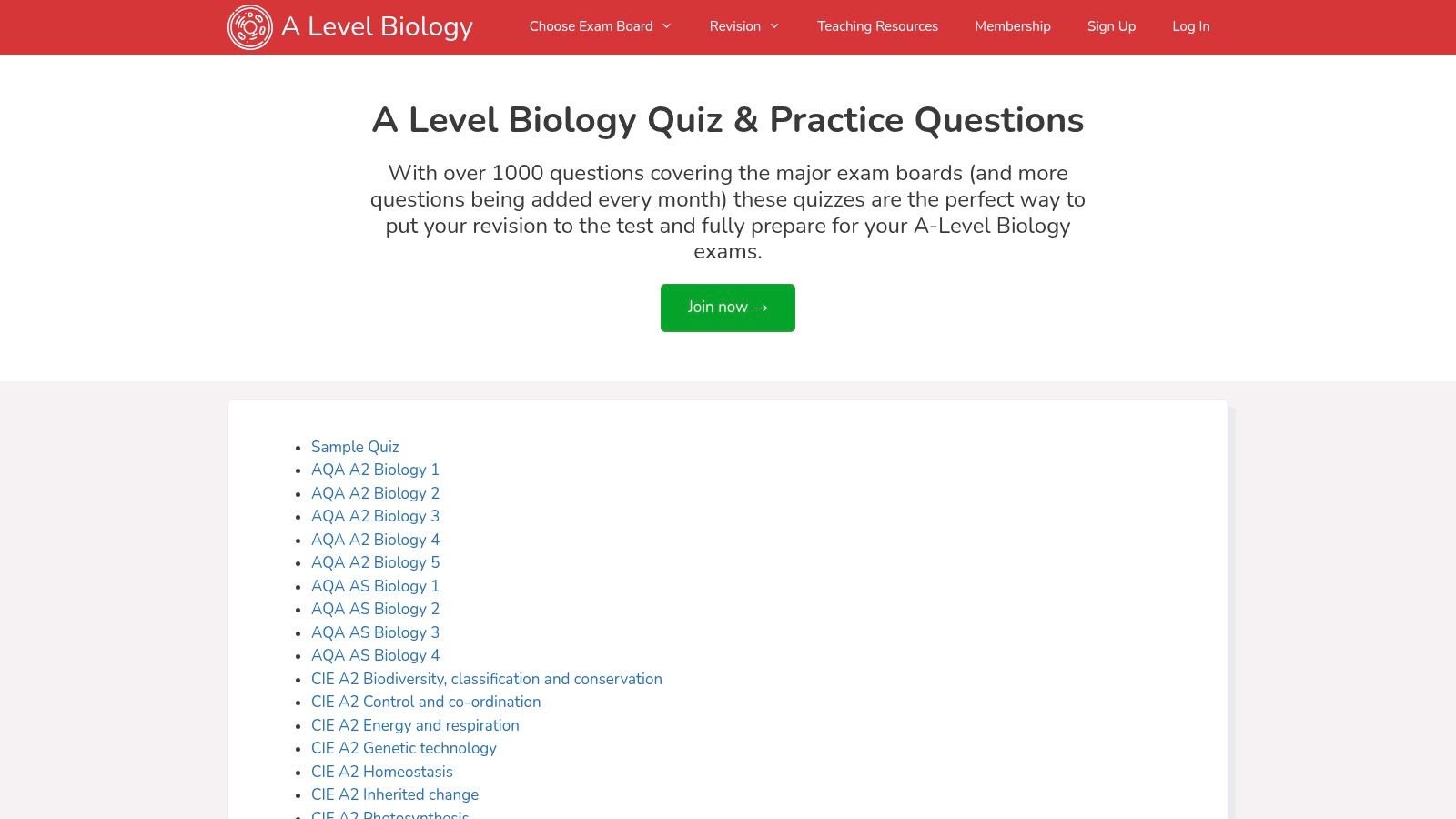
5. ALevelBiology.co.uk A-level Biology Quizzes
ALevelBiology.co.uk is designed for low-friction practice. You can open a topic, answer questions and use the result as a quick check without setting up a detailed revision programme. Its question pool contains more than 1,000 questions, as stated by the site, and the resource is board-agnostic.
That combination makes it useful between deeper study sessions. After revising enzymes, transport, gene expression or ecosystems from your course materials, complete a short quiz to see what you can recall without notes. If you miss a question, return to the relevant textbook or lesson rather than treating the score as evidence that the entire topic is secure.
Why simple can be useful
A straightforward interface removes barriers. Students rebuilding revision often need something they can start immediately, especially when a large dashboard or complicated planner makes the task feel bigger than it is. The site is also suitable for a quick warm-up before attempting a more demanding exam question.
The trade-off is limited sophistication. Tracking, adaptive sequencing and teacher tools aren't as developed as on larger platforms. The site also won't automatically train you to write a six-mark explanation, analyse uncertainty or plan a practical investigation because you've completed many multiple-choice questions.
Use it as a retrieval layer, not as your complete exam preparation system. Keep a separate record of the concepts you miss, then test those concepts in a different format. A student who can identify the correct answer may still struggle to explain the mechanism in a written response.
Best for: Quick, accessible board-agnostic topic checks when you need a short session with minimal setup.
6. SimpleStudy UK AQA A-level Biology Quizzes
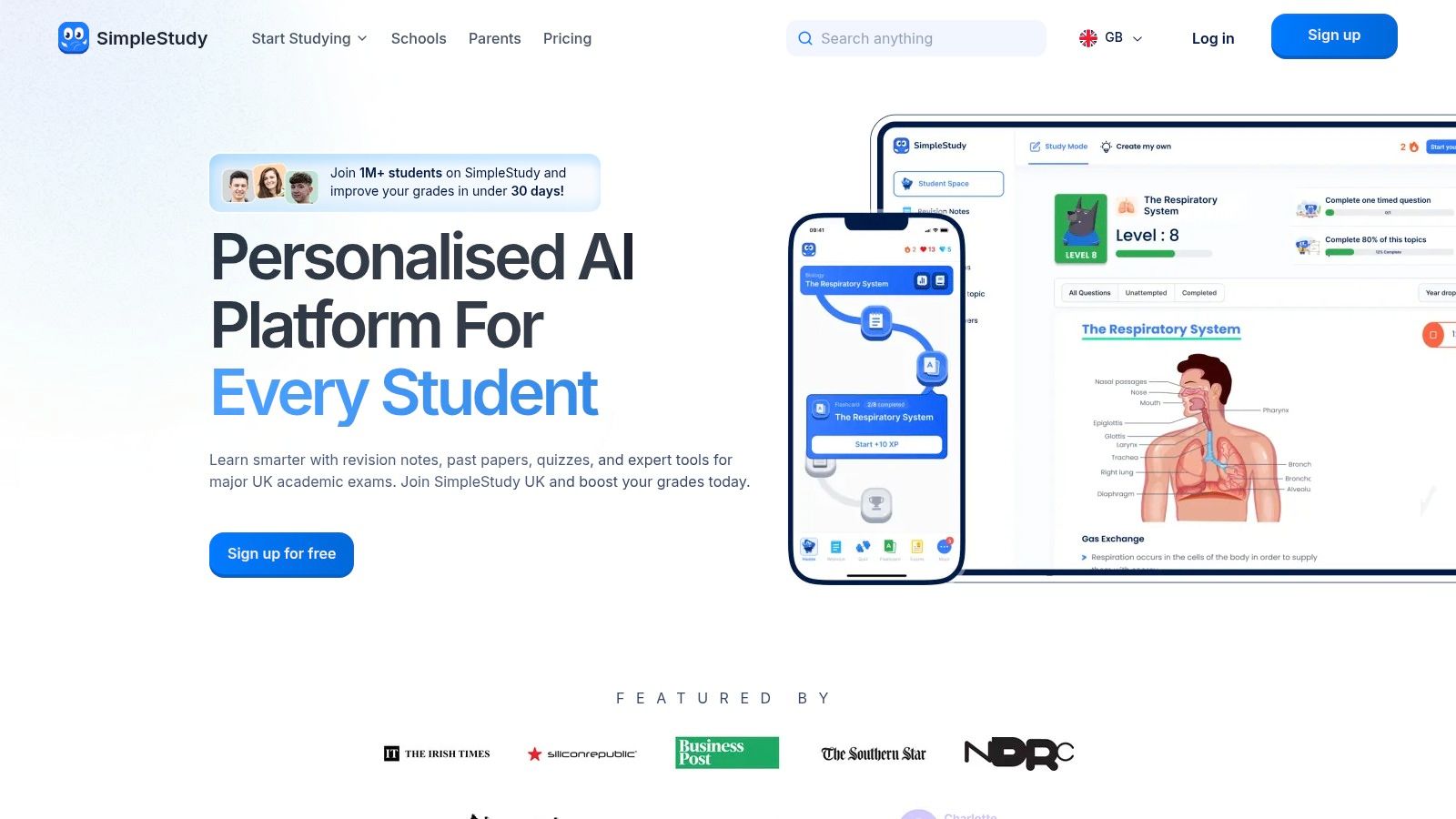
SimpleStudy suits students who want revision to feel like a daily mobile routine. Its UK-focused platform brings together AQA A-level Biology quizzes, notes, flashcards, mocks and progress tracking in a planner-style workflow. That makes it more useful than a standalone quiz page if your main problem is inconsistent study rather than a single difficult topic.
The sequence is clear. Review the notes, complete a topic quiz, check progress and return to the material later. A mobile-first design can help students fit retrieval into ordinary gaps in the day, but convenience shouldn't turn into passive tapping. Put the phone away while answering, and only check explanations after you've committed to an answer.
SimpleStudy is aimed at AQA, so board fit is a major advantage for AQA students and a limitation for everyone else. If you're following OCR, Edexcel or WJEC, confirm whether the available content matches your specification before using it as the central resource.
A planner isn't the same as a plan
Progress tracking can show activity, but it can't prove that you understand a difficult process. A high completion rate may mean you've worked through familiar questions. Teachers and students should look at the actual errors, especially in topics involving calculations, practical methods and data interpretation.
Full access requires a paid subscription, with pricing presented through the app or paywall. Community feedback on value is mixed, so use any available preview to check whether the question style and explanations suit your course.
Best for: AQA students who want an all-in-one mobile workflow from notes to quizzes to mock exams.
7. CramNow A-level Science Quizzes
CramNow focuses on speed. It offers free, self-marking A-level science quizzes, with Biology questions mapped to AQA topics. The format includes multiple-choice questions and short numeric or word-entry answers, followed by immediate feedback.
That's a strong setup for frequent retrieval. If you've just studied respiration, cell division or populations, a short CramNow session can reveal whether the key terms are available from memory. Immediate marking keeps the learning loop moving, which is useful when you're trying to establish a revision habit.
The free access is a meaningful advantage for students who can't justify another subscription. The question volume also supports repeated practice, although the platform's biology coverage is more AQA-centred than broadly UK-wide. Students on other boards should check each topic against their own specification instead of assuming that shared subject vocabulary means identical assessment coverage.
Keep the question type in perspective
CramNow is less suited to extended written responses, practical design or data-heavy questions. Multiple-choice practice can expose misconceptions, but it doesn't show whether you can construct a logical explanation or use evidence in a conclusion. Teachers will also find fewer progress analytics and classroom tools than on larger platforms.
Use CramNow at the start of a session, then spend the rest of the time on one written question. If the quiz reveals that you don't understand a term, revisit the content. If you understand the term but can't apply it to a graph or experiment, switch immediately to an application task.
Best for: Free, fast AQA retrieval practice with automatic marking.
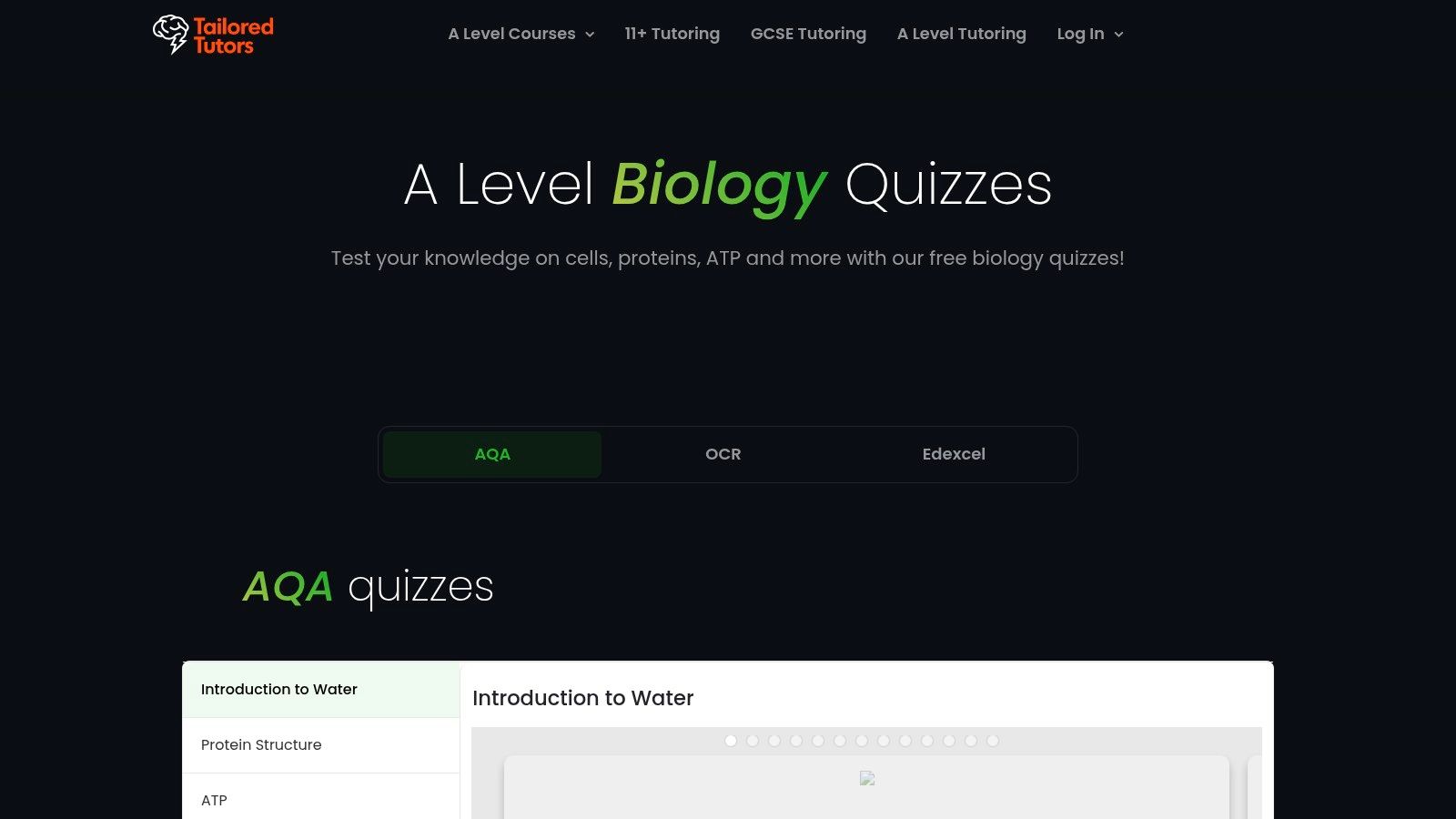
8. Tailored Tutors A-level Biology Quizzes
Tutors offers free topical Biology quizzes alongside premium video courses. Topics such as ATP, cells and proteins provide a focused starting point, while the exam-style phrasing makes the questions more relevant to students who are moving from textbook revision towards assessment practice.
The free quizzes are useful as a diagnostic warm-up. Attempt them without notes, mark the result and identify whether your problem is a missing fact or an incomplete explanation. Then use the related teaching material if you need a clearer walkthrough.
A useful sample, not a complete library
The quiz library is smaller than the largest platforms, so Tailored Tutors works better as one part of a routine than as your only source. Its questions often refer to common exam mark points, which can help students notice the level of precision expected in Biology answers. However, the more detailed step-by-step teaching and video support sit behind paid courses.
That creates a sensible free-to-paid pathway for sampling the difficulty, but students should compare the course content with their board before subscribing. A well-written question can still be less useful if it doesn't match the exact course emphasis.
For teachers, the quizzes may work as short starters or independent checks, especially when the next lesson will address a common misconception. For students, the best follow-up is a written question on the same concept, because recognising a mark point isn't the same as producing one under pressure.
Best for: Free exam-oriented warm-ups and students who want an explanation pathway after a quiz exposes a gap.
Tailored Tutors A-level Biology quizzes
9. ALevelBiologyTutor.com Self-marking MCQ Quizzes
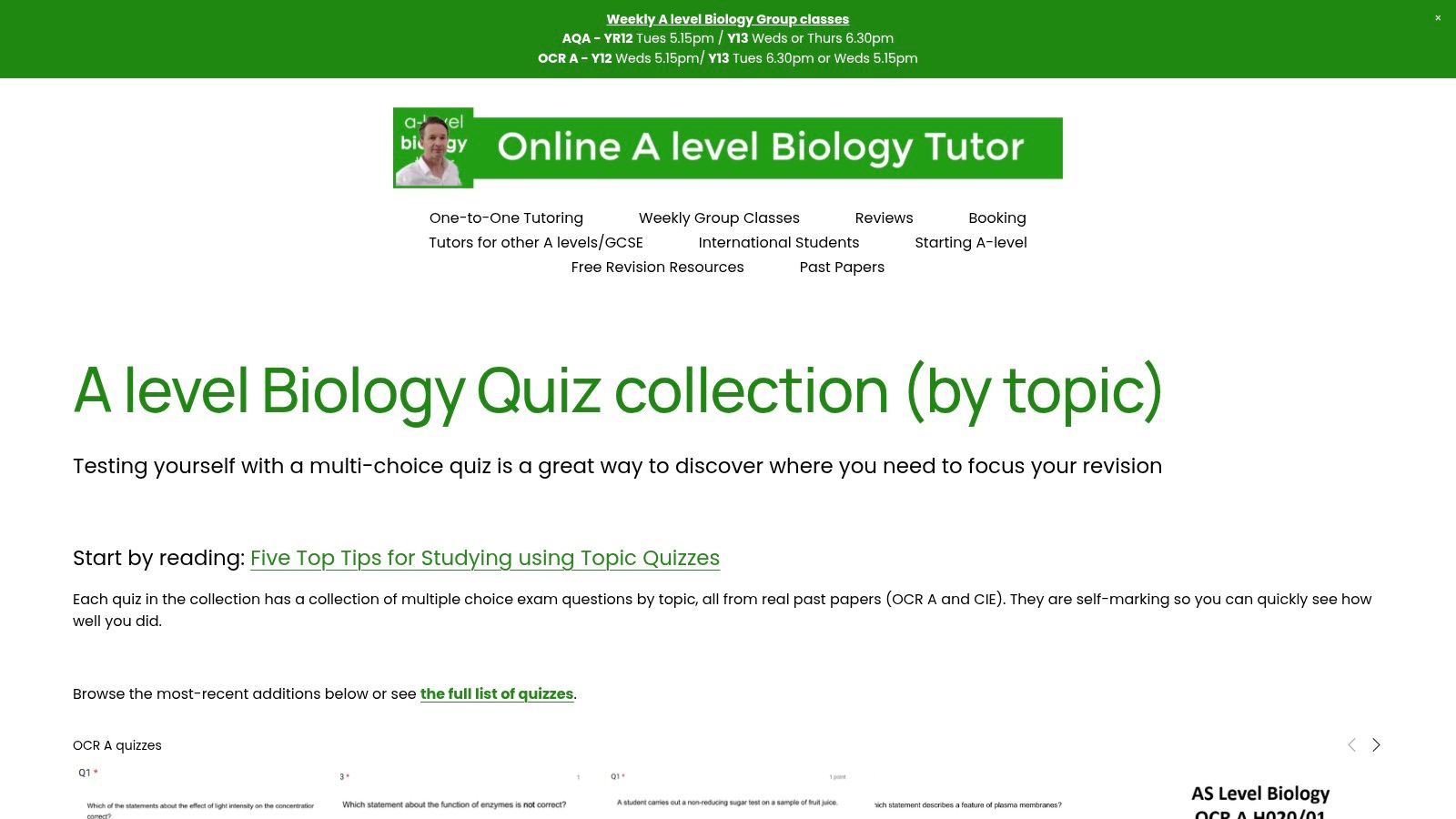
ALevelBiologyTutor.com provides teacher-built, self-marking multiple-choice quizzes aimed mainly at OCR A and CIE A-level Biology. The quizzes are organised by module and use past-paper-style stems, so they're particularly useful when you want focused familiarity with the way those boards frame common ideas and misconceptions.
The automatic marking makes the resource easy to use independently. You can answer a set, inspect the result and immediately return to the relevant module. That makes it a practical tool for retrieval before a lesson or as a short homework activity.
Stronger for board familiarity than broad coverage
The narrow board orientation is both the resource's strength and its limitation. OCR A and CIE students can use the module structure and exam tips with confidence, but students on AQA, Edexcel or WJEC shouldn't treat the questions as a complete course map.
There's also little progress tracking or analytics. You'll need to keep your own error log, recording the topic, the question type and the reason for the mistake. That manual step is worthwhile because it separates careless errors from genuine gaps.
Use the resource for MCQ retrieval, then test the same topic with a short-answer or data question. Multiple-choice questions are efficient, but they don't reveal whether you can explain a process in a connected chain or evaluate an experimental method.
Best for: Free, focused OCR A and CIE MCQ practice with quick feedback.
ALevelBiologyTutor.com online quizzes
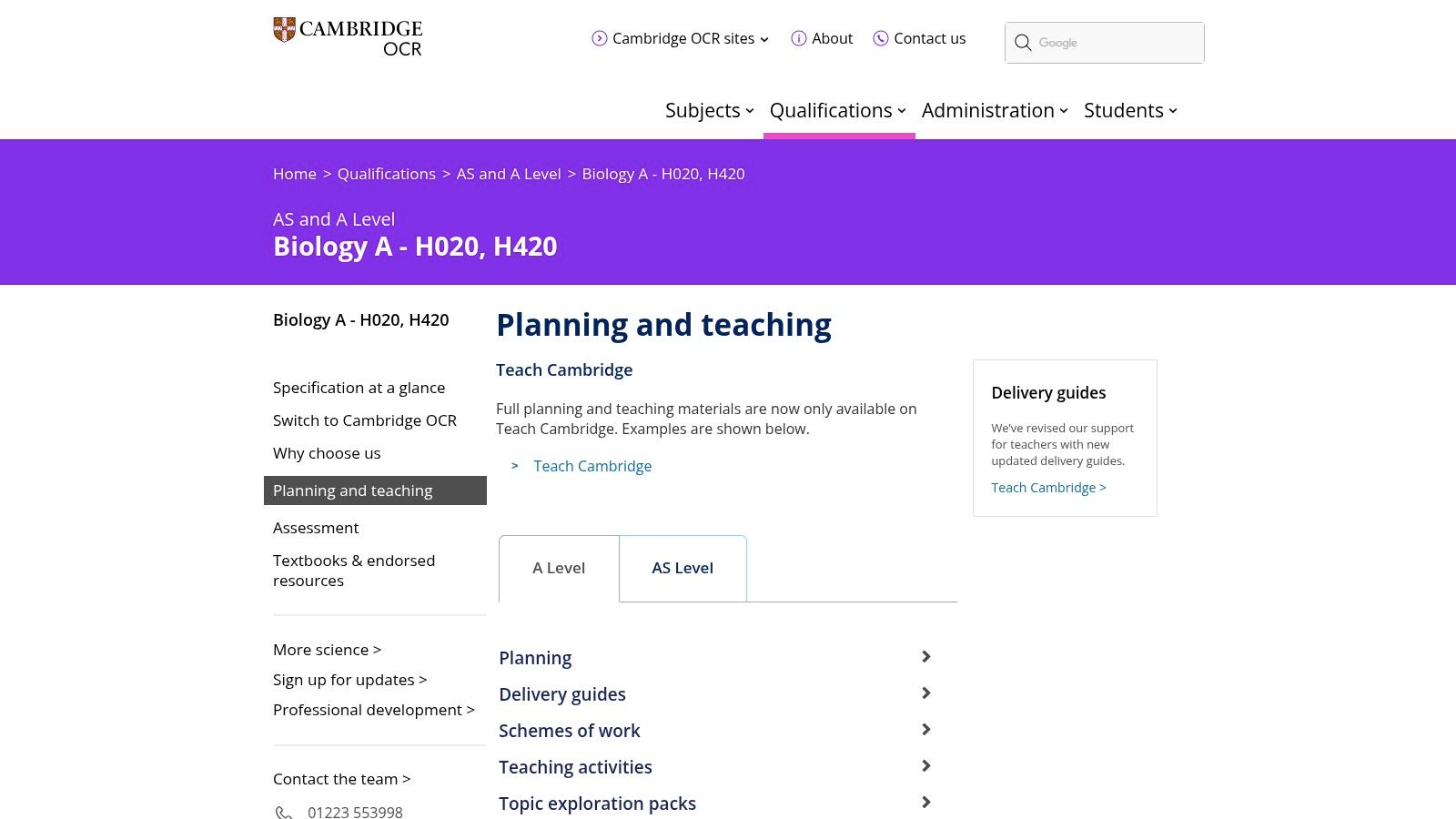
10. OCR A-level Biology Digital MCQ Topic Quizzes
OCR's own digital multiple-choice topic quizzes are the obvious choice for students following OCR A who want official, syllabus-faithful practice. The quizzes provide automated marking and explain correct and incorrect choices, including the distractors used to draw students towards a misconception.
That distractor feedback is valuable. If you select an incorrect option, don't only memorise the correct letter. Explain why the distractor is wrong, then write the biological principle that separates the two choices. This turns an MCQ into a short diagnostic exercise rather than a score-generating activity.
OCR also provides related planning and teaching materials, including notes and maths-skills resources. Teachers can use the quizzes as starters, exit tasks or short checks before reteaching a topic. The official source gives teachers stronger confidence about specification fit, although it still covers primarily OCR A and won't solve every need for other boards.
Treat official as accurate, not complete
An exam-board quiz is excellent for checking alignment, but it isn't a full revision system. The digital format is closer to a resource hub than a polished consumer revision app, and the emphasis is mainly MCQ practice. Students still need written questions, calculations, required-practical reasoning and full papers.
For students who need a broader route into OCR preparation, prepare for OCR A-Level exams can sit alongside the official materials, particularly when you need adaptive sequencing or feedback on longer answers.
Best for: OCR A students and teachers who need official topic MCQs with distractor explanations.
OCR A-level Biology digital resources
Top 10 A‑Level Biology Quiz Resources Comparison
| Product | Core features | UX / Quality (★) | Value & Pricing (💰) | Target audience (👥) | Unique selling points (✨) |
|---|---|---|---|---|---|
| MasteryMind 🏆 | Exam‑board‑aligned Qs (AQA/Edexcel/OCR/WJEC); adaptive (recall→24‑mark); NEA Coach; voice Blurt | ★★★★☆ Instant examiner‑style feedback; AO breakdowns | Free plan + Premium (advanced AI marking & NEA) 💰 | 👥 Years 3–13 students, parents, tutors, schools | ✨ Examiner‑style feedback; JCQ‑compliant NEA; spaced review; voice active‑recall |
| Save My Exams | Topic banks, flashcards, Target Tests, mocks, mark schemes | ★★★★☆ Clear progression; examiner‑written content | Free + Premium access for full answers 💰 | 👥 GCSE/A‑level students focused on exam technique | ✨ Large, structured library & Target Tests |
| Seneca Learning (Premium Quiz Mode) | Adaptive syllabus lessons; Premium Quiz mode; AI‑marked school features | ★★★★☆ Broad syllabus; lesson→quiz flow | Free tier; Premium for Quiz mode & extras 💰 | 👥 Students & teachers wanting adaptive lessons + quizzes | ✨ Converts lessons into rapid‑fire quizzes; Resource Hub |
| Cognito | Self‑marking quizzes, video lessons, build‑your‑own quizzes/papers | ★★★☆☆ Teaching + targeted self‑testing | Competitive paid plans; some free content 💰 | 👥 Self‑learners who want custom quizzes | ✨ Custom quiz/paper builder with teaching content |
| ALevelBiology.co.uk | 1,000+ board‑agnostic quizzes; quick dip‑in practice | ★★★☆☆ Low‑friction, fast retrieval practice | Mostly free 💰 | 👥 Students needing quick checks between study | ✨ Huge simple question bank for rapid practice |
| SimpleStudy (UK) | AQA‑organised quizzes, notes, flashcards, planner workflow (mobile) | ★★★☆☆ Mobile‑first daily revision UX | Paid subscription for full access 💰 | 👥 Mobile users who want planner‑style study | ✨ All‑in‑one mobile planner → quiz → mock workflow |
| CramNow | Free self‑marking AQA biology quizzes; immediate feedback | ★★★☆☆ Fast sets (20–25 Qs); instant feedback | Free 💰 | 👥 AQA students for quick retrieval practice | ✨ Free, speedy topic checks with immediate marking |
| Tailored Tutors | Topical exam‑style quizzes + paid video courses | ★★★☆☆ Useful warm‑ups; exam‑phrasing | Free quizzes; paid videos 💰 | 👥 Students sampling before paid tuition | ✨ Free exam‑style quizzes linked to paid lessons |
| ALevelBiologyTutor.com | Self‑marking MCQ quizzes (OCR A & CIE); module‑based practice | ★★★☆☆ Focused MCQ retrieval; quick feedback | Free/open access 💰 | 👥 OCR A & CIE students preparing MCQs | ✨ Past‑paper‑style stems & examiner tips |
| OCR (Exam Board) | Official digital MCQ topic quizzes; distractor explanations | ★★★☆☆ Syllabus‑faithful; teacher‑task ready | Free (official resources) 💰 | 👥 OCR A students & teachers | ✨ Official, specification‑accurate MCQs with distractor feedback |
Build a Quiz Routine That Leads to Marks
There isn't one universal winner. Choose the platform that matches your exam board and immediate revision job. AQA students may value SimpleStudy or CramNow for quick board-focused sessions, OCR A students have a strong official option through OCR, and students who need progression from recall to extended answers may prefer MasteryMind. Save My Exams is useful when you want notes, topic questions and mocks in a deliberate sequence, while Cognito and Seneca suit learners who want teaching content closely connected to retrieval.
A-level Biology is a major UK science entry. Official figures record 61,857 Biology entries in 2020/21, compared with 58,703 in 2019/20 and 62,556 in 2018/19. In the 2020/21 cohort, 17.9% of Biology entries achieved A*, 43.8% achieved A* to B and 86.0% achieved A* to C, according to the official Department for Education data table. Those figures show why a useful quiz routine has to serve both students rebuilding core knowledge and students trying to separate strong answers from top-grade performance.
Start every session by attempting questions without notes. Then inspect the explanation or mark scheme, record the precise gap and revisit that gap through spaced review. Don't write “bad at genetics” in your error log. Write “can state the definition of epistasis but can't use the ratio to explain the phenotype data”, or “calculation correct but unit missing”. Specific errors produce specific follow-up tasks.
The exam-board structure should guide your practice. AQA's A-level Biology assessment uses three written papers worth 35%, 35% and 30%, with raw marks of 91, 91 and 78 respectively, according to the AQA scheme of assessment. Paper 3 includes a 25-mark essay chosen from two titles. That means a learner who only completes MCQs is training one narrow part of the assessment experience.
A quiz score is evidence of what you recalled in that format. It isn't proof that you can apply the idea in an unfamiliar context.
Practise the same concept in different forms. After a quiz on photosynthesis, answer a graph question about light intensity, explain a control variable in an investigation and write a longer response about limiting factors. After genetics retrieval, tackle a pedigree, a probability calculation and an unfamiliar inheritance scenario. Practical and data-driven biology deserve deliberate attention because students often need to interpret graphs, evaluate methods, discuss uncertainty and apply knowledge beyond memorised definitions.
Command words should change how you answer. AQA links describe, compare and name commonly with AO1, explain and suggest with AO2, and evaluate with AO3 in its biology assessment guidance. The number of marks also gives a practical signal about how much developed content to provide. BBC Bitesize explains that questions show the mark total in brackets, such as [2 marks], and commonly use command words including describe, explain, calculate, determine, define and suggest in its biology exam guidance.
Students should therefore use short quizzes as the first step, not the finish line. Teachers can review error patterns to decide whether the class needs reteaching on a concept, more modelling of a six-mark structure or practice interpreting unfamiliar data. AI feedback can highlight likely weaknesses and generate targeted questions, but it shouldn't replace expert teaching, official mark schemes or a teacher's judgement about what a student meant.
Finally, plan the sequence across weeks rather than chasing one impressive session score. Mix older topics with current work, return to mistakes after a delay and use full papers to check whether knowledge survives a change of context. For further guidance on building effective revision habits, see these Kohru exam preparation tips.
MasteryMind offers specification-aligned A-level Biology quizzes for AQA, Edexcel, OCR and WJEC, taking students from quick recall to application, analysis and extended answers with examiner-style feedback. Visit MasteryMind to try a real question and build a more structured route from quiz practice to exam-ready responses.
Ready to master this topic?
Practise with quizzes, blurt exercises and exam questions on MasteryMind.
7 days Premium · Then free forever · No card, no charge