A Level Biology Revision Notes That Actually Work
You're staring at a Biology folder that's turned into a paper dump, a few colour-coded pages, some dead screenshots, and a nagging feeling that everyone else has the “proper” notes except you. The spec looks huge, the questions feel sneaky, and the worst bit is that re-reading your old pages doesn't seem to make anything stick. That's exactly where a level biology revision notes need to stop being pretty and start being useful.
Good notes for Biology aren't just shorter versions of the textbook. They're built to help you answer the exact kind of question examiners set, especially when they hand you unfamiliar data, a weird practical setup, or a command word that looks simple but isn't. The good news is that this can be fixed with a clear structure, a bit of honesty about what the exam board wants, and a revision routine that doesn't collapse after two evenings.
When the Biology Spec Feels Way Too Big
A lot of Year 13 students hit the same wall. The topic list feels endless, the folder is chaotic, and every time you try to “revise biology properly”, you end up reading instead of remembering. That's why the first job is not to make more notes, it's to make notes that match the specification and can survive exam pressure, because that's what A-level Biology rewards, precise topic knowledge plus application to unfamiliar data and experimental contexts, as shown in the exam-board-aligned approach used by SimpleStudy's AQA Biology revision guidance.
Start with the spec, not with the vibes
If your notes aren't mapped to the board, they drift. UK revision providers organise by board and topic for a reason, because AQA, OCR, Edexcel and WJEC don't all frame content in exactly the same way, and broad textbook summaries miss that detail as seen in UK board-organised biology resources. That's why the first pass through any topic should be boring in the best possible way, you tick off what your board wants, then build notes around that.
Practical rule: if you can't point to the spec line your note belongs to, the note is probably too vague.
Build notes you can actually use tonight
A decent rescue plan is simple. Pick one topic, strip it down to the exact learning points, and rebuild it as a page you could revise from without any extra fluff. A useful page should help you remember, test yourself, and fix mistakes, not just look neat on the desk while your brain leaves the room.
The big shift is this, revision notes are for retrieval. If they don't make you think of the answer before you see it, they're just decorated procrastination. A more efficient approach is to write with questions in mind, then test yourself later using MasteryMind active recall methods, because Biology marks come from getting the right idea out fast, not from recognising familiar paragraphs.
What a Top-Mark Note Page Actually Contains
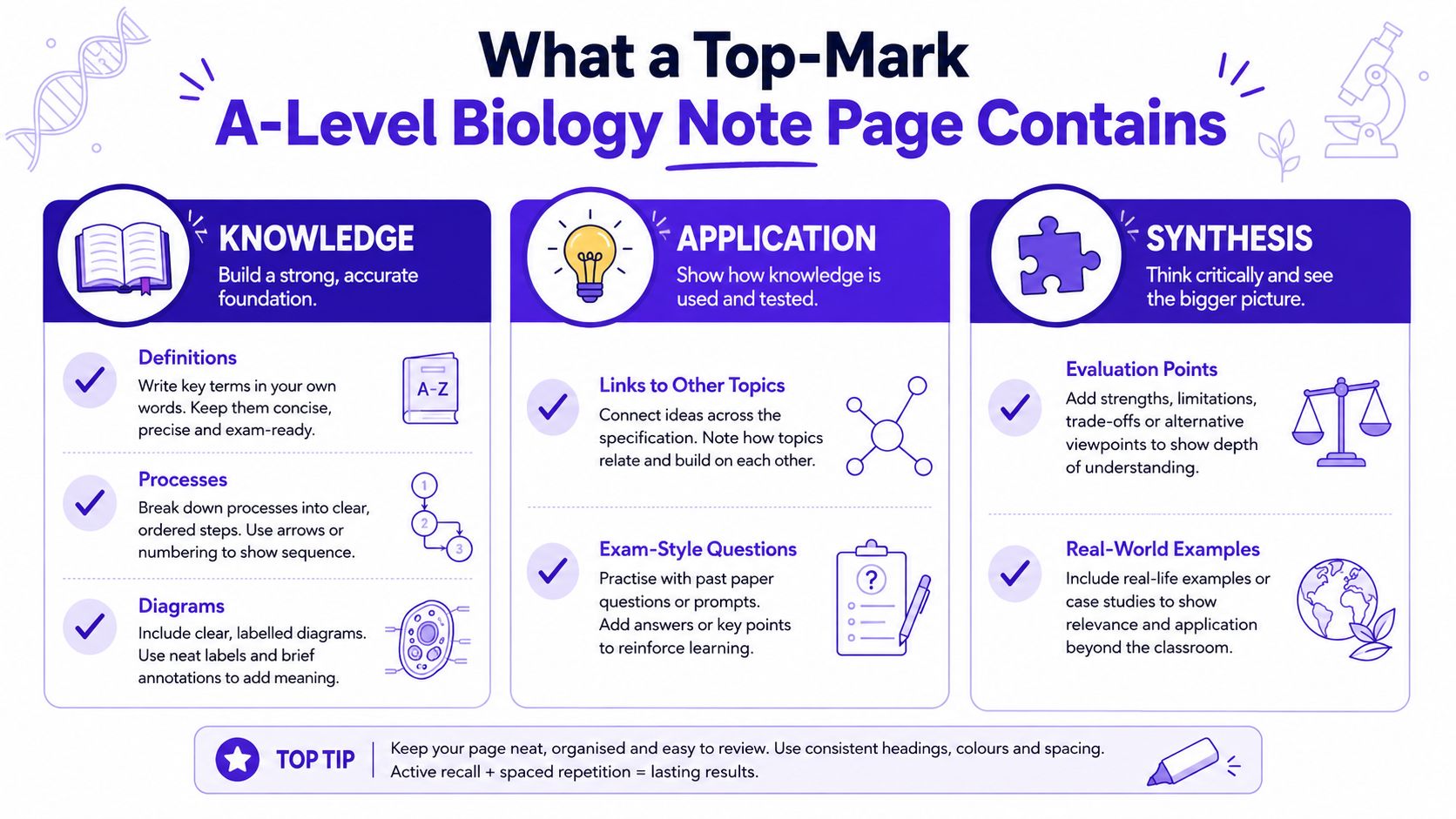
Most students are told to make notes concise and active, then left to guess what that means in real life. A strong page needs more than a paragraph of summary and a highlighted diagram, because Biology questions often want exact terms, accurate structure, and clear links between ideas. If you want notes that work under exam timing, build each page with the same core parts every time.
The anatomy of one strong page
Use a specification reference at the top, then a one-line definition in your own words. That sounds basic, but it stops you drifting into “sort of right” territory, which is where easy marks vanish. After that, add a labelled diagram or process map, because Biology rewards structure, and a visual often keeps the sequence straight when words get tangled.
A worked example helps. For a topic like the heart and cardiac cycle, a top page would include the topic name, the key stages of blood flow, the valve sequence, and a diagram with labels that you can redraw from memory. Then add one short synoptic link, maybe to gas exchange, transport, or exercise physiology, because Paper 3 can pull ideas across the specification.
The best note page feels slightly annoying to revise from, because it keeps asking you questions.
What the page should make you do
The last two bits matter more than most students realise. Add a worked past-paper style question so the page forces application, not just recognition, and finish with a common mistake to avoid line. For example, “don't confuse valves opening because of pressure differences with valves being actively pushed open”, which is the kind of thing that loses a mark for being nearly right.
That's also why concise notes on their own often fail. They compress information, but they don't train exam behaviour. A good page should leave you with facts, a diagram, one link to another topic, one question, and one trap to avoid, because that's a page built for marks, not decoration. If you want a clean structure to copy, the idea is the same whether you're revising cells, genetics, or ecosystems, with each page acting like a tiny exam workout rather than a textbook bookmark.
Matching Your Notes to Your Exam Board
UK A-level Biology is fragmented enough to catch out anyone who uses generic notes and hopes for the best. The content overlaps across AQA, OCR, Edexcel and WJEC, but the emphasis changes, and the mark scheme language changes with it. That's why a note page that works for one board can feel oddly incomplete on another, even when the science itself is the same.
Board alignment is not optional
On AQA, the assessment is split into three papers, each 2 hours long, with Paper 1 covering Topics 1–4, Paper 2 covering Topics 5–8, and Paper 3 acting as a synoptic paper that can draw on anything from Topics 1–8. The same source states that the Paper 3 essay is marked with up to 16 marks for scientific content, 3 for breadth, 3 for relevance, and 3 for quality of writing SimpleStudy's AQA Biology exam breakdown. That means your notes can't just sit in neat topic piles, they need links that help you move across the course.
For OCR, Edexcel, and WJEC, the broad point is still the same, board-specific organisation matters. UK revision hubs tend to organise by board and topic instead of broad textbook chapters for a reason, and the OCR Biology A notes pages make the same point by focusing revision around specification structure and past-paper demand OCR Biology A revision notes. If your notes don't reflect the board, you're practising with the wrong shape of question.
Quick audit for your current notes
Use this check before you trust any page:
- Board name visible: Make sure each page says whether it's AQA, OCR, Edexcel, or WJEC.
- Topic match clear: Check that the page matches the exact topic title used in your specification.
- Practical detail included: If the topic links to a required practical, the method and variables need to be there.
- Paper focus noted: Mark whether the content is mainly Paper 1, Paper 2, or synoptic for Paper 3.
- Label choices checked: A diagram of a nephron, leaf, or synapse can need different labels depending on the board's wording.
The trick is to make each note page board-aware, not just topic-aware. If you're revising AQA, think about how a page will help with the three-paper structure and the Paper 3 essay. If you're on another board, do the same thing, but through your own specification language, because the science might be shared, yet the exam route definitely isn't. If you want a single place to keep that alignment tidy, an A-Level Biology revision resource can help you keep board and topic matched without turning your desk into a swamp of loose sheets.
Decoding the Command Words Examiners Use
Lots of students lose marks without knowing why. They knew the content, but the question asked for something slightly different, and they answered the wrong thing very confidently. Biology command words look harmless, which is rude of them, but they tell you exactly what kind of answer is needed if you read them properly.
What each command word really wants
State wants the fact, no wandering. Describe wants what's happening or what's shown, in order and with detail. Explain wants the mechanism, the reason, the cause, the “because”.
Compare needs similarities and differences, not two separate mini-essays. Evaluate asks you to judge strengths and limitations, usually in a method or piece of evidence. Discuss needs balanced points and a conclusion, while suggest means apply Biology to something new without freezing because it doesn't look like your notes.
“Explain why” is not the same as “say what”. One is mechanism, the other is description.
A simple way to train answers
If the question says suggest, your notes should already have taught you to connect familiar knowledge to unfamiliar data. If it says evaluate, your notes should include method strengths, weaknesses, and the context that makes those weaknesses matter. That's why note pages need practice questions attached to them, because the command word is part of the content, not an extra bit added at the end.
A-level assessment also leans heavily on application and analysis, so notes that only train recall leave a gap. That's where A-Level Past papers become useful, because you can tag command words, compare model answers, and stop treating every question as if it's asking for the same kind of response. A “describe” answer and an “evaluate” answer are cousins, not twins.
The habit to build is simple, underline the command word, say out loud what it demands, then answer to that demand. If you do that regularly, you stop writing textbook dumps and start writing answers that fit the mark scheme. That's the difference between knowing biology and landing the marks for it.
Memory Tricks That Actually Stick for Biology
Mnemonics get mocked because people use them badly. A random sentence with no link to the spec just gives you a silly phrase and no Biology. Used properly, though, memory tricks take pressure off working memory, which leaves more brain space for the harder part of the paper, the application and evaluation stuff that decides grades.
Use different tricks for different failures
If you keep forgetting sequences, use a process mnemonic. The usual example is mitosis stages, or the order of events in kidney filtration, because order is where students often wobble. If the issue is visual detail, use dual coding, which means pairing words and pictures so the structure sticks more firmly, like linking a DNA double helix to a twisted ladder.
If you blank when talking, use the Blurt Challenge. Speak for two minutes on a topic with no notes, then check what you missed against the specification. That is much closer to exam retrieval than re-reading a colour-coded page while your brain nods off.
For students who like structured visual revision, Contesimal study tips is a useful extra resource because it links mind maps to study habits in a way that suits note-making. The important thing is not the pretty map, though, it's whether the map helps you pull information out later.
Make revision stick over time
Spaced repetition matters because memory fades if you leave a topic alone too long. A short daily review beats a desperate cram because the second method only feels productive while it's happening, then vanishes under pressure. If you use adaptive revision, weak topics keep coming back until they're secure, which is much smarter than only revising the units you already like.
The rule for Biology is this, use mnemonics for sequences, pictures for structures, and retrieval for everything else. If a memory trick doesn't lead to faster recall in a mock-style question, bin it and move on. Biology doesn't care whether your acronym is cute, it cares whether you can remember the damn pathway.
Nailing the Required Practicals Without Panic
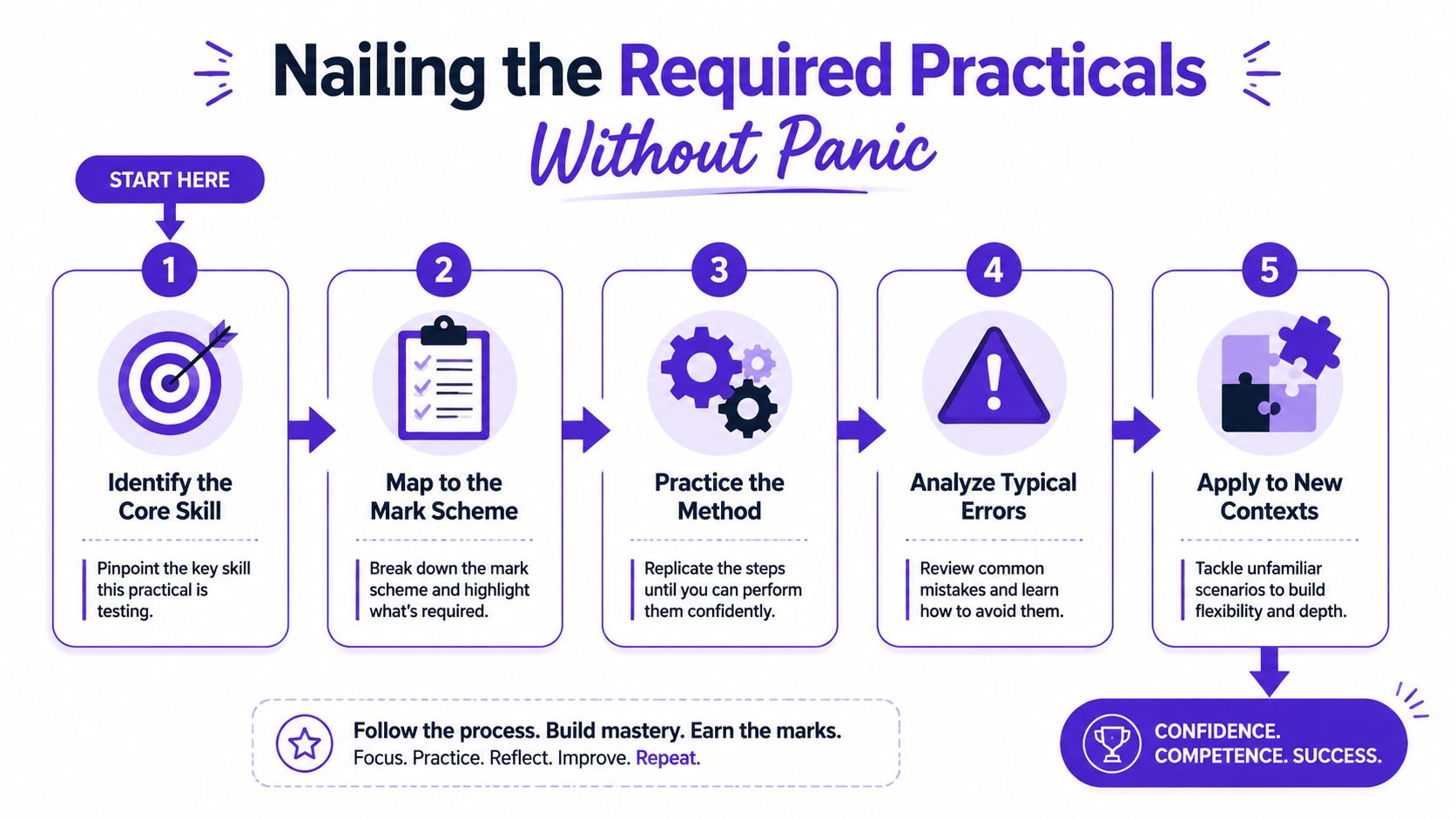
Required practicals are where too many students leave marks on the table. They're often revised last, even though they can show up across Papers 1, 2 and 3, and examiners love asking about method, variables, data handling and evaluation. The safest move is to treat every practical like its own mini note page, not as a random add-on at the back of your folder.
Build one practical page per activity
The government's science subject content says that for A level biology, knowledge and understanding make up approximately 60% of the specification, and that all listed practical techniques are assessed through a minimum of 12 identified practical activities within each specification science subject content document. So your practical notes need to be concrete. Each page should include the aim, numbered method steps, independent, dependent and controlled variables, and one sentence on reliability or improvement.
OCR's student revision checklist is even more direct. It says to identify variables that must be controlled where appropriate, use appropriate units for measurements, present observations and data in an appropriate format, and evaluate whether the method is appropriate to meet the expected outcomes OCR revision checklist. That's the standard your notes should mirror.
A worked example on method detail
Take an enzyme practical. A weak note says “change temperature, measure rate”. A strong note names the independent variable, says what is controlled, gives the unit for the result, and reminds you how to present the data properly. It also notes a likely weakness, such as keeping temperature stable, because that is the sort of thing that turns a method question into a real exam question.
If you prefer a quick structure, use this:
- Aim: State the biological question in one line.
- Method: Write the steps as if someone else had to run the practical.
- Variables: Name what changes, what is measured, and what stays controlled.
- Evaluation: Say how reliable it is and what could improve it.
If a practical note cannot help you answer a method question, it isn't finished yet.
The point is not to memorise a script. It's to know how the practical works, what can go wrong, and how to talk about it with enough precision to pick up marks. That's what examiners reward, and it's exactly why practical notes need more than a quick sketch and a vague sentence about fairness.
Your 6-Week Adaptive Revision Plan
A good plan beats a heroic all-nighter every single time. If Biology has got away from you, six weeks is enough to make a serious dent, as long as you stop bouncing randomly between topics and start revising in a deliberate order. The trick is to mix audit, rebuilding, retrieval, past-paper practice and timed review, not just rereading until your eyes go funny.
A workable six-week rhythm
| Week | Focus | Key Tasks | Adaptive Practice Role |
|---|---|---|---|
| Week 1 | Audit | Check notes against the specification, sort topics by confidence, and spot missing practicals | Use quick-fire recall to find weak spots |
| Week 2 | Rebuild | Rewrite weak topics with the note template, add diagrams, synoptic links, and mistake prompts | Use targeted topic practice to patch gaps |
| Week 3 | Topic practice | Do single-topic past-paper questions under time pressure | Use feedback to correct wording and method |
| Week 4 | Mixed practice | Mix topics together, especially for synoptic thinking and cross-topic links | Use spaced review to bring back earlier weak areas |
| Week 5 | Full papers | Sit timed papers and mark them with examiner-style scrutiny | Use detailed feedback to improve AO2 and AO3 responses |
| Week 6 | Light final review | Refresh diagrams, definitions, practicals, and common errors | Use short retrieval sessions, not heavy new learning |
If you want a guide to how personalised tools fit into that kind of routine, the guide to adaptive study tools is useful background because it shows why weak areas keep resurfacing when the system is doing its job. That's the point of adaptive revision, it notices what you're about to forget before your memory fully gives up on you.
Keep the finish calm and repeatable
Use the last week for light review, not panic. That means quick diagram redraws, practical reminders, and a final list of mistakes you keep making, like mixing up similar terms or skipping units. If you're using Exam Practice for A-Level, make it part of full-paper sessions so the timing feels familiar before the thing.
Before each paper: check your board, skim the command words you keep missing, and spend a few minutes on diagrams or practicals you're still shaky on.
The win is mixed-topic practice, because Paper 3 loves to force connections. If you only revise topics in isolation, the jump to synoptic questions feels brutal. If you mix them regularly, the exam starts to feel less like a trap and more like a paper you've already rehearsed.
Putting It All Together and Common Questions
The biggest improvement usually comes from one change, moving from passive reading to active retrieval under timed, board-specific conditions. That means your notes stop being a summary of what you once knew and start becoming a tool for getting marks back under pressure. Biology is still a heavy subject, but it gets much less scary when every page has a job.
A few questions come up again and again.
How many hours of revision a week is realistic?
Enough to be consistent, not enough to burn out. Short, regular sessions with spaced review are more useful than long sessions that leave you cooked by Thursday.
Are concise notes or detailed notes better?
Neither, by themselves. The best pages are compact enough to revise from quickly, but detailed enough to include definitions, diagrams, practicals, synoptic links and a mistake prompt.
Is using AI for feedback cheating?
Not if it's being used like a tutor tool. Feedback is only useful if it points out where your answer misses the spec, skips a variable, or doesn't fit the command word.
How do I revise if I've done hardly anything since Year 12?
Start with the spec, not guilt. Pick the most vulnerable topics, rebuild the notes properly, then use retrieval and past-paper questions to force the knowledge to come back.
The honest truth is that a level biology revision notes only help if they're designed for the exam you're sitting. Once they're board-specific, practical-aware, and built around retrieval, they stop being a comfort blanket and start acting like a scoring tool.
If you want to turn your Biology notes into something you can revise from, visit MasteryMind and use it to build board-matched practice, command-word feedback, and spaced review around the topics you keep missing. It's a sensible way to check whether your notes hold up under exam pressure, which is the only test that really matters.
Ready to master this topic?
Practise with quizzes, blurt exercises and exam questions on MasteryMind.
7 days Premium · Then free forever · No card, no charge