A Level Chemistry AQA Revision That Actually Works
You've got a stack of AQA Chemistry notes, a few half-finished flashcards and the uncomfortable feeling that recognising a topic isn't the same as being able to answer it. You can remember what an equilibrium is, but freeze when the question gives you unfamiliar data. You know the organic reactions, but your curly arrows disappear under pressure. Whether you're recovering after doing too little or pushing for the top grades, the answer isn't another passive read-through of the textbook.
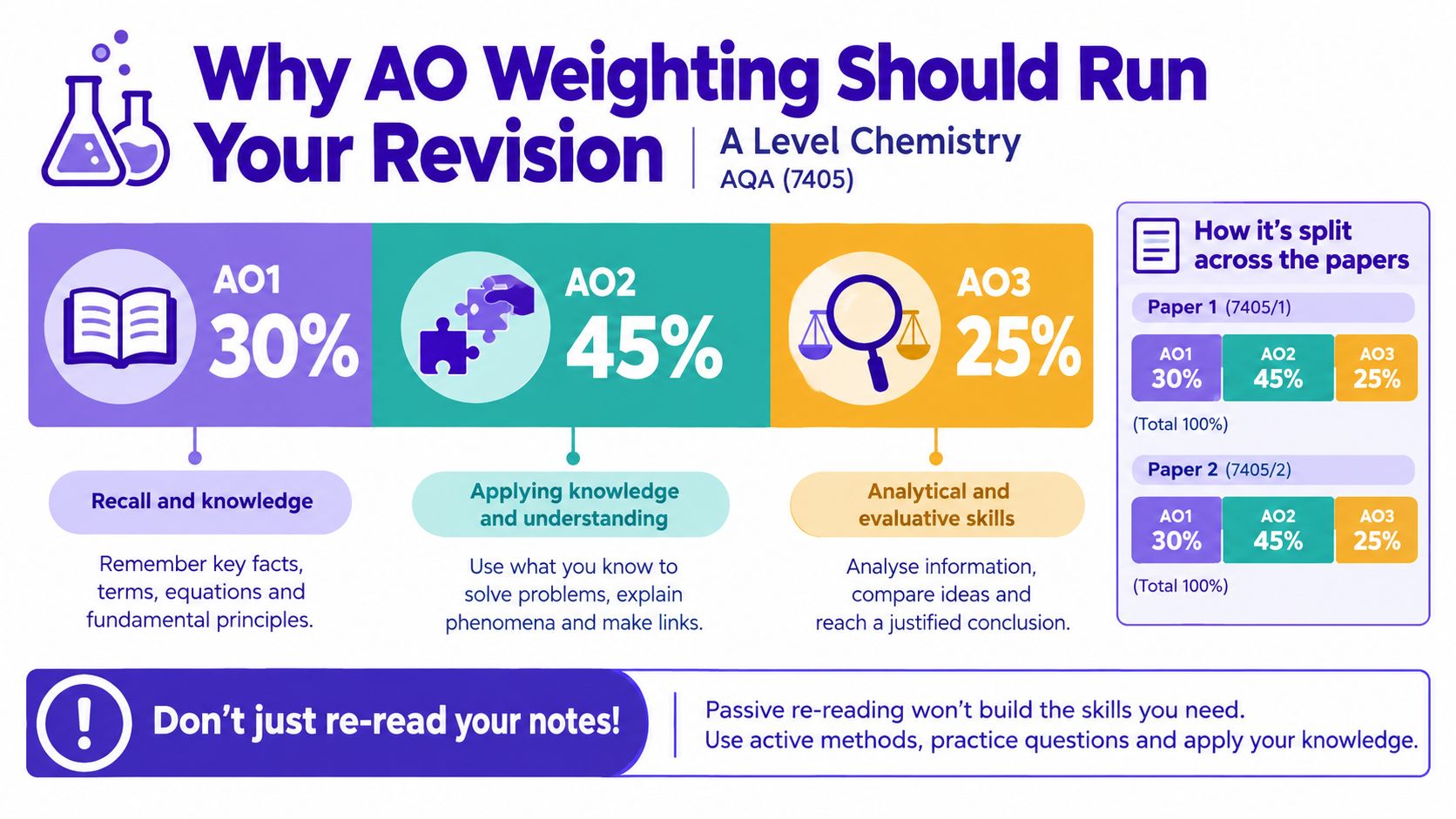
A level Chemistry AQA revision works best when it follows the assessment, not just the specification. AQA gives roughly 30% of marks to AO1 recall, 45% to AO2 application and 25% to AO3 analysis and evaluation, according to the official AQA scheme of assessment. So most of your time should be spent using chemistry, interpreting evidence and explaining decisions, not merely memorising it.
What the AQA 7405 Specification Actually Looks Like
Before planning revision, get the exam structure straight. AQA 7405 is a linear qualification, so the A-level papers are taken at the end of the course. The course is split into physical, inorganic and organic chemistry, and the written assessment consists of three externally examined papers, each lasting two hours. Paper 1 and Paper 2 are each worth 35%, while Paper 3 is worth 30%, as shown in AQA's specification overview.
| Paper | Content focus | Duration | Marks | Weighting | Practical-related marks |
|---|---|---|---|---|---|
| Paper 1 | Inorganic and physical chemistry | 2 hours | 105 | 35% | Included within paper |
| Paper 2 | Organic and physical chemistry | 2 hours | 105 | 35% | Included within paper |
| Paper 3 | Synoptic content, practical skills and multiple choice | 2 hours | 90 | 30% | 15 marks |
Paper 1 combines physical chemistry with inorganic chemistry. Expect calculations and explanations involving amount of substance, energetics, kinetics, equilibria, periodicity, Groups 2 and 7, transition metals and aqueous ions.
Paper 2 combines organic chemistry with further physical chemistry. It includes mechanisms, synthesis, spectroscopy, acids and bases, redox and electrochemistry. The physical content from earlier in the course can appear again because AQA treats earlier knowledge as assumed knowledge rather than a completed chapter that disappears.
Why the practical endorsement matters
The 12 required practicals are examined contexts, not coursework that contributes directly to your written grade. You need to understand the apparatus, variables, safety, calculations, sources of error and how to interpret results. The separate practical endorsement is teacher-assessed, so performing practical work properly still matters even though you won't sit a practical exam.
Paper 3 is the paper that makes the linear structure impossible to ignore. It can draw on the full specification, practical techniques and synoptic links. You aren't revising three isolated tests. You're preparing for one final assessment model that rewards recall, connection and accurate application across the whole course.
Use the wording in the papers as a shared language. State usually wants a concise fact, describe wants what the data shows, and explain wants the scientific reason. AQA's past papers, mark schemes and examiner reports are the most useful reference points because they show the command words and marking conventions you will meet.
Why AO Weighting Should Run Your Revision
Many students revise as if every mark comes from remembering a definition. They make a beautiful set of flashcards for lattice enthalpy, learn the conditions for electrophilic addition and then wonder why an unfamiliar calculation still goes badly.
The official assessment split tells you where the marks are. AO1 is about 30%, testing knowledge and understanding. AO2 is about 45%, testing whether you can apply that knowledge to unfamiliar situations. AO3 is about 25%, testing analysis, evaluation and practical reasoning. Together, AO2 and AO3 account for about 70% of the assessment, so a revision plan dominated by reading and recall is structurally unbalanced.
What the three objectives look like in questions
AO1 appears when you recall an equation, define a term, identify a reagent or state an observation. Flashcards are useful here, but they shouldn't become your entire strategy.
AO2 appears when the question changes the context. You might need to use equilibrium principles with unfamiliar substances, calculate an electrode potential from supplied data, explain a mechanism for a compound you haven't seen before, or choose the correct equation from information in the question.
AO3 appears when you interpret a graph, assess a method, judge the reliability of evidence or suggest an improvement. It rewards chemistry plus disciplined reasoning. Saying “the results are unreliable” isn't enough. You need to identify why and connect the problem to the conclusion.
Revision rule: Learn the chemistry, then practise making decisions with it.
Build your sessions around the mark distribution. A useful pattern is a short AO1 retrieval task followed by a longer AO2 question and an AO3 practical or evaluation task. Mark each answer using the AQA mark schemes, and write down the exact reason for every lost mark.
Definitions still matter because application depends on knowledge. But once you can recall a definition reliably, stop spending the majority of your time rereading it. Move to calculations, mechanisms, unfamiliar data and extended responses. That's where knowing the content becomes exam performance.
A Topic-by-Topic Checklist for A Level Chemistry AQA
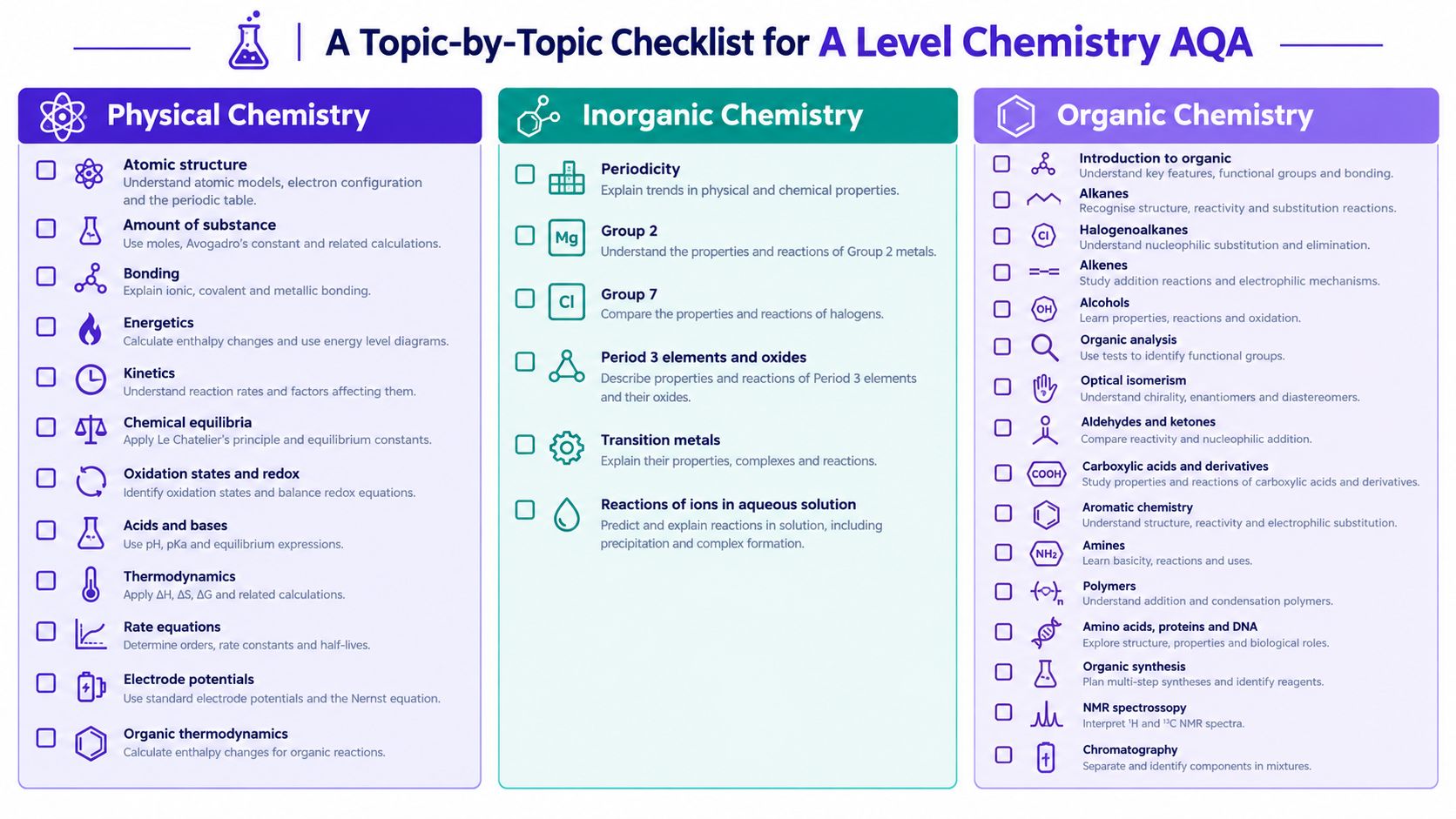
A checklist is useful only if it leads to a test. Tick a topic when you can retrieve its key ideas, complete a representative calculation or mechanism, and answer an unfamiliar question without copying a model response.
Physical chemistry
Start with the topics that support everything else:
- Atomic structure and amount of substance: relative masses, moles, concentrations, gas calculations and reacting quantities.
- Bonding: ionic, metallic and covalent bonding, shapes, intermolecular forces and how structure affects properties.
- Energetics: enthalpy changes, Hess cycles, bond enthalpies and interpreting energy profiles.
- Kinetics: collision theory, rate equations, orders, rate constants and graphs.
- Equilibria: dynamic equilibrium, Le Chatelier's principle and equilibrium constant calculations.
- Acids and bases: pH, weak acids, Ka, buffers and titration reasoning.
- Redox and electrode potentials: oxidation states, half-equations, cell notation and predicting feasibility.
- Thermodynamics and electrochemistry: Gibbs free energy, fuel cells and the optional electrochemistry content where applicable.
Don't just memorise the equation for Kc or Ka. Practise deciding which concentration belongs in the expression, what the units mean and how changing conditions affects the result. Equilibrium constant calculations and electrode potential predictions are common points of weakness because they require several decisions in sequence.
Inorganic chemistry
Revise periodicity as a set of linked explanations, not a list of trends. Cover periodicity, Group 2, Group 7, Period 3 elements and oxides, transition metals, and reactions of aqueous metal ions.
For each trend, ask three questions: what changes, what evidence shows the change, and what particle-level explanation accounts for it? In transition metals, connect oxidation states, ligand substitution, complex ion colours and redox behaviour. A memorised colour without the relevant ion or reaction context won't carry you far.
Organic chemistry
Organise organic chemistry around functional groups and reaction pathways:
- Homologous series and isomerism
- Alkenes, alcohols and haloalkanes
- Aldehydes, ketones, carboxylic acids and esters
- Amines, polymers, amino acids, proteins and DNA
- Aromatic chemistry and organic synthesis
- NMR spectroscopy and chromatography
Spend extra time on curly-arrow mechanisms, E/Z stereochemistry, optical isomers and structured NMR interpretation. In a mechanism, show the electron source, the destination of the curly arrow, charges, intermediates and conditions where required. In NMR, interpret the whole spectrum. Chemical shift, integration, splitting and the molecular formula need to agree.
Synoptic questions often expose gaps between topics. A reaction may require organic knowledge, mole calculations and an understanding of equilibrium or energetics. Once a topic is secure in isolation, mix it with another topic so you practise choosing the method rather than being told what chapter you're in.
Required Practicals and the Data Questions That Lose Marks
AQA's practical assessment includes 12 named required practical activities, beginning with making up a volumetric solution and carrying out an acid-base titration, then covering enthalpy, rates, aqueous ions, distillation, organic tests, electrochemical cells, pH changes, preparation of pure organic substances and thin-layer chromatography. The complete list appears in AQA's required practical assessment guidance.
The exam doesn't ask you to repeat the lesson word for word. It asks whether you understand what the method produces and whether the evidence supports the conclusion.
| Required practical | Core data skill tested | Most common mark-losing error |
|---|---|---|
| Volumetric solution and acid-base titration | Concordant titres, concentration and units | Mixing cm³ and dm³ |
| Enthalpy change | Temperature data and energy calculations | Inconsistent significant figures |
| Rate and temperature | Variables, trends and collision theory | Describing a trend without explaining it |
| Aqueous cation and anion tests | Observations and identification | Confusing a precipitate observation with an inference |
| Distillation | Apparatus and separation principles | Omitting control or safety details |
| Tests for alcohol, aldehyde, alkene and carboxylic acid | Qualitative analysis | Giving a reagent without the positive observation |
| Initial-rate and continuous monitoring methods | Rate graphs and gradients | Choosing unsuitable points for a gradient |
| EMF of an electrochemical cell | Cell measurements and feasibility | Incorrect signs or half-equations |
| pH changes during acid-base reactions | Curves, equivalence and indicators | Ignoring the relevant region of the graph |
| Pure organic solid preparation | Recrystallisation and purity | Missing the reason for cooling or washing |
| Pure organic liquid preparation | Heating, separation and purity | Treating distillation as a complete purification |
| Thin-layer chromatography | Retention and comparison | Failing to control solvent or baseline position |
The details that separate marks
A line of best fit shouldn't be drawn by joining every dot. A gradient should use two clear points on the line, or a tangent where the question requires one, rather than two arbitrary experimental points. Check whether the axis units are compatible before calculating anything.
A short practical question may ask you to describe a trend. A longer response may ask you to explain the trend, evaluate the method or suggest an improvement. “Repeat the experiment” is rarely enough by itself. Say what should be controlled, what measurement would improve and how that would affect confidence in the conclusion.
Use A-Level Past papers after revising each practical. Don't merely reread the method. Cover the page and reconstruct the apparatus, variables, calculation, graph and likely evaluation points from memory.
Reading Command Words and Examiner Reports Like a Top Band Student
The command word determines the shape of your answer. A response can contain correct chemistry and still lose marks because it answers a different question from the one AQA asked.
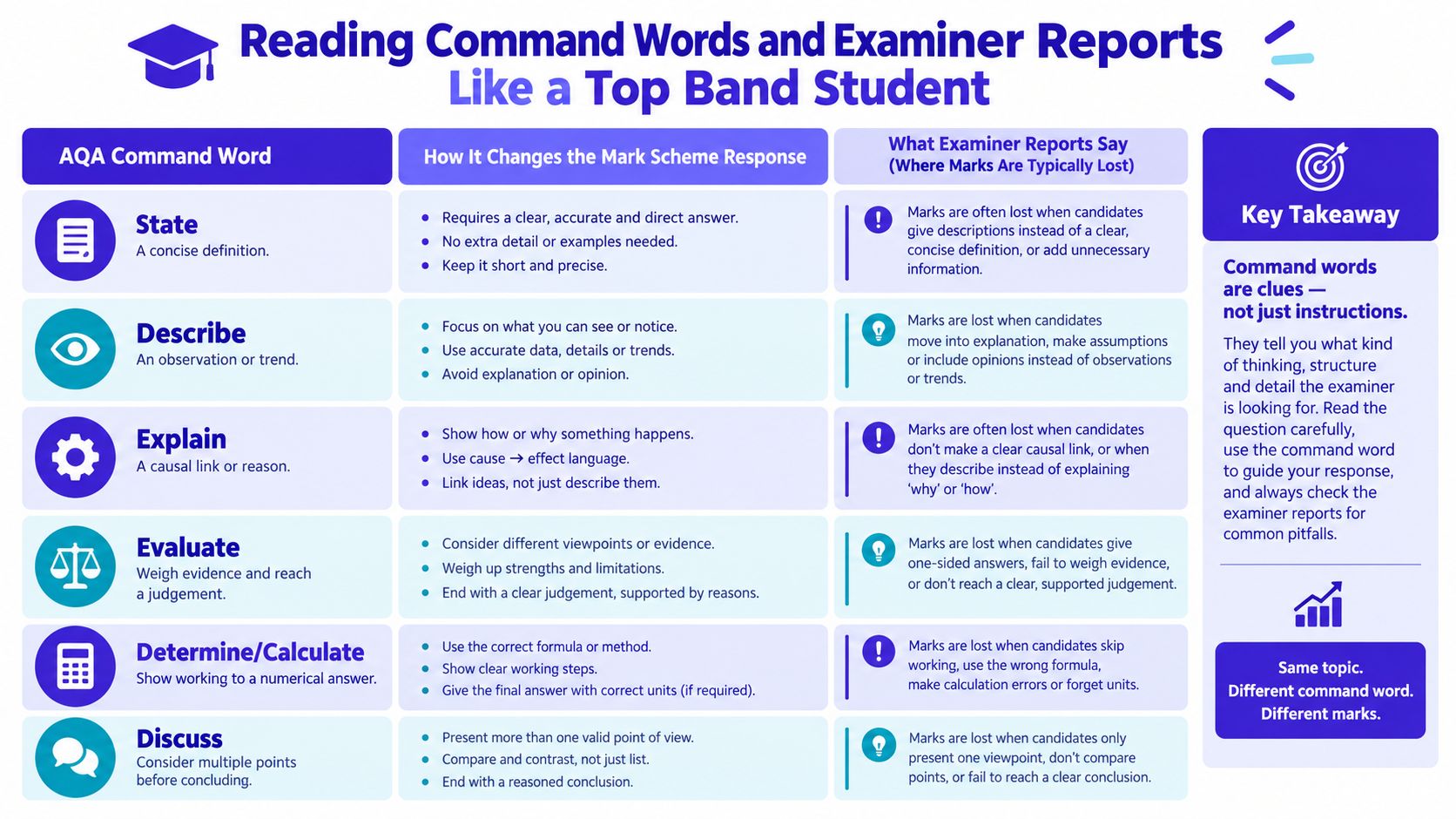
| Command word | What to do | Common mistake |
|---|---|---|
| State | Give the required fact or definition concisely | Adding irrelevant explanation |
| Describe | Report an observation, pattern or trend | Explaining instead of describing |
| Explain | Give a scientific reason or mechanism | Restating the result |
| Compare | Make direct comparisons using clear direction | Describing each item separately |
| Calculate or determine | Show working and give a final answer with units | Skipping steps or losing units |
| Evaluate or discuss | Weigh evidence, use chemistry and reach a judgement | Listing points without a conclusion |
Mark schemes are checklists, not scripts
Take a completed question and read the mark scheme before writing your own ideal answer. Identify each mark point, then plan a sentence or calculation step that earns it. This is reverse engineering, not cheating. You're learning how the assessment turns chemistry into marks.
For a comparison, write linked statements such as “X has a higher boiling point than Y because…” rather than two disconnected descriptions. For an explanation, move from observation to particle-level reason. For an evaluation, include the limitation, its effect on the result and a realistic improvement.
AQA examiner reports are particularly helpful when your answer feels scientifically sensible but scores less than expected. They show recurring problems such as vague comparisons, incomplete mechanisms, unsupported judgements and answers that copy familiar phrases without applying them to the data in front of the student.
Watch the explanation below, then try the same process on a question you've already marked.
Write your correction underneath the original answer. Don't erase the first attempt. The gap between the two versions tells you whether the problem was knowledge, interpretation, calculation method or command-word control.
A Spaced Revision Plan That Fits Around Real Life
A revision timetable should survive a normal week. School, homework, an EPQ, a part-time job and other subjects don't disappear because Chemistry feels urgent. Use shorter sessions that force retrieval, then increase the amount of mixed exam practice as the papers approach.
Use four repeating phases
Begin with a content pass. Make one A3 summary sheet per topic, but create it from memory first. Add corrections in another colour after checking the specification or your notes.
Follow that with a retrieval block. Use condensed flashcards, quick quizzes and blank-page recall. A useful guide to practical revision techniques for Chemistry A Level can help you vary the methods instead of turning every session into note-making.
Then move into mixed-topic papers. Mark them immediately and keep an error log with four headings: knowledge, application, analysis and careless error. Finish with a refinement phase focused on the command words and practical questions that still cost marks.
| Day block | Activity | 7405 topics covered | Duration |
|---|---|---|---|
| Monday | Retrieval and one calculation set | Amount of substance, energetics | 30 to 45 minutes |
| Tuesday | Mechanism recall and application questions | Alkenes, haloalkanes, alcohols | 30 to 45 minutes |
| Wednesday | Practical method and data interpretation | Titration, rates, enthalpy | 30 to 45 minutes |
| Thursday | Mixed-topic questions | Physical and inorganic chemistry | 30 to 45 minutes |
| Friday | NMR or spectroscopy practice | Organic analysis, NMR | 30 to 45 minutes |
| Weekend block | Timed paper section and detailed marking | Synoptic selection | 60 to 90 minutes |
Use spaced repetition for A-Levels to schedule topics before they completely fade. If a mock exposes a major weakness, don't just add more hours. Replace the next planned session with targeted retrieval and questions on that weakness, then return to the timetable.
A missed day shouldn't cause a dramatic restart. Continue with the next block and reduce the workload if necessary. Consistency beats a heroic session followed by several days of avoidance.
A Daily Routine That Builds Mastery Before Exam Day
A strong daily routine doesn't need to fill your whole evening. A 60 to 90-minute session can cover all three assessment objectives if each block has a job.
Start with 10 minutes of AO1 retrieval from yesterday. Close your notes and write equations, definitions, reagents or observations. Spend 5 minutes checking against the CGP guide or an AQA mark scheme, correcting only what you missed.
Next, take 20 minutes for two mixed past-paper questions from different topic areas. One could involve an equilibrium calculation, while the other asks for an organic mechanism. Mixing topics stops you relying on chapter labels to tell you which method to use.
Put practical reasoning in the middle
Use the next block to reconstruct one practical from memory. Sketch the apparatus, identify the independent and dependent variables, write one calculation or graph step, and check units and significant figures against the specification.
Finish with one extended response under timed conditions. Mark it against the band descriptors and give yourself a score out of six where that matches the question. Your correction should name the missing chemistry or reasoning, not just say “add more detail”.
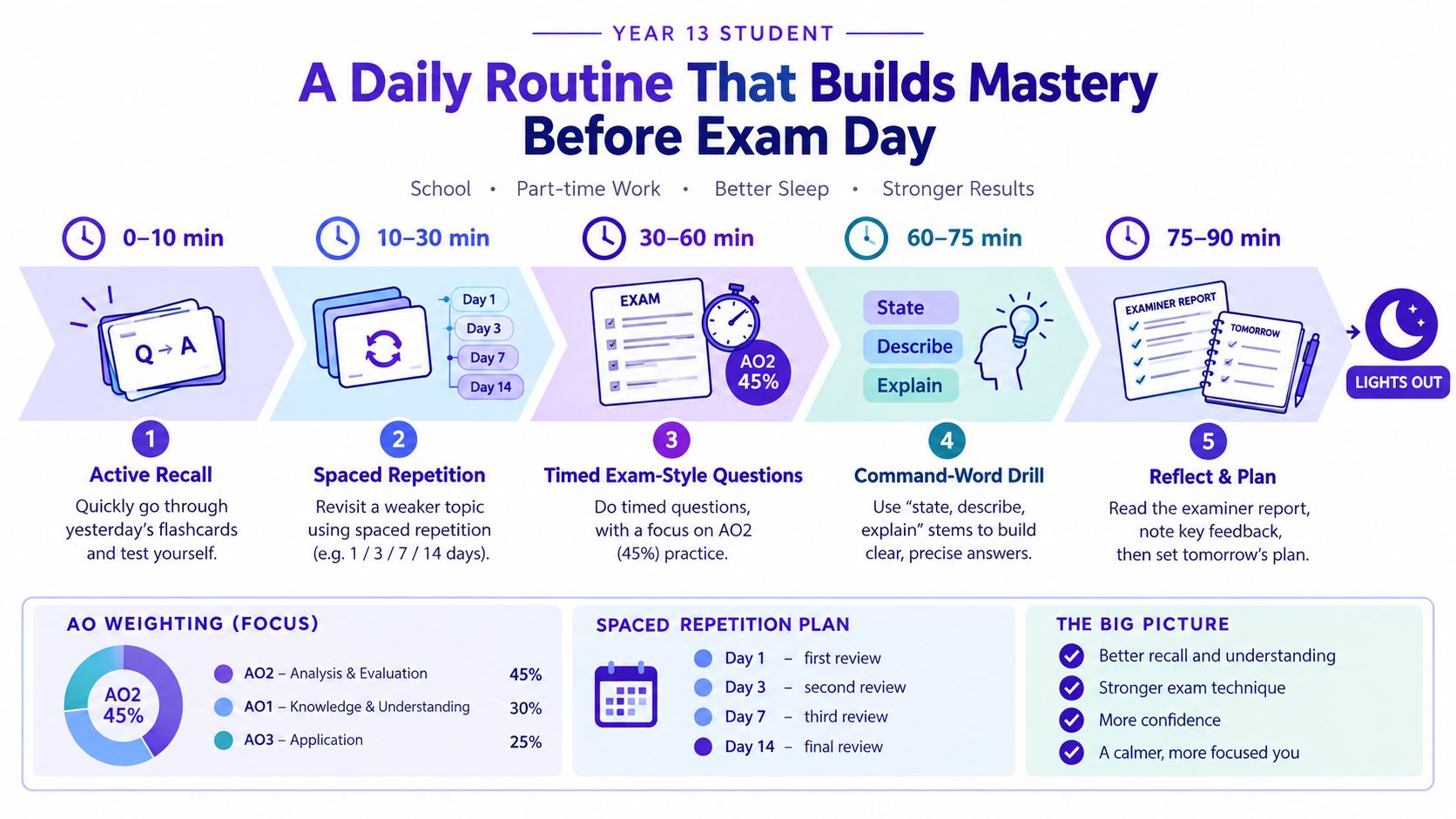
The routine is working when timed scores trend upwards, repeated unit errors become less common, and command words feel distinct. You should also see fewer lost marks in graph interpretation and practical evaluation.
Warning signs need a change of method, not punishment. If you recall content perfectly but blank on application questions, reduce flashcard time and add unfamiliar problems. If you avoid mechanisms, isolate one mechanism and practise it in small stages. If the same practical error appears repeatedly, reconstruct the data question rather than rereading the method.
Use Exam Practice for A-Level when you need a more exam-focused session. The point of the routine is simple: AO1 gives you the ingredients, AO2 makes you use them, and AO3 makes you judge the evidence.
MasteryMind offers AQA-aligned Chemistry quizzes, topic revision materials, mixed-topic practice and examiner-style feedback that separates recall, application and analysis. If you want structured practice for the areas you keep missing, visit MasteryMind and use your error log to guide the next session.
Ready to master this topic?
Practise with quizzes, blurt exercises and exam questions on MasteryMind.
7 days Premium · Then free forever · No card, no charge