A Level Chemistry Revision OCR: Ace Your Exams
You might be staring at a half-highlighted folder, a growing sense of panic, and a thought you don't especially enjoy: I know some chemistry, but I'm not answering OCR chemistry the way OCR wants.
That's a horrible place to be, especially if exams are close. It's also fixable.
The biggest mistake students make with A Level Chemistry revision OCR isn't always laziness or lack of ability. Often, it's using broad A-level chemistry advice for a paper that's very specific about structure, wording, practical knowledge, and the kind of answers that score. Teachers know this already. Students usually find out after they've dropped marks they didn't even realise were available.
Why Generic Chemistry Resources Fall Short
You spend an hour revising Hess cycles from a polished video, feel reasonably confident, then open an OCR past paper and lose marks on a six-marker about practical method, data handling, or the exact wording of your conclusion. That is the moment many students realise they were revising chemistry, but not revising for OCR.

Generic resources often teach the content well enough. The weak point is alignment. They usually group boards together, smooth over differences in wording, and skip the habits that turn chemical knowledge into OCR marks.
OCR A is a separate course from OCR B, and the specifications are organised differently. If a revision source labels itself "OCR chemistry" without showing which course it matches, treat it carefully. A neat summary sheet is far less helpful if it trains you to expect the wrong style of question.
Why this causes lost marks
Chemistry revision can feel like filling a cupboard with ingredients and still being unable to cook the meal the examiner asked for. You may know the ideas, but the exam rewards selection, precision, and method.
That gap shows up in familiar ways:
- Topic revision stays too broad: "equilibrium" or "organic" sounds clear until you check your mistakes and find the problem is a narrow point, such as justifying conditions, identifying a mechanism step, or explaining why a graph changes shape.
- Question practice comes from mixed boards: the science overlaps, but OCR often asks for a different type of response, especially in extended writing, practical questions, and application across topics.
- Practical knowledge gets revised separately from theory: OCR can test practical understanding inside written papers, so students who treat experiments as a different job often drop straightforward marks.
A student can be hardworking and still revise inefficiently. That is the frustrating part.
OCR success depends on interpretation, not memory alone
Strong OCR revision asks better questions than "Have I covered this topic?" It asks, "What does OCR usually want me to do with this topic?", "Which command words keep catching me out?", and "What pattern sits behind the marks I lost last time?"
That last question matters most.
After a past paper, many students only check which answers were wrong. A better approach is to diagnose the reason. Did you not know the chemistry? Misread the command word? Miss the practical detail? Give a statement when OCR wanted an explanation? Those are different problems, and they need different fixes.
What to use instead of generic revision
A better starting point is plain but effective. Use OCR-shaped resources, then test them against your own errors.
That usually means:
- the OCR specification as a reference point, mentioned earlier
- OCR past papers and mark schemes
- examiner reports and assessment materials from OCR, available through OCR Chemistry A qualification resources
- a mistake log that records the type of error, not just the topic
This method is less flashy than jumping between videos and summary cards. It works better because it trains exam judgement.
Practical rule: if a resource helps you remember chemistry but not decode OCR questions, it is only solving part of the problem.
Generic revision gives you exposure. OCR-specific revision gives you control.
Understanding the OCR Chemistry Exam Structure
You finish a past paper feeling reasonably confident, then the mark scheme gives a different verdict. Usually, the problem is not just chemistry knowledge. It is that OCR tests the course in a very particular shape, and revision works better once you understand that shape.
Early on, keep a visual map in front of you.
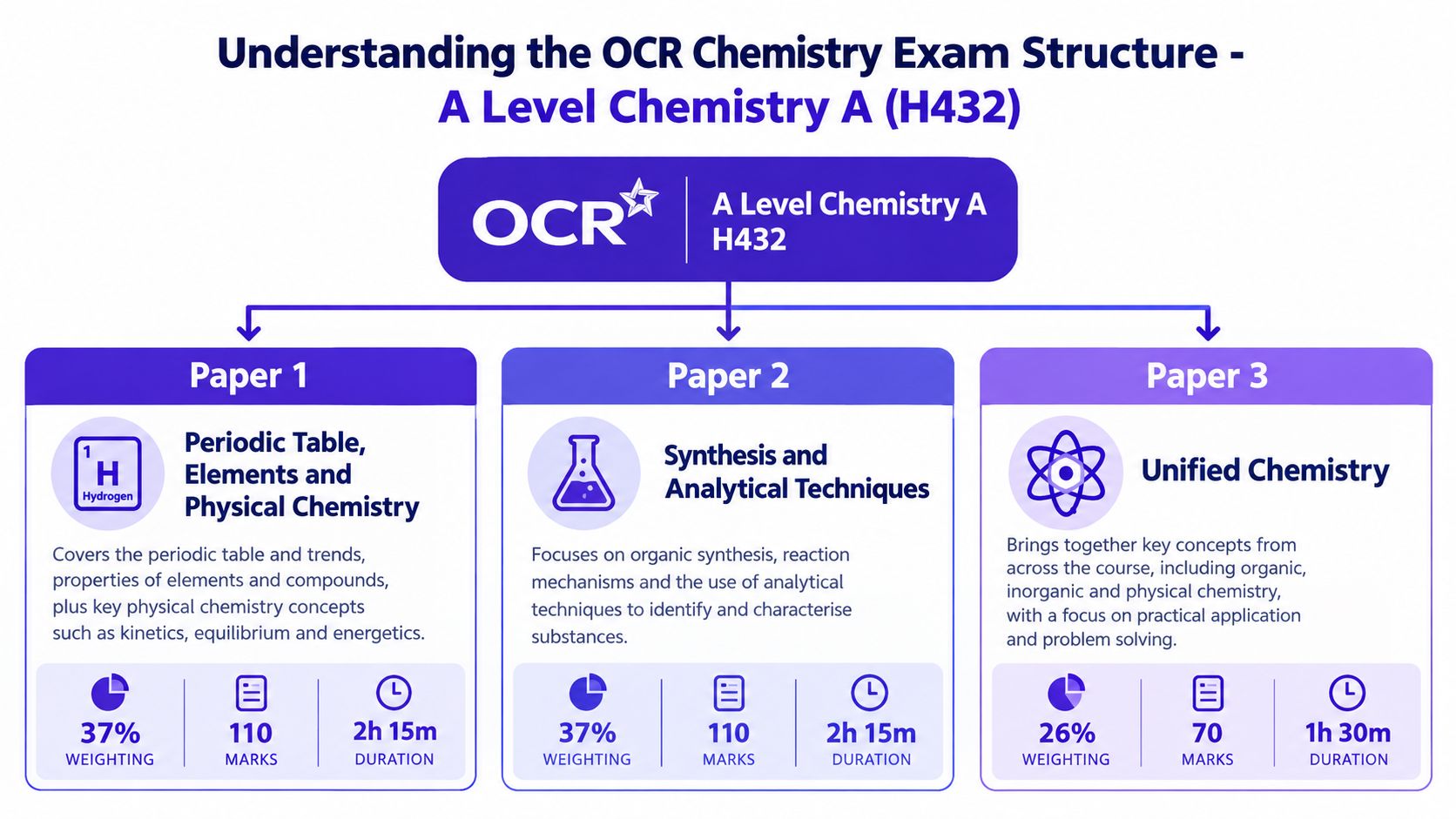
OCR Chemistry A (H432) is organised into six modules, but you do not sit six separate exams. You sit three written papers, and each one rewards a different kind of performance. If you revise as if every topic appears in the same way every time, you make the paper harder than it needs to be.
What the three papers actually look like
Here is the structure in one place:
| Paper | Focus | Time | Marks | Weighting |
|---|---|---|---|---|
| Paper 1 | Periodic table, elements and physical chemistry | 2 hours 15 minutes | 100 | 37% |
| Paper 2 | Synthesis and analytical techniques | 2 hours 15 minutes | 100 | 37% |
| Paper 3 | Unified chemistry | 1 hour 30 minutes | 70 | 26% |
Those details are set out in OCR's specification at a glance.
OCR also explains in its chemistry assessment overview that the written papers determine the grade. That matters because small slips add up fast in chemistry. One missed state symbol, one incomplete explanation, one practical detail left vague. Those are often the marks that separate a solid paper from a frustrating one.
For targeted practice, use real A-Level Past papers so you can see how OCR turns specification points into marks.
What this structure means for revision
Paper 1 and Paper 2 look easier to plan for because their titles feel more defined. Students often revise them by chapter heading and assume that will be enough. It helps, but only up to a point.
Paper 3 is where weak connections show up. OCR uses it to test whether you can link ideas across physical, inorganic, and organic chemistry instead of keeping them in separate boxes. A student may know enthalpy, equilibrium, chromatography, and organic mechanisms individually, then lose marks because they cannot switch between them quickly in one paper.
A simple way to picture it is this. Paper 1 and Paper 2 test whether you can handle major areas of the course with control. Paper 3 tests whether you can join the whole course together under pressure.
Where students get caught out
One common mistake is treating Paper 3 as the paper to worry about later because it carries fewer marks. That usually backfires. Unified Chemistry is shorter, but it is less forgiving if your knowledge is patchy or too compartmentalised.
Another mistake is separating practical work from written-paper revision. OCR does not. Practical knowledge feeds into method questions, observation questions, evaluation, graph work, and explanation. If you only revise practicals for the endorsement, you leave written marks behind.
The smarter question is not, “Have I revised module 5?” It is, “If OCR asks this in Paper 2 or blends it into Paper 3, what would a full-mark answer need?” That shift in thinking is what starts turning revision into exam strategy.
This short walkthrough is useful if you want a quick reset before planning revision:
Revise for the paper in front of you, not just the topic in your notes.
Creating Your Topic Checklist
A proper checklist beats a vague promise to “revise chemistry” every time.
If you're behind, a checklist stops panic from choosing your tasks. If you're already doing well, it stops overconfidence from hiding weak areas. Either way, the point is the same: make the course visible.
Build your list from the specification
Start with the six modules from OCR Chemistry A and turn them into a working checklist, not a decorative one. You want something you can mark up after each study session.
A useful structure looks like this:
Write every module and sub-topic down
Don't just write “physical”, “inorganic”, and “organic”. Break them into actual teachable chunks such as energetics, kinetics, electrode potentials, aromatic chemistry, spectroscopy, and practical techniques.
Add a status column
Use simple labels like:
- Secure
- Needs practice
- Not learned properly yet
Add evidence, not feelings
Next to each topic, note what the judgment is based on. A class test. A past-paper question. A homework you got wrong. A definition you couldn't recall.
What most students forget to include
A good checklist isn't just a content list. It should also include things students often leave out until too late:
- Required practical knowledge: methods, variables, observations, and evaluation points.
- Maths-heavy chemistry: calculations that need repeated method practice.
- Definitions and exact phrasing: especially where mark schemes are picky.
- Question styles: multi-step explanation, data handling, mechanism work, and synoptic links.
If you want a quick way to compare your answers with expected wording, OCR-specific MasteryMind mark schemes for OCR can help you check what the mark scheme is really rewarding.
Use a traffic-light system carefully
Traffic lights work. Misused traffic lights don't.
| Colour | What it should mean | What it should not mean |
|---|---|---|
| Green | I can answer exam questions on this topic accurately | I recognise the notes |
| Amber | I partly understand it but make errors under pressure | I've watched a video once |
| Red | I can't yet retrieve or apply this reliably | I just don't like this topic |
Reality check: A topic isn't green because it feels familiar. It's green when you can answer OCR-style questions on it without being rescued by the mark scheme.
Decoding Exam Command Words
A surprising number of dropped marks come from students answering the wrong task. They know the chemistry, but they misread the instruction. OCR questions often look straightforward until you notice that define, describe, explain, calculate, and evaluate are asking for different kinds of thinking.
Small wording changes create big mark differences
Take these two commands:
- Describe
- Explain
If a question asks you to describe a trend, you need to state what happens. If it asks you to explain the trend, you need the reason behind it. Students often blur the two and end up writing a half-answer that doesn't fully satisfy either.
Here's a simple comparison:
| Command word | What OCR usually wants from you |
|---|---|
| Define | A precise meaning, not a broad discussion |
| Describe | What happens or what is seen |
| Explain | Why it happens, using chemistry clearly |
| Calculate | A method, working, and the right final answer |
| Evaluate | A judgement supported by chemistry |
That sounds obvious on paper. Under time pressure, it isn't.
How to train yourself to spot the demand
When you read a question, pause before writing and ask:
- What action is this command asking for?
- Do I need a reason, a method, an observation, or a judgement?
- How many marks are available, and how many developed points does that suggest?
For example, if OCR asks you to evaluate a practical method, don't just list flaws. Weigh strengths and weaknesses, then reach a supported judgement. If it asks you to calculate, don't skip steps that show your method. If it asks you to define, don't hide the definition inside a long paragraph.
For realistic timed practice, Exam Practice for A-Level is useful because it lets you practise giving the kind of response each command word demands.
A quick way to improve written answers
Try this habit when reviewing questions:
- Circle the command word.
- Underline the topic trigger.
- Write a mini-plan in the margin before answering.
For example:
- Explain the effect of temperature on equilibrium position.
- Calculate the enthalpy change from the data.
- Evaluate whether the student's method is suitable.
That takes a few seconds, but it often prevents the classic error of writing a technically correct answer to a different question.
Write your answer to the command word first, and to the chemistry second. The best chemistry answer still drops marks if it does the wrong job.
The Art of Post-Mistake Revision
Doing more past papers feels productive. Sometimes it is. Sometimes it's just a neat way of repeating the same mistakes faster.
Students love asking, “How many papers should I do?” A better question is, “What did my last paper teach me?” If the answer is only a score, your revision loop is too shallow.
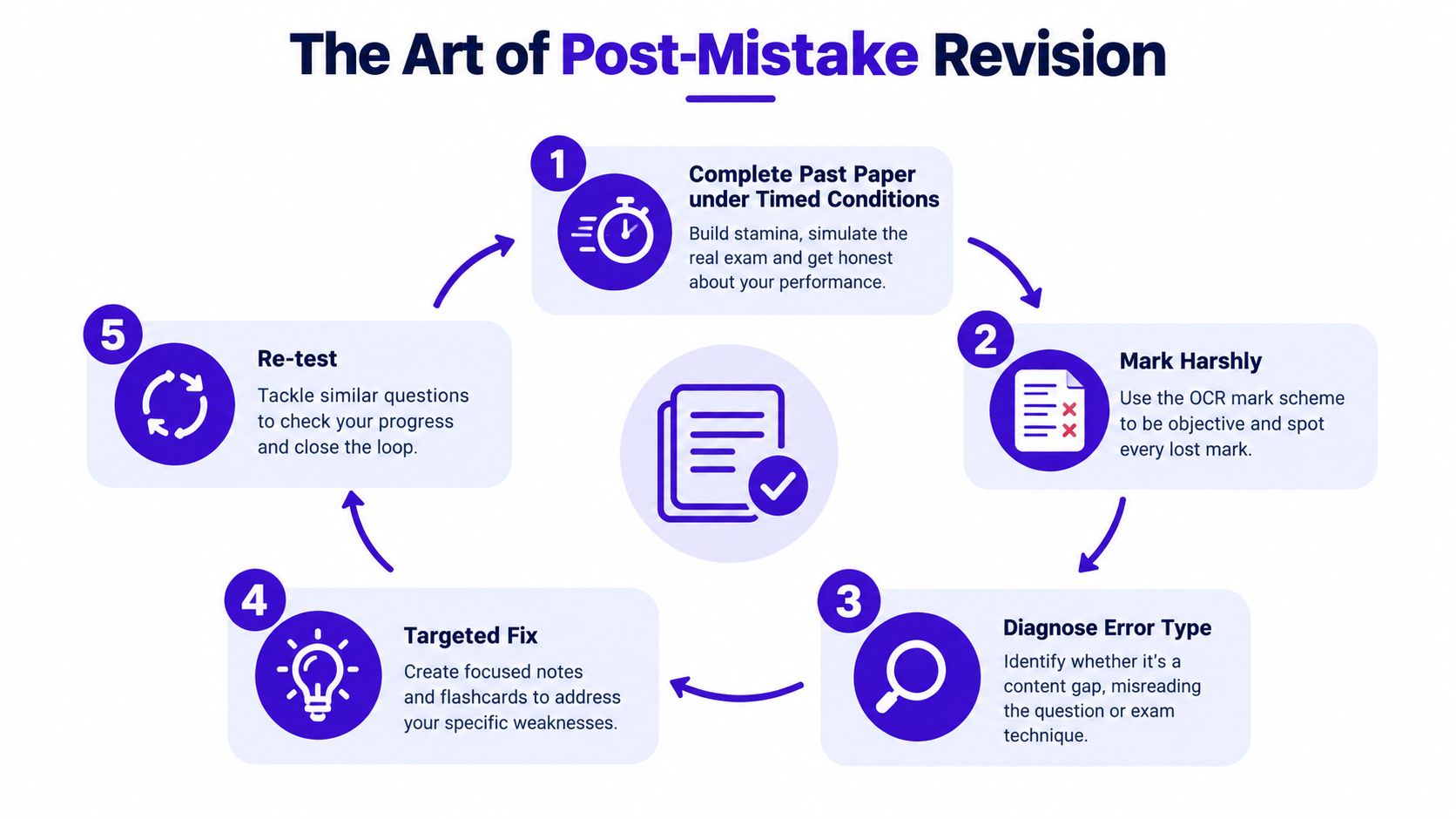
A really useful chemistry department revision resource recommends marking papers against the scheme, classifying errors as knowledge, expression, or process gaps, and then retesting weak areas in this chemistry revision guidance document. That idea is much more powerful than stacking completed papers.
The three types of mistake that matter most
When you lose a mark, label the reason.
Knowledge gap
You didn't know the chemistry securely enough. Maybe you forgot the condition for a reaction, mixed up a definition, or couldn't recall a mechanism.
Fix: relearn that exact point, then test yourself without notes.
Expression gap
You knew the idea, but your wording didn't land. This happens a lot in definitions, practical evaluation, and explanation questions where the mark scheme wants precision.
Fix: compare your phrasing with the mark scheme and rewrite from memory later.
Process gap
You knew the content but mishandled the task. Maybe you misread the command word, dropped a unit, missed a step in a calculation, or ran out of time.
Fix: practise that process in isolation before doing another full paper.
A revision loop that actually changes performance
Try this after every paper:
Mark harshly
Don't award yourself “nearly” marks.
Record every lost mark
Keep one mistake log, not ten scraps of paper.
Classify the error
Knowledge, expression, or process.
Set a repair task
One flashcard set, one practical summary, five calculation questions, one rewritten explanation.
Re-test later
Not the same question straight away. A similar one.
A platform such as MasteryMind can support this kind of loop because it aligns questions and command words to UK exam boards and gives examiner-style feedback, but the method matters more than the tool. The key is that your next revision session should be shaped by evidence from your last mistake.
Key move: A past paper is only useful when it changes what you study next.
Building a Sustainable Study Schedule
A revision plan for OCR Chemistry shouldn't look heroic. It should look repeatable.
Students often swing between two bad extremes. One is the “I'll do chemistry all weekend” fantasy. The other is the colour-coded timetable that collapses the first time life gets busy. A sustainable plan sits in the middle. It's clear, specific, and realistic enough to survive an ordinary week.
Compare the two common approaches
| Approach | What it feels like | What usually happens |
|---|---|---|
| Generic chemistry timetable | Flexible at first | Weak areas stay hidden because tasks are vague |
| OCR-specific timetable | More precise | You know which paper, topic, and skill you're training |
The better option is the second one. You're not just planning “chemistry”. You're planning OCR Chemistry tasks such as revising acids and buffers, then doing calculation questions, then checking command-word errors from a Paper 2 set.
A weekly structure that doesn't burn you out
You don't need to revise every topic every day. You do need a rhythm.
Try organising your week around different task types:
- One session for content repair: relearn weak theory from your checklist.
- One session for calculations: unit handling, method steps, and checking final answers.
- One session for practical knowledge: methods, observations, uncertainty, and evaluation.
- One session for timed questions: short OCR-style bursts under pressure.
- One session for review: mark, diagnose, and plan what comes next.
That's much stronger than repeatedly rereading notes.
If you want one place to combine OCR-aligned practice with wider subject revision, Online Revision for A-Level can sit alongside your school notes, textbook, and past papers.
How to keep the schedule honest
A timetable only works if it tells the truth. At the end of each week, ask:
- What did I finish?
- Which topics still collapse under exam questions?
- Am I avoiding one paper type?
- Have I done repair work, or just familiar work?
If your schedule keeps drifting, shrink it. A smaller plan you stick to beats a perfect plan you restart every Monday.
Frequently Asked Questions
Do I need to care about the Practical Endorsement if the written papers decide the grade?
Yes. Treat it as part of the course, not a side task, because OCR requires all components to be completed for the full A Level. For the detail on how practical work connects to exam performance, revisit Section 2.
Which paper should I prioritise if I'm short on time?
Prioritise the paper that produces the weakest marks after marking, not the one that feels least stressful. Your error log should decide.
If you keep missing OCR calculation setup, practical interpretation, or synoptic links, start there. A paper becomes a priority when it exposes the same weakness more than once.
Is Paper 3 harder because it's unified chemistry?
Many students find Paper 3 less predictable because OCR expects you to choose the relevant chemistry without being guided by a single topic heading. It rewards switching cleanly between ideas.
A good fix is mixed practice. Use short sets that force you to identify the topic before you answer.
Should I stick to one revision source?
Usually, no. One source may explain content well, but OCR success also depends on specification wording, question style, and mark scheme habits.
Give each resource a job. Notes help with recall, the specification keeps you accurate, past papers show OCR phrasing, and compact files of essential student PDF resources can help you keep materials organised.
How many past papers should I do?
There is no target number that guarantees a grade. A paper only has value if you mark it, sort the mistakes, and change your next revision block.
Three well-analysed papers beat a pile completed on autopilot.
I know the content, so why am I still losing marks?
Usually, the problem sits in one of three places: you misread the command word, you skip a step in the method, or you give a scientifically correct answer that does not match OCR's mark scheme wording closely enough.
Go back to your last few scripts and label the loss. If the same label keeps appearing, that is the revision target.
What should a simple weekly plan look like?
Keep it small enough to repeat. One weak topic, one OCR question session, one timed mixed set, and one review session is enough for many students.
The point is not to build a pretty timetable. The point is to create a cycle where each paper shows you what to fix next.
MasteryMind gives students OCR-aligned revision tools matched to questions, command words, and specification points. If you want practice shaped around exam demands rather than generic chemistry review, visit MasteryMind.
Ready to master this topic?
Practise with quizzes, blurt exercises and exam questions on MasteryMind.
7 days Premium · Then free forever · No card, no charge