10 a Level Chemistry Topics to Revise in 2026
You're in Year 13, staring at a mock paper. You coasted through Year 12, the titration question looks familiar until the calculation starts, and the Born-Haber cycle might as well be a map of somewhere you've never visited. Or perhaps you know the content, but you're still losing marks between understanding an answer and writing it clearly.
The good news is that the same ten areas cover most of the A-level Chemistry specification, whether you're pulling marks back or chasing an A*. AQA, Edexcel, OCR and WJEC all cover these core areas, although naming, depth and practical requirements vary. Check your own specification, particularly for practical work and board-specific calculations.
Think of these A-level Chemistry topics as ten topics, one revision plan that actually works. They're ordered by how much they help you understand the others, not by textbook chapter order.
Keep these command words beside your practice questions:
- State: Give the fact directly.
- Explain: Connect the observation to a chemical reason.
- Calculate: Show the route, quantities and units.
- Deduce: Use the evidence to reach a conclusion.
- Evaluate: Weigh evidence, limitations and possible improvements.
Chemistry can lead towards university or other study routes, including Access to HE for chemistry careers. Tonight, though, start with the chemistry that makes the next question easier.
1. Moles, Mass and Titration Calculations
Start here if calculations make you freeze. Moles connect mass, concentration, gas volume and theoretical yield, so the same reasoning supports titrations, equilibrium calculations and organic synthesis.
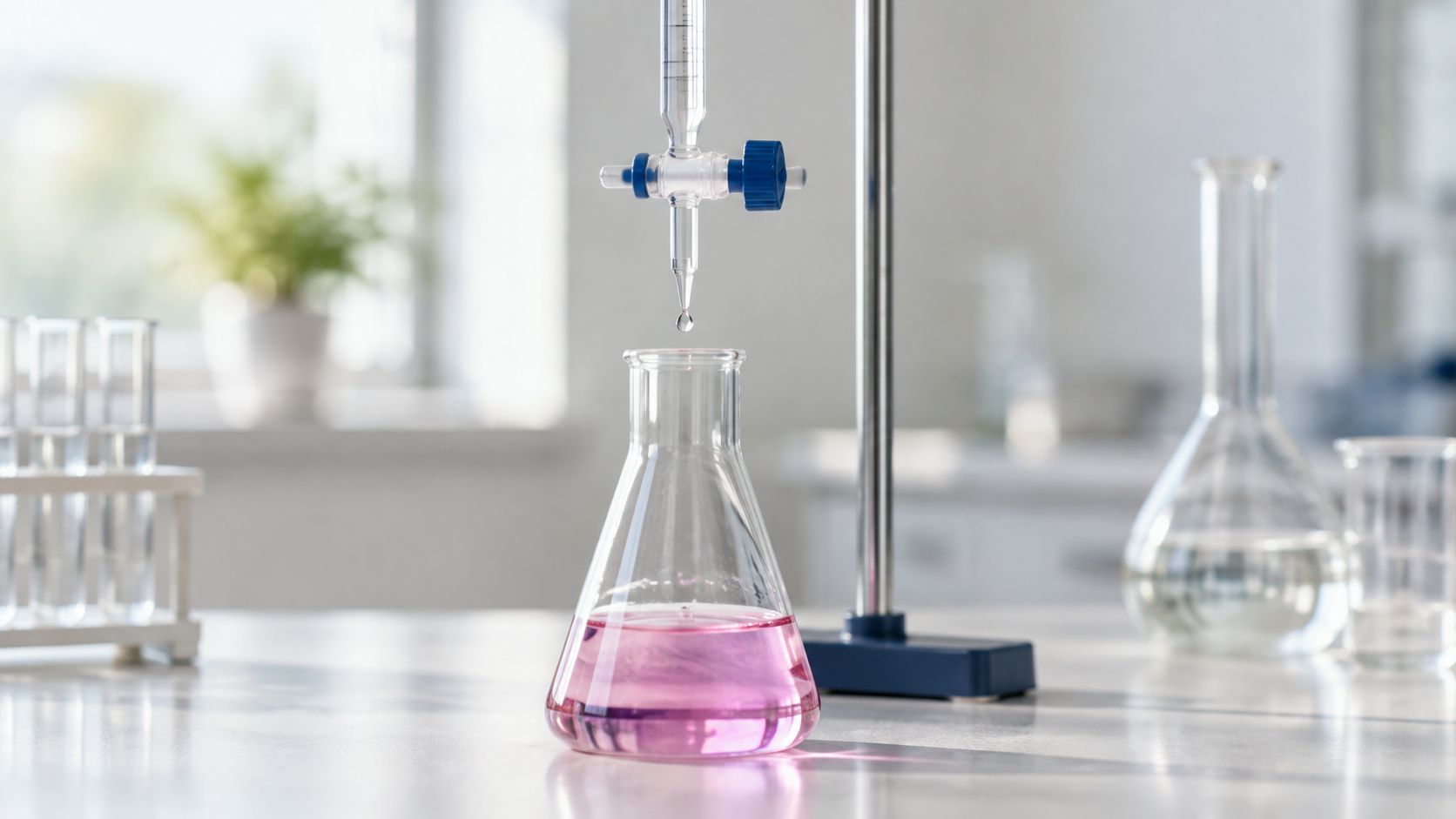
Take an ethanedioic acid titration. Calculate the amount of the known reagent, use the balanced equation to find the amount of acid, then divide by the acid sample's volume in dm³. Don't assume equal reacting amounts just because both substances are in solution.
The trap is invisible working
AQA's examiner report identifies problems with unit conversion, premature rounding, stoichiometric coefficients and unclear calculation working. A correct calculator entry isn't enough if the chemical relationship is missing.
- First drill: Write the balanced equation before calculating. Label each amount with its substance.
- Unit check: Use g with molar masses in g mol⁻¹ and dm³ with concentrations in mol dm⁻³. Gas-law calculations need their own consistent units.
- Stretch drill: Calculate ammonia yield from nitrogen, then introduce a limiting reactant.
Expect calculate, determine and practical evaluate questions. If time is short, prioritise concentration, mole ratios and dilution before unfamiliar multi-stage problems.
Use A-Level Past papers to practise the same calculation in different contexts. If concentration remains shaky, calculate molarity step by step before adding titration complications.
2. Bonding, Structure and Intermolecular Forces
Water boils at a higher temperature than hydrogen sulfide because water molecules form hydrogen bonds. That explanation concerns attractions between molecules, not the covalent bonds inside them.
Bonding helps you explain physical properties and predict organic reactivity. Revise ionic, covalent and metallic bonding alongside London dispersion forces, permanent dipole-dipole attractions and hydrogen bonding.
The trap is naming the wrong force
For an explain question, connect structure to particles, attractions and energy. Diamond is hard because its giant covalent structure contains strong covalent bonds throughout; graphite conducts because delocalised electrons can move along its layers.
Practical rule: Before explaining a melting or boiling point, identify the structure. A molecular explanation won't work for a giant ionic lattice.
For molecular shapes, draw the central atom's bonding pairs and lone pairs before naming the shape. VSEPR reasoning depends on repulsion between electron regions, not on how neatly you can arrange atoms on paper.
- First drill: Compare water and hydrogen sulfide, then diamond and graphite. Name the relevant attraction in every answer.
- Recall drill: Build a shape-and-angle sheet, cover it, and reconstruct it.
- Stretch drill: Explain why ice floats by linking hydrogen bonding to its open structure.
Use Online Revision for A-Level to practise these distinctions. If time is short, master structure-property explanations before polishing dot-and-cross diagrams you already understand.
3. Enthalpy Changes, Hess's Law and Born-Haber Cycles
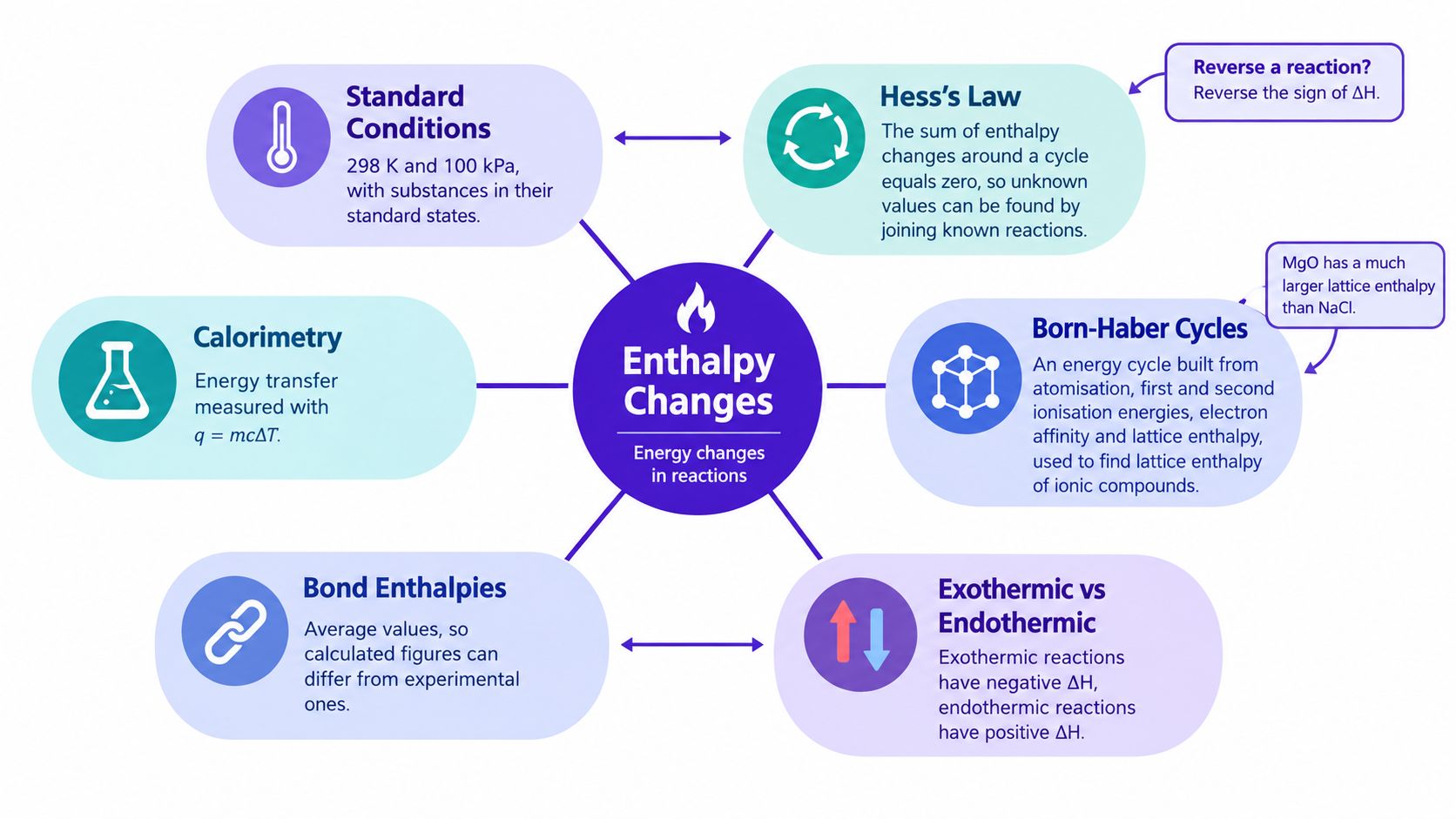
A clear energy cycle is more useful than a memorised string of signs. Enthalpy questions connect measured temperature changes, chemical equations and energy conservation.
Start with formation, combustion and neutralisation definitions. Each definition must specify the process accurately, including physical states and standard conditions where required.
The trap is reversing an equation without its sign
To calculate methane's enthalpy of formation from combustion data, draw both routes to the same combustion products. Follow the arrows algebraically rather than choosing whichever subtraction gives a familiar-looking answer.
For Born-Haber cycles, label every species and state. Include atomisation, ionisation, electron affinity and lattice formation or dissociation, using your board's convention.
- First drill: Reverse a thermochemical equation and change the enthalpy sign; then scale both together.
- Diagram drill: Draw a Born-Haber cycle from a blank page, placing endothermic steps upwards and exothermic steps downwards.
- Stretch drill: Explain magnesium oxide's greater lattice enthalpy magnitude than sodium chloride's using ionic charges and ionic sizes.
Expect calculate, construct and explain. Give enthalpy answers in kJ mol⁻¹ and distinguish lattice formation from lattice dissociation before judging the sign.
Use Exam Practice for A-Level once you can draw the route without prompts. If time is short, secure Hess's law before attempting complicated cycles.
4. Chemical Equilibria and Le Chatelier's Principle
At dynamic equilibrium, forward and reverse reactions continue at equal rates in a closed system. Concentrations remain constant, but they don't have to be equal.
This distinction supports both equilibrium calculations and industrial explanations. In the Haber process, higher pressure favours ammonia formation, while temperature involves a trade-off between equilibrium yield and reaction rate.
The trap is confusing rate with yield
A catalyst speeds up both directions and helps the mixture reach equilibrium sooner. It doesn't change the equilibrium constant or the equilibrium composition at a fixed temperature.
A faster reaction doesn't automatically give a greater equilibrium yield.
For predict or explain, write a chain: changed condition, favoured direction, resulting composition. For temperature changes, identify whether the forward reaction is exothermic before deciding the direction.
- First drill: Write the Kc expression from a balanced equation, including powers from coefficients.
- Calculation drill: Label initial, change and equilibrium amounts before converting to concentrations.
- Stretch drill: Compare pressure, temperature and catalyst changes without mixing up their effects on Kc or Kp.
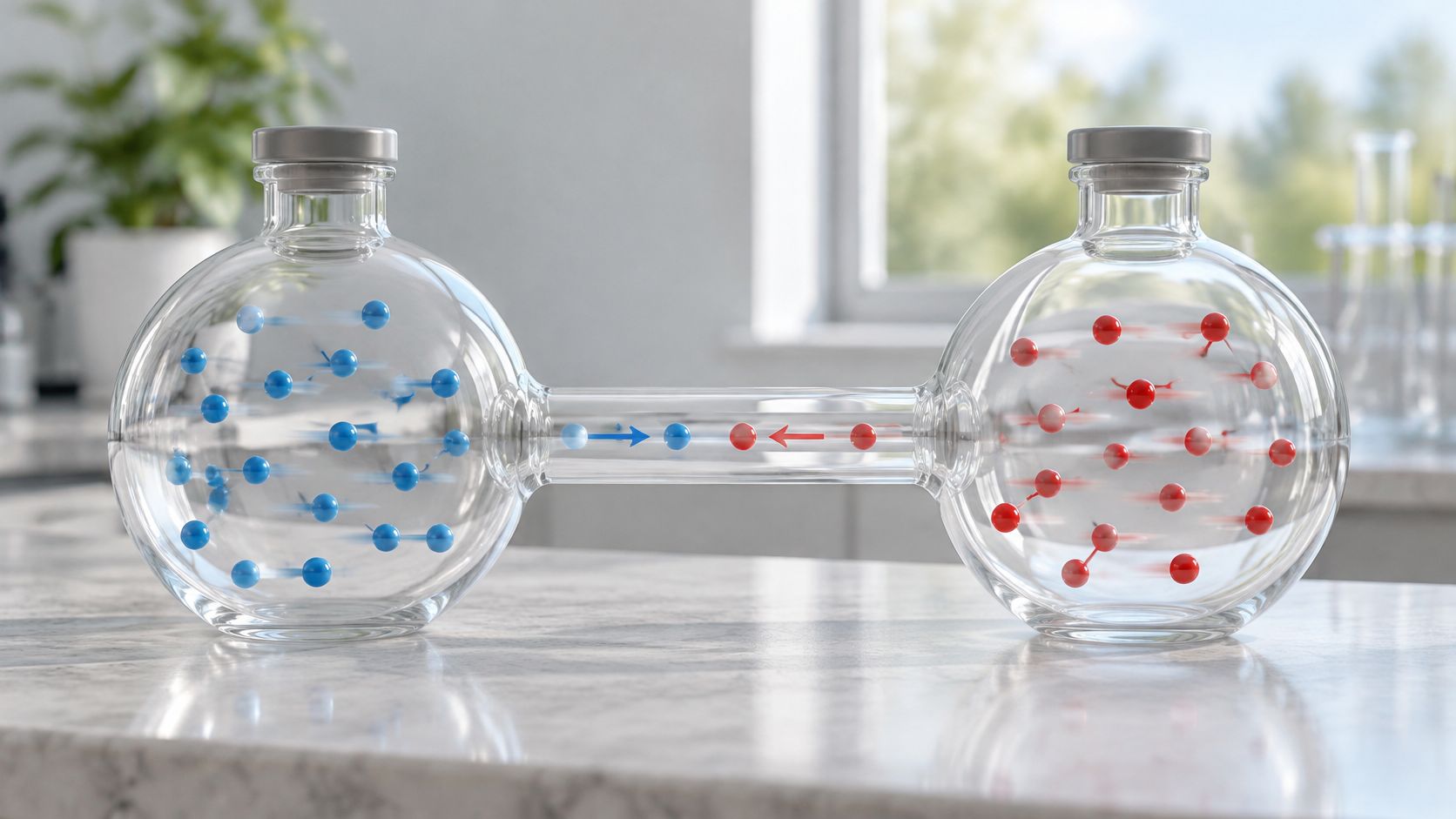
Treat this particle image as a mixing illustration, not a complete model of chemical equilibrium. If time is short, prioritise equilibrium expressions and temperature reasoning, then practise the industrial compromises behind Haber and Contact process conditions.
5. Acids, Bases, pH and Buffer Solutions
Before calculating pH, decide what is in the solution. A strong acid, a weak acid and an acid mixed with alkali need different starting points.
Strong and concentrated aren't synonyms. Strength describes dissociation; concentration describes the amount dissolved per unit volume.
The trap is using a weak-acid shortcut after neutralisation
In a buffer calculation, added alkali reacts with the acid before you calculate the new equilibrium. Update the acid and conjugate-base amounts first, then use their relationship.
The carbonic acid-hydrogencarbonate system provides a biological example. Explain how the conjugate base removes added hydrogen ions and how the acid reacts with added hydroxide ions.
- First drill: Sort questions into strong acid, weak acid, neutralisation or buffer before choosing an equation.
- Curve drill: Sketch a titration curve and label the starting region, equivalence point and steep section.
- Indicator drill: Place methyl orange or phenolphthalein's transition range within the steep section, rather than choosing by habit.
AQA's physical chemistry specification includes practical investigation of pH changes when weak acids react with strong bases and strong acids react with weak bases. Connect the curve to how readings are collected, not just its final shape.
Expect calculate, sketch, explain and justify. If time is short, distinguish acid strength from concentration, then practise neutralisation before buffers.
6. Reaction Kinetics and Rate Equations
In an iodine clock experiment, you measure the time taken to reach a visible endpoint. That time can help compare rates only when the endpoint represents the same reaction progress across experiments.
Kinetics connects practical measurements to particle behaviour. Collision theory explains changes in rate, while experimental data establish reaction orders and rate equations.
The trap is copying coefficients into the rate equation
You can't generally deduce reaction orders from the overall balanced equation. Compare experiments where one concentration changes while the others remain constant, and show how the rate responds.
- First drill: Annotate an initial-rates table before writing the rate equation.
- Graph drill: Sketch ln k against 1/T and identify the gradient as −Ea/R.
- Unit drill: Use kelvin for temperature and keep activation-energy units consistent with the gas constant.
Catalytic converters provide a useful explanation question: the catalyst offers an alternative pathway with lower activation energy. Don't claim that it gives particles more energy.
For mechanisms, distinguish a proposal that's consistent with the rate equation from proof that the proposal is correct. A matching rate equation supports a mechanism, but it doesn't establish every step uniquely.
Expect determine, calculate and suggest. If time is short, prioritise initial-rate comparisons before Arrhenius graphs, then practise explaining the difference between initial-rate and continuous-monitoring methods.
7. Redox Reactions and Electrochemistry
A positive calculated cell potential supports thermodynamic feasibility under the stated conditions. It doesn't promise that the reaction will happen quickly.
That distinction matters when using electrode potentials to predict reactions. Concentration changes and kinetic barriers can complicate a prediction based on standard values.
The trap is changing electrode potentials like equations
Balance electrons when combining half-equations, but don't multiply electrode potentials by balancing coefficients. Use the supplied reduction potentials consistently, identifying which half-cell undergoes oxidation and which undergoes reduction.
The standard hydrogen electrode provides the reference. Learn how its apparatus works, but use the question's data rather than trying to memorise a table of potentials.
- First drill: Assign oxidation states, identify the species oxidised and reduced, then balance the half-equations.
- Cell drill: Label electron flow, electrode reactions and the salt bridge's role.
- Stretch drill: Explain why a positive cell potential alone doesn't establish a useful reaction rate.
Galvanising steel with zinc gives a concrete application: zinc can oxidise sacrificially, protecting exposed iron. Lithium-ion batteries need more care; during discharge, oxidation occurs at the negative electrode, but don't describe every lithium-ion cell as containing lithium metal.
Expect deduce, calculate and explain. If time is short, repair electron balancing before tackling unfamiliar cells, then practise calculating potentials from clearly labelled half-reactions.
8. Organic Reaction Mechanisms
A curly arrow shows electron-pair movement. If its tail starts at a positive charge rather than a bond or lone pair, the mechanism is wrong before the product appears.
Mechanisms help you predict unfamiliar reactions rather than memorise isolated conversions. Prioritise nucleophilic substitution, electrophilic addition and elimination, then add the families your specification requires.
The trap is remembering the product but not the electrons
For bromoethane reacting with aqueous hydroxide, draw an arrow from an oxygen lone pair towards the carbon bonded to bromine. Show the carbon-bromine bond breaking towards bromine, with charges and products accounted for.
For electrophilic addition, draw any carbocation intermediate and consider its stability. Don't insert a carbocation into every mechanism just because you've revised one recently.
- First drill: Draw a mechanism from a blank page, then check every arrow's origin and destination.
- Conditions drill: Contrast aqueous hydroxide substitution with ethanolic hydroxide elimination.
- Stretch drill: Explain industrial ethene hydration using steam and a phosphoric acid catalyst, separating overall conditions from mechanistic detail.
Eduqas's examiner report found familiar practical questions were generally answered well, while unfamiliar applications exposed weaker understanding. Apply that warning to organic preparation: explain why you reflux, distil or purify, not just which apparatus appears.
Use a mechanism demonstration actively: pause before each arrow and predict it.
9. Transition Metals, Complex Ions and Catalysis
Adding ammonia to a copper(II) solution can produce different observations depending on how much you add. Memorising a colour without the reagent conditions leaves you unable to explain the sequence.
This topic joins electron configuration, ligand bonding, equilibria and redox. Revise observations alongside equations so you can distinguish precipitation from ligand substitution.
The trap is treating every colour change as substitution
A colour change might accompany a change in oxidation state, ligand or coordination environment. Identify the chemical change before explaining the observation.
Water, ammonia and chloride are monodentate ligands. Learn a bidentate example such as ethane-1,2-diamine separately; EDTA is multidentate, not bidentate.
- First drill: Build a chart with starting ion, reagent, observation and equation.
- Recall drill: Explain copper(II) and iron(II) test-tube reactions aloud without looking.
- Stretch drill: Compare homogeneous and heterogeneous catalysis using actual reaction steps where your course requires them.
Iron in the Haber process illustrates heterogeneous catalysis through surface adsorption and reaction. Vanadium(V) oxide in the Contact process illustrates catalytic redox chemistry, while platinum, palladium and rhodium feature in vehicle catalytic converters.
Expect state for observations, explain for colour or catalysis, and deduce for unfamiliar complexes. If time is short, learn the required ion reactions accurately before extending into less familiar ligand systems.
10. Organic Analysis: Mass Spectrometry, IR and NMR
Treat an unknown compound as a set of constraints. A proposed structure must fit all the evidence, not just the first familiar peak.
Mass spectrometry helps establish molecular mass and fragmentation. IR identifies useful functional-group evidence, while proton and carbon NMR reveal different chemical environments.
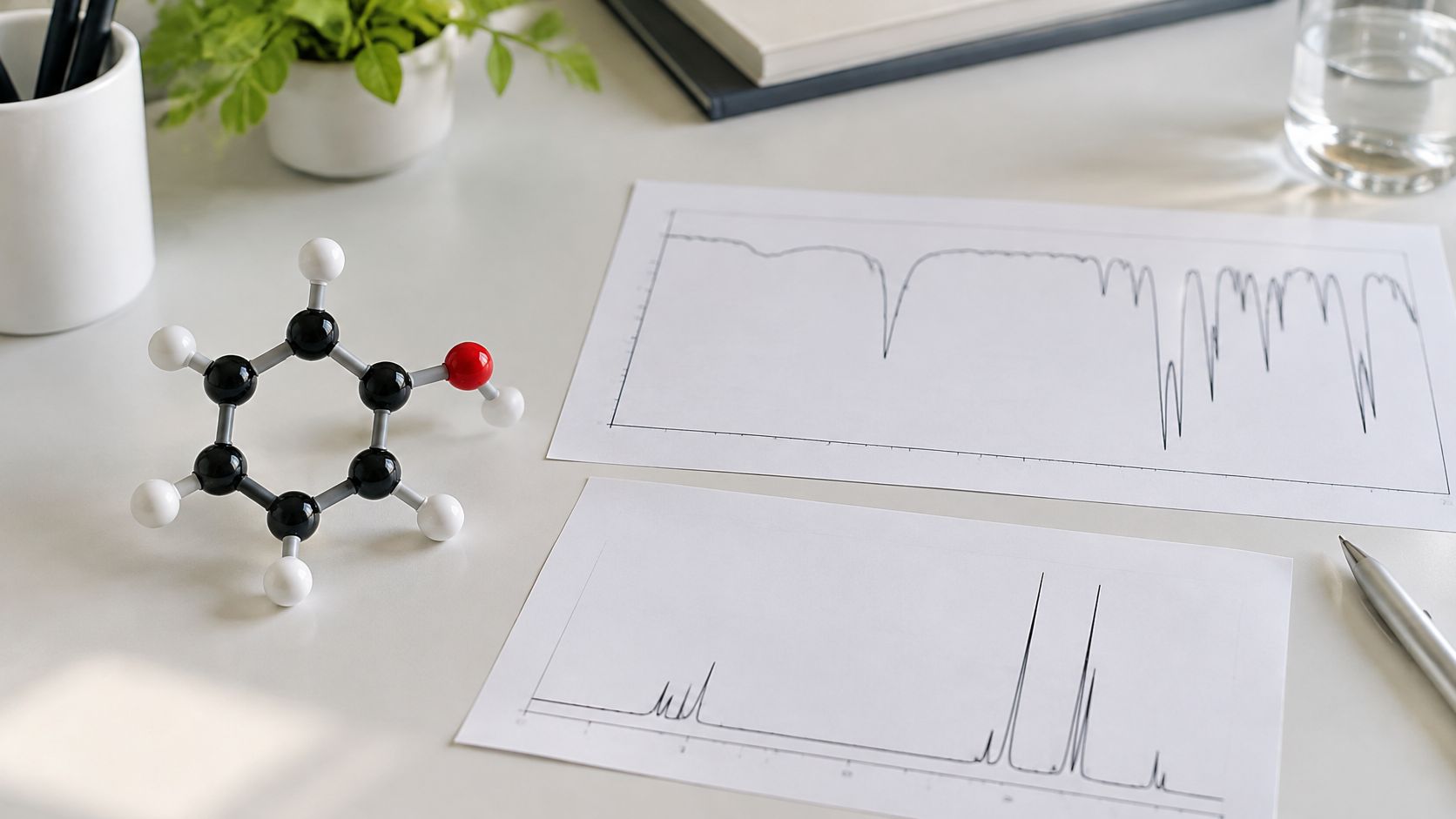
The trap is forcing the first guess to fit
Say an unknown could be an alcohol or a carboxylic acid. Check the molecular information, then look for carbonyl and O-H evidence before interpreting the NMR environments.
- First drill: Work in a fixed order: mass spectrometry, IR, then NMR.
- Evidence drill: Write what each clue supports and what it rules out.
- Stretch drill: Propose alternative structures, then reject each using a specific inconsistency.
For proton splitting, apply the n+1 rule only where its assumptions fit. Check integration against the proposed structure, and remember that exchangeable O-H signals may not show the splitting you expect.
Mass spectrometry also appears in drug testing and forensic identification, but an exam answer must use the evidence supplied rather than the application's name. Expect identify, deduce and justify, with explicit links between each feature and your structure.
Use explore exam board subject practice to find relevant analysis questions. If time is short, practise interpreting combined evidence rather than memorising isolated spectra.
How the ten A Level chemistry topics compare for revision priority, traps and links
| Item | Core Skill Tested | Most Common Trap | Best Revision Method | Feeds Into |
|---|---|---|---|---|
| Moles, Mass and Titration Calculations | Apply mole ratios, concentrations and units in calculations | Mixing up cm³ and dm³ | Practise multi-step questions, showing working and converting units first | Titrations, equilibrium calculations and quantitative chemistry |
| Bonding, Structure and Intermolecular Forces | Explain molecular shape, bonding and physical properties | Confusing intermolecular forces with covalent bonds | Draw electron-pair diagrams and review shapes and bond angles | Organic chemistry and explanations of physical properties |
| Enthalpy Changes, Hess's Law and Born-Haber Cycles | Calculate energy changes using cycles and calorimetry | Reversing a reaction without reversing the sign of ΔH | Draw cycles from memory and practise tracking signs and units | Energetics, ionic bonding and energy conservation |
| Chemical Equilibria and Le Chatelier's Principle | Interpret equilibrium shifts and calculate Kc | Claiming a catalyst changes the equilibrium yield | Write Kc expressions and explain each change, shift and effect | Industrial chemistry, buffers and mole calculations |
| Acids, Bases, pH and Buffer Solutions | Calculate pH and explain acid-base equilibria and buffers | Treating a weak acid as fully dissociated | Practise pH calculations and sketch titration curves with indicator ranges | Equilibrium, titration and biological buffer chemistry |
| Reaction Kinetics and Rate Equations | Determine reaction orders and interpret rate data | Using equation coefficients as reaction orders | Compare initial rates and practise Arrhenius graphs and calculations | Reaction mechanisms, catalysis and equilibrium |
| Redox Reactions and Electrochemistry | Balance half-equations and calculate cell potentials | Reversing the cell-potential sign through incorrect electrode order | Balance half-equations first, then calculate and check the cell potential | Batteries, electrolysis and feasibility of redox reactions |
| Organic Reaction Mechanisms | Use curly arrows to show electron-pair movement | Starting arrows from atoms instead of bonds or lone pairs | Draw mechanisms from a blank page and check each arrow's start and end | Organic synthesis and prediction of unfamiliar reactions |
| Transition Metals, Complex Ions and Catalysis | Explain complex-ion structures, colours and catalytic behaviour | Miscounting ligand charges or treating catalysts as used up | Review colour charts, ligand examples and catalyst comparisons | Industrial processes, coordination chemistry and catalysis |
| Organic Analysis: Mass Spectrometry, IR and NMR | Interpret spectra to identify molecular structures | Confusing the molecular ion peak with the largest fragment peak | Analyse spectra in a fixed order and practise with unseen examples | Organic chemistry, structural identification and forensic analysis |
Where to Start Tonight, and What to Revise Next Week
Start with Moles, Mass and Titration Calculations and Bonding, Structure and Intermolecular Forces. These give you the calculation methods and explanations needed across most later topics. If you can't follow a mole ratio or distinguish covalent bonds from intermolecular forces, a harder question usually adds confusion rather than useful challenge.
Tonight, choose a short calculation and a structure-property explanation. Attempt both without notes, mark them, and identify the precise missing step. Write “used solution volume before converting units”, not “bad at titrations”.
If you're behind
Pick one topic rather than opening every revision folder. Use the Blurt Challenge for five minutes a day to explain a small objective aloud, then answer a question that tests it. For bonding, that might mean explaining graphite's conductivity before attempting a comparison with diamond.
Build spaced review into the week by returning to the same skill after a gap. Keep the return task narrow: reconstruct a Hess cycle, explain a buffer response or label a titration calculation. Reading the same page again isn't a substitute for producing an answer.
If you're aiming high
Use mixed-topic practice to connect ideas. Combine moles with acid-base chemistry, bonding with organic mechanisms, and redox with transition-metal catalysis. Practise unseen questions under timed conditions, then separate chemistry errors from communication errors when marking.
For stronger answers: Make each inference visible. Show which data establish the reaction order, which peak supports the functional group, or which equation supplies the mole ratio.
Next week, move through enthalpy, equilibria, acids and kinetics before concentrating on more demanding mechanisms and combined analysis. Keep redox and transition metals in the rotation rather than saving them for a final cram.
Teachers should treat this order as a suggestion, not a replacement for diagnosis or classroom sequencing. Students should check their own specification and command-word guidance before final revision. A secure topic may need maintenance, while a prerequisite gap needs direct teaching.
Practical reasoning belongs throughout that plan: AQA's practical assessment guidance states that at least 15% of the overall qualification assesses knowledge, skills and understanding connected with practical work. When reviewing an experiment, explain why the apparatus, measurement and processing method suit the task.
Before bed, complete and correct one titration calculation with every quantity labelled.
MasteryMind offers exam-board-aligned Chemistry practice, mixed-topic questions and spaced review, with feedback on your answers. Visit MasteryMind to choose a topic you've struggled with and turn tonight's correction into your next practice task.
Choose your next course task
Use this idea with Chemistry. Confirm the qualification, awarding organisation and course version before choosing practice, assignment preparation or evidence planning.
Choose your Chemistry course