A Level History Coursework: A Practical Guide to Top Marks
You've got a topic in your head, a deadline approaching, and perhaps a document containing little more than a title and a blinking cursor. That uncomfortable gap is familiar to almost every A-level History student, whether you're trying to recover lost ground or aiming for the highest grade. The problem usually isn't a lack of interest. It's not knowing how to turn an interesting historical subject into a manageable, approved investigation with a clear argument.
A-level History coursework becomes much less intimidating when you treat it as one connected project. Your question controls your research, your research shapes your argument, and your argument determines how you use evidence. The rules vary between exam boards, so a good essay can still lose marks if its title, word count, sources or submission process doesn't match the specification.
What A Level History Coursework Actually Is
The first thing to understand is that A-level History coursework isn't a longer version of a timed exam essay. It's an independently researched historical enquiry, usually completed during Year 13 with teacher supervision. You choose or develop a question, investigate primary sources and historians' interpretations, draft your response, and submit a piece of sustained writing for assessment.
Exam boards often call this work the NEA, meaning Non-Exam Assessment. Across AQA, OCR and Edexcel, coursework generally contributes 20% of the A-level, although the exact route and requirements depend on your specification. AQA's Historical Investigation is worth 40 marks and 20% of the final A-level, while OCR describes its NEA as a topic-based essay worth 20% of the qualification. You can check the wider course structure through structured practice for history exams, but your teacher and current specification remain the final authority.
Coursework is a project, not a single sitting
In an exam, the question is given to you and time controls your decisions. In coursework, you have more control, but that freedom creates responsibility. You need to decide:
- What to investigate: The topic must be historically meaningful and narrow enough to handle properly.
- Which evidence to trust: You'll select primary sources and assess their value, limitations and context.
- Which interpretations to compare: Strong work recognises that historians may explain the same development differently.
- How to build a judgement: Your conclusion should answer the exact question, not merely summarise what happened.
AQA requires an independently researched investigation of 3,500 to 4,500 words, with a maximum of 4,500 words, set within a context of approximately 100 years and based on both primary and secondary sources. It also must not duplicate material from the examined components. The full AQA course must cover a chronological range of at least 200 years across all three components, so your coursework title needs to fit your school's wider programme rather than repeat it. These requirements are set out in AQA's Historical Investigation specification.
Academic honesty matters from the start. Keep your research notes, record where ideas come from, and make sure the final writing is your own. A coursework essay rewards independent thinking, not the ability to assemble impressive-looking material from websites.
How the Four Main Boards Assess Your Coursework
The safest approach is to identify your exam board before you plan the essay. Students often borrow advice written for another board, then discover that the word count, title process or assessment emphasis doesn't match their course.
The verified requirements differ most clearly between AQA and OCR. OCR describes its NEA as an independently researched essay using primary sources and historical interpretations, typically 3,000 to 4,000 words, alongside three examined components. AQA uses a Historical Investigation of 3,500 to 4,500 words, framed in an approximately 100-year context. Pearson's guidance recommends 3,000 to 4,000 words for its coursework and asks students to present their own view while evaluating three main relevant works. You should use your school's exact Pearson route before relying on general online comparisons.
| Board | Word Count | Mark Weight | Primary Sources | Title Approval |
|---|---|---|---|---|
| AQA | 3,500 to 4,500 words, maximum 4,500 | 20% | Required, alongside secondary sources and differing interpretations | Follow the current AQA and centre process |
| OCR | Typically 3,000 to 4,000 words | 20% | Required, alongside historical interpretations | Formal approval through OCR's text and task approval service |
| Edexcel | Pearson recommends 3,000 to 4,000 words | 20% in the stated general coursework guidance, with route-specific requirements to check | Relevant primary evidence and evaluation of three main works | Follow the current Pearson and centre process |
| WJEC/Eduqas | Check the current specification and centre guidance | Check the current specification | Check the current specification | Follow the current specification and centre process |
The table is a planning aid, not a substitute for the specification. Requirements can be route-specific, especially for Edexcel, so use your board's documents and your teacher's instructions. A useful starting point for understanding assessment language is this exam board mark schemes guide.
The assessment emphasis changes your writing
Your essay must show historical knowledge, analysis and evaluation, but boards may express these expectations through different assessment objectives. AO1 normally concerns relevant knowledge, explanation and judgement. AO3 focuses more directly on analysing and evaluating primary sources, depending on the specification.
That difference affects balance. A paragraph containing several quotations but no explanation of provenance, purpose or reliability isn't automatically strong. Equally, a fluent argument with thin factual support won't carry the investigation. Whatever board you sit, the same structural principle applies: make a clear judgement, support it with precise evidence, and explain why the evidence matters.
Choosing a Question That Will Actually Get Approved
A broad interest is a useful starting point, but it isn't yet a coursework question. “The Cold War in Cuba” identifies a subject. It doesn't tell the reader which years, decision, cause or historical dispute your investigation will examine.
A workable question passes three tests:
- It's specific enough to answer within your board's word limit.
- It's contestable, so you can argue rather than narrate.
- It connects to a genuine historical debate involving evidence and interpretation.
Start by writing down the broad subject that interests you. Then add a decision, factor or judgement. “Why did England break with Rome?” is broad because it invites a long list of causes. “To what extent was Henry VIII's break with Rome driven by his desire for a male heir?” gives you a central explanation to test against alternatives such as political authority, religious change, finance and international pressure.
Use a question funnel
Take “Weimar Germany” and narrow it through decisions:
- Broad subject: Weimar Germany.
- Possible issue: Why did the republic struggle?
- Sharper focus: The role of economic crisis in weakening support.
- Debatable question: To what extent did economic crisis, rather than political opposition, undermine the Weimar Republic?
The final version gives you something to weigh. It doesn't force you to agree with the wording. You might conclude that economic crisis created opportunities for extremist parties, while political weaknesses and conservative choices made those opportunities decisive.
OCR requires titles to be approved through its text and task approval service, so an interesting idea isn't enough if the proposed title doesn't fit the specification. OCR's recent guidance also says that improved marking clarity for Unit Y100 didn't change the standard expected. That makes early discussion with your teacher especially important. Send two or three possible questions rather than waiting until you've researched one title in depth.
Practical rule: If your question could be answered by listing events in date order, it probably needs narrowing or reframing.
Your final question should guide your source hunt. If you ask about Henry VIII's motives, you'll need evidence about royal policy, succession, religion and the perspectives of people who witnessed or interpreted the break with Rome. A focused title prevents random reading and gives every source a job. Tools such as an AI-powered NEA revision tool may help you test the logic of a plan, but your teacher must control approval and your submitted argument must remain your own.
Research and Source Handling That Scores
Good research doesn't mean collecting the largest possible pile of material. It means finding evidence that helps you answer the question and testing it against other evidence.
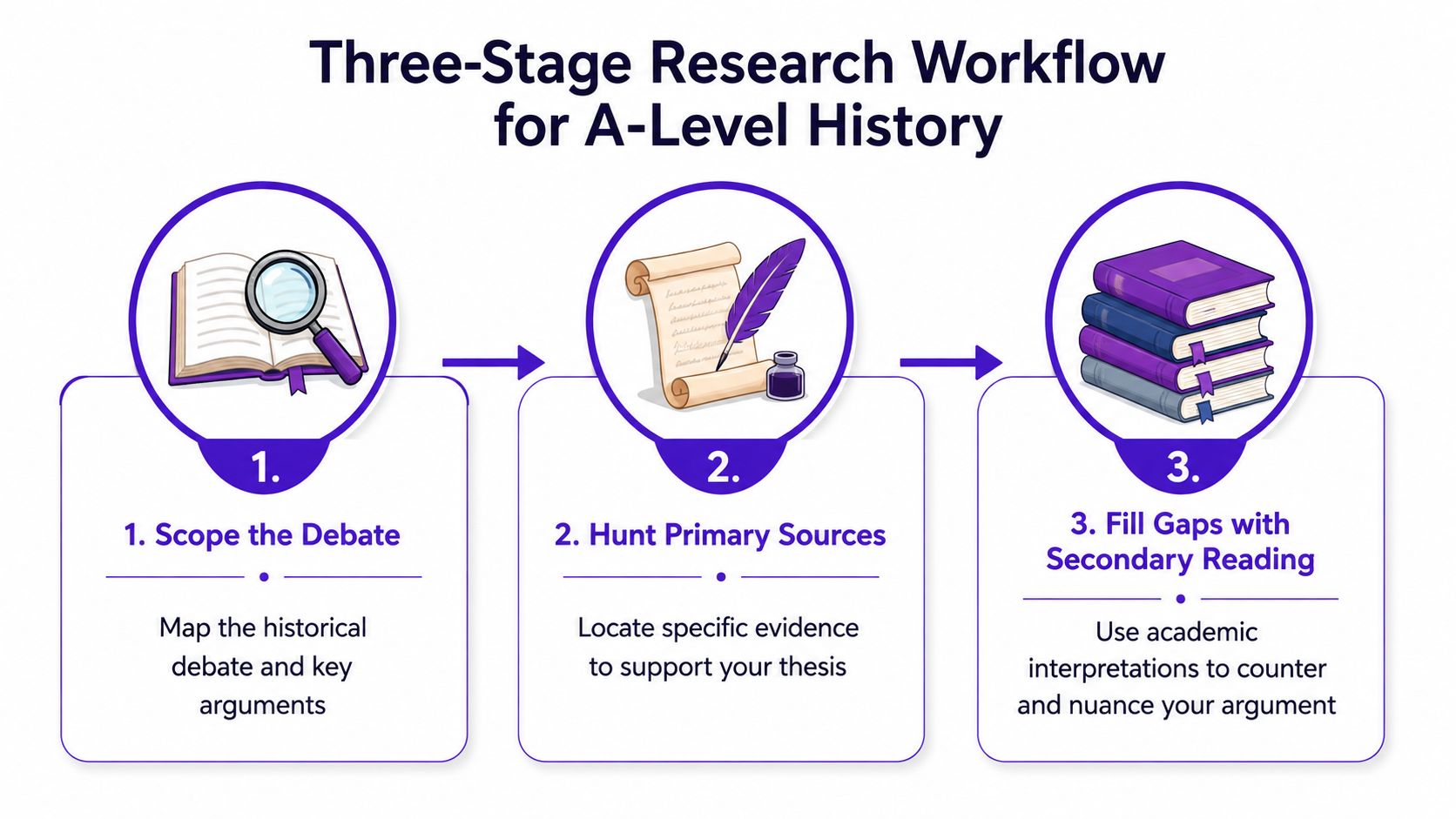
Use a three-stage workflow:
First, scope the debate
Begin with reliable secondary reading. Identify the main explanations historians use, the terms they disagree about, and the evidence that appears repeatedly. At this stage, you're not trying to write finished paragraphs. You're building a map of the argument.
Then hunt primary sources
Primary sources come from the period or people you're investigating. Examples include speeches, treaties, newspapers, memoirs, oral testimony and government papers. A primary source can reveal attitudes and intentions, but it doesn't automatically tell you the truth. You still need to ask who produced it, when, for what purpose, and what it leaves out.
Finally, fill the gaps
Return to secondary historians after you've identified the evidence you need. Look for interpretations that challenge your first view or explain sources you haven't yet understood. A useful research log should record the author, date, main argument, reliability, limitations and possible use of every important source.
Balance evidence instead of decorating paragraphs
For an Appeasement investigation, you might use Wheeler-Bennett's revisionist interpretation, then test it against Chamberlain's own papers and contemporary press coverage. The point isn't to mention all three sources in one paragraph. The point is to ask whether the evidence supports Wheeler-Bennett's explanation, qualifies it or exposes a limitation.
Write source analysis into your reasoning:
Chamberlain's papers are valuable for showing how the prime minister understood his own choices, but they cannot by themselves prove that his public explanation matched every political calculation.
That sentence does more than introduce a quotation. It gives the evidence a weight and explains how it affects the judgement.
Your board may set specific source expectations. OCR's guidance highlights the need to evaluate three cross-referenced sources in the A-level question, so don't treat sources as isolated quotations. Compare them directly. If a newspaper reports public enthusiasm but a private letter reveals anxiety, explain the difference rather than choosing whichever supports your thesis more conveniently.
For general advice on organising an extended investigation, this Humantext.pro research paper guide can help with research habits and planning. Use it alongside your History specification, because historical source evaluation has subject-specific demands.
Structure, Sample Paragraphs and Timing Plan
A high-scoring investigation usually has a visible line of enquiry. The reader should know your overall judgement, see it tested through organised arguments, and reach a conclusion that weighs the factors rather than repeating the introduction.
A practical structure is:
- Introduction: Define the issue, establish the scope and state a contested thesis.
- Argument one: Examine the strongest factor or explanation.
- Argument two: Test a competing factor.
- Argument three: Add a further factor or complication where useful.
- Historiography and conclusion: Compare interpretations, weigh the evidence and answer the exact question.
Suppose the question is, “To what extent was the policy of Appeasement caused by fear of another European war?” A useful thesis might be: Fear of another war was the most important public and strategic reason for Appeasement, but it became policy only because leaders also faced domestic political pressures, military uncertainty and assumptions about the grievances of revisionist states.
Build paragraphs around claims
A paragraph should not be a miniature timeline. Start with a claim that answers part of the question, then use evidence to test it.
Topic sentence: Fear of another European war strongly shaped the public defence of Appeasement.
Evidence: Chamberlain's public statements and contemporary newspaper coverage presented negotiation as a way to avoid another general conflict.
Analysis: This evidence supports the view that public opinion and memories of the First World War mattered. However, public language also had a political purpose, so it reveals how the policy was justified rather than proving that fear was its only cause.
Link to judgement: Fear therefore explains the policy's appeal, but it must be weighed against the government's assessment of military readiness and the political consequences of rejecting compromise.
That final link is where many essays fall short. A source may be accurate and relevant, yet still have limited value for the precise question. Explain the difference.
A nine-week working plan
| Week | Target |
|---|---|
| One | Discuss possible titles, check overlap with examined units and begin approval. |
| Two | Read introductory secondary material and map the main debate. |
| Three | Locate primary sources and create the research log. |
| Four | Complete targeted secondary reading and settle the working thesis. |
| Five | Draft the introduction and first argument section. |
| Six | Draft the remaining argument sections and add source evaluation. |
| Seven | Write the historiography discussion and conclusion. |
| Eight | Receive permitted feedback, revise your own work and check citations. |
| Nine | Proofread, check presentation and submit the final version. |
The exact timetable will depend on your centre. Keep research, drafting and feedback moving together rather than spending too long perfecting the introduction. Use the coursework structure and timing plan as a visual reminder that the conclusion deserves planned space.
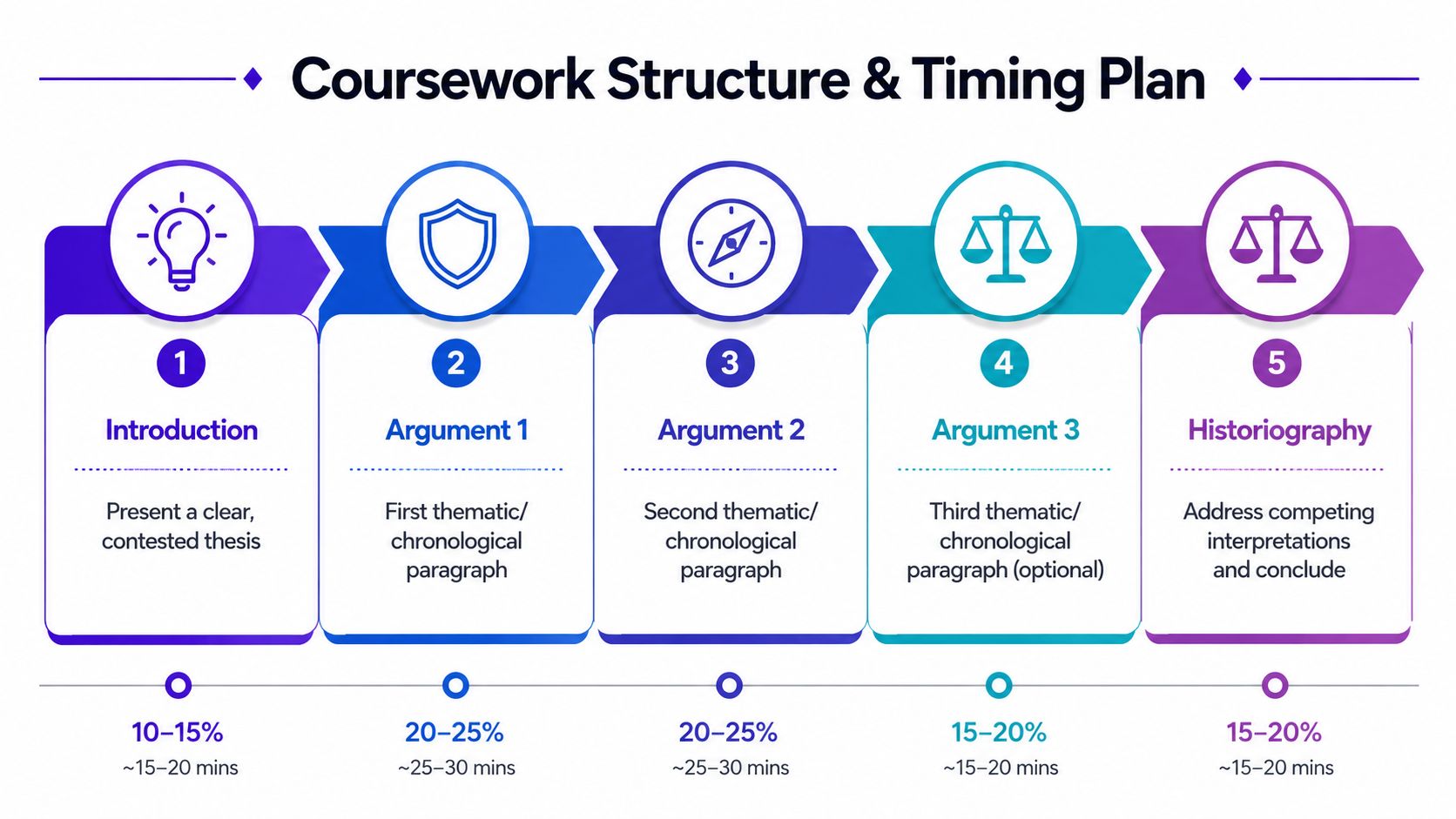
A common mistake is to analyse every possible issue in the body paragraphs, then rush the ending. Your conclusion is where you show the hierarchy of causes and the limits of your evidence. It shouldn't introduce a completely new argument, but it must do more than say that “both sides” had a point.
JCQ Rules and Academic Integrity Without the Panic
JCQ's central principle is straightforward: the submitted coursework must be your own work. Coursework submitted for assessment must be the candidate's own work, and JCQ requires a title and, where relevant, a contents page and bibliography. It also says coursework should, wherever possible, be word-processed or handwritten in black ink. You can consult the JCQ coursework instructions for the formal wording.
Your centre will explain how drafts and feedback operate. Don't assume that unlimited teacher editing is allowed. A teacher can guide you towards a clearer structure or ask questions about your reasoning, but they can't rewrite your argument, correct every expression or repair your references across repeated drafts.
Treat internet material, paraphrased ideas and digital tools carefully. If an AI system generates wording or ideas that you use, that material must be treated as someone else's work and acknowledged according to your centre's policy. Submitting unacknowledged AI-generated text as your own can create a malpractice risk and means you can't demonstrate that the thinking and writing belong to you.
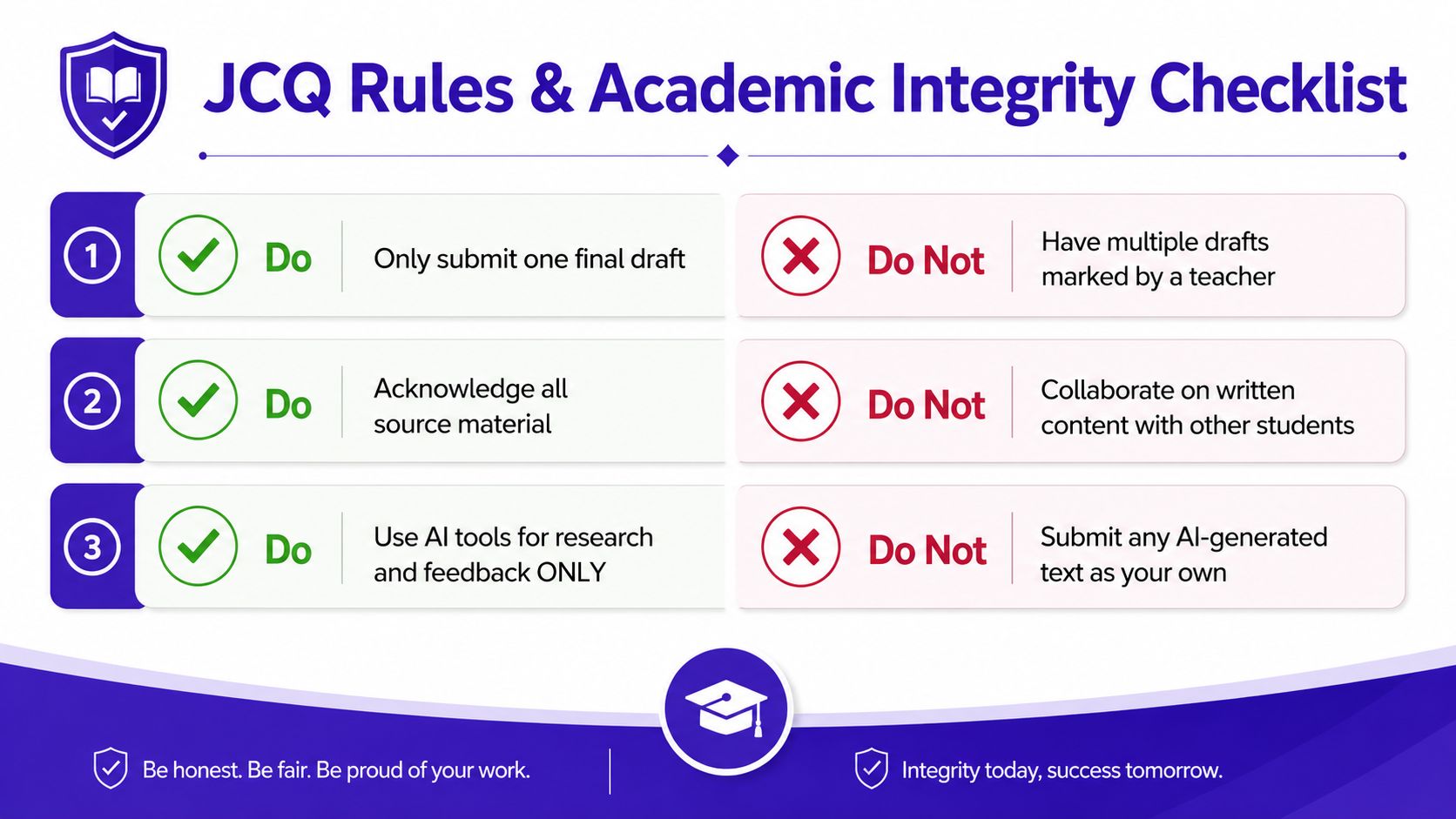
Keep a dated research log, save your notes and preserve earlier drafts where your centre requires them. Peer discussion and group research can be legitimate, but sharing written paragraphs or allowing another student to shape your final wording crosses the line into inappropriate collaboration.
This short video can support a class discussion about the practical meaning of academic integrity:
Examiner Tips, Common Mistakes and Final Checklist
A marker wants to see a sustained answer to a historical question. The strongest essays don't merely know a lot. They select knowledge, sources and interpretations because each one helps establish a judgement.
The recurring weaknesses are predictable:
- Narrative drift: Events are described in order, but the essay stops answering the question.
- Descriptive source use: A quotation is paraphrased without explaining its purpose, reliability or significance.
- Unclear judgement: The conclusion says every factor mattered equally, even when the evidence points to a clear hierarchy.
- Thin historiography: Historians' names appear, but their interpretations aren't compared or tested.
- Late bibliography work: Missing publication details and inconsistent references make accurate research difficult to verify.
Use this final checklist before submission:
- Question: Does every main section answer the exact wording?
- Title: Has the final title followed your board and centre approval process?
- Word count: Is the essay within the required limit and margin?
- Evidence: Have you used a balanced range of relevant primary sources?
- Interpretations: Have you compared historians rather than just mentioning them?
- Citations: Are quotations, paraphrases and borrowed ideas referenced consistently?
- Presentation: Are the title, contents page where relevant and bibliography included?
- Integrity: Have you followed your centre's instructions about drafts, feedback and declarations?
- File: Is the final document named clearly and saved in the required format?
Marker's advice: Every paragraph should either advance your judgement, test evidence or explain an interpretation. If it does none of these, it probably needs rewriting.
Use A-Level Past papers to strengthen the wider exam skills that support coursework, especially precise argument, source handling and judgement. The coursework rewards students who think like junior historians answering a real question, not students filling pages.
MasteryMind offers specification-aligned History practice, source analysis and essay guidance for UK exam boards, while its NEA Coach provides question-led support without rewriting your coursework or supplying direct solutions. Visit MasteryMind to practise the analytical skills that make your research and final argument stronger.
Ready to master this topic?
Practise with quizzes, blurt exercises and exam questions on MasteryMind.
7 days Premium · Then free forever · No card, no charge