A Level History Revision Guide That Actually Works
You've got colour-coded notes, a timeline open on your laptop, and a half-watched video explaining the topic you're meant to know. Then the mock question appears: “To what extent was economic weakness the main reason for the collapse of the ancien régime?” You know the events. You can remember several names and dates. But you can't turn that knowledge into a clear argument.
That's the problem with many revision guides. They give you more content when what you need is a better way to use the content. A useful A Level History revision guide must begin with the exam, then work backwards to the knowledge, command words, question types and writing habits that earn marks.
History remains a large UK A-level subject. In 2024, it had 47,297 entries across England, Wales and Northern Ireland, making it the fifth most popular A-level subject out of 37 and the second-largest subject in the arts, humanities and social sciences after Psychology, according to the Royal Historical Society's 2024 subject-entry analysis. Whether you're trying to recover after a poor mock or aiming for the highest grades, the fix isn't glamorous. You need to practise the exact decisions an examiner asks you to make.
The Night Before the Mock and Why Most Revision Falls Flat
At 10:47 p.m., Sam has three piles of notes on the floor. One covers causes, one covers key individuals, and one is filled with highlighted historian interpretations. A YouTube summary is playing in the background at double speed. Sam can explain what happened, but when asked to judge which factor mattered most, the argument disappears.
That situation is common because rereading feels productive. It gives you the comforting sense that the material is familiar. But familiarity isn't the same as retrieval, and remembering a fact isn't the same as using it to support a judgement.
The exam specification makes this especially important. UK A-level History courses require students to work across chronology, geography and historical method. Government subject content requires topics spanning at least 200 years, a substantial British-history element of at least 20%, and change over time across a long-term period normally lasting at least 100 years in the official A-level History subject content.
The practical change: stop asking, “What topic should I reread?” Ask, “What exam decision do I need to practise?”
A strong guide therefore starts with the question paper. You learn what analyse, evaluate, assess and to what extent demand. You learn how marks are divided between knowledge, analysis, sources and interpretations. Then you build notes that answer those demands.
If you're using Online Revision for A-Level, don't treat practice questions as a final test after revision. Use them at the beginning of a session to expose the gap between what you recognise and what you can argue. That gap tells you what to study next.
How A-Level History Is Actually Marked Across the Boards
A-level History isn't marked as a memory contest. The assessment objectives divide the work between AO1, which covers knowledge, understanding, explanation and substantiated judgement, and AO2, which covers analysis and evaluation of sources and historical interpretations. Official criteria place AO1 at 60–70% and AO2 at 30–40%, as set out in the GCE History subject criteria.
The exact paper structure depends on your board and option. That's why a generic folder labelled “A-level History” can leave you underprepared. AQA's current specification requires a breadth study, a depth study and a historical investigation in one series. Its three components are worth 80 raw marks, 80 raw marks and 40 raw marks, with a total scaled mark of 200, according to the AQA scheme of assessment.
What the paper architecture changes
AQA's Breadth Study is a 2 hour 30 minute written exam with three questions. One interpretation question is worth 30 marks, while two essays are worth 25 marks each. The paper is worth 80 marks and 40% of the A-level, as shown in the AQA specification at a glance.
That weighting should change your revision choices. If you spend all your time making chronological notes but rarely practise interpretations or extended judgement, you're revising only part of the assessment.
| Board | Number of papers | AO1/AO2/AO3 weighting | Signature question type |
|---|---|---|---|
| AQA | Three components | AO1 and AO2 are weighted through the national criteria | Breadth, depth and historical investigation, including interpretation work |
| Edexcel | Board-specific structure | Follow the exact specification for your options | Breadth, depth and source or interpretation investigation |
| OCR | Board-specific structure | Source-heavy elements require close AO2 attention | Source, depth and thematic breadth questions |
| WJEC | Board-specific structure | Paper demands vary by chosen options | Period study and Welsh or non-Welsh options |
OCR's structure makes board-specific planning particularly important. Its A Level History A assessment allocates 40% to the thematic study and historical interpretations component, while the non-exam essay is 3,000–4,000 words and worth 20%, according to the OCR and AQA specification comparison.
Before revising, write down your board, paper titles, question types, mark totals and timings. Your timetable should reflect those demands, not your personal preference for a topic.
Command Words That Decide Your Grade
Command words aren't interchangeable. Each one tells you what kind of thinking the question requires, and students lose marks when they answer the topic instead of the command.
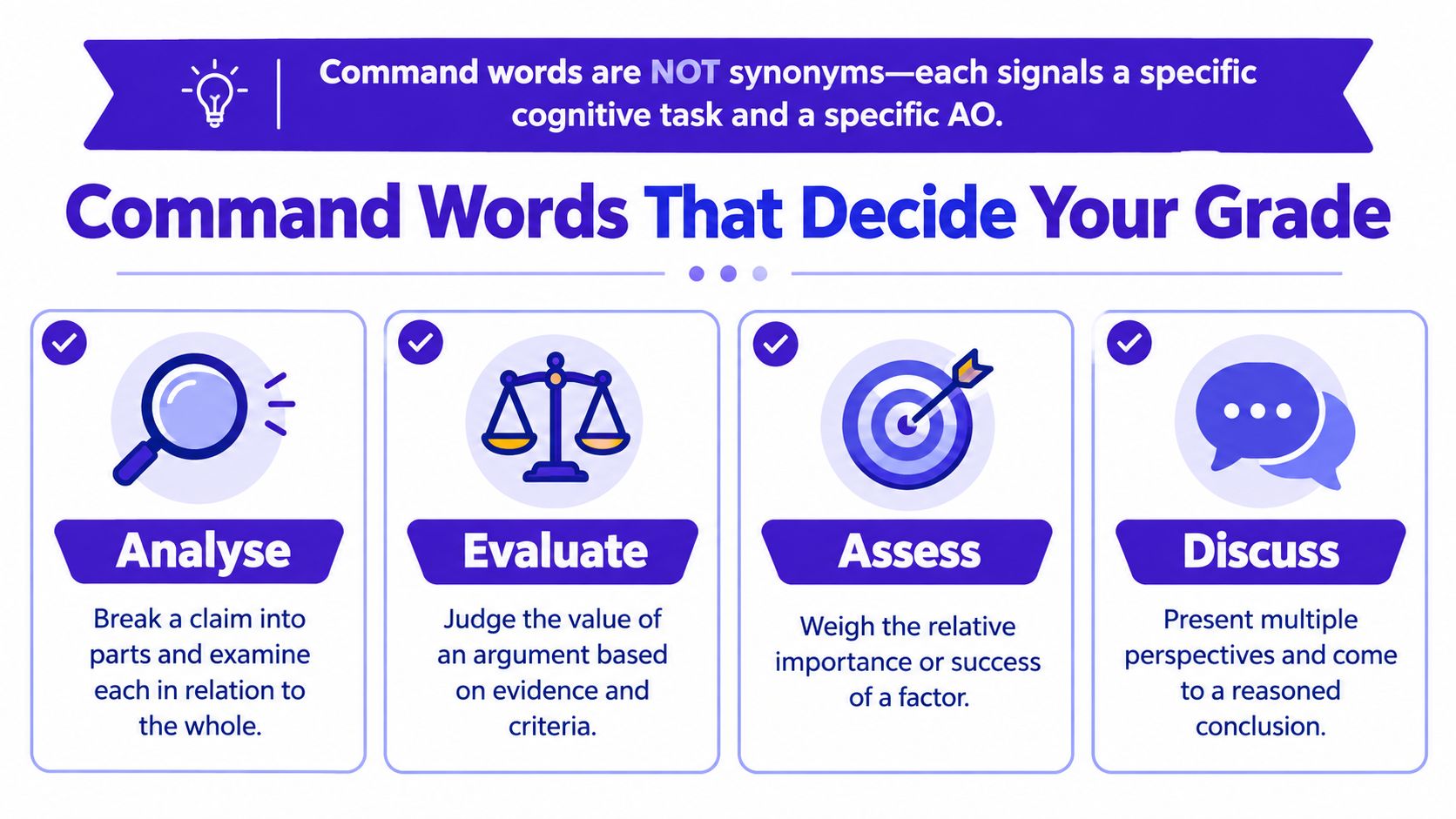
Analyse means show how parts connect
To analyse, break a claim into parts and explain the relationship between them. Don't state that an interpretation is different. Explain what the difference reveals about evidence, context or historical assumptions.
Useful phrasing might look like this:
“X argues that political weakness was decisive. However, Y demonstrates that financial pressure made the political crisis harder to contain, so the two factors worked together rather than operating separately.”
The sentence does more than name two views. It explains their connection.
Evaluate means judge strength
To evaluate, weigh an argument using clear criteria. You might consider how well it fits the evidence, how persuasive its explanation is, or what it leaves out.
Try: “On balance, the evidence weighs towards this interpretation because it explains both the immediate crisis and the longer-term conditions.”
You're not being asked to list advantages and disadvantages mechanically. You're being asked to decide how convincing something is.
Assess and “to what extent” require a position
To assess, weigh the relative importance, success or significance of a factor. A good answer doesn't treat every factor as equal. It establishes a hierarchy and defends it.
“To what extent” asks you to test the proposition against the evidence. Start by identifying what the statement explains well, then show where it becomes incomplete. Your conclusion should answer the precise extent, not repeat the introduction.
Be careful with describe, explain and outline. They can still require accurate and organised knowledge, but they don't automatically demand the same evaluative work as a judgement question. “Explain why” needs causes and connections. “Describe” mainly asks you to set out what happened.
After your last essay, circle every command word. Did each paragraph perform that task, or did you write a polished summary of the topic?
Writing a 25-Mark Essay That Earns Every Mark
A 25-mark essay needs a position before it needs paragraphs. If your introduction doesn't answer the question directly, the rest of the essay often becomes a collection of relevant information without a controlling argument.
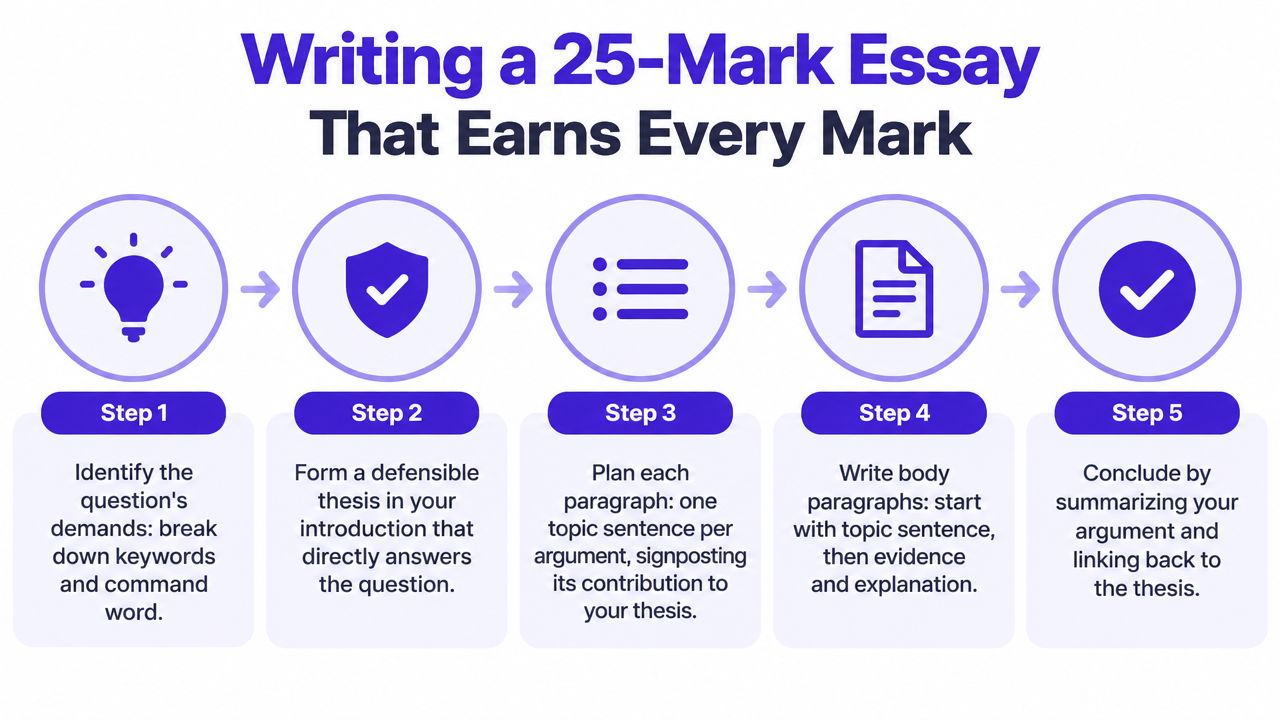
Start with the judgement
Take a question such as: “The Treaty of Versailles was the main reason for the weakness of the Weimar Republic. Assess this view.”
A weak plan lists the treaty, inflation, political violence and economic depression. A stronger plan decides how those factors relate:
Thesis: The Treaty of Versailles damaged legitimacy and created political resentment, but it wasn't sufficient on its own to explain Weimar's weakness. The more serious problem was that political instability and economic crisis allowed opponents to present democracy as incapable of protecting Germany.
That thesis gives every paragraph a job. Each section must either support it, qualify it or challenge it.
Build analytical paragraphs
A reliable paragraph pattern is:
- Make a claim in the topic sentence.
- Provide precise supporting knowledge.
- Explain how the evidence answers the question.
- Compare its importance with another factor.
- Link back to the thesis.
For example, a paragraph on the treaty might explain how its terms affected public acceptance of the new government. The analysis begins when you show why that mattered. “The treaty created resentment” is a point. “Because the new government accepted responsibility for implementing the settlement, opponents could connect international humiliation to parliamentary rule” is analysis.
A counter-argument isn't a paragraph added for decoration. It should change the weight of your judgement. If you argue that economic crisis was more important, explain why it affected political behaviour more directly than the treaty did.
A useful test: if a paragraph could be copied into an essay on any question about the topic, it probably isn't focused enough on the wording in front of you.
Finish by ranking the factors. Don't introduce a new point in the conclusion, and don't merely repeat your paragraphs. State which factor mattered most, why it outweighed the alternatives, and under what conditions the other factors became important.
Watch for the quiet grade caps: a chronological narrative, topic sentences that don't answer the question, evidence without explanation, a conclusion with no judgement and historian views dropped into the essay without analysis.
The AQA assessment structure is a useful reminder that substantial written components demand more than content coverage. Your revision must include repeated practice in turning knowledge into a substantiated judgement.
AQA, Edexcel, OCR and WJEC Compared
Your board determines what “good technique” looks like in practice. The broad skills overlap, but the balance between breadth, depth, sources, interpretations and independent investigation can differ sharply.
AQA's current 7042 qualification combines a Breadth Study, a Depth Study and a Historical Investigation. The breadth paper includes a 30-mark interpretation question and two 25-mark essays, so students need both sustained argument and confident evaluation of historians' views.
Edexcel also requires students to follow its own combination of breadth, depth and source or interpretation work. OCR's design includes thematic study, historical interpretations, source questions and an independent investigation route, which means students can't safely revise from an AQA structure and assume the same preparation will transfer.
WJEC students need to pay close attention to their chosen Welsh and non-Welsh options. The content may overlap in skill, but the evidence base, period framing and question wording won't be interchangeable.
| Board | Number of Papers | Total Marks | Distinctive Question Type |
|---|---|---|---|
| AQA | Three components | 200 scaled marks | Breadth, depth, interpretations and historical investigation |
| Edexcel | Three papers | Follow the chosen specification | Breadth, depth and source or interpretation investigation |
| OCR | Board-defined components | Follow the chosen specification | Sources, thematic breadth, interpretations and investigation |
| WJEC | Board-defined written papers | Follow the chosen specification | Period study with Welsh and non-Welsh pathways |
The safest approach is simple. Download your board specification, highlight every question type, and create a revision folder that mirrors the paper order. For targeted history revision for UK exams, use topic notes only after checking that they match your option code.
Don't borrow a friend's revision timetable without checking the board. Two students can study the same broad era while facing different assessment tasks.
Source Questions, Timed Practice and Spaced Review
Source questions reward controlled scepticism. You shouldn't accept a source as useful because it contains a relevant fact, or reject it because the author is biased. Ask what the source says, who produced it, why it was produced, when it was produced and what that means for the particular question.
Move from message to judgement
Start with a direct inference. Then test it against provenance and context.
A source written by a government minister may reveal how officials wanted a policy to appear, even if it tells you little about whether the policy worked. A private letter may provide a candid impression, but its writer still had a purpose, audience and limited viewpoint.
The key question is not “Is this source reliable?” in the abstract. It is “How useful is this source for investigating this specific issue?” Reliability can be part of that judgement, but usefulness also depends on content, purpose, context and what the source cannot show.
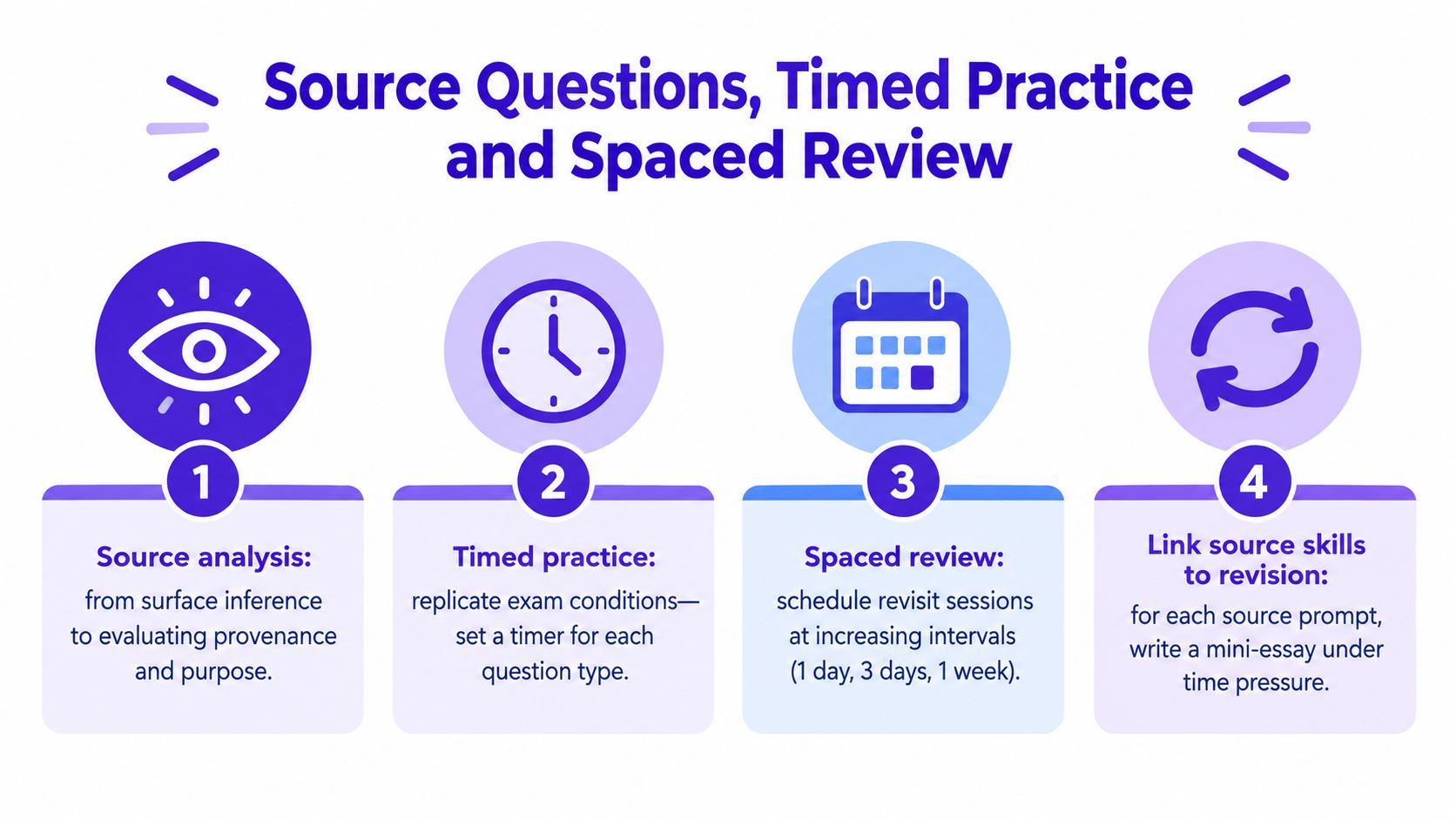
Make practice diagnostic
Use a past question without notes. After writing, compare your response with the mark scheme and examiner report. Don't just check whether you included the “right” facts. Mark where you made an inference, evaluated provenance, connected the source to context and reached a judgement.
Timed practice should expose a weakness you can fix. If your knowledge is secure but your answer lacks a conclusion, the next session should target conclusions. If you spend too long explaining the source's content, practise moving more quickly towards utility and evaluation.
Short, repeated retrieval sessions beat a late pile of rereading. Create condensed topic cards with one side containing a question and the other containing your answer. Revisit them after gaps that gradually widen, and write a timed essay at regular intervals so knowledge becomes usable under pressure.
Tutors who need to organise feedback and student work can also explore how to streamline tutoring with taap.bio. For students, an Exam Practice for A-Level session should end with a specific correction, not just a mark.
An 8-Week Revision Plan and Common Mistakes to Avoid
An effective plan changes focus as the exam approaches. Early sessions should repair knowledge gaps. Later sessions should test whether you can retrieve, select and evaluate that knowledge under exam conditions.
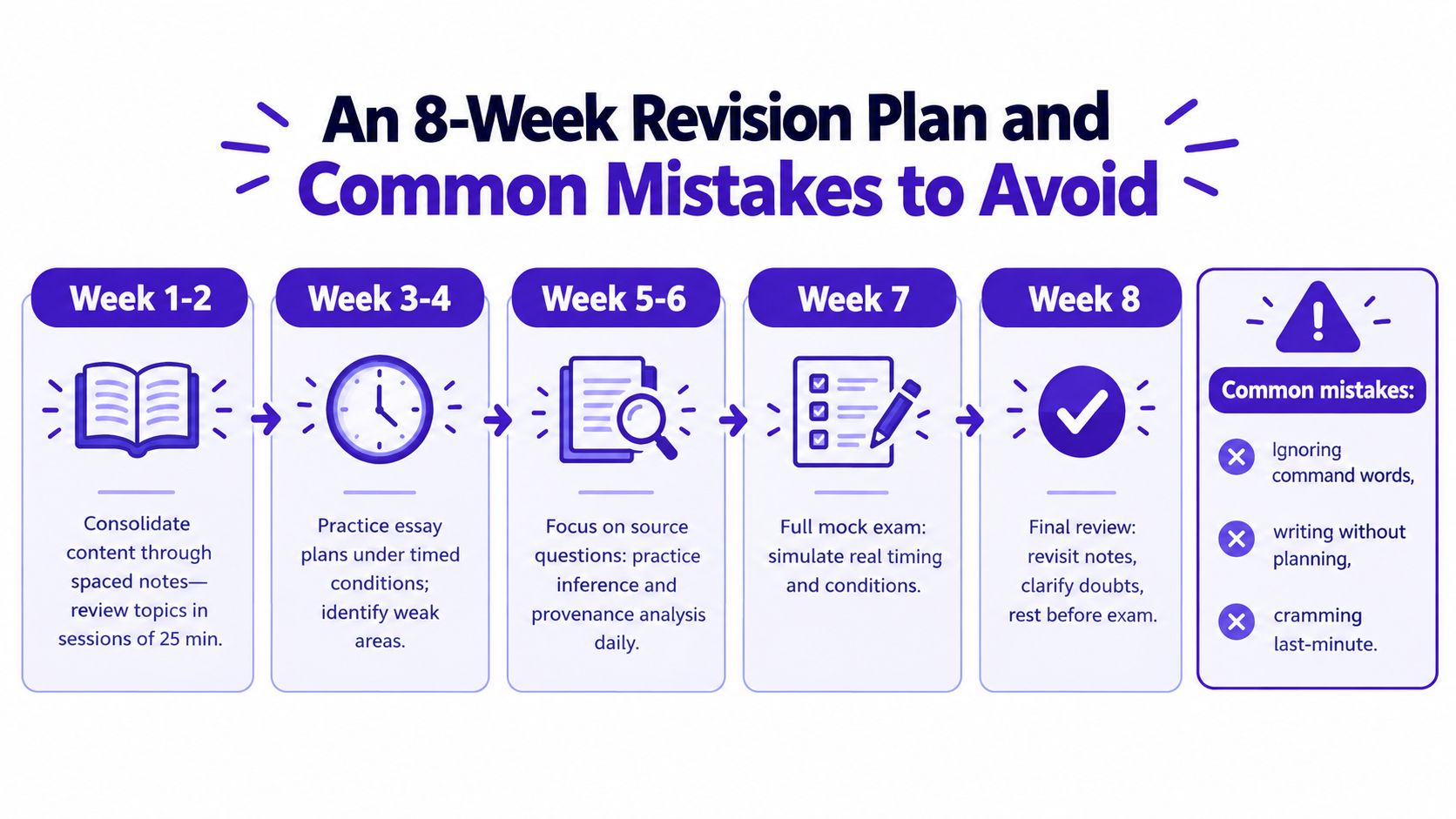
Weeks one to four
Weeks one and two: organise your specification into topics, periods and themes. Use short spaced-note sessions, then close the notes and reconstruct a timeline or explain a factor aloud. Don't rewrite the textbook. Produce questions that force recall.
Weeks three and four: introduce essay plans, source drills and command-word checks. For each essay plan, write a thesis, three argument headings, supporting evidence and a counter-argument. Complete one source-analysis exercise and review the wording of every question.
Weeks five to eight
Weeks five and six: use full past papers under the correct timing for your board. Review the paper against the mark scheme, then classify every lost mark as a knowledge, focus, analysis, source or time-management problem.
Week seven: target the weakest topics rather than revising everything equally. Write full responses on the question types you avoid, and ask a teacher to identify whether the problem is content selection or argument.
Week eight: reduce the intensity. Revisit condensed notes, practise brief plans and clarify uncertainties. Rest matters because an exhausted student often knows the material but can't organise it quickly.
Use A-Level Past papers as diagnostic material, not as a collection of answers to memorise. If you need a printable way to organise material, you can also find study notes PDF in 2026, then check every resource against your own specification.
The common mistakes are predictable:
- Chronological-only essays: A timeline is useful preparation, but it isn't an argument.
- Ignored historiography: Naming a historian without explaining the interpretation adds little.
- Weak analytical verbs: “Shows” often leaves the relationship unexplained. “Demonstrates” should be followed by what the evidence proves and why it matters.
- Passive note rewriting: Neat pages can hide poor recall.
- Confusing utility and reliability: A biased source can still be useful for revealing beliefs or propaganda.
- Skipping timing: An excellent untimed essay won't help if you can't finish the required response.
Treat mistakes as your revision map. The correction is usually more valuable than another summary sheet.
FAQs Students and Teachers Actually Ask
How many past papers should I do?
There isn't a magic number that guarantees a grade. Complete enough papers to encounter every question type on your board, then review them properly. One carefully diagnosed response can teach you more than several papers completed without checking the mark scheme.
Do flashcards work for source questions?
Yes, but only for the right purpose. Use them to test provenance, purpose, context, utility and reliability. Don't try to memorise an interpretation as though it were a fixed answer, because the question may ask you to evaluate it against different evidence.
How long should I revise each day?
A focused session is more useful than a long distracted one. Set a clear task, such as recalling a theme without notes, planning an essay or evaluating a source, and stop when you've completed and reviewed it. Passive screen time doesn't count as effective revision because the tab is open.
Can AI tools help?
They can act as a questioning partner. Ask an AI tool to challenge your thesis, generate counter-arguments or test your command-word understanding, but don't rely on facts you can't verify and defend yourself. Your exam answer must remain your own historical reasoning.
What if my mock went badly?
Read the script before you read the grade. Identify whether the problem was missing knowledge, weak question focus, limited analysis, poor source evaluation or timing. Then choose one correction task and repeat it before attempting another full response.
Should I revise breadth or depth first?
Start with breadth to anchor the chronology and major developments. Move into depth once that framework is secure, because detailed evidence is more useful when you understand where it fits in the wider argument.
Teachers are right to challenge students who measure revision by the size of their notes. The honest test is whether you can argue a judgement aloud, support it with precise knowledge and explain why one factor matters more than another.
MasteryMind offers board-aligned A-level History practice organised around specifications, command words, mark allocations, source analysis, essays and historical interpretation. Visit MasteryMind to practise exam-style questions, review structured feedback and turn your weakest assessment skill into your next revision task.
Ready to master this topic?
Practise with quizzes, blurt exercises and exam questions on MasteryMind.
7 days Premium · Then free forever · No card, no charge