A Level Organic Chemistry: The Complete Revision Guide
You sit down with an organic synthesis question, and the page looks like a code you were never taught to crack. There's a starting compound, a target product, three reagent sets, and a mechanism box staring back at you, while the clock keeps moving. That's the point where a lot of students decide organic chemistry is just memorising reactions. It isn't. It's a system, and once you learn how examiners think, the subject starts to feel a lot less random.
A level organic chemistry has a reputation for being heavy on memory, but the marks usually go to students who can explain why a reaction happens, why a reagent fits, and how to move from one functional group to another in a clean sequence. The AQA specification treats organic chemistry as formal subject content and requires nomenclature, isomerism, reactions, mechanisms, and synthetic routes to be studied directly, not as background extras, and its Paper 2 includes organic chemistry under exam conditions AQA subject content for organic chemistry. If you've got a poor mock to recover from, or you're aiming for top grades, the best move is to revise the logic, not just the list of reactions. A sensible place to build that habit is the active recall guide for GCSEs, because the same recall habits are what make A level chemistry stick.
Why Organic Chemistry Feels Hard and How to Fix It
A student in the hall sees a synthesis question, writes the first reagent that comes to mind, and loses the mark because the route does not fit the functional group change. That happens because a lot of learners revise organic chemistry as a list of isolated facts, then get punished when the exam asks for a chain of reasoning. The subject feels hard when the pieces are stored separately, but it becomes much easier when you can see the pattern underneath them.
Functional groups are the vocabulary; mechanisms are the grammar
Functional groups are the vocabulary. Mechanisms are the grammar. Once you know how a nucleophile behaves, how a double bond reacts, or why a carbonyl carbon is electrophilic, you can start predicting products instead of guessing them. OCR's content guide makes that logic explicit by requiring systematic IUPAC nomenclature and the use of homologous series formulas, while also naming homolytic fission as part of the bond-fission language students need in Module 4 OCR content guide.
That is why memory tricks help, but only after understanding is in place. A useful set of revision ideas for recall-heavy students is memory tricks for organic chem students, especially if you keep forgetting reaction conditions or reagent roles. The point is not to collect more facts than everyone else. It is to organise the facts so they behave like a map.
Practical rule: if a reaction question feels unfamiliar, name the functional group change first, then ask what mechanism and conditions match that change.
For students chasing a pass, that means focusing on the big recurring pathways first. For students chasing top grades, it means learning to justify every step in mark-scheme language. Teachers usually spot the difference quickly, because strong answers do not sound decorative, they sound controlled.
Core Organic Chemistry Topics You Must Know
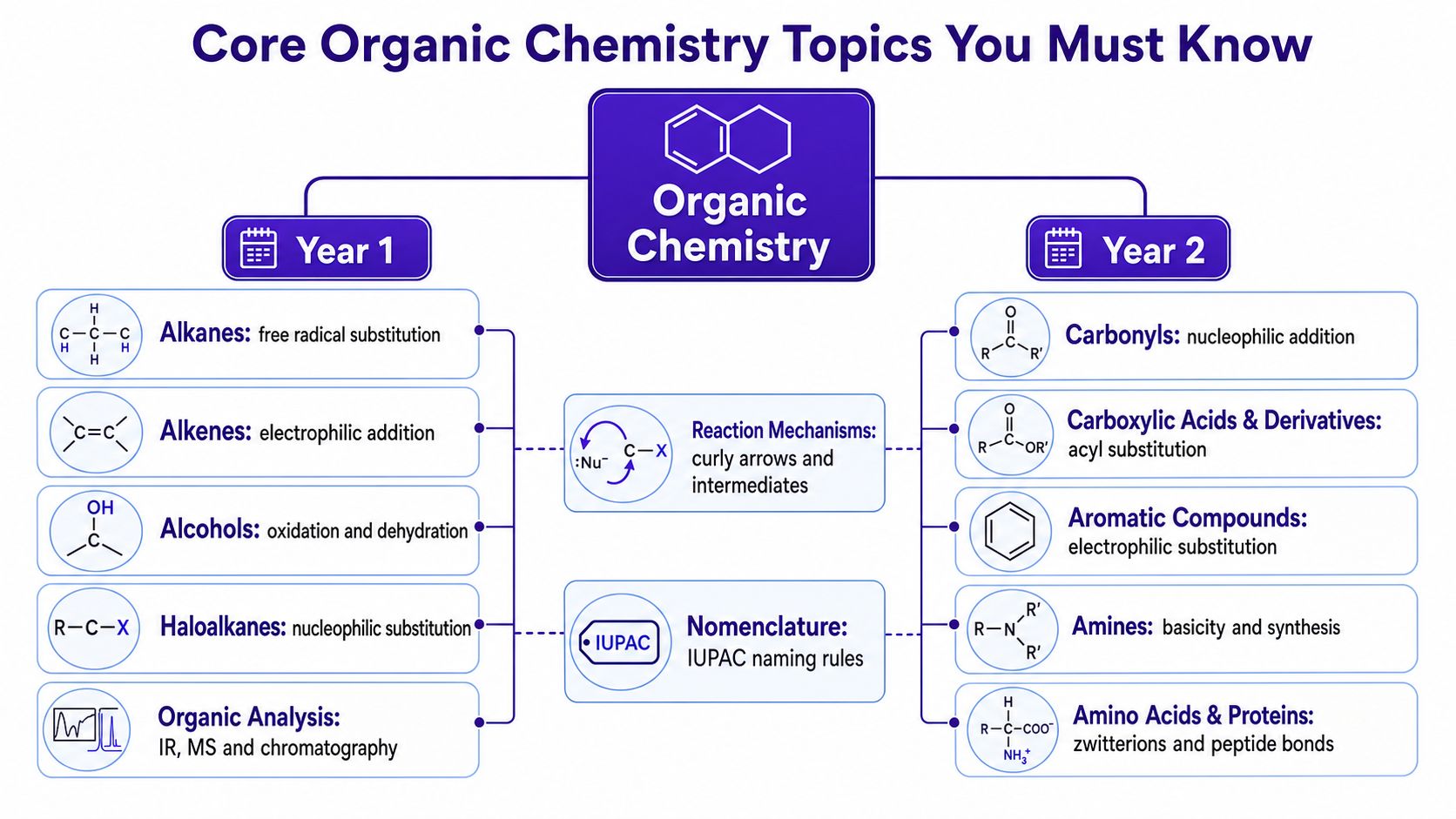
Organic chemistry at A level is not one topic, it's a chain of connected ideas that keeps reappearing in different paper contexts. AQA makes that clear by placing organic chemistry in formal subject content and by testing it across the course, while topic weighting reviews show that Year 1 organic chemistry accounts for around 4% of total marks and Year 2 organic chemistry accounts for just under 10% AQA subject content for organic chemistry. Those numbers are not massive in isolation, but they matter because organic questions often combine recall, explanation, and analysis in the same script.
Build the hierarchy first
Start with nomenclature and isomerism, because almost every later topic assumes you can name compounds and recognise structural differences. Then move through alkanes, alkenes, haloalkanes, and alcohols, since these are the basic reaction families that teach substitution, addition, and oxidation. In Year 2, the content expands into carbonyl compounds, carboxylic acids and derivatives, aromatic compounds, amines, and polymers, with mechanisms and synthesis linking the whole lot together. OCR's structure makes this easy to see, since Module 4 covers core organic chemistry and Module 6 covers organic chemistry and analysis OCR specification at a glance.
What examiners actually reward
They don't reward a tidy topic list. They reward correct functional group recognition, a suitable reagent and conditions, and a clear link between structure and product. That's why practical skills matter too. UK revision guides and topic lists repeatedly include thin-layer chromatography, preparation of a pure organic solid and liquid, hydrolysis, separation techniques, and organic analysis, because exam questions often expect you to interpret a result rather than recite a definition A-level chemistry topic guide.
MasteryMind A-Level Chemistry is a useful reference point for learners who want topic coverage aligned to school chemistry revision, especially if they need to keep different organic subtopics separated while revising.
Exam habit: if a question gives you an unfamiliar organic route, work backwards from the product, then forwards from the starting material. That stops random reagent swapping.
A good revision order is foundations first, then reactions, then analysis, then synthesis. Skip the first layer and the later layers get messy fast.
Mastering Reaction Mechanisms Step by Step
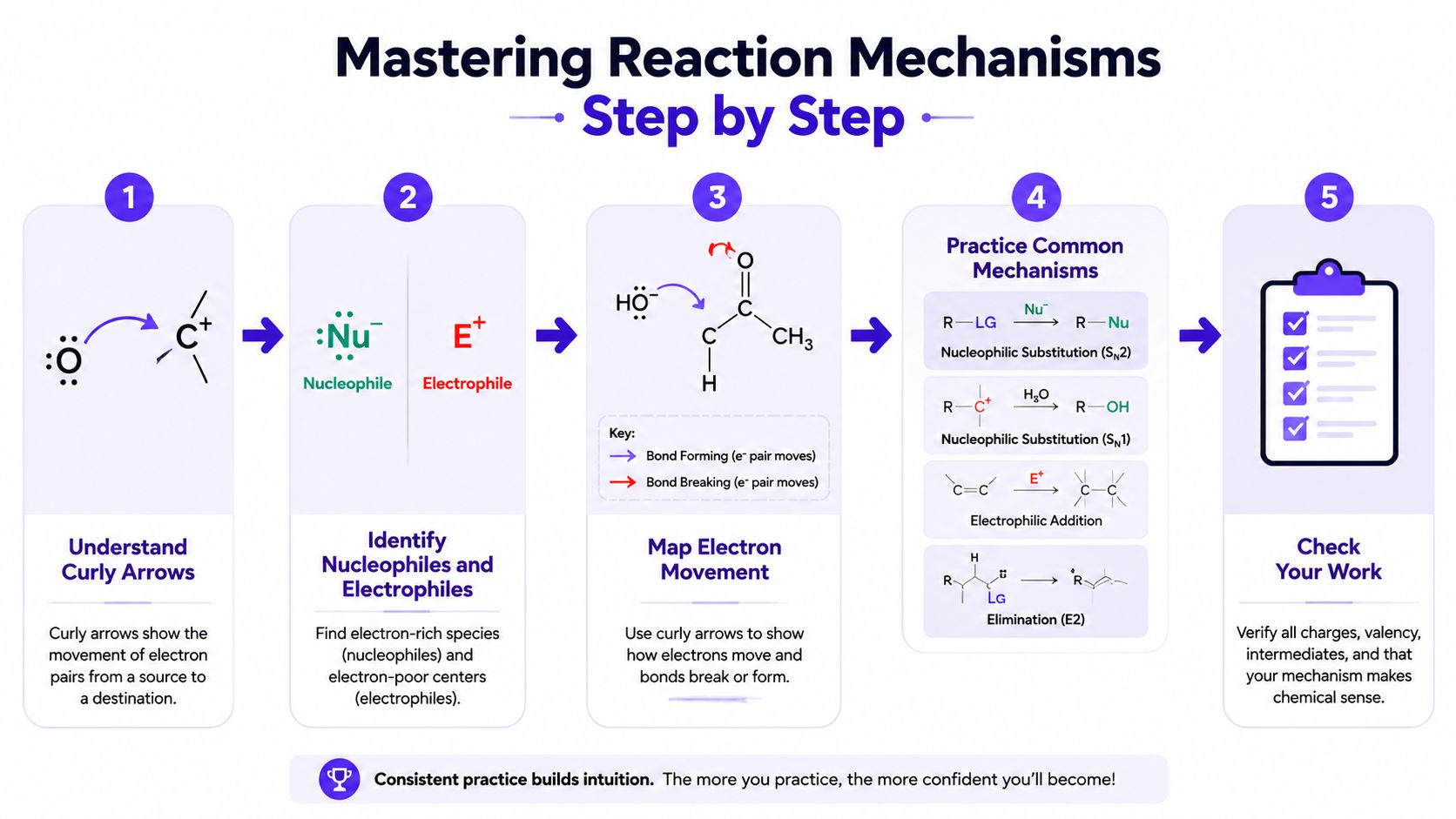
Mechanisms are where a lot of scripts fall apart. Students often know the reactants, but they lose marks because they can't show the electron movement cleanly or they label the species the wrong way round. The good news is that mechanisms are repetitive once you understand what curly arrows really mean. They show electron pair movement, not vague “reaction movement”, and examiners are very sensitive to where the arrow starts and ends.
The four mechanism families that keep returning
Electrophilic addition usually appears when a double bond is present. The π bond is electron-rich, so it can attack an electrophile.
Nucleophilic substitution shows up a lot in haloalkanes and alcohol chemistry. OCR explicitly expects students to use bond-fission language, including homolytic fission, so students need to be precise about what breaks and why OCR content guide.
Electrophilic aromatic substitution matters because benzene doesn't behave like an alkene. Its electrons are delocalised, so the mechanism is different.
Nucleophilic addition-elimination appears in carbonyl and derivative chemistry, where the carbonyl carbon is attacked first and the leaving group goes later.
The hardest AQA Paper 2 questions are often built around organic mechanisms, organic synthesis, and organic analysis such as NMR. One teacher analysis noted that mechanisms alone made up roughly 20% of difficult Paper 2 questions hard AQA organic questions analysis. That lines up with what teachers see in practice, students can memorise a reaction name, but they struggle when the paper asks them to connect several ideas in one response.
How to draw them without bleeding marks
Start by identifying the nucleophile and electrophile. Then ask where the electron pair is moving. After that, draw the arrow from the lone pair or bond, not from nowhere. If the mechanism has an intermediate, name it mentally before you draw it. If it's a concerted pathway, don't invent a carbocation just because it feels familiar.
The fastest way to lose a mechanism mark is to draw a curly arrow from a positively charged atom without showing the electron source.
If you want extra structured practice, Exam Practice for A-Level can help because timed repetition is what exposes weak mechanism habits. The key is to practise unfamiliar routes, not only the examples you already know.
Worked Examples for Multi-Step Organic Synthesis
A lot of students can name individual reactions, but they freeze when the exam links them together. That's where synthesis marks get donated to careful thinkers. The route isn't usually about finding a clever shortcut, it's about choosing a sensible intermediate that makes the next step chemically possible.
Example 1, a simple two-step route
Suppose the starting material is an alkene and the target is a carboxylic acid. The first thing to do is identify the functional group change. An alkene is reactive at the double bond, while a carboxylic acid needs oxidation-level thinking, so a sensible route often involves turning the alkene into something more oxidisable first.
A mark-scheme style answer would read like this.
- Hydrate or functionalise the alkene so the carbon skeleton stays intact.
- Oxidise the intermediate to the carboxylic acid using suitable conditions.
The point is not the exact reagent chain in the abstract. The point is to justify the route using structure and reactivity. If you name the intermediate, show the product of each step, and keep the conditions plausible, you're already writing like an examiner expects.
Example 2, a longer route through an aromatic ring
Now take an aromatic starting material and a substituted aromatic product. Here the central issue is not just “what reagent”, it's where substitution happens. Students often forget that aromatic rings can direct incoming groups, so they choose a reagent correctly but place the substituent in the wrong position. That's a route error, not a chemistry error.
A strong answer usually does three things. It identifies the activating or directing group, predicts the most likely position of substitution, and then states the reagent and conditions in a way that matches the mechanism. If the paper asks you to justify regioselectivity, say which group controls the ring and why the alternative product is less likely. Don't pad the answer with vague phrases. Examiner language is usually short and causal.
Useful habit: write the route as a chain of named intermediates on scrap paper before you start writing the final answer.
When the product is given and the route is missing, work from both ends. Ask what the target needs, then ask what the starting compound can reasonably become in one step. That's how you stop forcing impossible transformations into the answer.
Common Misconceptions and Exam Mistakes to Avoid
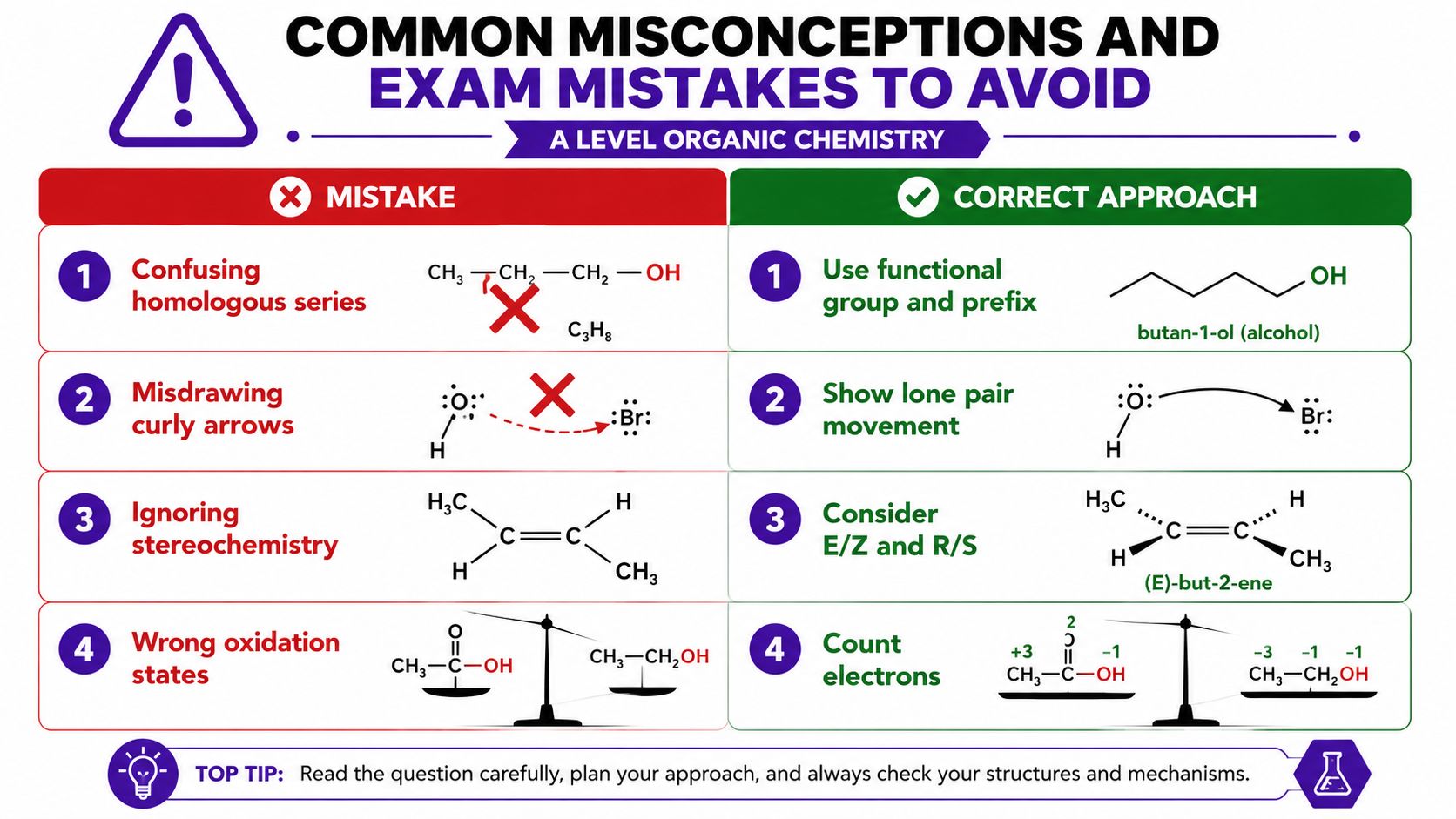
Some organic mistakes are so common that markers can spot them in the first line. The problem is usually not weak memory. It's a wrong mental model. Students think they understand the reaction, then they apply the model in a context where it doesn't fit.
Mistakes that show up again and again
| Mistake | Correct approach |
|---|---|
| Confusing homolytic and heterolytic bond fission | Use the electron source and product type to decide which fission applies. |
| Drawing curly arrows from the wrong atom | Start the arrow from the lone pair or bond that supplies the electrons. |
| Mixing up primary, secondary, and tertiary haloalkanes | Identify the carbon attached to the halogen before choosing substitution or elimination conditions. |
| Treating practical results as if they were perfect | Account for purification, separation, and interpretation limits in your explanation. |
The practical traps are just as expensive
Thin-layer chromatography causes trouble because students state a result without interpreting the pattern. Yield questions go wrong when learners write a formula but forget what the value means in context. Purification questions also lose marks when the chosen method is named without a reason. If a sample is impure, the examiner wants you to say what the method removes or separates, not just repeat the method name.
A lot of these errors come from shallow revision. You can recite the reaction, but the paper asks you to use the reaction. That's why practical organic chemistry deserves the same attention as mechanisms and naming. Teacher-facing chemistry guides also highlight practical chemistry, especially organic laboratory techniques, as one of the most common remaining difficulty areas after mechanisms, with organic analysis/NMR and organic synthesis repeatedly appearing among the hardest questions Save My Exams topic guide.
How to check your own answer
- State the type of bond change: substitution, addition, elimination, oxidation, or reduction.
- Check the carbon type: primary, secondary, or tertiary, if the mechanism depends on it.
- Match the conditions: reagent, solvent, temperature, and catalyst all matter.
- Justify the practical method: chromatography, distillation, extraction, or recrystallisation should be chosen for a reason.
If your answer sounds like a label without explanation, it probably won't score as well as you hope. Mark schemes reward chemistry, not decoration.
Specification Mapping for AQA OCR and Edexcel
Three exam boards can test the same organic chemistry idea in slightly different wording, and that is where a lot of lost marks begin. AQA organics sit inside the 7405 specification and are examined across the course, with Paper 2 including both organic and physical chemistry content in real exam conditions AQA subject content for organic chemistry. OCR Chemistry A splits organic chemistry more visibly across Module 4 and Module 6, while Edexcel still covers the same core ideas through its own topic order and practical requirements.
MasteryMind A-Level Past papers fits naturally here because board differences are easiest to spot when you practise the exact question style used by your specification.
| Exam Board | Year 1 Modules | Year 2 Modules | Key Practical Requirements |
|---|---|---|---|
| AQA | Core organic content within AS and first-year coverage | Extended organic content, including synthesis and analysis across the full course | Thin-layer chromatography, purification, preparation of pure organic solids and liquids, hydrolysis, and organic analysis are all part of the practical context described in UK revision guidance A-level chemistry topic guide |
| OCR Chemistry A | Module 4, Core organic chemistry | Module 6, Organic chemistry and analysis | Analytical techniques such as IR, MS, NMR, and chromatography are built into the module structure OCR specification at a glance |
| Edexcel | Board-specific first-year organic content | Board-specific second-year organic content | Practical organic work appears through the board's own assessment style and required laboratory techniques |
OCR is usually the simplest board to map clearly because the module split is explicit. AQA asks the same organic chemistry ideas in several papers, so students often do better when they stop treating it like one isolated chapter and start recognising where the same reaction, mechanism, or analysis skill reappears. Edexcel students still need the same functional groups and mechanisms, but they should practise them in the wording and exam style used in their own papers.
The exam logic is the same across all three boards. If a question asks for a synthesis route, the examiner wants the intermediate, the reagent, and the condition. If it asks for a practical choice, you need the method and the reason it suits the sample. That is the part revision notes often skip, even though it is what mark schemes reward.
Your Organic Chemistry Revision Plan
A good plan keeps the subject moving instead of cramming everything at the end. Start with functional groups, naming, and isomerism, then move to mechanisms and conditions, then finish with multi-step synthesis and practical questions under timed pressure. That order matters because every later topic depends on the earlier ones being automatic.
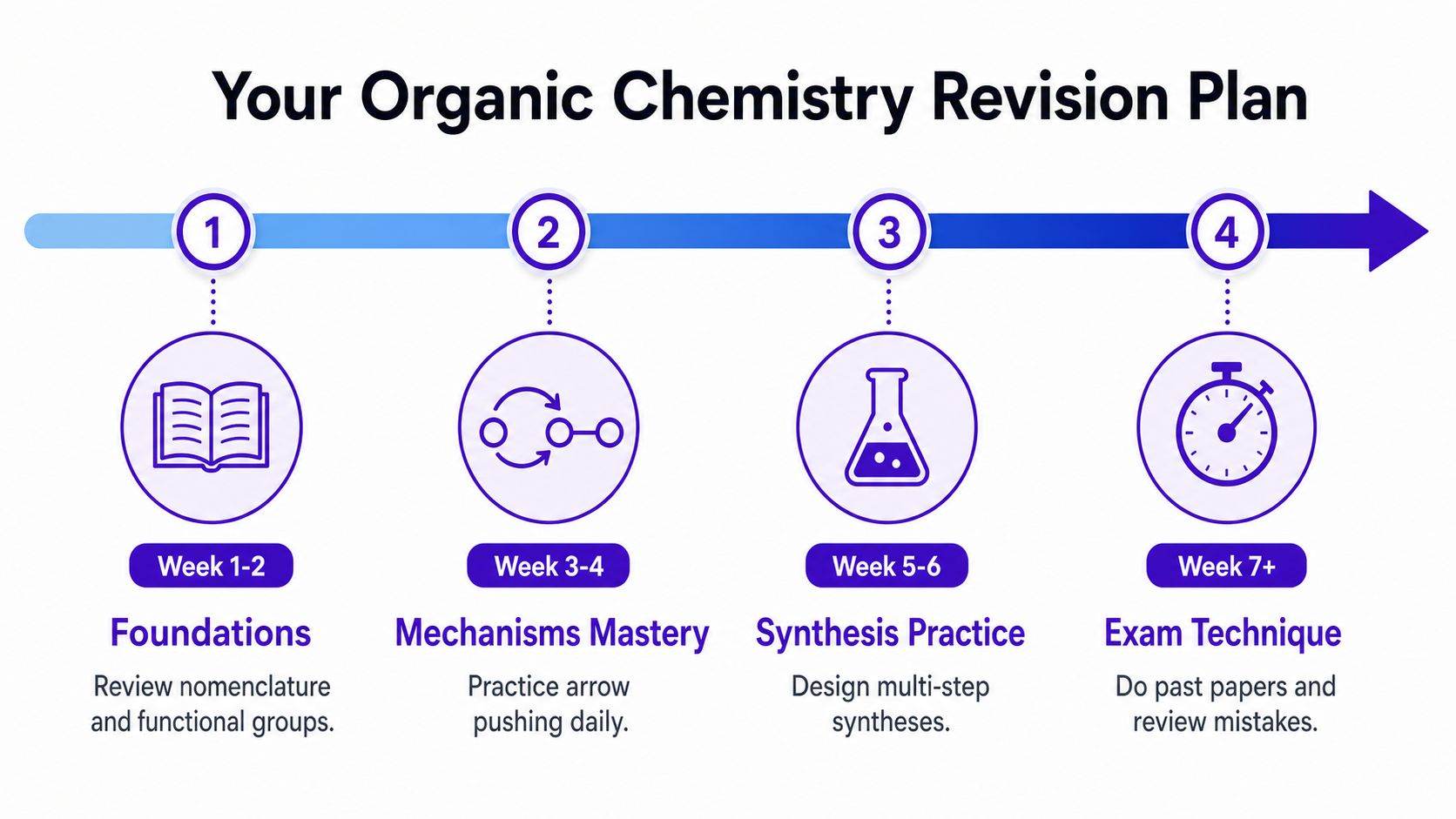
A simple four-part rhythm
Weeks 1 to 2, foundations. Review nomenclature, functional groups, and isomerism until you can name and recognise compounds without hesitation.
Weeks 3 to 4, mechanisms. Draw arrow-pushing questions from memory every day, then check them against a mark scheme.
Weeks 5 to 6, synthesis. Practise designing routes, including the intermediate, the reagent, and the condition.
Week 7 onward, exam technique. Do past papers, mark your own answers, and rewrite weak responses in examiner language.
If you want a revision platform that aligns questions to UK specifications and gives structured feedback, MasteryMind is one option worth using alongside your own notes. It's especially useful when you need mixed-topic practice rather than another passive revision page.
The final week before the exam should be about accuracy, not panic. Focus on the reactions you keep mixing up, the practical questions you keep skipping, and the mechanism drawings you still hesitate over. If you can explain the route, justify the reagent, and show the electron movement clearly, you're already answering in the way markers reward.
If you want organic chemistry practice that feels closer to the exam, visit MasteryMind and use its chemistry practice to drill mechanisms, synthesis routes, and organic analysis in a structured way. It's a practical next step if you need your revision to be more targeted and less random.
Ready to master this topic?
Practise with quizzes, blurt exercises and exam questions on MasteryMind.
7 days Premium · Then free forever · No card, no charge