A Level Physics Thermodynamics: The Complete Guide
The night before a physics mock, you open Paper 2 and land on a thermodynamics question. The diagram looks unfamiliar, the symbols seem to have swapped jobs, and suddenly even the calculator feels judgmental. You know the maths probably isn't the main problem. The difficulty is deciding which physical story the equation is describing.
That's why a level physics thermodynamics needs a different revision approach from memorising a page of formulas. You need to connect particles, energy transfers, graphs and machines, then practise writing the short explanations that examiners can award marks for. This guide builds those links carefully, with the exam-board language kept in view.
Why Thermodynamics Trips Up Even Strong A Level Physicists
A Year 12 student often avoids thermodynamics because it feels less tidy than mechanics. In mechanics, you can usually draw forces, choose a direction and follow the motion. In thermal physics, the same gas can be described by pressure, volume, temperature, internal energy, heat transfer and work done. The numbers may be manageable, but the vocabulary makes the question feel slippery.
The first trap is treating thermodynamics as one isolated chapter. UK specifications place it inside a wider course. For AQA, Section 6 is titled “Further mechanics and thermal physics”, and Paper 2 assesses Section 6.2, Thermal Physics, alongside other core areas. Under the current AQA 7408 structure, Paper 2 is a 2-hour written exam worth 85 marks and 34% of the A-level, so thermal physics sits inside a substantial, cumulative assessment rather than a tiny optional corner of the course. AQA's specification overview also states that the qualification is linear, with exams taken at the end of the relevant course.
Your map of the topic
Across AQA, Edexcel, OCR and WJEC, the exact wording and emphasis can differ, but the useful learning route is broadly:
- Energy language: internal energy, heating, work and temperature.
- Material behaviour: specific heat capacity, specific latent heat and phase changes.
- Gas models: ideal gases, particle motion, pressure and temperature.
- Diagrams: pressure-volume and temperature-entropy processes.
- Laws: energy conservation through the first law and direction through the second law.
- Machines: engines, refrigerators, heat pumps, efficiency and coefficient of performance.
If you can explain each item in ordinary language before reaching for a formula, you're not starting from scratch. If you can remember equations but can't explain what the signs mean, you've got a vocabulary gap rather than a maths problem. Structured Online Revision for A-Level can help you turn that gap into a short list of questions to practise instead of rereading the entire chapter.
Quick-fire check: A question asks you to “state” a definition. Do you need a paragraph? No. Give the precise statement, with the correct quantity and conditions. “Explain” needs a linked reason. “Calculate” needs an equation, substitution, answer and unit.
The Core Concepts Behind Internal Energy, Heat and Work
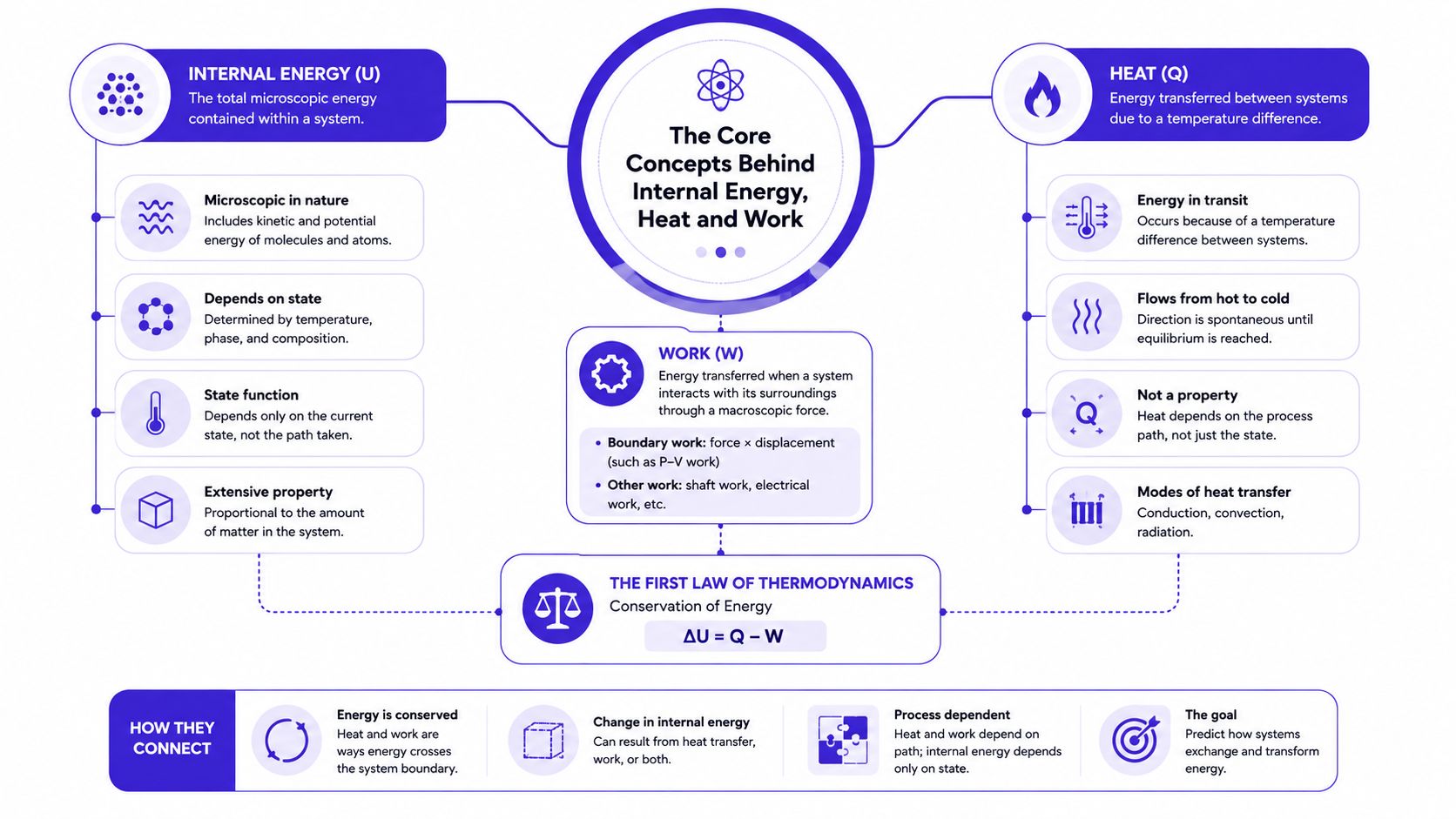
Start with a closed system, such as gas trapped inside a cylinder. Internal energy is the total microscopic energy stored in the particles. It includes the random kinetic energy of particles and the energy associated with their interactions. Temperature tells you about the average kinetic energy of the particles, but it isn't the same thing as the total internal energy.
A large mug of coffee can contain more internal energy than a tiny cup at the same temperature because it contains more particles. Also, energy can enter the coffee while its temperature stays constant during a phase change. That's why “heat” and “temperature” must never be used as interchangeable words in an exam.
Heat is energy transferred by heating. Work is another way energy crosses the boundary of a system. If a gas expands and pushes a piston, the gas does work on its surroundings. If you compress the gas, the surroundings do work on the gas. Think of a bicycle pump: rapid compression warms the air because work has been transferred into the gas.
The two material equations
For a temperature change without a change of state:
Q = mcΔT
Here, Q is energy transferred by heating, m is mass, c is specific heat capacity and ΔT is temperature change. Specific heat capacity means the energy needed to raise the temperature of a unit mass of a substance by a unit temperature interval, under the conditions given by the course.
For a change of state at constant temperature:
Q = ml
Here, l is specific latent heat. The energy changes the arrangement or separation of particles rather than raising their average kinetic energy.
Keep units consistent. If mass is in kilograms and specific heat capacity is in joules per kilogram per kelvin, use joules for energy. If a value is supplied in kilojoules, convert it before mixing it with quantities expressed in joules. A correct-looking substitution with mismatched units is still wrong.
For extra targeted practice, the MasteryMind Physics A Level course is one way to work through questions by topic rather than hoping a reread exposes the exact gap.
Quick-fire check: A substance melts while being heated. What happens to its temperature? It stays constant during the phase change in the idealised model, while energy is transferred into changing the state. That sentence earns more than simply writing “the temperature doesn't change”.
Ideal Gases and the Kinetic Theory Model
An ideal gas is a simplified model. Examiners aren't asking you to pretend real gases don't exist. They want you to use a model whose assumptions make the mathematics workable.
The model treats particles as tiny compared with the space between them, moving randomly and continuously. Collisions are elastic, particles exert negligible forces on one another except during collisions, and the particles are spread widely enough for the gas to behave as described. The model also treats the particles as identical for the calculation being used.
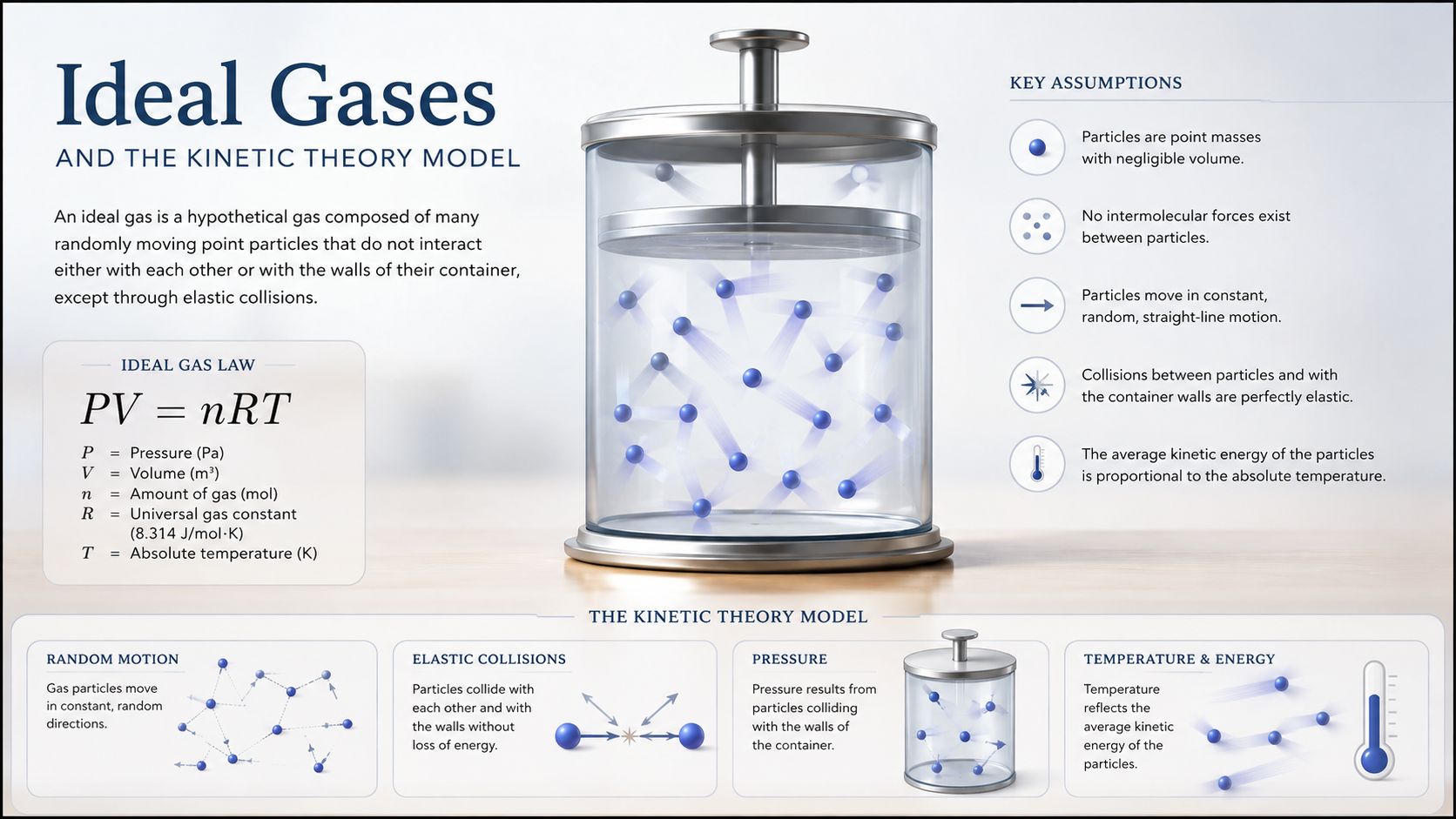
Pressure comes from particles colliding with the container walls. A faster particle changes its momentum by more during a collision, and more frequent collisions transfer momentum more often. That gives the physical link between temperature, particle motion and pressure.
Choosing the gas equation
Use pV = nRT when the amount of gas is given in moles. Here, p is pressure, V is volume, n is amount in moles, R is the molar gas constant and T is absolute temperature in kelvin.
Use pV = NkT when the question gives the number of particles. In this form, N is the number of particles and k is the Boltzmann constant.
A quick example shows the method. Suppose a question gives pressure, volume and temperature and asks for the amount of gas. Rearrange to n = pV / RT, convert the temperature to kelvin, substitute values in consistent SI units, and check that the answer has units of moles. Don't throw values into the calculator before deciding which version matches the information supplied.
The kinetic theory result is:
½m〈c²〉 = ³⁄₂kT
The left side represents the mean translational kinetic energy of a particle, where m is particle mass and 〈c²〉 is the mean square speed. The right side links that energy to absolute temperature. Root-mean-square speed is found from the mean square speed:
cᵣₘₛ = √〈c²〉
It isn't the same as mean speed. That distinction matters because squaring speeds before averaging gives a different result from averaging speeds directly.
Use kelvin, not degrees Celsius, in gas equations and kinetic theory. Absolute temperature measures from the point used by the thermodynamic scale, so inserting a Celsius value changes the physics, not just the formatting.
A visual explanation can help before you practise the algebra. This video gives another route through the particle model and ideal gas relationship:
Quick-fire check: Pressure rises in a sealed container. What particle explanation could support that? The particles may be moving faster, causing larger momentum changes and more frequent collisions with the walls. Link the microscopic change to the macroscopic pressure.
Reading and Drawing PV and TS Diagrams
A thermodynamic diagram is a storyboard. The line tells you how the system changes, and the area can represent a physical quantity. Before calculating anything, read the axes and identify what remains constant.
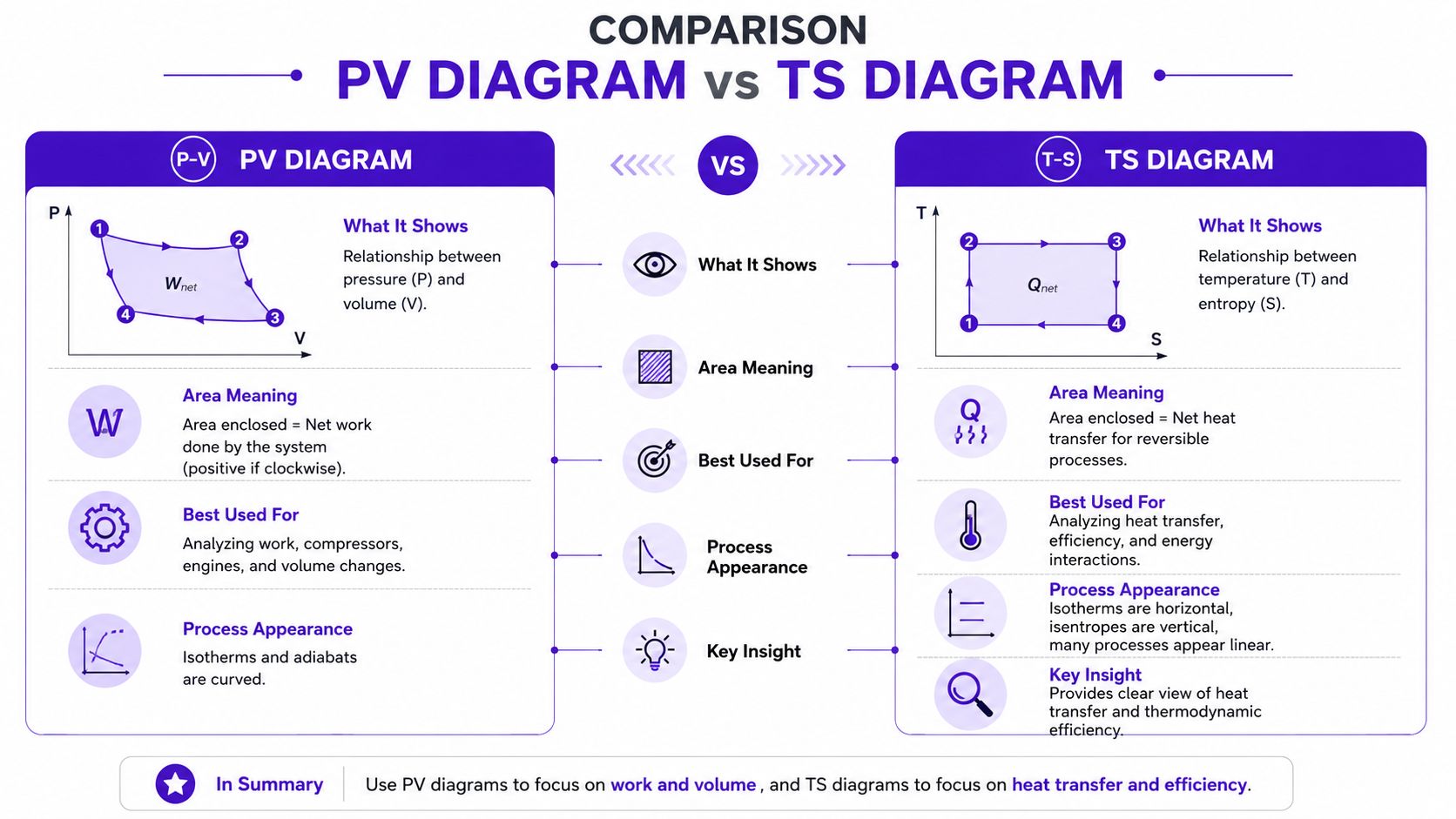
On a pressure-volume diagram, work done by the gas is represented by the area under the curve:
W = ∫p dV
For a constant pressure change, this becomes pressure multiplied by change in volume. Expansion gives positive work done by the gas under this convention. Compression gives negative work done by the gas, because the surroundings are doing work on the gas.
The four named processes
| Process | What's constant | PV diagram shape | TS diagram shape | Key equation |
|---|---|---|---|---|
| Isothermal | Temperature | Curved hyperbola for an ideal gas | Temperature stays fixed, so it is horizontal on a T against S graph | pV = constant |
| Isobaric | Pressure | Horizontal line | Temperature and entropy both change | V/T = constant |
| Isochoric | Volume | Vertical line | Temperature and entropy both change | p/T = constant |
| Adiabatic | No heat transfer | Steeper curve than an isothermal path | Entropy stays constant, so it is vertical on a T against S graph | Q = 0 |
An isothermal process keeps temperature constant, so pressure falls as volume rises for a fixed amount of ideal gas. An isobaric process keeps pressure constant. An isochoric process keeps volume constant, which means there is no boundary work because the piston hasn't moved. An adiabatic process has no energy transferred by heating, though work can still change the internal energy.
Areas and direction
On a temperature-entropy diagram, the area under a reversible curve represents heat transferred, using Q = ∫T dS. It isn't the work area from a PV diagram. A closed loop on a PV diagram can represent a cycle, with the enclosed area linked to net work done. Clockwise and anticlockwise direction tells you whether the cycle produces or receives net work under the chosen convention.
Exam habit: Write “work done by the gas” or “work done on the gas” beside your working. That tiny phrase prevents a sign error from spreading through the whole question.
Quick-fire check: A vertical line appears on a PV graph. Which process is it? Constant volume, so it is isochoric. What work is done by the gas? Zero, because the volume doesn't change.
The First and Second Laws Explained Without the Jargon
The first law is energy accounting. A useful convention is:
ΔU = Q − W
Here, ΔU is the change in internal energy, Q is energy transferred to the system by heating, and W is work done by the system. Heating adds to the system's energy. Work done by the system removes energy from it. If the surroundings compress the gas, work done by the gas is negative, so the equation records an increase in internal energy when appropriate.
The AQA engineering-physics extension connects thermodynamics to the first law through energy transferred by heating, increase in internal energy and work done. That wording is a reminder that the markscheme wants an energy pathway, not a loose statement that “heat equals energy”.
Entropy and the second law
The second law gives thermodynamics a direction. Heat flows naturally from hot to cold, not the other way round without an external energy input. A real engine can't convert all the heat supplied into useful work, because some energy must be transferred to a cooler reservoir.
For a reversible heat transfer:
ΔS = Qᵣₑᵥ / T
Entropy change measures how energy is distributed in relation to temperature. It isn't enough to write “entropy means disorder” and stop. That phrase can be a starting picture, but calculations require the correct heat transfer and absolute temperature.
For a phase change at constant temperature, use the energy transferred during the change divided by the absolute temperature. For a process involving separate reservoirs or stages, calculate each entropy change with its own sign, then add them to find the total entropy change.
A reversible process has zero total entropy change for the system and surroundings together. An irreversible process produces a positive total entropy change. The system's entropy can decrease, for example when a substance becomes more ordered, provided the surroundings gain more entropy.
Quick-fire check: Can a system's entropy fall? Yes. Can the total entropy change of the universe be negative in a spontaneous irreversible process? No. State the system result and the universe result separately.
Engines, Refrigerators and How to Compare Them
An engine takes energy from a hotter source, transfers some of it as work, and rejects the rest to a colder sink. A petrol engine and a diesel engine use different idealised cycles, but the exam comparison is built around the same bookkeeping question: where does energy enter, where does it leave, and what counts as useful output?
A four-stroke petrol engine is commonly described through intake, compression, power and exhaust. The piston compresses the fuel-air mixture, ignition raises the pressure, expansion drives the piston, and exhaust removes products. A diesel cycle also uses compression and expansion, but the idealised heat-addition process differs. Don't rely on a vague description of “explosion”. Name the stroke and connect it to pressure, volume or energy transfer.
Efficiency and coefficient of performance
For an engine:
η = W / Qᴴ
W is useful work output and Qᴴ is heat taken from the hot reservoir. If the question gives heat rejected instead, use the first law to find the work or express the energy balance clearly before substituting.
A refrigerator moves energy from a cold space to a warmer surrounding region. It doesn't create cold. Its compressor supplies work, allowing heat to be removed from the cold region. The coefficient of performance is:
COP = Qᴸ / W
For a heat pump, the useful quantity is the heat delivered to the warm space, so read the wording carefully before choosing the numerator. A COP can be greater than one because the device moves thermal energy rather than converting all input energy directly into heat output. That isn't a violation of the second law.
Real engines lose useful energy through friction, sound, unwanted heating and non-ideal gas behaviour. The ideal Carnot cycle provides a limiting comparison, not a promise about a real machine. Use A-Level Past papers to practise identifying whether the question wants efficiency, COP, work, heat input or heat rejected.
Quick-fire check: A refrigerator has a COP greater than one. Is it producing energy? No. It uses work to transfer a larger quantity of thermal energy from the cold reservoir.
Common Misconceptions That Cost Easy Marks
Heat and temperature are not synonyms. Temperature describes the thermal state of a system, while heat is energy transferred because of a temperature difference. A temperature can remain constant while energy enters during a phase change.
Compression does not automatically mean positive work done by the gas. Under the convention ΔU = Q − W, compression means the surroundings do work on the gas, so work done by the gas is negative. Write the convention at the top of the page if signs keep catching you.
Entropy is not just “messiness”. That phrase may help you form an intuition, but an exam calculation needs ΔS = Qᵣₑᵥ/T, with temperature in kelvin and the sign attached to the correct system or reservoir. A system can lose entropy while the total entropy change of the universe remains positive for an irreversible process.
A refrigerator doesn't make cold. It removes thermal energy from a colder region and transfers it to a warmer region using work. In a six-mark explanation, name the cold reservoir, hot reservoir, work input and direction of heat transfer.
An ideal gas is a model, not a description of every gas under every condition. If a question tells you to assume ideal behaviour, use the supplied model confidently. If it asks for an explanation, connect pressure to particle collisions rather than merely repeating that pressure rises.
Markscheme language: Start with the physical event, then state the energy consequence. For example, “The gas expands, so it does work on the surroundings. If heating is unchanged, internal energy falls.” The linked chain is what earns explanation marks.
Worked Examples, Practice Plan and Revision Tips
For an ideal-gas calculation, begin with the known variables. Choose pV = nRT or pV = NkT, convert temperature to kelvin, check SI units, rearrange, substitute, and include the unit. In a cycle question, label heat input, heat rejected, and work before applying η = W/Qᴴ. Calculate each entropy change separately, keep its sign, then add the results.
| Day | Focus | Practice type | Mark scheme focus |
|---|---|---|---|
| Day 1 | Definitions and units | Retrieval quiz | Precise state answers |
| Day 2 | Specific heat and latent heat | Short calculations | Equation, substitution, unit |
| Day 3 | Ideal gases | Mixed gas questions | Model assumptions |
| Day 4 | PV and TS diagrams | Diagram interpretation | Axes, area and direction |
| Day 5 | First and second laws | Explain questions | Linked energy reasoning |
| Day 6 | Engines and refrigerators | Timed mixed set | Formula selection |
| Day 7 | Full thermodynamics review | Past-paper section | Clear, complete working |
For Year 13 students, understanding assumptions, symbols, and the conditions attached to equations matters more than memorising every derivation. The most efficient way to identify remaining gaps is to practise timed questions. Use Exam Practice for A-Level without notes first, then mark your answer and record the exact phrase or step you missed. This mirrors the short calculation and explanation demands found across AQA, Edexcel, OCR, and WJEC mark schemes.
MasteryMind provides specification-aligned A-level practice across major UK exam boards, including adaptive questions, step-by-step maths checking, and examiner-style feedback. Use the results to choose a focused gas-law or energy-transfer session, rather than revising every topic equally.
Ready to master this topic?
Practise with quizzes, blurt exercises and exam questions on MasteryMind.
7 days Premium · Then free forever · No card, no charge