A Level Revision for Biology: 2026 Strategy Guide
You're probably in one of two places right now.
Either biology has turned into that subject you keep meaning to “properly start”, and now the specification looks absurdly long. Or you've already started, but your revision feels busy rather than sharp. Notes everywhere. Flashcards half-made. A past paper open in one tab and a guilt spiral open in your head.
That's normal. A-Level Biology does that to people.
The mistake is thinking the answer is to work longer. Usually, the answer is to work with a system. Good a level revision for biology isn't about making your desk look productive. It's about building a plan that tells you what to study, how to remember it, and how to turn that knowledge into marks when the paper gets awkward.
The Ultimate Game Plan for A-Level Biology Revision
Most students don't fail biology because they're lazy. They get buried by volume, then fall into low-value revision. They reread. They highlight. They watch videos without checking what they remember. It feels sensible, but under exam pressure it falls apart.
The students who recover a grade fast, and the ones who push from A to A*, usually do something much simpler. They treat revision like a game plan, not a pile of tasks. They know their weak topics. They use methods that force recall. They practise writing in the language the mark scheme rewards. They stop guessing and start training.

A good plan also lowers panic. That matters more than people admit. When you know what tonight's session is for, you stop wasting the first half hour deciding between photosynthesis, immunity, or “just doing some flashcards”.
What strong revision actually looks like
It usually has three parts working together:
- A realistic weekly structure that tells you where your time goes
- Active recall so facts stay available when questions twist the context
- Past paper analysis so you learn what examiners reward
You do not need a perfect routine. You need a repeatable one.
That's why random motivation isn't enough. You need a framework you can return to when you're tired, behind, or stressed. If you want a platform built around UK exam-board practice, Online Revision for A-Level is one example of how students organise that process in one place.
The trade-off nobody tells you
There's a real choice in revision. You can do work that feels comforting, or work that changes your grade. Those are not always the same thing.
Comfort revision is easy to start and hard to measure. Strategic revision feels harder because it exposes gaps. But that discomfort is useful. It tells you exactly where the marks are leaking.
Build Your Personalised Biology Battle Plan
Rigid revision timetables look impressive for about two days. Then school runs late, you're tired, one topic takes longer than expected, and the whole thing collapses. A better system is flexible but specific.
Start with your exam board specification. That document is your map. If a point is on there, it can be tested. If you revise without it, you'll drift towards familiar topics and avoid the ones that need work.
Start with a RAG audit
Go through the specification line by line and label each area:
- Green means you can explain it without notes and handle exam questions on it
- Amber means you mostly know it, but you hesitate on detail, application, or wording
- Red means it's weak, avoided, or currently a mess
This is boring for about ten minutes. Then it becomes one of the most useful things you do all term.
A student who says “I'm bad at biology” usually isn't bad at biology. They've got a scattered set of reds and ambers hiding inside a very broad subject. Once you can see them, the subject stops feeling infinite.
Time blocks beat hour-by-hour timetables
Don't write “Revise biology 6-8 pm”. That's too vague. Write the task and the method.
Good blocks look like this:
- Cell membranes, amber, blurting plus exam questions
- Inheritance, red, reteach then flashcards
- Required practicals, amber, method recall plus evaluation points
That way, if you only have one focused hour, you still know what to do.
Here's a simple model.
Sample Weekly Revision Block Schedule
| Day | Time Block | Focus (Based on RAG rating) | Technique |
|---|---|---|---|
| Monday | After school | Red topic, respiration | Teach it from notes, then blurt from memory |
| Tuesday | Evening | Amber topic, transport in plants | Flashcards, diagram recall, short questions |
| Wednesday | After school | Green topic mixed with red topic | Quick retrieval on green, deeper work on red |
| Thursday | Evening | Required practicals | Method recall, variables, errors, improvements |
| Friday | After school | Mixed amber topics | Interleaved questions and self-quizzing |
| Saturday | Morning | Past paper section | Timed questions and mark scheme review |
| Sunday | Afternoon | Essay and weak command words | Plan answers, improve wording, error log |
Interleave, don't camp on one topic
Students often spend an entire evening on one chapter because it feels thorough. Sometimes that helps. Often it just gets stale.
Mix topics across the week. Pair a difficult area with one you already handle reasonably well. That keeps momentum up and helps you switch between ideas, which is much closer to what the exam demands.
Practical rule: If you keep postponing a topic, it's red. Stop “saving it for later” and give it the first block of your best study day.
Keep the plan alive
Your timetable should change as your understanding changes. A red topic can become amber. An amber topic can stay amber for weeks if you only review it passively.
Some students like using adaptive tools to help decide what to revisit next. If that sounds useful, VideoLearningAI's practical guide gives a clear explanation of how adaptive learning works and why it can make revision planning less random.
A good battle plan isn't strict. It's responsive. That's why it works when life doesn't go neatly.
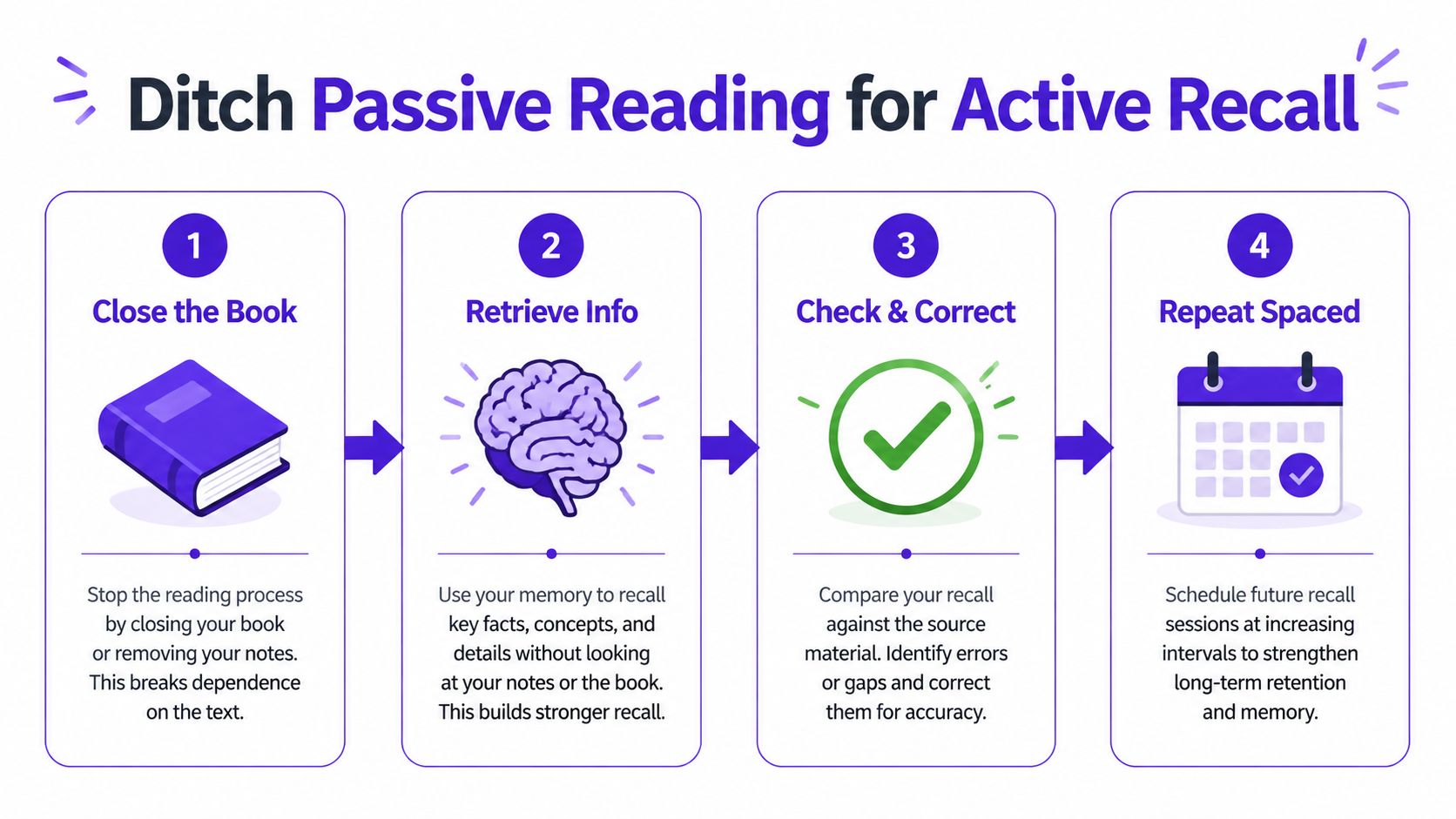
Ditch Passive Reading for Active Recall
Reading biology notes can feel productive because the content looks familiar. That's the trap. Recognition is not recall.
If you want a level revision for biology that survives exam pressure, you have to force your brain to retrieve information without prompts. That's what active recall does. It's harder in the moment and far more useful later.
Timed retrieval matters for another reason as well. In Biology, command words punish vague understanding. UK A-Level students struggle with distinguishing between command words like “explain,” “discuss,” and “evaluate” in Biology contexts, where 4-6 marks can depend on hitting specific Assessment Objective weightings. Most revision platforms focus on content and dedicate less than 5% of resources to exam-board-aligned essay frameworks, even though extended writing can account for 15-30% of marks according to this Save My Exams-linked data point.
Blurting for brutal honesty
Take a blank page. Write the topic title at the top. Then dump everything you know for ten to fifteen minutes.
Try this with the human retina, the cardiac cycle, or gene expression. Don't peek at notes. Once you're done, compare what you wrote with the specification or class materials and mark the gaps.
Blurting works because it exposes weak links quickly. You stop guessing what you know and start seeing it clearly.
Spaced repetition for keeping content alive
A-Level Biology has too much detail for one-and-done revision. Definitions, processes, practical variables, and tricky pairs of terms all need revisiting.
Use flashcards, but use them properly:
- One fact per card so you're testing a specific point
- Include command words such as explain, suggest, compare, evaluate
- Use images or diagrams for structures like the nephron or chloroplast
- Review cards you nearly forgot, not just the ones you got fully wrong
The logic behind this isn't just for school. If you want a broader explanation of why retrieval-based practice outperforms passive review, active learning strategies for corporate training gives a useful plain-English overview, even though the examples sit outside exam revision.
The Feynman check
Can you explain gene therapy to someone who knows almost nothing about biology? Can you explain why the Bohr shift matters without hiding behind textbook wording?
If not, you probably know the topic in fragments rather than as a whole.
Try this:
- Pick one hard topic.
- Explain it out loud in simple language.
- Notice where you hesitate or become vague.
- Go back and repair only that gap.
If your explanation depends on reading the sentence from your notes, you haven't learnt it yet.
Students who want a more structured version of this can look at effective study methods for UK students, especially if they revise better with prompts and guided retrieval.
Conquer the Maths and Practical Skills
A lot of biology students panic when they hear “maths skills”. Usually they picture doing pages of calculations from scratch. That's not what most A-Level Biology papers are asking for.

The job is to handle data like a scientist. You read a graph, compare values, spot a pattern, judge whether a difference looks meaningful, and connect that to the method.
A verified exam point matters here. In A-Level Biology exams, students are not required to manually calculate statistical tests like standard deviation or t-tests. The focus is on interpreting provided values to assess significance, and post-2015 exam specifications shifted towards data application skills that account for 15-20% of marks in data questions according to this AQA-aligned resource.
What you actually need to know
You need to be comfortable with the language of data:
- Mean tells you the average result
- Standard deviation tells you how spread out results are
- Error bars help you judge variation and whether results overlap
- p < 0.05 means the difference is treated as statistically significant rather than likely due to chance
That doesn't mean memorising jargon without context. It means being able to read a question and say what the data suggests.
One useful example from the same verified source compares zoo visitor data. Bristol Zoo had a mean visitor count of 32.3 with SD 9.3, while London Zoo had a mean of 48.8 with SD 1.7. The point isn't to calculate anything. The point is to see that the lower spread around London's mean makes it tighter and more reliable for comparison.
Choosing the right statistical test
Students often lose easy marks in such instances. The exam gives a scenario, and you choose the test.
Use this simple decision guide:
| Situation | Test commonly used |
|---|---|
| Categorical outcomes, expected vs observed | Chi-squared |
| Relationship between two ranked variables | Spearman's rank |
| Comparing two means | t-test |
You also need the story behind the choice. If the question involves inheritance categories, Chi-squared is the obvious candidate. If it asks whether two variables rise together in fieldwork, think Spearman's. If it compares means from two groups, think t-test.
A quick recap video can help if statistics feels abstract at first:
Required practicals are where this becomes real
Practical questions aren't just “remember the method”. They test whether you understand why each part of the method matters.
Revise practicals by asking:
- What is the independent variable
- What is being measured
- What must stay controlled
- Why are repeats needed
- What would improve reliability or validity
- What does the data let you conclude, and what does it not let you conclude
Practical marks often go missing because the student knows the experiment but doesn't evaluate it with enough precision.
If you can explain the method, spot flaws, and interpret the resulting data, you're doing the actual skill the paper rewards.
Use Past Papers Like an Examiner
Doing lots of past papers can help. Doing them badly can waste a lot of time.
The highest-value version is timed practice followed by serious analysis. Timed past paper practice combined with rigorous mark scheme analysis is the highest-impact revision method. Biology educators report that students completing 3-4 full papers with in-depth analysis can see a 10-15% grade uplift, and that analysis drives 70% of the learning gains. The same source notes retrieval practice yields 50-70% better long-term retention than passive rereading, which 80% of students mistakenly rely on according to biology revision guidance from Biology Education.
That fits what tutors see all the time. Students who do paper after paper without reviewing errors often plateau. Students who squeeze every lesson out of each script improve faster.
Sit the paper properly
If you do a paper in fragments with notes open, you're not really testing your exam performance. You're blending revision with reassurance.
At least some of your practice needs to be:
- Timed
- Silent
- Done in full sections or full papers
- Marked against the official scheme
That's what reveals whether your problem is memory, timing, question interpretation, or written precision.
Build an error log
After marking, don't just write the score and move on. That score is much less useful than the pattern behind it.
Use a simple error log with categories like these:
| Question | Topic | Type of error | Fix |
|---|---|---|---|
| 3b | Photosynthesis | Knowledge gap | Relearn limiting factors and test tomorrow |
| 5a | Practical methods | Misread command word | Practise “describe” vs “explain” |
| 7c | Immunity | Mark scheme wording | Rewrite answer using precise terminology |
| Essay | Synoptic | Poor planning | Create broader topic links before writing |
This stops revision becoming emotional. Instead of “I'm terrible at Paper 2”, you get “I'm repeatedly dropping marks on data interpretation and command words”.
Learn the mark scheme's language
At this stage, grades move.
Biology mark schemes are picky for a reason. They reward precision. If the accepted idea is “hydrolysed into amino acids”, then “broken down” might not earn the mark. If the question wants “complementary base pairing”, don't expect “matching bases” to always be enough.
When you lose marks, rewrite the answer using the wording that would have scored. Not because the examiner wants robotic writing, but because biology has technical language that carries exact meaning.
Examiner habit to copy: ask “What specific phrase was worth the mark?” after every lost mark.
Essay questions need structure, not panic
Longer responses and essays scare students because they seem open-ended. They're not random. They still reward clear exam behaviour.
Before writing, plan across the assessment objectives:
- AO1 for accurate biology
- AO2 for applying it to the question
- AO3 for analysis, links, judgement, or evaluation where needed
The biggest mistake is dumping everything you know about the topic. A better answer selects relevant knowledge, links ideas across the course, and keeps returning to the question wording.
If you want a place to practise this with examiner-style material, A-Level Past papers can be useful alongside official papers and mark schemes, especially for organised topic-based practice.
A short routine that works
After every paper, do this within a day:
- Mark it strictly
- Log every lost mark
- Sort the error by type
- Rewrite weak answers
- Revisit the same topic soon after
- Redo selected questions later without notes
That final step matters. If you only review mistakes once, you understand them. If you redo them later, you fix them.
Your Final Checklist for A-Level Biology Success
The best revision plans look less dramatic than people expect. They aren't built on twelve-hour days or colour-coded chaos. They're built on clear choices repeated often.
If you want your a level revision for biology to feel under control, keep coming back to this checklist.
The checklist
- Use the specification as your map so you know exactly what can be tested
- RAG-rate every topic so weak areas stop hiding inside general stress
- Time-block by task and method rather than writing vague study hours
- Default to active recall because recognition won't carry you through the paper
- Treat command words seriously so your knowledge lands in the mark range it deserves
- Revise practicals as analysis tasks rather than just methods to memorise
- Get comfortable with data interpretation because biology wants scientific judgement, not just facts
- Do past papers under pressure so exam conditions stop feeling unfamiliar
- Analyse every lost mark because that's where the grade movement happens
- Rewrite using mark scheme precision until the right phrasing starts to feel natural
What separates an A from an A*
It usually isn't effort alone. Plenty of hardworking students stay stuck because their revision never becomes exam-facing.
The step up happens when you stop asking, “Have I revised this topic?” and start asking, “Can I retrieve it, apply it, and phrase it in a way that scores?”
That's a different standard. It's also a learnable one.
Confidence in biology usually arrives after evidence. You've answered the questions, fixed the errors, and seen yourself improve.
If you're behind, start smaller than you think. One RAG audit. One red topic. One timed set of questions. One honest review. If you're already aiming high, tighten the system rather than adding more noise.
Smart revision feels calmer because it is clearer. That's what you want by exam season. Not the feeling that you've done “loads”, but the feeling that you know exactly why your work is paying off.
If you want a structured way to put this into practice, MasteryMind gives UK students exam-board-aligned revision across GCSE and A-Level subjects, including biology practice built around command words, active recall, spaced review, essays, and past-paper style questions.
Ready to master this topic?
Practise with quizzes, blurt exercises and exam questions on MasteryMind.
7 days Premium · Then free forever · No card, no charge