A Levels Government and Politics: The Ultimate 2026 Guide
You've probably had one of these thoughts already.
“I know the stuff, but my essays are still messy.”
“I've left this too late.”
“Politics is impossible to revise because the news changes every five minutes.”
“Everyone else seems to know what they're doing.”
That mix of panic and confusion is normal with A-Level Politics. The subject feels huge because it sits halfway between content and argument. You need facts, but facts alone won't carry you. You also need judgement, structure, and the ability to turn current politics into an answer that still fits the specification.
A lot of online advice misses the bit students struggle with. Public pages often tell you what topics are on the course, but they don't really deal with exam burden or the problem of turning broad knowledge into strong essays under pressure, as noted by Clarendon's A-Level Government and Politics course page. That's the gap that matters.
Your Roadmap to Acing A-Level Politics
The students who improve fastest usually stop treating Politics like a giant pile of facts. They start treating it like a game with rules. Examiners aren't asking, “How much can you remember?” They're asking, “Can you select the right knowledge, apply it to this question, and make a judgement?”
That shift changes everything.
If you're trying to rescue your grade, this matters because random revision won't save you. Reading the same notes again won't suddenly make your essays sharper. If you're aiming for an A or A*, it matters for a different reason. Top grades come from control. You need to know what to write, what to leave out, and how to keep your answer focused when the clock is moving.
What most students get wrong
A-Level Politics can feel like scrolling a social media feed with no filter. Parliament, elections, pressure groups, the constitution, ideologies, US politics, current examples. It all blends together. Students often revise by collecting more and more information, as if success comes from stuffing a bigger backpack.
It doesn't.
Selection is the key skill. Consider gaming: A strong player doesn't use every item in their inventory at once. They use the right tool for the situation. Politics works the same way. You need enough content to answer flexibly, but the marks come from how you deploy it.
Practical rule: Don't aim to know everything. Aim to know the things that answer questions well.
That's why your revision needs tactics, not just effort. If you need a broader reset on how to organise revision, these test preparation strategies are useful because they focus on planning and execution rather than wishful thinking.
A better way to approach the subject
Use three layers:
- Core knowledge first: Learn the institutions, concepts, thinkers, and debates well enough that you can explain them clearly.
- Exam skills second: Practise turning that knowledge into short, direct paragraphs with judgement.
- Current examples third: Add live political examples only when they strengthen the argument.
That order matters. Too many students reverse it and spend hours chasing headlines.
If you want a structured place to practise this kind of exam thinking, Online Revision for A-Level can help organise topic practice. But the main point is simpler. Your grade won't rise because you read more. It rises when you get better at answering the paper in front of you.
What A-Level Politics Actually Covers
A-Level Politics makes more sense when you stop seeing it as one giant subject and start seeing it as three connected arenas. You've got your home map, your ideology map, and your away fixture.
The UK content is the foundation. GOV.UK's subject content says students should understand political structures in their historical context, and Pearson's framework reflects that by making UK Politics and UK Government the whole of the AS qualification before full A-Level adds ideologies and comparative politics, as shown in the official Politics subject content. In plain English, that means the course expects you to know the UK system first, not as a side topic but as the base camp for everything else.
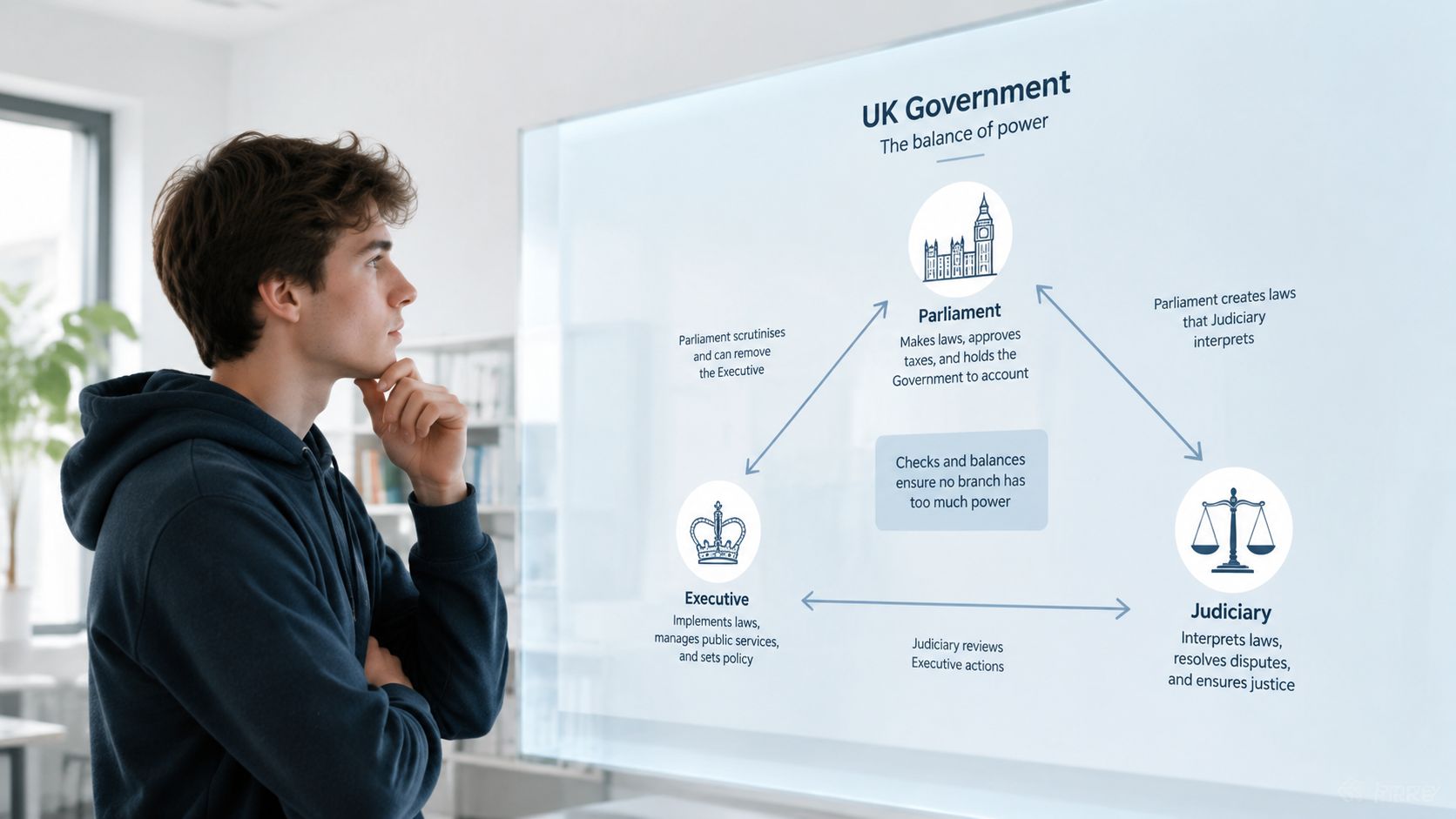
The home stadium of UK politics and government
Most students spend the biggest share of their thinking time here.
You're looking at topics like democracy, elections, parties, participation, Parliament, the Prime Minister, the constitution, and the judiciary. If Politics were football, this is your home stadium. You need to know the pitch so well that you can play without thinking about where the lines are.
A common confusion is the difference between Politics and Government.
- Politics is more about behaviour and participation. Who votes. Why parties win. How democracy works. What pressure groups do.
- Government is more about institutions and rules. How Parliament works. What the executive can do. How the courts fit in. How power is organised.
Those two areas constantly overlap. Students get stronger when they stop revising them as separate boxes.
Political ideas are the playbooks
Ideologies explain why political actors want different things.
Conservatism, liberalism, socialism, and other ideas on your specification are not just definitions to memorise. They're more like team playbooks. They tell you what different traditions believe about freedom, equality, the state, economy, authority, and human nature.
That helps when a question asks for evaluation. Instead of saying “this policy is good” or “this institution is bad”, you can judge it through an ideological lens.
Political ideas stop your essays sounding like a list of facts. They give your argument a point of view.
If you want a readable background piece on how choices in politics get shaped, this overview of factors influencing political decisions can help you think beyond isolated events.
Comparative politics is the away game
Many students wobble. They know the UK reasonably well, but when they encounter the comparative part, they feel like they've been thrown into another map with different controls.
That's normal.
The point of comparative politics is not to make you forget the UK. It's to test whether you really understand political systems by seeing if you can compare them. If your course includes the USA, you're not just learning American facts for fun. You're learning how presidential government differs from parliamentary government, how constitutions can work differently, and how institutions shape outcomes.
The best students keep asking one question: what does this comparison reveal?
Choosing Your Battlefield AQA vs Edexcel vs OCR
Students often say “I do Politics” as if every course is identical. It isn't. Your exam board shapes what you revise, the kinds of questions you face, and how much time you should spend on different parts of the course.
That's why the first practical step is brutally simple. Know your board. Know your papers. Know what the examiners usually reward.
For the common Edexcel structure, the course is assessed through three two-hour written exams, with UK Politics at 23.5%, UK Government at 23.5%, Political Ideas at 20%, and the USA component at 33%, with a strong emphasis on evaluation skills, according to the Jersey College for Girls A-Level Politics overview. That weighting tells you something important. UK content is not a warm-up act. It's a major part of the qualification.
Here's the board comparison most students need.
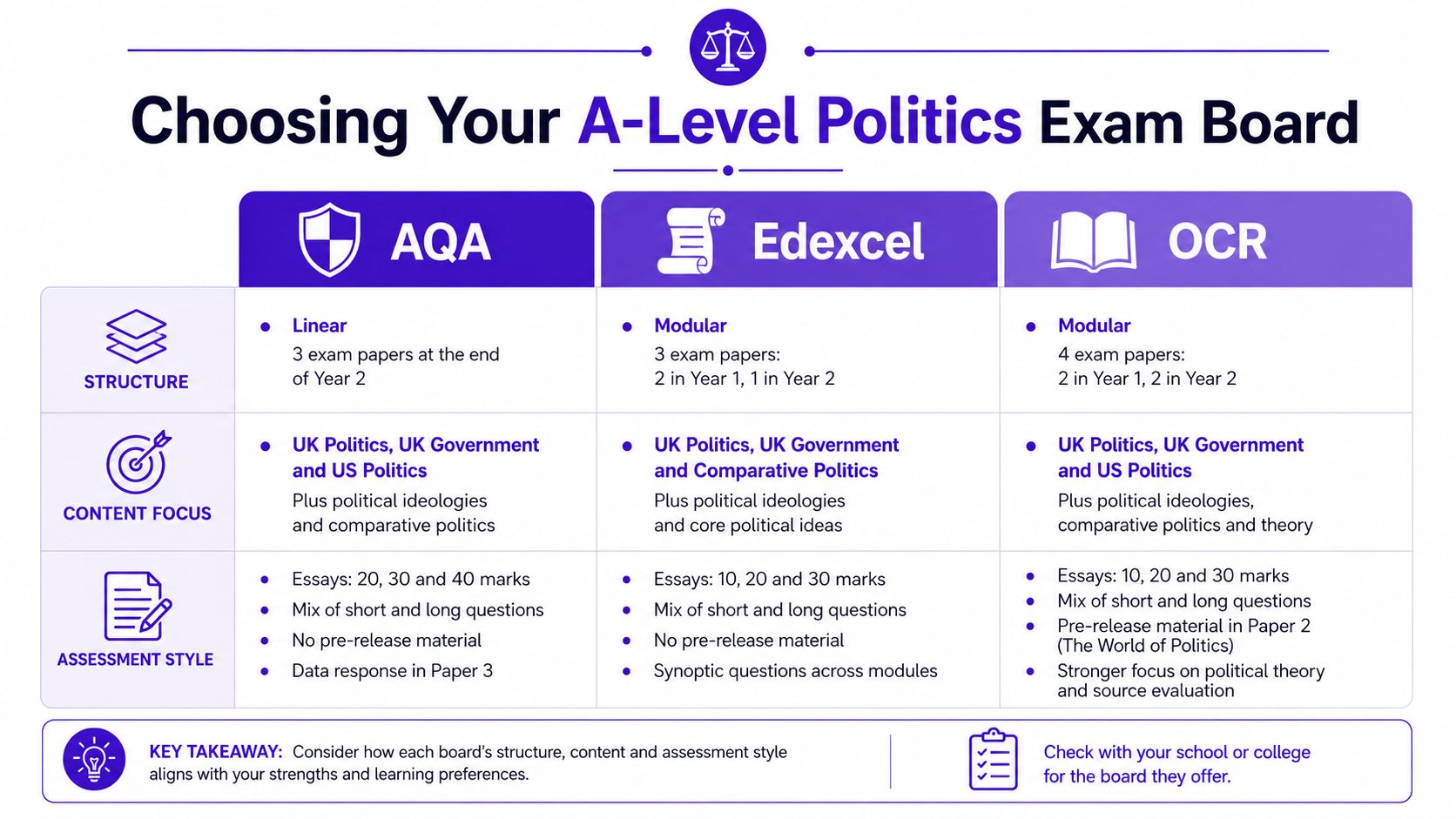
Quick comparison table
| Exam board | What to check first | What it usually means for revision |
|---|---|---|
| AQA | Your exact topic route and question style | Build revision around the wording of your specification and practise those exact question types |
| Edexcel | The split between UK content, ideas, and comparative politics | Plan revision by weighting and practise evaluative essays consistently |
| OCR | Which modules or core areas your centre teaches | Focus on how the board frames UK politics and government, then match practice to that structure |
This table is deliberately plain because students often overcomplicate the first decision. You don't need a grand theory. You need your board's specification and a realistic revision plan.
What the differences mean in real life
Different boards can reward slightly different habits.
One board might push you harder on comparative thinking. Another might suit students who are strong at direct essay writing. Another might frame content in a way that makes source use or thematic links more important. That doesn't mean one board is easier. It means careless revision is riskier if you don't tailor it.
Think of exam boards like different game maps. The same core mechanics exist, but the terrain changes. If you try to use one generic strategy everywhere, you waste time.
A student on AQA should revise with AQA wording in front of them. If that's your route, start with materials built around how to study AQA A-Level Politics. The key word is specific. “Politics revision” is too broad. “AQA Parliament and the executive essay practice” is much better.
A short video can help if you want a quick visual overview before diving back into notes.
Your board decides your emphasis
Use this as a checklist:
- Check compulsory content: Don't assume your friend's class covers exactly the same options.
- Check optional routes: Comparative politics can differ, and that changes your case examples.
- Check question habits: The command words and paper style shape how you should practise.
- Check weighting: If a large chunk of the course is UK-focused, don't let all your revision drift into ideologies or live news.
The best revision is board-specific, paper-specific, and question-specific. Generic revision feels productive but often leaves gaps.
For teachers, this point matters too. Students usually don't fail because they “don't like politics”. They struggle because they revise at subject level when they need to revise at specification level.
Hacking the Mark Scheme by Decoding the AOs
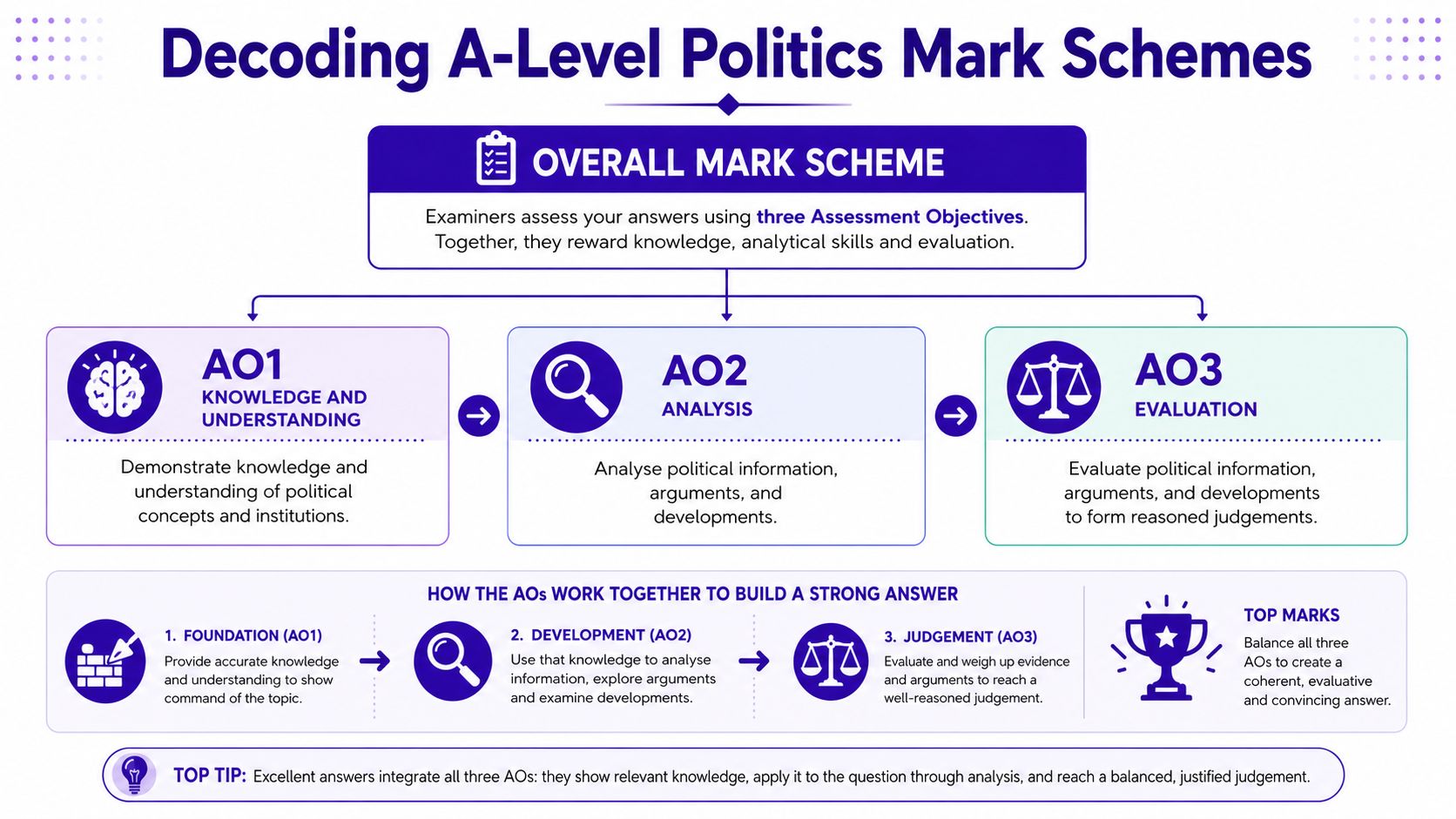
Most students see AO1, AO2, and AO3 and switch off. It sounds like examiner code. It isn't. It's a list of what you get marks for.
Once you understand the AOs, the paper stops feeling random.
According to the reformed Edexcel specification, A-Level Politics uses three 84-mark papers, and command words trigger different Assessment Objectives. AO1 is knowledge, while AO2 and AO3 require analysis and coherent argument, with top-band essays needing evaluative synthesis, as shown in the Edexcel specification and sample assessments.
AO1 means know your stuff
This is the base layer.
AO1 is your factual knowledge and understanding. Can you explain what parliamentary sovereignty is? Can you outline the role of the Supreme Court? Can you define liberalism accurately? Can you use political vocabulary properly?
Students sometimes think AO1 means dumping everything they know onto the page. It doesn't. It means using accurate knowledge that fits the question.
A weak AO1 paragraph is like posting a massive caption that doesn't match the photo. There might be lots of words, but it still doesn't land.
AO2 means connect the dots
AO2 is where you start showing that you understand how politics works, not just what it is.
This includes comparison, explanation of relationships, and analysis of political developments. If a question asks you to analyse, you should be looking for links, consequences, similarities, differences, and significance.
Try these mental prompts:
- Cause and effect: What led to this?
- Comparison: How is this similar to or different from another case?
- Linking: How does one institution affect another?
- Significance: Why does this matter politically?
AO3 means be the judge
This is the bit that separates decent answers from top ones.
AO3 is evaluation. You weigh arguments, test them, and reach a reasoned judgement. You don't sit on the fence. You don't say “both sides have good points” and leave it there. You decide which side is stronger and explain why.
Examiner mindset: Evaluation isn't a bolt-on sentence at the end. It should run through the answer.
That's why understanding exam mark schemes matters so much. Students often revise content hard but never translate it into AO language. Once they do, their answers usually become more focused.
Command words are your instructions
A lot of dropped marks happen before the first sentence is written. Students misread the command word.
Use this quick decoder:
| Command word | What the examiner wants |
|---|---|
| Explain | Clear knowledge with linked reasoning |
| Analyse | Break the issue down and show how parts connect |
| Evaluate | Make a judgement and weigh competing arguments |
If the question asks you to evaluate and you only explain, you've brought the wrong loadout to the match.
Mastering Essays and Source Questions
You do not need a magical writing style to do well in A-Level Politics. You need a repeatable structure that works even when you're tired, stressed, or staring at a question you don't love.
That's the part students resist at first. They think structure will make their writing robotic. In practice, structure gives you freedom. It stops you panicking and helps you hit the skills the examiner is rewarding.
A strong essay paragraph has a job
Every paragraph should do four things:
- Make a point that answers the question.
- Support it with relevant political knowledge.
- Analyse it by showing how or why it matters.
- Judge it with a mini-conclusion.
That last bit is where many answers level up. Don't leave evaluation until the final paragraph only. Build it in as you go.
A simple Politics paragraph often looks like this:
- Point: Parliament can limit the executive, but its effectiveness varies.
- Evidence: Use a relevant example from your course knowledge.
- Analysis: Explain what that example shows about scrutiny, accountability, or power.
- Mini-judgement: Decide how convincing the point is in relation to the question.
That mini-judgement is like a checkpoint in a game. It tells the examiner you haven't wandered off. You still know where the argument is going.
A paragraph without a judgement often reads like revision notes. A paragraph with a judgement reads like an essay.
Build essays like a thread, not a pile
Good essays feel connected. Weak essays feel stacked.
Think of your answer like a social media thread where each post develops the same core argument. If paragraph one says one thing, paragraph two should either deepen it, challenge it, or qualify it. It shouldn't feel like a random new topic.
Try this pattern for longer answers:
- Opening line: Answer the question directly, even if your judgement is qualified.
- Main paragraph one: Strong argument.
- Main paragraph two: Counter-argument or limitation.
- Main paragraph three: Best overall judgement or broader perspective.
- Final conclusion: Rank the arguments and state which is most convincing.
The conclusion shouldn't just repeat earlier sentences. It should do something extra. It should tell the examiner which side wins and why.
How to use current politics without drifting off-spec
At this stage, students either play too safe or go completely off-road.
A key challenge in Politics is judging how much real-world context matters for marks versus specification knowledge, and how recent political developments should be selected and used without drifting off-spec, as discussed in Kings Education's overview of studying Government and Politics.
The simplest rule is this. Use current examples as evidence, not as the main event.
If the specification is the song, current politics is the remix. It can improve the answer, but it can't replace the original track.
Use current examples when they do one of these jobs:
- Illustrate a principle: A recent political event can show how accountability, representation, or constitutional tension works.
- Update a debate: It can prove that an argument is still relevant now.
- Sharpen evaluation: It can show that a theory works in practice, or doesn't.
Don't use current examples just because they're interesting.
A useful test is this question: If I remove this example, does my paragraph still answer the specification? If the answer is no, you've relied on the headline too much.
Source questions reward control
Students often think source questions are a separate skill from essays. They aren't. They still reward knowledge, analysis, and judgement. The source just gives you material to work with.
Read the source like you're fact-checking a viral post. Ask:
- What argument is the source making?
- What assumptions sit underneath it?
- What language suggests tone or bias?
- What parts can I support or challenge with my own knowledge?
Don't copy the source into your answer. Interrogate it.
A strong source response usually does two things at once. It engages with what the source says, and it tests that claim using your own politics knowledge. That balance matters. If you only paraphrase the source, your answer stays thin. If you ignore the source and write a generic essay, you miss the task.
The no-nonsense rule for exam writing
When in doubt, be clearer.
Write shorter sentences. Use direct topic sentences. Signpost your judgement. If your paragraph sounds clever but the argument is hard to follow, the examiner won't reward the style over the substance.
Your Smart Revision and Practice Plan
Students often revise A-Level Politics in a way that feels busy but doesn't stick. They reread notes, highlight textbook pages, and watch politics videos while telling themselves it counts. Some of that has value, but it's not enough on its own.
You need revision that forces your brain to retrieve, connect, and judge.
Build revision around active recall
Start with recall before you chase perfection.
That means closing the book and trying to produce the answer from memory. Say it out loud. Write it from scratch. Explain it to someone else. If your brain has to work to retrieve it, that's usually a sign the revision is doing something useful.

A good weekly cycle looks something like this:
- Early week: Recall key topic knowledge from memory.
- Midweek: Turn that knowledge into short paragraph plans.
- Later week: Write timed answers or parts of answers.
- Weekend review: Revisit mistakes and redo weak areas.
That approach beats passive reading because it exposes what you can't yet do.
Mix content practice with exam practice
A lot of students separate revision into two boxes. First they “learn content”. Then much later they “do papers”. That split is too neat.
Politics revision works better when you blend them.
Try this:
| Revision task | What it trains |
|---|---|
| Flashcards or blurting | Topic recall and definitions |
| Short explain questions | Accurate AO1 knowledge |
| Comparison drills | AO2 links and differences |
| Mini-judgement paragraphs | AO3 evaluation |
| Timed essay plans | Speed and structure |
| Past questions | Full exam performance |
If you've got access to A-Level Past papers, use them in small bites as well as full timed sessions. You don't always need to sit a whole paper. One paragraph under pressure can be enough to train a weak area.
Track weak spots honestly
Most students know, deep down, which topics they're avoiding.
Maybe it's the judiciary. Maybe it's political ideas. Maybe comparative politics makes your brain leave the room. Don't build your revision around what feels comfortable. Build it around what would cost you marks.
Reality check: The topic you keep postponing is often the one dragging your grade down.
One practical option is to use a tool that combines quizzes, essay tasks, AO feedback, spaced review, and active recall in one place. MasteryMind does that for UK exam boards, including Politics, with board-aligned questions, mixed-topic practice, and a voice-based Blurt Challenge for retrieval practice. That matters because smart revision isn't just “more revision”. It's revision that matches how the exam works.
Keep your plan boring enough to follow
This is underrated.
The best revision plan is rarely the fanciest. It's the one you'll repeat. Three focused sessions done properly every week will usually beat a dramatic, overambitious plan that collapses after a few days.
For a levels government and politics, consistency matters because the subject tests fluency. You're not just trying to remember isolated facts. You're trying to become quick at using them.
Becoming a Confident Political Analyst
The students who do best in A-Level Politics usually make one mental switch. They stop seeing themselves as people trying to survive a content-heavy subject. They start seeing themselves as analysts.
That sounds grand, but it's practical. Analysts don't just collect information. They sort it, test it, compare it, and reach judgements. That's exactly what strong Politics answers do.
If your revision has felt chaotic, that doesn't mean you can't turn it around. It usually means you've been trying to solve the wrong problem. The issue isn't always “I don't know enough”. Often it's “I don't yet know how to use what I know.”
What confidence in Politics actually looks like
Confidence doesn't mean walking into the exam hall knowing every possible example.
It means you can do these things under pressure:
- Read the command word properly
- Select relevant knowledge fast
- Build paragraphs with a clear argument
- Use examples without losing focus
- Reach a judgement that answers the question
That kind of confidence is trainable. It comes from repetition, not talent.
Keep the subject in proportion
Politics can feel endless because public life keeps changing. But your exam isn't asking you to become a full-time commentator. It's asking you to think clearly about the parts of politics your specification puts in front of you.
That should be reassuring.
You do not need to know every headline. You need to understand the course well enough to interpret headlines through it. Once you can do that, the subject starts feeling less like chaos and more like pattern recognition.
The jump from stressed student to strong Politics candidate usually happens when your answers become deliberate.
By that point, you're not writing whatever comes into your head. You're making choices. You know why that example is there. You know why that counter-argument matters. You know what your conclusion is building towards.
That's when a levels government and politics becomes much more manageable. Difficult, yes. But manageable.
If you want a structured way to practise Politics with board-aligned questions, essay feedback, and revision tools built for UK exams, take a look at MasteryMind. It's a practical way to turn the strategies in this guide into regular study habits.
Ready to master this topic?
Practise with quizzes, blurt exercises and exam questions on MasteryMind.
7 days Premium · Then free forever · No card, no charge