Acids and Alkalis GCSE Guide for Exam Success
You're revising the night before a GCSE paper. One question asks you to classify a solution from its pH, another asks whether an acid is strong or concentrated, and then a titration calculation appears with unfamiliar readings. The chemistry isn't impossible, but similar words and rushed command words can turn secure knowledge into lost marks.
This guide builds acids and alkalis from the ground up. You'll meet the definitions, use the pH scale confidently, separate strength from concentration, write neutralisation equations, follow a titration method and practise the reasoning examiners expect. Along the way, you'll see how mark allocations and command words change the answer you need, whether you're rebuilding your knowledge or pushing for the highest grade.
Getting Prepared for GCSE Acids and Alkalis
A student called Maya once described acids and alkalis as “the topic where every answer sounds almost right”. She knew that acids had a low pH and alkalis had a high pH, but under pressure she confused bases with alkalis, wrote “strong” when the question asked for “concentrated”, and forgot to explain what happened to hydrogen ions during neutralisation.
That's a common revision problem, not a sign that you can't do chemistry. GCSE questions often test one small distinction at a time. Define asks for a precise meaning. State usually needs a short fact. Explain requires a scientific reason, often linked with “because”. Calculate needs a method, working and a suitable unit, not just a final number.
You'll also need to read practical contexts accurately. Acidic and alkaline substances can be hazardous, so laboratory work depends on suitable storage and handling. For broader professional context, Labs USA's corrosive safety options show how corrosive materials are managed outside the classroom.
Use this guide actively. Cover the model answers, say definitions aloud, and complete Exam Practice for GCSE with a timer. If you're recovering your exam, focus first on accurate vocabulary. If you're aiming for a top grade, add equations, practical details and explanations that connect observations to particles and ions.
Exam habit: Before writing, circle the command word and underline the chemical substance or measurement it refers to.
Understanding the Key Concepts
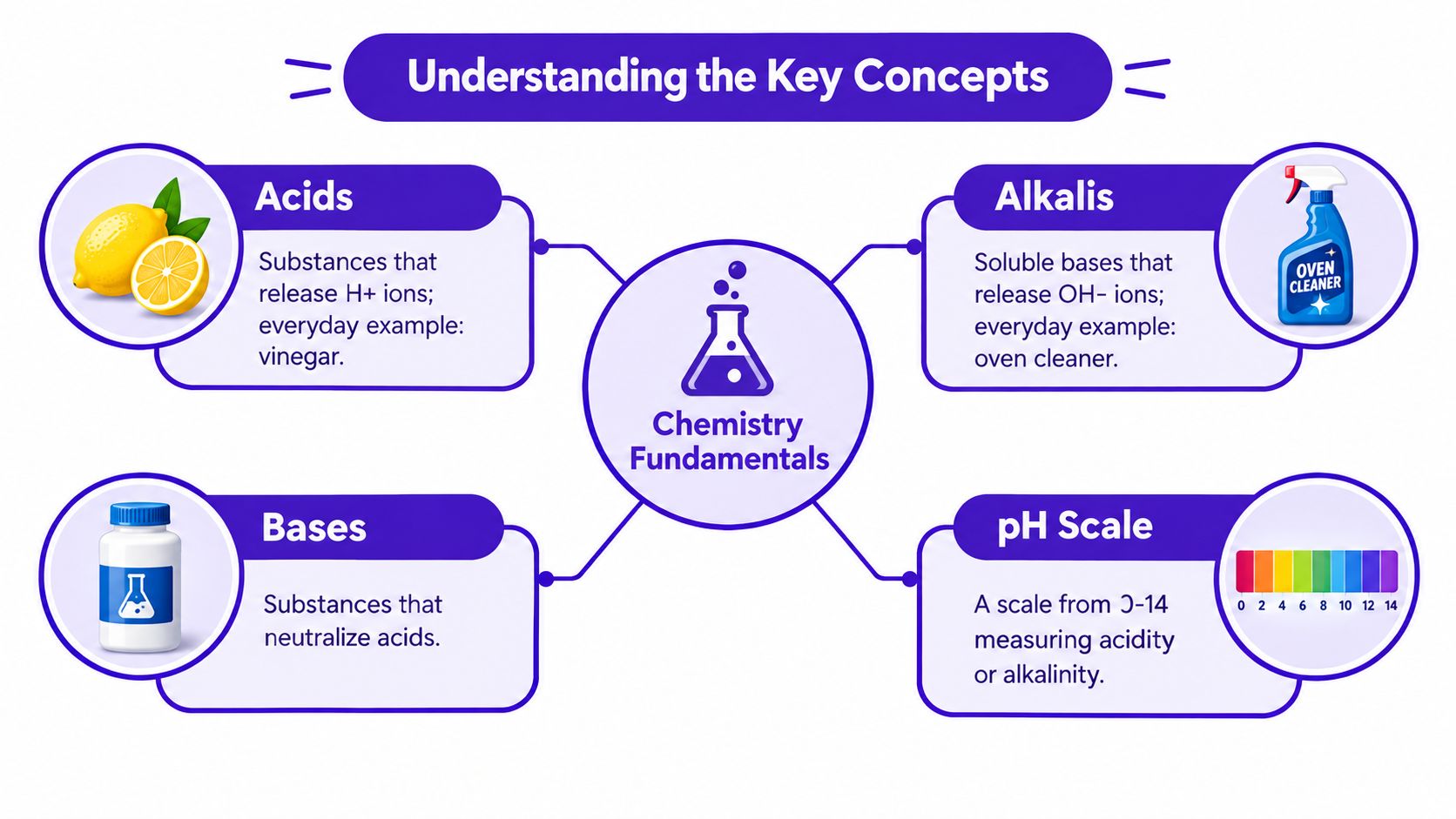
Start with the vocabulary. At GCSE level, an acid is a substance that produces hydrogen ions, H⁺, in aqueous solution. Vinegar is a familiar acidic solution. A base reacts with an acid to neutralise it, but not every base dissolves in water. An alkali is a soluble base that produces hydroxide ions, OH⁻, in aqueous solution. Oven cleaner is an everyday example of an alkaline product.
That distinction matters in exams. “All alkalis are bases” is correct because alkalis are soluble bases. “All bases are alkalis” isn't correct because a base must be soluble before it can be classified as an alkali.
Reading the pH scale
The pH scale gives you a numerical way to describe acidity or alkalinity. Acids have a pH below 7, neutral solutions have a pH of 7, and alkalis have a pH above 7, as shown consistently in British GCSE revision guidance on acids and alkalis. Treat the scale as graduated rather than as three isolated boxes. A solution can be slightly acidic, strongly acidic, slightly alkaline or strongly alkaline.
In a practical question, an indicator gives an observable colour change, while a pH meter gives a numerical reading. Don't write that an indicator “measures pH exactly” unless the question is describing a universal indicator colour chart. Instead, state the colour observed and use the chart or scale to infer whether the solution is acidic, neutral or alkaline.
The same model appears across UK exam-board-aligned materials because it links definitions, indicators, neutralisation and everyday examples. You can consolidate the terminology with these GCSE and A-Level study guides.
A useful answer structure is:
- Identify the category, acid, neutral or alkali.
- Use the pH evidence, below, equal to or above 7.
- Add the particle explanation if the question asks you to explain, such as a higher concentration of H⁺ ions for greater acidity.
Don't rely on colour alone. In an unfamiliar diagram, the pH value is stronger evidence than a vague description such as “looks reddish”.
Exploring Strength versus Concentration
“Strong” and “concentrated” describe different properties. A strong acid ionises fully in water, while concentrated describes how much dissolved substance is present in a given volume. BBC Bitesize makes this distinction explicitly, separating strong and weak from concentrated and dilute in its GCSE explanation of acids and alkalis.
Students often mix the terms up because both can affect the amount of acid present in a flask. The exam solution is to ask what the question is measuring. If it asks about ionisation, use strong or weak. If it asks about the quantity of solute per volume, use concentrated or dilute.
| Term | Meaning | What to write in an exam |
|---|---|---|
| Strong acid | Ionises fully in aqueous solution. | Link the answer to complete ionisation and hydrogen ions. |
| Weak acid | Ionises only partially in aqueous solution. | Explain that only some particles release hydrogen ions. |
| Concentrated solution | Contains a relatively large amount of dissolved substance per volume. | Discuss the amount of solute in the solution. |
| Dilute solution | Contains a relatively small amount of dissolved substance per volume. | Discuss the amount of solute and solvent. |
A strong acid can be dilute because it still ionises fully even when little acid is present. A weak acid can be concentrated because a large amount of it can be dissolved while only some particles ionise. Avoid using “strong” as a synonym for “dangerous” or “lots of molecules”.
The distinction also affects pH. Strength influences the proportion of particles that ionise, while concentration influences how much solute is present in the measured volume. For calculations involving amount per volume, an essential resource for lab professionals can help you check the arithmetic, but it can't decide whether the chemistry term should be “strong” or “concentrated”.
Marker's test: If your answer could describe either ionisation or the amount of solute, it's probably too vague for full marks.
Uncovering Typical Reactions
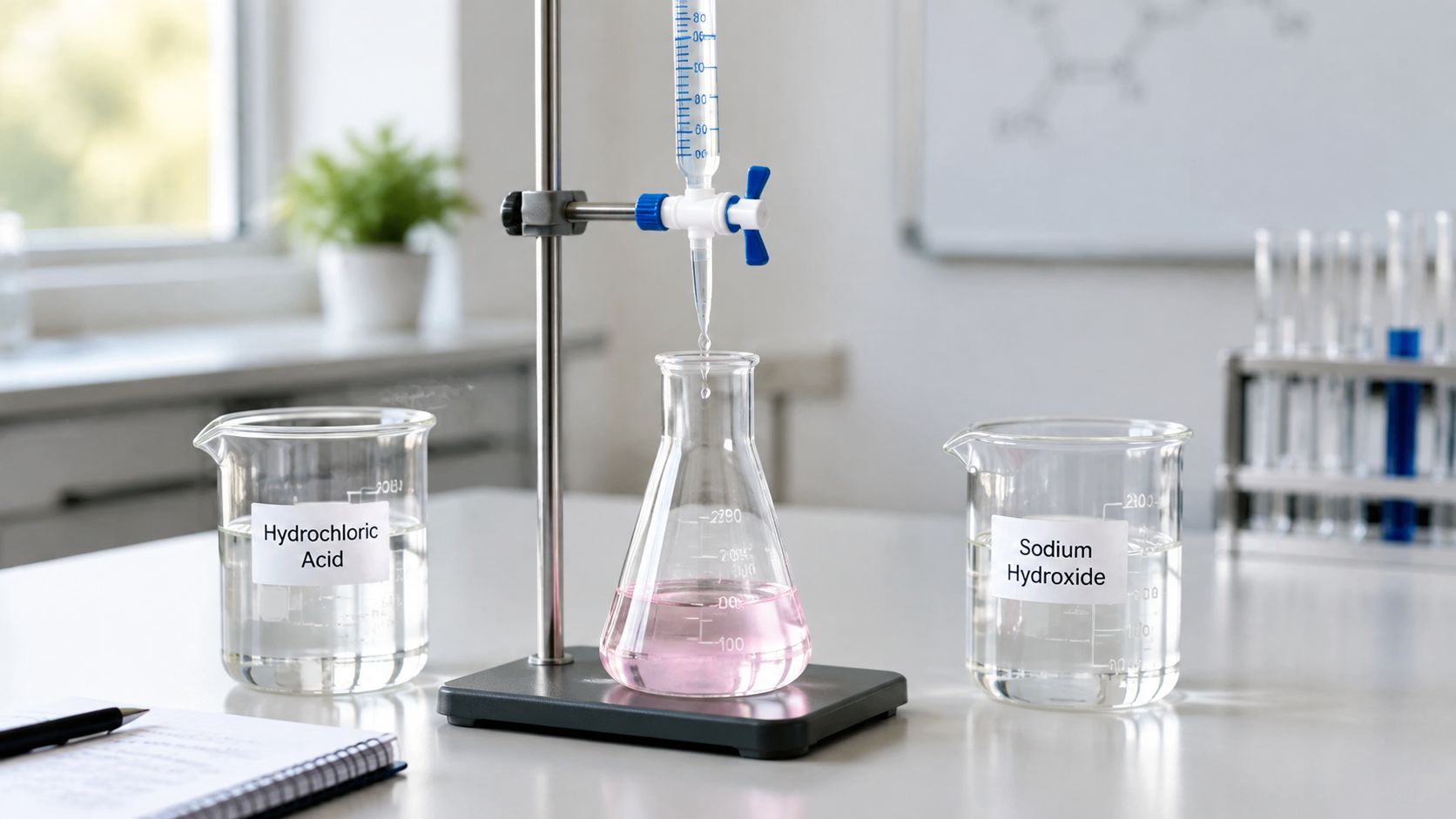
The central GCSE reaction is neutralisation. An acid reacts with a base, producing a salt and water. The essential ionic idea is that hydrogen ions from the acid react with hydroxide ions from the alkali:
H⁺(aq) + OH⁻(aq) → H₂O(l)
For a named equation, hydrochloric acid reacts with sodium hydroxide to produce sodium chloride and water:
HCl(aq) + NaOH(aq) → NaCl(aq) + H₂O(l)
The salt name comes from the acid and the metal or compound in the base. Hydrochloric acid produces chlorides, nitric acid produces nitrates, and sulfuric acid produces sulfates. Sodium hydroxide contributes sodium ions, so hydrochloric acid plus sodium hydroxide forms sodium chloride.
Building a complete exam answer
If the question says write a balanced symbol equation, check that each element appears in equal numbers on both sides. If it asks for state symbols, include the physical states. In the example above, aqueous substances are dissolved in water, while the produced water is liquid.
If the base is an insoluble metal oxide or carbonate, the products change. An acid reacting with a metal oxide still forms salt and water. An acid reacting with a carbonate forms salt, water and carbon dioxide. Don't add carbon dioxide to every neutralisation equation.
Acid rain gives the chemistry a wider context. UK environmental guidance defines acid rain as precipitation with acidity below pH 5.6, and explains that sulfur dioxide and nitrogen oxides are oxidised in water vapour to form sulfuric and nitric acids, increasing hydrogen-ion concentration (DEFRA glossary).
A strong environmental answer doesn't just say “acid rain is bad”. It links the gases to acids, then explains that increased acidity can affect ecosystems and materials. If asked to suggest treatment, describe neutralisation with a suitable base, while remembering that the correct base depends on the context.
Mastering the Titration Method
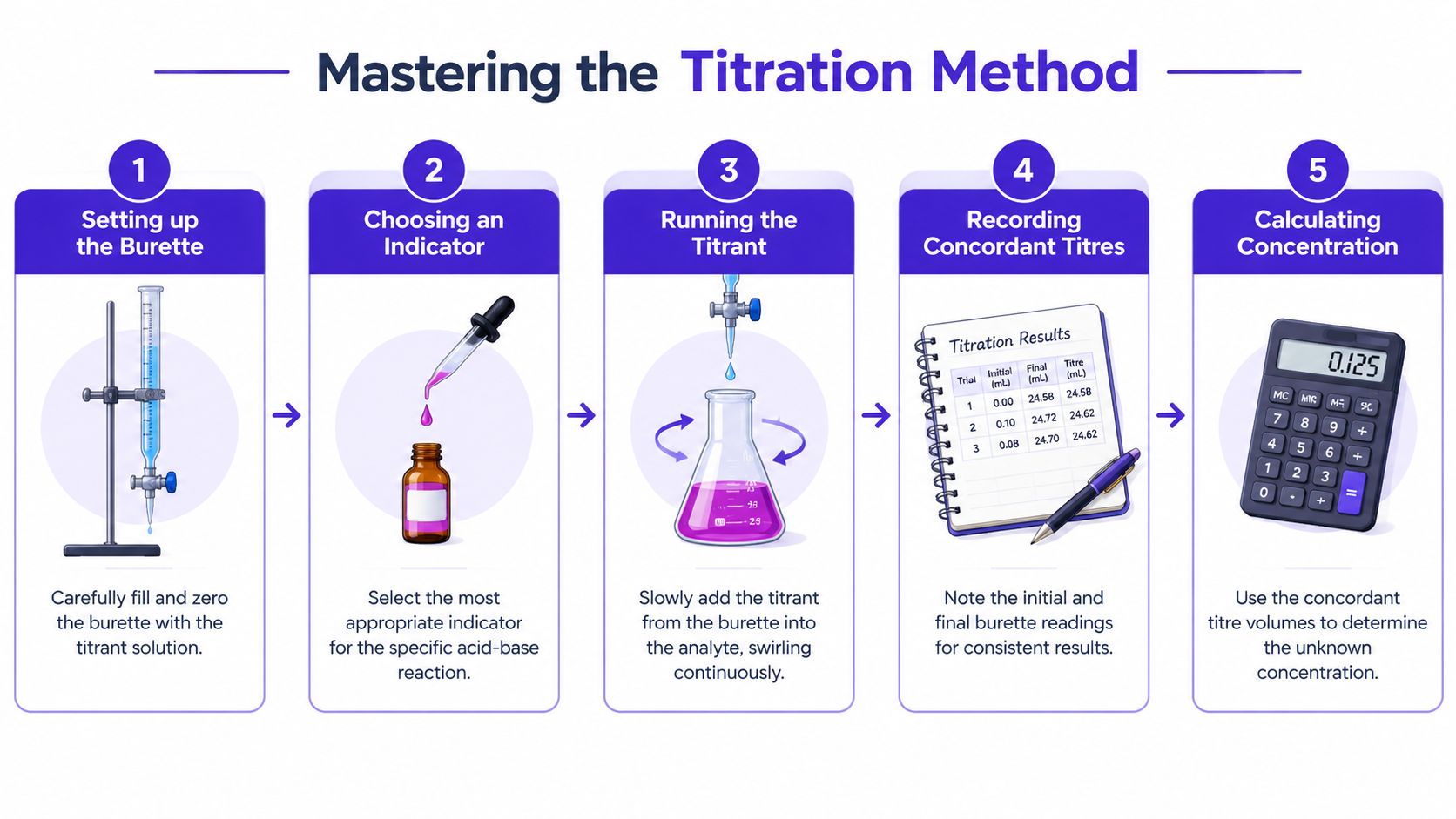
Titration is a practical method for finding the concentration of an acid or alkali by reacting it with a solution of known concentration. In an exam, marks are often awarded for the apparatus, method, readings and calculation, so skipping the practical details can cost more than one mark.
Preparing the apparatus
Use a pipette to transfer a measured volume of the solution being analysed into a conical flask. Add a few drops of a suitable indicator, then rinse and fill the burette with the titrant. Open the tap briefly to fill the tip, remove air bubbles and record the starting reading at eye level.
The burette reading increases as liquid leaves the apparatus. Read the bottom of the meniscus at eye level, unless your practical instruction specifies otherwise, and record readings to the precision shown by the apparatus. Swirl the conical flask continuously so the reactants mix.
Reaching the endpoint
Run the titrant quickly at first, then add it drop by drop near the colour change. The endpoint is the point where the indicator shows that neutralisation has been reached closely enough for the practical method. A suitable indicator depends on the acid and alkali used, so don't choose one only because you remember its colour.
Record the initial and final readings, then calculate:
titre = final burette reading − initial burette reading
Repeat the experiment until you have concordant titres, meaning readings that agree closely enough according to the practical criteria you've been taught. Use the concordant results to calculate a mean titre, excluding an obvious rough result where appropriate.
Why precision matters
The pH scale is logarithmic. A change of one pH unit represents a tenfold change in hydrogen ion concentration, as explained in UK STEM teaching material on acids and bases. That's why adding too much titrant beyond the endpoint can make your result less reliable, even if the excess volume looks small.
For calculation questions, convert volumes into the unit required by the equation, write the mole relationship from the balanced equation and show every step. A calculator may provide the final figure, but it won't earn method marks if your working is missing.
Review the full practical sequence with Mastering Chemistry for exams.
Practicing with Worked Examples and Exam Questions
Worked calculations are useful because they expose where a method breaks. However, the numerical values below are practice values, not measured results, so focus on the process rather than treating them as experimental data.
Calculation example one
A solution contains 0.10 mol/dm³ hydrochloric acid. A mean titre of 25.0 cm³ sodium hydroxide neutralises 25.0 cm³ of the acid. The equation is:
HCl + NaOH → NaCl + H₂O
The mole ratio is 1:1. Convert the sodium hydroxide volume to 0.0250 dm³, then calculate moles:
moles = concentration × volume
moles of NaOH = 0.10 × 0.0250 = 0.00250 mol
The same number of moles of hydrochloric acid reacted. Divide by the acid volume, 0.0250 dm³:
concentration = moles ÷ volume
concentration of HCl = 0.00250 ÷ 0.0250 = 0.10 mol/dm³
For a calculation question, show the formula, substitution, unit conversion and final unit. Those stages give an examiner evidence for method marks.
Calculation example two
A 25.0 cm³ sample of sulfuric acid reacts with 20.0 cm³ of 0.10 mol/dm³ sodium hydroxide:
H₂SO₄ + 2NaOH → Na₂SO₄ + 2H₂O
The sodium hydroxide volume is 0.0200 dm³. Its amount is:
0.10 × 0.0200 = 0.00200 mol
The equation shows that one mole of sulfuric acid reacts with two moles of sodium hydroxide. Therefore, the sulfuric acid amount is 0.00100 mol. Divide by 0.0250 dm³ to obtain 0.040 mol/dm³.
The most important step is the mole ratio. Don't assume every acid and alkali reaction is 1:1.
Short exam practice
Question: Define an alkali.
Model answer: A soluble base that produces hydroxide ions in aqueous solution.
Mark focus: Include both “soluble base” and hydroxide ions if the allocation expects a complete definition.
Question: Explain why a weak acid may have a higher pH than a strong acid of similar concentration.
Model answer: A weak acid only partially ionises, so it produces a lower concentration of hydrogen ions than a strong acid that ionises fully.
Mark focus: Use ionisation and hydrogen ions, not “it is less powerful”.
Question: Explain why an environmental question might mention acid rain or water treatment.
Model answer: The question is testing whether you can apply the definition of acidity and neutralisation to a real setting, rather than repeat an isolated definition. UK monitoring includes long-term precipitation chemistry records, so environmental acidity is a practical measurement topic, not merely a classroom example (UK Environmental Change Network data).
Practise these formats with GCSE Past Papers, and mark your response against the command word, not just the final answer.
Conclusion and Exam Strategies
Remember the core chain: acid below pH 7, neutral at pH 7, alkali above pH 7. Keep strong versus weak separate from concentrated versus dilute, balance neutralisation equations carefully, and read titration menisci at eye level.
Before submitting an answer:
- Spot the command word: Define, explain, calculate and compare need different responses.
- Check units: Convert volume before using concentration equations.
- Use particle language: Mention H⁺, OH⁻ and ionisation where relevant.
- Review indicators: Learn the expected colour change for the indicators in your specification.
- Protect method marks: Show equations, substitutions and working.
MasteryMind offers UK learners examiner-aligned questions, command-word practice and step-by-step feedback across GCSE chemistry topics. Visit MasteryMind to practise acids and alkalis with adaptive revision that helps you move from uncertain definitions to confident exam answers.
Ready to master this topic?
Practise with quizzes, blurt exercises and exam questions on MasteryMind.
7 days Premium · Then free forever · No card, no charge