Approaches to Psychology: A-Level Guide 2026
You've probably had this moment already. You open your psychology notes, see behaviourism, psychodynamic, cognitive, biological, humanistic, maybe social learning theory, and suddenly the whole topic feels like six people arguing in a group chat.
Fair enough. It can look like psychology can't make up its mind.
But that's not really what's going on. The different approaches to psychology exist because human behaviour is messy. One explanation won't cover everything. If someone develops a phobia, for example, you could explain it through learning, faulty thinking, unconscious conflict, or biology. In an exam, the smart move isn't to panic and pick one. It's to know what each approach focuses on, then compare them like an examiner would.
That's the difference between a vague answer and one that climbs into the top bands.
Why Are There So Many Approaches in Psychology
If the topic feels overcrowded, use this rule. An approach is a lens. It highlights one part of behaviour and pushes another part into the background. That's why the approaches can seem to clash. They're asking different questions.

Why psychology split into different lenses
Psychology didn't begin as the neat school subject you revise now. The formal start of psychology as a science is often dated to 1879, when Wilhelm Wundt opened the first experimental psychology lab in Leipzig, a shift that helped move psychology from philosophy towards evidence-based study, as outlined in this history of psychology overview.
Once psychology became more scientific, different schools of thought developed their own answers to the same basic question: why do people think, feel and behave the way they do?
A behaviourist says behaviour is learned from the environment.
A cognitive psychologist says you need to look at mental processes.
A psychodynamic psychologist says hidden unconscious forces matter.
A biological psychologist says the body and brain are doing heavy lifting.
That's not chaos. That's a toolkit.
Practical rule: when you revise approaches to psychology, don't memorise them as random theories. Memorise them as different explanations for the same behaviour.
What students usually get wrong
The biggest mistake is treating all approaches as if they're interchangeable. They aren't. If a question asks for a cognitive explanation, writing about conditioning won't rescue you. Examiners reward precision.
Another mistake is learning definitions without learning contrasts. That's why a decent summary sheet isn't enough on its own. If you're checking what AQA expects students to know, this expert guide for AQA Psychology is useful because it keeps the specification in view rather than drifting into waffle.
You'll also sometimes see newer areas discussed alongside the classic approaches. For example, if you've wondered how strengths, wellbeing, and flourishing fit into the bigger picture, this explainer on what is positive psychology gives a helpful contrast with the more traditional A-Level material.
Here's the simple version you need in your head:
- Approaches are not all saying the same thing. They focus on different causes of behaviour.
- Approaches are not equally useful for every question. Match your answer to the command word and the named approach.
- Approaches are not just AO1 content. They're built for AO3 comparison.
The Classics Psychodynamic and Behaviourist Views
These two are old-school heavyweights, and they could not be more different if they tried.
One says behaviour is driven by hidden unconscious conflict. The other says forget the hidden stuff, just look at what people do.
Psychodynamic and the iceberg idea
The psychodynamic approach is linked to Freud. The big idea is that much of human behaviour comes from the unconscious mind. In other words, people aren't fully aware of the underlying causes of their actions.
The classic way to remember it is the iceberg analogy. The tiny bit above the water is conscious awareness. The massive chunk below the surface is the unconscious, where buried memories, desires and conflicts sit.
Freud also described personality using three parts:
- Id wants instant gratification. It's the impulsive bit.
- Ego deals with reality. It tries to keep things sensible.
- Superego is the moral voice. It pushes guilt, rules and ideals.
If that sounds a bit like having an angel, a toddler, and an exhausted referee all living in your head, yes. That's a decent way to remember it.
Psychodynamic explanations often point to early childhood experiences. If something important happened early on and wasn't properly resolved, Freud thought it could still shape adult behaviour later.
Behaviourism and the blank slate
The behaviourist approach takes a very different view. It focuses on observable behaviour and says behaviour is learned from the environment.
For behaviourists, the mind is not the star of the show. What matters is what goes in from the environment and what behaviour comes out.
Two core learning processes matter here:
Classical conditioning
This is learning by association. Pavlov's dogs are the standard example. A neutral stimulus gets linked with something meaningful until it triggers a response by itself.Operant conditioning
This is learning through consequences. Rewards increase behaviour. Punishments reduce it.
So if a child gets praise every time they tidy their room, the behaviour is more likely to continue. If someone avoids a dog and feels immediate relief, that avoidance can also get reinforced.
Why examiners like putting these together
They make a brilliant comparison because their assumptions clash so clearly.
| Feature | Psychodynamic | Behaviourist |
|---|---|---|
| Cause of behaviour | Unconscious conflict and childhood experiences | Environmental learning |
| Focus | Hidden mental processes | Observable actions |
| View of the person | Driven by inner forces | Shaped by external conditions |
A short, sharp comparison often scores better than a long paragraph that never directly contrasts the two.
The confusion trap
Students often blur these together in essays on disorders. Don't.
If you say a phobia is caused by association with a frightening event, that's behaviourist.
If you say a symptom reflects repressed unconscious conflict, that's psychodynamic.
Those are not the same explanation wearing different clothes.
A solid revision move is to practise with one behaviour and force yourself to explain it twice. Example: someone refuses to speak in class. Behaviourist answer. Then psychodynamic answer. That's how the differences stick.
The Mind and Body Crew Cognitive and Biological Approaches
These are the approaches many students find easier because they feel more modern. They also tend to fit nicely with the scientific image of psychology.
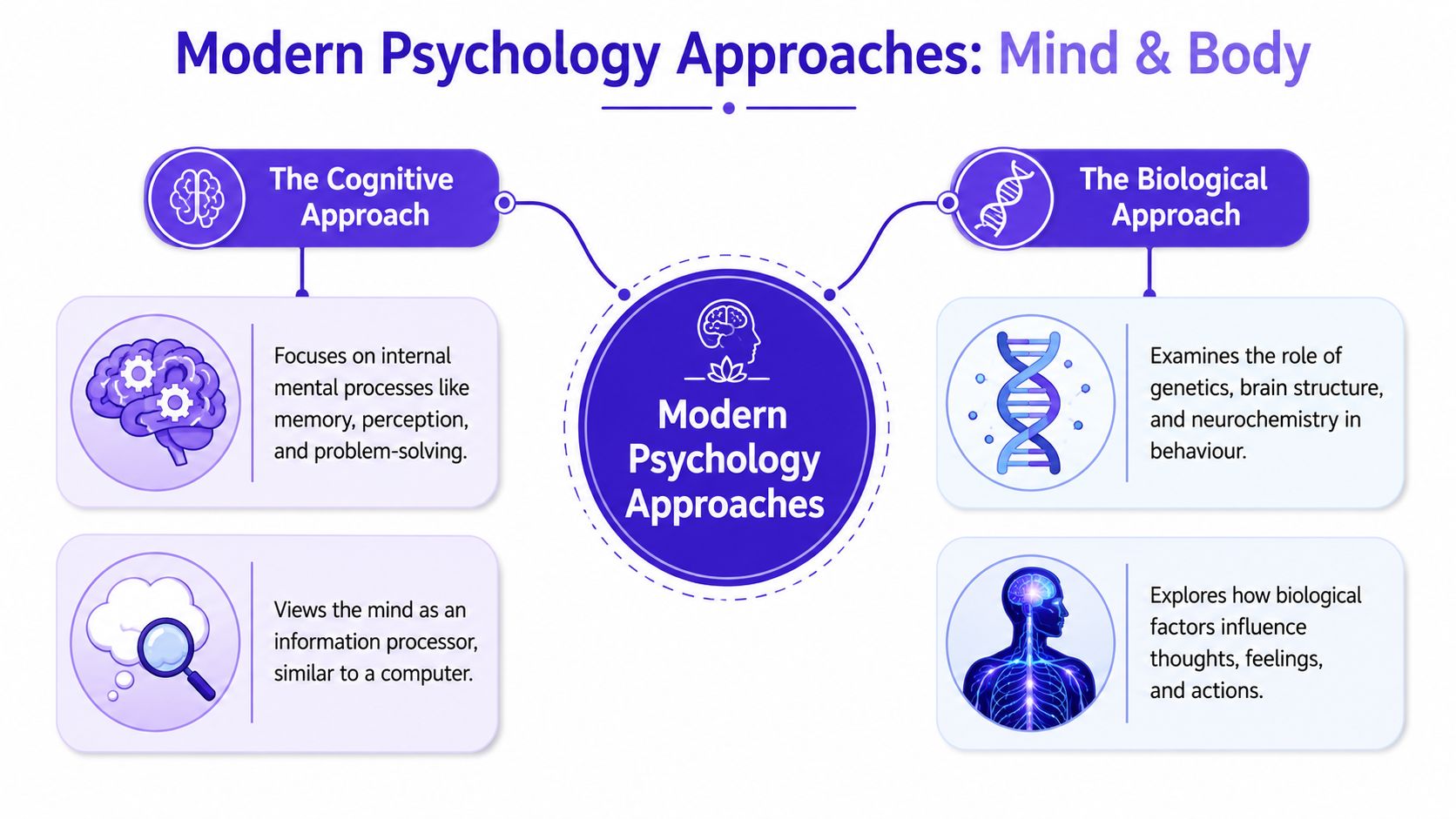
The key distinction is simple. The cognitive approach looks at the mind's processing. The biological approach looks at the body's machinery.
Cognitive psychology and the computer analogy
The cognitive approach brought mental processes back into psychology. It argues that to understand behaviour, you need to understand how people process information.
The easy analogy is a computer.
- Input comes in through the senses
- Processing happens in the mind
- Output appears as behaviour
That doesn't mean humans are laptops with feelings. It means cognitive psychologists use the model to explain things like memory, attention, perception and decision-making.
A key term here is schema. A schema is a mental framework built from experience. It helps you organise information quickly. Handy in daily life. Annoying when it leads to bias or distorted thinking.
If you walk into a classroom, you already have a schema for what belongs there. Desks, whiteboard, teacher, low-level panic before a test. That schema helps you process the situation fast.
Biological psychology and the physical hardware
The biological approach asks what role is played by genes, brain structure, neurochemistry, and physiology.
If the cognitive approach studies the software, the biological approach studies the hardware.
That means explanations often involve things like:
- Genes that may influence behaviour
- Neural processes in the brain
- Neurotransmitters affecting mood and behaviour
- Physiology and inherited characteristics
This approach feels concrete because it links behaviour to physical systems. Students often like it for that reason. It sounds testable.
Why these approaches often sound more scientific
Standard psychology teaching commonly treats behavioural, cognitive, and biological approaches as especially scientific because they rely heavily on controlled methods and testable ideas, while psychodynamic and humanistic accounts are more interpretive, as summarised in this overview of methods across approaches.
That matters in essays. If you're evaluating the cognitive or biological approach, a strong AO3 point is that they often produce testable predictions and can be supported using structured research methods.
Here's a useful visual recap before you carry on:
Where students slip up
The main trap is mixing up cognitive and biological because both can sound scientific.
Use this distinction:
- Cognitive asks how thinking processes explain behaviour.
- Biological asks how physical processes explain behaviour.
If your explanation includes schema, memory models, attention, or information processing, you're in cognitive territory. If it includes genes, neurotransmitters, or brain systems, you're in biological territory.
The Person and the Group Humanistic and Social Learning
Some approaches zoom in too far. Humanistic psychology pushed back against that and said, in effect, “Can we please remember there is an actual person here?”
Social Learning Theory did something else clever. It stood between behaviourism and cognition and said behaviour isn't just learned through direct rewards and punishments. People also learn by watching others.
Humanistic and the whole person
The humanistic approach is the optimistic one in the family. It focuses on free will, personal growth, and the drive to become the best version of yourself.
That drive is usually called self-actualisation.
Humanists argue that people aren't just pushed around by unconscious conflict or conditioned by the environment. They can make choices. They can grow. They can change.
Maslow's hierarchy of needs is the classic image here. You start with basic needs and move upwards towards fulfilment. Students sometimes memorise the pyramid and forget the point. The point is that growth becomes easier when more basic needs are in place.
That's why the humanistic approach is often described as a holistic view. It looks at the whole person rather than reducing behaviour to one tiny mechanism.
Social Learning Theory as the bridge
Social Learning Theory is one of the most useful approaches to understand because it links two camps that often seem separate.
It agrees with behaviourism that behaviour can be learned. But it also says learning involves mental processes, not just direct conditioning. In the AQA framing, this includes imitation, identification, vicarious reinforcement, and mediational processes, which are central to the learning approach material in these AQA approaches revision notes.
The famous example is Bandura's Bobo doll work. Children observed aggressive models, then some copied what they'd seen. The key idea is observational learning. You don't always need to experience a consequence yourself. Watching someone else get rewarded or punished can affect what you do.
That's where vicarious reinforcement comes in.
Why SLT is easy to misunderstand
Students often write Social Learning Theory as if it's just behaviourism with extra steps. It isn't.
SLT includes mediational processes, which means people think before they imitate. They notice behaviour, remember it, weigh it up, and decide whether to reproduce it. So a child may see aggression but not copy it.
If you're also revising earlier material and want a simpler bridge into observational learning, this guide on acing Edexcel GCSE Psychology exams can help with the lower-level foundations before you push into A-Level comparison.
Here's the clean contrast to remember:
- Humanistic says people are motivated by growth and choice.
- Social Learning Theory says people learn from others in a social world, but thinking still matters.
That's why both approaches feel like responses to the limitations of earlier theories. One restores the person. The other restores the social world.
The Ultimate Showdown Comparing the Approaches
Grades are often determined by this. Lots of students can describe the approaches. Fewer can compare them sharply. That's what examiners notice.
You don't need to write something mystical. You need to know where each approach sits in the main debates and use those comparisons with purpose.
The three debates you need ready
The most useful comparison debates are these:
Nature vs nurture
Is behaviour mainly caused by innate factors or experience?Reductionism vs holism
Does the approach break behaviour into parts, or look at the whole person?Free will vs determinism
Are people choosing their actions, or are those actions caused by forces outside conscious control?
For exam purposes, methodology matters too. Behavioural, cognitive, and biological approaches are often valued because they use scientific, experimental methods that produce testable and often replicable findings, while psychodynamic and humanistic approaches rely more on interpretation and are harder to falsify, as explained in that earlier methods overview.
Comparison of Psychological Approaches
| Approach | Main Focus | Nature vs. Nurture | Reductionism vs. Holism | Free Will vs. Determinism |
|---|---|---|---|---|
| Behaviourist | Learned behaviour through conditioning | Mostly nurture | Reductionist | Determinist |
| Psychodynamic | Unconscious conflict and childhood experience | Leans towards nature and early experience together, but strongly shaped by upbringing | Reductionist | Determinist |
| Cognitive | Mental processes such as memory, attention, schemas | Often an interaction, but usually gives a major role to internal processing shaped by experience | Reductionist | Soft determinist |
| Biological | Genes, brain, neurochemistry, physiology | Mostly nature | Reductionist | Determinist |
| Humanistic | Personal growth and self-actualisation | More balanced, but stresses personal experience | Holistic | Free will |
| Social Learning Theory | Learning through observation and imitation with mediational processes | Mainly nurture | Less reductionist than behaviourism, but not fully holistic | Soft determinist |
How to turn this into AO3
Don't dump definitions of debates and hope for mercy. Apply them.
Nature versus nurture in practice
If an essay asks about aggression, the biological approach might point to inherited tendencies or physiology. Social Learning Theory would point to observed models in the environment.
That gives you an evaluation line straight away. A biological account may explain why some people are more vulnerable, but SLT may explain why behaviour differs across situations and groups.
Reductionism versus holism in practice
Behaviourism is often called reductionist because it reduces behaviour to stimulus, response, and reinforcement history. That can make research tidy. It can also make explanations a bit thin if they ignore thinking or emotion.
Humanism goes the other way. It looks at the whole person. That sounds richer, but it can be harder to test neatly.
Better evaluation sounds like this: “The behaviourist approach benefits from clear, measurable variables, but its reductionism may oversimplify complex behaviour by ignoring conscious experience.”
Free will versus determinism in practice
Psychodynamic, behaviourist, and biological approaches all lean strongly towards determinism. They suggest behaviour is driven by unconscious motives, conditioning history, or biology.
Humanistic psychology stands out because it argues people can choose and direct their lives.
That contrast is exam gold because it lets you discuss whether an approach gives a realistic account of human agency.
A comparison shortcut that actually works
Use this sentence frame:
- Approach A explains X through…
- Approach B explains the same behaviour through…
- These contrasting explanations have implications for…
For example:
- Behaviourism explains phobias through learned associations.
- Cognitive psychology explains them through irrational thinking patterns.
- This matters because the two approaches suggest different treatments and different assumptions about what causes distress.
If you want a quick refresher on observational learning language before using it in comparisons, this explainer on concepts of social learning is a useful plain-English companion.
From Theory to Marks Writing a Top-Band Essay
You do not get top marks for knowing loads and spraying it everywhere.
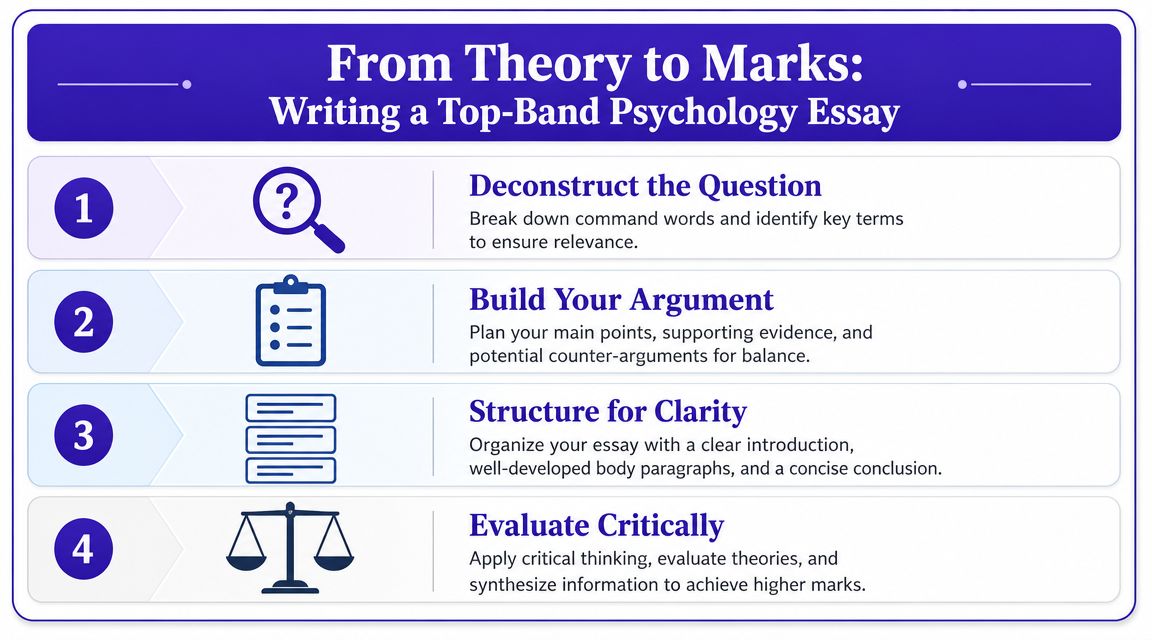
You get top marks for answering the question, selecting the right material, and evaluating with control. That's why students with decent knowledge sometimes get beaten by students with better structure.
What the examiner is really looking for
At A-Level, the specification expects students to compare learning approaches, cognitive, biological, and psychodynamic perspectives, and stronger answers evaluate them using debates such as reductionism and determinism while linking to applications, as set out in these AQA approaches revision notes.
Translated into normal language, that means this:
- AO1 is your accurate knowledge
- AO3 is your comparison, critique, and judgement
A lot of essays collapse because students write a huge AO1 chunk, then tack on two lazy evaluation points at the end. That's not balance. That's damage control.
Use PEEL, but use it properly
A good evaluation paragraph often works like this:
Point
State the evaluation clearly.Evidence or example
Use relevant support from the approach or its method.Explain
Show why that point matters.Link
Tie it back to the question.
Here's a model shape for a paragraph on behaviourism versus cognition in explaining phobias.
Behaviourism offers a clear explanation of phobias through learned associations, which is useful because conditioning principles are straightforward and testable. However, the approach may be too reductionist because it ignores the role of conscious thought. The cognitive approach strengthens explanation here by considering irrational beliefs and mental processing, which can better account for why two people exposed to similar experiences may respond differently. This makes cognitive explanations more flexible when discussing individual differences in phobic behaviour.
That's doing a lot in a small space. Comparison. Debate. Relevance.
A reliable essay routine
When you see a question, do this first:
Underline the command word
“Discuss” means description plus evaluation. “Compare” means you must compare.Circle the named approaches
Don't wander off into every theory you've ever met.Plan two or three clean AO3 lines
Methodology, determinism, reductionism, applications. Pick the ones that fit.Keep linking back
If the question is about explaining attachment, don't drift into random comments about depression treatment.
If you want actual question practice rather than just passive reading, working through A-Level Past papers helps because you can see how often the same command words and comparison patterns come up.
The biggest essay mistakes
- Listing approaches separately instead of comparing them
- Using generic AO3 that could fit any topic
- Forgetting application, especially where therapies or explanations differ
- Writing everything you know instead of answering the wording on the page
One practical option for revision is MasteryMind, which gives examiner-style practice aligned to UK specs and breaks feedback into assessment objectives. That's useful if your issue isn't knowledge anymore. It's turning knowledge into marks.
Your Smart Revision Playbook for the Approaches
You don't need a prettier highlighter strategy. You need a revision method that forces recall and comparison.
Revise the topic by contrasts
Make one card or one page per approach, but don't stop there. Add three things to each:
- Its core assumption
- A classic example or study
- One criticism or comparison point
Then build separate revision grids around the debates. Put each approach under nature or nurture, reductionist or integrative, free will or determinist. That's how you train the AO3 part of your brain, not just the memory part.
Use active recall, not fake revision
Reading notes feels productive because it's tidy. It's also one of the easiest ways to fool yourself.
Better options:
- Blurt answers aloud to a past question without looking at notes
- Plan essays in timed bursts instead of always writing full ones
- Swap one behaviour across approaches and explain it from different angles
- Use spaced review so the material comes back before you forget it
If your bigger issue is revising efficiently at home without drifting into “I'll just watch one video” territory, this Boss as a Service's study guide has sensible general habits that pair well with subject-specific revision.
For memory techniques that stop psychology facts evaporating overnight, MasteryMind's advice on retaining knowledge is also worth a look.
The students who do best on approaches to psychology usually aren't the ones with the thickest folder. They're the ones who can explain the same behaviour in three different ways under time pressure.
If you want a cleaner way to practise exam-style psychology questions, structure essays, and get feedback tied to the actual assessment objectives, take a look at MasteryMind. It's built for UK learners and keeps revision focused on what earns marks, not what just fills a notebook.
Ready to master this topic?
Practice with quizzes, blurt exercises, and exam questions on MasteryMind.
7 days of full Premium · No card required · Free plan forever after