10 AQA a Level Biology Notes That Actually Help
Behind on Biology? You've got a pile of notes, a half-remembered explanation of meiosis, and the uneasy feeling that reading everything again won't be enough. Whether you're rescuing a grade or chasing an A*, the right AQA A-level Biology notes can save time, but only if they help you remember, apply and explain the biology.
AQA 7402 isn't just a test of definitions. The three written papers cover all eight topics across six hours, and the assessment includes knowledge, application, analysis and evaluation. That's why a useful resource should do more than summarise content: it should help you check the specification, practise unfamiliar questions and fix mistakes in your scientific wording. AQA's specification overview sets out the paper structure and assessment objectives.
Below, the tools are ranked by the study job they do best: catching up, building understanding or polishing exam technique. Each pick has a simple way to use it, plus a reminder to check the current specification. If you're still choosing how to organise your own study materials, see Tinymoose's free note taking app guide.
1. Physics & Maths Tutor (PMT)
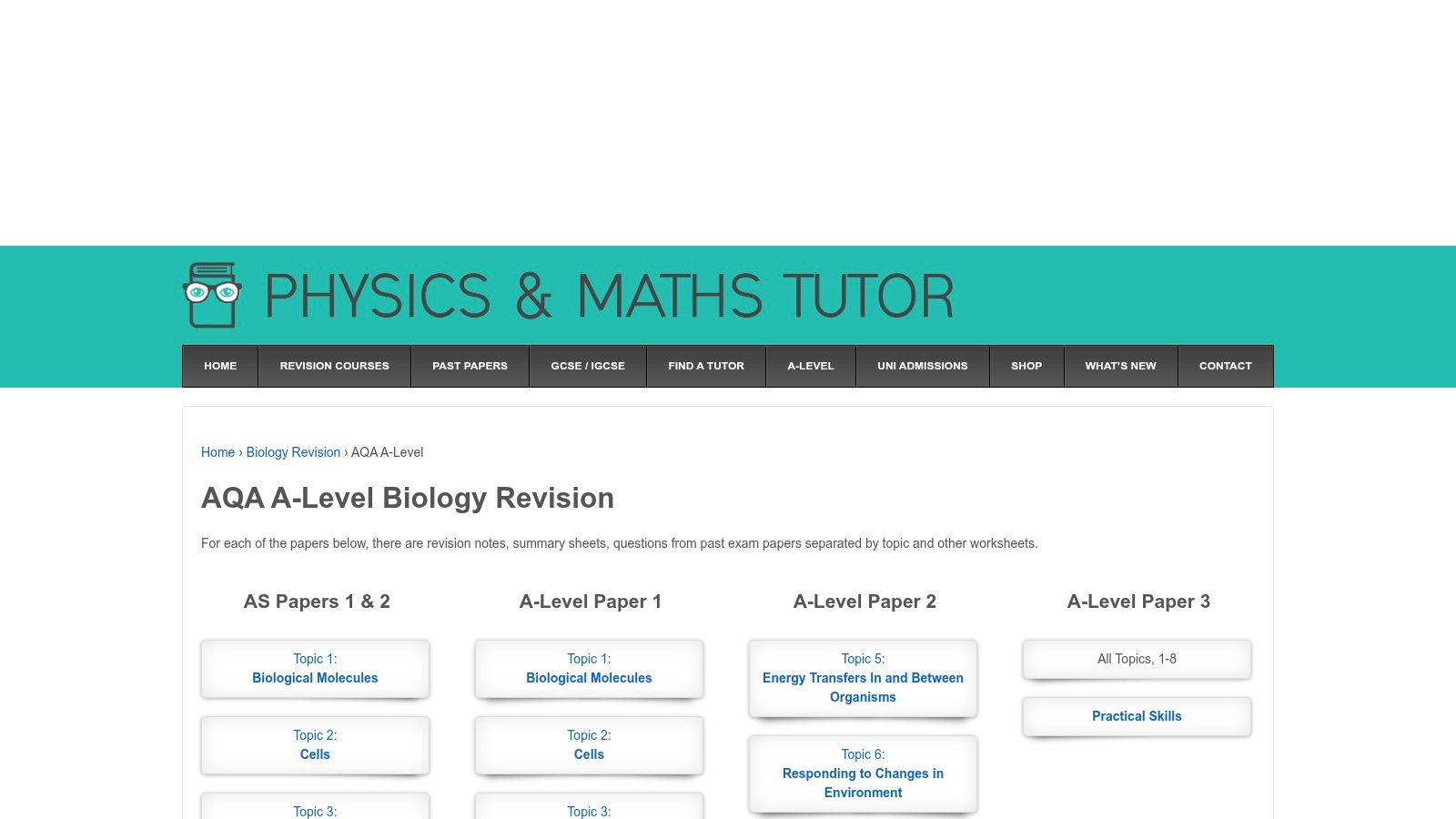
If you need to stop rereading and start answering questions, Physics & Maths Tutor's AQA Biology resources are a practical place to begin. The site brings together topic revision notes, summary sheets, topic-separated past-paper questions and practical-skills resources, so you can move from a quick content review into exam practice without hunting across multiple sites.
Best for a fast review-and-practise cycle
PMT's clear AQA topic structure makes it easier to find a specific area when you know what needs work. Choose a topic, read the notes actively, then attempt related questions with the notes closed. If you're revising exchange surfaces, for instance, draw the relevant structure from memory before you look at the explanation again.
The resource is free to access, and the direct route from notes to questions is its main strength. The trade-off is presentation: it's functional rather than interactive, and you'll need to check coverage against the current specification instead of assuming every note is complete.
Use it like this: Pick one weak subtopic, review the summary, then answer a related question before moving on. For more structured exam practice, try A-Level Past papers.
2. Save My Exams
When a short summary leaves you thinking, “I know the words, but I don't understand the process,” Save My Exams' AQA Biology notes offer a more detailed read. The notes are organised by AQA topic and include explanations, diagrams, definitions and exam guidance, with downloadable PDFs and related questions, flashcards and other revision resources.
Best for filling gaps in understanding
This can suit students who need more than a one-page recap. If a topic such as protein synthesis feels like a list of disconnected terms, use the diagrams and explanations to follow what happens, then close the PDF and explain the process in your own words. That last step matters: recognising a diagram isn't the same as being able to explain it in an exam answer.
The broad topic coverage is useful when you're working through both years of the course, but the amount of material can feel heavy if you only need a quick reminder. Some resources or features may also require a paid plan, so check what you can access before building your revision routine around them.
Turn the notes into marks
Don't treat a completed page as proof that you know the topic. Write a short question beside each section, answer it without looking, then practise a related exam question. Use Exam Practice for A-Level when you want to test how well your understanding holds up under exam-style conditions.
3. AQA Official Specification and Teaching Notes
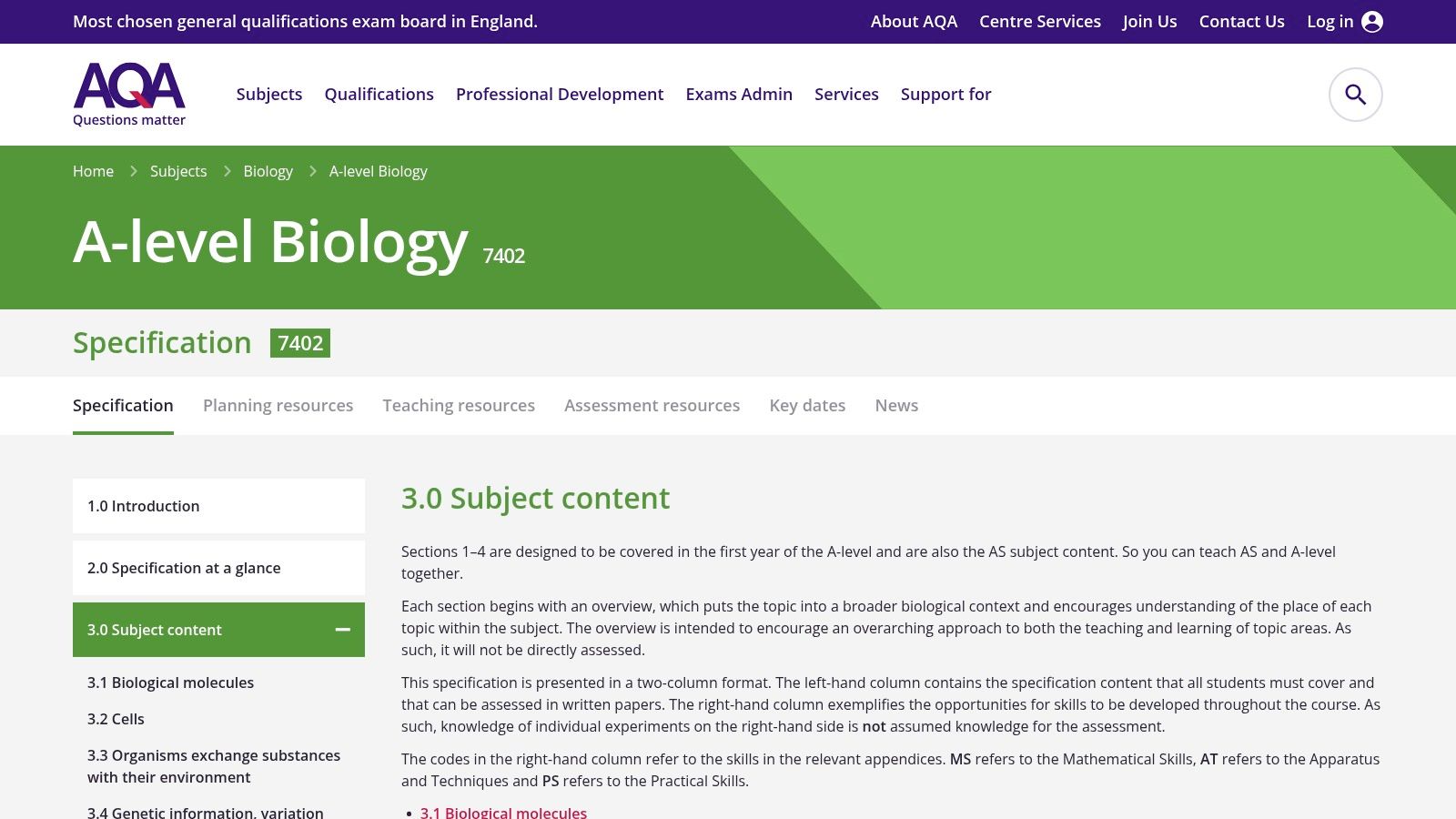
For a reliable answer to “Do I need to know this?”, go to AQA's official A-level Biology subject content. The specification gives the authoritative course requirements, including precise topic and subtopic wording. AQA also provides selected teaching notes and slides, which can help clarify particular areas.
Best for checking coverage, not learning from scratch
The specification isn't written like a friendly revision guide. It's a reference for checking what your notes cover, not necessarily the easiest place to learn a process for the first time. Teaching notes can add support, but they cover selected areas rather than serving as a complete set of student revision notes.
Try this when using any other resource: find the relevant specification point, then check whether your notes explain it clearly enough for you to recall and apply it. If a point is missing, add a brief note or ask your teacher which resource they recommend. Teachers can also use the specification wording to check that a polished-looking summary hasn't skipped a required detail.
Don't revise every sentence you find online. Revise what your course requires, then practise using it.
AQA's materials are free to access, and the specification is the final reference point when you're unsure about course coverage. You can also browse GCSE and A-Level subjects to find revision options across other courses.
4. Seneca Learning
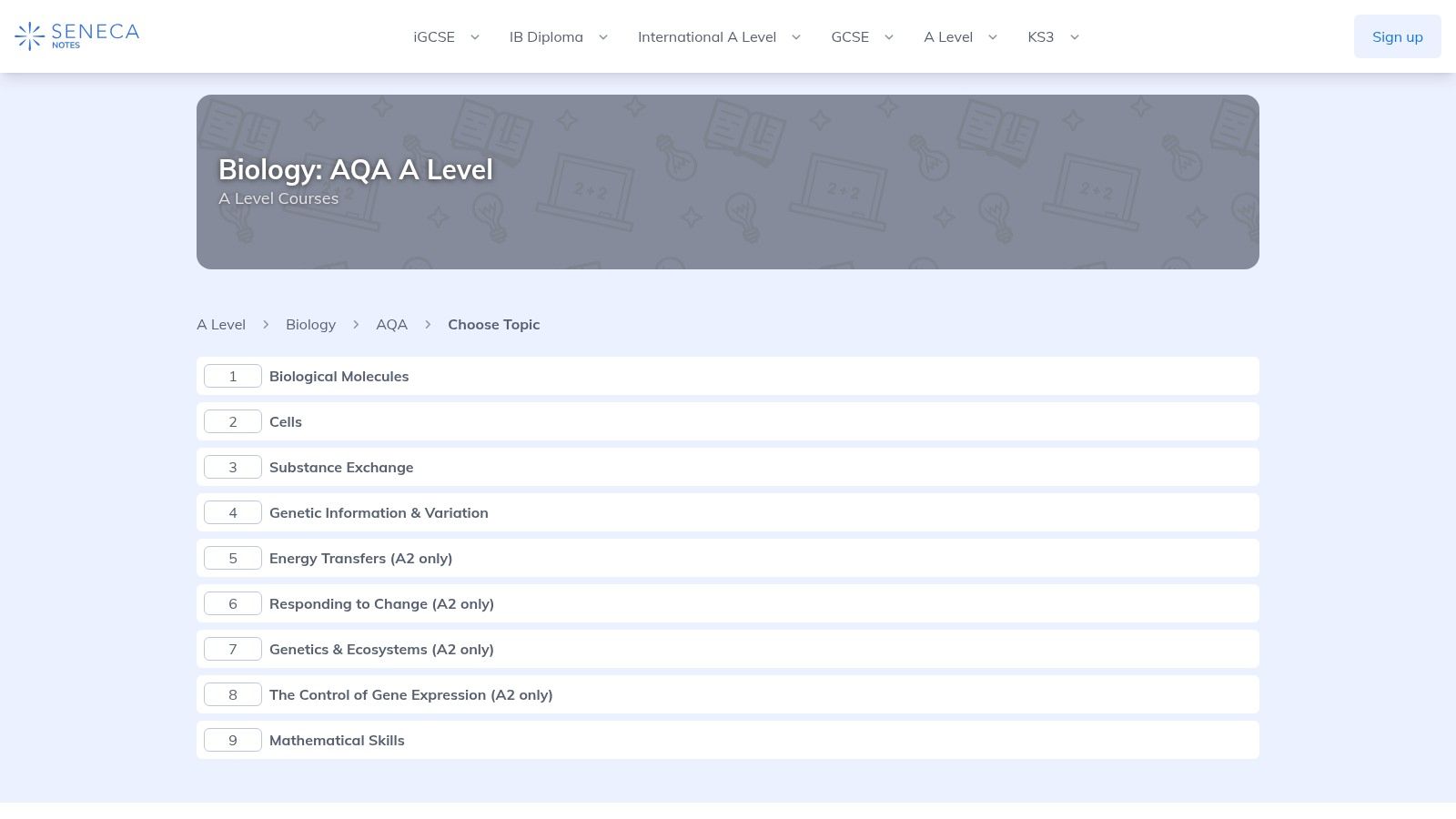
If a long PDF makes you switch off, Seneca Learning's AQA Biology course offers a different rhythm. It organises content by AQA topic and breaks study into short digital lesson sections, with topic tests and exam-style material for students who prefer interactive review to extended reading.
Best for short study sessions
A short lesson can be useful when you're tired, have a small gap between classes, or want to make a start on a topic you've been avoiding. Work through a section, answer the test questions, and note anything you guessed. Then return to those weak points in a longer session and explain them without the screen.
The interactive format encourages self-testing, while the AQA course structure makes topics easier to locate. But digital lessons may not replace detailed printable notes, especially if you want to annotate diagrams or build a full-page explanation. Access to particular features may depend on your account or plan, so check availability before relying on them.
Keep the session active
Don't click through just to finish a lesson. Pause before each answer and make a genuine attempt from memory. For extra practice alongside interactive revision, Online Revision for A-Level offers a route into exam-aligned study.
5. Dr Zoë Huggett Tutorials
Some students learn best from notes that explain a topic in a teacher's voice. Dr Zoë Huggett Tutorials offers AQA-focused downloadable Biology notes, free revision articles and tutoring, with options for Year 12, Year 13 and a complete set. The notes use explanations, key terminology and hand-drawn diagrams.
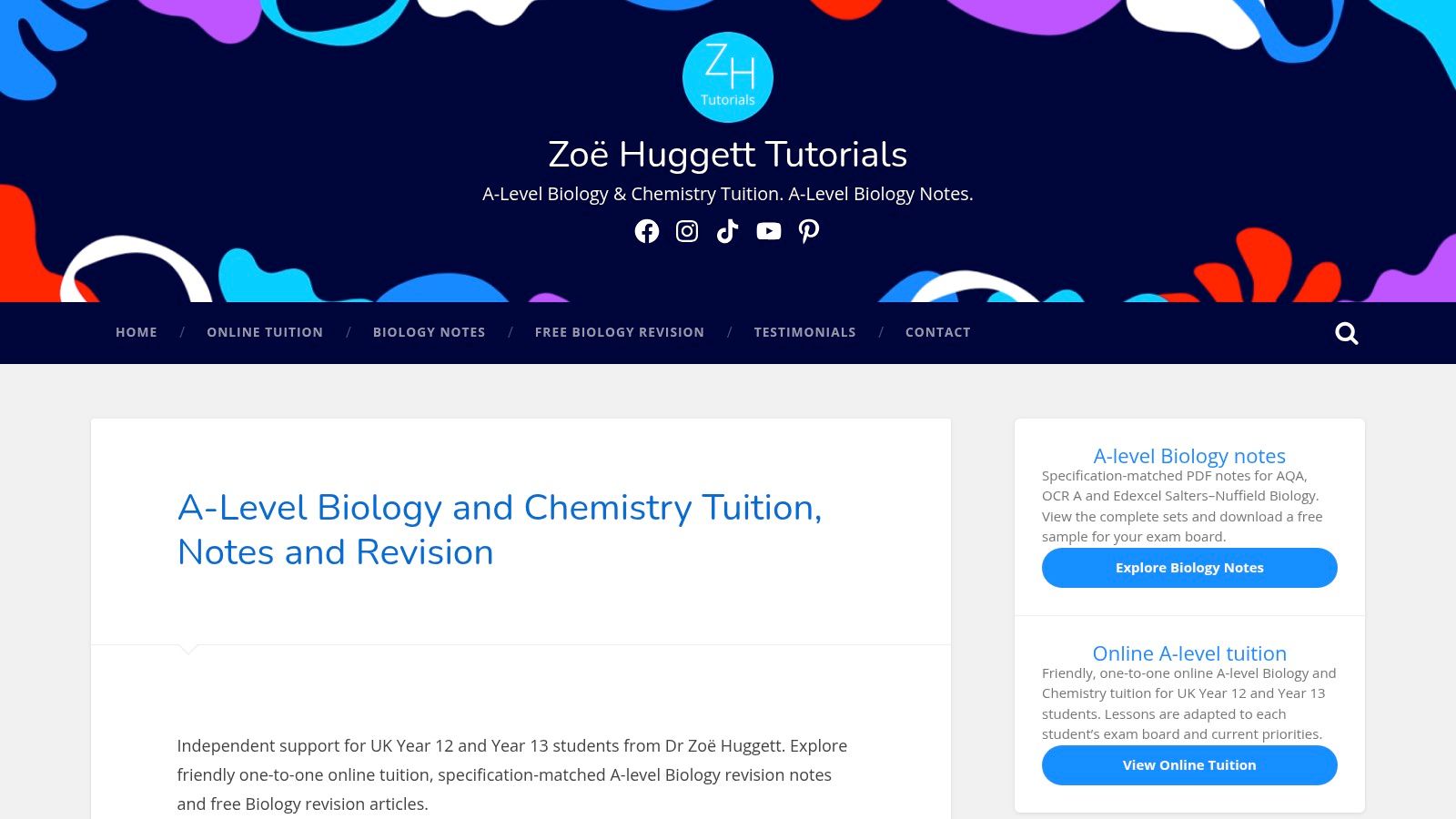
Best for a guided explanation
The choice of focused or full-course material is helpful if you're not ready to buy a whole set but want support with particular topics. Preview a sample first and see whether the language and diagrams make a difficult idea clearer for you. The site lists complete sets at £26, but check the current price and edition before buying.
A tutor-created resource can offer a more explanatory feel than a bare checklist. Still, notes are only one part of revision. After reading about a process, try to reconstruct it from memory, then answer questions that make you apply the idea in a different context.
Pair reading with practice
If a diagram helps you understand an idea, cover its labels and redraw it yourself. Then write a short explanation using the correct scientific terms. The full notes are paid, and you'll still need questions and past papers to practise application, data interpretation and exam technique.
6. Biology with Olivia
For students who learn by testing themselves, Biology with Olivia presents AQA-focused notes in a question-and-answer format. Concise bullet points, colour coding and diagrams make the material easier to scan, while common-mistake explanations and mark-scheme-informed guidance can help you notice where an answer needs more precise wording.
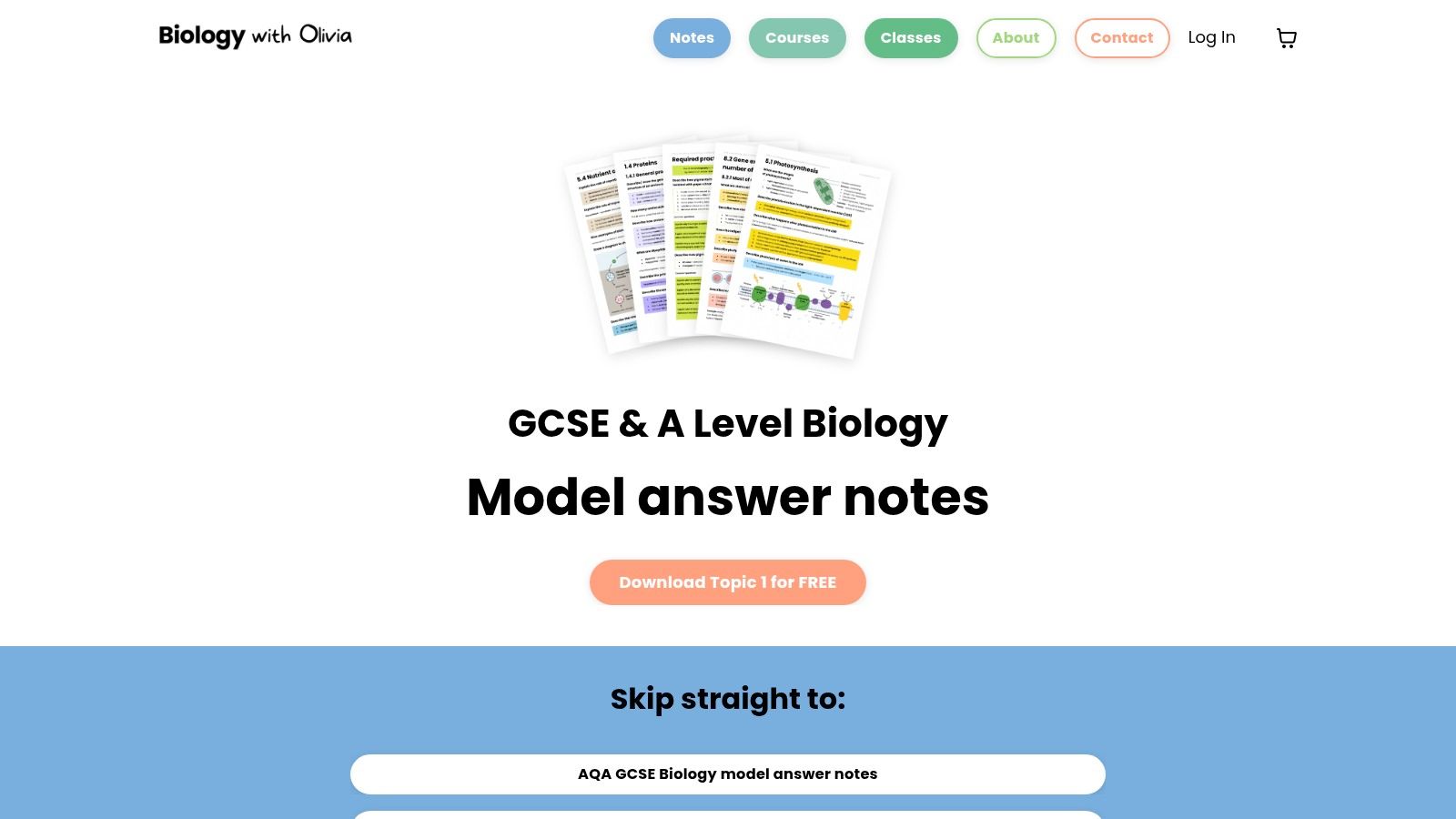
Best for recall prompts and misconception checks
A question-and-answer layout gives you a prompt to respond to instead of inviting you to reread passively. Cover the answer, try to explain it aloud or on paper, then check what you missed. If the notes flag a common misconception, turn it into a contrast question: what's the incorrect idea, what's the accurate explanation, and how would an exam question distinguish between them?
That kind of precision matters in Biology. AQA examiner reports discuss issues such as confusion between chance and probability, inaccurate use of statistical significance, and imprecise practical vocabulary. AQA's examiner report is a useful reminder that knowing a topic broadly isn't always enough if the wording is vague.
The notes are paid, and memorising them alone won't build application, data-analysis or exam-answer skills. Use each prompt as a starting point, then check whether you can handle a question with new data or an unfamiliar example.
7. MyEdSpace
Need to look up one detail without searching through a whole course pack? MyEdSpace's AQA Biology revision notes are arranged as a large library of topic pages and explanations across the course. The resources range from biological molecules to genetics and ecosystems, with teaching and examining expertise identified on the site.
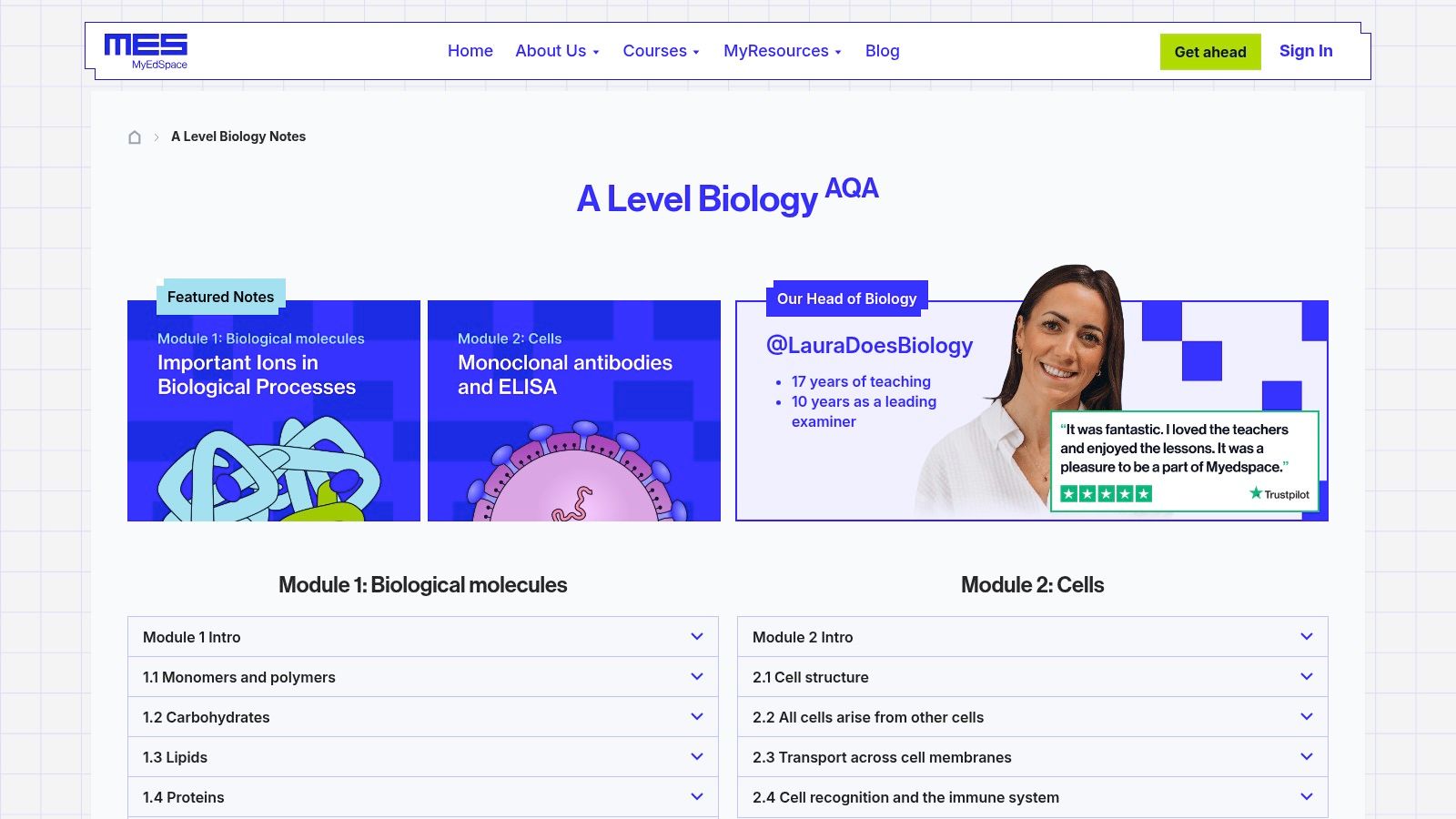
Best for targeted look-ups
A topic library can save time when you know exactly what you want to review. For example, if your notes on ecosystems make sense but you're unsure about a particular subtopic, go straight to that page rather than restarting an entire unit. The breadth also gives you room to read explanations, not just tick off a list of headings.
The trade-off is navigation. A broad library can take longer to browse than a condensed revision sheet, and some materials may require membership. Check the current access details before planning a session around a resource you may not be able to open.
Make a small note, not a second textbook
Use a page to answer a specific question: what part do you misunderstand, and what would a complete explanation include? After reading, write a compact answer from memory and compare it with the course requirements. That keeps your own notes useful instead of turning them into a second copy of the website.
8. Revisely
When you want to move between reading, watching and practising, Revisely's AQA Biology notes bring topic notes together with revision questions, video tutorials, past papers and mark schemes. That mix can help you keep one study session focused on a single topic while changing the way you work with it.
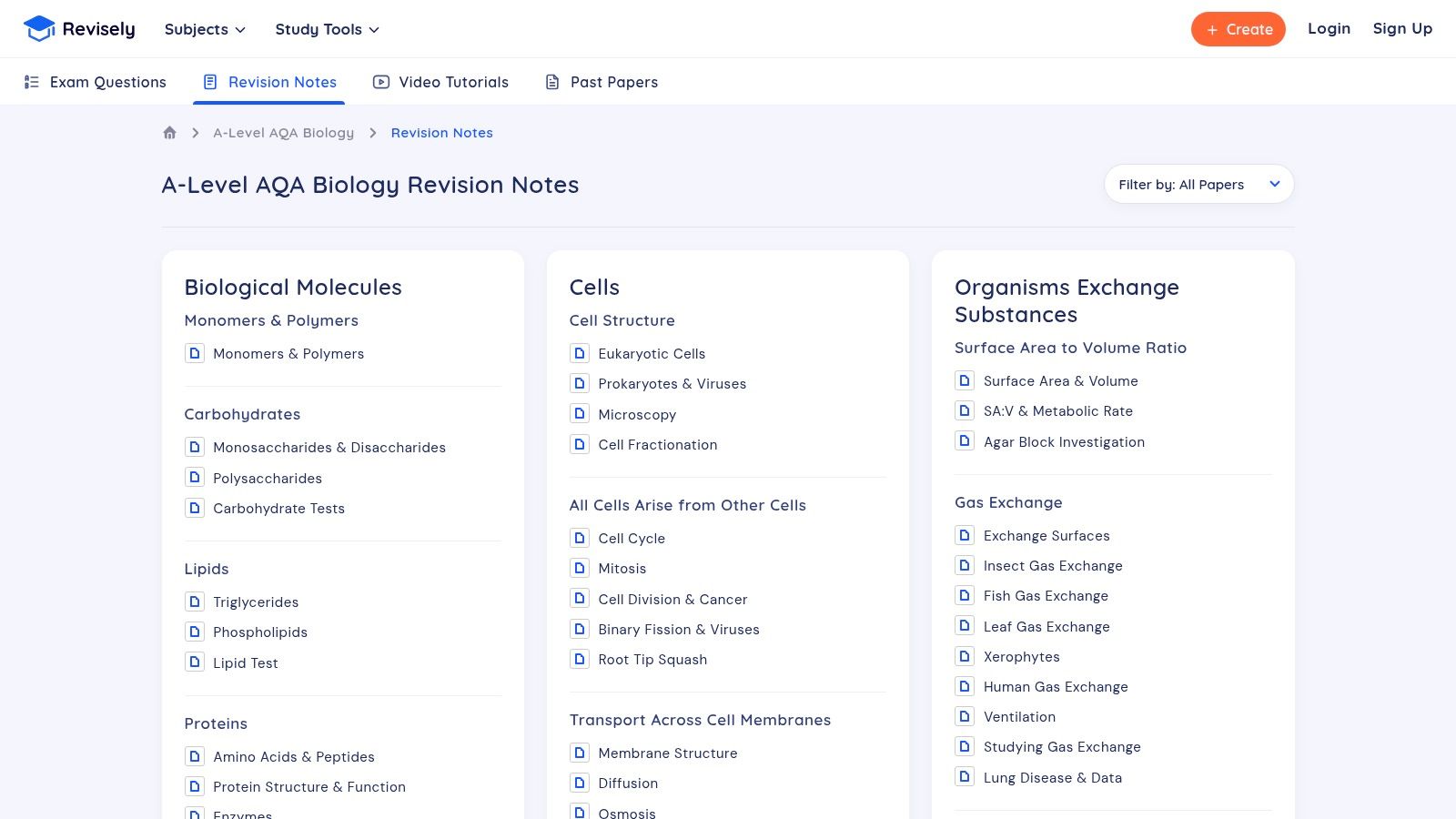
Best for changing format without losing your topic
Start with a short read, then use a video if the explanation hasn't clicked. Follow it with a question or a past-paper task, and check your answer against the mark scheme. That sequence gives you a chance to see whether a second explanation has helped, rather than assuming that familiarity means mastery.
Topic-based navigation makes it convenient to focus on a weak area. Still, compare coverage with the current AQA specification, and check whether the features you want are available without an account. A page titled for a topic isn't, by itself, proof that every specification detail is included.
Use the mark scheme to diagnose
When you mark an answer, don't only count lost marks. Identify whether the problem was missing knowledge, unclear terminology, a misread command word or weak interpretation of data. AQA describes command words such as describe, explain and evaluate as cues to different kinds of response, so practise shaping your answer around the task, not writing everything you remember. See AQA's guidance on command words.
9. InkBiology (Ink Learning)
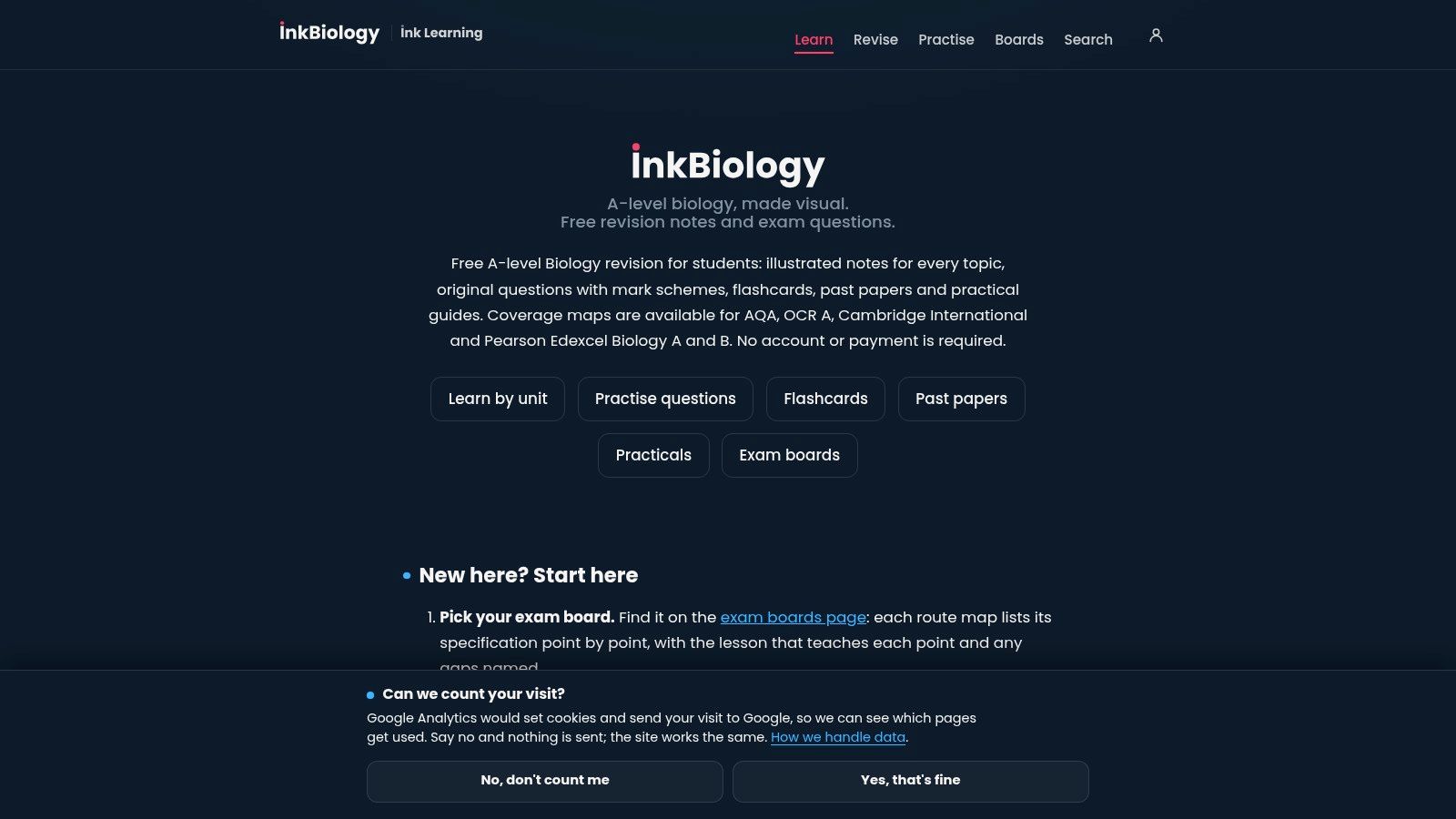
If diagrams and worked explanations help you build a mental picture, InkBiology offers illustrated lessons, practice questions, mark schemes, flashcards and practical-skills guidance. Its core materials are free to read and print, and you don't need an account to use those resources.
Best for combining explanation and active practice
The resource can support a useful loop: study an illustrated lesson, close it, draw or explain the process yourself, then try a question. Mark schemes make it easier to see which scientific terms your answer needs. Practical-skills guidance can also prompt you to think beyond biological theory and consider how an investigation is carried out and evaluated.
InkBiology's unit sequence doesn't follow AQA's specification order exactly. Use its AQA coverage maps to find aligned material and spot potential gaps, then check the official specification before treating a unit as complete. The content can support AQA revision, but the map is part of using it carefully.
Practical rule: For every topic, keep a short “still need to check” note beside your study materials. Clear that note against the specification before moving on.
10. School Ninja
For a student who wants to focus on one small area instead of opening a whole-course file, School Ninja's AQA Biology notes split revision into smaller topic pages. The site also places notes alongside past papers, topic questions and flashcards, which can help you build a focused study session around one subject area.
Best for a small, specific target
Choose one page because you have a clear reason to review it: perhaps you can't explain a process, you keep mixing up two terms, or you want another question on a topic you've already covered. Read only what you need, then test yourself with a flashcard or topic question. If you still can't explain the idea without looking, keep it on your list for another review.
The format may suit students who prefer small steps, but the notes are spread across many pages rather than presented as one complete set. Check the site for current access requirements and free availability before you rely on it for a full revision plan.
Keep the specification in view
Use the AQA course outline to confirm that you've covered the required content, and use the smaller pages as a way to review or practise particular points. The specification expects students to handle practical and mathematical assessment as part of Biology, not as optional extras. AQA's practical-assessment guidance explains why good revision should include methods, variables, controls, sources of error and data handling as well as theory.
10 AQA A-Level Biology Notes Resources Compared
| Resource | Core Features | AQA Alignment & Practice | Best For | Price & Standout Value |
|---|---|---|---|---|
| Physics & Maths Tutor (PMT) | Topic notes, summary sheets, topic questions, practical-skills resources | AQA-organised; supports review followed by exam-style practice | 👥 Students wanting a straightforward, topic-based revision hub | 💰 Free; ★ easy to move from notes to questions |
| Save My Exams | Detailed notes, diagrams, exam tips, PDFs, questions and flashcards | Focused on AQA Biology 7402; broad topic coverage | 👥 Learners who want detailed explanations and varied resources | 💰 Some features may require a paid plan; ✨ downloadable notes |
| AQA Official Specification and Teaching Notes | Specification, topic wording, selected teaching notes and practical requirements | 🏆 Authoritative course reference; teaching notes cover selected areas | 👥 Students checking course requirements or resource coverage | 💰 Free; ✨ most reliable source for specification content |
| Seneca Learning | Short digital lessons, topic tests and exam-style material | AQA course structure with interactive self-testing | 👥 Students who prefer short, digital study sessions | 💰 Feature access may depend on plan; ✨ bite-sized lessons |
| Dr Zoë Huggett Tutorials | PDF notes, diagrams, terminology, free articles and samples | AQA-specific; Year 12, Year 13 and complete-set options | 👥 Learners seeking tutor-created notes | 💰 Complete sets listed at £26; check current pricing; ✨ sample available |
| Biology with Olivia | Q&A notes, diagrams, practical content and common-mistake guidance | AQA-focused; supports recall, but should be paired with application practice | 👥 Students who benefit from prompts and visual notes | 💰 Paid notes; ✨ mark-scheme-informed guidance |
| MyEdSpace | Topic notes and explanations across a broad range of subtopics | AQA-organised; broad course coverage | 👥 Learners looking up specific topics in depth | 💰 Some materials may require membership; ✨ extensive topic library |
| Revisely | Topic notes, questions, videos, past papers and mark schemes | AQA topic structure; supports moving from review to practice | 👥 Students wanting multiple revision formats in one place | 💰 Check account requirements; ✨ notes, videos and practice together |
| InkBiology (Ink Learning) | Illustrated lessons, questions, mark schemes, flashcards and practical guidance | Includes AQA coverage maps, but its sequence differs from AQA | 👥 Learners wanting free explanations and active practice | 💰 Core resources free; ✨ no account required for core materials |
| School Ninja | Topic notes, past papers, questions and flashcards | AQA topic pages; check current coverage and access details | 👥 Students focusing on a specific topic | 💰 Check current availability; ✨ related practice formats alongside notes |
Your 4-Week Plan to Turn Notes Into Grades
Reading is not revising. A page can look familiar because you've seen it repeatedly, while your memory still goes blank when you need to explain the process or apply it to new data. Build a routine that makes you retrieve, use and check what you know.
Week one, find the gaps. Choose a topic and compare your notes with the specification. Mark points you can explain, points you only recognise, and points you can't explain yet. Start with a small target, such as a mechanism, a set of key terms or one practical method, rather than trying to rewrite a whole topic.
Week two, practise recall. Close the notes and blurt a summary from memory. Draw a diagram, explain a sequence aloud, or write definitions without peeking. Open your notes afterwards and correct errors in a different colour. Turn repeated mistakes into direct questions so you can test them again without relying on recognition.
Week three, apply the biology. Attempt timed topic questions and mark them. Don't just record the mark: name the reason you lost it. Was the science wrong, the terminology vague, the command word misread, or the data interpreted poorly? Use the relevant AQA notes to repair that specific gap, then try another question without looking at the correction.
Week four, mix and review. Combine topics instead of revising each one in isolation. Practise questions that make you choose what knowledge is relevant, and revisit earlier mistakes alongside newer material. Keep practical methods, calculations, data interpretation and extended writing in the rotation. AQA's assessment guidance describes a significant role for application and analysis as well as knowledge, so notes need to prepare you for more than recall; see AQA's scheme of assessment.
Use MasteryMind as one option for AQA-aligned practice, including specification-focused questions and feedback that can help you identify gaps. Keep your teacher's guidance, the official specification and your own marked work in the loop. The aim isn't to collect more notes. It's to get better at answering the question in front of you.
MasteryMind offers AQA A-level Biology revision with specification-aligned practice questions that can adapt to knowledge gaps. If you want to practise command words, revisit weak topics and get examiner-style feedback, visit MasteryMind and explore the free plan.
Choose your next course task
Use this idea with Biology B. Confirm the qualification, awarding organisation and course version before choosing practice, assignment preparation or evidence planning.
Choose your Biology B course