AQA as Level Computer Science: A Revision Guide for 2026

You can recite what a binary search does. You've highlighted the notes, watched the videos and made the flashcards. Then you open a mock paper, meet an unseen trace table, and the marks leak away.
That gap is common, and it's fixable. You're not short of facts. You're short of a clear view of how AQA AS Level Computer Science turns facts into marks. This guide shows you how each mark is earned, paper by paper, command word by command word, so you can revise for the exam you'll sit. Teachers can check the numbers, too. Where figures clash or need confirming, we'll say so.
The AQA AS Computer Science Exam at a Glance
A student can explain binary search in class, then lose marks by spending too much revision time on programming and too little on other parts of the course. A paper-by-paper view helps you spread your effort according to where the marks sit.
The AQA AS Computer Science specification, code 7516, was first taught from September 2015, with the first AS examinations and certification in May/June 2016. It is linear: you take both papers in the same May/June exam series.
| Paper | Length | Marks | Share of qualification | Covers |
|---|---|---|---|---|
| Paper 1 (on-screen) | 1 hour 45 minutes | 75 | 50% | Programming plus theory from areas 1 to 4 |
| Paper 2 (written) | 1 hour 30 minutes | 75 | 50% | Theory from areas 5 to 9, with extended response |
| Total | 3 hours 15 minutes | 150 scaled marks | 100% | Linear, one May and June series |
Each paper carries half the qualification marks. That makes the balance practical as well as numerical: strong programming cannot make up for leaving Paper 2 topics untouched. Paper 1 asks you to reason through programming problems; Paper 2 asks you to explain ideas in writing, including in longer answers.
Nine Topic Areas and Where Each One Is Tested
A revision plan built on chapter headings from a textbook will mislead you. Build it on the nine areas and the paper each one sits on. That tells you what kind of question to expect and what skill to practise.
Areas 1 to 4 on Paper 1
Area 1, fundamentals of programming, covers selection, iteration, arrays and functions. You'll trace code you haven't seen, predict outputs and write short routines. If you can only follow code you've been taught, this area will catch you out.
Area 2, fundamentals of data structures, covers records, stacks, queues, linked lists, trees and graphs. Questions often give you a scenario and ask you to pick a structure and justify it. A name alone won't score. You need the reason it fits.
Area 3, systematic approaches to problem solving, covers decomposition, searching, sorting and complexity. Area 4, theory of computation, covers finite state machines, Backus-Naur form and the limits of computation. One asks you to break a problem down and compare methods. The other asks you to work with formal models, such as completing a state diagram.
Areas 5 to 9 on Paper 2
Area 5, data representation, is binary, hexadecimal, character sets and compression. It's exact work where one dropped bit loses the mark. Area 6, computer systems, covers the CPU, the fetch-decode-execute cycle and Boolean logic. Area 7, computer organisation and architecture, covers memory, instruction sets and assembly language.
Area 8, consequences of using computing, covers legal, ethical, environmental and privacy issues. Area 9, communication and networking, covers protocols, layers and topologies. These areas reward written explanation more than calculation, and vague answers earn little.
| Topic area | Paper | What to know | Typical question |
|---|---|---|---|
| 1. Fundamentals of programming | Paper 1 | Selection, iteration, arrays, functions | Trace an unseen algorithm and give the output |
| 2. Fundamentals of data structures | Paper 1 | Records, stacks, queues, linked lists, trees, graphs | Choose and justify a structure for a scenario |
| 3. Systematic approaches to problem solving | Paper 1 | Decomposition, searching, sorting, complexity | Compare two algorithms for speed or memory |
| 4. Theory of computation | Paper 1 | Finite state machines, Backus-Naur form, limits of computation | Complete or draw a state diagram |
| 5. Data representation | Paper 2 | Binary, hexadecimal, character sets, compression | Convert between bases or work out a bit pattern |
| 6. Computer systems | Paper 2 | CPU, fetch-decode-execute, Boolean logic | Complete a truth table or describe the cycle |
| 7. Computer organisation and architecture | Paper 2 | Memory, instruction sets, assembly | Explain how an instruction is executed |
| 8. Consequences of using computing | Paper 2 | Legal, ethical, environmental and privacy issues | Discuss the impact of a named system |
| 9. Communication and networking | Paper 2 | Protocols, layers, topologies | Describe how data travels across a network |
Notice the two skill types. Programming skills, writing and tracing code in your centre's language, live mainly in areas 1 to 3. Non-programming skills, binary and hex conversion, truth tables and written explanation, live mainly in areas 5 to 9. You need both, and they need different practice.
Do this first: Mark the two areas that feel least familiar in the table, then start there, not with the area you enjoy most.
How the Marks Split Across AO1, AO2 and AO3
A student can memorise a definition and still lose marks when a question asks them to use it. The assessment objectives show why: they reward recall, application and problem solving in different proportions.
AO1 tests knowledge and understanding. AO2 tests how well you apply that knowledge to a given example, including in calculations. AO3 tests analysis, evaluation and problem solving, often in unfamiliar situations.
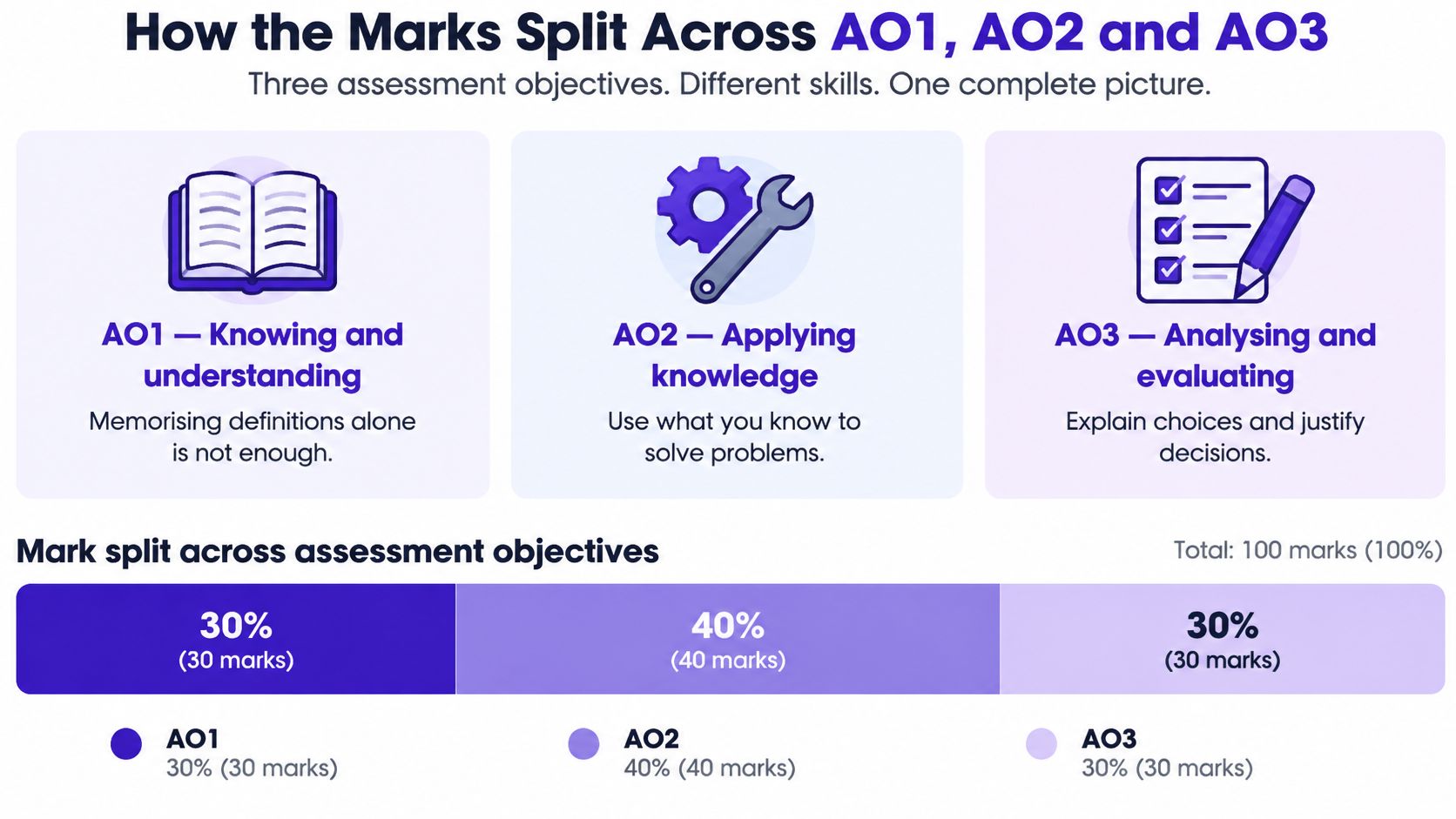
The Whole Qualification
AQA's scheme of assessment for AS Computer Science 7516 sets AO1 at approximately 35%, AO2 at 35% and AO3 at 30%. These weightings are approximate and can shift between series, so check the current scheme before quoting them.
Together, AO2 and AO3 account for roughly two-thirds of the marks. Knowing a definition is only the first step. You also need to apply it to a question and show how you reach or justify an answer.
The Split by Paper
Paper 1 carries approximately 7% AO1, 16% AO2 and 27% AO3. Paper 2 carries approximately 28% AO1, 19% AO2 and 3% AO3.
That makes the papers ask for different strengths. Paper 1 places more weight on problem solving, while Paper 2 places more weight on recall and application. Practise both rather than assuming strength in one paper will carry over to the other.
If Paper 1 is going well but Paper 2 is not, extra coding practice may not address the gap. Try short, regular recall checks on areas 5 to 9, then use questions to practise applying that knowledge. Keep a timed problem-solving task in your routine for Paper 1.
Command Words and What Earns Each Mark
A question asks you to compare two search methods. If you describe each one separately, the examiner must work out the comparison for you. Start by identifying the command word, then shape each point to match it.
Describe asks what happens or what something is. Give accurate points in a sensible order. Extra reasons do not answer the command and can waste time.
Explain asks why or how. Link a cause to its effect. “The list is sorted” is a fact; explaining how that lets binary search narrow the search earns the mark.
Compare asks you to use the same criteria for both items. Pair each point, such as speed or suitability, rather than writing two separate descriptions.
Discuss asks for more than one side of an issue. Support the different viewpoints. Evaluate asks you to judge how well something works in its stated context. Weigh strengths against weaknesses and reach a conclusion.
| Command word | What the question wants | What earns the mark | Common slip |
|---|---|---|---|
| Describe | What happens or what something is | Accurate, specific points in logical order | Adding reasons nobody asked for |
| Explain | Why or how something happens | A reason linked to a consequence with because and so | Stating the fact without the link |
| Compare | Similarities and differences on set criteria | Each point covers the same criteria for both items | Describing one item fully, then the other |
| Discuss | More than one side of an issue | At least two viewpoints, each supported | A one-sided list with no judgement |
| Evaluate | How well something works in a context | Strengths and weaknesses weighed, then a conclusion | Listing points without reaching a judgement |
AQA's assessment resources for AS Computer Science 7516 include past papers, mark schemes, examiner reports and exemplar answers. Use the mark scheme to check what credit is given for each point, and the examiner report to see common weaknesses. You can also browse AQA mark schemes.
Turning a Fact Into a Mark
Take this question: explain why binary search is more efficient than linear search on a sorted list. “Binary search is faster” gives a conclusion without explaining it.
A stronger answer states that each comparison halves the search space, so fewer comparisons are needed. It also connects the method to the question's condition: binary search works here because the list is already sorted. The command word sets the task; the marks come from showing the reason and linking it to the context.
How to Trace Algorithms and Solve Binary and Hex Questions
These questions look unforgiving, but they're the most learnable marks on the paper. Follow the same steps every time and the errors drop away.
The process below splits the work into tracing on one side and number conversion on the other.
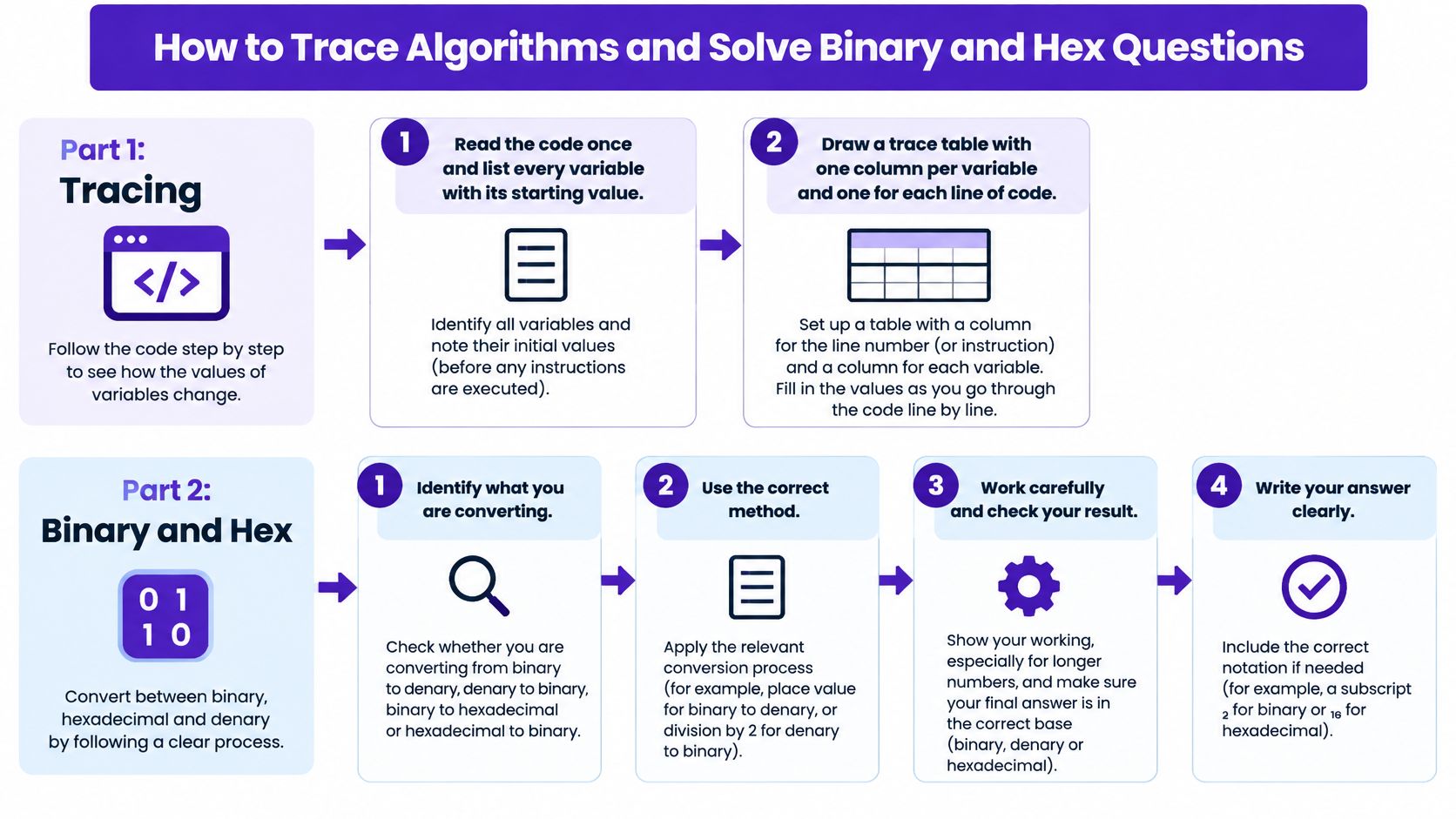
Part One Tracing
- List the variables: Read the code once and write down every variable with its starting value.
- Draw the table: Give each variable its own column, plus one column for output.
- Go line by line: Write a new value only when it changes.
- Track the loop: Note the counter and the condition on every pass, not just the first.
- Check the end: Compare your final output with what the question asked for.
Here's a small example. A variable called total starts at 1. A loop runs five times, and each pass doubles total. Your table shows 1, then 2, 4, 8, 16 and 32. The final value is 32, because five doublings means multiplying by two five times. If you'd guessed, 10 or 16 would look tempting. The table stops you guessing.
Watch the worked demonstration below, then try the same steps without pausing it.
Part Two Binary and Hex
- Split into nibbles: Break an 8-bit number into two groups of four bits.
- Read each nibble: Each group is one hex digit, so 1011 0110 becomes B6, which is 182 in denary.
- Add with carries: When two bits sum above 1, carry into the next column and check for overflow beyond 8 bits.
- Use two's complement for negatives: Invert every bit and add one, so 0000 0101, which is 5, becomes 1111 1011.
Check that conversion yourself. B is 11, and 11 times 16 is 176. Add 6 and you get 182. If your two routes disagree, you've made an arithmetic slip, not a concept error, and you can find it.
Three mistakes cost most marks here. Students drop a carry and carry on regardless. They forget a loop variable updates before the condition is tested again. They mix up 0-based and 1-based indexes, so the first array element shifts by one. Each one is a habit, and habits can be retrained with timed practice such as Exam Practice for A-Level.
Trace slowly on paper first. Speed comes from a method you trust, not from rushing the steps you skip.
Your language matters too. AQA's June 2024 mark scheme for Paper 1 states the paper applies to programming languages A, B, C, D and E, identified elsewhere as C#, Java, Python and VB.NET. Practise in the language your centre uses. Python lists, loop syntax and input handling don't match C# or Java, and copied examples in the wrong syntax will teach you the wrong reflexes.
Grade Boundaries to Benchmark Your Mock Results
A mark of 50 means different things on different papers. Compare each mock score with the boundary for that paper, then use the result to decide what to practise.
AQA's June 2025 published grade boundaries report grades for the two 75-mark papers separately, alongside the combined 150-mark total. These were the paper-level boundaries:
| Grade | Paper 1 (C# route) | Paper 2 |
|---|---|---|
| A | Not listed | 75 |
| B | 57 | 57 |
| C | 49 | 50 |
| D | 41 | 43 |
| E | 33 | 35 |
| U | 25 | 25 |
Grade boundaries can change between exam series because the papers and cohort results vary. Treat these figures as a benchmark for a mock, not a prediction of your final grade.
How to Use Your Mock Score
Mark each paper against its mark scheme and record the scores separately. For example, 50 out of 75 on Paper 2 reaches grade C in June 2025. One mark fewer, 49, falls below the C boundary and reaches grade D.
Then look at where marks went missing. If Paper 1 is the weaker score, identify whether programming questions or command words caused the problem. If Paper 2 is weaker, check which topics need more recall practice.
A Revision Roadmap and Past Paper Plan
Random revision feels busy and changes little. Work through four phases in order, and let a resit stretch phase 2 if you have more weeks.
The timeline below shows the four phases from first diagnostic to final review.
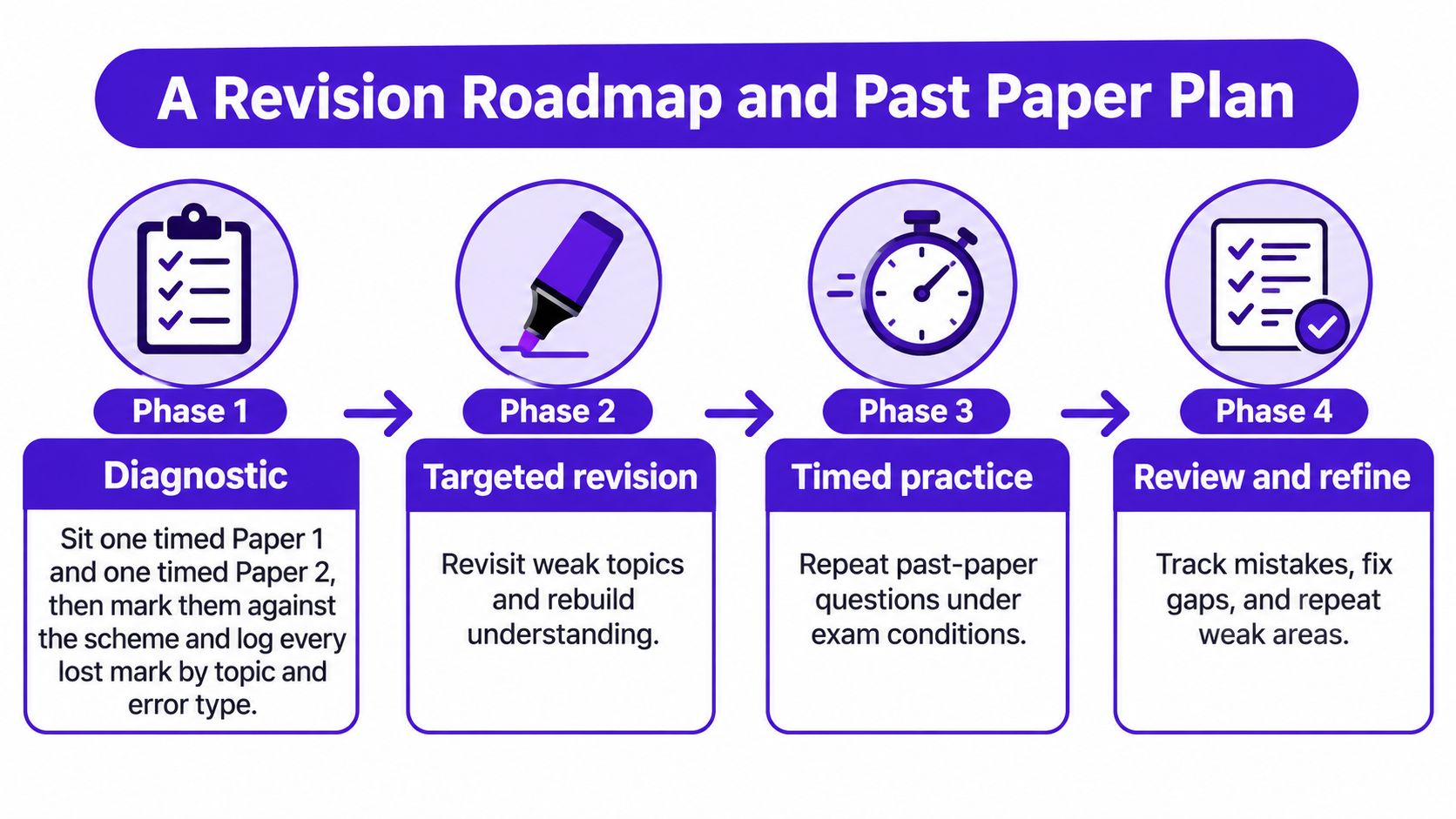
- Diagnostic: Sit one timed Paper 1 and one timed Paper 2, mark both against the scheme and log every lost mark by topic and assessment objective.
- Targeted repair: Spend most time on your two weakest areas, with short recall checks most days and worked traces twice a week.
- Mixed practice: Move to full timed papers that mix topics, and keep a list of command words you misread.
- Final stretch: Redo every question that lost marks, read examiner reports for the hardest ones and sit one last full paper.
Past papers only help if you mark them properly. Use A-Level Past papers, mark each answer against the scheme rather than your memory, then rewrite it in the scheme's wording. If you use a practice platform, check its feedback follows the official mark scheme and reports marks by assessment objective. Treat those marks as provisional until your teacher confirms them.
Turn the Plan Into Practice This Week
You don't need more content this week. You need one decision and one finished action, based on your phase 1 diagnostic.
Run three checks first. Confirm the paper lengths and marks on the current AQA specification. Confirm which Paper 1 programming language your centre uses. Confirm with your teacher what help is allowed before you upload any assessed work anywhere. Skipping those checks can waste weeks of well-meant effort.
Then act. Pick one answer from your weakest topic. Mark it against the scheme, mark by mark. Rewrite it so the command word's job is done. That's one page of work, and it teaches you more than rereading a whole topic.
For steady practice alongside your teacher's marking, Online Revision for A-Level can help, since MasteryMind offers practice for GCSE and A-Level courses. Pro marks unlimited exam-style answers, typed or handwritten, against the mark scheme. Be honest about the limit. Platform marks are a guide, and your teacher's marking settles the result.
Which paper will you start with, and what will you check first?
Start with one traced algorithm or one rewritten answer this week, then build from there with AQA-aligned practice and mark scheme feedback at MasteryMind. Bring your weakest topic, work through exam-style questions for AQA AS Level Computer Science, and check your marks by assessment objective before your next mock.
Choose your next course task
Use this idea with Computer Science. Confirm the qualification, awarding organisation and course version before choosing practice, assignment preparation or evidence planning.
Choose your Computer Science course