AQA Biology a Level Revision: A Practical Guide

You've got a stack of notes, half-finished flashcards and the uncomfortable feeling that you should have started revising weeks ago. Or perhaps you have been revising consistently, but your marks still stop short of the grade you want. AQA Biology A-level revision becomes much more manageable when you stop treating it as a race through every page of a textbook and start treating it as a design problem: which skills earn marks, where are they assessed, and what evidence shows that you can use them?
The AQA Biology specification is broad, but the exam rewards more than knowing facts. You need to recall precise biology, apply it to unfamiliar situations, interpret data, evaluate methods and write extended arguments. The plan below is designed for students catching up and students pushing towards an A*, while still being practical enough for teachers to recognise as sound exam preparation.
Why AQA Biology A Level Revision Needs a Strategy Not Just Hours
The first reality check is the assessment structure. AQA's current Biology 7402 qualification is linear, with three written papers rather than separate modular exams. Paper 1 covers topics 1 to 4, Paper 2 covers topics 5 to 8, and Paper 3 covers all topics alongside practical skills, as set out in the AQA specification overview.
Paper 1 lasts 2 hours and carries 91 marks, worth 35% of the A-level. Paper 2 also lasts 2 hours, carries 91 marks and is worth 35%. Paper 3 lasts 2 hours, carries 78 marks and is worth 30%. The whole qualification therefore totals 260 marks, not 273. Paper 3 also contains a 25-mark essay, so extended scientific argument can't be treated as a last-minute extra.
| Assessment component | Marks available | Approximate share | Revision priority |
|---|---|---|---|
| Paper 1 | 91 | 35% | Content, application and practical questions |
| Paper 2 | 91 | 35% | Content, application and practical questions |
| Paper 3 | 78 | 30% | Synoptic thinking, practical work and essay writing |
| Full qualification | 260 | 100% | Balanced preparation across all papers |
AQA's assessment objectives are AO1 35%, AO2 35% and AO3 30%, with at least 15% of the overall assessment focused on practical work-related knowledge, skills and understanding, according to this assessment objective breakdown. In plain English, direct recall is only one part of the job. Application, analysis and evaluation together represent the larger challenge.
Practical rule: Don't measure a revision session only by pages covered. Measure it by answers produced, marks recovered and mistakes explained.
Students often spend equal time on every topic because equal coverage feels safe. It isn't always efficient. A difficult data question, a practical-method review or a timed essay may create more useful exam practice than another passive reread of a familiar chapter. If you're using a GCSE spaced repetition method, adapt the same principle for A-level Biology by returning to weak material before it feels comfortable.
Mapping the 7402 Specification by Mark Weight
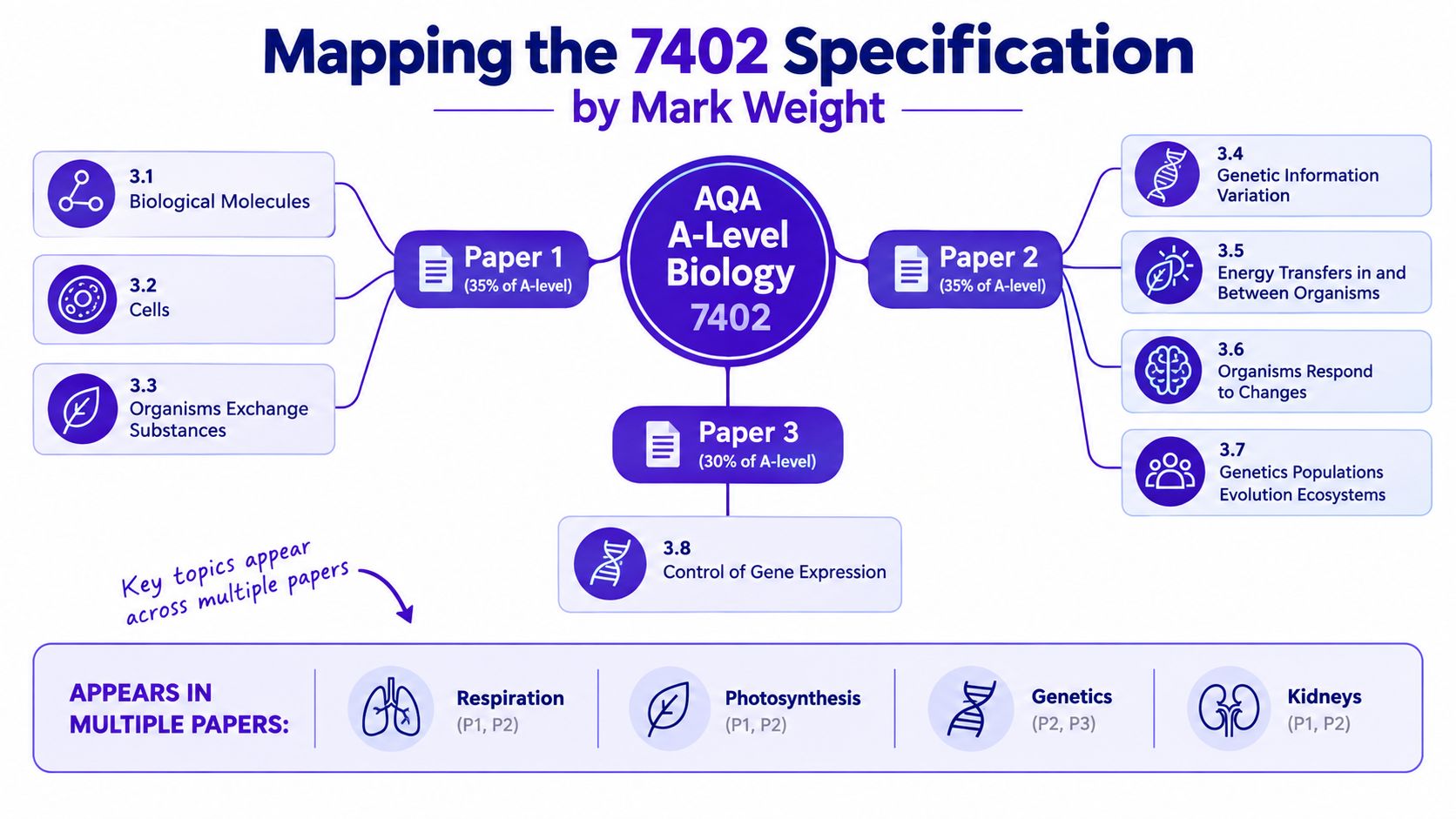
AQA organises Biology 7402 around 8 content areas. The paper structure gives you a useful first map:
- Paper 1: Biological molecules, Cells, Organisms exchange substances with their environment, and Genetic information, variation and relationships between organisms.
- Paper 2: Energy transfers in and between organisms, Organisms respond to changes in their internal and external environments, Genetics, populations, evolution and ecosystems, and Control of gene expression.
- Paper 3: All content areas, plus practical skills and synoptic questions.
The official paper allocation matters, but it shouldn't tempt you into believing that a topic belongs to only one exam. Respiration, photosynthesis, genetics and kidney function can be used in questions that require links across areas, particularly where Paper 3 asks you to combine knowledge with practical interpretation or evaluation.
The specification also tells you where short recall stops being enough. AQA allocates 38 marks to structured questions including practical techniques, 15 marks to critical analysis of experimental data, and 25 marks to one essay, as reported in the AQA results statistics and assessment material. That creates a substantial revision priority around method, data and extended writing.
A sensible weighting logic looks like this:
- Single-paper content still needs secure coverage, but it can receive a defined block of revision time rather than endless revisiting.
- Content appearing across papers, such as homeostasis or ecosystems, deserves repeated retrieval in different contexts.
- Practical knowledge should run through the timetable as a separate thread. Required practicals support questions on variables, controls, uncertainty, validity, improvements and data interpretation.
- Essay themes need deliberate practice because knowing eight topics doesn't automatically produce a coherent argument.
AQA requires 12 required practical activities, including work such as an enzyme-rate investigation, mitosis squash preparation and a water potential calibration curve, as explained in the AQA practical assessment guidance. Don't file these activities away as classroom memories. Turn each into a one-page recall sheet containing the aim, variables, method, safety, expected pattern, limitations and possible improvements.
Building Your Weekly Revision Timetable
A timetable works when it protects the activities you avoid. For most students, that means data questions, practical analysis and timed writing, not another colourful summary sheet.
Use a 12-hour revision week as a planning model, then scale it to your actual life. A workable split is:
- Content rebuilding: 4 hours for weak areas, using the specification and concise notes.
- Active recall: 3 hours of flashcards, blurting, diagrams and verbal explanations.
- Exam practice: 4 hours of timed structured questions, data questions and essays.
- Review and planning: 1 hour to mark work, classify errors and set the next targets.
A 90-minute block can contain three focused periods with short breaks. Start with a retrieval warm-up, complete a focused content task, then finish by producing an exam answer. The order matters because you don't want a session that ends with recognition. You want it to end with evidence that you can perform.
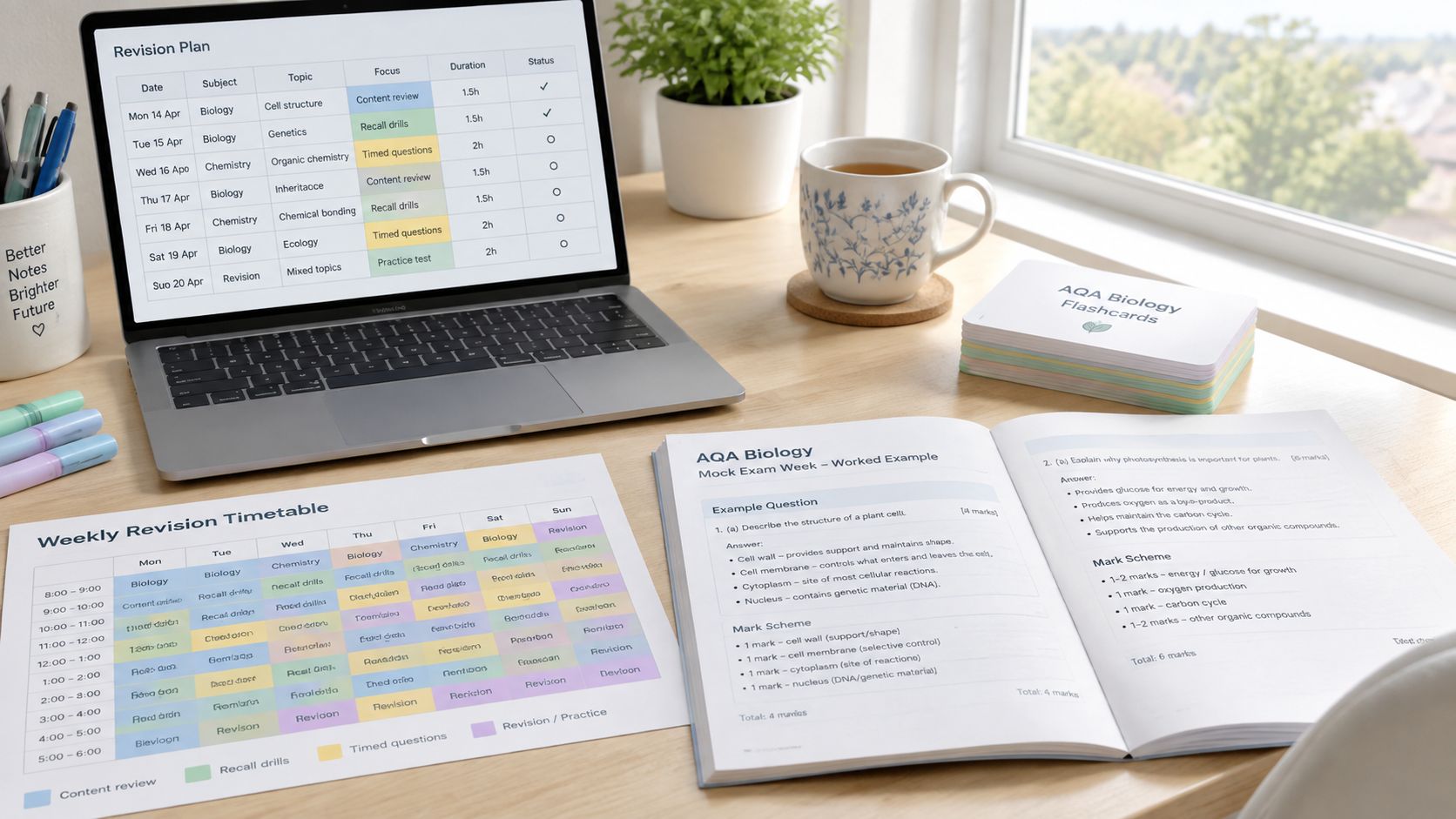
Here's a worked example for a student preparing for a mock while keeping up with coursework:
| Day | Main task | Example focus |
|---|---|---|
| Monday | Content and recall | Cells, followed by a closed-book pathway diagram |
| Tuesday | Practical and data work | Enzyme investigation and graph interpretation |
| Wednesday | Content and application | Respiration, linked to an unfamiliar scenario |
| Thursday | Extended response | Plan and write one essay paragraph, then improve it |
| Friday | Timed mini-paper | A 30-question mixed-topic mini-paper |
| Saturday | Weak-area repair | Relearn the topics responsible for lost marks |
| Sunday | Review and scheduling | Mark, log errors and choose the next targets |
Rotate the specification areas rather than revising them chronologically. Each of the 8 content areas should reappear during the fortnight, but not always in the same format. For example, Cells might appear as a diagram task, a short-answer question and a practical-data question.
Pin the timetable somewhere visible. At the end of each week, record what you completed, not what you intended to complete. A timetable that says “three sessions missed” is useful information. It tells you to shorten blocks, move them around school commitments or remove tasks that are too vague to start.
Active Recall Techniques That Actually Stick
Not every revision method solves the same problem. Flashcards are useful for precise definitions, but they won't teach you how to evaluate a respirometer. Blurting can reveal what you understand about a pathway, while a past-paper question shows whether you can use that knowledge under command-word pressure.
| Technique | Best for | Time per block | Watch out for |
|---|---|---|---|
| Flashcard recall | Definitions, terms and comparisons | Short, repeated bursts | Flipping cards without answering |
| Blurt Challenge | Processes, pathways and whole-topic recall | One focused recall block | Copying from notes too quickly |
| Past-paper questions | Application, practicals and command words | Timed question sets | Marking without analysing errors |
| Spaced repetition | Keeping older content available | Brief scheduled reviews | Revising only what feels familiar |
Flashcards work well for water potential, active site, codominance and complementary base pairing, provided you answer before turning the card over. Write the definition from memory, then compare it with the required wording. If your answer is broadly right but scientifically loose, keep the card in rotation.
The Blurt Challenge suits processes such as the Calvin cycle, synaptic transmission or the immune response. Close your notes and write, draw or say everything you can. Then use a different colour to add missing stages. The missing stages, not the neat original diagram, are your next revision targets.
Past-paper drills are the strongest test of exam readiness because they combine recall with application. Use a short timed set for one skill, such as comparing two data sets or explaining a practical limitation. AQA examiner guidance highlights that some students quote figures without properly comparing them. A complete comparison should state the direction of the difference, include relevant magnitude and units, and connect the observation to biological meaning.
Interleave topics in one 45-minute block. A Paper 1-style session might move from membrane transport to biological molecules and then enzyme data. A Paper 2-style session might mix respiration, nervous coordination and inheritance. Switching forces you to identify which biology and which command word the question needs.
For a more detailed explanation of retrieval practice, use the MasteryMind active recall page. The decision rule is simple: choose the method that makes you produce an answer, not merely recognise one.
Reading AQA Mark Schemes Like an Examiner
A mark scheme isn't just the document you open after giving yourself a score. It's a compact lesson in the language AQA accepts.
Start with the command word. State normally needs a direct fact. Describe asks for what the data or process shows. Explain requires linked biology, usually a reason leading to an outcome. Discuss expects a balanced treatment, while evaluate asks you to weigh evidence, limitations or alternatives before reaching a judgement.
Decode the question before writing
Take a five-mark structured question about an enzyme investigation. Before answering, underline the organism or substance, the variable being changed, the measurement taken and the command word. Then divide the response into likely mark-sized ideas:
- Identify the independent variable.
- Identify the dependent variable and how it is measured.
- Explain why other variables should be controlled.
- Describe a suitable repeat or calculation.
- Link reliability or validity to the conclusion.
That structure prevents the common mistake of writing everything you know about enzymes when the question asks about experimental design. One relevant, linked sentence can be more valuable than a paragraph of disconnected facts.
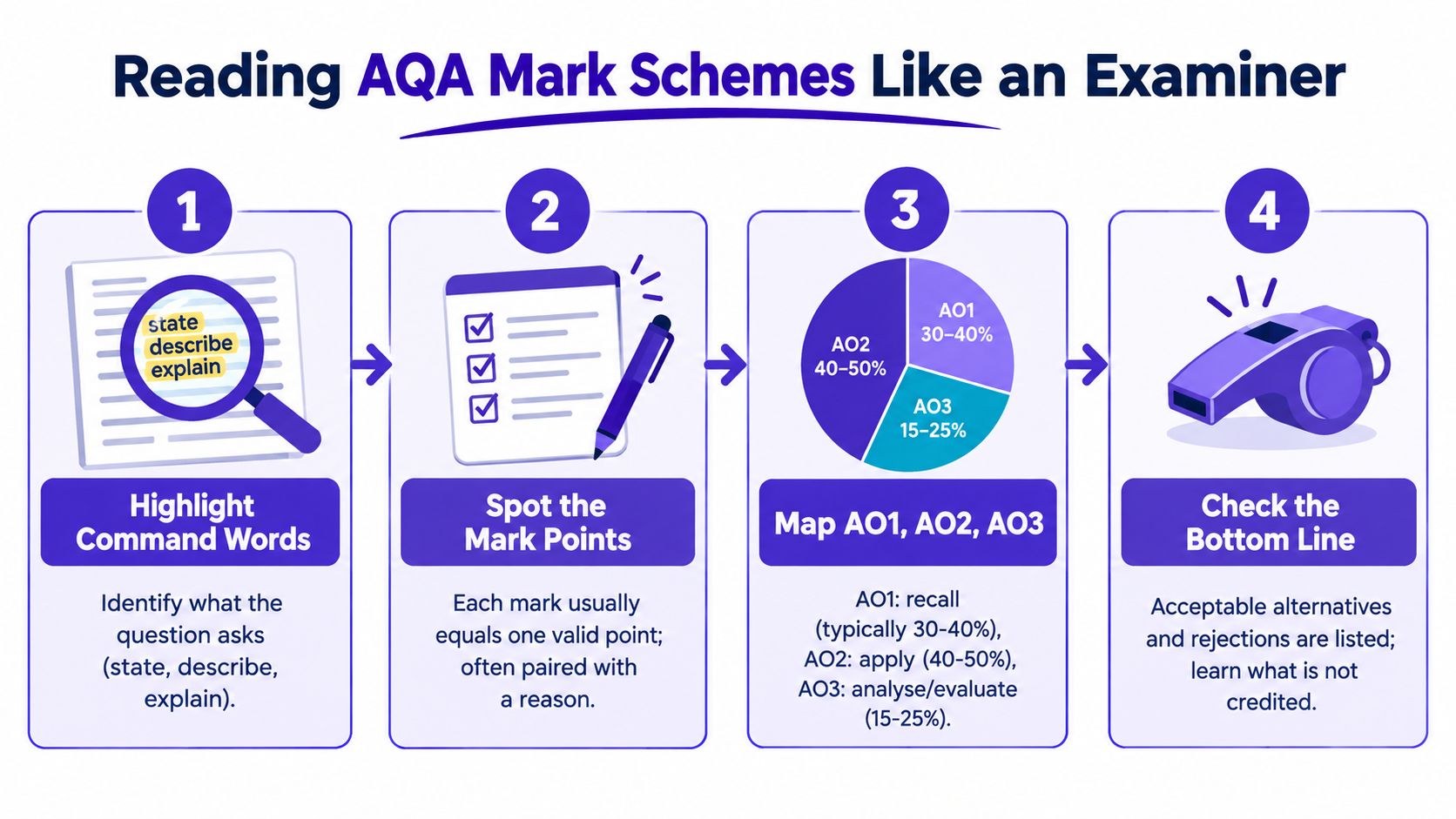
Mark schemes often award linked statements. They may also use an “or” separator to show alternative acceptable answers. Read the accepted points and the rejected answers. The rejected material can expose a terminology trap, such as describing a concentration gradient vaguely when the question needs a precise statement about movement or direction.
Make the scheme teach you
After every timed question, read the mark scheme before checking your answer in detail. Cover your response and ask what each mark point is trying to reward. Then classify the miss:
- Content gap: you didn't know the biology.
- Language gap: you knew the idea but used an imprecise term.
- Technique gap: you answered a different question from the one asked.
Use the AQA mark scheme resource alongside official AQA material, not instead of it. This short video can also support your routine:
Writing 10, 12 and 25 Mark Answers That Score
Use one idea, water potential, to see how answer length changes the job. The biology stays connected, but the response must become more selective, analytical and synoptic as the mark allocation grows.
For a 10-mark structured question, begin with a precise definition, then chain linked statements. For example, explain that water moves from a region of higher water potential to lower water potential, through a partially permeable membrane, by osmosis. Apply that to a root hair cell by connecting soil water, cell sap, water movement and turgor. Each sentence should cause or explain the next, using connectives such as “because”, “therefore” and “so that”.
A 12-mark data question needs more than description. Suppose a graph shows potato cylinders placed in solutions with different solute concentrations. You might identify where the mass change reaches zero, compare the pattern on either side and use the trend to estimate the tissue's water potential. Then explain the biological meaning through water entry, turgor pressure or plasmolysis. Don't copy values from the graph. State what changed, how it changed and what that suggests.
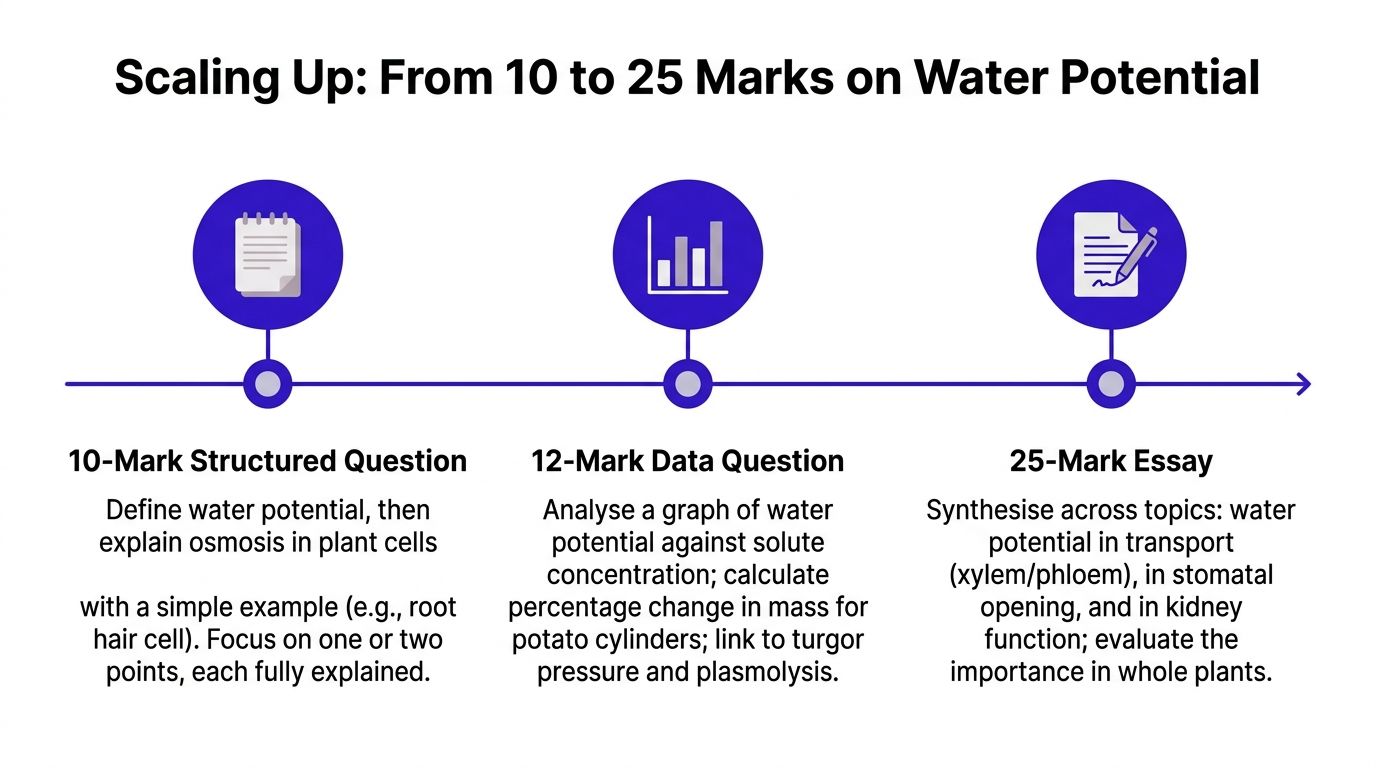
The 25-mark essay needs a line of argument. A four-paragraph plan could look like this:
- Thesis: water potential controls water movement and therefore supports transport, regulation and cell function.
- Plants: connect water uptake, xylem transport and stomatal behaviour, while recognising that water potential is only one part of the system.
- Wider biology: compare plant water relations with kidney function and the role of water potential in producing concentrated urine.
- Judgement: weigh the examples and decide how far water potential is central, rather than repeating the introduction.
The quote-only trap appears when students lift stimulus material without explaining its importance. Convert a quoted observation into AO3 reasoning by asking, “What does this evidence support, and what can't it prove?” A graph pattern becomes evaluation when you discuss anomalies, controls, sample limitations or whether the conclusion is justified.
Practise with the A-Level Past papers, but mark the quality of your links, not just the number of pages filled.
Tracking Mastery and Running a Weekly Review Loop
A revision system becomes useful when it tells you what to do next. You don't need a complicated dashboard. You need a visible record of weak topics, error types and the date of the next retrieval attempt.
Start each weekly cycle with a quiz from the weakest red topic. Mark it against an AQA scheme, then log the result under one of three headings: knowledge, application or evaluation and technique. Add required practicals and essay writing to the same tracker. They shouldn't sit in a separate folder labelled “later”.
A simple Sunday-to-Saturday loop
- Sunday: Review last week's red items and choose the weakest content area.
- Monday: Relearn only the missing biology, then complete closed-book recall.
- Tuesday: Apply it to structured questions or a practical scenario.
- Wednesday: Mix it with an older topic through interleaved questions.
- Thursday: Write or improve one extended response.
- Friday: Sit a timed question set, then mark it carefully.
- Saturday: Update the tracker and schedule the next retest.
Schedule reviews after 3, 7 or 14 days, depending on how secure the material feels. Use an 80% accuracy threshold as a practical checkpoint before moving a topic from active repair to maintenance. That isn't a prediction of a grade. It's a decision rule that stops you abandoning a topic after one lucky attempt.
Anki and a spreadsheet work well for students who like simple systems. Notion can suit learners who want linked topic pages, while physical cards are perfectly effective if you revisit them. The tool matters less than keeping one reliable record. Scattered apps create the illusion of organisation without showing whether your answers are improving.
Sunday question: What mistake did I repeat this week, and what exact task will force me to correct it?
Teachers can use the same loop with short retrieval starters, practical-method checks and one marked extended response. Students catching up should prioritise repeated red items. Students aiming for A* should inspect answers that already earn marks and improve the precision, links and judgement.
Print this checklist:
- Review: Revisit last week's red items.
- Plan: Assign content, recall and question blocks.
- Practise: Complete one timed question.
- Mark: Use the scheme and identify the error type.
- Retest: Schedule the next attempt.
- Record: Update the tracker.
MasteryMind offers specification-aligned quizzes, mixed-topic practice, spaced review scheduling and examiner-style feedback for UK GCSE and A-level learners. If you want one place to turn your AQA Biology revision plan into repeated recall and marked practice, visit MasteryMind and start with the topics where your tracker shows the clearest gaps.
Ready to master this topic?
Practise with quizzes, blurt exercises and exam questions on MasteryMind.
7 days Premium · Then free forever · No card, no charge