AQA Chemistry as Revision: Your Step-by-Step Plan
AQA Chemistry AS exams require you to balance factual recall with application skills, so a targeted plan is essential for success. The qualification's written assessment uses 300 scaled marks across three papers, with 20% of the overall assessment testing mathematical skills and at least 15% assessing practical work (AQA's scheme of assessment).
You may be revising after putting things off, or you may be aiming for a top grade and wondering why familiar topics still fall apart in exam questions. That usually isn't a sign that you can't do Chemistry. It means your revision has to move beyond recognising information in notes. You need to retrieve it, apply it to unfamiliar situations, explain it precisely and check whether your method earns marks.
Why AQA Chemistry AS Revision Needs a Plan
Turn the specification into actions
Set up each topic in four columns, then revise through all four every week.
- Recall: definitions, equations, reactions and conditions you must reproduce.
- Application: unfamiliar questions where you choose the right idea and use it accurately.
- Practical: apparatus, variables, observations, risks and improvements.
- Evaluation: data interpretation, limitations, conclusions and uncertainty.
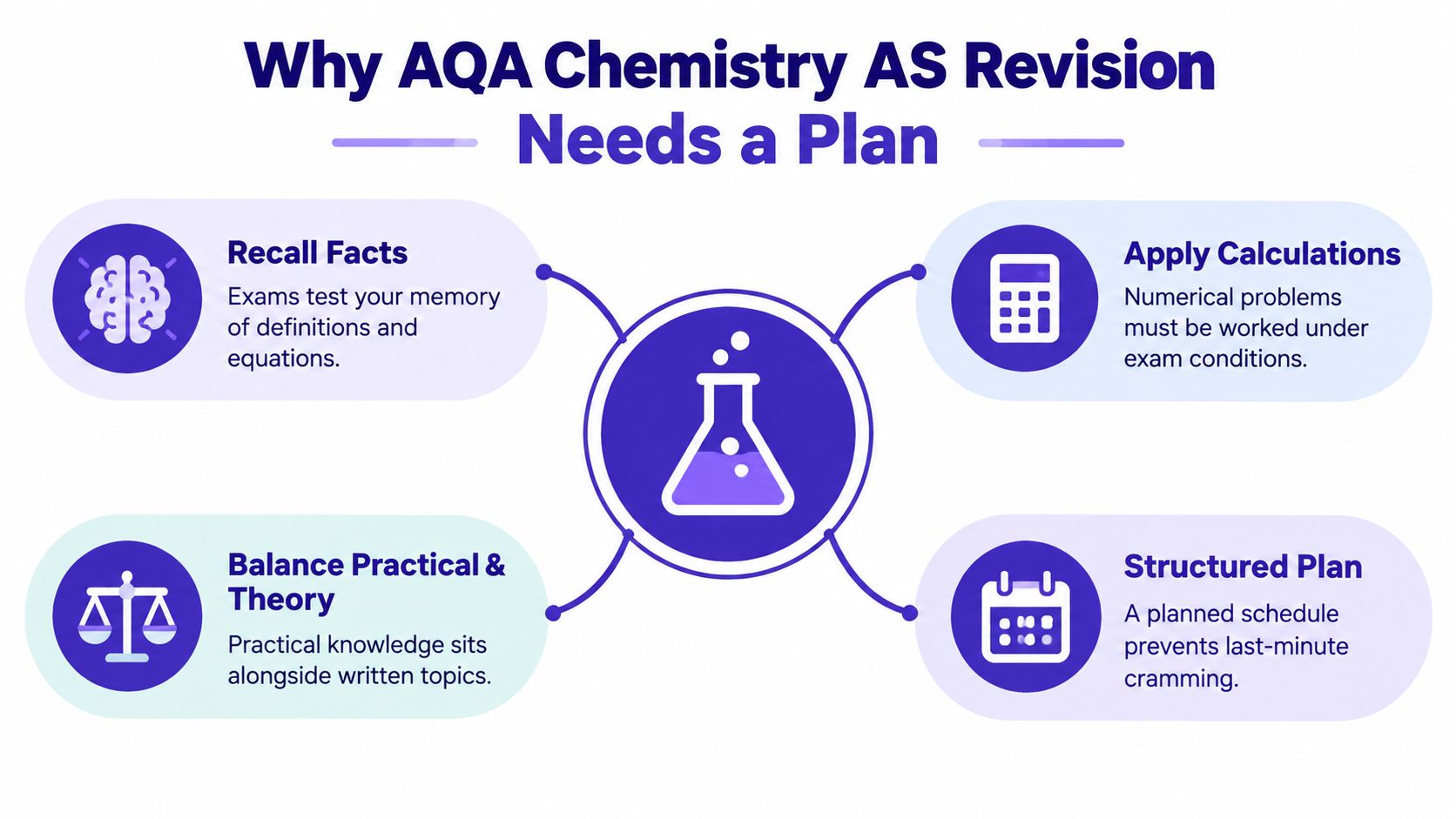
A student revises bonding for two hours, can recite the definitions, then drops marks on a question about conductivity or structure. I see this constantly. The problem is rarely effort. The problem is that Chemistry success depends on switching between different modes of thinking, and many students revise only the one that feels comfortable.
That is exactly why a simple topic checklist is not enough. Your revision needs to reflect how the papers reward performance across knowledge, application and analysis, as noted earlier in the assessment breakdown. Official examiner reports make this even clearer. Students often know a fact, but lose marks by applying it to the wrong context, missing a command word, or giving a vague practical point. A good plan closes those exact gaps instead of rewarding time spent.
The four-column method helps because it turns a large topic into clear jobs. Recall is your raw material. Application is using that material when the question changes shape. Practical is where many students become generic, writing “improve accuracy” without saying how. Evaluation is the judgement layer, where you explain whether data are reliable, whether a conclusion follows, and what a method cannot show.
Use the framework diagnostically as well. If you can explain a topic aloud but still lose marks when the wording changes, the weak point is usually application or evaluation, not memory.
Mark a short mixed set carefully and label each lost mark as knowledge, application, maths, practical or communication. That gives you something specific to fix in the next session. For extra structured practice, Online Revision for A-Level can sit alongside your specification, teacher feedback and official AQA materials.
Mastering Core Chemistry Topics
Start with the specification, not a random list of online videos. AQA's course requires you to connect physical, inorganic and organic ideas, so revise in a sequence that makes those links visible.
Build the foundation first
Atomic structure and amount of substance should include subatomic particles, isotopes, mass spectrometry, electron configurations, relative atomic mass, the mole, empirical and molecular formulae, concentration and reacting quantities. Don't memorise equations without practising when each one applies. A calculation mark often depends on choosing the correct relationship before any arithmetic begins.
Bonding and structure needs more than definitions of ionic, covalent and metallic bonding. Link bonding to structure, intermolecular forces, melting points, electrical conductivity and solubility. Practise explaining properties through particles and forces, because “it has strong bonds” is often too vague. Specify which bonds or attractions are involved and whether they are being broken.
Energetics and kinetics require a cause-and-effect chain. Learn enthalpy changes, calorimetry, Hess cycles, bond enthalpies, collision theory, Maxwell-Boltzmann distributions and factors affecting rate. Draw the diagrams from memory, then explain what changes when temperature, concentration or a catalyst changes.
Add application to every topic
For equilibrium and redox, practise interpreting conditions rather than reciting Le Chatelier's principle. For periodicity and inorganic chemistry, connect trends to electron arrangements, nuclear charge, shielding and atomic radius. For organic chemistry, organise reactions by functional group, reagent, conditions, observation and product. Include mechanisms and isomerism where required, but always test whether you can identify the reaction from an unfamiliar starting material.
Practical knowledge belongs in the same checklist. AQA requires students to complete a minimum of 12 required practical activities, alongside a separate practical endorsement assessed by teachers (AQA practical assessment requirements). For every practical, record the purpose, controlled variables, measurements, safety decisions, expected observations, uncertainty and one justified improvement.
Use MasteryMind Alevel Chemistry resources as one possible source of topic practice, but check coverage against the current AQA specification. Finish each study block by closing your notes and answering questions from memory. If you can't produce the explanation without prompts, you've identified the next gap.
Practising with Past Papers
Past papers become useful when they provide evidence about what you can do alone. Completing a paper while looking at notes may feel reassuring, but it doesn't show whether you can select a method under pressure. Begin with individual questions, then combine topics, and only later attempt a full paper in realistic conditions.
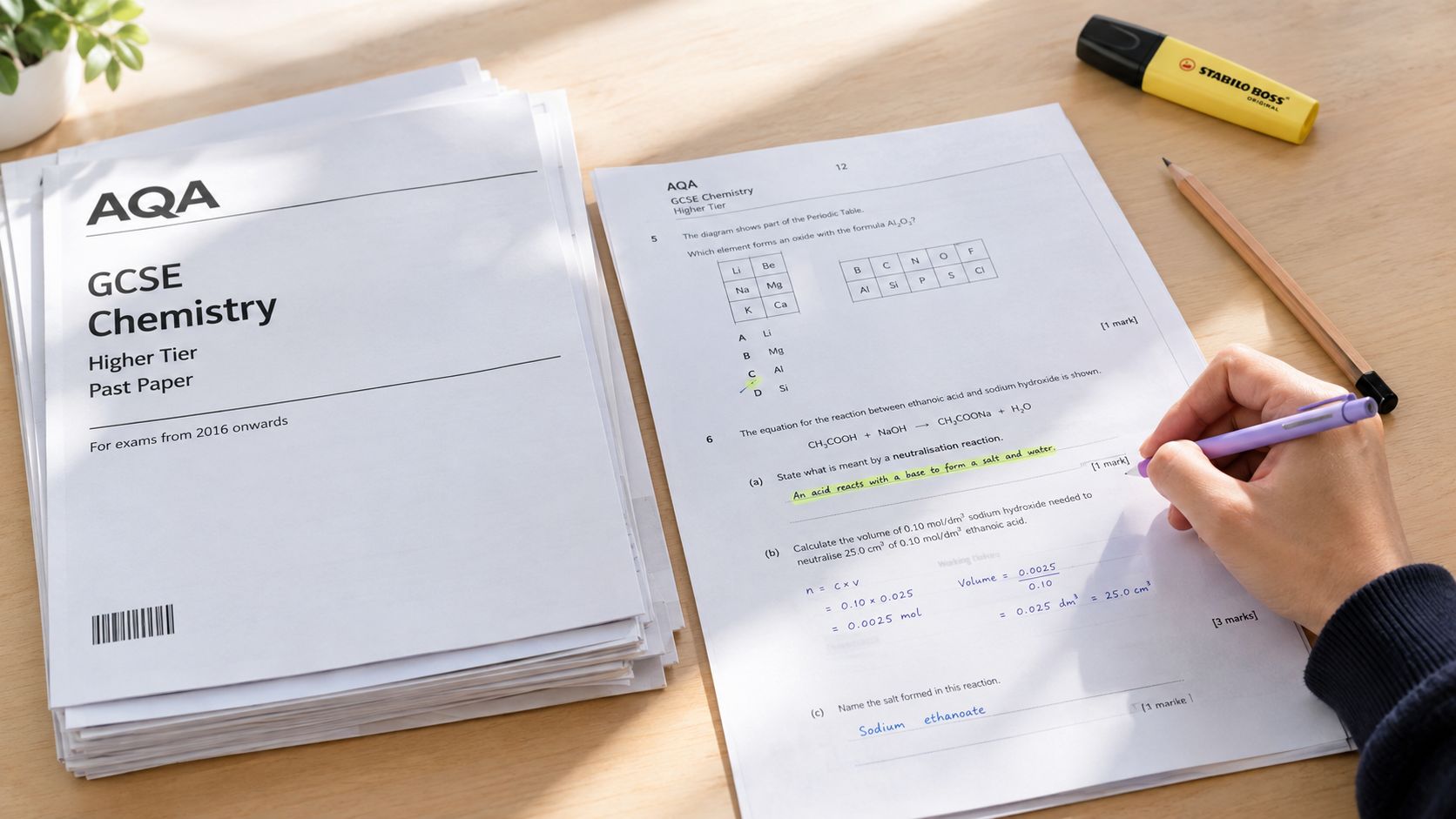
Use a four-stage paper routine
- Attempt first: Work without notes. Show equations, substitutions, units and reasoning, even when you're unsure.
- Mark precisely: Use the official mark scheme. Don't award yourself a mark because your answer sounds scientifically sensible.
- Diagnose the loss: Write the first reason the mark disappeared. Was the issue a missing definition, an incorrect unit, a weak explanation, a missed command word or a calculation choice?
- Reattempt later: Cover the correction and answer the question again. A correction only becomes useful when you can reproduce the skill independently.
For calculations, mark the setup separately from the final answer. A wrong final number might come from arithmetic, but it might also come from an incorrect mole ratio, incompatible units or a poor understanding of the reaction. Keep an error log with the question reference, error type, corrected method and a short rule for next time.
A paper also trains decisions about time. AQA's A-level papers vary in length and mark allocation, so practise checking how many marks a question carries before deciding how much explanation to write. A one-mark recall answer doesn't need a paragraph, while an evaluation question needs a conclusion supported by the data.
A useful correction is specific: “I forgot to convert the volume into compatible units” is actionable. “I'm bad at calculations” isn't.
After marking, choose a small group of questions that target the same weakness. A-Level Past papers can provide additional syllabus-focused practice, but official AQA papers and mark schemes should remain central to your preparation.
Use this video as a further way to think about exam technique, then return to written practice rather than watching passively.
A strong weekly cycle might include a short untimed set for learning, a timed section for stamina and a review session devoted only to errors. That pattern is more revealing than repeatedly completing papers without changing how you revise.
Decoding Examiner Reports for Better Marks
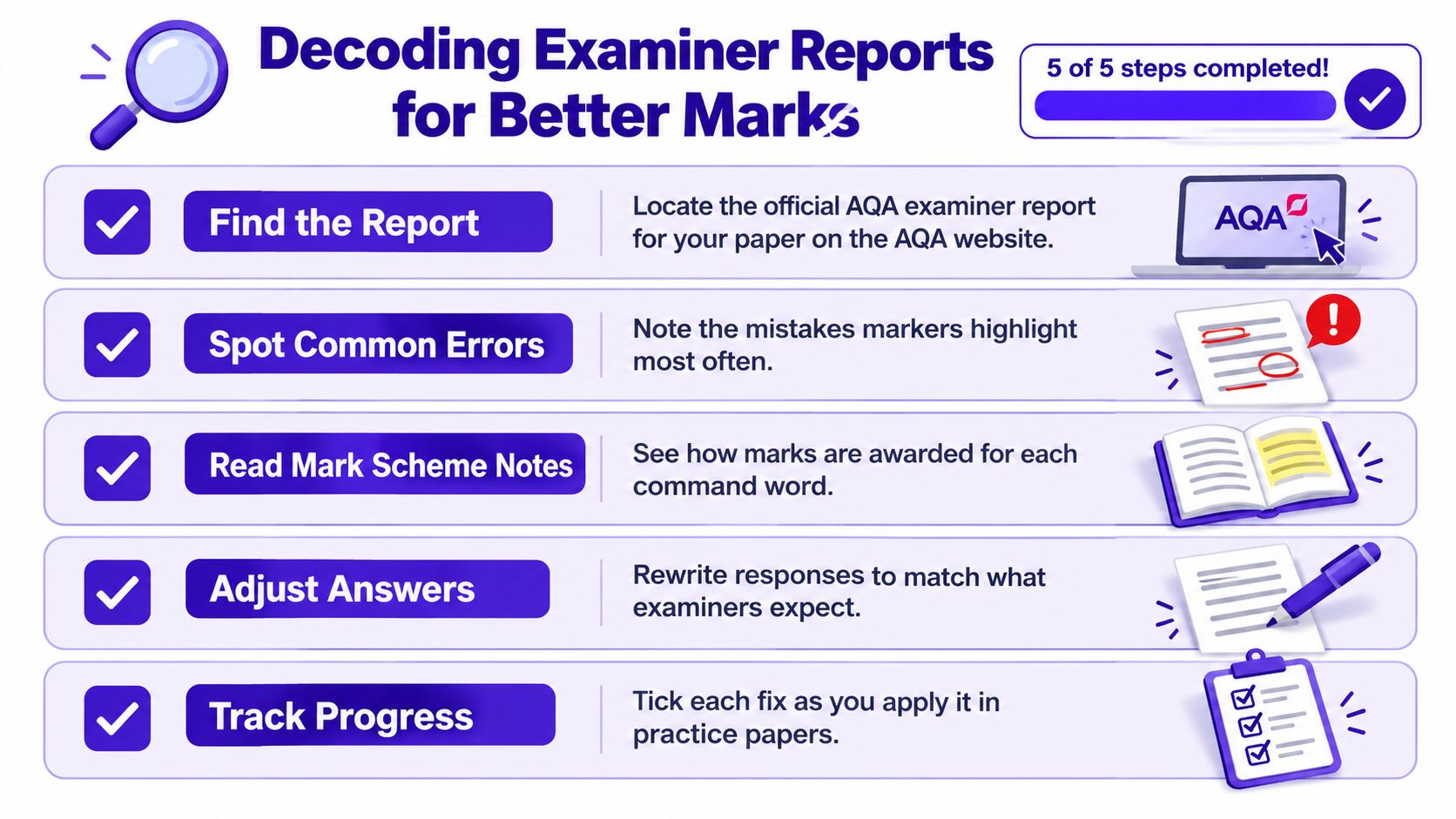
You finish a past paper, check the mark scheme, and still feel unsure why a reasonable answer dropped marks. That is the gap examiner reports fill. They show how AQA examiners describe the mistakes that appear again and again in real scripts, so your revision can target the places marks are lost, not just the topics you have covered (AQA examiner report).
Read for repeated behaviours
Read examiner reports like a driving instructor's notes, not like a textbook. You are looking for repeated habits that cause errors under exam pressure. A useful comment from an examiner report is that “Candidates frequently described the effect of temperature without linking it to particle energy” (AQA examiner report). That one sentence tells you exactly what went wrong. Students knew the topic, but the explanation stopped one link too early.
So when you read a report, translate each comment into a writing action. If candidates named a process but did not explain its effect, your task is to practise answers with a full chain: point, chemical reason, outcome. That is how you turn vague advice such as “be clearer” into something you can do on the next paper.
Command words also need separate attention because they ask for different shapes of answer.
- Calculate: set out the relationship, substitute values, show units, give an appropriate final answer.
- Explain: show the link between cause and effect. A stated fact on its own often falls short.
- Suggest: apply relevant chemistry to an unfamiliar situation.
- Evaluate: weigh the evidence, note limitations, reach a supported judgement.
- Determine: choose the needed information and use a justified method to get the result.
Students who answer every command word in the same style usually lose marks before the chemistry itself is judged.
Convert feedback into a repair task
A short record helps. Keep three columns and make each one specific.
| Examiner criticism | What I did | What I'll do next |
|---|---|---|
| “Described the effect of temperature without linking it to particle energy” | Stated that rate increased, but did not explain why collisions changed | Add the particle-energy link before the final effect |
| Calculation lost accuracy | Rounded too early or missed unit conversion | Keep intermediate values, check units at each step |
| Evaluation was missing | Described results without a judgement | End with a conclusion supported by the evidence given |
Use GCSE and A-Level mark schemes alongside this record. The mark scheme shows what gets credit. The examiner report shows where students slip. Your rewritten answer is the proof that you have closed the gap.
Before moving on: write one sentence on why your original answer lost the mark, then rewrite it.
This method also works well in class. A teacher can show the exact missing link in an answer, ask students to rewrite it with the right command word, and make the improvement visible straight away.
Building a Spaced Revision Timetable
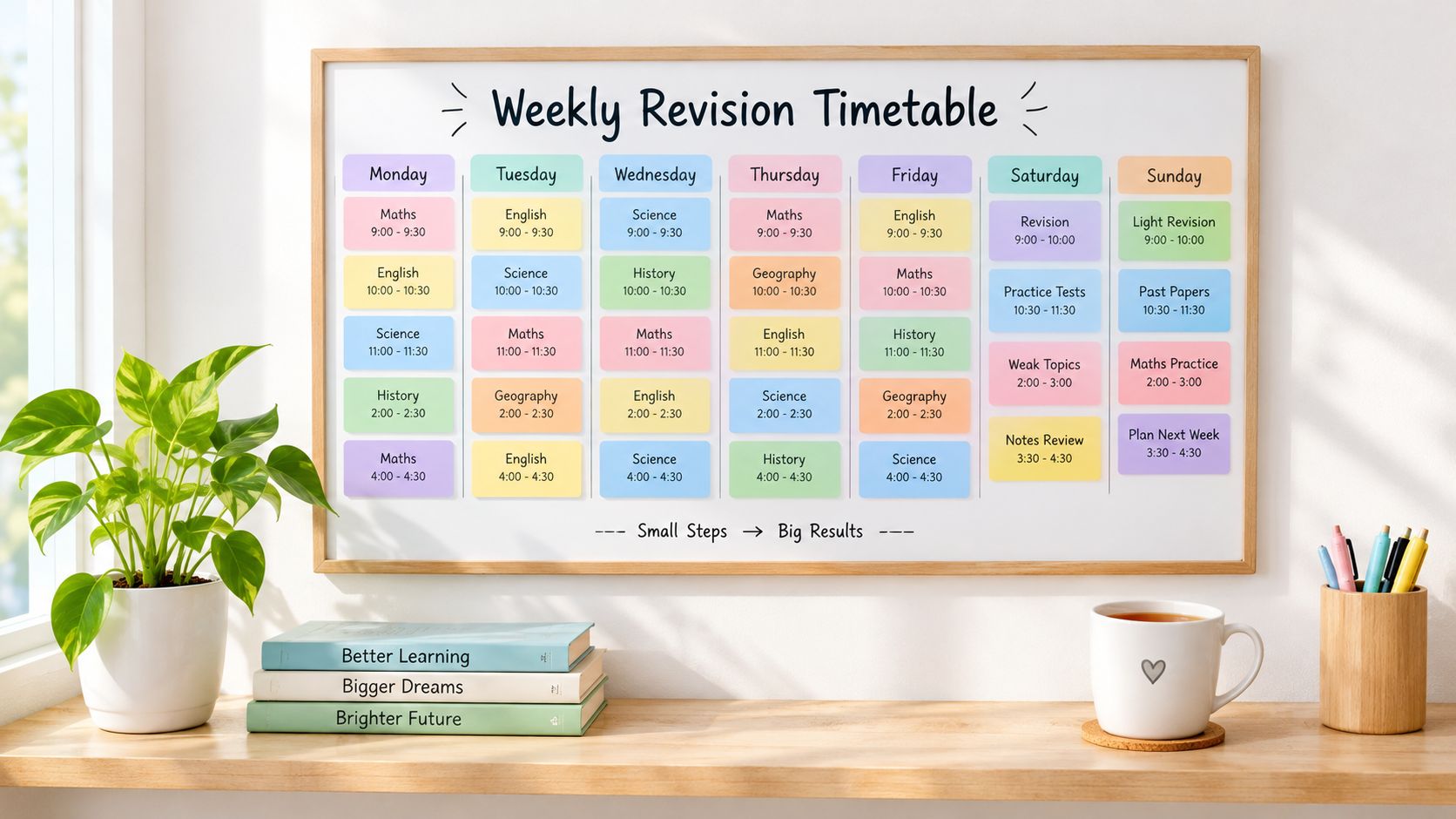
A timetable should make weak areas return before they disappear again. Give each topic an initial learning session, a retrieval session without notes and a later mixed-question session. The exact dates depend on your exam schedule, but the principle is stable: distribute contact with the material instead of placing all of it in one late burst.
Give each session one job
A useful week might rotate between:
- Recall sessions: Reproduce equations, definitions, mechanisms and trends from memory.
- Application sessions: Complete unfamiliar questions and explain each decision.
- Practical sessions: Reconstruct apparatus, variables, safety points and improvements.
- Calculation sessions: Practise units, mole ratios, significant figures and uncertainty.
- Review sessions: Revisit your error log and reattempt questions you previously missed.
Keep sessions manageable enough that you can start them on a tired evening. A short, focused calculation drill is more useful than a grand timetable you abandon after the first difficult week. Leave space for lessons, homework, sleep and unexpected changes.
If your study commitments are spread across school, tutoring and personal calendars, time blocking for multi-calendar users offers a practical way to reserve revision periods without double-booking yourself. The tool matters less than protecting the appointment and knowing exactly what you'll practise.
Use an error-led timetable
Don't divide time equally if your marks aren't divided equally. A student who recalls organic reactions confidently but repeatedly loses marks on energetics calculations should give the calculation weakness more attention. Keep a small traffic-light system, then change the colour only after you've completed a fresh question successfully without help.
Your timetable should respond to evidence. If a test exposes a weak area, the plan has to change.
Teachers can make this process more effective by giving students one specific follow-up task after each assessed piece of work. Parents can help by asking what the next revision action is, rather than asking how many hours were completed. The aim is not to create a crowded calendar. It's to create repeated opportunities to retrieve, apply and correct.
Final Tips for Exam Success
As the exam approaches, stop measuring revision by the number of pages you've read. Measure whether you can answer without notes, explain why a method works, complete calculations accurately and respond to command words. That evidence is more useful than a feeling of familiarity.
Use past papers selectively in the final phase. Complete realistic sections, mark them carefully and spend at least some of your follow-up time repairing errors. If every paper produces the same mistake, pause full-paper practice and return to the underlying skill. Repeating an error under timed conditions only makes the error more familiar.
Protect the basics that support concentration. Sleep, food, movement and short breaks aren't distractions from revision. They help you sustain attention when a question looks unfamiliar. Before each paper, prepare a simple checking routine: read the command word, underline relevant data, write units, inspect significant figures and check that your conclusion answers the question asked.
Keep anxiety useful
A little pressure can prompt action, but vague worry doesn't tell you what to do. Turn it into a written list of three current weaknesses and choose one question for each. If you're unsure about a practical method or an ambiguous mark scheme, ask your teacher directly. A precise question, supported by your attempted answer, is far easier to answer than “I don't understand Chemistry”.
AQA Chemistry AS revision works when it is examiner-focused. Recall gives you the raw material, application shows that you can use it, practical work strengthens method questions, and error analysis stops the same marks disappearing repeatedly. Whether you're recovering from a slow start or chasing the highest grade, consistent diagnosis beats frantic rereading.
MasteryMind offers specification-aligned AQA Chemistry practice, adaptive questions, spaced review scheduling and examiner-style feedback that can help you turn an error log into targeted study. Visit MasteryMind to build a more organised revision routine around the skills your papers test.
Ready to master this topic?
Practise with quizzes, blurt exercises and exam questions on MasteryMind.
7 days Premium · Then free forever · No card, no charge