AQA Command Words: Decode & Ace Your Exams 2026
You're probably in one of two places right now. Either exams are getting close and you've had that horrible moment where a question says analyse and your brain goes blank, or you're already working hard and you want to squeeze every possible mark out of the paper.
Both groups usually have the same problem. They know the topic, but they don't always answer in the way AQA is rewarding.
That's why AQA command words matter so much. They aren't just exam vocabulary. They're instructions. They tell you what kind of thinking the examiner wants, how much depth you need, and often how the marks are likely to be split. Once you spot that, exam questions stop feeling random and start feeling much more beatable.
Why AQA Command Words Are the Secret Code to Exam Success
You know the topic. You revised the facts. Then the exam paper asks you to describe, explain, or evaluate, and three questions that look similar suddenly need three different kinds of answer.
That mismatch is where marks are often lost.
Command words are the examiner's instructions in miniature. They tell you what mental job to do before you start writing. A good way to picture them is as the verbs on a recipe. If the recipe says whisk, fold, and bake, you would not treat those as the same action. AQA questions work in the same way. If the command word is state, the marker wants a precise point. If it is analyse, the marker wants you to break something down and show how parts connect. If it is evaluate, the marker wants judgement supported by evidence.
AQA does not award marks merely for showing that you know something. Marks are awarded for showing knowledge in the form the question demands. That is why strong students can still underperform. Sometimes the problem is merely that they answered a different question from the one the command word set.
What command words tell you about the mark scheme
Each command word gives you clues about three things:
- The task. What are you being asked to do with your knowledge?
- The depth. How far do you need to go beyond a basic point?
- The likely marking focus. Is the examiner rewarding recall, explanation, analysis, or judgement?
This is the connection many students miss. Command words are closely tied to Assessment Objectives, which are the skills AQA is measuring, and those AOs shape the mark scheme. So learning command words is not just learning exam vocabulary. It is learning how AQA sorts answers into low, middle, and high bands.
That is why looking at AQA exam grading criteria helps. You start to see a pattern. Short command words often point to direct retrieval or application. Bigger command words usually ask for chains of reasoning, supported interpretation, or balanced judgement.
Why similar words cause different results
In everyday English, these verbs blur together. In an exam, they do not.
A student might read describe and give reasons. Another might read explain and only list features. A third might see analyse and write a long descriptive paragraph with no breakdown of methods, effects, or relationships. All three students may know the content well. The issue is method, not memory.
Examiners notice that difference quickly. A descriptive answer to an analytical question can sound fluent and still sit in a lower level because it misses the skill being rewarded. The same is true when a student evaluates too early, giving opinions before they have explained or analysed the evidence those opinions should rest on.
A simple way to read the code
Before writing, pause for a few seconds and translate the command word into an action:
State = give the answer.
Explain = give the reason or process.
Analyse = break it into parts and show how they work.
Evaluate = weigh both sides and reach a judgement.
Those few seconds can change the whole answer.
Once you start reading command words this way, exam questions feel less unpredictable. You are no longer guessing what kind of response might work. You are reading the same signals the marker is trained to use.
Decoding the Three Tiers of Command Words
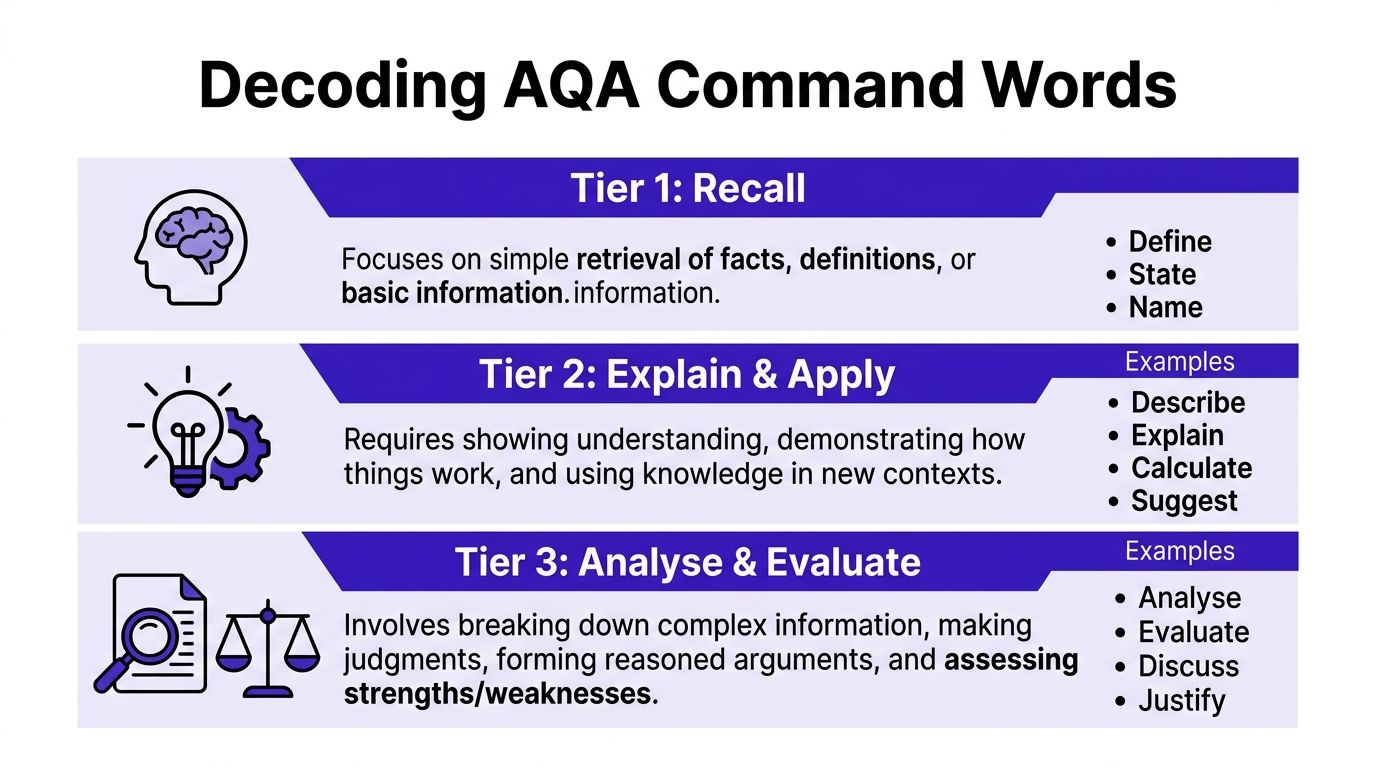
Trying to memorise one giant alphabetical list isn't the best way to learn AQA command words. A better approach is to group them by the level of thinking they demand.
It's similar to moving through levels in a game. Level one gets you the easy, quick marks. Higher levels ask for more control, more precision, and better judgement.
Tier 1: Recall
These are your fast-response command words. They test whether you know a fact, term, name, or piece of information.
Common examples include:
- State
- Name
- Identify
- Define
- Give
For AQA command words like State, Identify, or Name, the mark scheme typically allocates only 1 to 2 marks and requires one correct piece of information, usually a word, short phrase, or brief answer, with no explanation. Examiners also don't reward copying the wording of the question, as outlined in this comparison of command words across AQA and other boards.
A student mistake here is writing too much.
If the question says State one reason, and you write half a paragraph, you're spending time without earning extra credit.
| Command word | What the examiner wants | What to avoid |
|---|---|---|
| State | One clear fact | A long explanation |
| Name | Correct term | A sentence with waffle |
| Identify | Pick out the right item | Repeating the question |
Tier 2: Explain and Apply
This middle tier is where students show understanding, not just memory.
You'll often see:
- Describe
- Explain
- Calculate
- Suggest
- Compare
These words ask you to do something with knowledge. Describe means give features or characteristics. Explain means show how or why. Calculate means work with the figures provided and get the answer accurately. In AQA GCSE Science, for example, Calculate requires students to use the numbers given, while Balance checks whether they can correctly balance a chemical equation rather than write descriptive commentary, according to AQA GCSE Science command words.
A quick way to hear the difference:
- Describe = what happens
- Explain = why it happens
- Calculate = work it out
- Suggest = propose a sensible answer based on what you know
Here's a helpful video if you want to hear command words broken down in a more guided format:
Tier 3: Analyse and Evaluate
Here, top grades are usually achieved.
These command words include:
- Analyse
- Evaluate
- Discuss
- Justify
- Assess
These questions want more than knowledge. They want selection, structure, reasoning, and often a final judgement.
A strong answer at this level doesn't just say what happened. It shows relationships, strengths, weaknesses, and a reasoned conclusion.
If you can spot which tier a command word belongs to, you instantly know how much depth you need. That alone can stop you under-answering easy questions or over-writing simple ones.
Mapping Command Words to Marks and Assessment Objectives
You open a paper, spot a 9-mark question, and start writing everything you know. Five minutes later, the answer looks full. The mark scheme may still reward only part of it, because AQA does not give marks for volume. It gives marks for the skill named in the command word.
That is why command words work like a decoder for the mark scheme.
AO1, AO2 and AO3 in plain English
Students often hear Assessment Objectives described in abstract language and switch off. Keep it practical:
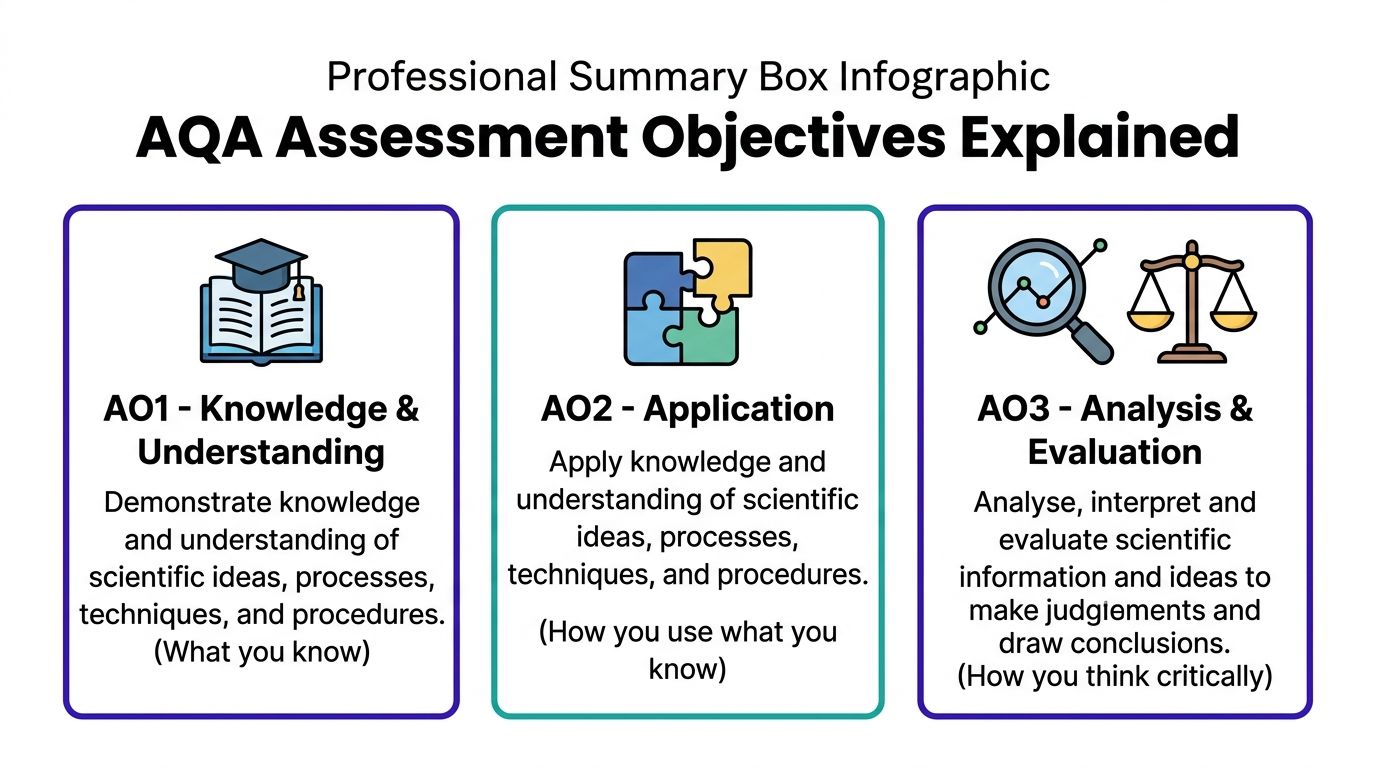
- AO1 tests what you know and can select accurately.
- AO2 tests how you use that knowledge, often through method, evidence, or application.
- AO3 tests how well you analyse, judge, compare, or build an argument.
A simple way to remember it is this. AO1 = facts. AO2 = use. AO3 = judgement.
That link matters because command words usually point you toward the dominant AO. They tell you what kind of thinking earns marks. If a question asks you to identify, short accurate retrieval is enough. If it asks you to analyse, the examiner wants relationships, effects, and careful interpretation. If it asks you to evaluate, you need a reasoned judgement, not a long description.
Why students lose marks here
A common problem is knowledge dumping. A student knows the topic, writes plenty, and still underperforms because the answer does not match the AO being rewarded.
AQA's own subject guidance shows this pattern clearly across specifications. Command words are tied to different kinds of performance. For example, AQA's geography command word guidance distinguishes between terms such as describe, explain, and evaluate, each requiring a different depth of response and a different kind of evidence in the answer, as shown in AQA geography command words guidance.
That is the part many command word lists miss. The word in the question is not just vocabulary. It is a clue to the mark scheme.
A practical command word to AO map
| Command word | Main AO focus | What the examiner is rewarding |
|---|---|---|
| State / Name / Identify | AO1 | Accurate selection of knowledge, briefly and clearly |
| Describe | AO1, sometimes AO2 | Relevant detail about what is happening |
| Explain | AO2 | Clear reasoning, causes, effects, or how something works |
| Calculate / Apply | AO2 | Correct use of knowledge, formulae, methods, or rules in context |
| Analyse | AO2 and AO3 | Breakdown of parts, patterns, methods, and connections |
| Evaluate / Assess / To what extent | AO3 | Balanced judgement supported by evidence |
This is why two answers with similar knowledge can get very different marks. One matches the AO. One does not.
How this works in real questions
Take describe and explain. Students often blur them together.
If a question asks you to describe, you are usually showing what you can observe, select, or state accurately. If it asks you to explain, you need a chain of reasoning. Cause leads to effect. Evidence supports the point. The answer must move.
Now take analyse and evaluate. These sit higher because they ask for more control. Analyse breaks something apart and shows how the pieces work together. Evaluate goes one step further and weighs how convincing, effective, important, or successful something is before reaching a judgement. In subjects such as English Language, that judgement-based writing is built directly into the assessment objectives published by AQA in its specification materials.
Past papers help here because they show the same command word attached to different mark tariffs and question styles. Practising with real questions from A-Level Past papers makes this pattern much easier to spot.
A three-step check before you write
Use this quick routine in the exam hall:
- Circle the command word.
- Name the likely AO in your head.
- Shape the answer to that AO before writing full sentences.
For example:
- State needs a precise answer, often one line.
- Explain needs linked reasoning.
- Analyse needs parts, methods, patterns, or effects.
- Evaluate needs evidence plus a judgement.
An examiner reads with the command word in mind from the first line. If the question asks for evaluation, a page of accurate description still stays capped.
Students who improve fastest are usually not learning more words. They are learning what each word allows the examiner to reward.
Answer Plans for High-Impact Command Words
You open a 9-mark question, read evaluate, and start writing everything you know. Two paragraphs later, the answer is full of facts but still feels slippery. That usually happens because the command word has not shaped the plan.
High-mark answers are built to match what the examiner can reward. Command words act like instructions on the mark scheme. If you can plan for explain, analyse, and evaluate, you are not just learning vocabulary. You are learning how AQA allocates marks through different Assessment Objectives.
Explain
Explain asks for a chain of reasoning. The examiner is looking for cause, effect, or process, not a loose set of facts.
Weak answer style: “Deforestation causes flooding. It removes trees. There is more water.”
Each sentence points in the right direction, but the links are missing.
Stronger answer style: “Deforestation can increase flooding because trees intercept rainfall and absorb water through their roots. Once they are removed, more water flows over the surface into rivers, so water levels rise more quickly after heavy rain.”
That answer earns credit more securely because each idea leads to the next. It shows the mechanism.
A quick plan for Explain
Use a three-part chain:
- Point: What is happening?
- Because: Why is it happening?
- Therefore: What follows from that?
This works like showing your working in Maths. The final idea matters, but the steps in between are what prove you understand it.
Practising on real questions helps because you start to see how much development AQA expects at different mark levels. A-Level Past papers are useful for spotting that pattern.
Analyse
Analyse means breaking something into parts, then showing the relationship between those parts. Detail on its own is not analysis. Connection is.
Students often write analytical answers as separate comments. Examiners reward the answers that go one stage further and show pattern, contrast, method, or consequence.
Weak vs strong analysis
Weak analysis style: “Social media affects teenagers. It changes confidence. It can also affect sleep.”
That reads like notes placed next to each other.
Stronger analysis style: “Social media affects teenagers in connected ways. Exposure to edited images can lower confidence, while late-night scrolling can reduce sleep. Those effects interact, because poor sleep can make someone less resilient emotionally, which may worsen the impact on confidence.”
Now the answer is doing analytical work. It separates the issue into parts, then explains how those parts influence one another.
A plan for Analyse
- Identify the parts
- Comment on each part
- Link them through a pattern, method, cause, contrast, or effect
A useful self-check is simple: could you draw arrows between your ideas? If not, the response may still be descriptive.
This is also where Assessment Objectives start to matter more clearly. In many AQA subjects, analysis is rewarded when students examine methods, effects, structure, relationships, or significance. The wording varies by subject, but the mark scheme always values explanation of how and why, not just what.
Evaluate
Evaluate is where many students lose marks because they treat it as a longer version of give your opinion. AQA expects more control than that.
Evaluation means judging the value, strength, success, or importance of something using evidence. The judgement is the destination, but analysis is the road that gets you there. If the reasons are thin, the judgement will sound asserted rather than earned.
A plan for Evaluate
Use this four-step structure:
- Argument for
- Argument against
- Weigh the evidence
- Reach a clear judgement
That middle step matters most. Listing both sides is not enough. You need to decide which side matters more and say why.
“There are good points on both sides” is not a conclusion. It tells the examiner you stopped weighing the evidence.
Weak vs strong evaluation
Weak evaluation style: “One advantage is cost. One disadvantage is quality. Another advantage is speed.”
This gives points, but no judgement about their relative importance.
Stronger evaluation style: “Lower cost and faster production support the method, but quality matters more when the product must be reliable. On balance, the weakness in quality is more significant because the main purpose of the process is accuracy, not convenience.”
That answer does what evaluation requires. It compares, prioritises, and judges.
A helpful way to picture it is this. Explain builds a chain. Analyse builds a structure. Evaluate inspects that structure and decides how strong it really is.
Useful conclusion starters include:
- Overall...
- On balance...
- The stronger view is...
- This is more convincing because...
If you train yourself to plan this way before writing, the command word starts doing some of the thinking for you. That is how students move from writing more to writing what the mark scheme can reward.
Common Command Word Mistakes That Cost You Marks
You finish an exam feeling confident because you wrote a lot. Then the paper comes back, and the marks are lower than expected. In many cases, the problem is not missing knowledge. The problem is that the answer did not match the command word, so it did not meet the Assessment Objective the mark scheme was rewarding.
That is why command words matter so much. They are not just instructions. They signal the kind of thinking AQA wants to see.
Mistake one: Giving too much when the question only asks for retrieval
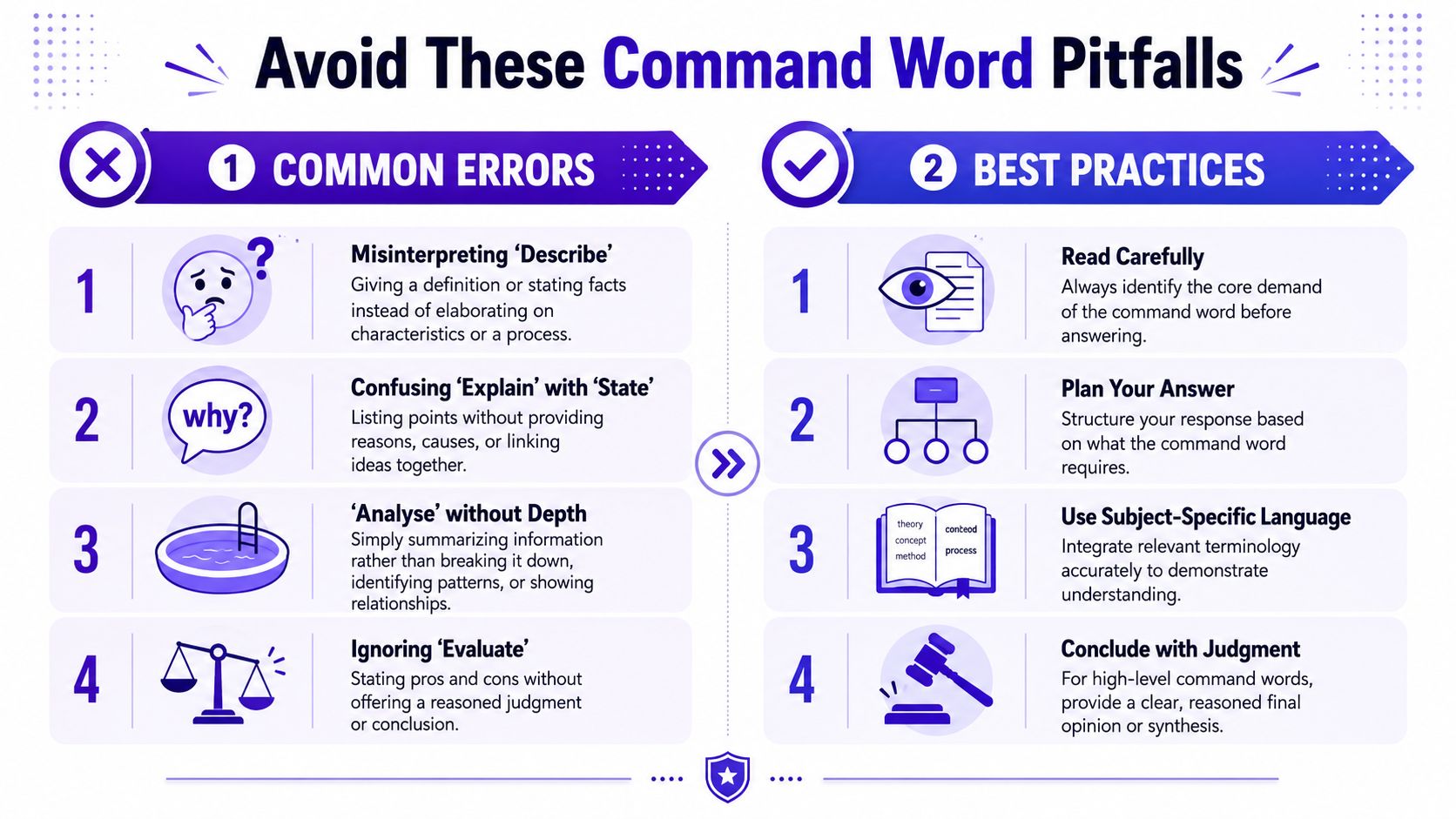
Students often assume that longer answers feel safer. In a state, name, or identify question, that instinct can waste time and sometimes blur a correct answer.
A retrieval command word usually points to straightforward recall. The mark scheme is looking for the fact itself, not a paragraph built around it. If the question asks you to state one reason, give one clear reason. Treat it like handing over the exact key the examiner asked for, not your whole keyring.
Mistake two: Describing what you see instead of showing how it works
This mistake appears in questions with command words like analyse or sometimes explain. Students spot relevant features, list them accurately, and still miss marks because they stop one step too early.
Description names the parts. Analysis shows the relationship between the parts and the effect of that relationship. An examiner is usually rewarding links, patterns, and consequences here because those are what the AO is targeting.
A quick self-check helps. If each sentence could stand alone without changing the meaning of the next one, you may still be describing. Analysis usually sounds more connected. Words like because, therefore, this suggests, and which leads to often signal that you are doing the harder thinking the mark scheme can credit.
Mistake three: Answering only half of an evaluate or assess question
Students sometimes write a strong argument for one side and assume that confidence equals evaluation. It does not.
Evaluation works like a set of scales. You place evidence on both sides, compare the weight, then decide which side is stronger and why. If you skip the weighing stage, you often miss the highest marks because the judgement is unsupported. The examiner cannot reward a conclusion that appears from nowhere.
This is a common reason high-mark answers stall in the middle band. The student knows the topic, but the response does not fully match the command word.
Mistake four: Ignoring the marks because the content feels familiar
A familiar topic can trick students into writing from memory instead of reading the task carefully. That is risky. A 2-mark identify question and a 9-mark assess question may cover similar content, but they ask for different evidence, different depth, and a different answer shape.
Marks are a clue to method. They tell you how far the command word needs to be developed. If you train yourself to read the verb and the mark value together, you make better decisions before you write a single sentence.
Four fast fixes that work in the exam hall
- Read the command word first. It tells you which AO the examiner is likely rewarding.
- Match the length to the marks. Short retrieval answers should be brief. High-mark judgement questions need developed reasoning.
- Choose the right sentence pattern. Retrieval gives facts. Explanation gives reasons. Analysis gives links. Evaluation gives a supported judgement.
- Check your final line. If the question says assess or evaluate, end with a decision, not a summary.
One useful revision habit is to sort past-paper questions by command word, then practise switching between them quickly. Spaced retrieval makes that pattern recognition much faster under pressure. MasteryMind's guide to spaced repetition is a good place to start if you want a simple system.
Students often think, “I need to revise more content.” Sometimes the faster mark gain comes from a different fix. Read the verb accurately, match the AO, and give the mark scheme the type of answer it is built to reward.
For teachers, this is often the missing layer. Students may know the material well, yet still lose marks in predictable ways because they have not been trained to spot what the command word is really asking them to do.
Smart Revision Strategies for Command Word Mastery
You open a past paper, spot evaluate, and write everything you know. The answer sounds detailed, but the mark is still low. Why? Because command words are not just vocabulary. They are instructions for which Assessment Objective is being tested and what kind of evidence the mark scheme will reward.
That is why revision for command words has to feel more like practising a response pattern than memorising a definition. A command word works like the label on a toolbox drawer. If you pull out the wrong tool, effort goes in, marks do not.
Build revision around response habits
Strong students revise command words in layers.
First, learn the core meaning of the word.
Next, connect it to the likely AO.
Then, practise the answer shape that usually scores well.
For example, identify usually calls for selection or retrieval. Explain asks for reasons or clear cause-and-effect links. Evaluate asks for a judgement supported by evidence. If students revise only the dictionary meaning, they miss the examiner's real question: what performance is this command word asking for?
Revision methods that train exam reactions
- Make command word cards that go beyond definitions. Put the word on one side. On the other, add the likely AO, typical mark range, and a sentence starter that fits the task.
- Run short mixed drills. Answer one low-tariff retrieval question, one explanation question, and one judgement question in a single sitting. This trains quick switching between answer types.
- Annotate past papers by command word family. Group words such as state and identify together, then explain and describe, then analyse, assess, and evaluate. Students start to see patterns in how AQA builds papers.
- Rewrite one answer after marking. Improvement happens in the rewrite. That is where students learn how a better response sounds on the page.
One habit matters more than it seems. Time each drill. If starting focused work is a problem, a simple countdown can boost your study focus and make short command word practice easier to begin.
Why spaced practice works better than cramming
Command word mastery fades if it is revised once and then ignored. Students often recognise a term on Monday and misread it under pressure on Friday. Spaced practice fixes that by bringing the same skill back at intervals, so recognition becomes automatic.
A useful pattern is 10 minutes now, 10 minutes in two days, then 10 minutes the following week. Each revisit should include a fresh question and a quick self-check against the command word. MasteryMind's guide to spaced repetition gives a clear method for setting that up.
A weekly routine that is realistic
Try this over one week:
- Choose three command words that students confuse.
- Find one past-paper question for each.
- Predict the AO before answering.
- Write timed responses.
- Mark each answer by checking whether it met the command word's instruction.
- Rewrite only the weakest one.
That final step is where the learning sticks.
Teachers can use the same routine for retrieval starters, homework, or exam intervention groups. Students get repeated exposure to the wording AQA uses. Teachers get clearer evidence of whether the problem is subject knowledge, question reading, or answer structure.
Revise command words this way and the task becomes much simpler. Students stop asking, "What can I say here?" and start asking, "What does this mark scheme want me to do?" That is a much better question.
Turn Practice into Top Grades with MasteryMind
Knowing what AQA command words mean is one thing. Being able to recognise them fast, adapt your structure, and improve your answers consistently is something else.
That's where smart practice tools help. AI Powered Revision gives students a way to practise exam-style questions that are aligned to UK specifications, then get feedback that reflects how answers are judged. For command words, that matters because students need more than “right” or “wrong”. They need to know whether they described, explained, analysed, or evaluated at the right level.

It also helps to build the conditions around your revision. If you struggle to settle into focused practice, a simple timer can help you boost your study focus and make short command-word drills feel easier to start.
For students, that means less guessing and more targeted improvement. For teachers, it means a clearer line between the language of the question, the AO being tested, and the feedback students receive.
Mastering AQA command words can change your exam results faster than most students expect, because it sharpens how you use the knowledge you already have. If you want exam-style practice, AO-aware feedback, and revision built around real UK specifications, try MasteryMind.
Ready to master this topic?
Practise with quizzes, blurt exercises and exam questions on MasteryMind.
7 days Premium · Then free forever · No card, no charge