AQA English Literature Mark Scheme: A Guide for Top Grades
You get an essay back. It says 21/30. Your teacher writes “thoughtful” in the margin, maybe adds “develop analysis”, and that's somehow meant to tell you what to do next.
If you're a student, that feels maddening. You knew the plot. You revised quotes. You wrote loads. So why 21 and not 25, or 26, or higher?
If you're a teacher, you've probably seen the same problem from the other side. Students often treat the AQA English Literature mark scheme like a hidden code only examiners understand, when really it's a public set of rules. Dense, yes. Mysterious, no.
The good news is that the AQA English Literature mark scheme is far more useful than most students realise. It doesn't just judge your essay after the event. It tells you, in advance, what strong writing looks like. Once you translate the jargon into plain English, it becomes a revision tool, a planning tool, and a self-marking tool.
That matters whether you're trying to rescue a grade after not doing enough work earlier in the year, or whether you're aiming for the very top and want to squeeze every possible mark from your essays.
Why Your Exam Mark Is Not a Mystery
You open your marked essay and see a number that feels oddly precise. Maybe it is 21. Maybe it is 24. The frustrating part is not the mark itself. It is not knowing what moved it there.
The AQA mark scheme gives that number a structure. Examiners are not inventing a score from personal taste. They place your response into a level, then decide where it sits within that level based on how securely the essay meets the criteria. The process is closer to judging a gymnastics routine than picking a favourite song. There is still professional judgement involved, but it is judgement against shared standards.
AQA's essay questions use a six-level banding system. The lower levels reward relevant understanding and some explanation. The highest level rewards a developed, conceptual argument, careful use of evidence, and analysis that keeps testing ideas rather than just spotting techniques. You can see that scale in the AQA specimen mark scheme.
That matters because students often revise for literature as if marks come from memory alone. They do not.
What that looks like in real life
Take two students writing about Macbeth.
Student A explains that Macbeth is ambitious, includes a few quotations, and mentions guilt. The essay is relevant and clear. It shows knowledge.
Student B starts with a sharper idea: Macbeth tries to turn violence into a source of identity and control, but Shakespeare steadily shows that this version of manhood destroys him. Each paragraph returns to that thread. Quotations are selected because they help prove something. Comments on language and structure are tied to the argument, not added like decorative labels.
Both students know the play. One student is using that knowledge as raw material for analysis. That is the difference the bands are trying to capture.
A useful comparison is a driving test. Knowing where the pedals are matters, but the examiner awards the pass for how well you control the car in real conditions. In English Literature, quotations, plot knowledge, and context are the pedals. The mark comes from control.
Practical rule: Examiners reward argument, not quotation dumping.
Once students see that, the mark scheme becomes a planning tool. A mid-band essay usually says sensible things about the text. A higher-band essay builds a line of reasoning and keeps developing it. That is a much clearer target than the vague advice to “write more analytically”.
It also makes practice more precise. Instead of writing full essays and hoping for general improvement, you can train one mark-scheme habit at a time: thesis statements, method analysis, embedding evidence, or linking each paragraph back to the main idea. Used well, AI practice can help here because it can give fast feedback on the exact skill a student is trying to strengthen, especially when paired with real GCSE Past Papers.
For students, that takes some of the fear out of the process. For teachers, it gives a shared language for feedback that maps directly onto what examiners reward. The mark scheme is not a secret code. It is a set of writing habits, written in examiner language, waiting to be translated into actions you can practise.
Understanding the Structure of Your Exam
You open the paper, see several sections, and the whole exam suddenly feels bigger than it really is. That panic often comes from not knowing the layout. Once the paper has a clear shape in your head, revision gets calmer and your planning gets sharper.
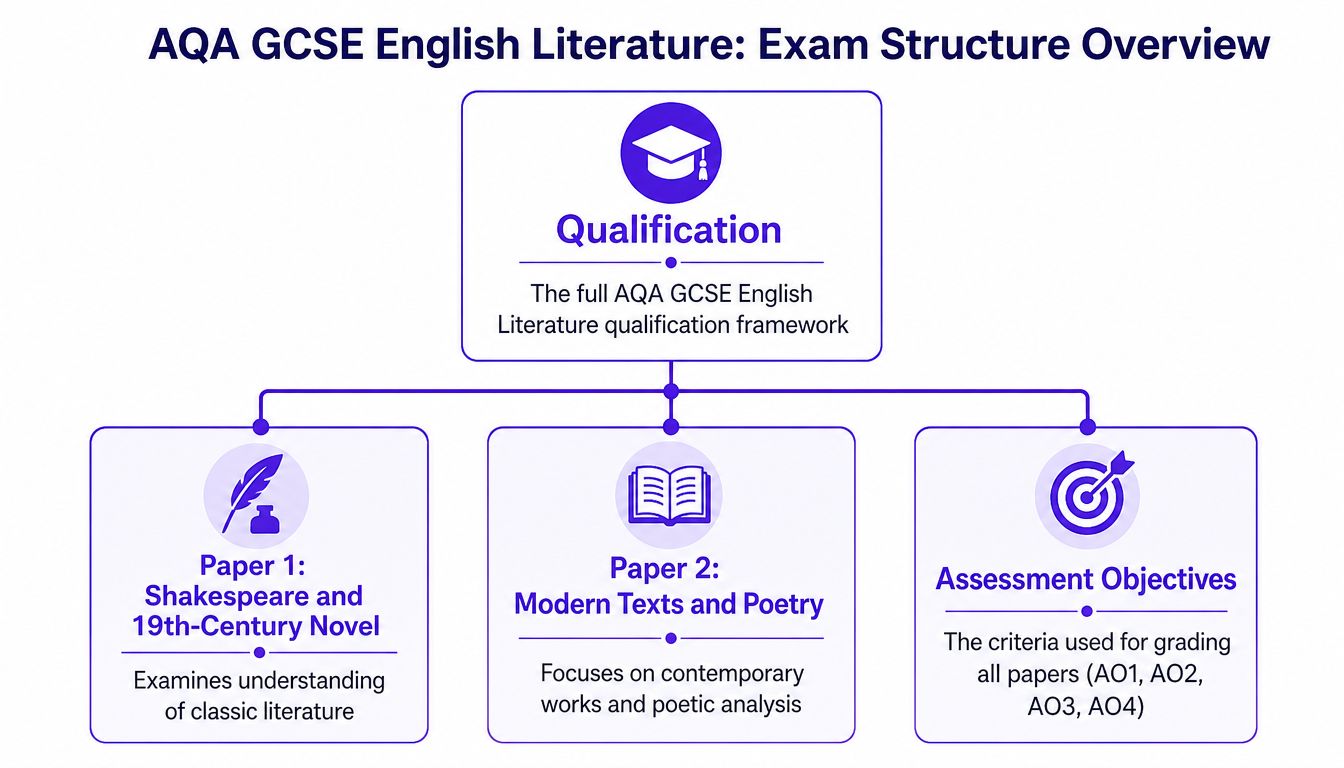
AQA GCSE English Literature has two written papers. One focuses on Shakespeare and the 19th-century novel. The other covers post-1914 literature and unseen poetry. Both are closed-text, so success depends on recall, selection, and control under time pressure.
The big picture
Here is the map students need.
| Paper | What it covers | Time | Marks |
|---|---|---|---|
| Paper 1 | Shakespeare and the 19th-century novel | 1 hour 45 minutes | 64 |
| Paper 2 | Post-1914 literature and unseen poetry | 2 hours 15 minutes | 96 |
That split matters because each paper creates a different writing problem. Shakespeare and the 19th-century novel ask you to work from set texts you know well and shape a precise argument from memory. Unseen poetry tests something slightly different. You have to read quickly, notice methods fast, and build a response without the safety net of pre-learned quotations.
Students often revise all literature in one pile. That usually leads to blurred preparation. A better approach is to match revision to the paper in front of you.
Why the structure matters for the mark scheme
The structure of the exam tells you what kind of performance AQA is judging.
A student who knows dozens of quotations but cannot organise them under timed conditions will not score as highly as expected. Another student may know fewer quotations, but if they choose them well, answer the question directly, and analyse methods with purpose, their mark can be stronger. The paper rewards control.
This is why mark schemes use levels. Examiners judge the overall quality of the response on that task, in that time, for that question. They are not counting random features like a shopping list. They are asking, in effect, “How well did this student handle the job this question set?”
A useful classroom way to explain this is to compare the exam to two different practical tests. One paper asks for rehearsed knowledge used with precision. The other asks for live reading and quick judgement. Same subject. Different demand.
How to revise for the structure you actually face
Revision works best when it mirrors the paper.
- Divide revision by paper type. Train Shakespeare and the 19th-century novel together, then separately train post-1914 texts and unseen poetry.
- Practise recall without notes. Closed-text means you need to remember quotations, references, and ideas well enough to use them under pressure.
- Use real paper layouts. Working from GCSE Past Papers helps you rehearse timing, question wording, and stamina.
- Practise method spotting in isolation. The Kuraplan worksheet on literary techniques is useful for sharpening the kind of close analysis students need, especially for unseen poetry.
- Use AI practice for specific weak points. Instead of writing full essays every time, target one exam skill at a time, such as planning introductions, selecting short quotations, or turning language analysis into a clear paragraph.
That last point matters. AI practice is most useful when it trains the exact move that lifts a student into a higher band. “Write another essay” is vague. “Give me a Paper 1 question and check whether each paragraph stays tied to my thesis” is much closer to how examiners read.
Once students can see the paper as a set of distinct tasks, the exam stops feeling like one large fog of English. It becomes a series of manageable jobs, each with its own method, timing, and mark scheme habits.
What AQA Examiners Actually Look For
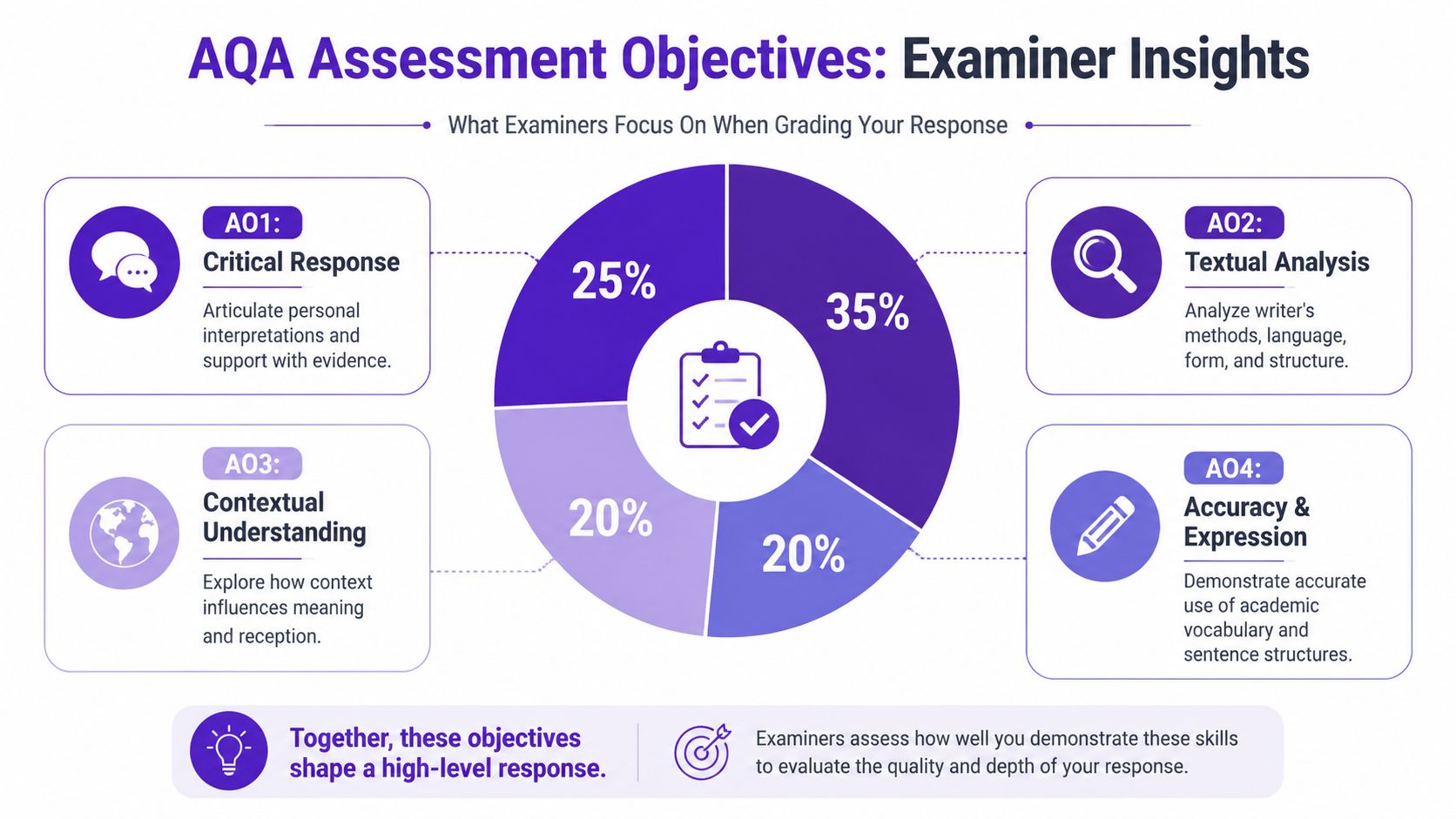
Students usually hear the Assessment Objectives as a string of codes. AO1, AO2, AO3, AO4. That sounds technical, so many students tune out. Big mistake. These objectives are the closest thing you have to an examiner's checklist of attention.
Near the opening of any serious look at the AQA English Literature mark scheme, one fact stands out. On a 30-mark essay, the marks are distributed 12:12:6:4 across AO1, AO2, AO3 and AO4. That means AO2 accounts for 42.5% of the overall grade, making it the heaviest technical factor in that question, as shown in this guide to the modern prose and drama essay mark scheme.
AO1 is your argument
AO1 is about your response to the text. In plain English, it asks: do you have a clear idea, and can you support it?
Students often think AO1 means “put in lots of quotes”. It doesn't. It means use references well. A short quotation that proves a sharp point beats a long quotation that just sits there.
For practice with methods you can spot and discuss, a resource like this Kuraplan worksheet on literary techniques can help students move from feature spotting to purposeful analysis.
AO2 is where top answers separate themselves
AO2 covers language, form and structure. In this domain, examiners look for analysis of the writer's methods.
A weak AO2 move sounds like this: “This makes the reader want to read on.”
A stronger AO2 move sounds like this: “Priestley delays the Inspector's full authority at first, then gradually gives him control of the stage, which makes his moral challenge feel unavoidable.”
That second version treats the text as crafted. Not accidental. Not just plot.
Examiner habit: AO2 is often where an essay either climbs or stalls. If your analysis stays general, your mark usually stays lower than your knowledge deserves.
AO3 and AO4 matter, but not in the way students think
AO3 is context. The trap is treating it like a bolt-on paragraph about “Victorian society” or “patriarchal norms”. Context should help explain meaning. If it doesn't deepen the point, it's just luggage.
AO4 is technical accuracy and terminology. That means clear expression, accurate spelling, and subject vocabulary used properly. It matters, but it won't rescue a thin essay.
Here's a quick plain-English version:
- AO1: What's your argument?
- AO2: How does the writer shape meaning?
- AO3: Why does context sharpen that idea?
- AO4: Is your writing accurate and controlled?
A good place to compare these against the official wording is a set of AQA mark schemes, especially when you want to match classroom advice to what the board rewards.
Later in the paper, this video is useful if you want to hear the language of marking unpacked in a more visual way.
How to Reach the Top Mark Bands
Most students can understand the difference between a weak essay and a decent one. The harder jump is the one that frustrates high-attaining students. They're writing solid essays, using quotations, making developed points, and still not quite breaking into the very top band.
That's because the jump from Level 5 to Level 6 is not about writing more. It's about writing with a stronger governing idea.
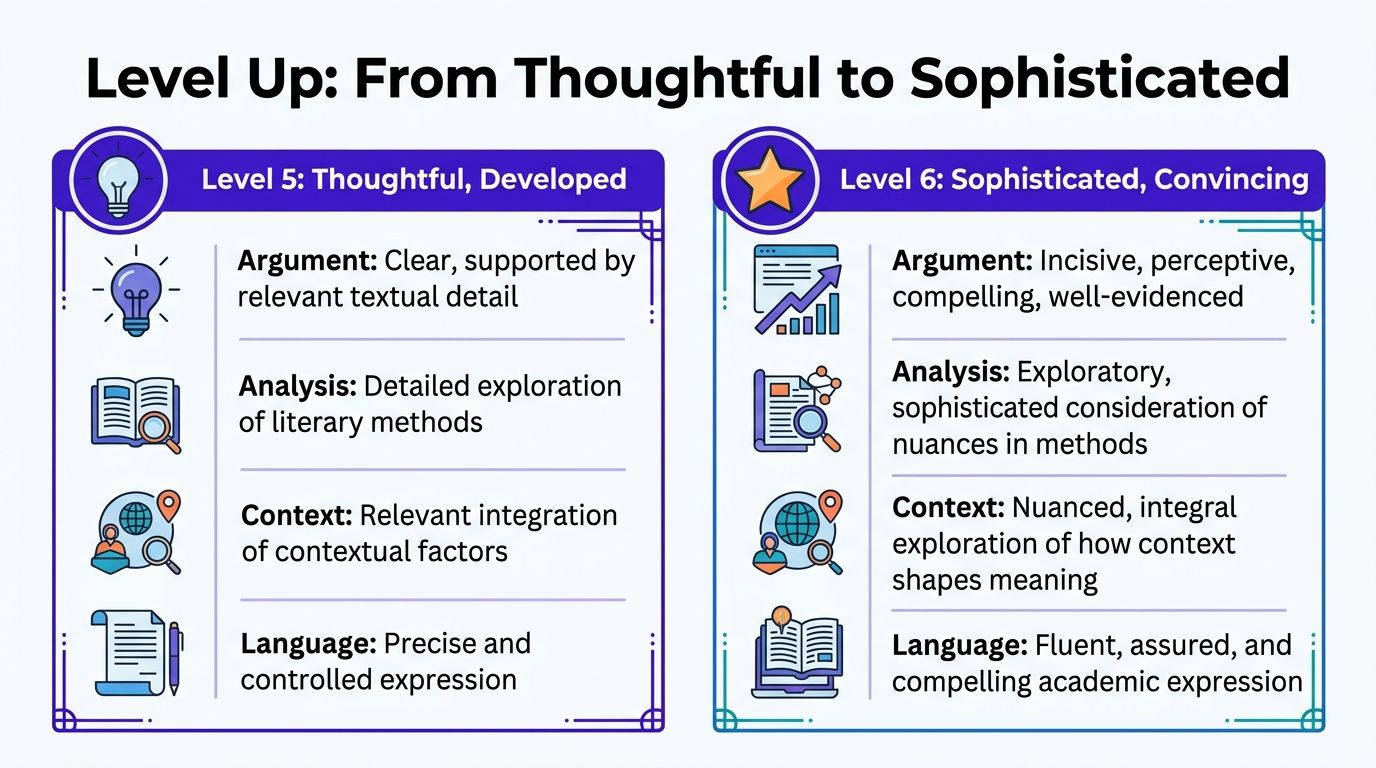
The official distinction is clear. Level 5 is thoughtful and developed. Level 6 requires convincing critical analysis and a conceptual thread, and without that thread students are effectively capped in Band 5 at 21 to 25 marks, as explained in the AQA scheme of assessment.
Level 5 compared with Level 6
Here's the simplest way to picture it.
| Level 5 response | Level 6 response |
|---|---|
| Explains what the writer does | Explores why and how it works |
| Uses quotations accurately | Uses quotations to drive an argument |
| Makes developed points | Builds a line of thought across the whole essay |
| Analyses methods | Evaluates the writer's choices as deliberate |
A side-by-side example
Suppose the question is about power in An Inspector Calls.
Level 5 style paragraph
Priestley presents Birling as arrogant because he thinks he understands everything. He says things with certainty, which shows he is confident and dismissive of others. This makes the audience see him as foolish and unlikeable.
Level 6 style paragraph
Priestley makes Birling's confidence feel performative rather than solid. His certainty is part of a wider pattern in the play where social power depends on sounding authoritative, even when that authority is hollow. That makes Birling useful as more than a foolish man. He becomes a critique of a class that mistakes status for moral credibility.
The second paragraph doesn't just explain. It interprets. It sees the character as part of a deliberate design.
“Treat the text like it was built, not like it simply happened.”
That's the habit students need if they want the top band.
How to build a conceptual thread
A conceptual thread is just a central idea that keeps returning in sharper forms. It is not a fancy phrase at the start of the introduction that you forget by paragraph two.
Try this method:
Start with a debatable idea
Instead of “Lady Macbeth is ambitious”, try “Shakespeare presents ambition as something that breaks identity before it breaks morality.”Make each paragraph prove part of that idea
One paragraph might focus on language, another on stagecraft, another on change over time.Keep judging the writer's method
Ask not only “what is shown?” but “why shape it this way?”
If you want a platform built around this kind of deliberate essay practice, Online Revision for GCSE can help students work on the difference between developed explanation and sharper interpretation without turning revision into guesswork.
Common Mark Scheme Myths Busted
Bad advice spreads quickly in English because it often sounds sensible. “Always include context.” “Use as many quotes as possible.” “Write a context paragraph near the end.” Students hear these lines so often that they start treating them as laws.
Some of them cost marks.
Myth one, you must include context in unseen poetry
This is the big one.
For Paper 2 Unseen Poetry, the mark scheme explicitly says, “You do not need to write about the social or historical context of the poem”, as stated in the AQA Paper 2 mark scheme guidance.
That means forcing in biography or historical background is not a clever extra. In many answers, it pulls attention away from the only thing that matters there: the poem on the page.
In unseen poetry, if you can't prove it from the words in front of you, be careful.
Myth two, more quotations always mean more marks
Students who worry about running out of things to say often overcompensate with quotation dumping. The essay looks busy, but the analysis thins out.
A short, well-chosen reference often does more than a chunk of copied text. Examiners reward selection and use, not hoarding.
Myth three, context should sit in its own paragraph
This usually produces clunky writing like: “In Victorian times, women were expected to…” followed by a generic fact that never really connects back to the point.
Better context is woven into the analysis:
- Less effective: “This was written in a patriarchal society.”
- More effective: “Because the play was written for an audience used to stricter gender expectations, Lady Macbeth's rejection of softness feels especially provocative.”
That second version makes context earn its place.
Myth four, if you know the story well, you'll do well
Plot knowledge matters. Of course it does. But retelling the story is not analysis.
Teachers know this already, but students under pressure often slip into narrative summary because it feels safe. The mark scheme sees that as limited. Better answers keep asking what the writer is doing with the story, not just what happens next.
Practise Like an Examiner with MasteryMind
Understanding the AQA English Literature mark scheme is useful. Applying it to your own writing is harder. Most students can spot strong analysis when a teacher points it out. Fewer can reliably produce it under timed conditions.
That gap is where practice matters most.
The hardest jump is the move from thoughtful, developed writing to convincing, critical analysis. Students often confuse detailed explanation with genuine evaluation, and a strong feedback tool should flag whether an essay has a conceptual thread, as highlighted in the June 2023 AQA mark scheme.

A better way to self-assess
After writing a practice paragraph or essay, ask yourself four things:
- Is there an argument running through it? Not just points, but a line of reasoning.
- Have I analysed methods properly? Language, form, structure. Not just effects in vague terms.
- Is context helping the point? If it isn't, cut it.
- Am I evaluating the writer's choices? Top-band answers usually feel different here.
That kind of review is easier when you can compare your answer against examiner-style criteria instead of just relying on instinct.
For students who want another way to review written work, tools that analyze education essays can be useful for checking clarity and structure before redrafting. The key is to use them critically, not as a shortcut.
Why targeted practice changes more than generic revision
Generic revision often produces generic essays. You memorise themes, collect quotes, maybe write a plan, and hope the question happens to suit what you revised.
Exam-focused practice is different. It trains the exact move the mark scheme rewards. That might mean turning a vague point into AO2 analysis, or spotting that your essay is detailed but doesn't yet carry a full conceptual thread.
A tool like Exam Practice for GCSE is useful because it pushes students to work under realistic conditions rather than endlessly rereading notes. That matters whether you're trying to recover from a shaky start or chase the highest grades.
Teachers tend to be rightly cautious about AI in education. They should be. The useful standard isn't “does it sound impressive?” It's “does it reflect the exam properly?” When feedback is tied closely to AOs, question styles and mark bands, it becomes far more than automated praise. It becomes usable revision.
If you want revision that mirrors the actual exam instead of just talking about it, MasteryMind is a strong next step. It gives UK students exam-style practice, AO-based feedback, and a clearer sense of why an answer sits in one band instead of another. That makes the mark scheme easier to use, whether you're trying to pull your grade up fast or push into the top band with confidence.
Ready to master this topic?
Practise with quizzes, blurt exercises and exam questions on MasteryMind.
7 days Premium · Then free forever · No card, no charge