BTEC Applied Science Revision: A Smart Study Plan

The most popular BTEC Applied Science revision advice is also the least useful: read every topic again, highlight the important bits, and make more flashcards. That approach can help you remember isolated facts, but it won't prepare you for questions that combine biology, chemistry, physics, calculations, practical methods and unfamiliar data.
Effective BTEC Applied Science revision is more active. You need to retrieve information, interpret evidence, follow command words and apply scientific principles to a situation you haven't seen before. You also need a plan that reflects how your qualification is assessed, because practical work and coursework matter alongside exam preparation.
Understanding the BTEC Applied Science Structure
Before choosing a revision technique, identify the qualification you're taking. Students often use advice designed for a traditional exam-only course, then discover too late that BTEC assessment includes different units, assessment methods and evidence requirements.
The Pearson Level 3 National Certificate in Applied Science specification sets the National Certificate at 180 guided learning hours. It contains two mandatory units, each worth 90 guided learning hours. Principles and Applications of Science I is externally assessed, while Practical Scientific Procedures and Techniques is internally assessed.
That split changes how you should revise. The mandatory content represents 100% of the qualification, and external assessment accounts for 50%, according to Pearson's specification. You therefore need exam preparation for the principles unit, but you can't treat practical evidence as an afterthought. You must achieve at least a Near Pass in the mandatory external unit and a Pass in the mandatory internal unit.
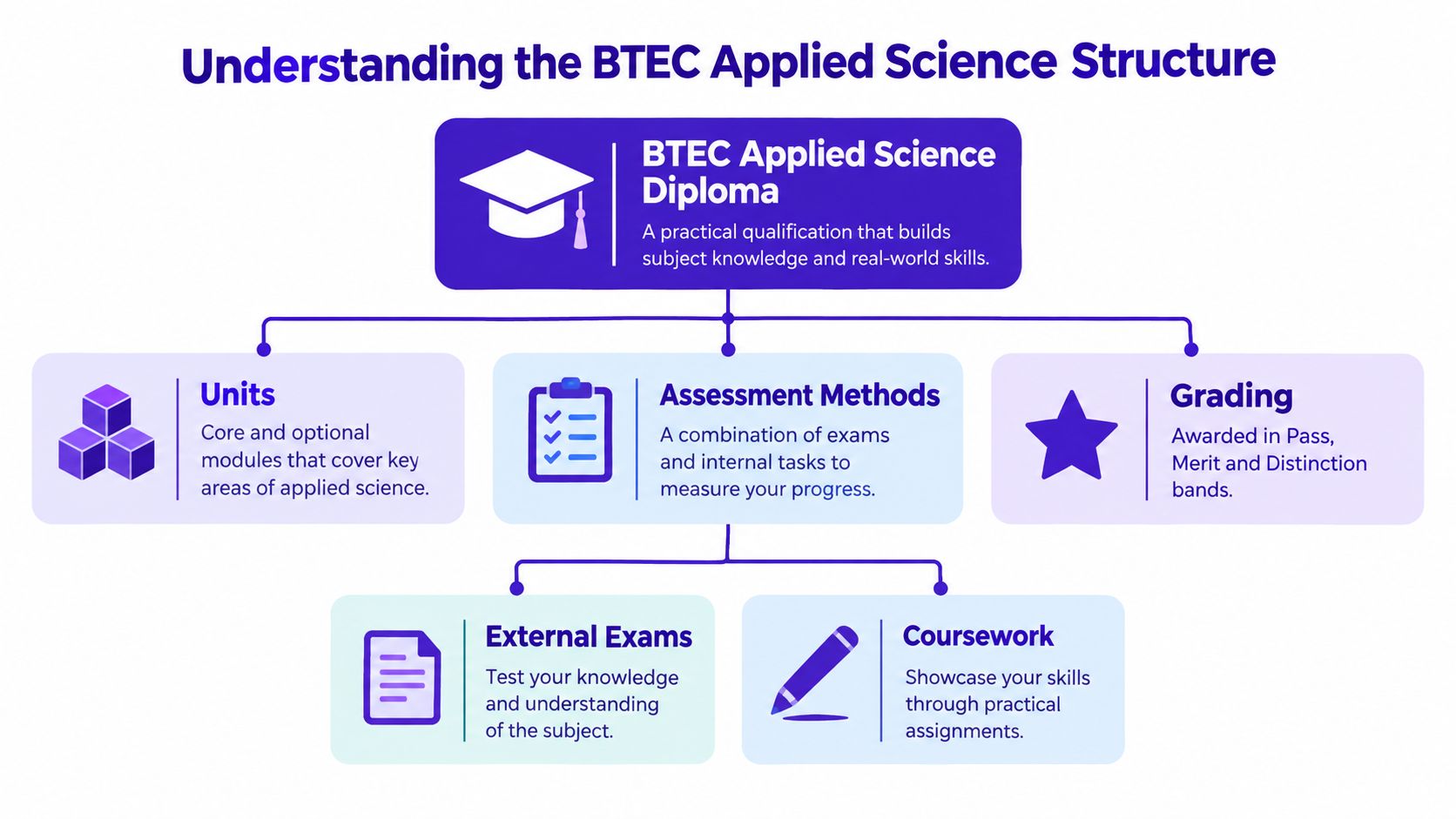
Check your qualification before planning
The Level 3 National Extended Certificate is broader. Pearson's Extended Certificate specification describes 360 guided learning hours across four units. It includes three mandatory units, Principles and Applications of Science I, Practical Scientific Procedures and Techniques, and Science Investigation Skills, plus one option unit.
Your option might focus on human-body-system physiology, biological molecules and metabolic pathways, inorganic chemistry applications, or electrical circuits and their applications. That choice affects what specialist knowledge you need to retain, so write it clearly at the top of your revision plan.
Use a simple tracking system:
- Mandatory units: Keep a separate checklist for every required topic and practical skill.
- External assessment: Practise recall, calculations, data interpretation and extended responses.
- Internal assessment: Review procedures, observations, analysis and evaluation, while keeping your submitted work authentic.
- Option unit: Record the exact specialist content selected by your centre.
For wider topic support, you can also use GCSE applied science topics to revisit foundations where your BTEC work depends on earlier scientific knowledge. The important point is proportional planning. Don't spend all your time memorising exam facts while leaving practical evidence, investigation skills or your option unit until the last minute.
Planning rule: Revise according to the assessment structure, not according to whichever topic feels easiest to make flashcards for.
The external unit is also synoptic, so your revision needs to connect biology, chemistry, physics, scientific calculations and applications. A topic list is useful, but it isn't a complete strategy. Add a second layer that shows how each idea appears in data, practical work and unfamiliar contexts.
Tackling Synoptic and Data-Rich Questions
Knowing a definition doesn't guarantee that you can use it. Synoptic questions test whether you can select relevant knowledge from different areas and apply it to the evidence in front of you.
The 2025 Pearson BTEC National Applied Science specification explains that synoptic assessment requires learners to apply knowledge from one unit to another. Examinations may combine multiple-choice questions, calculations, short answers and extended open responses, often using unfamiliar contexts and data. The specification includes a 50-mark, one-hour examination, so you must practise making decisions quickly as well as recalling content.
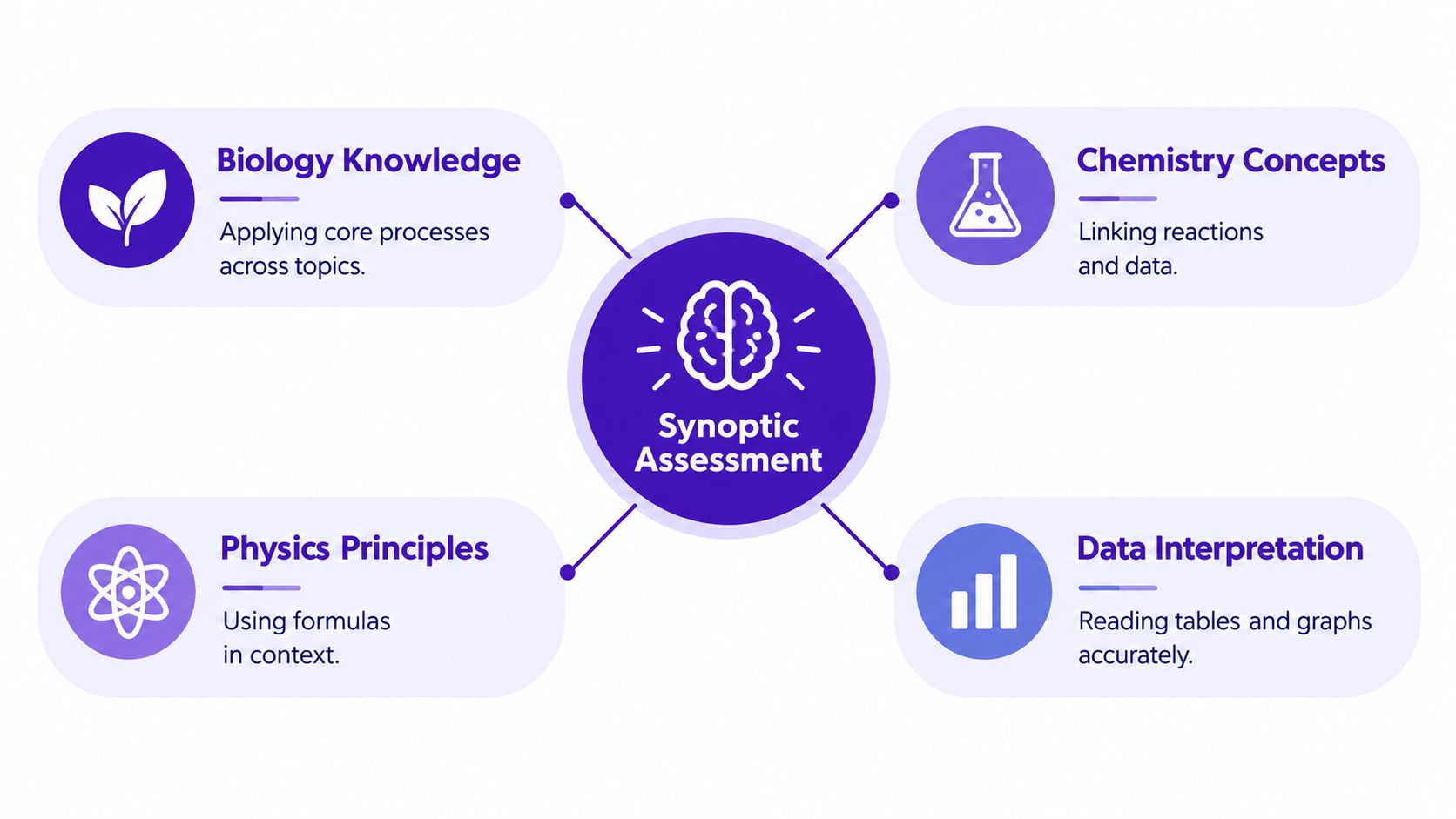
Read the evidence before reaching for memory
Start every data question by identifying what has been provided. Look at the table headings, graph axes, units, patterns and anomalies. Then ask which scientific ideas could explain those observations.
For example, a practical investigation might give you measurements from a circuit. You may need physics knowledge to use a formula, practical knowledge to judge the method, and data skills to identify a relationship. If you only revise “circuits” as a list of definitions, you may miss the connection between the variables and the quality of the investigation.
A useful annotation routine is:
- Circle the variables being changed and measured.
- Underline units and identify whether a calculation needs conversion.
- Mark the trend in the table or graph.
- Name the scientific principle that could explain the trend.
- Check the command word before writing the conclusion.
Don't practise every paper as a single-unit exercise. Mix questions deliberately. A biology question about respiration can sit beside a chemistry question about molecules and a physics calculation involving energy, provided you force yourself to identify the knowledge needed before answering.
Turn practice into transfer
Use A-Level Past papers as an additional source of mixed exam practice where the question style and science overlap usefully, but always check that the content matches your own specification. The point isn't to collect papers. It's to create uncertainty about what comes next, just as an exam does.
After marking, classify each mistake:
- Knowledge gap: You didn't know or couldn't recall the science.
- Data error: You misread a graph, table, trend or unit.
- Calculation error: Your method, substitution, arithmetic or unit was wrong.
- Application error: You knew the principle but didn't link it to the context.
- Command-word error: You described when the question required explanation or evaluation.
This diagnosis matters more than just recording a score. More content coverage won't automatically fix a transfer problem. If your knowledge is strong but your answers remain disconnected from the presented evidence, your next session should contain mixed, data-rich questions rather than another page of notes.
Mastering Command Words and Exam Technique
Examiners can't award marks for knowledge that you haven't used in the way the question requires. A short answer can contain correct science and still lose marks if it doesn't explain a cause, make a judgement or show a calculation.
Read the command word first. Then identify the subject, the evidence and the number of marks available. For longer answers, sketch the logical order before you begin writing.
Match the verb to the response
| Command Word | What the Examiner Wants | How to Structure Your Answer |
|---|---|---|
| Describe | Accurate features, observations or stages | State what happens in a clear order. Include relevant patterns or characteristics. |
| Explain | A cause-and-effect scientific account | Make the point, then connect it to the scientific reason using words such as “because” or “therefore”. |
| Calculate | A correct numerical answer with a method | Write the formula, substitute values, show working, give the answer with a unit and check its sense. |
| Compare | Similarities and differences | Refer to both items in each comparison, rather than writing two separate descriptions. |
| Evaluate | A supported judgement about strengths, weaknesses or suitability | Use evidence, discuss limitations or alternatives, then reach a justified conclusion. |
The mark allocation gives you a useful answer-length signal, but don't treat it as a demand for one sentence per mark. A four-mark explanation usually needs several linked scientific points, while a calculation may earn marks for the formula and method even if the final arithmetic goes wrong.
Build extended responses in layers
For an unfamiliar practical context, use this sequence:
- Identify the scientific idea. Name the principle, process or relationship.
- Use the supplied evidence. Quote or describe the relevant pattern from the graph, table or scenario.
- Apply the principle. Explain how the science accounts for what happened.
- Deal with limitations. Mention reliability, validity, controls, uncertainty or an alternative explanation when relevant.
- Finish with a judgement. State whether the evidence supports the claim and why.
Keep calculation working visible. A marker should be able to follow your method without reconstructing it from a final answer. For practical planning, name equipment, justify its use, identify variables, include repeats, state safety controls and explain how the data will be processed.
Protect your time
Don't spend most of the paper polishing a low-mark response. Read the paper quickly enough to understand the full route through it, answer the questions you can access, and leave space for extended responses. If you become stuck, write down the relevant formula or principle, move on, and return later.
AI Powered Revision can be used as one practice option for command-word questions and feedback, but it shouldn't replace your own working. The most valuable habit is still simple: after every answer, ask whether you responded to the exact verb in the question.
Navigating Coursework and Authenticity Rules
Coursework can give you an opportunity to demonstrate careful practical thinking, but only when the work genuinely belongs to you. JCQ guidance requires candidates to sign a declaration confirming that submitted work is their own and that assistance and sources have been acknowledged.
The JCQ coursework guidance for 2026 to 2027 states that teachers must not assess work that hasn't been properly authenticated. If a candidate can't confirm authenticity, the centre must record a mark of zero. JCQ also warns that copying, plagiarism from a source or AI tool, allowing another candidate to copy, or cheating can lead to disqualification from at least the subject concerned.
Pearson's BTEC guidance makes the boundary clear too. AI-generated content must be identified, and AI output alone doesn't demonstrate that the learner independently met the marking criteria.
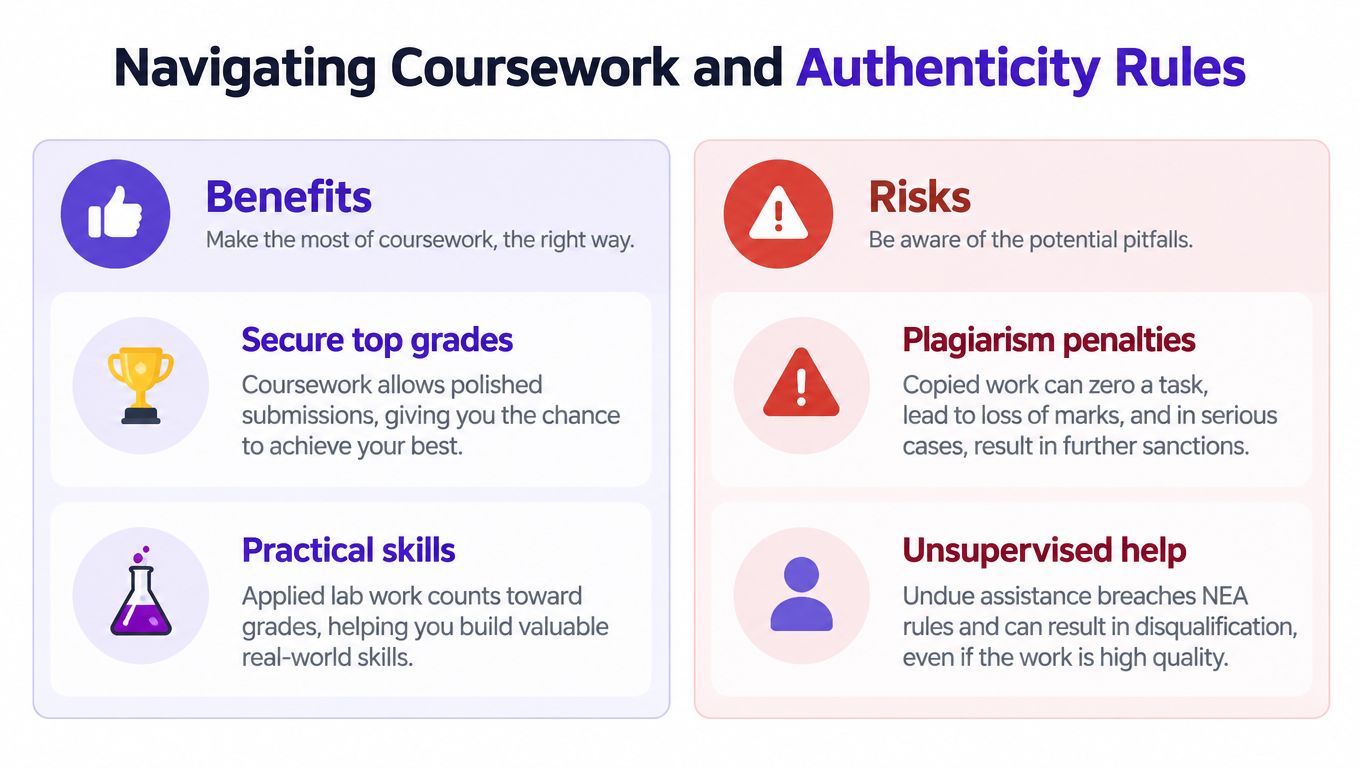
Use support without outsourcing the work
Revision help is appropriate when it improves your understanding or helps you find your own errors. It becomes risky when a tool, tutor or website produces the analysis, evaluation or scientific writing that you submit.
Acceptable support can include:
- Questioning: Ask for prompts that help you identify a variable, control or limitation.
- Quizzing: Test your recall of methods, safety points and scientific principles.
- Feedback: Compare your draft reasoning with the assessment criteria, then rewrite it yourself.
- Planning: Create a checklist of what your practical report needs to address.
- Source handling: Record references and acknowledge help as your centre requires.
A completed answer can look impressive while teaching you very little. It also creates a problem if you can't explain the work independently when your teacher checks it.
Authenticity test: If you couldn't reproduce the reasoning in your own words, don't submit it as your own work.
Teachers should make this boundary explicit. Students need to know whether a resource is offering a hint, an example for learning, or text that must never be copied into assessed evidence. Keep drafts, notes and raw observations so your progress is visible, and ask your centre how it wants AI assistance recorded.
Using Spaced Repetition and Active Recall
Rereading feels comfortable because the answer is already in front of you. Retrieval feels harder because you have to produce the answer without support. That difficulty is useful, particularly for formulae, practical procedures, safety controls and command-word responses.

Make every card require a decision
A weak flashcard says, “What is diffusion?” A stronger one asks, “A cell is placed in a solution with a different concentration. Explain the movement of particles and identify the direction of net movement.” The second card makes you recall knowledge and apply it.
Create several types of prompts:
- Recall prompts: Define a term or write a formula from memory.
- Procedure prompts: Put practical steps in order and identify safety controls.
- Data prompts: Describe a trend and explain what could cause it.
- Calculation prompts: Select the correct equation, substitute values and include units.
- Evaluation prompts: Judge whether a method produces reliable and valid evidence.
Schedule difficult cards more often and delay cards you can answer accurately. That is the principle behind how uses spaced repetition, where review timing responds to what you remember rather than treating every topic identically.
You can also speak your answer aloud before checking your notes. Explain a practical method as if you're teaching a classmate, then listen for missing variables, vague equipment choices or unsupported conclusions. A voice-based activity such as a spoken recall challenge can expose gaps that silent reading hides.
For editable resources, you can add notes to PDF so that graphs, examiner comments and your own corrections stay together. Annotate the exact point you missed, not just the mark you lost.
The following video can support a focused study session after you've chosen a specific topic and retrieval task:
Move from recall to application
Start with a simple definition, then change the context. Ask yourself what would happen if a variable changed, how you would test the prediction, and what evidence would support your conclusion. Finish with a mixed question that combines content from more than one area.
Keep a mistake log with four columns: question, error type, corrected method and next review date. Don't copy the full model answer. Write the smallest reminder that will help you avoid the same mistake next time.
Your Final Weeks Revision Checklist
Your final revision period should become more selective, not more frantic. You aren't trying to reread every page. You're trying to remove predictable errors, strengthen weak areas and make your response process automatic.
Build the countdown around evidence
At the start of the final stretch, confirm your exact qualification, mandatory units, option unit and assessment arrangements. Check that internal work has been submitted through your centre's process and that authenticity declarations, acknowledgements and required records are complete.
Then use your practice data to choose priorities:
- Weak knowledge: Relearn one small concept, close the notes and retrieve it.
- Weak application: Complete a question using unfamiliar data and explain every link.
- Weak calculations: Practise formula selection, substitution, units and checking.
- Weak practical reasoning: Plan a method with variables, repeats, safety and data processing.
- Weak technique: Complete a timed response and mark the command word before writing.
In the middle of the countdown, use mixed practice rather than repeating your favourite topic. Include short recall, a calculation, a data interpretation task and an extended response. Mark the work soon afterwards while you still remember why you chose each step.
Use the last sessions carefully
Complete a timed mock under realistic conditions, then spend at least as much effort analysing it as answering it. Build a final mistake list that contains actions, such as “show units in every calculation” or “link the conclusion to the table”, rather than vague labels such as “revise physics”.
In the last few sessions, revisit formulas, essential definitions, practical procedures, common hazards, graph skills and the topics appearing most often in your error log. Don't replace sleep with endless rereading. A tired student is more likely to misread a command word, skip a unit or lose the thread of an extended answer.
On exam day, read the question carefully, use the supplied evidence, show your method and leave time to check. If an answer feels too short for the command word and marks available, add the missing explanation, comparison, calculation working or judgement.
Final check: Your preparation is ready when you can explain not only what the science is, but how you would use it in a new context.
MasteryMind offers specification-aligned practice for biology, chemistry, physics, laboratory techniques, data analysis and scientific investigation, with adaptive quizzes, spoken active recall and feedback on calculations and command words. Visit MasteryMind to build a mixed-topic BTEC Applied Science revision routine that targets your actual mistakes.
Ready to master this topic?
Practise with quizzes, blurt exercises and exam questions on MasteryMind.
7 days Premium · Then free forever · No card, no charge