BTEC Health and Social Care Revision: 2026 Guide

Most revision advice for BTEC Health and Social Care starts with “do more questions”. That sounds sensible, but it's often the reason students work hard without seeing their marks move. A learner can complete dozens of practice questions and still lose marks because they prepared for an internal assignment like an exam essay, or revised an external assessment without practising under its real conditions.
Assessment literacy comes first. Before choosing flashcards, past papers or a revision timetable, identify whether you're preparing for a timed external assessment, a Pearson-set assignment or a centre-marked internal unit. Each one rewards a different kind of preparation. The content matters, but the assessment route determines how you must use it.
Teachers see this problem regularly. Students often know the definition of safeguarding or person-centred care, yet fail to apply it to the scenario, match evidence to a criterion or make a justified judgement. The missing skill isn't always knowledge. It's knowing what the assessor is asking you to do with that knowledge.
Why More Revision Questions Is Not the Answer
A student may complete fifty questions and still lose marks in a mock. The usual reason isn't laziness. They've practised the wrong task. They may have written polished paragraphs for an assignment when the actual assessment requires a timed response, or memorised topic summaries without learning how command words change the answer.
That's why more questions don't automatically mean better revision. Practice only helps when it resembles the assessment you'll sit. A short recall question, a structured report and a supervised examination response may all use the same topic, but they test different behaviours.

Start with the assessment route
Pearson states that most BTEC Health and Social Care units are internally assessed, while external assessments are set and marked by Pearson under designated conditions, as explained in its assessment efficacy report for BTEC Nationals. That split changes how you revise.
For an external assessment, you need timed application. You must recognise command words, select relevant knowledge and respond directly to the context before time runs out. For an internal assignment, you need a clear evidence trail. You must show how each section meets the assessment criterion, not merely produce an attractive essay.
Pearson identifies treating internal assignments like ordinary essays as a common pitfall. Students may describe a service or care value accurately but fail to demonstrate how their evidence satisfies each criterion. A criterion-by-criterion matrix is a useful control. Create columns for the exact claim, contextual example, supporting evidence and evaluative judgement.
Practical rule: If you can't point to the criterion your paragraph satisfies, the paragraph isn't finished.
Build recall around application
Flashcards still have a place. They're useful for terms, legislation, theories and stages of development, but they're only the first layer. After recalling a definition, add a scenario prompt:
- Knowledge: What does person-centred care mean?
- Application: How would a care worker demonstrate it when supporting someone with a different communication need?
- Evaluation: What could prevent the approach from working, and how might the worker respond?
This turns revision from copying notes into making decisions. If you're using flashcards, browse active recall methods that force you to answer before looking at the explanation.
Your first decision should be simple. Check the qualification title, specification year, unit name and assessment method with your teacher or handbook. Only then choose practice material. A smaller set of accurately matched questions will usually do more for your grade than a large bank built for a different BTEC route.
Understanding the New 2025 BTEC Assessment Model
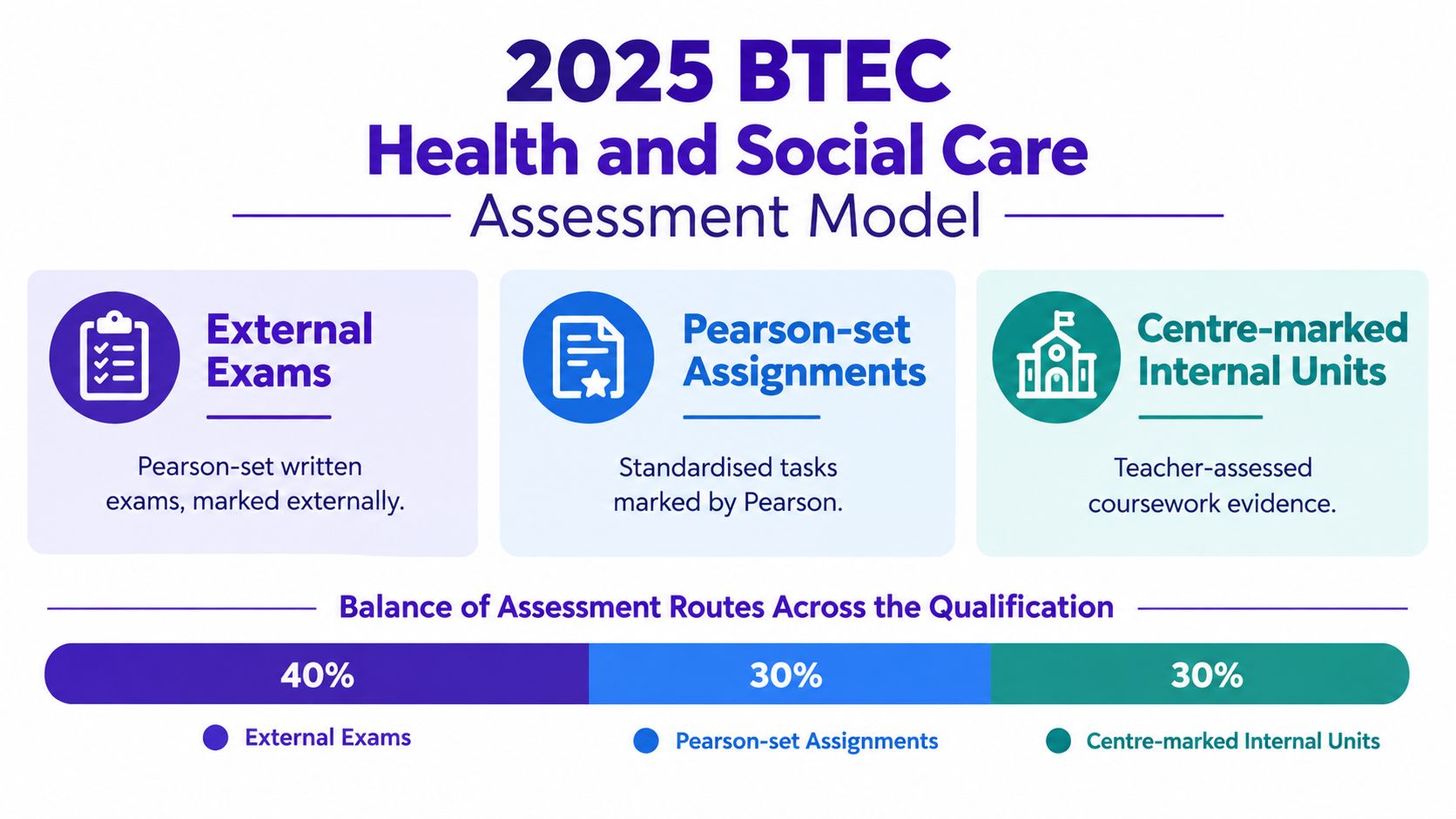
The 2025 BTEC Level 3 Health and Social Care model requires more careful planning because it combines different assessment routes. Learners may prepare for an externally set examination, a Pearson-set assignment or a centre-marked internal unit. Those routes aren't interchangeable, even when they cover related content.
What changes in practice
The revised model includes one unit assessed by an 80-mark, one-hour examination. Other assignments may involve approximately 12, 15 or 17 hours of supervised work, with the work centre-marked and Pearson-verified, according to the 2025 BTEC Level 3 Health and Social Care specification.
The exam route rewards concise recall, accurate application and controlled timing. You should practise command words, unfamiliar scenarios and short planning routines. The assignment route rewards organisation, evidence selection and sustained work within the supervised conditions. You need to understand the brief before you start, keep your work connected to the criteria and use planning checkpoints rather than improvising every paragraph.
Centre-marked internal units follow the assessment brief and your centre's evidence requirements. Your teacher initially marks the work, while Pearson quality-assures the process through verification. That means your class instructions and assignment brief matter. Generic online advice can't replace them.
Pearson scheduled multiple webinars in 2025 on getting started with teaching and internal assessment, which indicates that centres and learners are still adapting to the structure. Check the current documents rather than assuming a guide written for an older specification still applies.
A two-minute route check
Use this quick decision flow before revising:
- Read the qualification title. Is it the revised AAQ, a legacy BTEC National or another Health and Social Care award?
- Find the unit assessment table. Look for examination, Pearson-set assignment or internal assessment.
- Check who marks it. Pearson marking points towards external assessment. Your centre's assessment process points towards internal work.
- Read the conditions. Note the time limit, supervised hours, permitted resources and submission requirements.
- Change your practice. Use timed questions for exams, planning and evidence checks for assignments, and criterion mapping for internal units.
Legacy National learners may still be preparing under a different structure, particularly those completing a resit. Don't borrow a 2025 revision plan without checking your own specification. A route-specific bank of BTEC exam practice is only useful when it matches the qualification and assessment mode you're taking.
Building a Timetable That Matches Your Unit Weight
Equal revision time for every unit feels fair, but it isn't always efficient. Pearson's BTEC National grading system uses Pass, Merit, Distinction, Near Pass and Unclassified at unit level. Unit contribution is linked to guided learning hours, or GLH, so a 120-GLH unit contributes twice as much as a 60-GLH unit, as set out in the BTEC National Health and Social Care specification.
That doesn't mean you can ignore a smaller unit. A learner normally needs at least Near Pass in every external unit and Pass or above in all mandatory units. Your timetable therefore needs two priorities: the units with the greatest weighting and the units where you're below the required threshold.
Make the priority list
Write every unit in a table. Add its GLH, assessment type, current confidence and next assessment date. Then sort it in two ways:
| Question | What it tells you |
|---|---|
| Which unit has the highest GLH? | Where extra revision time may have the greatest effect on the overall qualification |
| Which unit feels weakest? | Where targeted practice is needed immediately |
| Which external unit is below Near Pass standard? | What needs urgent exam-focused attention |
| Which mandatory internal unit is incomplete? | What evidence must be checked with your centre |
Don't spend all your time on the unit you enjoy. Familiar topics can create a false sense of progress. Start each session with a short test from a weak area, then use your notes to repair the gaps that the test exposes.
Use proportional time, not perfect balance
Suppose your timetable includes one 120-GLH unit and one 60-GLH unit. The larger unit deserves a greater share of your available revision because its contribution is twice as large. You might still give the smaller unit regular sessions, especially if it's an external assessment or a personal weakness.
A practical two-week pattern could look like this:
- Days 1 to 3: Rebuild the weakest learning aims in the largest unit, using closed-book recall followed by applied questions.
- Day 4: Complete a timed section for the relevant external unit and mark it against the official criteria.
- Days 5 to 7: Prepare evidence for an internal unit, checking each criterion and correcting missing context.
- Days 8 to 10: Return to the largest unit, focusing on command words and unfamiliar scenarios.
- Day 11: Review the smaller unit through short recall prompts and one extended response.
- Day 12: Complete a supervised-style task or assignment planning checkpoint.
- Day 13: Mark errors, group them by topic and rewrite only the weak parts.
- Day 14: Run a final mixed recall session and review the assessment conditions.
Keep the timetable visible. A digital AI-powered study planner for A-Levels can help organise sessions, but the decisions still need to come from your specification, GLH and assessment requirements.
Active Recall and Spaced Practice for Health and Social Care
Re-reading notes feels productive because the material looks familiar. Familiarity isn't the same as being able to produce a clear answer under pressure. BTEC questions often require you to recall a concept, apply it to a person or service and explain why your response is appropriate.
Turn topics into spoken answers
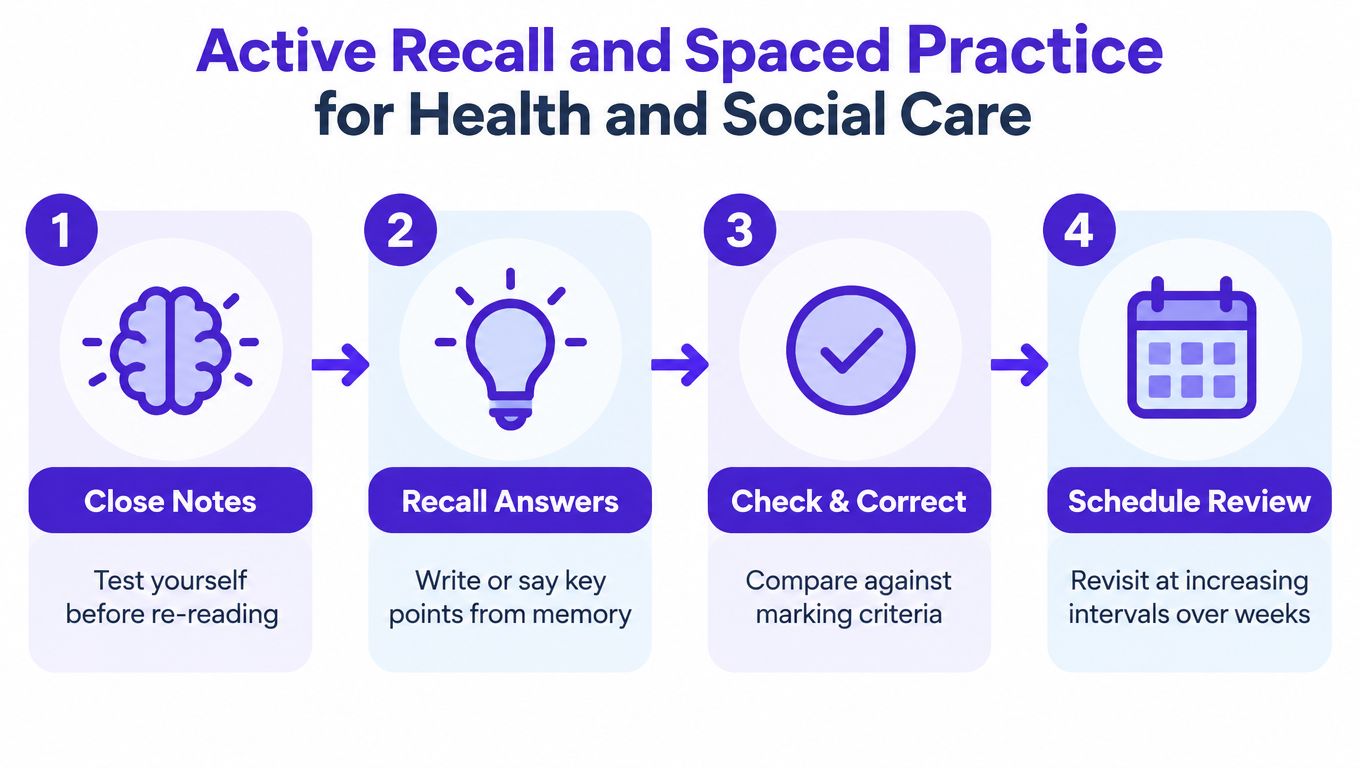
Active recall means closing the notes and retrieving the answer from memory. For Health and Social Care, speaking can be particularly useful because it exposes vague understanding quickly. If you can't explain duty of care without reading, you probably won't apply it confidently in a scenario.
Try this routine:
- Close your notes.
- Say what the term means in plain language.
- Give a care-setting example.
- Explain one benefit and one limitation.
- Check the specification or marking criteria.
- Record the missing point as a new prompt.
For example, don't stop after defining safeguarding. Ask yourself how a care worker might recognise a safeguarding concern, what action they should take, why confidentiality may have limits and what could happen if the concern is ignored. The same approach works for human development, care values, communication and research methods.
A voice-based activity such as a Blurt Challenge is useful here. Saying an answer aloud makes you commit to a line of reasoning, rather than merely recognising words on a page. A tool that compares the response with curriculum objectives and creates follow-up questions can then direct practice towards what you left out.
Here's a short demonstration of the kind of active recall routine to use:
Schedule the return, not just the first session
Spaced practice is a scheduling choice. You don't need to master an entire unit in one sitting. Test a topic, leave it, then return before the memory becomes completely secure.
A four-day cycle might look like this:
- Day 1: Human development. Recall life stages, influencing factors and relevant theory, then apply one factor to a person in context.
- Day 2: Care values. Explain how dignity, respect, choice and partnership might affect a care interaction.
- Day 3: Research methods. Test validity, reliability, ethics, bias and methodological limitations using a short study scenario.
- Day 4: Return to human development without rereading first. Correct only the gaps, then restart the cycle.
Use spaced repetition for A-Levels as a general scheduling reference, but adapt the prompts to your BTEC unit and assessment criteria. The best schedule is one that makes you retrieve, apply and correct, not one that merely fills your calendar.
Practising Questions the Right Way for Each Assessment Type
The same topic can produce completely different answers depending on the assessment. An exam question may demand a concise response to a case study under strict timing. An assignment may require a structured report with evidence matched to criteria and a clear evaluative conclusion.
The supervised task approach
For the BTEC Tech Award Health and Social Care supervised task, the specification describes a 60-mark task completed in two hours, so approximately two minutes per mark is a useful working benchmark, according to the Health and Social Care assessment specification. Don't treat that as a reason to write continuously. Use the time to plan, answer and check.
Use four passes that match AO1 through AO4:
- Recall factors affecting health and wellbeing. Identify physical, lifestyle, social or environmental factors that fit the person in the scenario.
- Interpret health indicators. Explain what the information suggests, rather than copying the figure or description.
- Construct a person-centred improvement plan. Make the intervention realistic for that individual, with reasons for each choice.
- Evaluate obstacles and solutions. Consider barriers such as motivation, finance, access, communication or support, then suggest ways to reduce them.
Before writing, annotate the scenario and highlight command words. Allocate time by marks, draft one contextual point for every requirement and leave a final checking period. Ask whether each intervention is genuinely person-centred and justified.
Exam-style and assignment-style responses
Consider these two prompts about supporting an individual with a health need.
Exam-style prompt: Explain how a care worker could use a person-centred approach to support the individual.
A strong response identifies the approach, applies it to the person and explains the effect. It might discuss choice, communication, involvement in planning and review, but each point must connect to the scenario. A list of care values without context shows knowledge but doesn't fully answer the question.
Assignment-style prompt: Assess how effectively a selected service uses person-centred practice to meet an individual's needs, supported by evidence.
This response needs a different shape. Start with the service and individual, map evidence to the assessment criteria, explain strengths and limitations, then reach a justified judgement. Keep a record of where evidence came from and how it supports the claim. A confident tone cannot compensate for missing criterion coverage.
Marking question: What does this sentence prove, and which assessment criterion does it satisfy?
For self-assessment, mark in three passes. First, underline knowledge. Next, circle application to the case or service. Finally, box evaluation and justification. If a paragraph has only underlining, you've recalled content but haven't completed the assessment task.
Coursework, NEA and Digital Tool Tips
Coursework and NEA work punish a different mistake from exams. In an exam, you may lose marks through weak timing or incomplete application. In an internal task, you can lose them because the evidence doesn't prove the criterion, the research method has limitations you haven't considered, or the work doesn't show an independent and auditable process.

Use an evidence checklist
Before submitting an internal assignment, check:
- Criteria coverage: Can you highlight the exact sentence or evidence that meets every criterion?
- Context: Have you connected the point to the named person, service, setting or research question?
- Evidence trail: Can your centre see how you developed the work independently?
- Research quality: Have you considered bias, validity, reliability, ethics and methodological limitations?
- Evaluation: Have you weighed strengths and weaknesses before reaching a conclusion?
- Presentation: Does the structure make it easy for the assessor to follow your reasoning?
Research assignments need more than a method description. Explain why the method was suitable, what might distort the findings and how ethical principles affected the process. If your conclusion is stronger than your evidence, reduce the claim or improve the evidence.
Choose digital help carefully
A revision platform can support recall and feedback, but it shouldn't write assessed work for you. Look for questions aligned to the correct awarding body, specification and command words. Topic tracking and spaced scheduling are useful only when the content matches your route.
For stuck coursework, Socratic guidance is safer than direct answers. A tool such as an NEA Coach should ask questions that help you interpret the brief, test your evidence and identify gaps while following JCQ rules. It shouldn't rewrite your assignment or supply a submission-ready solution.
| Assessment route | Best preparation | Common error |
|---|---|---|
| External exam | Timed questions, command-word practice and mark-scheme checks | Writing everything you know without answering the scenario |
| Pearson-set assignment | Brief analysis, supervised planning and evidence mapping | Treating the task like an ordinary essay |
| Centre-marked internal unit | Criterion matrix, independent evidence trail and evaluation | Describing content without proving the criteria |
BTEC Level 3 Health and Social Care combines externally and internally assessed units. Pearson sets and marks external assessments at specified times, while your school or college designs, administers and initially marks internal assessments before Pearson verification. Depending on qualification size, learners may have between one and four external assessments and between one and nine internally assessed units, as described in Pearson's guide to BTEC Nationals in Health and Social Care. For a resit, identify the route before opening a practice paper.
MasteryMind offers exam-board-aligned questions, command-word practice, active recall through the Blurt Challenge, spaced review scheduling and Socratic NEA support that guides rather than writes your work. If you want BTEC Health and Social Care revision to match the assessment you're preparing for, visit MasteryMind and start with the free plan.
Ready to master this topic?
Practise with quizzes, blurt exercises and exam questions on MasteryMind.
7 days Premium · Then free forever · No card, no charge