BTEC Sport Revision That Actually Works for Real Students

You've got two BTEC Sport units to submit, an external exam in five weeks, and a folder full of notes you can't find. Your phone is in one hand, your half-finished coursework is in the other, and every revision video seems to assume you started months ago.
You haven't ruined your chances. BTEC Sport revision is recoverable when you stop treating every task like a memory test. An exam, a synoptic task, coursework and video evidence all reward different habits. The useful question isn't “How do I revise everything?” It's “What does this assessment ask me to do?”
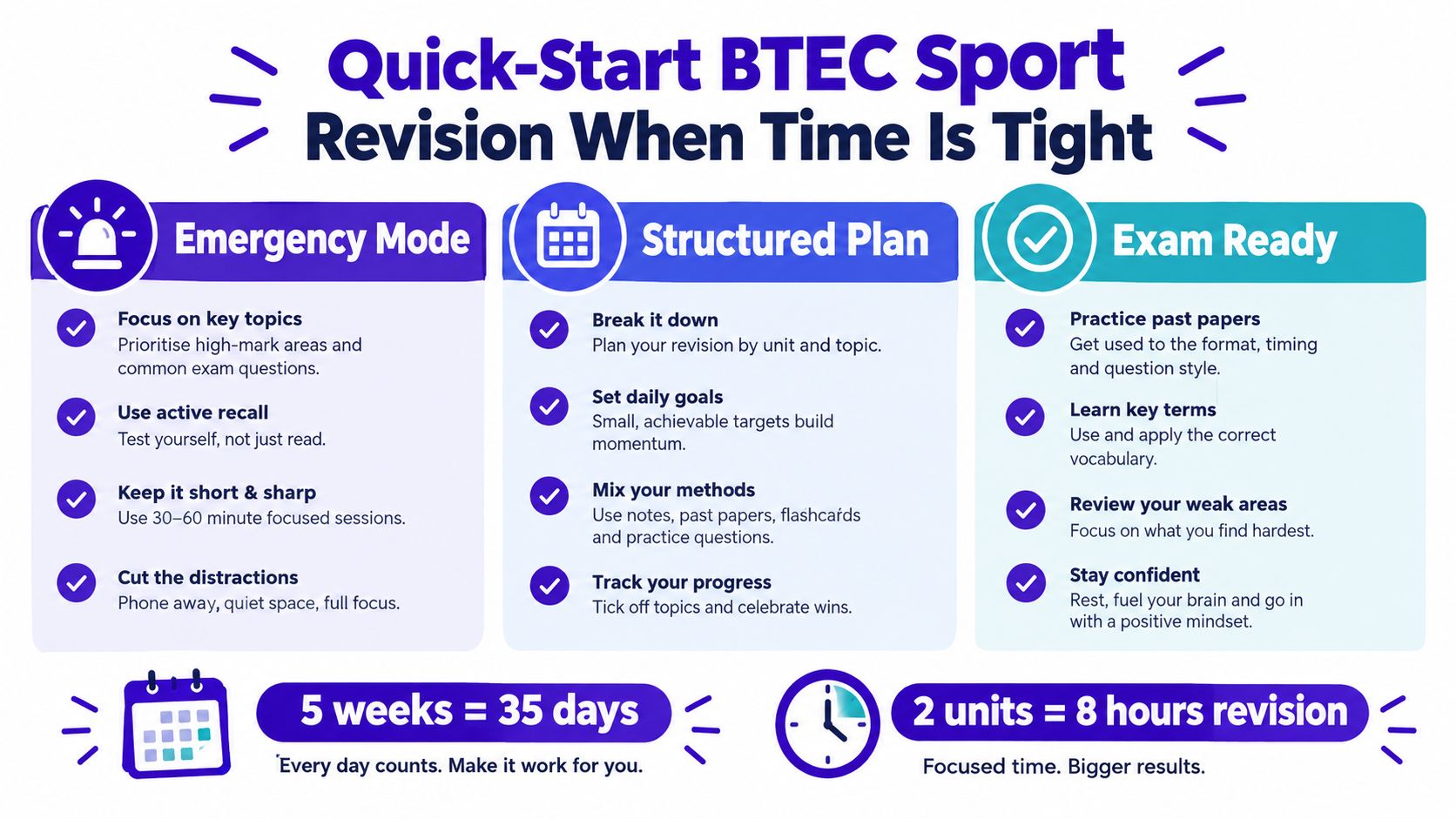
Quick-Start BTEC Sport Revision When Time Is Tight
Start with a small plan you can follow tonight, not an ambitious timetable you'll abandon tomorrow. A Wednesday evening is enough to create order, even if your notes are scattered across your phone, OneDrive and a folder with no label.
Use 25-minute focused blocks after school. From Monday to Thursday, give each evening one unit or component. On Friday, complete a 20-question retrieval quiz covering the week. Keep the weekend free if you can. Rest isn't laziness, and a plan that leaves room to breathe is more likely to survive.
Practical rule: Triage by assessment risk, not by whichever topic feels easiest.
Work in this order:
- Externally assessed unit first. It has a fixed exam date and usually needs repeated practice under time pressure.
- Synoptic NEA second. You'll need to apply ideas from more than one area to a case study or performer.
- Internal coursework third. Protect time for unfinished sections, evidence, feedback and presentation quality.
For the UK Pearson BTEC Level 1/Level 2 Tech Award in Sport, the qualification uses three components. Component 1 contributes 30% and Component 2 contributes 30%, while both are internally assessed and externally moderated by Pearson through supervised tasks. Pearson's BTEC Tech Award Sport quick guide explains that Component 1 includes five hours of supervised assessment time and Component 2 includes four hours. Check your own specification because BTEC Sport exists across different levels and frameworks.
Your tools don't need to be fancy. Use your phone notes app for quick explanations, Quizlet for retrieval cards, the bookmarked specification PDF for the exact content, and past papers from your exam board for question practice. If you use AI Powered Revision, use it to generate questions or test yourself, not to replace your own thinking.
Your first-night checklist
Before you finish your first study session:
- Download the specification: Save the correct version to your phone and computer.
- List every component and weighting: Write down what is examined, moderated or submitted.
- Find the mark scheme: Keep it beside every practice answer.
- Locate one past paper: Choose the paper that matches your unit and assessment format.
- Set three calendar reminders: Schedule your next revision block, a coursework check and a timed practice.
That's enough for night one. You're not trying to become fully prepared in one sitting. You're building a route through the work.
Unit-by-Unit and Component Checklists That Actually Cover the Spec
A topic list tells you what exists. A command-word checklist tells you what to do with it. Before revising a unit, highlight words such as state, describe, explain, analyse, justify and evaluate. Then practise the action, rather than copying definitions into another set of notes.
For Anatomy and Physiology, an explain answer should usually connect four parts: name the structure, locate it, give its function and apply it to a sporting example. “The quadriceps extend the knee” is a starting point. A stronger response identifies how that function matters in an action such as jumping or kicking.
Fitness Testing needs separate preparation for different demands. You might need to describe a test procedure, analyse what a result suggests about a performer, and evaluate whether the test is suitable for a particular goal. Don't revise the test name alone. Practise explaining what the result means and what could affect its usefulness.
| Unit | Assessment type | Key command words | What to know |
|---|---|---|---|
| Anatomy and Physiology | External exam or written assessment, depending on specification | State, describe, explain, analyse | Body systems, movement, functions and sporting application |
| Fitness Testing | Written answers and possible applied tasks | Describe, analyse, evaluate | Test procedures, reliability, validity, results and limitations |
| Practical Performance | Practical assessment and video evidence where required | Demonstrate, describe, analyse | Fitness, technical and tactical skills, plus performance decisions |
| Coaching | Coursework or practical evidence | Plan, explain, justify, evaluate | Session structure, SMART targets, coaching points and feedback |
| Sport Psychology | Written or coursework assessment | Explain, analyse, evaluate | Theories, personality types, motivation and the inverted-U relationship with arousal |
| Nutrition | Written or synoptic application | Explain, justify, evaluate | Macronutrients, hydration and timing before, during and after a match |
| Synoptic NEA | Supervised case study or applied task | Analyse, justify, evaluate | Linking assessment results, goals, risks, nutrition and training choices |
Practical Performance deserves two checklists, not one. The first covers fitness, technical and tactical skills. The second covers the evidence rules, including a 10-minute maximum clip, no edits and a clear date where those requirements apply to your centre's task. Ask your teacher to confirm the current evidence rules before recording.
Pearson's assessment document states that 20% of the overall qualification is assessed practically. The document includes activities such as selecting suitable physical activity for a case study, planning and demonstrating a warm-up, presenting rules and officials' responsibilities, and submitting video evidence for skills in isolated practices and competitive situations. That means revision can involve speaking clearly, demonstrating safely and organising evidence, not just remembering theory. Read the BTEC Sport assessment document alongside your centre's instructions.
Cross-reference every checklist item to the specification. A list you made from memory might miss a small requirement that appears in the actual assessment. For broader GCSE and A-Level Btec support, use the same principle: match practice to the qualification and task, rather than revising from a generic sports page.
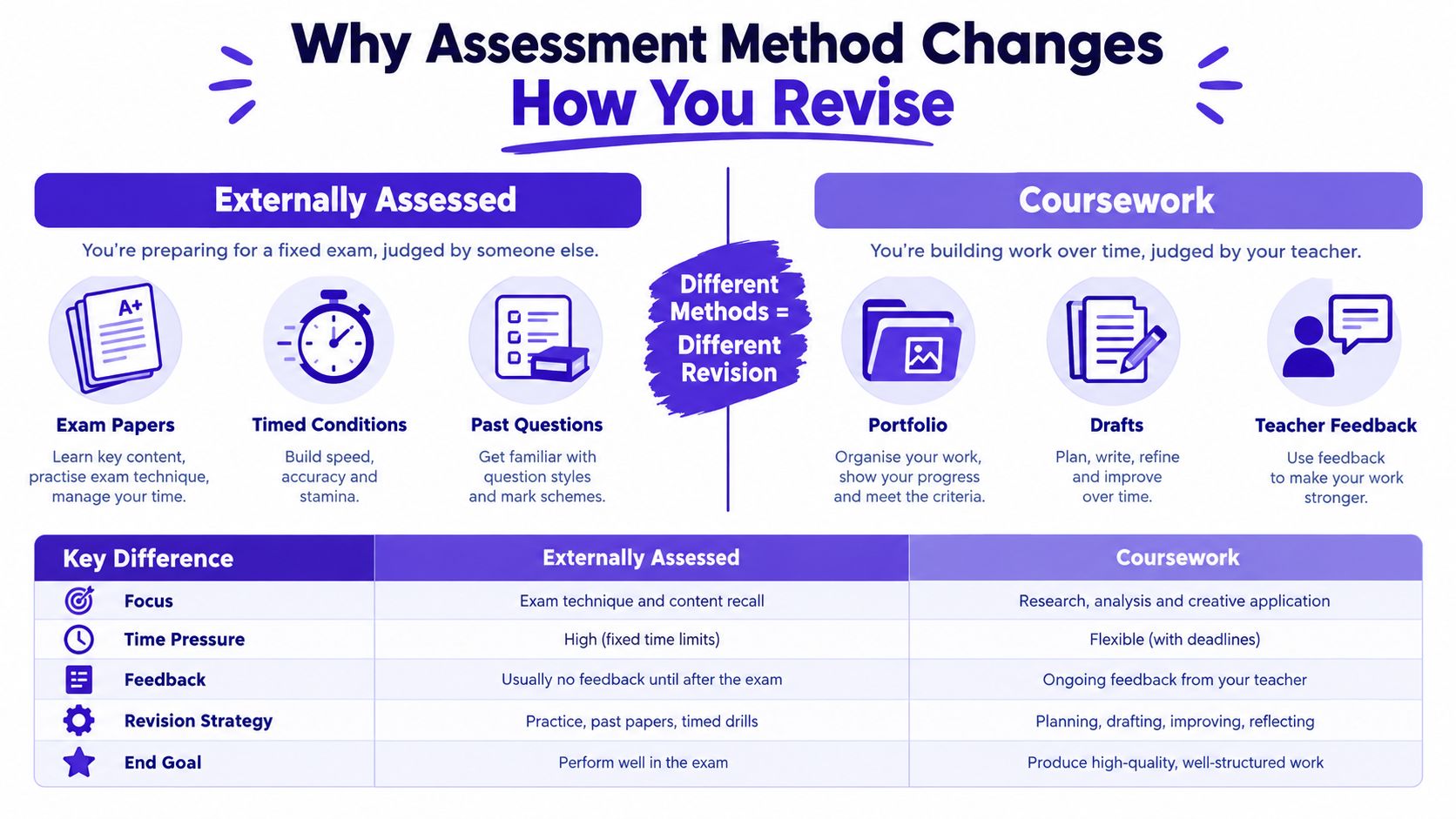
Why Assessment Method Changes How You Revise
Most students revise every BTEC Sport unit in the same way. They make flashcards, reread them and hope the information appears in the assessment. That works for some recall, but it doesn't prepare you for a timed written exam, a synoptic case study or a video submission.
The assessment method should decide the revision method.
External exams need retrieval and transfer
For an external exam, practise recalling information without looking at your notes, then apply it to the wording of the question. Use timed short answers, complete past-paper questions and compare your work with the mark scheme. You're training two skills together: knowing the content and recognising what the question is asking you to do with it.
The Level 3 Extended Certificate places about 67% of its assessment externally, with the remaining work completed as coursework through internal assessment and Pearson standards verification, according to the BTEC Sport assessment overview. Your exact qualification may differ, so check your specification rather than borrowing someone else's weighting.
Synoptic tasks need connected thinking
A synoptic NEA is not a collection of separate topic answers. It asks you to bring together information about a client or performer, then make decisions that fit that person. You might need to connect a fitness result with a goal, a health risk, nutrition and a training programme.
Unit 2, Fitness Training and Programming, shows the problem clearly. The June 2025 report describes an open-response task involving lifestyle factors, nutrition, training methods and a six-week programme for a specified individual. A student who memorises training principles but can't adapt them to the client will struggle to show the required application. The June 2025 Unit 2 report also highlights the importance of making responses specific to the scenario.
The highest-value practice is often writing a suitable recommendation for a new client, not making another page of topic notes.
Coursework and video evidence need organised proof
Internal assessment rewards habits that memory cards can't build. Keep a reflection log, record dates, respond to teacher feedback and check that your footage is clear and complete. A clean demonstration with suitable evidence is more useful than another evening spent rereading the textbook.
The format changes what “revision” means. For an exam, close the book and retrieve. For a case study, practise making decisions. For coursework, improve the evidence and explanation. For video work, rehearse the performance and check the recording requirements.
Active Recall and Spaced Review Routines You Can Stick To
You don't need a two-hour evening to make progress. Put this routine into your phone calendar: three new flashcards, two tricky cards and one confidence check. The whole cycle takes about 12 minutes if you keep your answers focused.
Make the front of each card a real command-word prompt, not a topic label. “Energy systems” is too vague. “Explain the difference between aerobic and anaerobic energy production during exercise” tells you what kind of answer to practise. On the back, write a complete answer with an example, not one isolated word.
Try these prompts:
- Skeletal system: State the function of synovial joints.
- Energy systems: Explain when aerobic and anaerobic energy systems might be used.
- Screening: Explain the purpose of a PAR-Q before exercise.
- Goal setting: Justify why a SMART target suits a performer.
- Training principles: Analyse how the FITT principle changes a programme.
- Motivation: Compare two motivation types in a sporting situation.
Put reviews on the calendar
Use the same card again after one day, then three days, seven days, 14 days and 21 days. Apply the schedule to Unit 1 Anatomy and Physiology and Unit 2 Fitness Training topics, but don't keep a card in rotation forever if you can answer it accurately and apply it in a question.
A simple calendar entry could say:
- Day 1: Three new cards and two difficult cards.
- Day 3: Answer the difficult cards without looking.
- Day 7: Apply the same ideas to a short scenario.
- Day 14: Complete a timed question using the command word.
- Day 21: Confidence check and remove or rewrite weak cards.
Active recall explained simply is useful if you're unsure why testing yourself works better than repeatedly highlighting notes. The key point is practical: make your brain produce the answer before you check it.
Pair the routine with a five-minute stretch or water break. You're more likely to continue when revision feels like a manageable habit rather than a punishment.
A 25-minute block to copy
Spend the first 12 minutes on the 3-2-1 card routine. Use the next eight minutes to answer one exam-style question without notes. Finish with five minutes to mark it, circle one missing detail and write the next review date. Then stop, or take a proper break before another block.
Turning Pass Answers Into Merit and Distinction
The difference between a basic answer and a high-level answer often appears when the client changes. The knowledge may stay similar, but the recommendation, evidence and reasoning must move with the scenario.
Take a beginner client who wants general fitness. A Pass-level response might state that interval training uses periods of work and rest. That shows a correct fact, but it doesn't yet explain why this choice suits the client or how the programme should be used.
A Merit-level answer develops the point: interval training uses work and rest periods, which can help the beginner manage exercise intensity and gradually build fitness. The writer explains the effect instead of stopping at the definition.
A Distinction-level response makes the choice defensible: the beginner may need manageable work periods and recovery so they can maintain technique and complete the session safely. The recommendation links the method to the client's starting point and goal, rather than presenting interval training as suitable for everyone.
Now change the scenario to an injured athlete returning to competition. Repeating the same answer loses the opportunity to show judgement. If the athlete has a hamstring strain, you could justify avoiding high-impact plyometrics at first and selecting pool-based plyometrics to rebuild elastic strength with less impact, provided the programme follows appropriate professional guidance.
A correct fact earns more when you explain why it belongs in this scenario.
The same upgrade applies to Unit 1 energy systems. “The anaerobic lactic system provides energy during intense exercise” is a factual starting point. Analysis connects incomplete recovery and repeated high-intensity efforts to the demands of the performer. Evaluation then considers whether the choice fits the athlete's phase of return, goals and safety constraints.
| Pass | Merit | Distinction |
|---|---|---|
| State or describe: Give the fact, feature or method accurately. | Explain or analyse: Show how and why it affects the performer. | Justify or evaluate: Defend the decision, weigh suitability and reach a clear judgement. |
| Interval training has work and rest periods. | The rest periods allow the performer to manage intensity and repeat efforts. | The work-to-rest ratio should suit the client's current fitness, goal and ability to recover safely. |
| A SMART target is specific and measurable. | A measurable target helps the performer track progress. | The target is justified because it matches the performer's starting result, deadline and intended outcome. |
| Plyometrics develop explosive qualities. | Plyometrics can support powerful movement through rapid stretch-shortening actions. | Pool-based work may be more suitable for an athlete returning from a hamstring strain, subject to appropriate guidance and progression. |
Use this self-check on your last piece of work. Did you state the knowledge? Did you explain its effect? Did you make a decision and support it with details from the case study? If the answer only works for a generic athlete, it probably needs more application.
Mock Papers, Teacher Support and a Two-Week Finish Plan
A mock paper is most useful when it creates your next revision list. Don't just record the grade. Mark the question types you missed, identify why you missed them and practise the same skill again.
Use this two-week finish plan:
Week one
- Monday: Complete a Unit 1 Anatomy self-test without notes.
- Tuesday: Do a Unit 2 short-answer drill, focusing on command words.
- Wednesday: Rest. Keep the day free from formal revision.
- Thursday: Sit a timed Unit 1 paper under exam conditions.
- Friday: Mark it with the official mark scheme and log your three weakest topics.
- Weekend: Review those weak topics, then answer a short question on each.
Week two
- Monday: Complete a Unit 2 knowledge retrieval session.
- Tuesday: Practise a synoptic case study and apply recommendations to the named client.
- Wednesday: Rest or complete only a brief card review.
- Thursday: Attempt another timed Unit 2 task.
- Friday: Mark it, improve one answer and check your coursework evidence.
- Weekend: Sit one final full mock, then review errors rather than cramming new topics.
Use GCSE Past Papers as a model for the kind of question practice you need, but always confirm that the paper matches your BTEC level, unit and assessment format. Pearson's BTEC Firsts results show why that check matters. Sport had 48,800 learners in 2022/23, with 40,800 completions, but the reported Sport cohort was 8,300 learners with 5,900 completions in 2023/24. Pearson presented these figures for different reported cohorts, so don't assume a historical entry total describes your current specification. See the Pearson BTEC Firsts results data.
Asking for help doesn't need to feel awkward. Try one of these:
- “Can you show me which part of this answer keeps it at Pass level?”
- “Which command word should I practise most before the exam?”
- “Can you check whether my programme decisions link clearly to the client?”
- “Could you point me to the specification line for this coursework requirement?”
Parents can help without becoming last-minute teachers. A quiet timed space, help finding the correct specification, and encouragement to review feedback are useful. A huge topic dump on the night before the exam usually creates panic rather than understanding.
Pack what you need on the day:
- Pencil: For planning or annotating where permitted.
- Black pen: Bring a reliable spare if possible.
- Calculator for Unit 2: Check your centre's rules before the assessment.
- Printed command-word glossary: Use it during revision and review the meanings before you enter the exam.
Start with one 25-minute block tonight. Download the specification, choose the highest-risk assessment and answer one question without your notes. That small action gives tomorrow's revision somewhere useful to begin.
MasteryMind offers UK learners specification-aligned quizzes, command-word practice, spaced review and examiner-style feedback that can support your BTEC Sport routine. Visit MasteryMind to turn weak topics into targeted practice instead of guessing what to revise next.
Ready to master this topic?
Practise with quizzes, blurt exercises and exam questions on MasteryMind.
7 days Premium · Then free forever · No card, no charge