BTEC vs a Level: The Definitive UK Student Guide 2026
You've finished GCSEs, or you're looking at your latest results, and the same question keeps coming back: BTEC or A level? Perhaps exams went badly, but coursework was strong. Perhaps you're aiming for a demanding degree and don't want to close any doors. Or perhaps you're keen to do well and need to know which qualification rewards the way you learn.
The useful answer isn't that one route is automatically better. It's that BTECs and A levels place pressure in different parts of the course, and universities assess them in different ways. Choose by looking at your target degree, assessment strengths, subject requirements and recovery plan, not by accepting somebody else's idea of prestige.
Why the BTEC vs A Level Choice Matters Now
A levels and BTECs are both UK Level 3 qualifications, but they weren't designed for exactly the same purpose. A levels were introduced in England and Wales in 1951 as subject-based academic qualifications intended mainly to support progression to higher education. BTECs were introduced by the Business and Technology Education Council in 1974, with greater emphasis on applied learning, occupational skills and coursework or practical assignments. The official 2025 qualification results information gives the historical context behind that distinction.
That history still affects your daily routine. A student taking A levels usually works across separate academic subjects and prepares for examinations. A BTEC student normally develops knowledge in a vocational area through units, assignments and assessed tasks. Neither description tells you which student will achieve the better result. It tells you where each student must become reliable.

Start with the destination
Before comparing grades, write down the degree or career area you're considering. Then check the exact university course requirements. A course may accept a BTEC but ask for particular units, a particular grade, an additional A level or a specific subject studied in a particular qualification.
If you don't yet know your destination, A levels can offer broader subject coverage. If you're confident about an applied area and learn best by producing evidence, a relevant BTEC may fit more naturally. A mixed programme can also be sensible, but only if your school or college confirms the workload and the target courses accept the combination.
Practical rule: Don't ask, “Are BTECs as good as A levels?” Ask, “Will this exact qualification, at this expected grade, meet the entry requirements for my intended course?”
Compare the pressure, not the reputation
Students recovering from weak exams need to be particularly honest. If one poor examination tends to hide what you know, a course with assessment spread across units may give you more opportunities to demonstrate progress. If you procrastinate on long assignments, however, continuous assessment can create pressure that lasts throughout the year.
A levels can suit students who enjoy theory, independent reading and timed written work. BTECs can suit students who prefer applied tasks, structured criteria and sustained projects. You can find practical guidance on how helps with BTECs, but the decision still belongs to you, your teachers and the course requirements.
The phrase “BTEC” also hides important differences. Awards vary in size, assessment balance and subject. A BTEC can be equivalent in size to one, two or three A levels, so comparing one BTEC certificate with one A level certificate can give a distorted picture of workload or progression.
How BTECs and A Levels Work
The decisive difference in the BTEC vs A level debate is assessment architecture. A levels usually collect evidence through subject examinations, often taken at the end of the course. BTEC Nationals use a unit-based vocational structure, combining internally assessed assignments with externally assessed components. The balance depends on the qualification and specification.
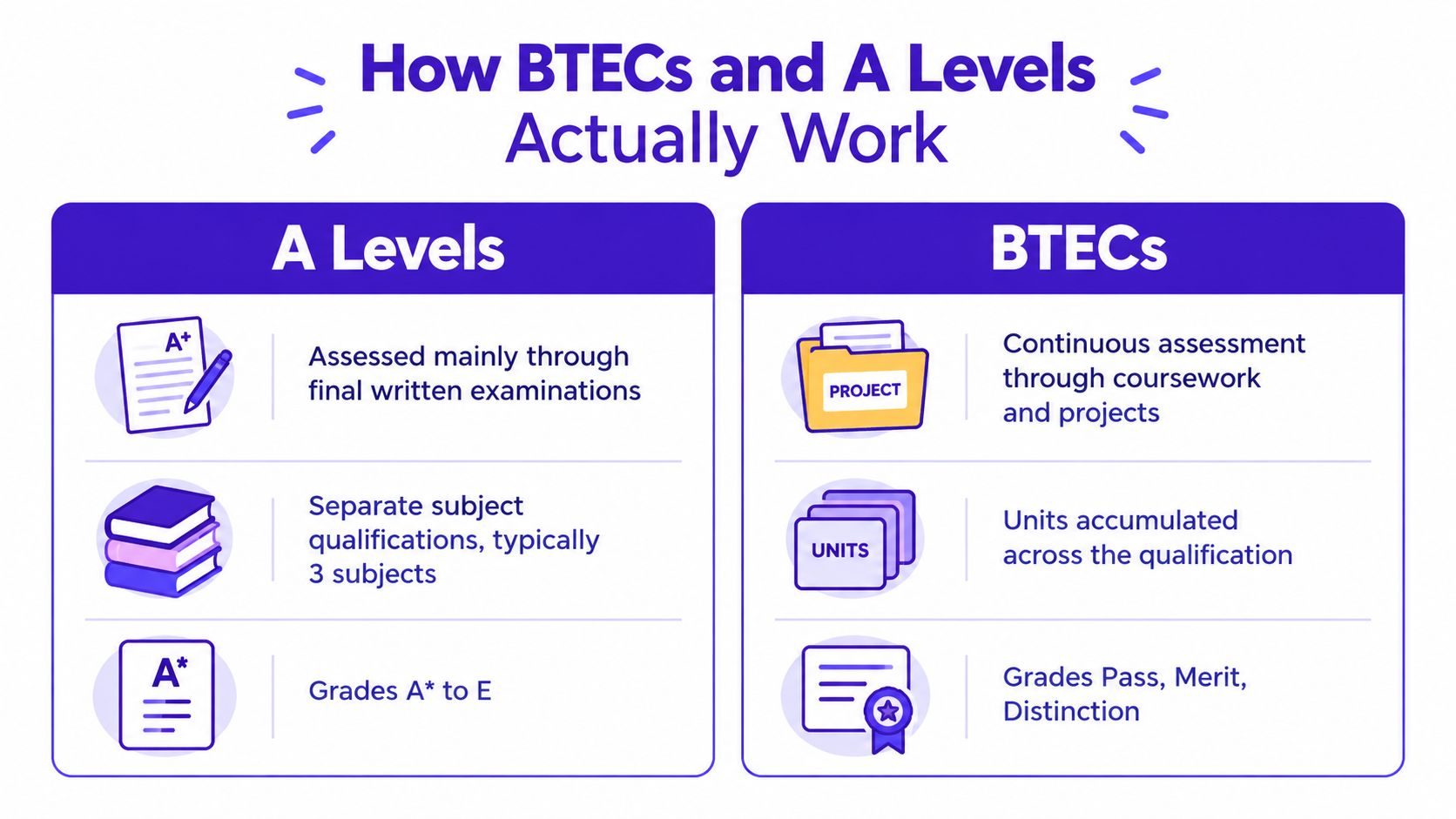
That difference changes how you revise and how you recover from a weak result. A level preparation must end in timed performance. You need to retrieve information, interpret command words and build a developed answer before the paper ends. BTEC preparation must produce assessable evidence. You need to meet the required criteria, submit suitable work and follow the conditions for that unit.
Pearson's external assessment windows for BTEC Nationals take place at set points in the year, so missing a sitting can delay progress until the next available opportunity. A level resits are generally concentrated in the May and June examination period. Check the dates and rules in the BTEC Nationals assessment information before planning a recovery timetable.
The daily workload looks different
| Feature | A levels | BTEC Nationals |
|---|---|---|
| Main evidence of learning | Predominantly final examinations | Internally assessed assignments and externally assessed components |
| Organisation | Separate subject qualifications | Units accumulated across a vocational qualification |
| Typical focus | Academic subject depth and breadth across several subjects | Applied knowledge, occupational skills and vocational depth |
| Grading structure | Grades A* to E for graded outcomes | Unit grades such as Pass, Merit, Distinction, Near Pass and Unclassified |
| Recovery pressure | A weak examination can affect the evidence available for a subject | Progress may depend on improving specific unit work or preparing for an external component |
| Planning challenge | Spaced revision, timed papers and extended responses | Criteria mapping, evidence quality, deadlines and assessment conditions |
The difference is not a simple measure of difficulty. It reflects what each route accepts as convincing evidence. A level students need repeated retrieval, topic diagnosis, timed papers and developed responses. BTEC students need a unit tracker, clear evidence for each learning aim, draft feedback and protected time before deadlines.
Pearson uses set assignment briefs for internally assessed BTEC units. Teachers mark the work, while Pearson carries out external standards verification. Externally assessed units are completed under Pearson's conditions and marked by Pearson, as explained in the BTEC Nationals assessment information. Because assessment windows and submission rules matter, a missed deadline or incomplete piece of evidence can require a specific recovery plan rather than general revision.
Grades aren't interchangeable labels
A level results use grades from A to E, while BTEC unit results use Distinction, Merit, Pass, Near Pass and Unclassified. A BTEC Distinction is not a percentage score that can be placed directly beside an A level A or A. Pearson's criteria-based system requires the learner to meet the relevant criteria for the grade, so a strong section may not compensate for a missing required criterion. The Pearson guidance on BTEC assessment support explains how this assessment logic works.
Recovery therefore looks different. An A level student should identify weak topics, practise retrieval and improve exam execution. A BTEC student should identify missing learning aims or criteria, strengthen the evidence and schedule work around the next assessment deadline. Both routes require feedback, but the feedback must match the qualification.
A useful video can help students and families visualise the distinction between the routes.
A level resources should match your exam board, specification and command words. BTEC resources should match the unit criteria, assignment brief and assessment conditions. The subjects on MasteryMind can support either route as part of a specification-led plan, alongside teacher feedback and official materials.
University Entry, UCAS Points and Progression
University entry is where broad claims about BTECs and A levels become risky. A BTEC can lead to higher education, but acceptance depends on the exact qualification, size, grade, subject and course. Check the requirements for the degree you want, rather than asking whether universities accept “BTECs” in general.
UCAS presents historical accepted-grade profiles separately for applicants with three UK A levels and those with three BTEC Extended Diplomas. The UCAS guidance on historical entry grades reflects the different assessment structures and evidence produced by each route. That distinction matters when you compare entry data.
Tariff points need context
The UCAS Tariff Guide gives an A level a size band of 4, with grades worth 16 points for E to 56 for A. BTEC points depend on the qualification's size and grade. A full-size BTEC Distinction can therefore carry 56 UCAS Tariff points, matching an A level A*, while a BTEC Pass carries fewer points. The tariff offers a numerical comparison for specified qualifications. It does not show that the qualifications assess knowledge in the same way.
For example, a DDM Extended Diploma totals 112 tariff points, which meets a typical 112-point offer at many mid-table universities. A course asking for “A levels at ABB or equivalent” may still reject that application if it names required A level subjects. The points total is only one part of the decision.
Before choosing a post-16 programme, check the course page, admissions notes, required subjects, qualification size and any exclusions. Save a copy of the requirements and ask admissions staff to confirm unusual combinations. If you are already on a BTEC and find that a target degree requires an A level subject, change your shortlist early, ask whether an accepted equivalent exists and discuss an alternative route with your tutor. An A level student should also check that their subject choices meet degree-specific requirements instead of assuming a strong tariff total will cover every option.
Progression evidence deserves an honest reading
Evidence submitted to the UK Parliament found that students holding only applied general qualifications such as BTECs were, on average, 17 percentage points less likely to progress to higher education than students holding only A levels, after adjustments for prior GCSE attainment, special educational needs and disabilities status, ethnicity and other background characteristics. Among university entrants with comparable prior attainment, BTEC-only students were approximately 1.7 times more likely to repeat their first year and nearly twice as likely to leave before starting their second year. The figures come from the written evidence submitted to Parliament.
These are population-level findings, not a prediction for an individual. Course fit, prior attainment, institution, subject and personal circumstances can change the outcome. A BTEC learner applying for a well-matched practical degree may be better prepared than an A level learner whose subjects do not support the intended course.
The same evidence reported different degree outcomes by entry profile. 71% of students entering with BTEC grades DDD* achieved a first or upper-second-class degree, compared with 75% of entrants with A levels at CCD and approximately 95% of entrants with AAA*. Treat these figures as context, not a promise or a warning about your own result.
Use the assessment architecture to plan ahead. If your degree relies heavily on exams, a BTEC student should practise retrieval, timed answers and independent revision before university. If the degree is strongly applied, use relevant BTEC projects and subject experience, while checking how the first year is assessed. Keep coursework evidence organised, meet every criterion and build an exam routine where the destination requires it.
Real Student Scenarios and Recovery Paths
Consider a student who understands the content but freezes in final exams. Their coursework is organised, their explanations improve after feedback and they can sustain effort over a project. A BTEC may give this learner a more suitable way to demonstrate knowledge, provided they can manage deadlines and satisfy every criterion. The route isn't automatically easier. It distributes the evidence differently.
The recovery plan should begin with an audit. Which assignments are incomplete? Which criteria are missing? Is the problem weak subject knowledge, poor evidence, rushed presentation or missed deadlines? The student should work with the teacher on the exact specification rather than rewriting everything from the beginning.
The exam-strong student
Another student performs well under timed conditions, enjoys abstract ideas and hasn't decided which degree to study. A levels may provide the breadth and academic subject depth that keeps more options available. That student still needs a system, because confidence based on GCSE performance won't carry an A level course by itself.
The sensible recovery plan is targeted rather than dramatic:
- Find the weak topics: Use recent tests, teacher comments and marked answers to identify gaps.
- Practise retrieval: Close the textbook and reproduce definitions, processes or arguments from memory.
- Add timed work: Start with individual questions, then build towards complete papers.
- Review the mark scheme: Identify whether lost marks came from knowledge, application, analysis or evaluation.
- Repeat the task: Rewrite or reattempt only after understanding why the first answer fell short.
The mixed-programme student
A third student wants applied learning but needs an academic subject for a possible degree. A combination of a BTEC and A levels may reduce reliance on one assessment mode while preserving a relevant route. It can also create a demanding timetable, because the student must manage assignment deadlines alongside revision and examinations.
The recent English results release reported more than 250,000 vocational and technical results alongside 814,335 A level results in 2025, according to the official Level 3 and A level results infographic. That scale shows that vocational and academic qualifications are both established parts of the post-16 system. It doesn't prove that every combination works for every course.
A mixed programme only creates flexibility if the target university recognises the exact combination.
Students often hear that BTECs are “easier”. That judgement misses the pressure of criteria-based assessment. A learner can understand a topic and still lose progress by failing to address a required learning aim, submitting weak evidence or missing a deadline. Conversely, an A level student can know the content but underperform because the answer lacks the precision demanded by the question.
The right recovery route is the one that turns your existing strengths into reliable evidence, while directly repairing the weakness that previously held you back.
Revision and Study Strategies for Each Route
Revision works when it resembles the assessment. That principle sounds obvious, but many students revise the subject in a general way and only discover later that they haven't practised the performance the qualification demands.
A level preparation
A level revision should move through three stages. First, retrieve core knowledge without notes. Second, apply it to unfamiliar questions. Third, produce complete answers under realistic time limits. Reading a chapter repeatedly may feel productive, but it doesn't prove that you can recall and use the content.
Build your week around the exam board specification:
- Use command words precisely: Treat “explain”, “analyse”, “evaluate” and “compare” as different instructions.
- Practise mixed topics: Don't revise one comfortable unit for too long. Mix older and newer material so retrieval becomes less dependent on context.
- Write before checking: Attempt the question from memory, then compare your answer with the mark scheme and teacher feedback.
- Prepare extended responses: Plan arguments, evidence and conclusions before writing full essays.
- Track recurring errors: Keep a short list of misconceptions, missing links and timing problems, then revisit it through spaced practice.
A student recovering after weak exams should start with manageable timed sections rather than jumping straight into full papers. Once the method improves, increase the amount of paper completed under exam conditions.
BTEC preparation
BTEC revision needs a different dashboard. Start with the unit criteria and create a map showing what you've completed, what your teacher has accepted and what still needs evidence. Your notes should help you explain the knowledge, but the assessment brief tells you what the submitted work must demonstrate.
Plan backwards from each deadline. Leave time to check whether every learning aim is addressed, whether examples are relevant, whether sources are handled properly and whether the final work follows the assignment conditions. For externally assessed units, practise the required task under the stated conditions. Don't assume that strong internal assignments automatically prepare you for an external assessment.
Use teacher feedback as a checklist, not as a verdict on your ability. If the feedback says your analysis is descriptive, improve the links between evidence and conclusion. If a criterion is missing, identify the exact evidence needed. Ask for clarification before submitting rather than hoping the marker will infer your meaning.
For A level exam preparation, Exam Practice for A-Level can sit alongside past papers, teacher marking and official examiner materials. Whichever tool you use, it should follow the specification and assessment mode. Adaptive questions are useful when they expose a gap, but they're not a substitute for a BTEC assignment brief or a full A level paper.
Recovery principle: Fix the assessment behaviour that lost marks, not just the topic that happened to appear on the paper.
The transferable habits are active recall, spaced review, mixed-topic practice and feedback-led correction. The format changes, but passive rereading remains a weak main strategy for both routes.
How to Choose the Right Path and Next Steps
Choose between BTEC and A level by testing the route against your destination, assessment habits and recovery needs.
Destination: Identify the degree, university or career area you are considering. Check its entry requirements for your exact BTEC size, subject and units. If acceptance is unclear, email admissions with your qualification code and predicted grades before enrolling. Keep the written reply, because verbal assurances about BTEC acceptance may not help during Clearing.
Assessment fit: Ask where you produce stronger evidence: timed exams, extended coursework, practical tasks or a combination. Coursework rewards planning, drafting and meeting criteria. A levels demand regular revision and exam technique under time pressure. Use past papers to test the second route, and review a sample assignment brief before choosing the first.
Recovery need: If exams regularly hide what you know, repeated coursework and practical assessment may give you more chances to recover. Build that recovery into your plan by tracking each learning aim and acting on feedback early. If long assignments remain unfinished, A levels may offer a clearer revision cycle, provided you practise questions rather than rely on rereading.
Qualification size: Do not compare one BTEC grade with one A level grade without checking the award size. A one-A-level-equivalent BTEC cannot replace a three-A-level offer by itself. Confirm the full offer with the institution.
A levels suit students who need broad academic preparation, specific subjects or flexibility while their destination is uncertain. BTECs suit students with a clear vocational direction, an accepting course and stronger performance in applied assessment. A mixed route can work if the institution accepts it and both assessment calendars are manageable.
Use Online Revision for A-Level with specification documents, teacher feedback and timed practice. MasteryMind provides specification-aligned practice and feedback for UK learners. Choose the route you can complete strongly, not the one that sounds impressive.
Ready to master this topic?
Practise with quizzes, blurt exercises and exam questions on MasteryMind.
7 days Premium · Then free forever · No card, no charge