Business A Level Revision: Ace 2026 Exams

Your revision starts badly for a lot of students in the same way. You open a folder, see half-finished notes on marketing, a worksheet on break-even, a case study you barely remember, and then spend an hour “revising” by highlighting things you already highlighted in February.
That feels like work. It often is not the kind of work that moves a grade.
Good business a level revision is not about drowning in content. It is about building a system that tells you what to revise, how to revise it, and how to turn what you know into marks under pressure. That matters whether you are recovering after wasting time or pushing for the top band.
Teachers know this too. Students rarely lose marks only because they know nothing. They lose marks because knowledge is patchy, retrieval is weak, and answers stop at description when the examiner wanted analysis or judgement.
This guide treats revision like exam preparation, not content hoarding. You need a method that matches your board, strengthens memory, and trains exam technique at the same time. If you get that right, the textbook stops feeling like a brick and starts looking like a set of manageable jobs.
Your Game Plan for Acing A-Level Business
A common student mistake is trying to “do loads” without deciding what winning looks like.
Take two students. One spends three hours reading through operations notes and feels productive. The other spends the same time checking the exam structure, planning a week of revision blocks, testing herself on finance formulas, and writing one timed paragraph. The second student usually makes faster progress because every task points at the exam.
That is the shift you need.
Business a level revision works best when you treat it as four linked jobs:
- Know the paper
- Plan your revision time properly
- Use retrieval, not just reading
- Practise answers the way examiners reward them
If you skip the first job, you revise blindly. If you skip the second, you cram. If you skip the third, you forget. If you skip the fourth, you know more than your script shows.
There is also a useful mindset point here. Business is not a subject made of random facts. It is a subject about decisions, trade-offs, evidence, and consequences. That means your revision should feel active. You should be comparing, calculating, judging, and applying ideas to real business contexts.
If you want examples of modern business tools and how businesses organise work, this round-up of freelance tools to supercharge your business in 2026 can also give you useful real-world language and commercial context for wider reading. Use material like that to sharpen application, not to replace your specification.
Tip: If your current revision mostly involves rereading notes, you do not need more motivation. You need a different method.
Deconstruct the Exam to Know What to Revise
A student spends two hours making flashcards on every marketing theory, then opens a past paper and realises the hardest questions are asking for judgement, context and chains of reasoning, not loose definitions. That mistake is common. It feels productive because a lot of content gets covered. It is weak revision because it ignores how marks are awarded.
Your first job is to reverse-engineer the paper.
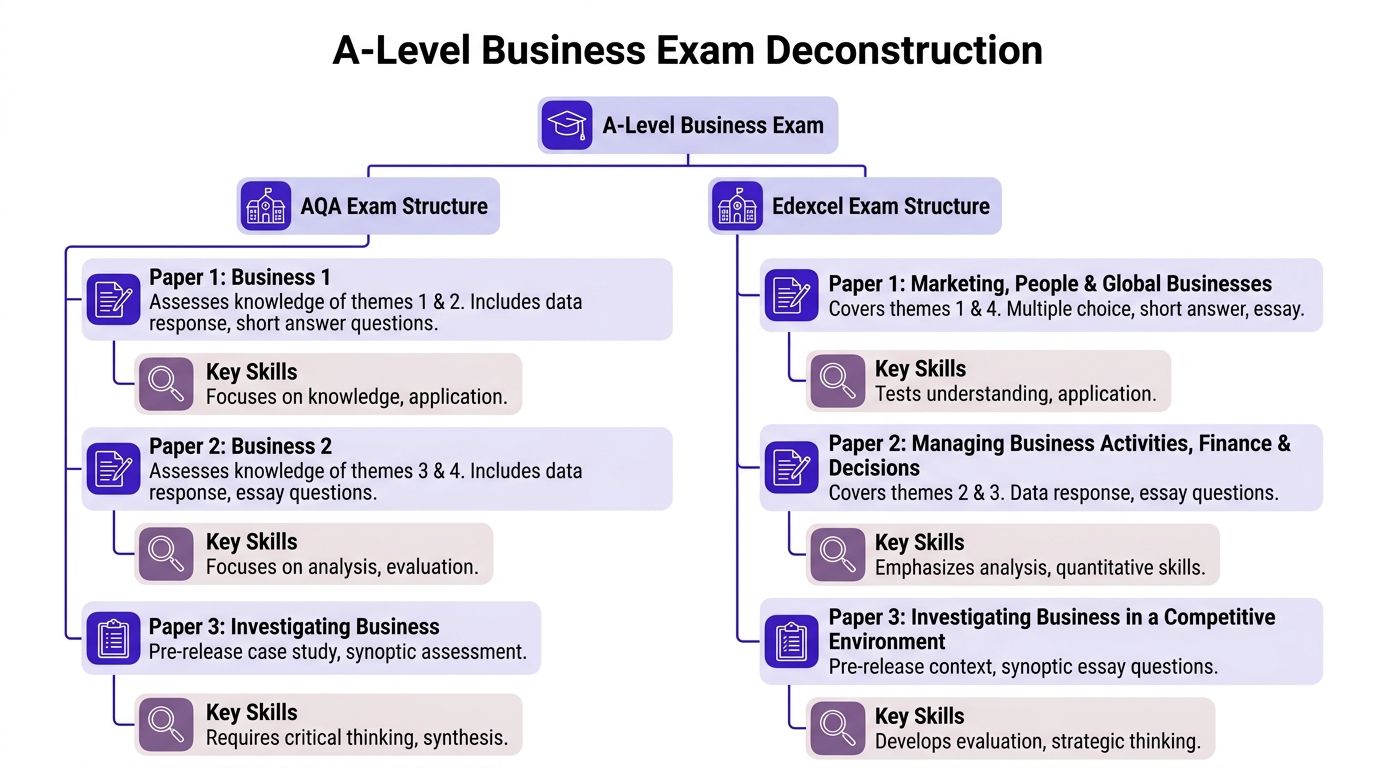
Start with your board
Exam boards are not interchangeable. They test similar business ideas, but they package them differently. That changes what you should practise, how often you should revisit topics, and what “being ready” looks like.
For AQA A-Level Business specification 7132, there are three equally weighted exam papers. Each is a 2-hour written exam worth 100 marks, and each contributes 33.3% of the final grade, according to the AQA specification at a glance.
That matters because the paper design gives you clues about your revision design. Paper 1 includes 15 multiple-choice questions for 15 marks, short answers worth 35 marks, and two 25-mark essays. Paper 3 is one 100-mark compulsory case study focused on integrated strategic decision-making. So if you are revising AQA by topic in isolation, you are missing part of the course. The exam expects you to connect marketing, finance, operations and HR in the same answer.
For Edexcel A-Level Business, the course is organised into four themes and assessed through three 2-hour papers worth 300 marks overall. Paper 1 and Paper 2 each contribute 35%, while Paper 3 contributes 30%, with a mix of multiple-choice, short answers, data response and essays, as summarised in this Edexcel A-Level Business study guide.
If you study AQA, a board-specific resource such as this guide to managers, leadership and decision making in AQA A-Level Business shows how a single topic should be learned in the language and level the exam rewards.
A good rule for students and teachers is simple. Do not ask, “Have we revised the topic?” Ask, “Have we revised the way this board tests the topic?”
Translate the assessment objectives into plain English
Assessment objectives sound technical, so many students leave them to teachers. That is a mistake. AO1 to AO4 are not admin labels. They are the marking logic behind the whole paper.
A useful way to explain them is to compare them to building a case in court. First you show you know the key idea. Then you connect it to the evidence in front of you. Then you explain the consequences. Finally, you judge which argument is stronger.
| Assessment objective | What it really means in your answer |
|---|---|
| AO1 Knowledge | Define it or identify it accurately. |
| AO2 Application | Use the details from the business in the question. |
| AO3 Analysis | Explain the chain of effects. What happens because of this? |
| AO4 Evaluation | Make a judgement and justify it. Show what depends on what. |
Here is where students often get stuck. They think analysis means “write more,” and evaluation means “add however on the end.” Examiners want something much tighter than that.
Compare these two responses:
- Weak: “A business could lower price to increase sales.”
- Stronger: “Lower pricing may help this business regain market share because the case suggests customers are price-sensitive. Higher sales volume could spread fixed costs across more units, improving competitiveness. However, the strategy depends on whether the firm can absorb lower margins and whether rivals respond with price cuts.”
The second answer is better because each sentence does a different job. It identifies the concept, applies it to the case, explains the mechanism, and judges the conditions. That is what high-mark Business writing looks like.
Match revision to the question, not just the topic
Students often treat revision like packing for a trip by throwing everything into one suitcase. The smarter approach is packing for the weather. The exam format tells you what tools you need.
Multiple-choice questions test precise knowledge and careful reading.
Short answers test direct application.
Data response questions test your use of figures, trends and context.
Essays and case-study questions test developed analysis and judgement under time pressure.
So your revision method should match the task:
- For MCQs: practise definitions, formulas and common distractors
- For short answers: train concise responses that use the case
- For data response: practise selecting one telling figure and explaining why it matters
- For essays: rehearse paragraph structure, counter-argument and final judgement
- For case study papers: practise combining topics, because the business problem will not arrive labelled “HR” or “finance”. Learning science helps here. Active recall is not just a memory trick. It lets you train the exact response the paper demands. Spaced repetition is not just about reviewing later. It helps you revisit a formula, a chain of analysis, and a judgement structure before they fade. Tools such as MasteryMind can automate that cycle so students are not guessing what to revisit next.
What students usually get wrong
The biggest error is revising everything in the same format.
Finance needs retrieval and calculation practice. Strategy needs applied judgement. A case-study paper needs synthesis across the whole course. If all three are revised through rereading notes, the revision feels tidy but produces weak transfer into the exam.
That is why some students walk out saying, “I knew it, but I could not do the paper.” Usually, they knew the topic in notebook form. The exam asked for decisions in context.
Your revision list should reflect the exam’s demands. Split each topic into three columns:
- Core knowledge I must recall accurately
- Typical contexts or data I may need to apply it to
- Question types where this topic is likely to appear
That turns a topic list into a revision system. It also makes later timetable planning much easier, because you are no longer scheduling vague blocks like “revise marketing.” You are scheduling the exact skill the paper will reward.
Build a Smart Revision Timetable That Works
It is 7:30 on a Wednesday. A student opens a colour-coded timetable, sees three hours of “Business”, already feels behind, and ends up rereading notes on motivation theory because it feels safe. Two weeks later, the plan looks organised, but little has stuck.
A good timetable prevents that.
It tells you exactly what to study, how to study it, and when that topic comes back again. In other words, it works like a training plan, not a wish list. That matters in A-Level Business because the exam rewards retained knowledge, accurate application, and fast decision-making under time pressure. Your timetable should train all three.

Why spaced repetition beats cramming
A strong timetable uses spaced repetition. You study a topic, leave a gap, then test yourself on it again before it fades too far. That feels harder than cramming because your brain has to work to retrieve the idea. That effort strengthens memory.
According to Save My Exams’ A-Level Business revision guidance, structured timetables that include spaced repetition improve long-term recall compared with ad hoc studying. The same guidance also reports gains from mixing methods such as flashcards, practice questions, and mind maps.
For Business students, the benefit is straightforward. You are not only trying to remember what break-even means. You are trying to recall it days later, spot when it matters in a case study, and use it in a chain of analysis. Cramming gives short-term familiarity. Spacing builds retrieval you can still use in the exam hall.
Build your week around cycles, not chapters
Students often make one of two mistakes. They either pack the week with unrealistic hours, or they write vague blocks such as “revise marketing”.
A better approach is to build short, repeatable cycles. Each block should answer three questions:
- What exact topic or skill am I studying?
- What method will I use?
- When will I revisit it?
“Theme 2” is too broad to be useful. “Liquidity ratios, then one 9-mark question on cash flow decisions” is clear. A clear task lowers friction, and lower friction makes follow-through more likely.
Here is a model week that real students can sustain:
| Day | Block 1 | Block 2 | Quick review |
|---|---|---|---|
| Monday | Marketing retrieval quiz | 9-mark application question | Flashcards on segmentation and targeting |
| Tuesday | Finance calculations | Correct mistakes from yesterday | Formula recall |
| Wednesday | Operations topic recall | Data response question | Review error log |
| Thursday | Human resources retrieval | Timed paragraph on motivation | Judgement sentence practice |
| Friday | Strategy mixed recall | Essay plan from a case study | Weak-topic recap |
| Saturday | Timed paper section | Self-mark and improve | Add patterns to revision notes |
| Sunday | Light mixed-topic review | Rest or short catch-up | Plan next week’s revisits |
Notice the pattern. Topics return. Methods vary. The week trains memory, application, and exam performance together.
Use the 60/40 split without kidding yourself
A timetable should spend more time on what is weak.
A useful rule is 60/40. Put about 60% of your time into weak or shaky areas and 40% into stronger ones, as noted earlier in the same Save My Exams guidance. Stronger topics still need revisiting so they stay available under pressure. Weaker topics need more frequent turns because they are the marks you are currently losing.
Students often reverse this. They spend most of their time on topics that already feel comfortable because success is pleasant. That is understandable, but it is poor allocation of revision time.
Use this ranking method at the end of each week:
- Put every topic into secure, shaky, or weak.
- Check those labels against actual evidence, such as class tests, homework, and timed answers.
- Schedule next week from the weak pile first.
That turns revision from mood-based study into a feedback system. It is also where digital tools help. If you are using A-Level Past papers, your question performance gives you hard evidence about which topics need another pass, rather than relying on guesswork.
Mix methods because the exam asks for different mental moves
Business is a mixed-skill subject. Definitions, calculations, chain analysis, and evaluation do not all improve through the same method.
Use different methods for different jobs:
- Flashcards for definitions, formulas, and theorists
- Blurting or free recall for whole-topic memory checks
- Practice questions for application to context
- Essay plans for structure and judgement
- Timed responses for pacing and stamina
- Error logs for spotting repeat mistakes
A useful comparison is physical training. If a footballer only practised penalties, you would not expect great defending, passing, and fitness. In the same way, a Business student who only rereads notes should not expect strong analysis and evaluation.
The timetable should reflect the full exam skill set, not just content coverage.
Keep the plan small enough to survive real life
The best timetable is the one you can still follow after a tiring school day, a poor mock result, or a missed evening.
That usually means shorter blocks, tighter tasks, and built-in catch-up space. One focused 35-minute session on investment appraisal, followed by 10 minutes checking mistakes, is far better than writing “2 hours finance” and avoiding it. Specificity reduces procrastination because the starting point is obvious.
If you fall behind, shrink the task. Do one ratio set. Plan one 12-marker. Review one weak topic. Momentum matters more than drama.
A smart timetable is not there to look disciplined. It is there to automate good revision decisions, revisit material at the right time, and make sure the methods match the marks on the paper.
Master Content with Active Recall and Practice Questions
Reading notes can make you feel familiar with a topic. Familiarity is not the same as recall.
That distinction matters a lot in Business. In the exam, the paper is not asking whether your notes look organised. It is asking whether you can retrieve a concept, apply it to a case, and explain its consequences under time pressure.

Why active recall changes revision quality
Active recall means forcing your brain to bring information back without looking at the answer first.
The evidence behind this is hard to ignore. According to SimpleStudy’s revision notes page, active recall techniques can boost long-term retention by up to 200% compared to passive rereading. The same source reports that 68% of A-Level Business students underperform on application and evaluation questions due to poor retention.
That tracks with what teachers see. Students often do recognise the content when they see it. They just cannot pull it out fast enough or use it well enough in the exam.
Passive revision hides that weakness. Active recall exposes it, which is exactly why it works.
Use blurting properly
Blurting is one of the simplest and best revision methods for Business.
Take a topic like sources of finance. Close your notes. On a blank page, write everything you can remember. Definitions, examples, advantages, limitations, links to business size, links to risk, anything.
Then compare what you wrote with your class notes or textbook.
What usually happens?
- You remember the obvious bits.
- You miss the precise terms.
- You realise your examples are weak.
- You spot where your understanding is thin.
That is useful feedback. It tells you what needs work.
Blurting works especially well for topics like:
- Marketing mix
- Motivation theories
- Break-even and profit concepts
- External growth
- Globalisation and market entry
It is less useful on its own for calculation-heavy work, where you need written method practice as well.
Tip: Do not rewrite the whole topic neatly after blurting. Fix the gaps, then test yourself again later.
Turn notes into questions
Students often keep notes in statement form. That encourages rereading.
Change them into question form instead.
For example:
| Statement note | Better active recall prompt |
|---|---|
| The product life cycle has four stages | What happens to sales, costs and promotion at each stage of the product life cycle? |
| ARR compares average return with investment | How do you calculate ARR and when might a business still reject a project with a higher ARR? |
| Herzberg distinguishes hygiene factors and motivators | Why might a business raise pay and still fail to improve motivation in the long term? |
Question-first revision creates retrieval. It also pushes you toward explanation, which is more useful than reciting a label.
Practice questions are content revision
Some students treat questions as a final stage, something to do after they “finish the content”.
That is the wrong order.
Questions do not just test revision. They are revision. A 9-marker on capacity utilisation forces you to retrieve knowledge, apply it, structure analysis, and spot what you still cannot do.
A smart sequence looks like this:
- Open-book practice when the topic is fresh
- Closed-book practice once you know the basics
- Timed practice once structure is stable
- Mixed-topic practice once separate topics start to feel secure
If you want a bank of topic-linked exam questions, A-Level Past papers are useful when you want to move from recall into realistic exam practice.
Watch someone model thinking, then copy the process
A good explanation can save hours of confusion, especially if you keep making the same retrieval mistakes.
This walkthrough is worth using as a study break with purpose. Watch it, then pause and try the method yourself before going back to your notes.
A practical active recall routine
If you need a no-nonsense routine, use this:
- Start with recall: Two or three quick questions from memory on yesterday’s topic.
- Do one focused task: A blurt, calculation set, or short question.
- Check and correct: Fill gaps in a different colour.
- Return later: Test again after a gap.
- Mix topics: Do not always revise in neat chapter order.
This works because memory strengthens when retrieval is effortful, corrected, and repeated.
Where students usually get stuck
The biggest complaint is, “I tried active recall and it felt harder.”
Yes. That is normal.
It feels harder because you are measuring what you can retrieve, not what you vaguely recognise. That is a better signal. If you struggle to blurt a topic in your bedroom, you would struggle far more in the exam hall.
Another issue is that students blurting badly sometimes just produce a messy page and stop there. The value is in the next step. Compare, correct, and revisit.
Business a level revision improves fastest when you stop asking, “Have I read this?” and start asking, “Could I explain this right now without looking?”
Unlock Top Marks with Killer Exam Technique
Knowing the course helps. Writing answers that match the mark scheme is what converts knowledge into grades.
Many decent students get trapped here. They know a topic, start writing, and produce an answer that sounds sensible. The problem is that “sensible” is not the same as high-mark.
Examiners reward structure. They reward clear chains of reasoning. They reward judgement that uses the context, not generic business waffle.

Use PEACE for 9 and 12 markers
For analysis questions, one of the strongest frameworks is the PEACE model from Beths Grammar School’s revision guidance.
According to that revision guidance document, using a structured method like the 5-stage PEACE model can boost marks by an average of 40%. The same guidance says 60% of mid-band scripts feature weak, single-stage analysis, while top-band answers usually build 2-3+ linked developments. It also highlights the importance of integrating quantitative case data.
PEACE stands for:
- Point
- Explain
- Analysis chain
- Context evidence
- Evaluation hook
Here is what that looks like in practice.
Question: Analyse one benefit to a business of investing in staff training.
- Point: Training can increase labour productivity.
- Explain: Staff learn better methods and make fewer mistakes.
- Analysis chain: Higher productivity can raise output per worker, which may reduce unit costs and improve profit margins.
- Context evidence: If the case shows the business has quality complaints or slow output, use that.
- Evaluation hook: However, the impact depends on whether training is relevant and whether staff stay with the firm.
That is much stronger than writing one undeveloped sentence and then repeating the point.
Build analysis in links, not blobs
Students often hear “analyse more” and do not know what to change.
The answer is simple. Add the next consequence.
Weak analysis:
- Staff training improves productivity.
Better analysis:
- Staff training improves productivity because workers use equipment more effectively.
Stronger analysis:
- Staff training improves productivity because workers use equipment more effectively. Higher productivity can lower unit costs, which may let the firm compete more aggressively on price or improve margins.
Best analysis:
- Staff training improves productivity because workers use equipment more effectively. Higher productivity can lower unit costs, which may improve margins. In a competitive market, that could give the firm more scope to reduce prices and defend market share. However, this depends on whether demand is strong enough for the extra output to be sold.
That is the difference between one link and a chain.
Use the context like evidence, not decoration
Students know they should “use the case”. Many still bolt on a figure at the end and hope for the best.
Context should support the argument itself.
Instead of writing:
- Profit may rise. The business has 200 employees.
Write:
- Because the business employs 200 staff, even a small increase in output per worker could materially improve total output, which strengthens the case for training.
That is context doing a job.
Evaluation is a judgement, not a shrug
A weak conclusion often sounds like this: “Overall, it depends.”
That is not a judgement. It is a pause.
Strong evaluation weighs factors and decides which matters more in that context.
A better conclusion sounds more like:
- Overall, training is likely to benefit the business more in the long term because persistent productivity and quality improvements can strengthen competitiveness. The main limitation is cost, but if the business already faces quality issues, the gains are likely to outweigh the short-term expense.
That works because it chooses and justifies.
Key takeaway: Evaluation is not balance for its own sake. It is a reasoned decision.
Do calculations like a business student, not a magician
Finance marks disappear when students jump from question to answer without method.
For calculations such as ARR or payback, always show workings clearly. Even when the final figure is wrong, visible method can still support credit in many mark schemes. Do not stop at the number. In Business, the interpretation matters.
For example, after calculating ARR, the useful follow-up questions are:
- Is this return attractive enough for the level of risk?
- How does it compare with the alternative option?
- Does the business value quick return, long-term profit, or cash flow security more?
That is where the business judgement sits.
Train under realistic pressure
Technique improves only when you use it repeatedly under exam conditions.
If you want timed practice that mirrors actual exam demands, Exam Practice for A-Level is useful because it pushes you to answer in the right format and within a proper time limit.
Also train pacing. Beths Grammar School’s guidance recommends a time approach tied to marks. That helps students avoid the common habit of spending too long on one answer and rushing the final section.
A practical rule is to treat each question as a time budget, not a writing invitation.
A quick exam technique checklist
Before you move on from any practice answer, ask:
- Did I answer the exact command word?
- Did I use the business context properly?
- Did I build a chain, not just state a point?
- Did I include a judgement where the marks required one?
- Did I show workings if a calculation was involved?
Students who do this consistently tend to improve faster because they stop repeating the same avoidable errors.
Your Final Month Action Plan
It is 6:45pm on a Tuesday. The exam is four weeks away. A student has colour-coded notes on marketing, half-finished flashcards on finance, and a growing sense that they are busy without getting sharper.
The fix is not more hours. It is a tighter system.
Your last month should work like a training taper before a race. You are not trying to build the whole course from scratch. You are strengthening recall, increasing exam realism, and cutting avoidable errors. Because A-Level Business questions often pull several topics together, your revision in this phase should do the same. A question on pricing can also test cash flow, capacity, brand position, and staffing pressure. If you revise each topic in isolation, the exam will feel harder than it needs to.
A good final-month plan combines two things. First, learning science: spaced repetition and active recall, so knowledge stays available under pressure. Second, exam execution: timing, judgement, and case application, so knowledge turns into marks. Tools such as MasteryMind can automate parts of that cycle by organising retrieval, timed practice, and feedback, but the method matters more than the platform. The aim is a repeatable routine you can trust.
Week by week focus
Week 4 before the exam
Audit the course. Test, do not reread.
Use short retrieval rounds across all major units and record the topics that still collapse when you answer from memory. Then sort those weak areas into two groups: knowledge gaps and exam skill gaps. That distinction matters. Forgetting the formula for ARR needs a different fix from writing descriptive paragraphs instead of analysis.
Week 3
Shift from isolated recall to applied practice.
Use mixed questions that force links across functions. For example, if a business cuts price, ask what happens next to sales volume, contribution, staffing needs, supplier pressure, and brand perception. Business works as a chain of consequences. Your revision should train that habit until it becomes automatic.
Week 2
Increase timed answers and mark them with a cold eye.
Treat each response like a mini experiment. What did you know? What did you show? Where did marks stop being available? Strong students often improve quickly here because they stop guessing how good an answer felt and start checking what each paragraph earned. If your judgement is weak, compare two possible conclusions and defend one. If your analysis is thin, add one more because step to each chain.
Final week
Protect sharpness.
Keep sessions shorter and more focused. Use mixed-topic retrieval, a few timed questions, formula checks, and your error log. Do not spend hours making tidy notes you will never test yourself on. The goal now is fluent recall and calm execution.
What to do each day
A final month plan works best when the daily pattern stays simple:
- Start with retrieval. Ten to fifteen minutes of blurting, flashcards, or quick questions from older topics.
- Do one exam task. A calculation set, a data response, or one longer question under a time limit.
- Review errors immediately. Write down what went wrong and the fix.
- Revisit old mistakes later in the week. That is the spaced repetition part. If you only correct an answer once, the lesson fades.
This system is effective for a reason. Active recall strengthens memory by forcing retrieval. Spacing helps you remember it later, not just tonight. Timed application then teaches you to use that knowledge in the form the exam demands.
Final checks before exam day
- Command words are secure. You know how analyse differs from assess, discuss, and evaluate.
- Case evidence is precise. You lift details from the extract and use them to support the point, not decorate it.
- Calculations are accurate and readable. Your workings are clear enough to earn method marks.
- Evaluation reaches a decision. You weigh both sides, then choose based on the context.
- Timing feels familiar. You have practised finishing sections within a realistic time budget.
- Your error log is active. You are revisiting repeated mistakes until they stop repeating.
What calm confidence looks like
Calm confidence is not the feeling that nothing can surprise you.
It is knowing what you will do when something does.
You read the command word carefully. You find the relevant context. You build a chain of reasoning. You make a judgement that fits the business. That is what a strong revision system gives students in the final month. Control, not guesswork.
Ready to master this topic?
Practise with quizzes, blurt exercises and exam questions on MasteryMind.
7 days Premium · Then free forever · No card, no charge