AQA · A-Level · Business
Managers, Leadership and Decision Making
This study guide provides a deep dive into the critical AQA A-Level Business topic of Managers, Leadership, and Decision Making (Specification 3.2). It equips candidates with the precise theoretical knowledge and exam technique needed to score in the top mark bands, covering the Tannenbaum-Schmidt Continuum, the Blake Mouton Grid, and quantitative Decision Tree analysis. Mastering this topic is essential for securing marks in both short analytical questions and extended 25-mark essays.
- 6 min read
- 3 worked examples
- 5 practice questions
- 8 key terms
Study Notes
Overview
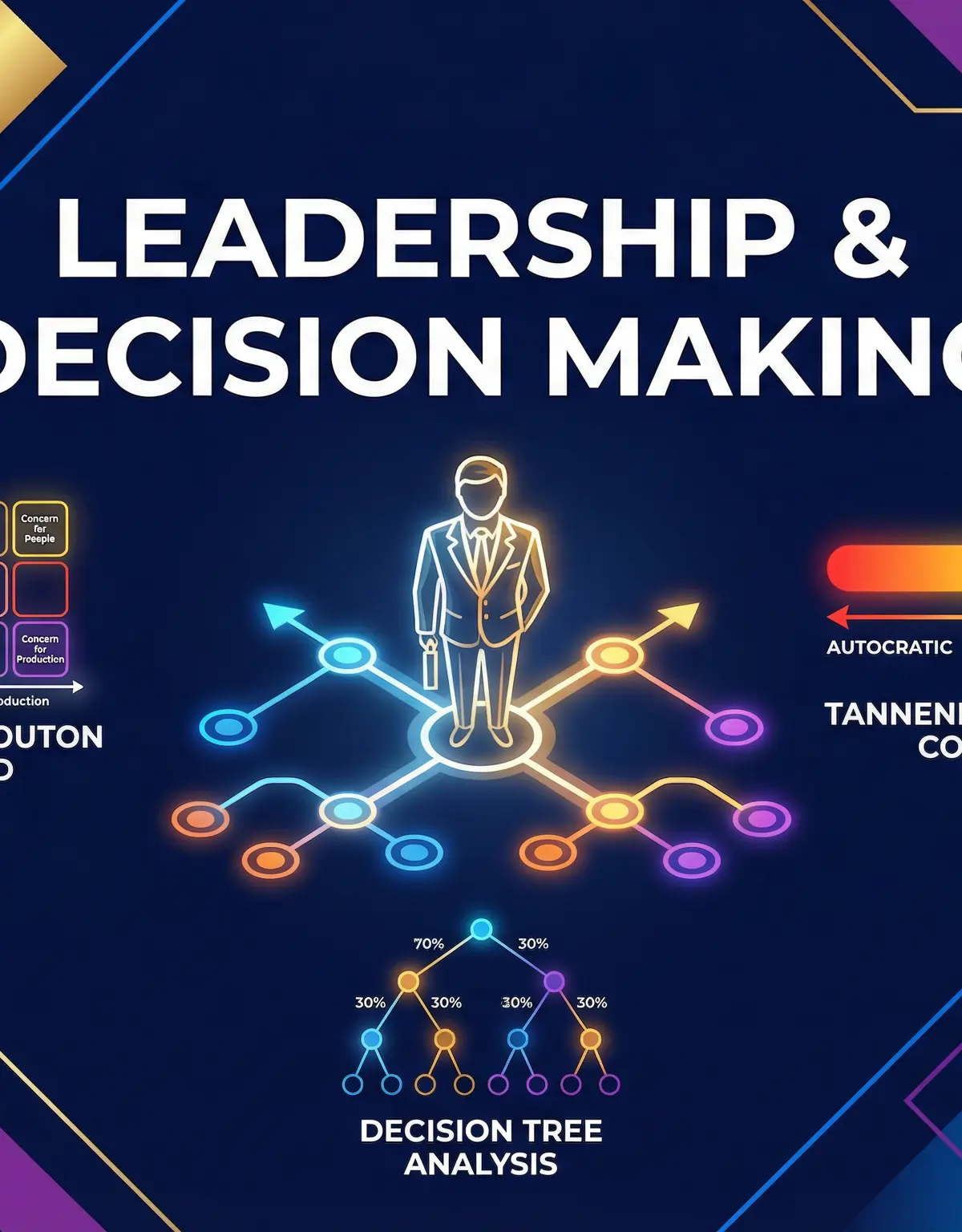
This section of the AQA A-Level Business specification (3.2) explores the crucial distinction between management and leadership, equipping candidates with theoretical frameworks to analyse decision-making in a business context. Examiners expect students to move beyond simple definitions, applying models like the Tannenbaum Schmidt Continuum and the Blake Mouton Grid to specific case study scenarios. A key focus is the ability to evaluate different approaches to decision-making, weighing the structured, data-driven scientific method against the more fluid, experience-based intuitive approach. Furthermore, candidates must analyse the impact of these decisions on various stakeholders, considering their relative power and interest. Marks are awarded across all four Assessment Objectives: AO1 (Knowledge, 20%), AO2 (Application, 20%), AO3 (Analysis, 30%), and AO4 (Evaluation, 30%).

Key Theories and Models
The Tannenbaum and Schmidt Continuum (1958)
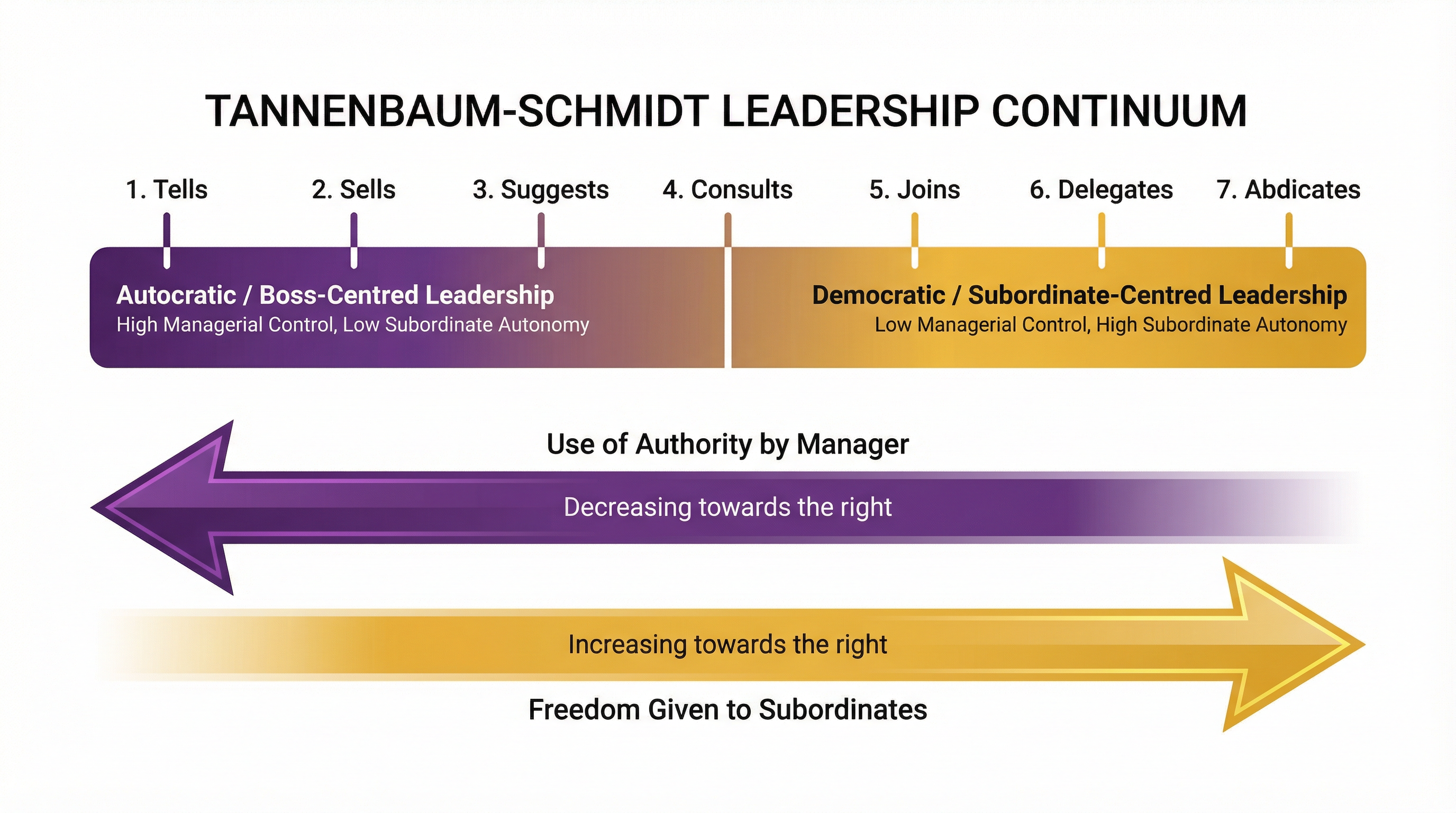
What it is: A model that illustrates the relationship between the level of authority a manager uses and the freedom they give to their team. It presents a spectrum of seven leadership styles, from purely autocratic at one end to fully democratic at the other.
Why it matters: This model provides a nuanced way to analyse leadership beyond simple labels. Examiners credit candidates who can pinpoint a manager's position on the continuum (e.g., 'Consults' rather than just 'democratic') and justify their reasoning with evidence from a case study. It is a powerful tool for AO2 Application and AO3 Analysis.
Specific Knowledge: Candidates must know all seven points in order: Tells, Sells, Suggests, Consults, Joins, Delegates, Abdicates.
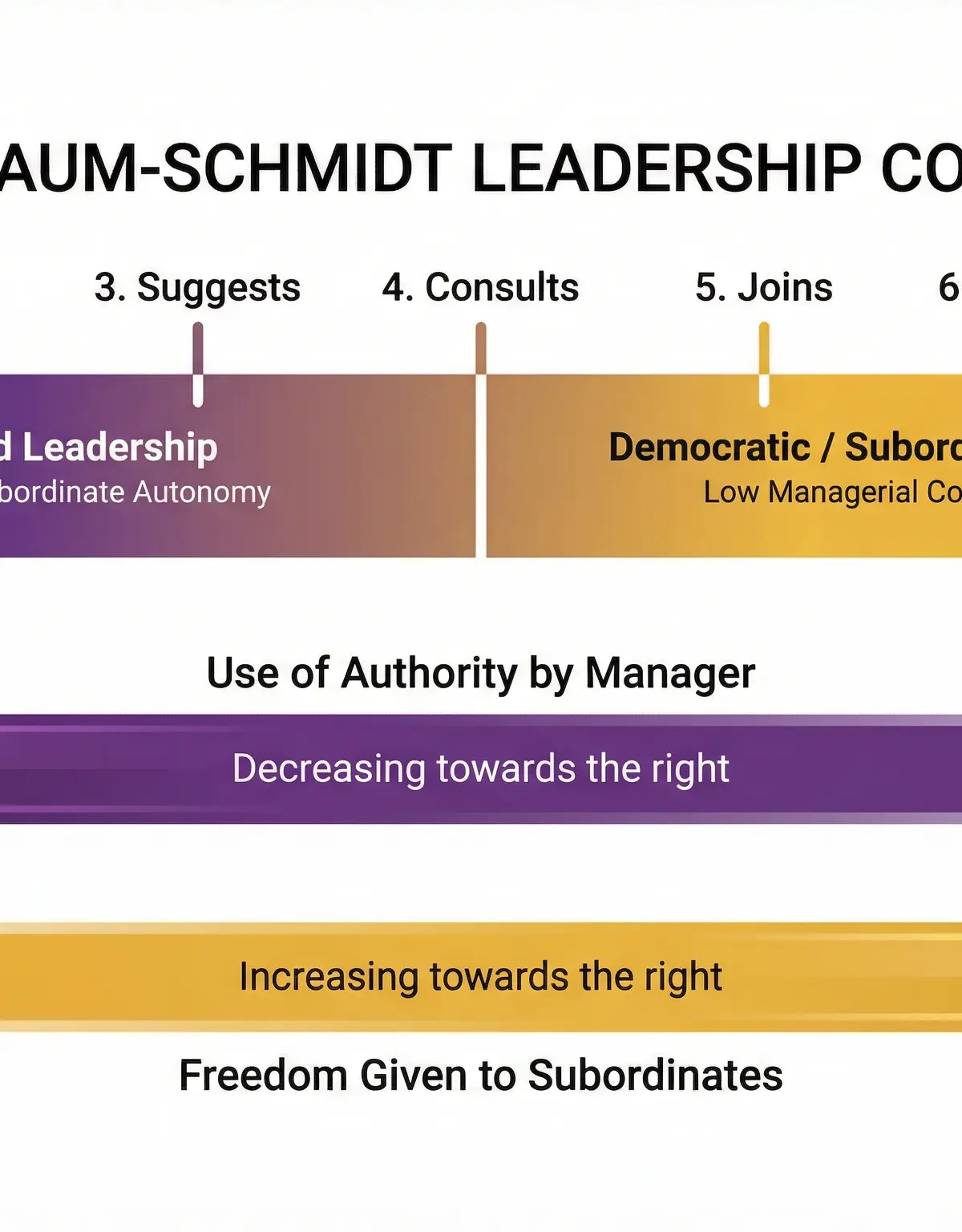
Factors influencing position on the continuum: The nature of the task (crisis vs. routine), the skill and experience of the workforce, the personality of the manager, the organisational culture, and the time available to make the decision.
The Blake Mouton Managerial Grid (1964)
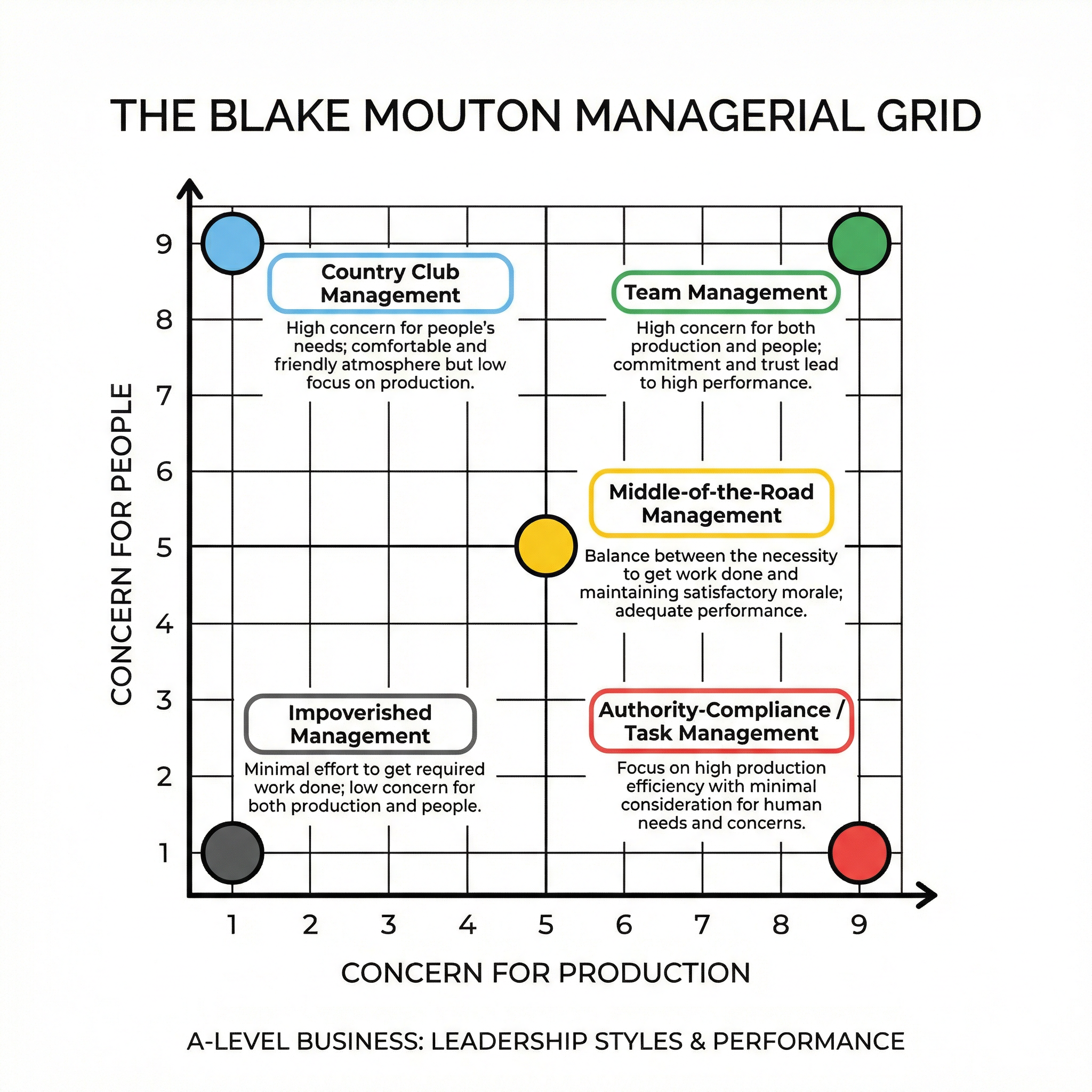
What it is: A two-dimensional grid that plots a manager's style based on their Concern for Production (x-axis, 1-9) and Concern for People (y-axis, 1-9). It identifies five key management styles.
Why it matters: The grid allows for a sophisticated analysis of how a manager's focus impacts both performance and morale. High-level responses will use the grid to explain how a particular style leads to specific outcomes, such as high staff turnover or increased productivity, and will link to motivation theories such as Maslow and Herzberg.
Specific Knowledge: All five styles and their coordinates: Impoverished (1,1), Authority-Compliance/Task (9,1), Country Club (1,9), Middle-of-the-Road (5,5), and Team Management (9,9).
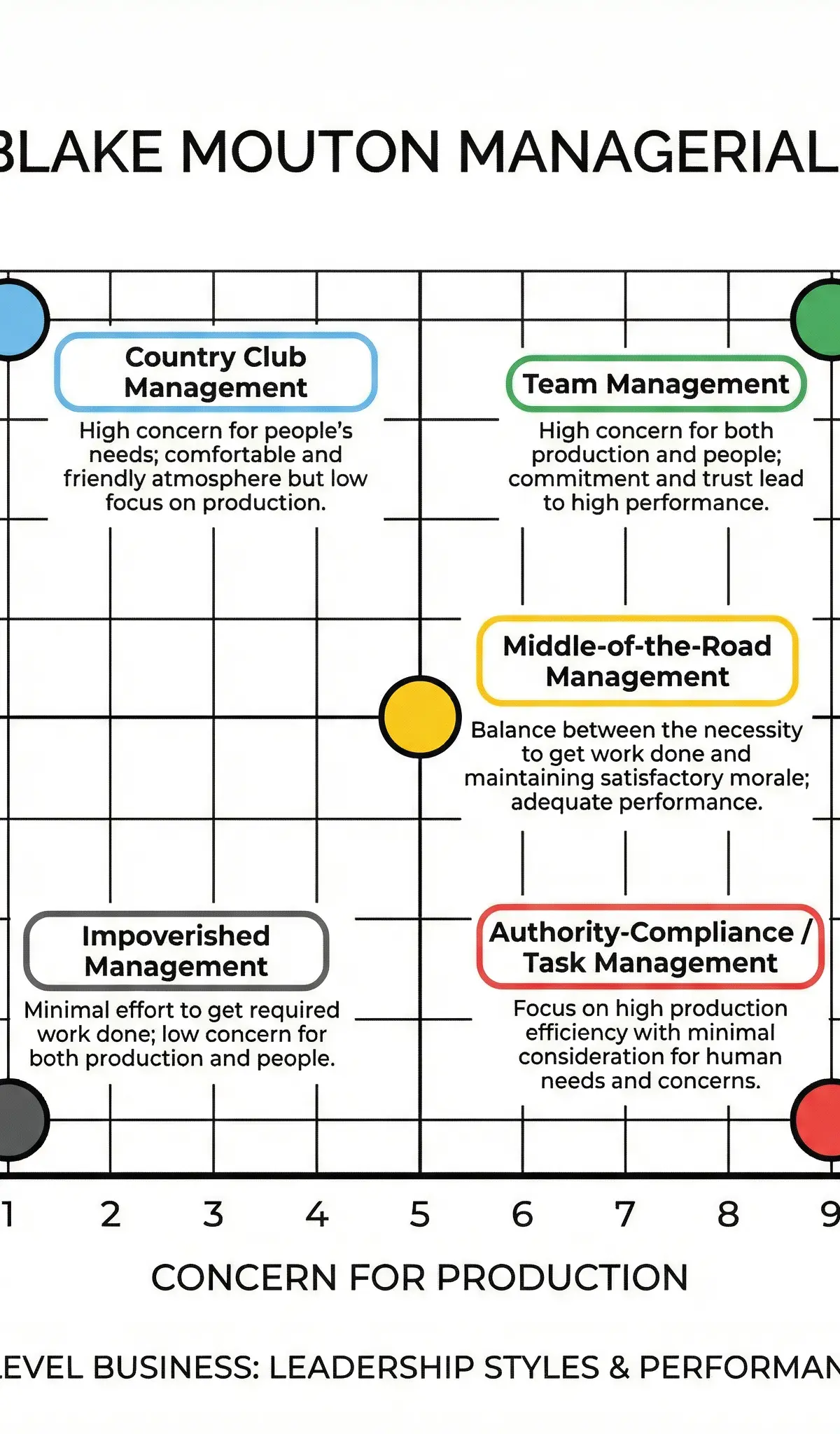
Critical Warning: Do not confuse Country Club (1,9 - high people, LOW production) with Team Management (9,9 - high on BOTH). This is the single most common error on this topic.
Decision Making: Scientific vs. Intuitive
Scientific Decision Making: A structured, rational, data-driven process following a logical sequence: identify the problem, gather data, generate options, evaluate options using quantitative tools, make a decision, implement, and review. The key quantitative tool is the Decision Tree.
Intuitive Decision Making: Based on experience, gut feeling, and judgement rather than formal data analysis. Can be faster and more appropriate in rapidly changing environments where data is scarce or unreliable. However, prone to cognitive bias and inconsistency.
Decision Trees
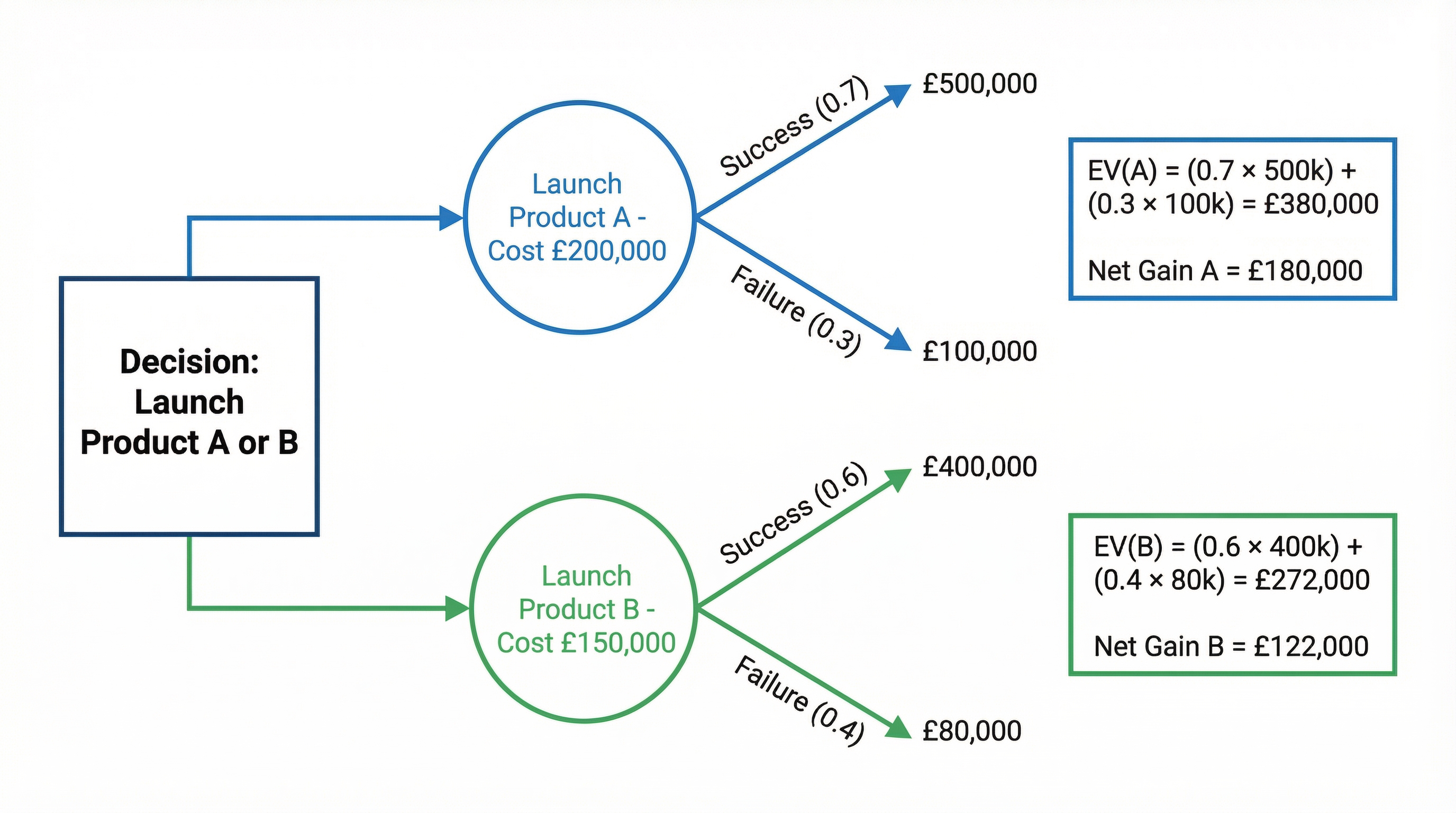
What it is: A quantitative tool used in scientific decision-making. It models a decision by mapping out choices and their potential outcomes, incorporating probabilities to calculate an Expected Value (EV) and Net Gain for each option.
Key Symbols: Square nodes = decision points; Circle nodes = chance events.
Key Formulas:
- Expected Value (EV) = Sum of (Probability x Outcome) for each branch
- Net Gain = Expected Value - Initial Cost

Critical Warning: The Expected Value is NOT a guaranteed outcome. It is a weighted average based on estimated probabilities. Those probabilities are subjective. This is a powerful AO4 evaluation point in any essay.
Second-Order Concepts
Causation
Understanding the causes of leadership style choices is crucial. A shift towards autocratic leadership might be caused by a sudden economic downturn requiring rapid decisions. A move towards democratic leadership could be caused by the hiring of a highly skilled workforce that responds better to autonomy.
Consequence
Candidates must trace the consequences of a particular style. A Task Management (9,1) style might have the immediate consequence of increased output, but a long-term consequence of poor morale and high staff turnover. A decision based on a Decision Tree might yield the most financially optimal outcome but could damage corporate image.
Change and Continuity
A business might change its leadership style over time. A start-up might begin with a democratic 'Joins' style but transition to a more formal 'Consults' style as it grows. Continuity might be seen in a long-established family business where an autocratic style is passed down through generations.
Significance
The significance of this topic lies in its direct impact on business performance. Leadership and decision-making directly influence employee motivation, productivity, financial performance, and brand image. Examiners look for an appreciation of this significance in extended answers.
Worked Examples
3 worked examples — open one to explore the question and available guidance.
Practice Questions
Test your understanding — click to reveal model answers
A business is considering two options for expansion. Option A has a 70% chance of earning £1.2m and a 30% chance of losing £0.4m. It costs £0.5m to implement. Option B has a 50% chance of earning £2m and a 50% chance of losing £0.8m. It costs £0.6m to implement. Using a decision tree, calculate which option the business should choose. (8 marks)
Hint: Calculate the Expected Value for each option first, then subtract the initial cost to find the Net Gain. The best option has the highest Net Gain.
Explain two reasons why a manager might choose to use an intuitive approach to decision-making rather than a scientific one. (6 marks)
Hint: Think about situations where data is limited or time is short. Intuition is not just guessing — it is experience-based judgement.
Analyse how a manager adopting a 'Country Club' (1,9) style on the Blake Mouton grid could affect a business. (9 marks)
Hint: Consider the impact on both people (e.g., morale, retention) and production (e.g., efficiency, targets). A strong answer will show the tension between these two outcomes.
Explain the difference between leadership and management. (4 marks)
Hint: Think about 'doing the right things' versus 'doing things right'. Give a clear definition of each and a point of contrast.
A manager of a fast-food restaurant faces a sudden health and safety inspection. Which leadership style on the Tannenbaum-Schmidt continuum would be most appropriate and why? (5 marks)
Hint: Consider the urgency of the situation and the need for clear, immediate action. Which specific point on the continuum best fits this scenario?