Command Words in Exams: How to Decode and Answer Them
You know the topic. You revised the case studies, memorised the formulas, and learned the key terms. Then the question says “evaluate”, and you write a neat description of what happened. The content may be accurate, but your answer hasn't done the job the examiner asked for.
That moment is frustrating, especially if you're trying to recover a grade quickly or push an already strong grade into the top bands. It also explains why command words in exams deserve more attention than a quick glossary exercise. They tell you what to do with your knowledge, how much reasoning to show, and whether your answer needs a conclusion.
A reliable revision routine can help you practise that decision rather than just rereading definitions. For example, AI Powered Revision can be used alongside past questions to turn command words into a regular part of your preparation.
Why Command Words Decide Your Exam Grade
A student can know the case study, formula, or quotation and still lose marks by answering the wrong task. If a question asks you to evaluate, a paragraph that only describes the topic shows knowledge but does not make the judgement the mark scheme requires. The command word determines the route your answer must take.
In a geography question about the impact of a flood-management strategy, describe might require the scheme's features or effects. Explain would require linked reasons showing how or why those effects occur. Evaluate demands a more developed response: use relevant evidence, weigh benefits against drawbacks, and reach a supported verdict. The topic stays similar, but the answer depth, structure, and scoring potential change.
Practical rule: Knowledge earns credit when it is used in the way the command word requires.
UK exam boards build these verbs into formal assessment design. AQA explains that subject-specific command-word lists draw on Ofqual's official list and connect verbs with assessment objectives such as AO1, AO3, and AO4 in its English Language command-word guidance. This gives you a useful map: a recall verb may point mainly towards knowledge, while verbs requiring explanation, analysis, or judgement demand evidence and developed reasoning. Exact meanings and mark tariffs still depend on the subject specification.
The same principle applies in GCSE English, A-Level geography, mathematics, biology, history, and PE, although the assessment objective attached to a verb may differ. A short answer that performs the required operation can outscore a longer response full of relevant facts but missing comparison, analysis, or judgement.
The exam-room test
Before writing, ask:
- What is the verb? Circle or highlight it.
- What does it mean in this subject? Use your exam board's definition rather than relying on a generic glossary.
- What does the mark tariff allow? A low-mark recall response needs precision. An extended judgement needs developed evidence, reasoning, and often a conclusion.
This check is not a substitute for revision. It prevents you from wasting knowledge you already possess. Teachers can use it when marking too, because it helps separate a content gap from a command-word error. Practising with past questions, including through AI Powered Revision, makes the decision automatic under exam pressure.
What Command Words Actually Are
A command word is the operational verb in an exam question. It identifies the mental operation your answer must perform. Define requires a precise meaning, describe requires relevant characteristics or features, explain requires reasons, causes, or processes, and evaluate requires a supported judgement.
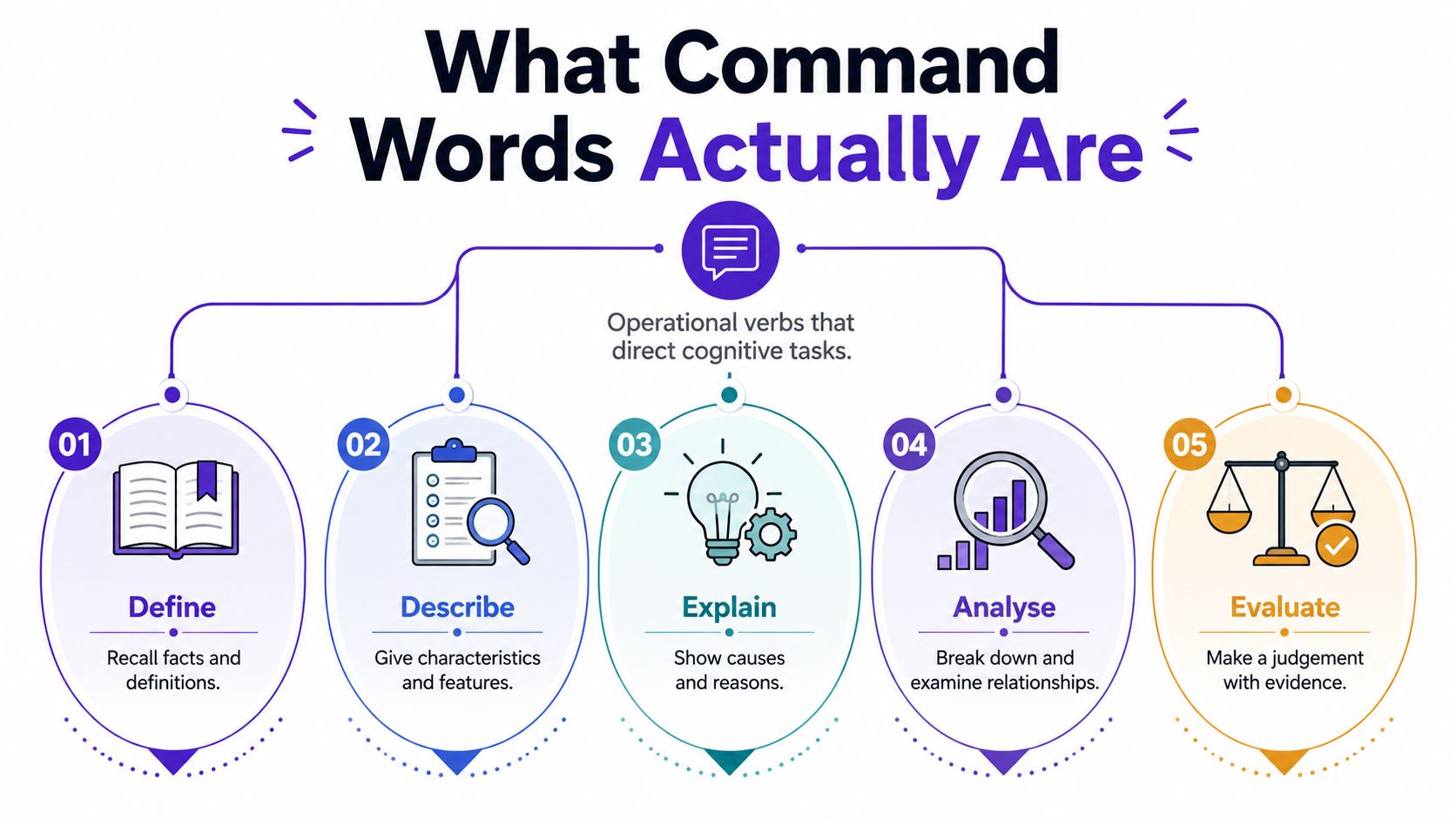
The topic supplies the knowledge area. The command word determines how that knowledge must appear on the page. A coastal-management question might ask you to describe a scheme, explain how it reduces erosion, or assess its success. The subject remains similar, but the answer structure, reasoning, and scoring potential change.
Command words and assessment objectives
UK qualifications use assessment objectives, often written as AO1, AO2, AO3, and AO4, to identify the performance being assessed. Their exact meanings and weightings depend on the specification. Broadly, AO1 often covers knowledge and understanding, while other objectives may assess application, analysis, evaluation, interpretation, or practical use of information.
Published exam-board guidance connects command words with assessment objectives and draws on Ofqual's official list. The AQA command-word guidance illustrates why command words cannot be learned as a simple synonym list. The same verb can test different objectives in different subjects, and its mark tariff determines how far your answer must develop.
“Evaluate” therefore does not always mean “write advantages and disadvantages.” The mark scheme might reward a comparison of interpretations, a judgement based on geographical evidence, or another form of supported decision-making. Read the verb alongside the subject context and available marks.
The bridge to the mark scheme
Command words connect three parts of an exam:
- The question, which names the required operation.
- Your response, which carries out that operation.
- The mark scheme, which rewards the relevant knowledge, reasoning, evidence, and judgement.
If a question asks you to analyse, listing accurate facts is not enough. You must show relationships, effects, or significance. If it asks you to justify, an unsupported opinion cannot earn the full response marks. Examiners need to see the operation in your sentences, not infer that you intended it.
Use command words as a revision target. A weak script may contain enough subject knowledge but fail to connect that knowledge to the required verb. Practising past questions helps you identify whether the problem is missing content, insufficient development, or the wrong answer shape.
The Command Word Hierarchy From Recall to Evaluation
Command words often give you a rough signal about response depth, but don't treat them as a fixed ladder. AQA's Geography guidance says a command word can be used for any mark and any assessment objective, so the mark tariff and subject context still matter. Its guide includes Identify, State, and Name across lower-mark questions, while Explain, Assess, Evaluate, Discuss, and Justify also appear in higher-mark questions. See the AQA Geography command-word guide for the subject-specific definitions and tariff information.
A useful way to organise your thinking is to move from retrieval, through development, to reasoning and judgement. The table below is a planning aid, not a replacement for your specification.
| Tier | Example Verbs | Cognitive Demand | Typical Marks | Answer Structure |
|---|---|---|---|---|
| Recall | State, Name, Identify, Give | Retrieve a precise fact or label | Often short, but the mark allocation controls the depth | Direct answer, no padding |
| Description | Describe, Outline | Give features, stages, or characteristics | More than a single fact when the question allows it | Ordered points or developed features |
| Explanation | Explain | Show causes, reasons, processes, or consequences | Development should match the available marks | Point, reason, link to result |
| Analysis | Analyse, Compare | Break down material and examine relationships | Usually needs linked evidence and developed reasoning | Evidence, interpretation, relationship |
| Judgement | Assess, Evaluate, Discuss, Justify | Weigh evidence, arguments, or options and reach a conclusion | Extended responses need a clear line of reasoning | Balanced points, evidence, final verdict |
Recall is short because the task is narrow
State, name, and identify usually need a precise answer. If the question asks you to name a process, adding a paragraph of background can waste time and create opportunities for errors. The important point is accuracy, not length.
Describe goes further, but it still focuses on what something is like or what happens. You might describe a trend in a graph, the features of a source, or the stages of a process. Don't automatically add causes unless the question also asks you to explain them.
Explanation and analysis need visible links
For explain, use connective reasoning. Show how one factor leads to another, or why a result occurs. A sentence that merely repeats the question won't demonstrate the required operation.
Analyse asks for more than a chain of facts. Break the material into parts, then explain how those parts work together or affect meaning, significance, or outcome. In English, that might involve language and structure. In biology, it may involve interpreting data and linking it to theory.
Judgement verbs need a position
Assess, evaluate, and discuss usually require a response that weighs material rather than merely collecting it. Justify requires reasons and evidence supporting a conclusion. Your final paragraph shouldn't introduce a judgement for the first time. Establish your direction as you develop the answer, then make the conclusion clear.
Use GCSE Past Papers to practise sorting questions by command word before you attempt them. For each question, predict the answer shape from the verb and marks, then compare your response with the mark scheme.
How Command Words Shift Meaning Across Subjects
A command word never works in isolation. Its meaning is shaped by the subject, assessment objective, question type, and mark scheme. Analyse in English Literature isn't the same task as analysing a biology data set, even though both answers must examine relationships rather than list information.
In English, analysis normally needs close attention to the writer's choices and their effects. You might examine a word, image, structural decision, or pattern, then link it to meaning, interpretation, or the task. Naming a technique without explaining its effect is identification, not developed analysis.
Biology uses the same word differently. Analyse may require you to interpret data, identify a pattern, and connect that pattern to biological knowledge. The answer must stay close to the information provided. A general fact that ignores the graph or table may not meet the demand of the question.
History brings another emphasis. Analysis may involve weighing causes, consequences, significance, or interpretations. You need to show relationships between factors and explain why one factor may matter more, or why an event produced a particular outcome. A chronology alone is not analysis.
Mathematics has its own command-word rules
OCR's mathematics guidance demonstrates why everyday meanings can mislead. Calculate, find, solve, and work out may require working, but the working doesn't always have to be shown. Write down or write requires neither working nor justification, while show that requires structured evidence leading to the stated result. The distinctions are set out in the OCR command-word poster.
That means a maths student should read the instruction before deciding how much to write. For show that, a final answer alone doesn't demonstrate the route. For write down, adding a long derivation may be unnecessary. Your method needs to match the exact wording.
Computer Science also gives familiar verbs a specialised shape. Analyse may involve tracing logic, discussing efficiency, or examining how a system behaves. A response that defines an algorithm but doesn't inspect its operation hasn't completed the task.
Religious Studies shows the link between verb and tariff
OCR's GCSE Religious Studies guidance makes the relationship especially clear. Name, State, and Give are used for 3-mark AO1 questions. Describe and Outline appear in 3- and 6-mark AO1 questions. Explain and Compare are used for 6-mark AO2 questions, while Discuss is used for 15-mark AO1/AO2 questions, as shown in OCR's GCSE Religious Studies exam guidance.
The lesson isn't that every subject uses a universal mark tariff. It's that the verb can signal the output expected in that paper. Before answering, check the subject specification and any board guidance your teacher uses. You can also browse KS3 to A-Level topics to practise the wording used across different subjects.
A Repeatable Strategy for Answering Any Command Word
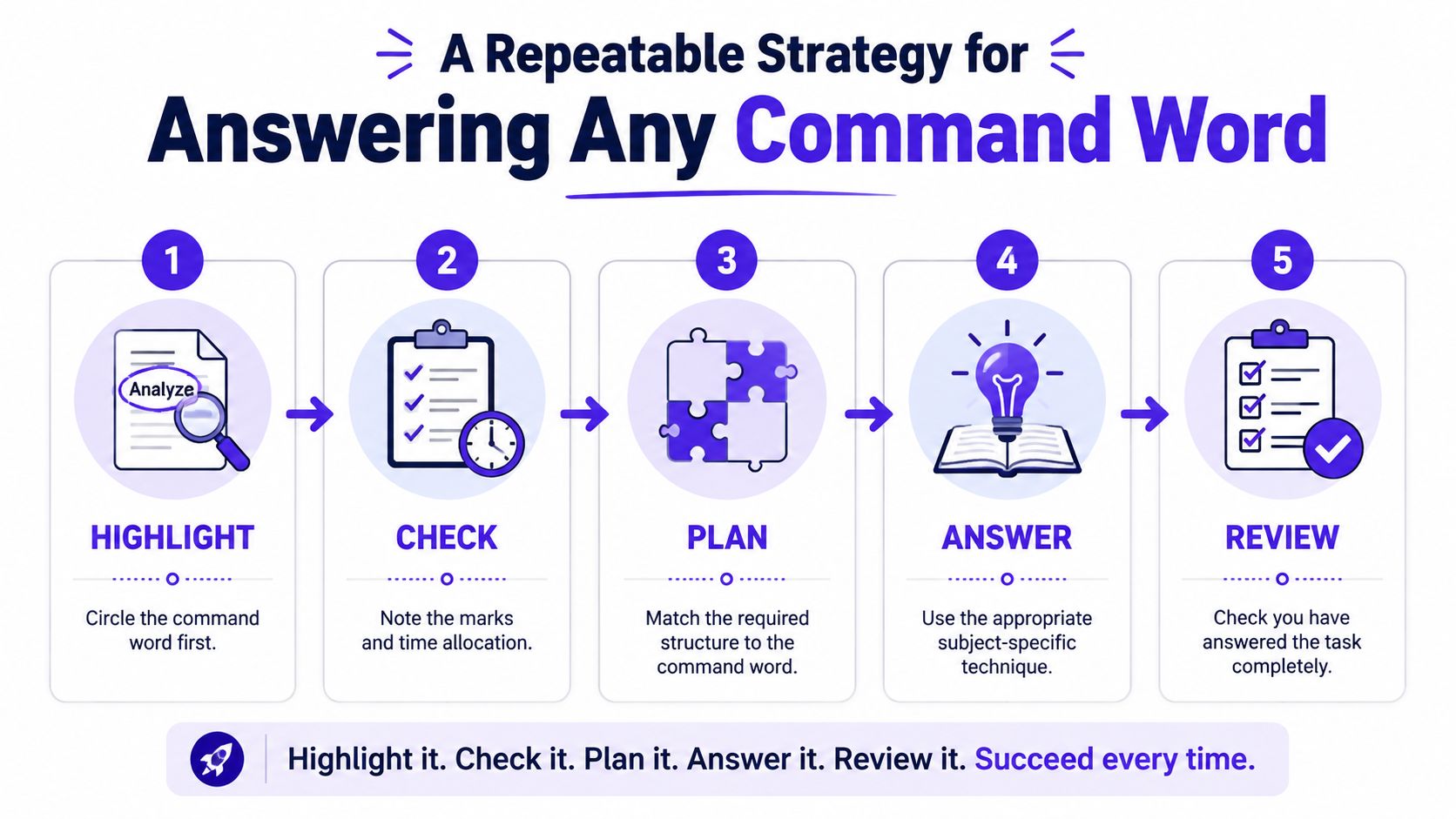
Exam pressure makes familiar words look harmless. A simple routine prevents that. Start before you write, not halfway through a paragraph.
Step one is to isolate the instruction
Circle the command word. Then underline the subject content and any limiting phrase, such as a named case study, source, time period, or data set. This stops you from answering a nearby question that you know better.
Next, check the mark allocation. Marks don't provide a rigid sentence count, but they tell you whether a one-line answer is sensible or whether you need developed points, evidence, and a conclusion.
Build the response around the verb
Use this quick matching process:
- State, name, identify: Give the precise fact or label.
- Describe: Give characteristics, observations, or stages.
- Explain: Link causes, reasons, processes, and effects.
- Compare: Make direct links between the subjects, including the similarities or differences the question asks for.
- Analyse: Select evidence and examine how its parts or features work together.
- Justify: Give reasons and evidence for a decision or conclusion.
- Assess or evaluate: Weigh evidence and reach a supported judgement.
- Discuss: Develop more than one side or perspective, then follow the wording of the question about whether a conclusion is required.
For a longer response, plan the function of each paragraph before writing. A paragraph should add a relevant point, develop it with subject knowledge, and connect it back to the question. In an evaluative answer, include a counterpoint where it matters, then explain which side carries more weight and why.
Treat multiple command words as separate jobs
Some questions contain more than one command word. BBC Bitesize advises students to highlight the command word and warns that using the wrong response style can leave marks behind, especially when a question has multiple commands, as explained in its exam command-word advice.
If a question asks you to describe and explain, don't write a description and assume explanation is implied. Give the features, then make the causal links explicit. If it asks you to identify and justify, provide the identification first and then support it with a reason or evidence.
Mid-answer check: Am I completing the task in the verb, or am I writing everything I remember about the topic?
Use the following embedded resource as a quick visual reminder while practising:
Common Command Word Mistakes and How to Fix Them
Most command-word errors are habits, not evidence that you can't do the subject. That's good news. Habits can be spotted and changed.
Mistake one is treating describe and explain as twins
A description tells the reader what happens or what something looks like. An explanation adds the reason or process. If asked to describe a graph, report its pattern. If asked to explain the pattern, connect it to the relevant cause.
A useful test is to look for a meaningful link such as because, therefore, or this leads to. Those words don't automatically create explanation, but they can reveal whether you're making the required connection.
Mistake two is evaluating without deciding
Students often produce a balanced list and stop. OCR's geography guidance defines evaluate as giving a verdict after evidence that both agrees with and contradicts an argument. It defines discuss as setting out both sides and justify as giving valid reasons and evidence, according to the OCR Geography command-word sheet.
So don't finish with “there are advantages and disadvantages”. Finish by answering the question. State which factor, strategy, interpretation, or argument is more convincing, and explain the evidence that makes it so.
Mistake three is ignoring the second instruction
A question with two commands has two jobs. Students often answer the first because it feels familiar, then move on. Split the question into parts in the margin and make sure your plan includes both.
Mistake four is over-writing a recall question
A state question doesn't become stronger because you add everything you know. Give the exact fact, then move on. Time spent decorating a low-tariff response is time unavailable for analysis or judgement elsewhere.
Quick Checklists and Practice Prompts for Mastery
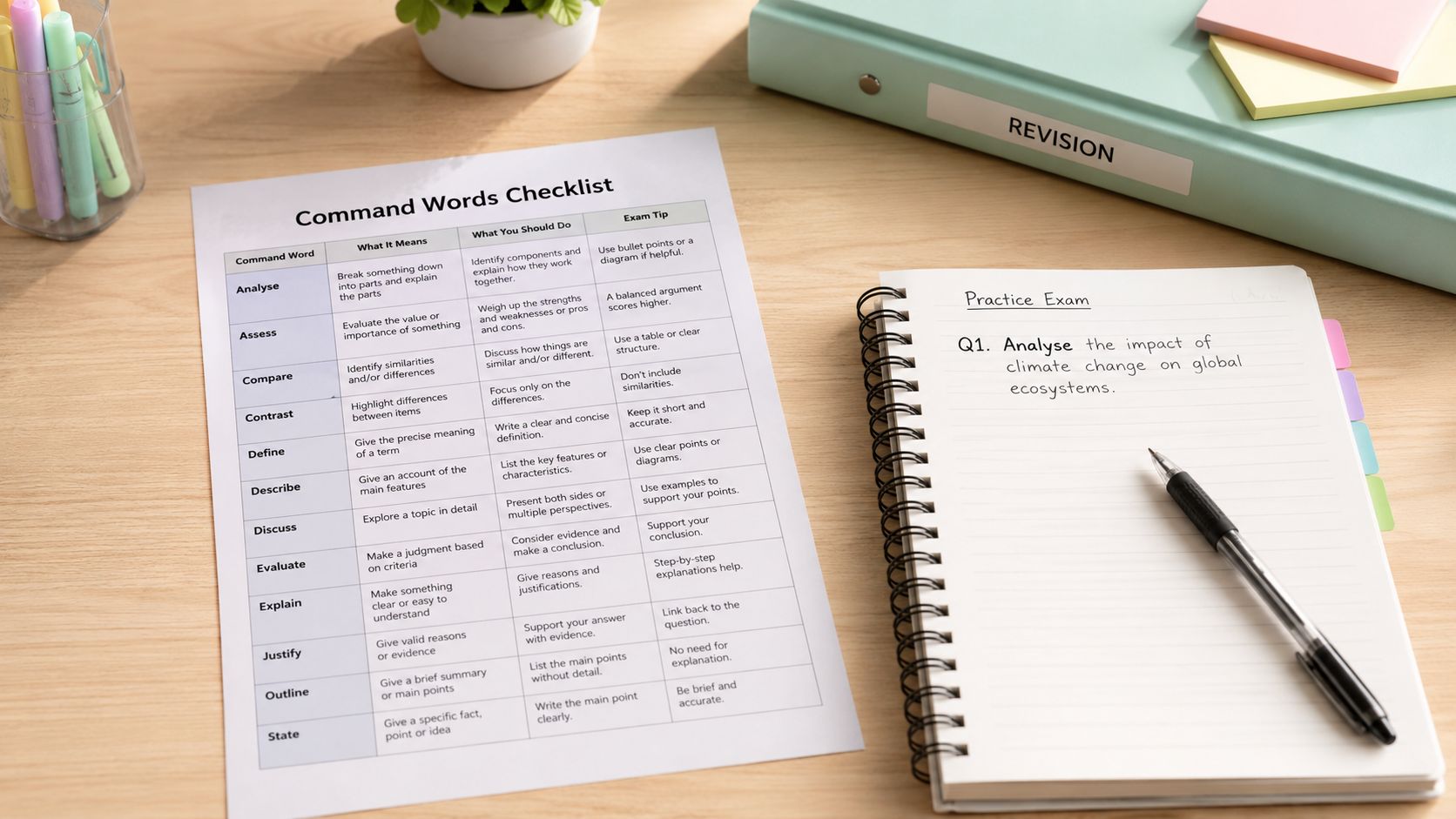
Use this short checklist before every practice answer:
- Circle the verb: Identify the operation.
- Check the marks: Estimate the depth required.
- Name the evidence: Decide which source, case study, quotation, calculation, or data point belongs.
- Match the structure: Use explanation, comparison, analysis, or judgement as required.
- Check every command: Return to the question before moving on.
Try rewriting one topic into different question types. For example, ask yourself to describe a process, explain why it happens, analyse evidence about it, and evaluate its importance. Teachers can turn this into a quick starter, a peer-marking activity, or a spoken recall drill without creating a new lesson sequence.
For independent work, Exam Practice for GCSE can support targeted practice by pairing questions with their command words and mark allocations. The important part is the routine: attempt, identify the verb you missed, rewrite one paragraph, and practise the same operation again later.
MasteryMind offers UK curriculum-aligned practice across GCSE and A-Level subjects, with questions mapped to command words, assessment objectives, and mark allocations. Use MasteryMind to practise moving from recall to explanation, analysis, and evaluation, then start your next question by circling the verb before you write.
Ready to master this topic?
Practise with quizzes, blurt exercises and exam questions on MasteryMind.
7 days Premium · Then free forever · No card, no charge