Cross Curricular Learning Made Simple for GCSE and A-Level

You're halfway through a mock exam when a question suddenly asks you to analyse a source, interpret a graph and judge how convincing an explanation is. You know each skill separately, but the combination feels unfamiliar. That's often the moment students realise they've been practising subjects in separate boxes, while exams expect them to move between those boxes confidently.
Cross curricular learning can help, but only when it's planned carefully. For a GCSE or A-Level student, it doesn't mean turning every lesson into a huge project. It means recognising where English, maths, science, history, geography and other subjects use connected ways of thinking, then practising those connections without losing the precise knowledge an exam rewards.
Teachers can be sceptical of fashionable education language, and fairly so. A colourful theme won't rescue weak subject knowledge. The useful question is more practical: does the connection help you answer a real exam question better, or does it make the lesson look joined-up?
Why Cross Curricular Thinking Keeps Showing Up in Your Exams
A Year 11 pupil is sitting a mock with a highlighter in one hand and a calculator nearby. The paper gives them a written source, a graph and a question asking them to evaluate a claim. None of those tasks is impossible alone. The difficulty comes from switching between reading, data interpretation and judgement while the clock keeps moving.
That combination isn't accidental. UK exam boards use command words such as describe, explain, calculate, evaluate and compare to control the structure of an answer, and mark schemes reward a response that matches the verb's demand, not merely one that mentions the right topic. The guidance on how command words shape exam answers makes that expectation clear.
The hidden combination of skills
A question may belong to History, but you still need to read a source closely, identify a viewpoint, select evidence and construct an explanation. Geography can ask you to interpret data before evaluating a development. Biology may require statistical reasoning alongside accurate scientific terminology. English answers often depend on contextual understanding, comparison and controlled written expression.
The specification may not call this cross curricular learning. Instead, it lists assessment objectives, command words and subject content. The connection appears in what you have to do, rather than in the label printed at the top of the page.
England's curriculum history helps explain why this keeps happening. The 2004 National Curriculum revisions encouraged cross-curricular dimensions, while the Independent Review of the Primary Curriculum, published in 2009, proposed organising primary learning around 6 broad areas of learning rather than a strict subject-only model. Cross-curricular work has therefore been a recurring curriculum design principle, not a passing classroom trend.
Exam rule: Treat every command word as an instruction about thinking, not decoration around the topic.
For students, the problem is that lessons often teach the ingredients separately. You practise source analysis in History, graph work in Science and extended writing in English, but nobody always names the transfer between them. Timed papers then expose the gap.
You can practise that hidden combination deliberately with Exam Practice for GCSE, especially by checking whether your answer uses the command word accurately and whether each piece of evidence serves the subject's assessment objective.
What Cross Curricular Learning Actually Means
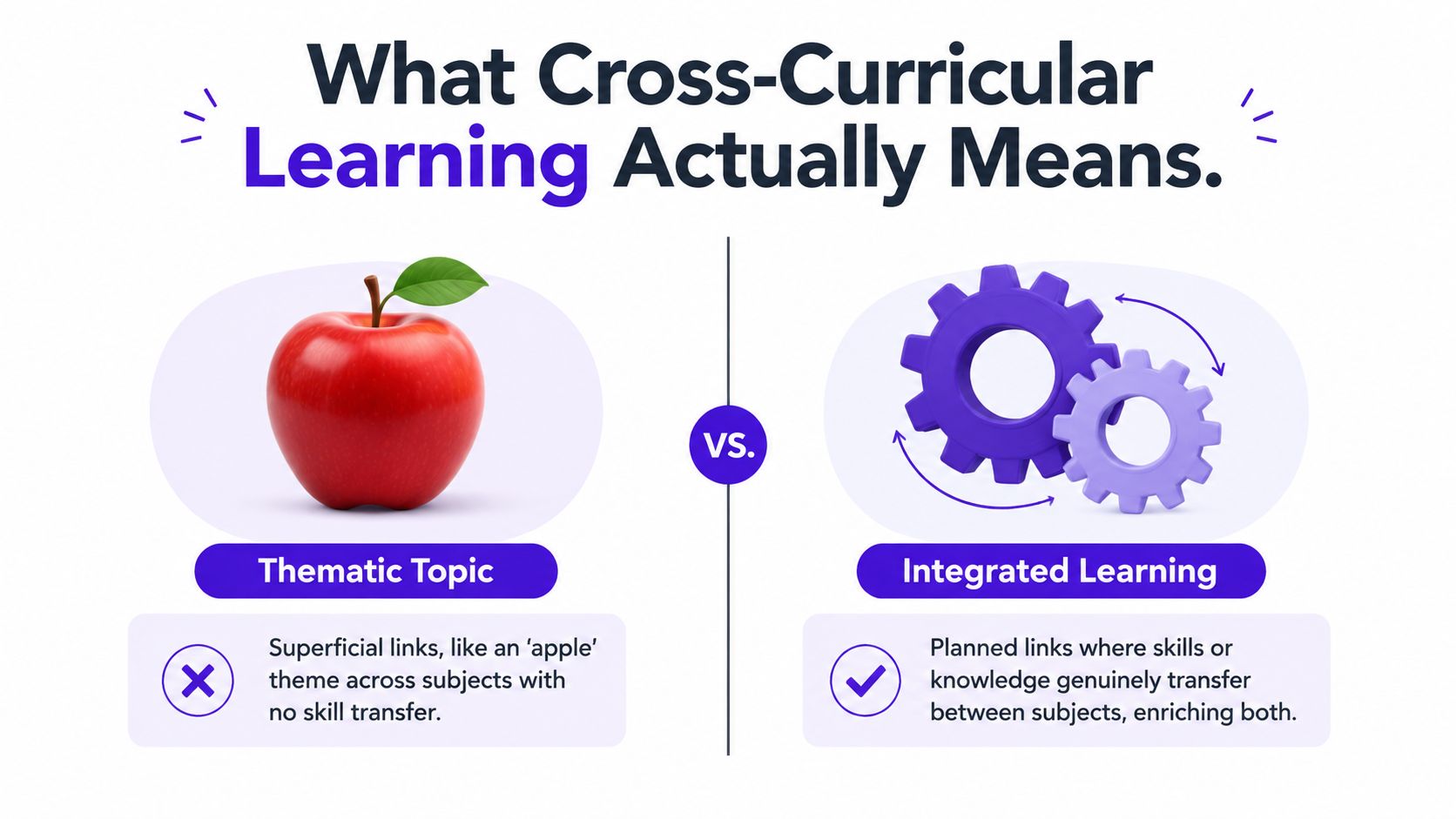
In plain classroom language, cross curricular learning means making a planned link between two or more subjects so that knowledge or a skill transfers. You might use graph interpretation from Maths while learning Biology, or use argument structure from English to write a stronger History judgement. The link has to improve the learning in both places, or at least make one subject's task more rigorous.
A shared topic alone isn't enough. Studying “the environment” in Geography, English and Art can be thematic teaching if each lesson runs separately. The topic is shared, but the thinking doesn't travel.
Three approaches that sound similar
Multidisciplinary work puts subjects beside one another. History studies the Industrial Revolution, English reads a related text and Maths handles factory data, but the lessons may never require students to combine those methods.
Interdisciplinary work goes further. Students tackle one problem and blend methods, perhaps using historical evidence, economic reasoning and persuasive writing to judge whether industrialisation improved people's lives.
Cross-curricular learning is the useful middle phrase for school practice. It focuses on a deliberate connection across subject boundaries, while keeping each subject's identity visible.
A relay team is a helpful analogy. In multidisciplinary work, runners complete their own races in the same sports day. In cross-curricular work, one runner hands a baton to the next, so a skill or idea moves forward. In interdisciplinary work, the team behaves more like a jazz combo, with different players responding to one another and shaping one shared performance.
At GCSE and A-Level, skill-based integration matters more than a decorative theme. A Year 10 English lesson on propaganda can become connected to History when students analyse how language creates a viewpoint and then test that interpretation against historical evidence. A Science lesson becomes meaningfully linked to Maths when students use a mathematical model to interpret scientific data, not when a worksheet contains a few numbers.
Teachers looking for accessible ways to make a shared topic memorable could adapt PersonalizedComics classroom ideas, provided the creative task still leads back to a defined subject objective. The comic is the vehicle, not the assessment target.
The Honest Benefits and the Quiet Drawbacks
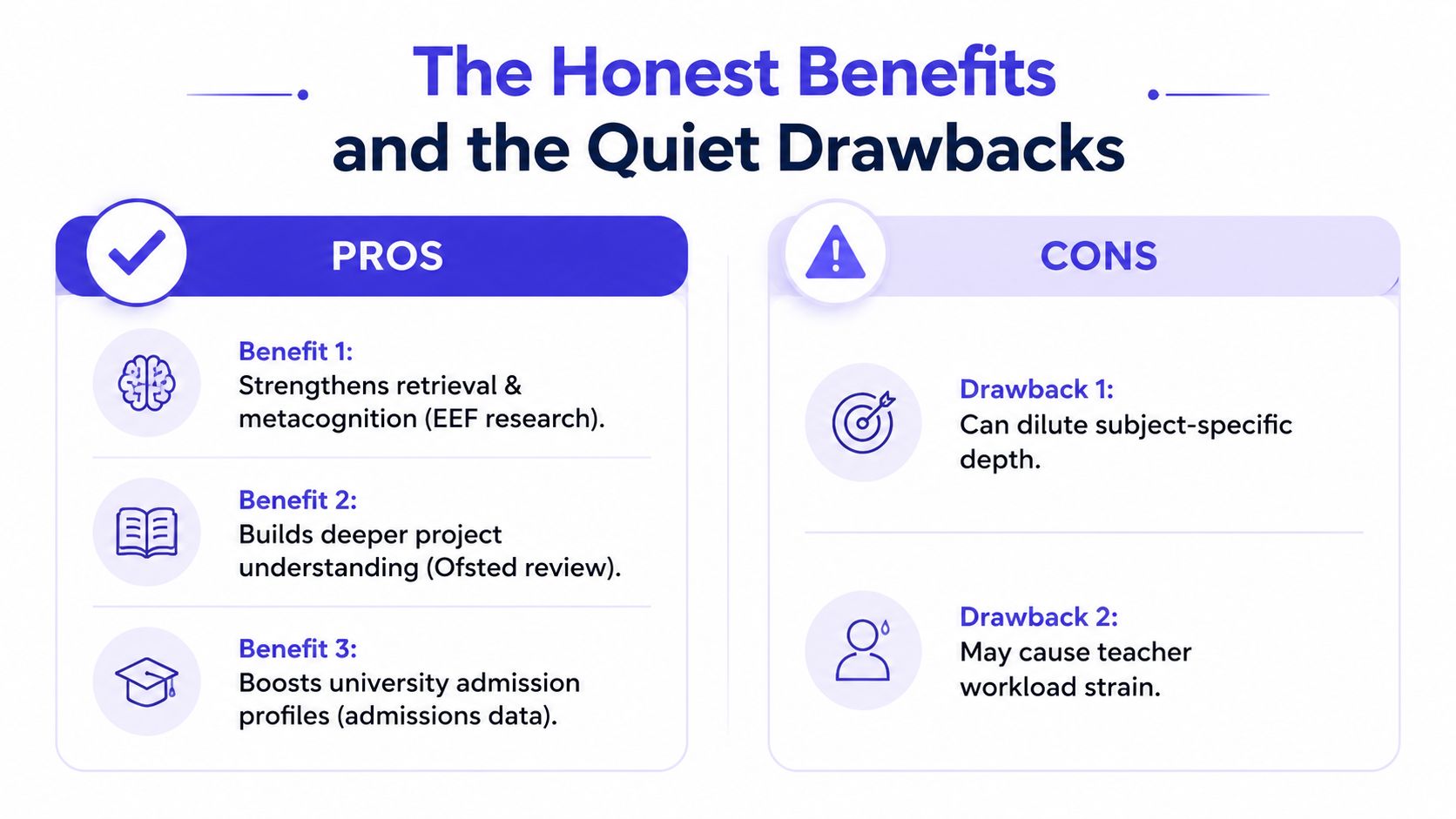
Good cross curricular learning can make knowledge easier to use. The UK evidence synthesis on creative and connected school practice reports that 44 schools used connected-learning approaches to help pupils ask questions independently, connect ideas, think creatively and reflect on learning, with the report linking the approach to achievement and personal development. You can read the evidence on creative approaches that raise standards for the full context.
That finding doesn't mean every integrated project raises attainment. It shows the mechanism is plausible when pupils have to transfer, synthesise and think about their own learning. The design still determines whether the connection helps.
A quick weighing-up
| Potential gain | Possible cost |
|---|---|
| Students apply knowledge in a new context. | Subject content can become less precise. |
| Retrieval becomes connected to earlier learning. | Teachers may spend longer planning and marking. |
| Discussion can expose different interpretations. | A forced link can distract from the original objective. |
| A meaningful task can improve motivation. | A polished final product may hide weak understanding. |
The UK evidence base also carries an important warning. A UK secondary-school review identifies context-based learning, parental involvement, structured dialogue, collaborative learning and pupils' existing conceptual understanding as factors that can support or hinder cross-curricular pedagogy. A 2017 Durham University doctoral study concluded that some integrated models may do little to improve learning when the links are superficial, because teaching can drift towards skills alone rather than a balanced mix of knowledge, skills and understanding. Its discussion of integrated curriculum models and their limitations is particularly relevant to exam classes.
Teacher test: If you remove the second subject, does the main subject lesson become weaker, or merely less colourful?
Collaboration can also create social benefits, but those shouldn't be confused with evidence of higher exam marks. A short activity involving collaboration and well-being activities may help pupils communicate and listen, yet the teacher still needs to assess the intended subject knowledge separately.
For revision, connected recall can be useful when it forces you to explain a relationship. You can browse the interleaving guide for a related approach, but remember that mixing topics isn't automatically the same as integrating subjects. Both require careful retrieval and accurate feedback.
Where Cross Curricular Skills Hide in GCSE and A-Level Specs
Exam boards including AQA, Edexcel, OCR and WJEC rarely advertise a neat “cross-curricular” section in a GCSE or A-Level specification. Instead, the demand hides in the actions students must perform. Evaluate needs a judgement and support. Discuss needs developed reasoning. Refer to requires precise use of the material provided.
Four worked examples
AQA GCSE English Language: A question about a writer's viewpoint may ask you to analyse how the writer presents an issue. The English objective remains language analysis, but the task can draw on the same source-reading habits used in History. You need to identify selection, tone and purpose, then explain how those choices shape the viewpoint.
Edexcel A-Level Biology: Data questions may require students to interpret patterns, consider reliability and use statistical ideas. Maths supports the process, but Biology still decides what the result means biologically. Calculating a value without explaining the scientific significance won't complete the answer.
OCR GCSE Geography: A sustainability question can connect geographical knowledge with Citizenship-style reasoning. You may need to weigh environmental, social and economic consequences, then evaluate which choice is most sustainable. The answer must stay geographically grounded rather than becoming a general opinion.
WJEC A-Level Religious Studies: Comparing ethical frameworks may involve reasoning about human behaviour and decision-making, areas that overlap with Psychology. The RS answer still needs accurate religious and philosophical knowledge, clear comparison and a justified conclusion.
The safest approach is to audit the specification by skill, not by theme. Look for where the subject asks you to interpret evidence, use numbers, compare viewpoints, construct an argument or evaluate consequences.
| Exam Board | Subject and level | Hidden cross-curricular skill | Real command word example |
|---|---|---|---|
| AQA | GCSE English Language | Source analysis and viewpoint | Analyse how the writer presents a viewpoint |
| Edexcel | A-Level Biology | Mathematical interpretation of evidence | Calculate or interpret data |
| OCR | GCSE Geography | Evaluation using social, economic and environmental reasoning | Evaluate the sustainability of a strategy |
| WJEC | A-Level Religious Studies | Comparative argument and ethical reasoning | Compare ethical frameworks |
Use AI-powered subject practice as one way to practise the subject-specific version of a shared skill. The key is to check whether your response meets the relevant mark scheme, not only whether it sounds intelligent.
A Teacher-Friendly Workflow for Planning Integrated Lessons
A useful integrated lesson starts with one subject, not with a spectacular theme. The teacher first decides what pupils must know or be able to do, then checks whether another subject adds a genuine tool.
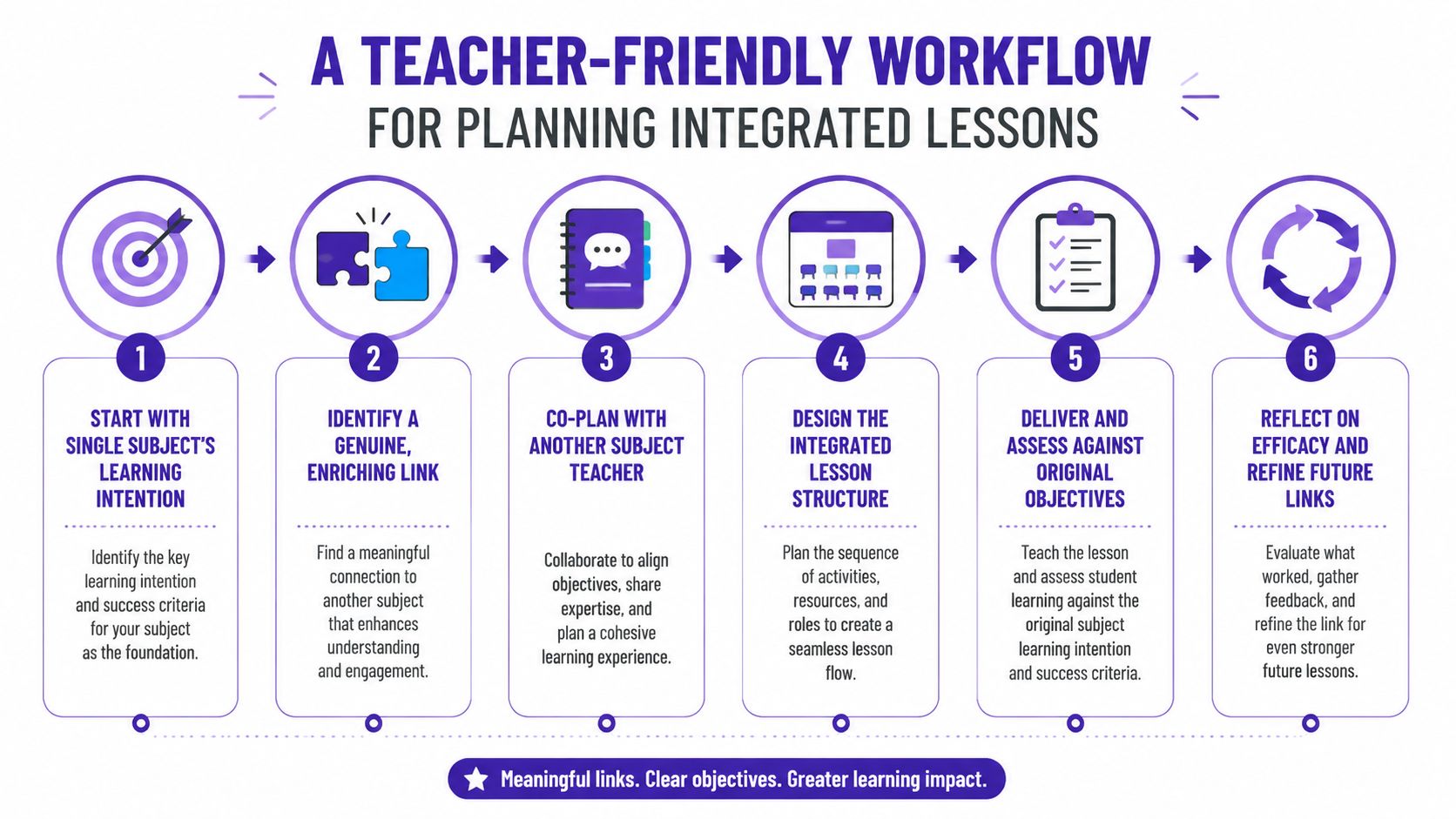
Six stages that keep the lesson honest
Start with the home objective. Write the learning intention and assessment objective for the main subject. For a Science lesson, that might be interpreting an electricity graph accurately.
Find the connection. Ask which second-subject skill improves that task. In a North London secondary school, a Year 9 electricity lesson used a Maths graph-skills checkpoint because pupils needed to read scales and describe relationships. The Maths element supported the Science objective rather than replacing it.
Map the contribution. Decide exactly what the second subject contributes. A Year 10 History lesson on the Industrial Revolution used an English argument frame to help pupils build a claim, select evidence and explain significance. The frame supported historical reasoning, but it didn't become a generic literacy lesson.
Protect the sequence. Teach the disciplinary knowledge before asking pupils to transfer it. Keep the exam-style task at the centre, then use the second subject to remove a barrier.
Add a retrieval check. Use a short, low-stakes recall task at the start or end. Ask pupils to retrieve the relevant graph convention, historical fact or command-word meaning without looking at their notes.
Ask the value-added question. After the lesson, ask: “What could pupils do here because of the connection that they couldn't do as well before?” If the answer is vague, redesign the link.
In the North London examples, the pupil work stays visible. A graph checkpoint might show a correctly labelled axis and a written description of the trend. The History exercise might show a claim followed by a precise piece of evidence and an explanation of why it matters. Those samples let teachers judge the contribution rather than relying on enthusiasm.
A short planning video can help departments visualise the sequence:
Two Classroom-Ready Exemplar Lesson Plans
These plans are deliberately modest. Neither asks teachers to rebuild a scheme of work, and both keep the home subject responsible for the final judgement.
Plan A, History and English
Class: Year 10
Length: 60 minutes
Topic: Nazi propaganda
Learning intention: Analyse how propaganda creates a viewpoint and support a historical judgement with accurate evidence.
Success criteria: Students identify language choices, explain their effect, use relevant historical context and write a balanced judgement. The task links to AQA GCSE English Language Paper 2 writing and Edexcel GCSE History source and interpretation skills.
0 to 10 minutes, source analysis: Display a propaganda source and ask students to annotate audience, purpose, word choices and implied values. Keep the first response short. The History teacher checks contextual accuracy, while the English focus is on explaining how the language influences the audience.
10 to 30 minutes, discursive writing: Students answer a question such as whether the source is useful for understanding Nazi methods of persuasion. They should use a clear line of argument, select evidence from the source and add relevant contextual knowledge.
30 to 45 minutes, structured improvement: Students exchange work and use a grid with four checks: viewpoint identified, language analysed, historical knowledge applied, judgement justified. Peer assessment should identify one successful move and one precise improvement, not award invented marks.
45 to 55 minutes, redraft: Students improve one paragraph, keeping the historical claim visible. The teacher samples paragraphs for accuracy and command-word control.
55 to 60 minutes, exit check: Students write one sentence explaining how a language choice supports a historical interpretation.
Homework: Redraft the response and signpost the SPaG marks by checking sentence boundaries, punctuation, spelling and paragraph control. Integration helps because source interpretation and written explanation reinforce each other. Resist adding a full propaganda poster design, because that would consume time without strengthening the assessed response.
Plan B, Science and Maths
Class: Year 12
Length: 60 minutes
Topic: Radioactive decay
Alignment: AQA A-Level Physics and A-Level Maths
Learning intention: Model radioactive decay, draw an appropriate graph and interpret half-life data.
0 to 10 minutes, graph starter: Students sketch the expected shape of a decay graph and label axes. The teacher checks whether they understand scale, units and the distinction between a curve and a straight-line relationship.
10 to 20 minutes, teacher model: Model a half-life calculation using a clearly labelled set of values. Think aloud about what the number represents physically. Students then complete a similar calculation independently.
20 to 35 minutes, paired data task: Pairs interpret a data table, identify the half-life and explain any irregularities. One student explains the mathematical pattern, while the other translates it into a physics statement, then they swap roles.
35 to 52 minutes, exam questions: Students answer short questions on graph interpretation, calculation and explanation. The teacher gives marking guidance that separates the numerical method from the scientific conclusion.
52 to 60 minutes, retrieval exit ticket: Students define half-life, state the graph relationship and identify one common error.
The link helps when Maths makes the graph and calculation more secure. It becomes over-linking if students spend the lesson discussing abstract modelling while neglecting the Physics meaning of decay.
When Cross Curricular Design Starts to Dilute Your Marks
A Year 11 class spends a week producing a polished STEM exhibition. The display combines Biology diagrams, Art design and persuasive English captions. Near the mock exams, pupils discover that they have practised presentation more than required equations, practical knowledge and exam questions. The project looked joined-up, yet their Science answers still lacked the precise terms the mark scheme required.
Integration becomes risky when a shared theme replaces the home subject's specification. A History and English lesson on war poetry can work if students analyse imagery, apply historical context and write a focused comparison. It loses value if a general discussion of conflict leaves them unable to explain provenance, context or a writer's methods.
Use this check before approving the activity:
- Assessment objective: Which named objective does the connection strengthen?
- Command word: Does it prepare students for the exact verb, such as analyse, explain or evaluate?
- Specification time: Will the activity sharpen practice, or displace content that may be examined?
- Exam relevance: Does the second subject contribute knowledge or a method that the assessment rewards?
- Assessment rules: Could the task blur tier requirements or controlled-assessment expectations?
- Fair assessment: Can the home subject still be marked on its own terms?
The same test applies to an integrated project. If an A-Level group spends several lessons researching a shared environmental theme, check the final scripts against the home specification. A confident presentation may hide weak evaluation, missing subject vocabulary or an unsupported judgement. Use targeted practice, including A-Level Past papers, to see whether the connection transfers into marks.
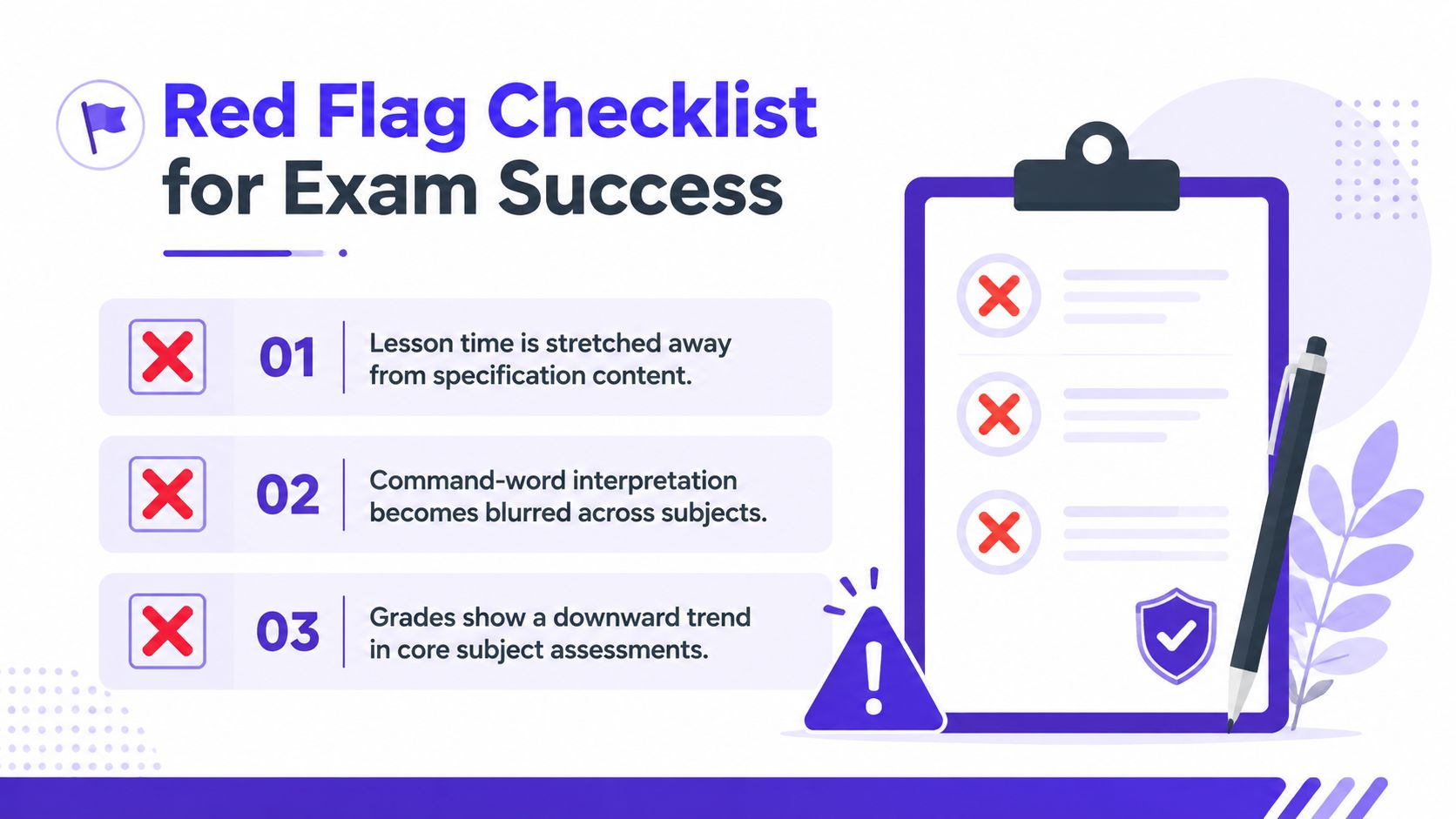
If home-subject performance falls, change the link, however enjoyable the lesson felt.
What to Try This Week as a Student or Teacher
Students can start with one small habit called a bridge note. After learning a new topic, write one sentence connecting it to an earlier idea from another subject, then test yourself on that sentence across the week.
For example: “Radioactive decay uses graph and rate ideas from Maths, but the Physics explanation must describe what happens to unstable nuclei.” Or: “A History source analysis needs English-style attention to word choice, but the judgement must use historical context.” The point isn't to create decorative revision notes. It's to practise moving knowledge between contexts while keeping the subject rule clear.
Teachers can use a two-spec check before approving an integrated lesson. Place the specifications for both subjects side by side, highlight overlapping assessment objectives in one colour and non-overlapping content in another, then ask whether the overlap earns its place.
A connection is probably worth keeping when it improves retrieval, explanation or evaluation without displacing essential content. If it only supplies a shared theme, leave it out or make it a short context rather than the lesson's centre.
The strongest cross curricular learning sharpens exam focus. Return to the six-stage planning workflow, keep the home subject objective visible and judge the lesson by pupil work, not by how impressive the theme sounds.
MasteryMind offers UK-aligned practice for GCSE and A-Level learners across subjects, with questions organised around specifications, command words and mark allocations. Visit MasteryMind to practise connected skills while still checking each answer against the demands of its home subject.
Ready to master this topic?
Practise with quizzes, blurt exercises and exam questions on MasteryMind.
7 days Premium · Then free forever · No card, no charge