Edexcel Math Mark Scheme
You've got a returned maths paper in front of you. Your score is circled in red, a few lines have ticks beside them, and yet the final answer is marked wrong. The frustrating question is obvious: where did the marks go?
An Edexcel maths mark scheme is the missing rulebook. It shows why an examiner awarded a method mark, withheld an accuracy mark, accepted an alternative form, or followed your answer through after an earlier mistake. Once you stop treating it as a list of correct answers, it becomes one of the most useful revision tools you have.
Whether you're recovering an exam or pushing for the highest grade, the habit is the same: attempt a question, compare every line with the scheme, then rewrite the solution in a way an examiner can follow. Teachers can use the same process to make feedback more consistent and easier for students to act on. Resources such as practice with past paper mark schemes can help you build that routine, while parents supporting A-level students may also find these A Level grade boundaries for parents useful when discussing results.
Why the Mark Scheme Matters More Than You Think
A correct answer written on one line can be less useful than a wrong answer supported by clear working. That sounds unfair until you remember what the examiner is assessing. Maths papers often award credit for the method, the accuracy of intermediate steps, and the final result, not just the number at the end.
The UK government explains that trained examiners use a mark scheme to decide how marks should be awarded. It's therefore better understood as the examiner's rulebook, rather than an answer key that just says right or wrong. You can read the official explanation of how GCSE and A level marking works if you want the wider assessment context.
Read the scheme like a set of instructions
After marking a question, ask yourself three things:
- What method did the scheme reward? Identify the equation, substitution, diagram, formula, or transformation that earned credit.
- Where did accuracy matter? Check whether the next mark depended on the previous method.
- What wording changed the rules? Look for terms such as “cao”, “show that”, “correct answer only”, or “follow-through”.
This changes how you write in the exam. Instead of keeping every step in your head, you leave a clean trail for someone else to check. That matters most on multi-stage questions, where one small slip doesn't always destroy the whole solution.
Practical rule: Before answering, predict what the next mark in the scheme is likely to reward. Then put that step visibly on the page.
For GCSE students, this habit can help separate a borderline grade 4 performance from a grade 7 performance. At A-level, it can make the difference between a B and an A because stronger answers usually show controlled reasoning rather than unexplained results. The exact grade boundaries vary by qualification and series, but the marking logic stays anchored in the working you provide.
How the Three-Paper Structure Shapes Every Scheme
The paper in front of you determines the marking language you need to expect. Pearson Edexcel GCSE Maths has three papers, one non-calculator paper and two calculator papers. Each paper lasts 90 minutes, and the assessment contains 240 marks in total across the three papers, as summarised in this Edexcel exam-board overview.
At GCSE, students also need to know whether they're sitting Foundation or Higher tier. A question may test a similar skill across tiers, but the available methods, demand, and mark allocation can differ. A Foundation scheme may focus on a shorter calculation, while a Higher question may expect algebraic manipulation, exact values, or a connected chain of reasoning.
A-level Mathematics uses papers covering Pure Mathematics, alongside an applied paper involving Statistics and Mechanics. The official guidance for A-level marking uses staged M, A, and B credit, so the structure of a long question often mirrors the mathematics itself. You may need to establish a model, use it in a calculation, then interpret the result.
| Paper | Content | Typical Duration | Calculator | Mark Scheme Focus |
|---|---|---|---|---|
| GCSE non-calculator | Number, algebra, geometry and reasoning without calculator support | 90 minutes | No | Exact methods, algebraic steps and clear arithmetic |
| GCSE calculator | Number, algebra, geometry, statistics and problem solving | 90 minutes | Yes | Appropriate calculator use, method, accuracy and interpretation |
| A-level Pure | Algebra, functions, calculus and other pure topics | Set by the paper | As specified on the paper | Connected M and A marks across extended methods |
| A-level Statistics and Mechanics | Data, probability, forces, motion and modelling | Set by the paper | As specified on the paper | Formula use, modelling assumptions, units and interpretation |
The mark scheme therefore tells you more than whether a calculator was permitted. It shows how much working the paper expects. A short early question may need only a clear calculation, while a later question usually rewards sustained, organised reasoning. Use the paper structure to pace yourself, and use the scheme afterwards to judge whether your written method matched the level of demand.
Decoding the Shorthand Inside Every Edexcel Scheme
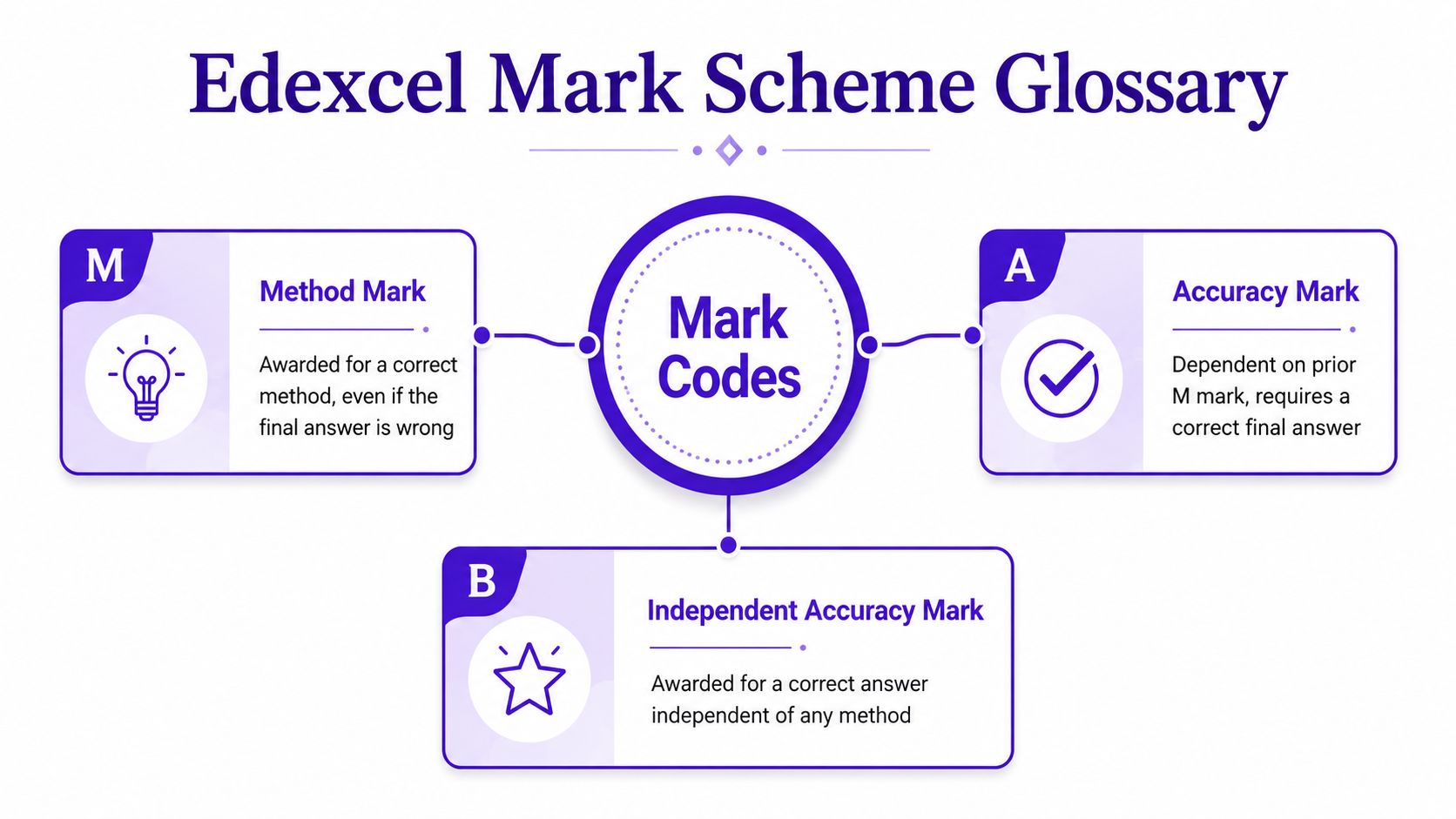
Pearson's shorthand looks cryptic until you connect each code to a marking decision. The official A-level guidance states that only M, A and B marks are used. M marks reward knowing and attempting a valid method, A marks depend on the relevant method marks, and B marks are unconditional accuracy marks.
The core codes
- M1: One mark for a valid mathematical method. The final answer can still be wrong.
- A1: One accuracy mark, awarded when the required method has been established and the calculation is correct.
- B1: One independent accuracy mark. It doesn't depend on a previous method mark.
- ft: Follow-through. The examiner may use your earlier value in a later, valid calculation.
- bod: Benefit of doubt. The method is accepted despite a minor ambiguity or slip where the intended approach is clear.
- cao: Correct answer only. The answer must be correct, and extra working won't create additional credit under that condition.
- cso: Correct solution only. The complete solution must be correct, so an incorrect intermediate step can prevent the mark.
- oe: Or equivalent. A mathematically equivalent form or method can be accepted.
- →: Implies. The line or result on one side leads to the statement on the other.
A small example
Suppose the question asks you to solve an equation. The scheme might show:
- M1 for rearranging the equation into a usable form.
- A1 for solving that rearranged equation accurately.
- B1 for stating a separate correct value, perhaps a value read directly from a diagram.
If your rearrangement is valid but your arithmetic slips, you may keep the M1 while losing the dependent A1. That's why “M0 A1” is impossible in the normal M and A sequence. You can't receive the accuracy mark for a method that hasn't earned the required method credit.
For a later A-level part, “ft” can mean the examiner uses your earlier answer, even if that answer was wrong, provided your later method is mathematically valid. The scheme isn't being generous at random. It's protecting credit for reasoning that remains consistent.
Command Words and What They Actually Demand
Command words tell you what kind of evidence belongs on the page. Students often lose marks because they solve the mathematics but ignore the instruction attached to it.
| Command Word | What the Scheme Demands | Typical Marks Triggered |
|---|---|---|
| Show that | A clear verification or proof chain leading to the stated result | M marks for reasoning, followed by accuracy credit |
| Find | A value, with enough working to show how it was obtained | Method and accuracy marks where the calculation has stages |
| Hence | A result built directly from the previous part | Method marks for using the earlier result appropriately |
| Determine | A justified conclusion, often involving interpretation | Method, accuracy and interpretation credit |
| Prove | A rigorous algebraic or geometric argument | Method marks for a complete logical chain |
Read the instruction before the numbers
Show that is not an invitation to copy the answer printed in the question. If the question tells you the result should be a particular value, your job is to demonstrate why. Write the substitution, simplification, or logical steps that arrive there.
Find usually asks for a value. You still need working when the scheme separates method from accuracy, especially if the calculation has multiple stages.
Hence means use what you've just established. Starting again with an unrelated method may work mathematically, but it can miss the intended method mark. “Hence, or otherwise” gives you more freedom, but a direct link to the previous part is often the clearest route.
Determine normally needs interpretation. A graph, model, or inequality may produce several possible values, so state the conclusion and explain why it answers the question.
Prove demands a complete argument. Numerical checking can support your thinking, but it doesn't replace algebraic or geometric reasoning.
Worked Example Earning Marks Despite a Wrong Answer
Consider a GCSE-style question:
Solve (x^2 - 5x + 6 = 0) by factorising.
A student writes:
[
x^2 - 5x + 6 = (x-2)(x-3)
]
[
(x-2)(x-3)=0
]
[
x=2 \text{ or } x=-3
]
The final sign is wrong. The correct roots are (x=2) and (x=3), but the working still gives the examiner useful evidence.
How the marks can survive
The scheme could award:
- M1 for recognising that the quadratic should be factorised.
- A1 for finding the correct factor pair, ((x-2)(x-3)).
- M1 for setting each factor equal to zero and attempting to solve both linear equations.
- A1 cao for the correct final roots, subject to the scheme's exact wording.
The student has a strong chance of keeping the method marks and the accuracy mark for the factorisation, even though the final answer is wrong. The “cao” condition applies to the specified final-answer credit. It doesn't automatically erase earlier marks that were earned for valid working.
The examiner may circle the correct factorisation, place a tick beside the zero-product step, and mark the sign error at the final line. An answer-key approach would compare the roots and report “wrong”. A mark-scheme approach asks a better question: which mathematical decisions were correct before the slip?
Write each root-solving step separately:
[
x-2=0 \Rightarrow x=2
]
[
x-3=0 \Rightarrow x=3
]
That layout makes the method visible and reduces the chance of changing a sign accidentally. If you want feedback that checks individual marking points rather than just the final number, an exam-style marking tool can be used alongside a teacher's review, not as a replacement for the official scheme.
Follow-Through Marks and How A-Level Recovery Works
Follow-through marks matter because an early error shouldn't automatically make every later piece of valid mathematics worthless. Pearson's A-level guidance defines M marks as method credit, A marks as dependent accuracy credit, and B marks as independent accuracy credit. In a later line, ft tells the examiner to consider whether your method works with the value you produced.
Take a simplified kinematics chain. A student misreads an acceleration value in part (a), then uses that same value consistently in parts (b) and (c). The examiner may mark the script like this:
- Part (a): M1 for selecting and using the correct equation, with the wrong acceleration leading to a lost accuracy mark.
- Part (b): M1 ft for using the correct method with the student's own acceleration.
- Part (b): A1 ft if the calculation is accurate using that value.
- Part (c): M1 ft for setting up the next stage consistently.
- Part (c): Further accuracy credit where the working remains correct on its own terms.
This doesn't mean every later mark is guaranteed. Follow-through usually requires a sensible, consistent value and a valid method. It won't rescue an answer that contradicts information given later, and “show that” questions often require the stated result rather than a result built on an incorrect earlier value.
Keep going after a mistake. Circle the value you carried forward, then use it consistently and show every step.
The examiner is marking the mathematics demonstrated in each stage. A wrong starting point can reduce the total, but it doesn't necessarily collapse the rest of the question. That's one reason leaving blank pages is so costly: you can't earn follow-through credit for work you never write.
Common Examiner Annotations and What They Really Mean
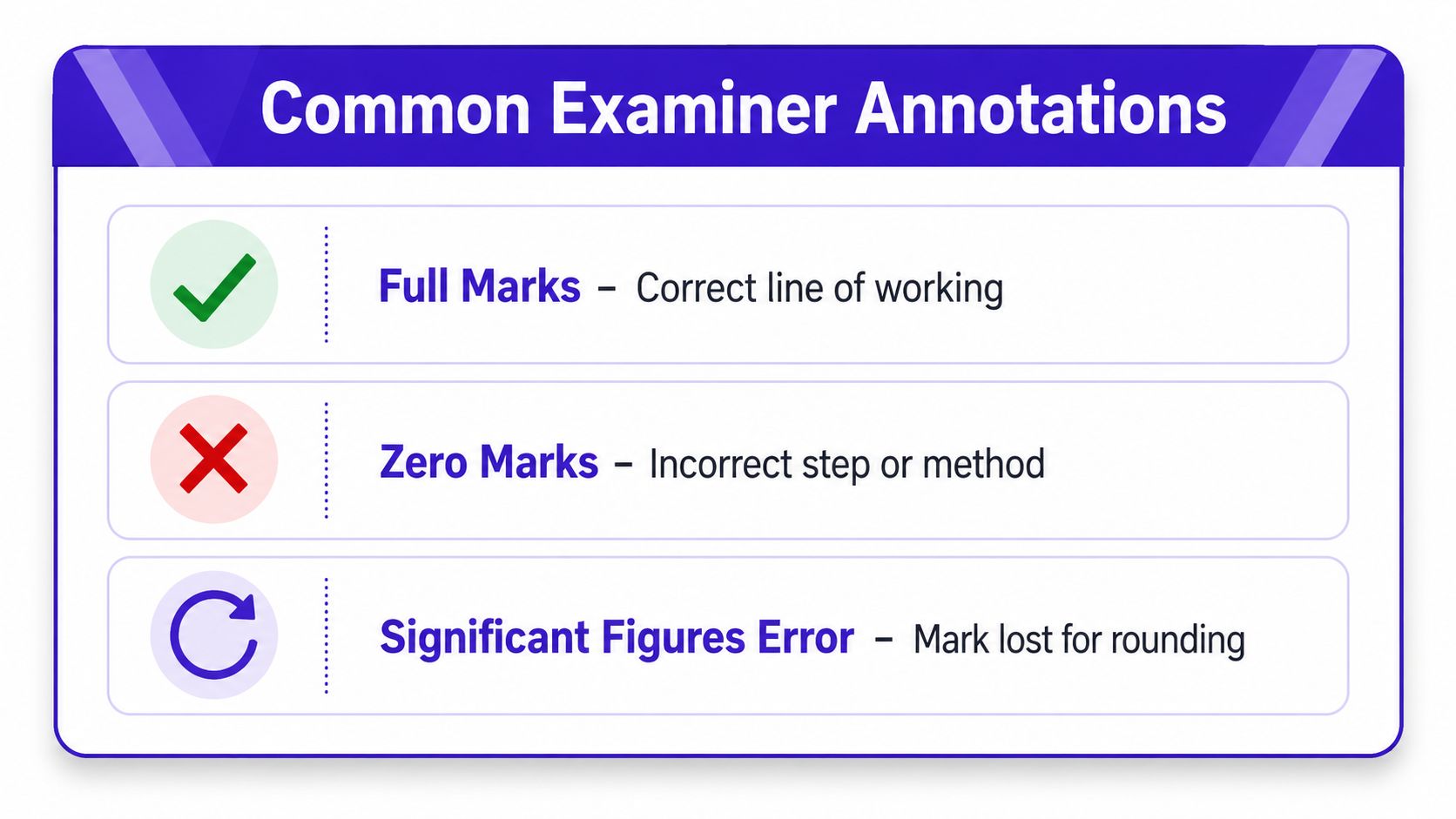
The marks in the margin are a quick record of what happened on each line. A green tick normally indicates that the line has earned its available credit. A cross shows that the step didn't earn a mark, while a dotted tick often signals partial credit, such as a valid method without the required accurate result.
The shorthand in the margin
- bod means the examiner has accepted the intended method despite a minor slip or unclear presentation.
- ft means a later stage has been marked using your earlier result.
- cao means the final answer must be correct for that particular credit.
- oe means another equivalent mathematical expression or approach is acceptable.
A circled zero, sometimes written with a slash, records that no mark was awarded for that step. A question mark usually flags something the examiner needed to inspect or interpret, rather than automatically meaning the whole answer failed. On review, a question mark may lead to a mark being awarded or withheld, depending on the exact scheme and working.
If you see “bod” beside a sign error, don't assume the entire line was ignored. The examiner may have accepted the method and withheld only the affected accuracy credit. To practise reading scripts, underline the command word, bracket the final answer, and annotate each intermediate line with the mark code you think applies. Then compare your judgement with the official scheme.
Finding the Right Scheme on the Pearson Site
A mismatched paper and scheme can teach you the wrong lesson. Pearson distributes live mark schemes through its official Qualifications site, where users select the qualification, subject, course materials, exam materials and mark scheme, then filter by exam series. Use the Pearson support guidance for finding mark schemes when the site layout changes.
Use this routine:
- Start with Pearson's official qualifications website. Avoid relying on an unsourced copy when the final version is available from the awarding body.
- Select the qualification. For GCSE, check Mathematics and the correct tier. For A-level, check Mathematics and the relevant component.
- Match the paper code and series. Check the code on the front of the question paper before downloading anything.
- Download both PDFs. Keep the question paper and paired mark scheme together so you can compare wording, diagrams and allocations.
- Organise class copies clearly. Teachers can store papers by qualification, series, paper and tier in a shared folder.
Pearson's guidance also explains that mark schemes for live assessments are made available to centres after results, while the official site lets users filter by series. Students looking for extra practice can combine the scheme with GCSE Past Papers, provided they confirm the board and paper before starting.

A Pre-Exam Checklist That Puts You in Examiner Mode
Run this check before you turn the page. With practice, it becomes automatic.
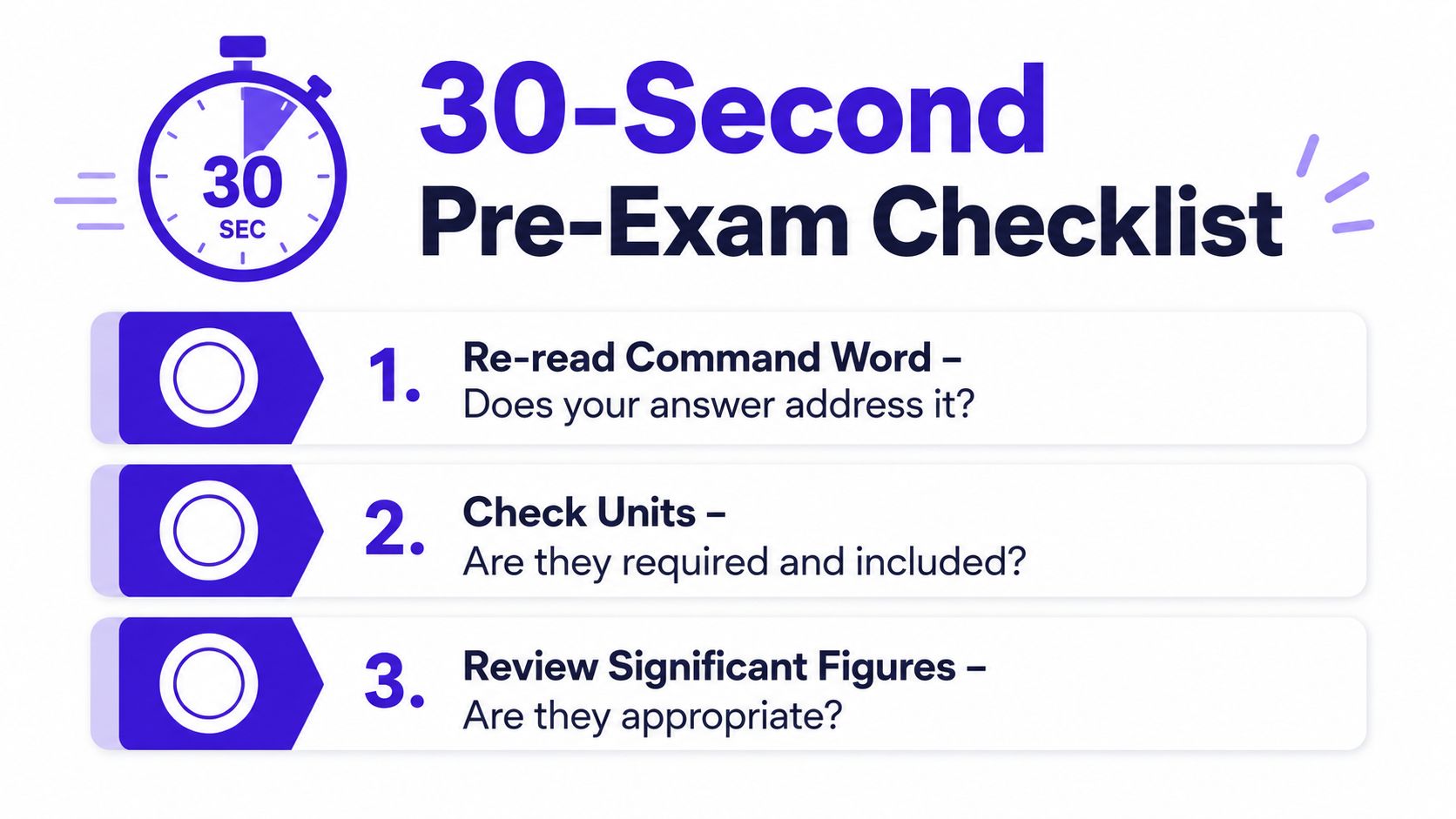
- Re-read the command word. “Show that” needs evidence, “find” needs a value, and “determine” needs a justified conclusion.
- Match working to method marks. Make sure the key equation, substitution or transformation is visible, even if the final answer looks wrong.
- Check units and form. Look for units, simplified surds, exact values and the requested rounding.
- Mark carried values. Circle any answer used in a later part so consistent follow-through is easier to identify.
- Protect the final line. Box or underline the answer so the examiner can find it quickly.
Use this routine on every practice paper. Tools such as Exam Practice for GCSE can support timed work, but the important habit is checking your own page before moving on.
M marks live in your working, A marks live in your answer. Protect both.
Quick Answers to the Questions Students Always Ask
How do raw marks become UMS? Pearson describes raw marks as the marks earned. UMS, or Uniform Mark Scale, is a conversion used to show performance in unit-based qualifications, so check the official results information for your qualification.
Where are grades published? Pearson publishes qualification results information and grade-related guidance through its official Qualifications site. Boundaries can differ between series, so use the figures attached to your own paper rather than an old screenshot.
Are examiners anonymous? Examiners mark scripts using the awarding body's procedures and mark scheme. Your centre details aren't a reason to change the mathematical credit awarded.
When is the scheme released? For live papers, mark schemes are made available to centres after results are published. Older papers and schemes remain useful for practice when the paper and qualification match.
Do third-party papers use Pearson conventions? Not necessarily. Treat them as practice unless the paper is clearly paired with an official Edexcel scheme.
What if a mark seems missing? Ask your teacher or exams officer to check the script and the exact mark scheme. They can explain the review process and whether a clerical or marking review is appropriate.
MasteryMind offers Edexcel-focused practice with mark-scheme explanations and instant feedback on typed or handwritten answers. Visit MasteryMind to practise showing method, protecting accuracy marks and reviewing your working like an examiner.
Ready to master this topic?
Practise with quizzes, blurt exercises and exam questions on MasteryMind.
7 days Premium · Then free forever · No card, no charge